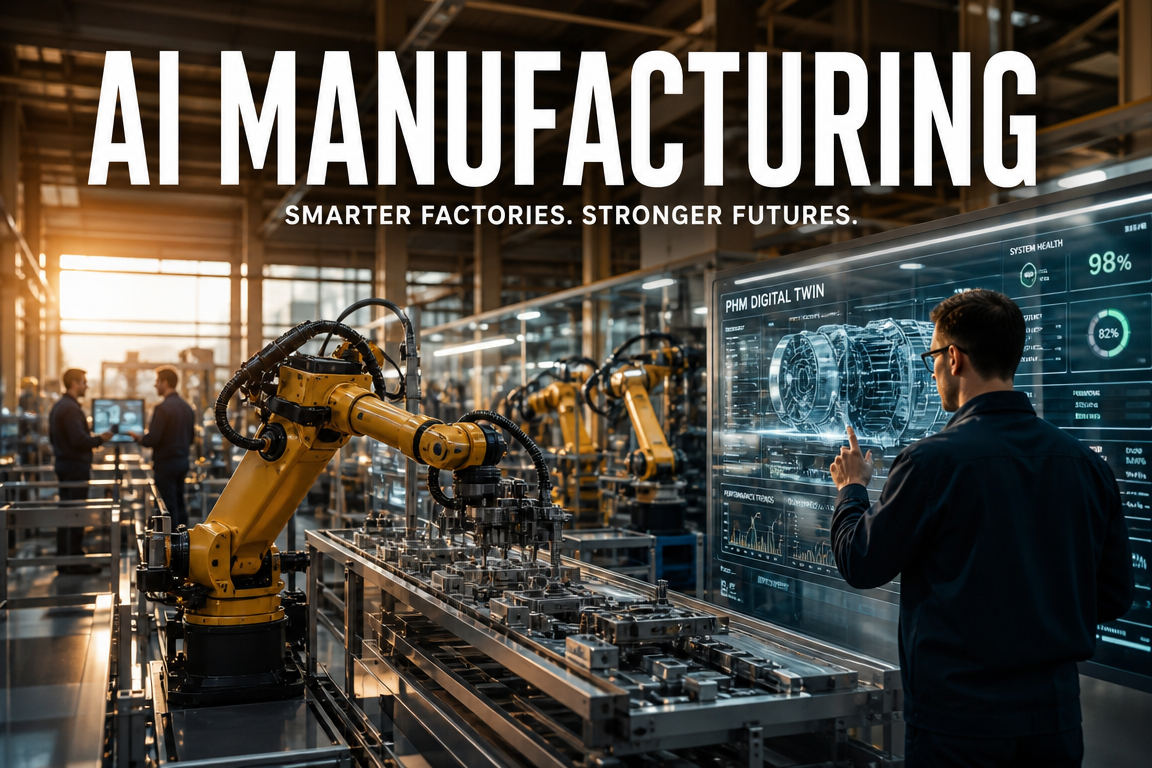
● AI-Driven Manufacturing Boom
The AI Manufacturing Revolution Has Not Yet Been Born: Why a Real Opportunity Is Emerging for Korea’s Manufacturing Sector
The core message of this article is not simply that AI is entering manufacturing.
It explains why Korea’s manufacturing sector may capture a significantly larger-than-expected opportunity in global manufacturing AX, AI factories, and physical AI markets.
In particular, it examines the links among manufacturing data, PHM, digital twins, HBM semiconductors, robotics, autonomous driving, and smart factories from a macroeconomic perspective.
It also addresses a key issue often overlooked in news coverage and online commentary: manufacturing data are abundant, but they are not yet an asset.
The conclusion is that the AI industrial revolution is likely to begin not with generative AI such as ChatGPT, but with the AI factory, where factories, equipment, energy systems, quality control, and maintenance make autonomous decisions.
1. Industrial AI Has Not Yet Truly Begun: General AI and Manufacturing AI Are Fundamentally Different
Professor Yoon Byung-dong of Seoul National University’s Department of Mechanical Engineering describes industrial AI as being in a nascent stage.
In simpler terms, consumer AI has been born, but industrial AI in manufacturing is still in the early development stage.
Generative AI, search AI, and image AI are already rapidly commercializing.
By contrast, industrial AI that predicts equipment failures, adjusts production conditions, detects quality anomalies in advance, and optimizes energy efficiency still has a long way to go.
This distinction matters.
General AI works with text, images, and video, where context is relatively clear.
Manufacturing AI, however, works with sensor readings, equipment logs, process conditions, vibration, temperature, pressure, and current data.
These are numerical sequences that are difficult for AI to interpret directly.
As a result, industrial AI requires not only better models, but also field data, equipment expertise, domain knowledge, and operational systems.
2. Why Korea’s Manufacturing Sector Needs AI Factories Now
Korea’s manufacturing sector has already achieved a high level of automation.
However, Professor Yoon’s diagnosis is clear:
“Automation has been achieved, but autonomy has not.”
Traditional factory automation relies on machines operating according to rules and procedures defined by humans.
In contrast, an AI factory interprets data, anticipates problems, and supports or executes decisions autonomously.
-
Quality control must move beyond post-failure analysis.
-
Maintenance must move from repair after failure to prediction before failure.
-
Energy management must be optimized not only for electricity cost, but also for productivity, carbon emissions, and equipment efficiency.
-
Production management must become data-driven rather than dependent on the judgment of individual experts.
Many manufacturing sites still operate in silos, with quality, maintenance, energy, and production management separated from one another.
That structure creates limits to productivity gains.
In addition, experienced field workers are aging, and tacit knowledge held by skilled operators is disappearing quickly.
The greatest risk in manufacturing is not equipment failure, but the loss of know-how held by people.
AI factories and manufacturing AX are emerging as key responses to this challenge.
3. What Manufacturing AX and M.AX Mean: From Factory Automation to Factory Autonomy
M.AX can be understood as manufacturing AX, or AI transformation in manufacturing.
Where DX creates and connects data, AX uses AI to interpret that data and execute decisions.
In simple terms, DX lays the neural network across the factory, while AX adds the brain on top of it.
-
At the DX stage, data are generated through ERP, MES, PLC, sensors, and equipment control systems.
-
At the AX stage, AI interprets those data for quality, maintenance, production, and energy optimization.
-
At the AI factory stage, the goal is a structure in which factories can operate autonomously even when expert labor is limited.
This is not a short-term technology trend.
It is directly linked to Korea’s slowing potential growth, demographic change, labor shortages in manufacturing, and global supply chain realignment.
Going forward, manufacturing competitiveness is likely to be determined less by labor cost and more by data utilization, equipment autonomy, and AI investment pace.
4. Three Reasons Korea Has an Advantage in Manufacturing AI
Professor Yoon believes Korea has three critical advantages for realizing manufacturing AX.
This is the most important economic message in the discussion.
① Korea’s Manufacturing Sites Already Have Data Flowing
Over the past decade, Korea has advanced smart factory and digital transformation initiatives.
As a result, manufacturing sites have accumulated ERP, MES, PLC, sensor, and equipment log data.
These data are not yet a complete asset, but they are raw material for manufacturing AI.
Future manufacturing competitiveness may depend on who has more factory data and who can interpret them more effectively.
② Korea Is One of the Few Countries With Broad Coverage Across 12 Major Manufacturing Industries
Korea has a manufacturing base spanning semiconductors, displays, automobiles, shipbuilding, batteries, steel, petrochemicals, machinery, electronics, and home appliances.
Unlike countries that are strong in only one sector, Korea has globally competitive positions across multiple manufacturing industries.
AI factory technologies scale better when validated across multiple sectors rather than in only one.
Korea already has a substantial domestic testing ground for such validation.
③ Public and Private Investment Are Beginning to Align
Professor Yoon said that one year ago Korea was viewed as part of a broad third-tier group after the United States and China.
However, over the past year, government investment and private-sector efforts have combined to move Korea into what he described as a distinctive third-place position.
Moving from third place to first is a different challenge.
Even so, the potential for Korea to lead the manufacturing AI market remains open.
5. Korea’s Real Strength in the Physical AI Value Chain
Physical AI refers to AI that operates and makes decisions in the real world.
Robotics, autonomous vehicles, smart factories, logistics automation, and autonomous manufacturing equipment are all connected to physical AI.
Korea is unusually strong in this area because it possesses much of the value chain.
-
Telecommunications infrastructure is among the world’s best.
-
Power infrastructure and industrial park foundations are solid.
-
HBM semiconductors, led by SK hynix and Samsung Electronics, hold a central position in the global market.
-
Mobile devices, home appliances, and IT hardware manufacturing capabilities are also strong.
-
Automobiles, robotics, batteries, shipbuilding, and machinery provide a broad industrial base connected to the physical world.
Korea does not have an absolute GPU leader like Nvidia.
However, excluding GPUs, Korea holds a substantial share of the key industrial components needed for physical AI.
This supports the case for Korea’s transition from a contract manufacturing economy to an AI manufacturing platform economy.
In particular, as semiconductor exports continue to support Korea’s growth, manufacturing AI could become a new growth engine that helps reduce dependence on semiconductors alone.
6. Why PHM and Digital Twins Matter: Core Tools for Manufacturing AI
Professor Yoon is also widely recognized as an expert in PHM.
PHM stands for Prognostics and Health Management, a technology that diagnoses equipment condition, predicts failures, and manages lifecycle health.
In practical terms, it is a health-check system for industrial equipment.
-
It predicts when equipment is likely to fail.
-
It adjusts maintenance schedules before failures occur.
-
It optimizes component replacement timing.
-
It reduces unnecessary maintenance costs and production downtime risk.
PHM has a direct impact on manufacturing productivity.
In industries such as semiconductors, batteries, automobiles, and shipbuilding, where equipment uptime is critical, even one failure can result in losses of tens of millions of won.
For manufacturing AI, PHM is therefore essential rather than optional.
Digital twins are equally important.
A digital twin creates a virtual replica of a real factory or piece of equipment for simulation and optimization.
It allows new production conditions to be tested virtually before being deployed in the real factory.
As this technology advances, it can reduce operational trial and error, improve capital investment efficiency, and lower energy costs.
7. The Most Important Issue: Manufacturing Data Are Abundant, But Not Yet an Asset
The sharpest point in the discussion was the issue of manufacturing data assetization.
Korean manufacturing sites are accumulating large volumes of data.
However, Professor Yoon noted that these data have not yet been properly turned into assets.
The reason is straightforward.
The data lack context.
Language data contain meaning within words and sentences.
Image data also contain context through object shape and position.
Manufacturing data, however, often remain as isolated numbers such as temperature 78 degrees, pressure 3.2, and vibration 0.08.
If it is not clear when, on which machine, for which product, during which process, and under what quality outcome or maintenance history those values were recorded, AI cannot learn effectively.
In other words, manufacturing data do not become assets simply because they are stored.
They must be connected to time, equipment, product, operator, process conditions, quality outcomes, and maintenance records.
Only then can manufacturing AI become a technology that generates value on the factory floor.
8. A Key Point Often Missing From Other Coverage: The AI Gap Could Widen Manufacturing Polarization
Much of the coverage on AI emphasizes productivity gains across industry.
That is correct.
However, the more important issue is the gap between firms that can adopt AI and those that cannot.
Large corporations can secure internal AI teams, data infrastructure, cloud resources, GPU capacity, and consulting expertise.
By contrast, small and mid-sized manufacturers often do not know where to begin.
AI was expected to become a universal technology, but in practice it is becoming difficult to access without infrastructure and talent.
This issue is also linked to structural imbalances in the Korean economy.
A significant share of recent export growth has been concentrated in semiconductors and AI-related products.
The gaps between export-oriented firms and domestic firms, between large companies and smaller companies, and between the Seoul metropolitan area and regional industrial zones may all widen.
If the AI divide is added to these existing gaps, manufacturing polarization could intensify further.
9. Three Government Priorities: Training, Compute Infrastructure, and Testbeds
Professor Yoon said government intervention is important in reducing the manufacturing AI gap.
The key is public infrastructure.
① Retraining Engineers in Small and Mid-Sized Manufacturers
Field engineers need rapid retraining so they can understand and use AX.
AI capabilities must be added to existing equipment operations knowledge.
This is especially important for small and mid-sized firms, where it is difficult to retain outside experts continuously.
② Tailored Training for CEOs and C-Level Executives
AI transformation is not only a shop-floor issue.
Executives must understand what needs to be done in order for investment to occur.
CEOs and senior managers need to understand the ROI of manufacturing AX, data strategy, and process innovation.
③ Public Compute and Data Infrastructure
It is difficult for small businesses to build AI compute infrastructure independently.
Accordingly, public compute resources and data infrastructure should be provided at the industrial-park level.
Companies should be able to use these resources through low-cost membership models.
Such a structure would significantly lower the barrier to AI investment.
④ Testbeds and Demonstration Spaces
Solution providers need spaces where their AI systems can be tested in real manufacturing environments.
Demand-side firms need spaces where they can evaluate which AI tools fit their factories.
This is why demonstration sites for digital twins, agentic AI, PHM, and robotics automation are becoming more important.
10. Korea’s M.AX Has Drawn Attention in Germany: A Global Standard Competition Is Beginning
An interesting point is that Korea’s M.AX program has reportedly been cited as a benchmark in Germany.
Professor Yoon said that during a global trade forum, he held a discussion with the chairman of Siemens, and that the German government views Korea’s M.AX as a useful model.
The fact that Germany, a manufacturing powerhouse, is looking at Korea’s manufacturing AX model is highly significant.
Germany led Industry 4.0.
Its attention to Korea’s M.AX suggests that a new competition over manufacturing AI standards is beginning.
Going forward, the key issue will not be merely building technology well.
The core of global competition will be how manufacturing data are standardized, which platform is used for validation, and what kind of industrial ecosystem is created.
11. Korea’s Manufacturing Opportunity and Risks in Summary
Opportunity Factors
-
Korea has a broad manufacturing base in semiconductors, automobiles, batteries, shipbuilding, and electronics.
-
Manufacturing data have accumulated through a decade of smart factory and DX initiatives.
-
HBM semiconductors, telecommunications, power infrastructure, and industrial park foundations are strong.
-
As physical AI expands, Korea’s manufacturing value chain may become even more important.
-
If public and private AX investment align, Korea may gain an edge in global standard competition.
Risk Factors
-
If manufacturing data are stored without context, they are difficult to use as AI training assets.
-
Dependence on GPUs and AI semiconductor platforms remains a weakness.
-
The AI adoption gap between large companies and smaller manufacturers may widen.
-
Seoul-centered AI infrastructure may deepen the disadvantage of regional manufacturers and industrial zones.
-
A shortage of manufacturing AI talent may become a bottleneck to productivity gains.
12. Key Points for Investors and Industry Analysis
Manufacturing AX is likely to be more than a technology theme; it may reshape macroeconomic outlooks and industrial strategy.
As AI enters real industrial environments, it directly affects productivity, capital expenditure, export competitiveness, and corporate margins.
In particular, companies in semiconductors, HBM, smart factories, robotics, autonomous driving, and digital twins may benefit from the spread of physical AI.
However, benefits will not be uniform across firms.
Companies that own data, can solve operational problems, and can integrate deeply into customer processes are better positioned.
AI software alone is not sufficient to succeed in manufacturing AI.
Conversely, even traditional manufacturers can gain a premium if they successfully assetize data and complete their AI transition.
13. The Decisive Factor Is Context-Rich Manufacturing Data
In one sentence, the message is this:
Korea’s future manufacturing competitiveness depends not on how much data it collects, but on how precisely it adds context to those data.
Manufacturing AX is likely to be decided less by flashy AI models than by the organization, standardization, and reusability of field data.
The country and companies that can convert factory numbers into language AI can understand may secure the next phase of manufacturing leadership.
Korea’s manufacturing base therefore represents a major opportunity.
But turning that opportunity into results will require data assetization, support for small and mid-sized firms, workforce retraining, and testbed infrastructure.
< Summary >
Industrial AI remains in an early stage, and the real AI revolution in manufacturing is only beginning.
Korea has three major strengths: manufacturing data, a broad base across 12 major industries, and aligned public-private investment.
In the physical AI era, HBM semiconductors, telecommunications, power infrastructure, robotics, automobiles, and smart factory capabilities become important competitive assets.
The main bottleneck is that manufacturing data are not yet an asset if they lack context.
The AI gap may widen polarization between large and small companies, as well as between the Seoul area and regional manufacturing centers.
The government should expand the manufacturing AX ecosystem through training, public compute infrastructure, and testbeds.
Korea’s M.AX is drawing attention even in Germany and may become a key reference point in global manufacturing AI standard competition.
[Related Articles…]
*Source: [ 경제 읽어주는 남자(김광석TV) ]
– AI는 아직 시작도 안 됐습니다…한국 제조업에 진짜 기회가 옵니다 | 경읽남과 토론합시다 | 윤병동 교수 M.AX [1]● AI, Semiconductors, Selloff, Shock
Why the Fear That “Semiconductors Are Over” Is Misplaced: The Real Drivers Behind the Sharp Decline in Samsung Electronics and SK Hynix, and a Review of the AI Investment Cycle
The key issue in the current selloff is not that China has caught up in semiconductors.
The more important questions are whether the AI investment cycle is weakening, whether Big Tech cash flows can support continued spending, and when semiconductor price declines will be reflected in share prices.
The sharp drop in Samsung Electronics and SK Hynix is best understood as the result of multiple overlapping factors, including concerns over rising Chinese supply, weaker free cash flow at Google, Nvidia credit risk, debates over AI efficiency, and interest rate concerns.
The market is reacting more to potential future demand softness than to current earnings.
This report reviews the outlook for the KOSPI, semiconductor equities, AI investment, interest rates, and global supply chain risks in a single framework.
1. The Sharp Drop in Samsung Electronics and SK Hynix Is Not Only About the CXMT Listing
Market commentary has often linked the decline in Samsung Electronics and SK Hynix to the listing of China’s ChangXin Memory Technologies, or CXMT.
However, interpreting the move simply as “Chinese semiconductor listing pressure causing Korean semiconductor weakness” misses the main point.
- The CXMT listing itself did not directly absorb market liquidity
- There was no large-scale capital rotation into China
- The real concern is that the listing could support future fundraising and higher CAPEX
Based on the original source, the listed float was described as approximately 6% to 7% of the total.
That is not enough by itself to explain the sharp decline in Korea’s leading semiconductor names.
The issue is the possibility of additional supply growth.
The semiconductor industry is ultimately driven by supply and demand.
When AI demand expands rapidly and supply remains constrained, prices rise.
When supply increases quickly or demand slows, prices can fall sharply.
2. Why the Potential Development of Chinese DUV Equipment Matters More
A more sensitive issue than CXMT is the possibility that China may develop DUV equipment domestically.
DUV is one of the key lithography technologies used in semiconductor manufacturing.
While EUV is required for the most advanced nodes, DUV remains critical for capacity expansion across a wide range of production lines.
At present, EUV tools are effectively dominated by ASML in the Netherlands.
U.S. export controls toward China are largely designed to prevent these advanced tools from reaching Chinese foundries.
If China succeeds in developing DUV equipment and applying it at scale in production, the implications would be significant.
- China’s fab expansion could accelerate
- The effectiveness of U.S. export restrictions could weaken
- Concerns over Chinese memory supply expansion could intensify
- Pricing power for Samsung Electronics and SK Hynix could weaken over time
The key variable, however, is time.
Developing equipment is not the same as achieving stable yield in mass production.
Validation, testing, and ramp-up all take time.
Accordingly, the China supply shock is better viewed as a forward-looking market concern rather than an immediate realized shock.
3. Google’s Negative Free Cash Flow Raised Concerns Over AI Spending
The most important issue in the latest decline is Google’s free cash flow, or FCF.
Google is not a company that lacks operating profitability.
The issue is that CAPEX for AI infrastructure is growing faster than cash generation.
Free cash flow can be defined simply as follows:
- Operating cash flow: cash generated from core business operations
- CAPEX: spending on data centers, servers, GPUs, and related infrastructure
- Free cash flow: the cash remaining after subtracting CAPEX from operating cash flow
Negative free cash flow at Google indicates that AI infrastructure investment is outpacing operating cash generation.
This raised several questions for the market:
- Can CAPEX continue to rise next year with sufficient cash available?
- Will additional funding require bond issuance?
- If Big Tech bond issuance rises, will interest rates move higher?
- Will higher financing costs reduce the return on AI investment?
This is a central issue when assessing Big Tech earnings.
Even if revenue and operating profit remain strong, shares can weaken if CAPEX requirements rise too quickly.
4. The Real Issue Behind Nvidia’s Decline Is Credit Risk, Not Earnings
One of the most symbolic market events was the decline in Nvidia’s share price.
Nvidia sits at the center of the AI investment cycle.
When Nvidia weakens, Korean semiconductor shares are affected almost immediately.
The key issue is the rise in Nvidia’s CDS premium.
A CDS premium is essentially the insurance cost against default risk.
Higher insurance costs indicate that the market is assigning greater credit risk to the company.
According to the original source, market concern increased around Nvidia’s financial support and investment relationship with OpenAI.
This raised several questions:
- Can OpenAI sustain its investment pace without Nvidia’s support?
- Is Nvidia effectively financing customers that later purchase Nvidia GPUs?
- Is AI CAPEX being driven by end demand, or supported by a financing loop?
This is the market’s concern over a circular AI investment structure.
The issue is no longer simply that Nvidia is selling GPUs well; the market is now questioning whether the broader AI infrastructure ecosystem is being sustained by debt and credit support.
5. The First Area to Weaken in the AI Ecosystem Is Likely to Be Neocloud
The AI investment ecosystem can be viewed in layers:
- Top layer: frontier AI model companies such as OpenAI, Anthropic, and Google
- Middle layer: hyperscalers such as Microsoft, Amazon, Google, and Meta
- Lower layer: neocloud companies such as Oracle, Nebius, IREN, and Hut 8
- Suppliers: semiconductor companies such as Nvidia, SK Hynix, Samsung Electronics, and Micron
When demand is very strong, all layers benefit.
Frontier AI companies demand more compute, hyperscalers expand data centers, and neocloud firms absorb residual demand.
This drives strong demand for GPUs and HBM.
However, if demand slows even modestly, the first area to be affected is usually the lower layer.
That is, neocloud companies.
They serve as a buffer for unmet demand from large platform companies.
When demand weakens, hyperscalers may use internal capacity first, reducing the need for external leasing.
For this reason, neocloud credit ratings, bond yields, and funding conditions may become important leading indicators for the AI investment cycle.
6. The Similarity to the Dot-Com Bubble: The Key Variable Is Efficiency
The latest market weakness was also amplified by concerns over AI efficiency.
A similar pattern appeared during the 1990s dot-com period.
The internet’s long-term expansion proved correct.
However, the problem was that too much cable and infrastructure investment came too early.
As data transmission efficiency improved rapidly, the market began to question whether as much cable capacity was truly needed, undermining the investment thesis for related companies.
The same question is now emerging in AI:
- Will more GPUs continue to be required?
- If model efficiency improves, will CAPEX growth slow?
- If Chinese AI models achieve strong performance at lower cost, will the existing investment logic weaken?
The original source cited Moonshot AI’s Kimi K3 as an important example.
If a model can approach frontier-level performance with relatively limited compute, the market may begin to question the durability of AI CAPEX growth.
That said, one important difference remains.
The ultimate objective of AI is AGI, or artificial general intelligence.
AGI remains far from realization.
For that reason, improved efficiency does not necessarily imply an immediate halt in AI investment.
In fact, better efficiency may intensify competition to build even larger models at the same cost.
7. The Real Issue for Semiconductor Shares Is the Post-2028 Price Cycle
The reason semiconductor shares have remained strong so far is straightforward.
Demand has surged while supply has remained tight.
That has supported higher prices, stronger revenue, and significantly higher margins.
However, the market is now looking beyond 2028.
After 2028, supply may increase and the imbalance between supply and demand could gradually ease.
If that happens, pricing could move lower.
The original source noted that CAPA could roughly double by 2030.
On a simple annualized basis, that implies supply capacity growth of about 17% per year.
The implication is important:
- Volume growth rises by about 17% annually
- Prices fall by about 17% annually
- Revenue may remain broadly flat
- Depreciation and labor costs continue to rise
- Net profit may therefore decline
This is the market’s core concern.
The issue is not that AI semiconductor demand disappears, but that price declines can offset earnings growth.
8. High Margins in HBM Have Largely Been Reflected in Share Prices
HBM and AI memory products have been described as generating very high margins.
The original source referred to gross margins and operating margins reaching the 80% range for some products.
That is exceptionally high for manufacturing.
It implies that even after accounting for plants, equipment, labor, power, and utilities, profitability remains very strong.
The problem is that additional margin expansion is now harder to achieve.
If high margins have already been embedded in valuations, shares need a new driver to move higher.
Previously, the market relied on the following thesis:
- Semiconductors are no longer a traditional cyclical industry
- AI demand justifies a higher valuation multiple
- PERs of 10x to 12x could be re-rated higher
However, if the sustainability of AI CAPEX becomes questionable, that thesis weakens.
As a result, even strong earnings can be overshadowed by negative sentiment during sharp selloffs.
9. The Main Condition for a Rebound Is Big Tech CAPEX Guidance
Can semiconductor shares recover?
The answer is yes, but the more realistic expectation is a rebound driven by easing fear rather than a rapid return to the prior uptrend.
The key conditions for recovery are as follows:
- No sharp reduction in AI CAPEX from major hyperscalers
- Stable data center investment guidance from Google, Meta, Microsoft, and Amazon
- A market consensus that semiconductor price declines will be manageable
- Reduced uncertainty around Nvidia and OpenAI’s financing structure
- No further spread in credit risk across neocloud companies
The most important variable is the scale of price declines.
If the market concludes that prices will fall, but not as sharply as feared, shares may rebound.
By contrast, any signal that AI CAPEX is actually being reduced could add further downside pressure.
10. Why Are Markets More Sensitive to Negative News Now?
Markets do not always move in the same way.
In an uptrend, positive news is rewarded.
Even modest earnings beats can drive strong share price gains.
In a downtrend, negative news dominates.
Even strong earnings can be outweighed by minor uncertainty in guidance.
The current decline in semiconductor shares reflects this pattern.
The market has already priced in a substantial amount of AI investment optimism.
As Google’s FCF, Nvidia CDS, China’s DUV development, and AI efficiency concerns emerged together, investors shifted focus away from positive catalysts.
That said, sentiment can change once the final major concern is confirmed.
If Big Tech earnings and CAPEX guidance are not worse than expected, fear may begin to ease.
11. Interest Rate Hikes and a Strong Dollar Are Pressuring Semiconductor Sentiment
Interest rate concerns also contributed to the decline.
When liquidity is abundant, growth stocks and semiconductors tend to outperform.
When rates rise and the dollar strengthens, risk appetite weakens.
Korean equities are especially sensitive to exchange rates and foreign investor flows.
KRW weakness and dollar strength are not the same issue.
When only the won weakens, regional factors such as yen weakness may also be involved.
But when the dollar index itself strengthens, global capital may move out of risk assets.
Even so, the original source suggests that rate-hike concerns may already be largely priced in.
In other words, a single actual rate hike would not necessarily trigger a materially larger shock.
The greater risk comes when rate pressure coincides with war, oil volatility, and broader supply chain disruption.
12. Global Supply Chain Risk: Refined Products Matter More Than Crude
Geopolitical risk also remains relevant.
Even if crude oil prices appear stable, a disruption in refined product supply or refining margins can still create supply chain shocks.
The original source referred to Ukraine’s attacks on Russian refining facilities.
If fuel shortages emerge inside Russia, prices for refined products could rise.
This is not only an energy market issue.
- Shortages in refined products can raise manufacturing input costs
- Production costs in Southeast Asian manufacturing hubs may increase
- Supply chain disruptions can re-ignite inflationary pressure
- Some emerging markets may face credit risk
Many Southeast Asian countries have relatively limited oil inventories and strategic reserves.
If both crude and refined product prices become unstable, manufacturing and logistics costs can rise further.
13. The Most Important Point That Is Often Missed in Other Coverage
The main issue in the current semiconductor selloff is not weak earnings.
The real issue is whether the AI investment ecosystem can remain stable amid credit, debt, CAPEX, and efficiency concerns.
Many reports discuss Samsung Electronics, SK Hynix, Chinese competition, or Nvidia weakness in isolation.
But the more important point is that these developments are part of one connected structure:
- Negative FCF at Google reflects pressure on Big Tech AI spending
- Higher Nvidia CDS indicates credit risk within the AI ecosystem
- OpenAI financing support raises questions about the quality of demand
- AI efficiency debates challenge the sustainability of GPU demand
- China’s DUV developments raise the possibility of longer-term supply expansion
In other words, the market is not saying that semiconductors are over.
It is recalculating how much of the current semiconductor boom in margins and valuation should be justified going forward.
14. Practical Rules Investors Should Prepare Now
The most useful analogy in the original source is a “disaster backpack.”
No one can know in advance whether a crisis will happen.
But the outcome is very different for investors who have prepared an action plan versus those who have not.
What investors should prepare now is not a physical backpack, but a set of decision rules.
- What should be done if Big Tech announces reductions in AI CAPEX?
- How should positions be adjusted if HBM price declines are larger than expected?
- What if Nvidia’s credit risk widens further?
- What if neocloud credit ratings are downgraded again?
- Conversely, what should be done if Big Tech maintains CAPEX and earnings remain solid?
The key is not to sell impulsively out of fear or buy blindly on optimism.
Investors need to define their key indicators and response rules in advance.
15. Conclusion: Semiconductors Are Not Over, but the Market Is Reassessing Pricing and Valuation
The semiconductor cycle is not necessarily over.
AI’s ultimate destination, AGI, is still far away.
It is also unlikely that Big Tech investment in AI will stop suddenly in the near term.
However, the simple logic that “AI demand is infinite, semiconductor prices will keep rising, and margins will improve further” is weakening.
Going forward, the market must assess price declines, volume growth, CAPEX sustainability, and credit risk together.
The current environment may be one in which fear is being over-discounted in the short term.
At the same time, it may also mark a transition in the long-term logic supporting semiconductor share prices.
Investors should therefore distinguish between near-term rebound potential and longer-term deceleration in growth.
< Summary >
The sharp decline in Samsung Electronics and SK Hynix is not due to the CXMT listing alone.
Multiple factors are at work, including China’s DUV developments, negative free cash flow at Google, rising Nvidia CDS, OpenAI financing concerns, and AI efficiency debates.
The key issue is not whether the AI investment cycle has already peaked, but whether the market is recalculating the sustainability of AI CAPEX and the possibility of semiconductor price declines.
Semiconductors are not over.
However, the period in which high margins and premium valuations were automatically accepted may be ending.
Going forward, investors should track Big Tech CAPEX guidance, HBM pricing, Nvidia credit risk, and neocloud funding conditions together.
Investors should avoid reacting to fear and instead establish clear decision rules in advance.
[Related Articles…]
*Source: [ Jun’s economy lab ]
– 반도체 끝났다는 공포에 속지 마세요(ft.장우진 대표 1부)