● Leverage Margin Calls Trigger AI Semiconductor Crash
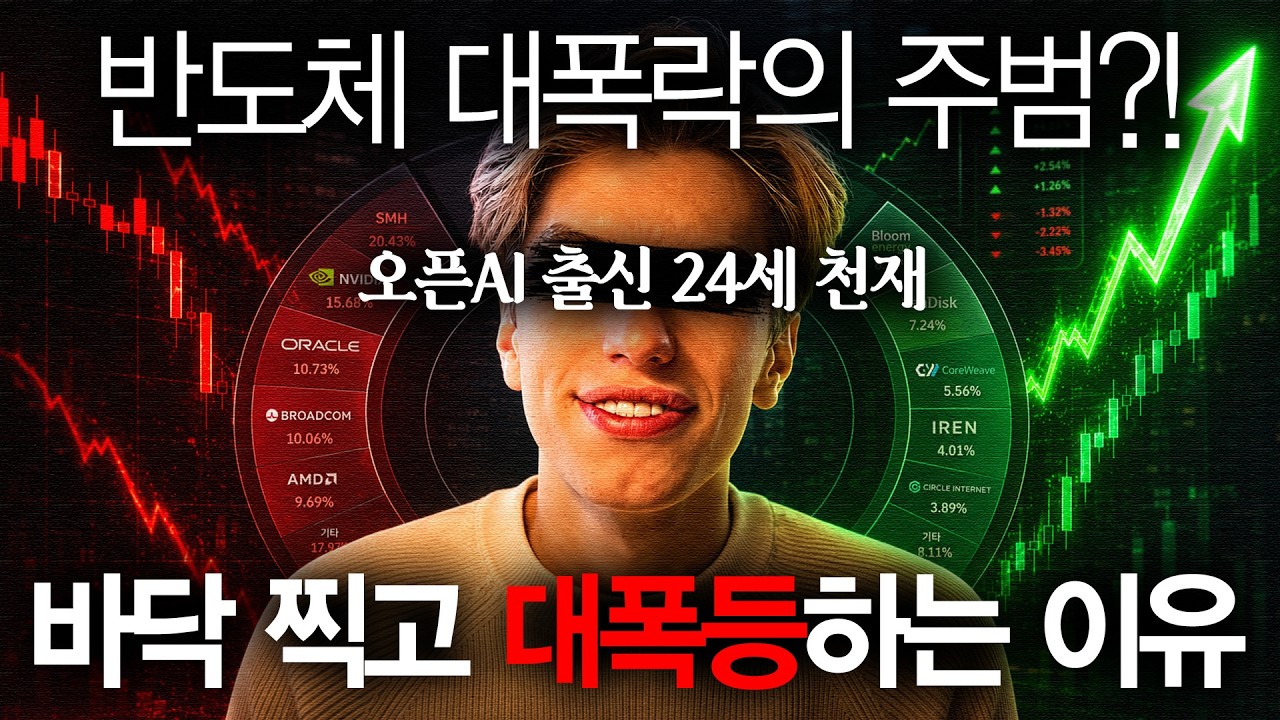
Was the 22-Year-Old AI Genius the Culprit Behind the Semiconductor Crash: The Real Core Point of the Memory Semiconductor Slump and the Rebound in AI Infrastructure Stocks
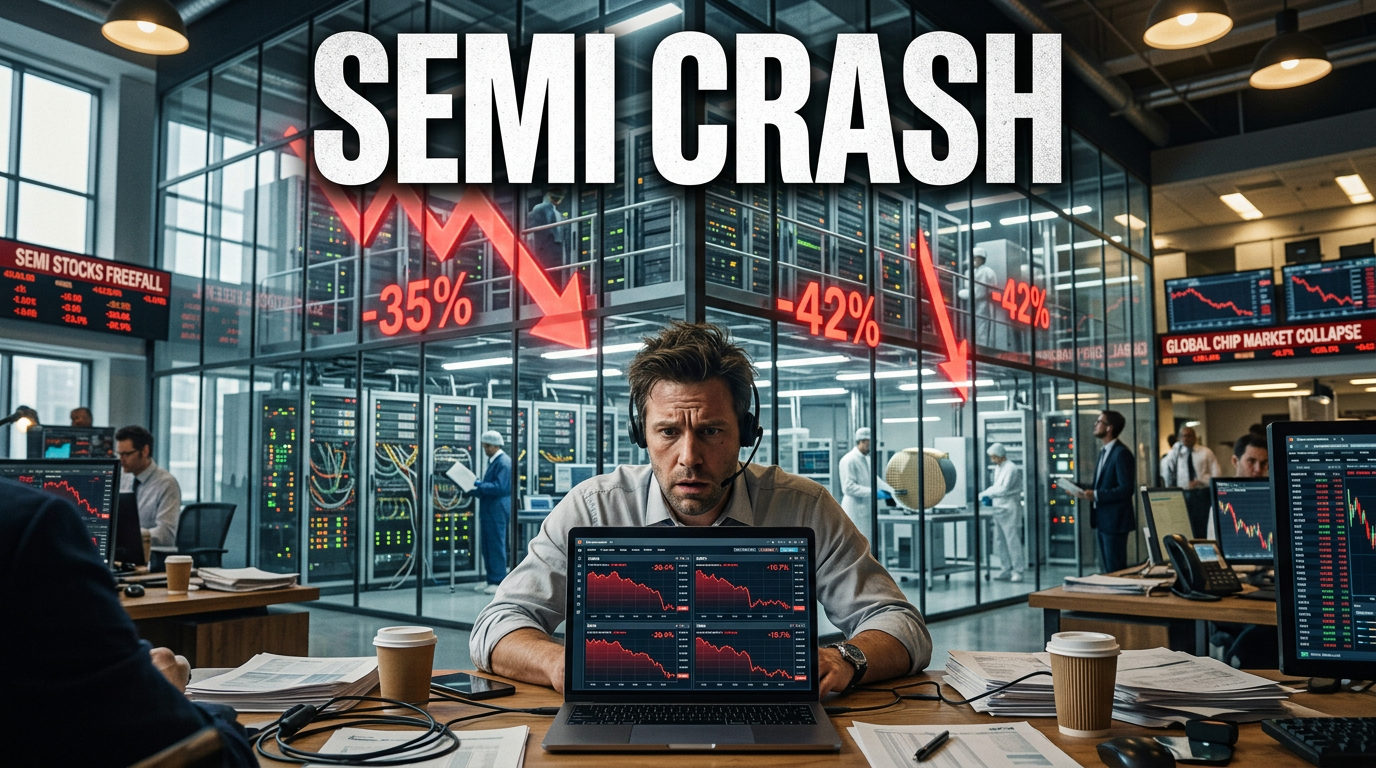
This recent semiconductor selloff is hard to explain simply as “the AI bubble burst” or “earnings got worse.”
Rather, the key takeaway is that this was more plausibly an event in which leverage, margin calls, forced liquidation, short-covering, and AI infrastructure bottlenecks became intertwined all at once.
In particular, even though Samsung Electronics and SK Hynix reported strong earnings, their share prices wobbled, and AI semiconductor and data center-related stocks in the U.S. market plunged before rebounding sharply. That pattern looks very much like a classic liquidation-driven decline.
Today’s core point comes down to three things.
First, why did memory semiconductor stocks and AI infrastructure names with good earnings suddenly collapse?
Second, what kind of shock did the rumored “22-year-old AI genius hedge fund manager” and margin-call story send through the market?
Third, after this decline, what investment opportunities now appear across AI investment, data center power, HBM, and the memory semiconductor cycle?
1. The Starting Point of the Event: A Strange Market Where Earnings Were Good but Stocks Collapsed
The strangest part of the recent market was that semiconductor companies’ fundamentals and share prices moved in opposite directions.
Samsung Electronics emphasized the recovery in the memory semiconductor industry and expanding HBM demand.
SK Hynix is also continuing a strong earnings trend thanks to AI server and HBM demand.
Micron, too, has long been viewed as a major beneficiary of improving memory market conditions.
Yet the stock prices suddenly plunged instead of reflecting earnings.
The same thing happened in the U.S. market.
AI data center-related stocks, power infrastructure companies, fuel cell firms, and memory semiconductor names all dropped sharply over a matter of days.
Notable names such as Nebius, SanDisk, Bloom Energy, CoreWeave, Micron, TSMC, Applied Digital, and Core Scientific saw major volatility in the market.
What matters is that this collapse was raised as potentially linked not to deteriorating earnings, but to forced reductions in a large position.
2. The Center of the Wall Street Rumor: “Situational Awareness” and AI Bottleneck Investing
At the center of this story is a young hedge fund manager who came from AI research and drew attention on Wall Street.
He is known to have studied economics and computer science at Columbia University and to have worked at FTX and OpenAI.
Later, he drew major attention with an AI outlook report called “Situational Awareness.”
This report was praised for laying out in concrete terms how AI could reshape national competitiveness, power demand, data centers, and semiconductor supply chains.
The core investment idea was simple.
As AI grows, the bottlenecks are not in software, but in power infrastructure, data centers, semiconductors, and memory.
This view itself was quite convincing.
In fact, since 2024 the market has been driven by AI semiconductors, data center power, cooling infrastructure, HBM, and server DRAM as the strongest themes.
The issue was not direction, but position structure.
3. The Key Position: Long AI Infrastructure, Short Software
The strategy attributed to him in the market was roughly a long AI infrastructure, short software structure.
In other words, the bet was that AI infrastructure stocks would rise while software stocks would relatively underperform.
For a while, that strategy worked perfectly.
AI data center demand surged, power infrastructure companies were re-rated, and memory semiconductor prices also rose.
But the market recently moved in the opposite direction.
AI infrastructure stocks plunged, while some software names rebounded relatively strongly.
If this position had been a simple cash position, it would likely have been able to withstand the move.
But rumors circulated in the market that significant leverage had been embedded in the strategy.
Some even mentioned leverage of around 4x.
Leverage can dramatically amplify returns when you are right, but when you are wrong, it becomes a knife that forces positions to be liquidated.
4. The Margin Call Structure: Why Good Stocks Can Still Collapse
To understand this situation, you need to understand the margin call structure.
Leveraged investing means borrowing money against stocks as collateral to buy more shares.
When share prices rise, the collateral value increases and you can maintain a larger position.
But when share prices fall, the collateral value shrinks.
When that collateral value falls below a certain level, the broker or prime broker demands additional margin.
That is a margin call.
If you cannot add more cash, you have to sell the position.
The problem is that when a large fund sells a basket of holdings all at once, the stock price falls further.
As the share price falls further, the collateral value shrinks again, and another margin call is triggered.
If this process repeats, even good stocks can be pushed to absurd prices in a short time.
This recent plunge in AI semiconductors and data center-related stocks looks very similar to that structure.
5. The Citadel Theory: The Market’s Interpretation That the Book Was Handed Over in One Go
In the market, there was talk that the fund came under funding pressure and transferred part, or even a significant portion, of its positions through block trades.
The name most often mentioned as the counterparty was Citadel.
Citadel is a global hedge fund and market-making group led by Ken Griffin.
According to market rumors, Citadel may have acquired the portfolio at a substantial discount.
The important point here is that this is not something officially confirmed; it is a scenario that market participants are interpreting based on price action and trading context.
Still, if you look only at the price movement, it is quite explanatory.
Certain AI infrastructure names fell sharply for no apparent reason.
Then, within a single day, they rebounded by around 20%.
Such moves often appear when large funds buy back cheaply after forced selling and when existing short positions are covered.
6. Why Did Stocks Suddenly Surge Again? Short-Covering and the End of Forced Selling
There are two ways to explain why the stocks suddenly rebounded.
First, the forced selling may have been largely absorbed.
Once the shares that had to be sold due to margin calls disappear from the market, there is no longer as much selling pressure on the stock.
Second, there is short-covering by bearish traders.
As the price begins to rebound after a sharp decline, investors who shorted the stock have to buy shares again to limit losses.
This buying pressure pushes the price even higher.
That is why a rebound after a plunge can look less like a normal recovery and more like a breakout surge.
The short-term spikes in stocks such as Nebius, SanDisk, and Bloom Energy can be interpreted in this framework.
7. The Link to the Korean Semiconductor Selloff: Samsung Electronics and SK Hynix Were Also Exposed to Leverage Pressure
The plunge in U.S. AI infrastructure stocks and the fall in Korean semiconductors should not be treated as completely separate events.
For global investors, Samsung Electronics, SK Hynix, Micron, TSMC, Nvidia, and data center power stocks are all part of one AI investment basket.
When AI infrastructure positions are liquidated in the U.S., Korean memory semiconductors can also be sold off alongside them.
If you add domestic leveraged ETFs and margin loan exposure on top of that, the downside can become even larger.
In particular, if Korean retail investors were heavily concentrated in leveraged products tied to Samsung Electronics and SK Hynix, then even a small move lower could trigger ETF rebalancing and forced selling pressure at the same time.
Ultimately, the Korean semiconductor collapse should also be viewed not only through company earnings, but through the impact of supply-demand imbalances and leverage unwinding.
8. The Most Important Truth: AI Investment Has Not Ended; the Bottlenecks Are Getting Stronger
It is still too early to say, based on this decline, that “the AI bubble is over.”
In fact, looking at the remarks and capital expenditure plans of big tech companies, demand for AI investment remains strong.
Hyperscalers such as Alphabet, Meta, and Microsoft are signaling that they will increase AI data center investment rather than cut it.
The core issue is that computing resources are insufficient.
Meta explained that while external companies are offering high premiums for its computing resources, internal use generates a higher return on investment.
That is a very important point.
It means that even if AI GPUs can be rented out externally at a profit, using them for in-house AI services produces a higher ROIC.
In other words, big tech is not wasting money; it is concluding internally that AI infrastructure investment is still economically rational.
9. GPU Economics: Why Big Tech Borrows Money to Buy AI Servers Anyway
According to some reports, hyperscalers are estimated to be able to earn substantial margins when renting GPUs.
For example, if the financing cost is around 5% but GPU rentals or AI services generate a 20% to 40% range of return on investment, then there is no reason for the company to stop investing.
Of course, concerns that AI capital spending has become excessive are valid.
But it is hard to say that big tech executives are simply being swept along by the mood and spending tens of trillions of won.
They internally calculate IRR, NPV, and ROIC.
And because the results still look positive, they are aggressively securing data centers, GPUs, power contracts, and HBM supply.
This is the core point that most other news coverage misses.
AI investment is not an emotional theme; it is capital expenditure whose actual return calculations are running inside big tech’s current financial models.
10. What to Watch in Samsung Electronics’ Earnings Call: HBM and Memory Prices
Samsung Electronics’ earnings call also offered important hints about the memory semiconductor cycle.
DRAM and NAND price increases are continuing, and supply shortages were mentioned as potentially lasting through 2026.
In particular, the outlook for HBM price increases should be treated as very important by the market.
AI servers require much more high-performance memory than ordinary servers.
The more Nvidia GPUs are sold, the greater the demand for HBM becomes.
HBM is difficult to scale up quickly.
That is because process complexity, packaging, customer qualification, and yield issues are all intertwined.
So if HBM prices remain strong, earnings estimates for Samsung Electronics and SK Hynix could continue to be revised upward.
11. SK Hynix’s Strength: The Most Direct Beneficiary of the AI Memory Cycle
SK Hynix is regarded as one of the most advanced companies in the HBM market.
HBM is a core component in Nvidia’s AI GPU supply chain.
As AI semiconductor performance rises, the importance of memory bandwidth grows even more.
In other words, the bottleneck in the AI era is not just a single GPU chip, but the entire system that makes the GPU work properly: high-bandwidth memory, power, and data center infrastructure.
From this perspective, SK Hynix and Samsung Electronics need to be re-rated not as simple cyclical stocks, but as core companies in the AI infrastructure supply chain.
12. The China Semiconductor Threat Narrative: Some Parts Are Overstated
Recently, the market has also heard talk that China’s CXMT and Chinese DUV equipment could threaten Korean memory semiconductors.
But this should be viewed coldly.
Even if China succeeds in localizing some equipment, it will be difficult to catch up to ASML-level productivity, precision, and supply capacity in the short term.
Semiconductors are a much more complex industry than simply making one piece of equipment.
They require lithography tools, materials, processes, yield, customer qualification, and manufacturing experience.
CXMT is growing, yes, but given its current profitability and technological gap, it is not easy for it to replace the competitiveness of SK Hynix and Samsung Electronics in HBM over the short term.
Therefore, the China threat should be seen as a long-term risk, but interpreting it as a short-term factor capable of breaking the current memory semiconductor price cycle may be excessive.
13. The Most Important Thing Other Coverage Often Misses in This Selloff
The first key takeaway is that a stock price decline does not always mean fundamentals have worsened.
This decline was likely driven more by position unwinding and leverage reduction than by earnings.
The second key takeaway is that AI infrastructure bottlenecks are still an investment opportunity.
What is more scarce than AI software is power, data centers, GPUs, HBM, and high-performance memory.
The third key takeaway is that even strong companies can break down in the short term when leverage-driven flows hit the market.
Even good names can move irrationally when the entire market enters a forced-liquidation phase.
The fourth key takeaway is that the process of powerful players acquiring desired assets cheaply can look like a market crash.
When block trades, short selling, margin calls, and short-covering combine, retail investors can get shaken out without understanding why.
The fifth key takeaway is that more important than interest-rate forecasts is the return on investment from big tech’s AI spending.
Even if rates are high, big tech will keep investing if AI infrastructure returns are higher.
14. Checkpoints Investors Should Watch
1. You need to determine whether the rebound is only a technical bounce.
Even if AI infrastructure stocks rebound after a sharp drop, you need to look at volume and short-covering as well.
2. You need to watch changes in Samsung Electronics’ and SK Hynix’s earnings estimates.
More important than share prices is whether the 2025 and 2026 operating profit consensus continues to rise.
3. You need to check HBM prices and long-term supply agreements.
If HBM prices remain strong and long-term contracts with customers expand, the memory semiconductor cycle could last longer.
4. You need to monitor the order backlog of data center power-related companies.
AI data centers cannot be built without electricity.
Power infrastructure companies are hidden beneficiaries of the AI cycle.
5. You need to be careful with leveraged ETFs and margin balances.
Even if you invest in a good industry, excessive leverage is the first thing to break down in front of market volatility.
15. Conclusion of This Event: The Real Culprit Behind the Semiconductor Crash Was Not “Earnings” but “Structure”
This semiconductor selloff should be viewed differently from a traditional downturn caused by poor corporate earnings.
The key is that large leveraged positions concentrated in AI infrastructure were shaken, and in the process margin calls and forced selling likely occurred.
This shock rattled U.S. AI-related stocks and also pressured Korean memory semiconductor names.
But if you look at the fundamentals, it is hard to say that AI investment itself has ended.
Big tech is still building data centers.
GPUs and HBM are still in short supply.
Power infrastructure remains one of the biggest bottlenecks in the AI era.
Memory semiconductor prices are in an upward cycle.
So rather than seeing this plunge as the end of the AI industry, it is more realistic to view it as a shock that arose during the process of unwinding excessive leverage.
From an investor’s standpoint, rather than focusing only on fear, you need to look at which companies truly control the bottlenecks.
AI semiconductors, memory semiconductors, data center power, HBM, and high-performance server infrastructure remain the core areas.
Still, the lesson from this event is clear.
No matter how good a theme is, if you use too much leverage, it is hard to survive long in the market.
Invest in good industries, but managing position size and cash allocation is ultimately the most realistic way to protect returns.
< Summary >
The recent plunge in semiconductors and AI infrastructure stocks may have been driven more by leverage unwinding and margin calls than by worsening earnings.
On Wall Street, the pressure on a large fund that used a long AI infrastructure, short software strategy and the rumor that Citadel acquired its positions via block trades were both discussed.
The sharp rebound in some AI data center, power, and memory-related stocks after the selloff can be interpreted as the result of forced selling ending and short-covering.
The core point for Samsung Electronics and SK Hynix is HBM, DRAM, NAND price increases, and AI server demand.
AI investment is not over; it is becoming even more concentrated in GPU, HBM, and data center power bottlenecks.
Investors should watch the fundamentals of AI semiconductors and memory semiconductors, but must be especially careful with leveraged ETFs and excessive margin investing.
[Related Articles…]
- Outlook for the AI Semiconductor Cycle and the Memory Supercycle
- AI Data Center Power Infrastructure Investment Trends
*Source: [ 월텍남 – 월스트리트 테크남 ]
– 반도체 대폭락 범인은 22세 천재?..”바닥 확인 후 대폭등 중”