● Samsung, SK Hynix slump, Kosdaq surges on rotation signal
Why Samsung Electronics and SK hynix Were Weak: Is the KOSDAQ Surge a Sign of Rotation?
Today’s key point in the Korean equity market was not simply that Samsung Electronics and SK hynix were weak.
The main issue was that institutional flows moved out of Samsung Electronics and SK hynix and into previously neglected KOSDAQ names.
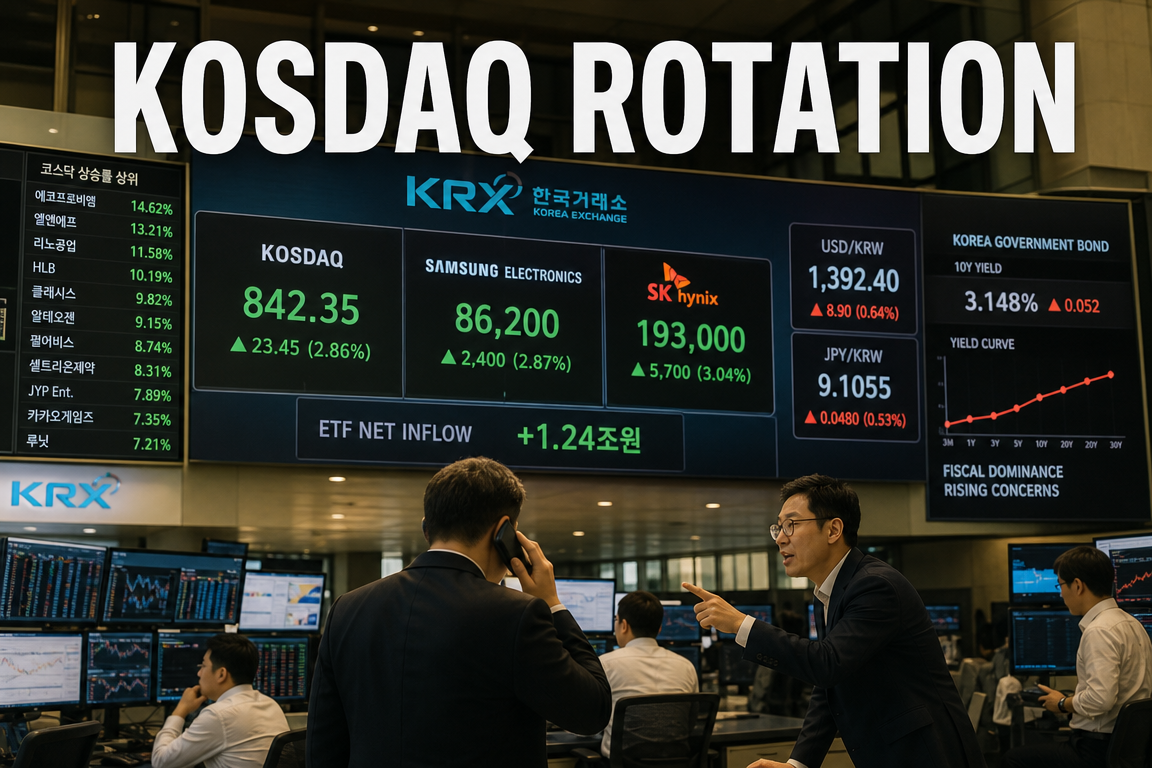
The KOSDAQ’s gain of more than 5% was difficult to explain by a single stock-specific catalyst and instead suggests a shift in market liquidity.
Today’s session reflected a broadening away from large-cap semiconductor leadership toward biotech, secondary battery, AI software, and small- and mid-cap growth stocks.
To determine whether this was a one-day event or the start of a broader rotation, investors should monitor Samsung Electronics, SK hynix, the KOSDAQ, institutional flows, and semiconductor ETF activity together.
1. What Actually Happened in Today’s Market
At the open, the market did not show any unusual direction.
U.S. equities the previous day were relatively stronger in non-tech sectors, while U.S. semiconductor stocks did not post a meaningful breakout.
Accordingly, Samsung Electronics and SK hynix moved in a largely ordinary range early in the session.
The key change came shortly after the open, when the flow of funds shifted.
Institutional capital began leaving Samsung Electronics and SK hynix and moved into sectors that had been under pressure for an extended period.
As capital entered the KOSDAQ, the index posted a strong intraday advance.
In that sense, today’s market was less about weakness in semiconductors and more about a reallocation of capital from large-cap semiconductors into broader market segments.
2. Why Samsung Electronics and SK hynix Were Weak
The weakness in Samsung Electronics and SK hynix should not be interpreted solely as a deterioration in fundamentals.
Today’s move was driven more by supply and demand conditions than by earnings revisions.
Until recently, the Korean market had been dominated by Samsung Electronics and SK hynix.
Capital had concentrated in these names due to expectations for AI semiconductors, HBM demand, and a recovery in the memory cycle.
However, when positioning becomes too crowded in a small group of stocks, even modest outflows can create a noticeable market impact.
That is what appeared to happen today.
Samsung Electronics and SK hynix did not break down structurally; rather, institutions appear to have taken partial profits and reallocated capital into other sectors.
Such behavior is typical in a rotation phase, when leadership pauses and lagging groups begin to catch up.
3. Why the KOSDAQ Surged: Capital Moved Into Neglected Names
The main driver behind the KOSDAQ’s sharp rise was a re-rating of neglected stocks.
Market attention had been concentrated on Samsung Electronics, SK hynix, large-cap semiconductors, and AI infrastructure names.
By contrast, KOSDAQ sectors such as biotech, secondary battery materials, robotics, AI software, gaming, entertainment, and small- and mid-cap growth stocks had remained comparatively weak.
When capital leaves crowded large-cap positions, the most responsive area is often the group that has been most depressed.
Because the KOSDAQ has a smaller market capitalization base, even modest institutional inflows can produce a large index move.
The KOSDAQ’s rise of more than 5% therefore appears to reflect concentrated buying into previously overlooked names rather than a simple rebound.
If sustained, this could signal a shift in the Korean equity market from large-cap semiconductor leadership toward broader participation.
4. How Semiconductor Leveraged ETF Restrictions Affected Flows
One of the most important but less visible factors today was ETF-related flow dynamics.
Recently, leveraged ETFs with heavy exposure to Samsung Electronics and SK hynix have had a strong influence on domestic market flows.
Because leveraged ETFs seek roughly twice the return of the underlying index, inflows typically require additional buying of the constituent large-cap stocks.
Conversely, when flows slow or volatility rises, trading in the related stocks can intensify on the downside as well.
This structure has made Samsung Electronics and SK hynix the central axis of ETF-driven demand.
However, with tighter oversight and regulatory attention on leveraged ETF activity, the force of concentrated buying into these names has become less pronounced.
In effect, the market structure that had been repeatedly lifting Samsung Electronics and SK hynix temporarily weakened.
That created room for capital to broaden into the KOSDAQ and small- and mid-cap names.
This is a key factor that is often missed in headline coverage, but it is essential to understanding today’s market.
5. The Core Message: Market Breadth, Not a Semiconductor Shock
Today’s weakness in Samsung Electronics and SK hynix should not be read as a sudden deterioration in the semiconductor cycle.
Expectations for AI server investment, HBM demand, and memory price recovery remain important market themes.
That said, after a strong advance, short-term profit-taking pressure can increase.
For institutions, reducing exposure to highly extended large-cap semiconductors and reallocating toward less-run KOSDAQ names was a rational portfolio adjustment.
From a market-wide perspective, this is not necessarily negative.
In fact, an expansion in the number of rising stocks and a reduction in concentration risk can indicate a healthier market structure.
In short, today’s session was less about weakness in Samsung Electronics and SK hynix and more about capital beginning to spread into a wider set of stocks.
6. Is This the Start of a Full Rotation or Just a One-Day Event?
The key question now is whether the KOSDAQ’s surge marks the beginning of a broader rotation.
If this was only a one-day event, capital could quickly rotate back into Samsung Electronics and SK hynix, while the KOSDAQ gives back part of its gains.
If it is the start of a rotation phase, lagging growth stocks and neglected sectors could continue to move sequentially over the next several sessions.
There are three main points to watch.
First, institutional buying in the KOSDAQ must show continuity.
If the buying persists for two to three trading days rather than just one session, the rotation case becomes stronger.
Second, the advance should remain broad.
A move led by only a few themes is less durable, while participation across biotech, secondary batteries, AI, robotics, and materials would support market breadth expansion.
Third, Samsung Electronics and SK hynix should hold at least a constructive consolidation pattern rather than a sharp decline.
If large-cap semiconductors pause without breaking down, the rotation into KOSDAQ names can develop more sustainably.
7. Key Indicators Investors Should Watch Now
In this environment, the index level alone is insufficient.
The more important issue is where capital is moving.
The first indicator to monitor is the list of top institutional net purchases.
Tracking which sectors institutions are buying after reducing exposure to Samsung Electronics and SK hynix can help identify the next rotation candidates.
The second is KOSDAQ trading value.
A durable KOSDAQ advance requires rising turnover.
If prices rise without meaningful trading value, the move is more vulnerable to short-term reversal.
The third is net flow into and out of semiconductor ETFs.
If outflows continue, near-term upside in Samsung Electronics and SK hynix may remain limited.
If ETF inflows return, large-cap semiconductors could regain leadership.
The fourth is the exchange rate and foreign investor activity.
A stable KRW/USD exchange rate and sustained foreign buying would be broadly supportive for Korean equities.
However, if foreigners sell large caps while institutions buy the KOSDAQ, the rotation may be strong but also more volatile.
8. The Key Point Missed by Other Coverage: The Market Engine Is Changing
The most important development today was not a simple leadership change, but a shift in the market’s operating engine.
For much of the period, the Korean market was driven primarily by Samsung Electronics and SK hynix.
As AI semiconductor expectations strengthened, capital concentrated in large-cap semiconductor names, while the rest of the market lagged.
Today, however, the main engine appeared to pause while multiple smaller engines turned on at the same time.
If KOSDAQ biotech, secondary batteries, AI software, robotics, and mid-cap semiconductor equipment names all responded together, the move is more meaningful than a short-term bounce.
From a market structure perspective, lower concentration and wider participation can be positive.
That said, stock selection becomes much more important in this type of market.
A rising KOSDAQ does not imply that all small- and mid-cap stocks will continue to advance.
Stocks with earnings support, credible themes, and active trading value are more likely to sustain momentum.
9. Market Scenarios Ahead
Scenario 1: Rotation Continues
If institutional capital keeps flowing into the KOSDAQ and Samsung Electronics and SK hynix consolidate without a major decline, the market could maintain a healthier pattern.
In that case, biotech, secondary batteries, AI-related names, and robotics stocks could rotate higher in sequence.
For investors, names with rising trading value and constructive pullbacks may be preferable to chasing extended movers.
Scenario 2: A One-Day Event
If institutional buying fades quickly and capital returns to Samsung Electronics and SK hynix, today’s move may prove to be a temporary flow event.
In that case, many of today’s KOSDAQ gainers could see rapid profit-taking.
Stocks that rose mainly on theme-driven speculation may be especially volatile.
Scenario 3: Large Caps and the KOSDAQ Strengthen Together
The strongest market outcome would be one in which Samsung Electronics and SK hynix stabilize while the KOSDAQ continues to rise.
That would support a broader improvement in sentiment across both the KOSPI and KOSDAQ.
Such a setup would likely require supportive foreign flows, a stable exchange rate, and favorable U.S. market conditions.
10. One-Sentence Summary
Today’s weakness in Samsung Electronics and SK hynix was driven more by institutional capital rotation than by a sudden deterioration in the semiconductor outlook.
Funds leaving large-cap semiconductors moved into neglected KOSDAQ names, pushing the index sharply higher.
As leveraged ETF concentration in semiconductors weakened, market flows broadened into a wider set of stocks.
If institutional buying in the KOSDAQ and trading value remain firm, the move could evolve into a broader rotation phase.
The key issue is not a semiconductor shock, but the possibility of a broader reallocation within Korean equities.
[Related Articles…]
Samsung Electronics Stock and Semiconductor Flow Shifts
KOSDAQ Surge and Rotation Market Outlook
*Source: [ 내일은 투자왕 – 김단테 ]
– 오늘 삼전닉스만 부진한 진짜 이유 #삼성전자 #하이닉스 #코스닥
● Yen Slump, Won Drift, Japan Fiscal Trap
The real reason yen weakness is not stopping: fiscal dominance and won movement are stronger than Bank of Japan rate hikes
The key issue is not simply, “Why is the yen still weak even after Japan raised rates?”
This report focuses on why yen weakness and won weakness have moved in similar directions, why Bank of Japan rate hikes have had limited effect on the exchange rate, and which variables matter most when assessing whether USD/KRW will move toward the 1,300 range or remain near 1,500.
The central point is that the market sees Japan’s fiscal expansion as constraining monetary tightening, which limits the Bank of Japan’s ability to deliver a forceful policy shift.
News coverage typically emphasizes the U.S.-Japan rate differential, the strong dollar, and Japanese rate hikes. In practice, however, yen and won weakness are also linked to Japanese government bond supply, the pace of quantitative tightening, capital outflows, and the erosion of export competitiveness in both Korea and Japan.
1. Why should yen and won be analyzed together?
The first point raised in the discussion is the correlation between yen and won movements.
In the past, Japanese yen and Korean won were often analyzed separately.
Recent market behavior, however, shows that both currencies face similar pressures.
The first reason is the weakening of their positions as manufacturing and trade-oriented economies.
Japan was once a leading trade power with exceptional strength in manufacturing and technology.
That position has gradually weakened as the United States has increased pressure, Korea’s manufacturing base has expanded, China has advanced industrially, and Taiwan has strengthened its semiconductor position.
Korea is not materially different.
Although Korea’s exports have increased over time, its relative competitiveness has weakened compared with Taiwan and China.
Outside memory semiconductors, Korea’s manufacturing position is no longer as dominant as it once was.
The second reason is the low-growth and low-rate structure.
Japan has long operated under low growth, low inflation, and low interest rates.
Korea is also being assessed as moving into a similar path due to demographic change and a declining potential growth rate.
Bloomberg Economics has also highlighted the possibility of lower long-term potential growth in both Korea and Japan.
The third reason is the structural outflow of domestic capital.
Japanese capital has long been heavily allocated overseas.
In Korea, overseas investment began rising rapidly around 2015.
After the COVID-19 shock in 2020, it became much easier for investors to buy U.S. stocks and global ETFs through smartphones.
As overseas investing became as accessible as domestic trading, capital outflows accelerated further.
That trend has continued as global capital has shifted toward big tech and AI-related investment themes.
2. Why is the yen weak even as Japan raises rates?
In general, higher interest rates tend to support a currency.
In Japan’s case, however, yen weakness has continued despite rate hikes.
This is the most important issue in the yen outlook.
Historically, the yen strengthened when the U.S.-Japan yield spread narrowed.
The yen was highly sensitive to external interest rate differentials.
As a result, the U.S.-Japan government bond yield spread once provided a useful explanation for yen movements.
That relationship is now less reliable.
Even as the U.S.-Japan yield spread narrows, the yen has not strengthened and has instead remained weak.
This shift is difficult to explain using a simple rate-differential model.
The key concept is fiscal dominance.
Fiscal dominance refers to a situation in which monetary policy becomes constrained by government fiscal policy.
In practical terms, even if a central bank wants to tighten policy to control inflation, monetary policy has limited effect when government spending remains expansionary.
3. How Japan’s fiscal expansion is reinforcing yen weakness
The Japanese government appears inclined to expand fiscal spending to support the economy.
Higher government spending implies larger bond issuance.
When bond supply rises, market funding pressure increases and Japanese government bond yields come under upward pressure.
The issue does not end there.
The Bank of Japan has also been pursuing quantitative tightening, or QT.
QT reduces the amount of government bonds held by the central bank.
However, if bond supply rises due to fiscal expansion while the Bank of Japan simultaneously reduces bond purchases, pressure on the bond market increases further.
As a result, the Bank of Japan faces limits on how aggressively it can continue QT.
The market interprets this as evidence that the Bank of Japan may raise rates, but not to a degree that would be materially restrictive.
In other words, yen strength has not followed rate hikes because the market doubts the Bank of Japan’s ability to tighten meaningfully.
A modest increase in nominal rates is not sufficient.
The market is asking whether Japan can lift real rates into positive territory.
Given fiscal pressure and bond market instability, the view is that the Bank of Japan is unlikely to raise real rates enough to generate sustained yen appreciation.
4. Understanding Japan’s policy mix through the air conditioner and heater analogy
The clearest way to understand this dynamic is through the air conditioner and heater analogy.
Bank of Japan rate hikes are equivalent to turning on the air conditioner.
They represent a tightening policy aimed at cooling the economy and stabilizing prices.
Fiscal expansion is equivalent to turning on the heater.
It is an expansionary policy designed to support growth and inject more money into the economy.
The problem is that Japan is effectively using both at once.
Rates are being raised, but fiscal spending is also expanding.
As a result, the overall policy stance remains accommodative despite the appearance of tightening.
Under this structure, the yen is unlikely to strengthen materially.
If fiscal expansion exerts more force than rate hikes, the market will continue to view Japan’s macro policy stance as expansionary.
That is why yen weakness persists.
5. What yen weakness means for Japanese households
When the yen falls, Japanese households lose purchasing power abroad.
Overseas travel becomes more expensive, and imported inflation rises.
In dollar terms, household purchasing power declines.
For that reason, it is not entirely inaccurate to say that Japan has become poorer than it was before.
The impact is especially visible in areas that depend on foreign currency payments, such as overseas travel, energy imports, and food imports.
That said, a currency’s value should not be treated as a complete measure of national fundamentals.
Exchange rates reflect interest rates, inflation, trade balances, capital flows, geopolitical risk, government policy, and market sentiment.
For example, India has strong growth and high expectations for its digital economy, but the rupee has still weakened.
Strong growth does not automatically lead to currency strength.
Likewise, it would be excessive to interpret yen weakness as a total collapse of the Japanese economy.
6. Why the won is facing similar pressure
The Korean won is under similar structural pressure.
Korea continues to post current account surpluses, but capital outflows have become large.
In simple terms, even if exports generate dollars, the won can weaken if investors move more capital overseas to buy foreign equities and assets.
The won’s relatively high level over the past five years is also linked to this capital outflow structure.
Korean retail and institutional investors have increasingly shifted funds into U.S. stocks, big tech, AI semiconductors, global bonds, and overseas real estate.
Unless this trend changes, a current account surplus alone will not be enough to sustain won appreciation.
Rate hikes by the Bank of Korea can support the won in the short term.
At times, the market has priced in strong expectations for Korean rate increases relative to other major economies.
Over the long term, however, capital flow dynamics may matter more than rates alone.
7. Will USD/KRW move back toward 1,300 or remain near 1,500?
The exchange rate outlook discussed here is more about structure than a single target.
In the short term, market momentum matters.
Once the exchange rate begins moving in a stronger won direction, it can continue unless a major external shock intervenes.
Long term, the issue is different.
If dollar inflows from the current account are weaker than dollar outflows from overseas investment, USD/KRW can return to a higher level.
The Korean government appears to regard the 1,300 range as more consistent with underlying fundamentals.
Macro models can even imply a value in the 1,200 range.
However, from a market-clearing perspective, 1,500 may also look like an equilibrium level.
In other words, the answer depends heavily on the framework used.
A fundamental model may suggest the won is undervalued.
Actual market flows, however, can still justify persistent weakness.
Accordingly, the near-term probability may favor stabilization around the 1,400s or 1,300s rather than a move toward 1,600.
But if capital outflows remain unchanged, upward pressure on USD/KRW may reappear over the longer term.
8. The most important point missing from most coverage
First, the core issue in yen weakness is not simply the rate hike itself, but confidence in the Bank of Japan.
The market cares less about whether rates are raised than about how far they can realistically go.
If fiscal pressure prevents a meaningful rise in real rates, the yen can remain weak even after rate hikes.
Second, the supply-demand condition in the Japanese government bond market is now directly linked to the exchange rate.
Fiscal expansion raises bond supply.
Higher supply lifts yields and makes QT more difficult for the Bank of Japan.
At that point, the market may conclude that the central bank has limited room to act independently of fiscal policy.
Third, yen and won weakness is not only a strong-dollar story.
The strong dollar remains important.
But Korea and Japan also share slower growth, weakening manufacturing competitiveness, and capital outflows.
Unless those structural factors change, exchange rates are unlikely to return easily to prior levels.
Fourth, exchange rate forecasts depend more on the framework than on the number itself.
The key is not whether the forecast is 1,300, 1,500, or 1,600, but why that level is expected.
Current account, capital account, rate differentials, fiscal policy, monetary policy, and bond market supply all need to be considered together.
Fifth, the AI investment boom is also affecting exchange rates.
As Korean investors increase exposure to U.S. big tech and AI-related equities, dollar demand rises.
This acts as a headwind for the won.
In that sense, AI trends and global capital allocation are now relevant to currency analysis.
9. What investors and companies should monitor
When analyzing the yen, do not focus only on the U.S.-Japan rate spread.
Fiscal spending, Japanese government bond yields, and the pace of Bank of Japan QT should be monitored together.
When analyzing USD/KRW, the capital account matters as much as the current account.
Even if exports remain strong, the won will struggle to strengthen if more dollars are leaving through overseas investment.
Exporters may consider reducing dollar exposure when the exchange rate stabilizes.
If the won appears to be stabilizing in the near term, exporters may have incentives to convert held dollars into won.
Individual investors should recognize that overseas investing introduces FX risk.
Even when U.S. equities rise, a stronger won can reduce local-currency returns through exchange-rate losses.
Conversely, if the won remains weak, foreign asset returns may be amplified by currency effects.
In the global outlook, the policy mix matters more than interest rates alone.
The era of judging currencies only by rates has passed.
How much governments spend, and how independently central banks can act, are now central variables for exchange rates.
10. Conclusion: Yen weakness may indicate the future path of the won
Yen weakness is not simply the result of insufficient rate hikes.
It reflects a combination of fiscal expansion, limited monetary tightening, bond market supply pressure, and inadequate real-rate adjustment.
The won faces similar structural conditions.
Korea earns dollars through exports, but if overseas investment and capital outflows intensify, USD/KRW can remain elevated.
Looking ahead, exchange rate forecasts cannot be reduced to a simple view that lower U.S. rates will automatically strengthen the won and yen.
Structural changes in the Japanese and Korean economies, global capital movement, AI investment trends, and the interaction between fiscal and monetary policy all need to be considered.
The most important task is not memorizing a target level.
It is understanding the rationale behind the forecast.
Exchange rates can always be disrupted by geopolitical risk, financial shocks, and policy changes.
Investors who focus on structure rather than headline numbers are better positioned to navigate market changes.
< Summary >
Yen weakness has continued despite Bank of Japan rate hikes.
The core reason is fiscal dominance, in which monetary policy is constrained by government fiscal expansion.
Japan is raising rates while also expanding fiscal spending, leaving the overall policy mix relatively accommodative.
The won and the yen are both under pressure from weaker export competitiveness, slower growth, and overseas capital outflows.
USD/KRW may stabilize in the short term, but unless the capital outflow structure changes, a higher level may persist over the long term.
Exchange rate analysis should focus on the current account, capital account, fiscal policy, monetary policy, and global capital flows rather than on the headline number alone.
[Related Articles…]
KRW Exchange Rate Outlook and Global Capital Flow Dynamics
Yen Weakness and Japan’s Macro Policy Shift
*Source: [ 경제 읽어주는 남자(김광석TV) ]
– 엔화는 왜 계속 무너질까?” 일본이 금리를 올려도 약세인 진짜 이유 | 경읽남과 토론합시다 | 백석현 연구위원 [3편]