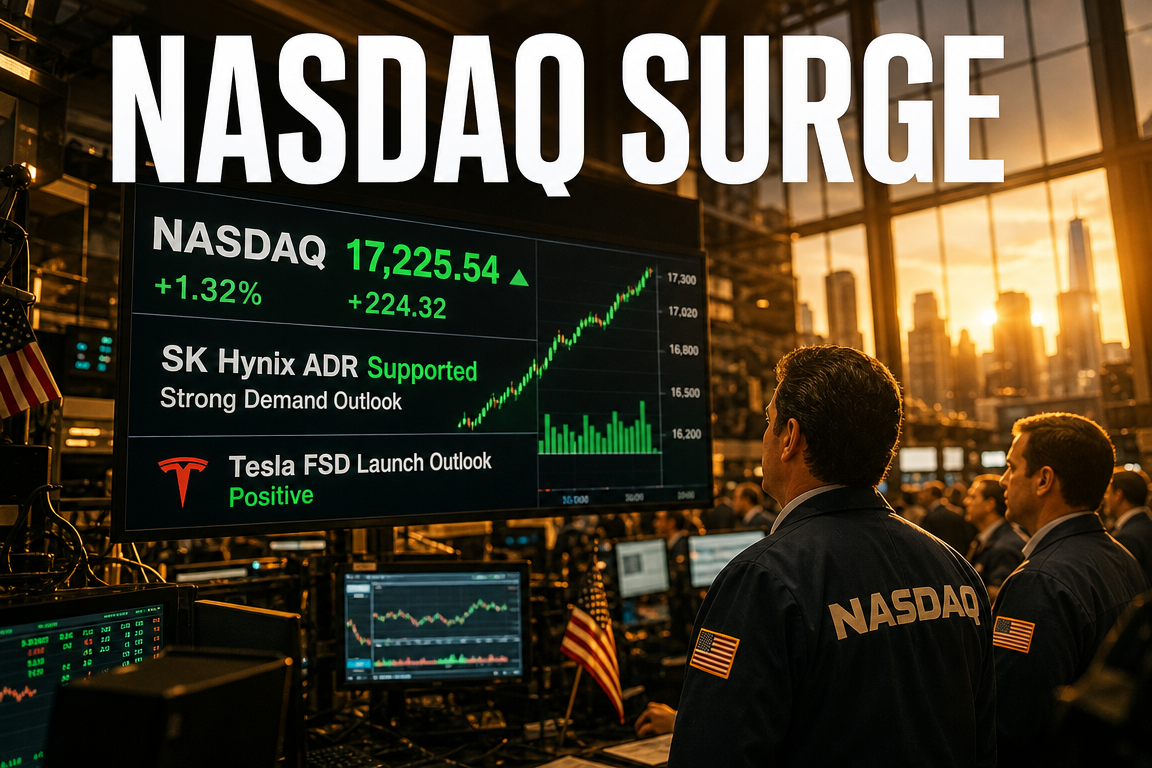
● Market Shock Nasdaq, Tesla, Samsung, SK Hynix, AI Boom, Dollar, Gold
Market focus: the key issue is not headlines, but price location across SK hynix, Samsung Electronics, Tesla, Micron, and SpaceX-related themes
The most important point in the current market is not simplistic conclusions such as “semiconductors are over,” “Tesla is back,” or “AI is a bubble.”
The real focus is the position of the Nasdaq index, the price range of semiconductor leaders, FX and dollar trends, Tesla’s FSD expectations, and the AI infrastructure investment cycle.
In particular, the key takeaway is that the declines in SK hynix and Samsung Electronics should not be interpreted as a collapse, but as a normal price correction after an extended rally.
As the discussion extends to Tesla, Micron, Nvidia, AMD, SpaceX-related AI demand, U.S. currency intervention, gold prices, and optical communications infrastructure, the current U.S. equity market can be viewed in a more integrated way.
This report organizes the original material into a news-style framework from the perspective of economic outlook, U.S. equities, the Nasdaq, semiconductors, Tesla, and AI investment.
1. The market’s main misconception: “good news always lifts stock prices”
The core message repeated throughout the original text is simple.
Stocks do not move purely on news; they move according to price position and investor sentiment.
For example, even if reports say Tesla’s FSD has improved, that alone does not guarantee further upside in the stock.
If the market has already priced in FSD optimism, the next focus becomes whether enough new customers convert into paid subscriptions.
In other words, better technology does not automatically translate into a higher share price.
The same applies to semiconductors.
Even if SK hynix is executing well on HBM, Samsung Electronics is benefiting from AI semiconductor recovery expectations, and Micron is supported by data center demand, prices can still correct naturally after a rapid run-up.
That should not automatically be interpreted as the end of the semiconductor cycle.
2. Why investors should not rely blindly on brokerage and investment bank forecasts
The original text cites Goldman Sachs’ bullish outlook on Korea as an example of why large financial institution reports should not be accepted uncritically.
Goldman Sachs projecting strength in the KOSPI does not mean the forecast is sufficient to protect an individual investor’s portfolio.
Brokerages and investment banks operate in a structure where higher trading activity generally supports revenue.
Whether the market rises or falls, they can still benefit from trading volume and product distribution as investors buy and sell.
As a result, investors should always ask:
Is this forecast truly investor-focused analysis, or is it a sales message designed to stimulate market participation?
This does not mean that large institutions are necessarily wrong.
Rather, it means their views should not be treated as a definitive guide for portfolio decisions.
3. Key Nasdaq levels to monitor
The original text emphasizes the index rather than individual names.
In particular, whether the Nasdaq breaks above or loses key ranges has a direct impact on growth stocks such as semiconductors, large-cap technology, and Tesla.
The key levels cited in the original text are as follows:
-
Upper reference level: around 30,350 on the Nasdaq
-
Lower reference level: around 29,300 on the Nasdaq
If the Nasdaq breaks decisively above and holds near 30,350, the market can be viewed as attempting to move out of a short-term downtrend.
Conversely, if it falls back below 29,300, even a rebound in individual names may not be enough to restore overall market strength.
Moves inside this range should generally be viewed as consolidation.
Assigning excessive significance to daily fluctuations within this zone can lead to poor timing decisions.
4. Tesla: why better FSD does not automatically lift the stock
Tesla is one of the most extensively discussed names in the original text.
The central point is straightforward.
Improvement in Tesla’s FSD does not automatically mean the stock should rise.
When FSD was first introduced and expectations were elevated, there was a large pool of potential customers.
Over time, however, the market has differentiated between actual users, subscription cancellations, and customers sensitive to pricing.
As a result, even if FSD improves technically, share-price upside may remain limited if expected revenue conversion does not materialize quickly enough.
The original text indicates that Tesla is working through the lower end of a broken price range.
The main levels referenced are as follows:
-
Short-term rebound level: around 360 dollars
-
Sentiment recovery zone: around 370-380 dollars
-
Stronger recovery confirmation: above 380 dollars and holding
A move to 360 dollars should not be read as the start of a renewed uptrend.
That level is better understood as a rebound after a sharp decline.
Only if the stock stabilizes above 370-380 dollars and buying sentiment improves can additional upside be discussed.
5. Tesla’s data center and Texas: why U.S. infrastructure matters
The original text also mentions the possibility that Tesla could expand AI-related data center or infrastructure activity in Texas.
The key issue is not simply that Tesla may build a data center.
Data center expansion in the U.S. is directly linked to electricity costs, water usage, local opposition, and state-level regulation.
Regions such as New York may be less favorable for expansion due to stronger consumer protections and policy constraints.
By contrast, Texas is more business-friendly, has more available land, and is relatively open to energy infrastructure expansion.
For that reason, AI data centers, electric vehicles, robotics, and autonomous driving infrastructure are likely to continue expanding around Texas.
This theme extends beyond Tesla to Nvidia, AMD, Micron, power infrastructure, and optical communications equities.
6. SK hynix: the important levels are 125 dollars and 150 dollars, not the decline itself
SK hynix is discussed in the original text from both a Korean equity and ADR perspective.
The key point is not the decline itself, but where support and rebound occur.
The important levels cited for the SK hynix ADR are as follows:
-
Major support: around 125 dollars
-
Sentiment recovery zone: above 150 dollars
-
Downside risk area: a break below 125 dollars with possible movement toward 100 dollars
If SK hynix moves back above 150 dollars, the market may interpret that as a recovery in semiconductor sentiment.
If 125 dollars is broken, the market should allow for a possible move toward 100 dollars.
However, the original text does not suggest that the semiconductor cycle has fully broken down.
Rather, it views the move as a normal correction after a very rapid advance.
From a Korean equity perspective, a fast rally followed by a sharp pullback is not unusual for SK hynix.
The focus should remain on the long-term price range and support levels rather than emotional reactions to volatility.
7. Samsung Electronics: the 180,000 won level remains the key reference
Samsung Electronics is also treated as an important semiconductor name in the original text.
The key support levels cited are approximately:
-
Major support: around 180,000 won
-
Broad support range: around 170,000-210,000 won
Based on price action alone, Samsung Electronics appears less volatile than SK hynix.
The original text suggests that there is no need for excessive concern unless the stock falls decisively below 180,000 won.
Semiconductor stocks can move sharply based on earnings expectations, HBM supply, AI server demand, and the memory price cycle.
However, not every decline should be interpreted as the end of the cycle.
8. Micron and SanDisk: memory semiconductors require tolerance for volatility
Micron is a representative U.S. semiconductor name linked to AI servers and memory demand.
The original text emphasizes that highly volatile names such as Micron can fall sharply and then rebound quickly.
Memory semiconductor stocks typically show strong price elasticity.
They can rally rapidly on expectations for DRAM, NAND, and HBM pricing, and correct just as fast when peak-cycle concerns emerge.
For that reason, names such as Micron and SanDisk should be assessed by their broader trading range and support levels rather than daily swings.
The original text cites 1,000 dollars as an important lower level for SanDisk and says that recovery above 1,500 dollars should be confirmed.
However, those levels reflect the original context, and investors should verify the current price, split history, ticker, and chart structure before making any investment decision.
9. SpaceX and AI semiconductors: AMD is not undermined simply because it is not selected
One notable point in the original text is the interpretation of news that a major AI-related company or SpaceX-related initiative may choose Nvidia rather than AMD.
The market often reacts to such news by concluding that AMD is finished.
That interpretation is overly simplistic.
AMD has a diversified business structure across data centers, CPUs, GPUs, custom semiconductors, consoles, and embedded products.
The fact that one company does not use AMD does not eliminate AMD’s overall investment case.
Nvidia remains dominant in AI semiconductors, but as AI demand expands, customers will continue to consider cost, supply stability, power efficiency, and custom design requirements.
For that reason, the semiconductor ecosystem involving AMD, Broadcom, Micron, SK hynix, and Samsung Electronics still requires broad monitoring.
10. FX: dollar weakness is not simply a positive signal
The original text also places meaningful emphasis on foreign exchange.
Currency intervention by the U.S. and Japan, dollar weakness, and won strength should not be interpreted only as “good news.”
When the dollar weakens, entry prices for foreign investors buying U.S. assets become more favorable.
In other words, a lower dollar can help drive capital into U.S. equities, U.S. bonds, and U.S. ETFs.
From a policy perspective, a weaker dollar can also support U.S. manufacturing and attract capital into U.S. assets.
The original text treats the dollar as a range-bound asset.
-
Key dollar accumulation range: around 1,350-1,450 won
-
Core view: FX should be analyzed in ranges, like equities
-
Practical note: avoid converting all at once; use staged allocation
The dollar may also fall further, but trying to precisely time the bottom is not a practical strategy.
For long-term U.S. equity investors, managing FX exposure in stages is generally more prudent.
11. Gold: central bank purchases do not automatically create a new bull market
The original text also takes a cautious view on gold.
When gold rises, the same explanations often reappear:
central bank buying, the Bank of Korea purchasing gold after 13 years, and dollar weakness supporting prices.
These factors can influence gold, but they do not by themselves confirm a new sustained bull market.
Gold is better understood as a long-duration asset that reflects inflation hedging and confidence in the monetary system.
It is more appropriate as a long-term strategic holding than as a short-term trading instrument.
A rebound in gold should not automatically be interpreted as the start of a major price breakout.
12. Optical communications: the infrastructure theme to watch after AI data centers
One of the more overlooked but important themes in the original text is optical communications infrastructure.
As AI data centers expand, GPUs alone are not enough.
The ecosystem also requires networking equipment, optical cables, switches, power infrastructure, and cooling systems.
The original text notes that U.S. communications infrastructure is relatively underdeveloped in many regions compared with Korea.
As a result, investment in optical communications may become increasingly important in the AI era.
Many optical communications stocks have already risen significantly, so chasing them at current levels may not be ideal.
Rather than focusing only on Nvidia and semiconductors, investors should also track the next phase of the AI cycle, which may extend into power grids, optical communications, data center REITs, cooling technologies, and network equipment.
13. The AI bubble question: the more important issue is earnings durability
The original text also addresses concerns about an AI bubble.
The key issue is not whether AI is a bubble, but how sustainable the current earnings growth rate will be.
During the dot-com bubble, the internet itself did not disappear.
In fact, it later transformed the global economy.
The problem was that valuations and earnings did not justify share prices at the time.
The same framework applies to AI.
AI as an industry has strong long-term growth potential.
However, whether Nvidia, Micron, SK hynix, Samsung Electronics, Broadcom, and other AI-linked companies can sustain their current earnings growth rates is a separate question.
For that reason, rather than worrying too early about an AI bubble, investors should watch how prices react when peak-earnings concerns emerge.
14. The key points that are most important, and often omitted in other coverage
First, the index matters before the individual stock.
Before focusing on Tesla, SK hynix, Samsung Electronics, or Micron, investors should monitor the Nasdaq’s upper and lower ranges.
If the index weakens, even strong names can come under pressure.
Second, the meaning of a positive catalyst depends on price location.
The same Tesla FSD development has different implications when the stock is near the lower end of its range versus when it is already trading near prior highs.
Third, a decline in semiconductors should not automatically be viewed as the end of the cycle.
SK hynix and Samsung Electronics may simply be correcting after a strong advance.
Fourth, FX weakness can support U.S. asset inflows.
Although a weaker dollar may appear negative in the short term, it can support new capital inflows into U.S. markets.
Fifth, the next phase of AI investment may extend into optical communications and power infrastructure.
Investors who focus only on Nvidia may miss the next stage of the AI infrastructure cycle.
15. What investors should do now: respond, do not predict
The central message of the original text is clear.
Investors should avoid prediction-based strategies such as “the market will rise in month X,” “it will fall in month Y,” or “semiconductors will return in 2027.”
Seasonal narratives alone, such as September being weak and December bringing a Santa rally, are not sufficient for investment decisions.
Stocks are not a prediction game; they are a response game.
This is especially true in volatile markets such as U.S. equities and semiconductors.
Investors should focus on the following four points:
-
Whether the Nasdaq breaks above its key range
-
Whether Tesla stabilizes above 370-380 dollars
-
Whether SK hynix holds 125 dollars and recovers toward 150 dollars
-
Whether Samsung Electronics maintains support near 180,000 won
Without tracking these levels, investors are likely to react emotionally to headlines and trade inconsistently.
< Summary >
The key issue in this market is not the news flow around Tesla, SK hynix, Samsung Electronics, Micron, or SpaceX-related developments, but price location.
For the Nasdaq, the critical levels are 30,350 on the upside and 29,300 on the downside.
For Tesla, a rebound to 360 dollars is only a short-term move; stabilization above 370-380 dollars is needed to confirm recovery in sentiment.
For SK hynix, the key levels are support at 125 dollars and recovery above 150 dollars.
For Samsung Electronics, the main reference remains the 180,000 won area.
AI bubble concerns are less important than the durability of earnings growth.
FX exposure can be managed in stages around 1,350-1,450 won.
Gold should be viewed through a long-term inflation-hedging lens rather than short-term news flow.
The next phase of AI investment is likely to extend beyond semiconductors into optical communications, power grids, and data center infrastructure.
In short, this is a market in which response matters more than prediction.
[Related Articles…]
-
AI Semiconductor Cycle and Investment Strategy for SK hynix and Samsung Electronics
-
Tesla FSD and the Next Growth Scenario for Autonomous Driving
*Source: [ 미국주식은 훌륭하다-미국주식대장 ]
– 지금 놓치면 따라가기 어렵습니다. SK 하이닉스 삼성전자 테슬라 마이크론 스페이스X