● Fiscal Shock to Rule Markets
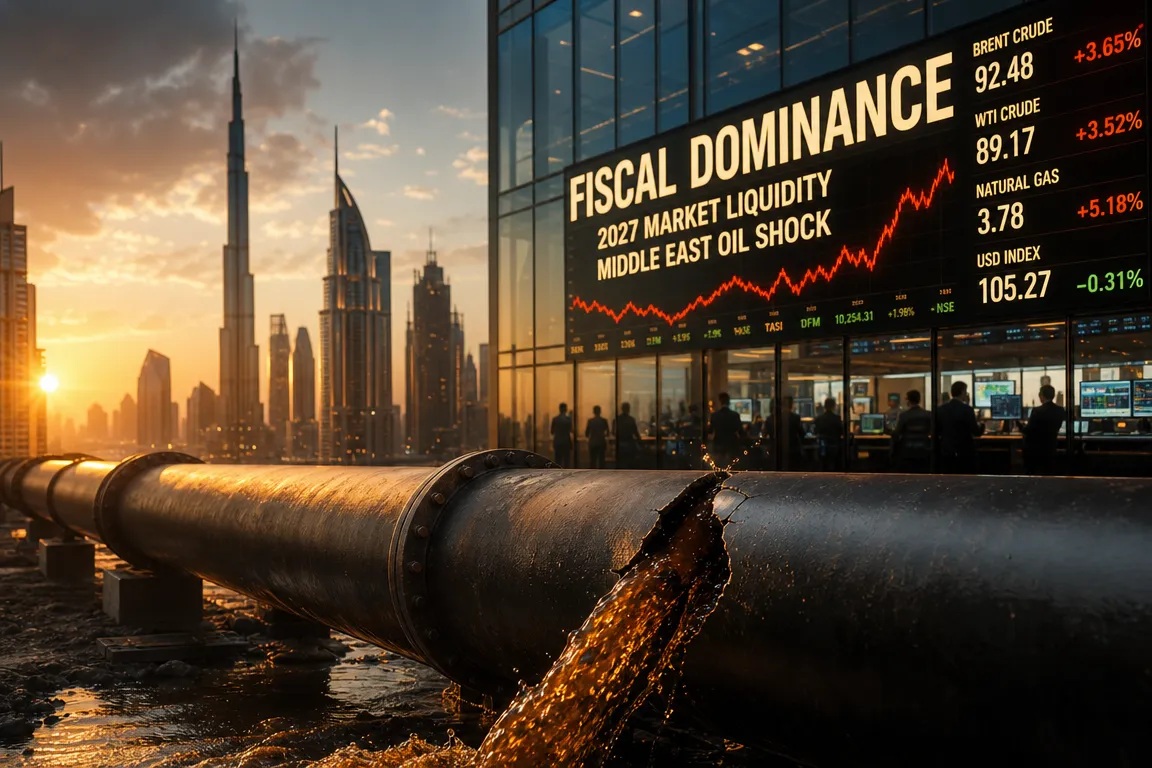
2027 Economic Outlook Key Takeaway: Fiscal Policy, Not Rates, Will Drive Market Liquidity
In assessing markets in 2027, focusing only on policy rates risks missing the broader trend.
The key point in this outlook is that fiscal policy may create a stronger liquidity effect than monetary policy.
Middle East conflict, crude oil, inflation, sovereign yields, semiconductors, and AI investment are increasingly interconnected, reshaping the 2027 macro outlook.
Many headlines focus narrowly on rate hikes or cuts, but actual market liquidity may increasingly come from government budgets, bond issuance, tax revenue growth, and fiscal spending.
1. The first rule for reading the economy: near views distort, distance clarifies
The first message emphasized in the presentation is that economic judgment changes depending on perspective.
From close range, a house may appear to be in the mountains, but from a distance it may be a lakeside home.
The same applies to the economy.
Weakness in one’s own company, household budget, or sector can feel like a full-blown crisis.
However, on aggregate indicators, the global and Korean economies appear closer to a prolonged low-growth phase than to a systemic crisis.
That distinction matters.
If the situation is viewed as a crisis, investors tend to avoid risk entirely; if it is viewed as a low-growth regime, attention shifts to sectors benefiting from policy support and capital allocation.
2. How Middle East conflict distorted the macro backdrop: oil, inflation, rates, and fiscal policy moved together
The most important variable in this outlook is the Middle East conflict.
It is framed not as a geopolitical event alone, but as a key shock that bent the direction of the global economy.
- Middle East conflict emerges
- Crude oil rises
- Inflationary pressure increases
- Expected inflation rises
- Sovereign yields rise
- Pressure builds for central banks to raise policy rates
- Downside pressure on growth intensifies
- Government fiscal spending increases
- Government bond issuance rises
- Further upward pressure emerges on sovereign yields
The key point is that inflation and rates do not move independently.
War lifts oil prices, oil lifts inflation, inflation raises pressure for rate hikes, and conflict weakens growth, forcing governments to spend more.
The result is a market environment in which monetary and fiscal policy move in different directions.
3. Why a rate hike can, paradoxically, reduce sovereign yields
In general, higher policy rates are assumed to push market rates higher as well.
However, the presentation argued that rate hikes can instead help stabilize sovereign yields.
The rationale is twofold.
- First, a rate hike signals a stronger commitment to contain inflation expectations.
- Second, it reinforces market confidence in the central bank’s credibility.
Sovereign yields are not driven solely by the current policy rate.
Investors also assess future inflation, central bank credibility, and confidence in the currency and government bonds.
If markets believe a central bank lacks the resolve to control inflation, demand for government bonds weakens and yields rise.
By contrast, a policy-rate hike can support bond demand by signaling anti-inflation discipline.
In that case, long-term sovereign yields may stabilize even as policy rates rise.
4. 2027 is closer to an era of fiscal dominance than of broad-based tightening
Many investors equate liquidity conditions with policy-rate cuts.
But the main point here is that fiscal policy may become more powerful than monetary policy.
The presentation described this as fiscal dominance.
In past cycles, monetary and fiscal policy often moved in the same direction.
- During the 2020 pandemic, rate cuts and fiscal expansion occurred simultaneously.
- During the 2022 inflation phase, rate hikes and fiscal tightening occurred simultaneously.
In those periods, policy rates alone provided a reasonable guide to overall liquidity.
2027 may be different.
Monetary policy may remain restrictive to contain inflation, while fiscal policy may turn more expansionary to cushion downside growth risks.
In practical terms:
- Monetary policy opens the window and lets in colder air.
- Fiscal policy turns up the heat to support the economy.
As a result, it would be incorrect to assume weak liquidity simply because rates remain high.
Even with elevated policy rates, government spending and fiscal transfers can continue channeling funds into selected sectors and assets.
5. 2027 inflation and policy rates: room for additional tightening appears limited
The presentation offered an important view on 2027 inflation.
Prices may remain elevated, but the inflation rate could ease.
Inflation is measured year over year.
If crude oil spiked in 2026, then even if oil remains high in 2027, the year-over-year inflation rate can still decline.
In other words, consumer prices may feel high while the statistical inflation rate moves closer to the 2% target.
That would reduce the case for aggressive additional rate hikes.
For the United States, the presentation suggested that any further hikes would likely be limited to one or two moves at most.
If inflation stabilizes afterward, discussions of rate cuts could reappear in mid-2027.
6. Why fiscal policy is the key liquidity driver in 2027
Fiscal policy matters in 2027 because of the tax revenue structure.
If the semiconductor cycle and AI investment cycle remain strong in 2026, their effects may feed into corporate tax revenue in 2027.
If governments expect higher tax receipts, they can set larger budgets.
This has important market implications.
- The semiconductor and AI boom does not end at corporate earnings.
- Corporate earnings translate into higher tax revenue.
- Higher tax revenue supports larger government spending plans.
- Higher spending then flows back into market liquidity.
The presentation also referenced large budget plans in Korea.
The central point is that expenditure can rise even as revenue increases materially.
That allows governments to expand spending while maintaining a degree of fiscal discipline.
This is why 2027 liquidity should be viewed through fiscal expansion rather than only through lower rates.
7. Global outlook: prolonged low growth rather than a full crisis
It is difficult to characterize the current global economy as a crisis.
However, low growth is persisting, and for some industries and households, conditions feel very weak.
Middle East conflict remains a major factor that has made 2026 more difficult for the global economy.
Without the conflict, crude oil may have remained more stable, and inflation and rate pressures may have been lower.
Instead, the conflict raised oil prices, fueled inflation, and increased government spending pressures.
Even so, major international institutions generally expect the global economy in 2027 to improve somewhat versus 2026.
That said, the pace of recovery will depend heavily on developments in the Middle East, oil prices, the semiconductor cycle, and the durability of AI investment.
8. Korea’s 2027 scenario: semiconductors and geopolitical risk will be decisive
Korea’s outlook can be organized around two axes: semiconductor exports and geopolitical risk.
Base case
- Semiconductor export growth remains near current levels.
- Middle East conflict and geopolitical risks do not worsen materially.
- Korea’s growth rate may ease versus 2026, but a sharp downturn appears unlikely.
Under this scenario, Korea would continue to rely on the semiconductor cycle for growth.
Domestic demand and non-semiconductor sectors could remain weak in terms of sentiment and activity.
Bull case
- Demand for physical AI, data centers, and high-performance semiconductors expands further.
- Global hyperscalers continue increasing AI capital expenditure.
- Middle East tensions ease or market expectations shift toward de-escalation.
- Crude oil and inflation pressures moderate.
In that case, Korea could post stronger-than-expected growth.
Semiconductor exports would likely support growth, while the won and sovereign yields could face less pressure.
Bear case
- Hyperscalers reduce AI data center and semiconductor capex.
- Semiconductor pricing and export growth slow.
- Middle East conflict drags on or escalates.
- Crude oil rises again and inflation pressure returns.
In that case, Korea’s high exposure to semiconductors could lead to a faster slowdown in growth.
If the semiconductor cycle weakens while oil rises, both exports and domestic demand could face pressure.
9. The most important market blind spot
The key point often missed in mainstream coverage is not the direction of rates, but the changing source of money.
- First, 2027 liquidity may come more from government budgets than from central banks.
- Second, a rate hike is not automatically negative if it helps stabilize sovereign yields.
- Third, the AI and semiconductor booms create second-order effects through tax revenue and fiscal spending.
- Fourth, equity markets can remain range-bound even during rate hikes if fiscal liquidity provides downside support.
- Fifth, scenario analysis matters more than a single forecast for 2027.
In other words, 2027 should not be interpreted through the simple formula that markets rise only when rates fall.
Even with high rates, markets can find support if government spending increases and policy funds are concentrated in selected sectors.
From this perspective, AI semiconductors, defense, energy security, infrastructure, power grids, robotics, and physical AI may benefit from the intersection of fiscal policy and AI investment.
10. Key checkpoints for investors
- Monitor whether crude oil breaks above its 2026 peak.
- Track the number of additional rate hikes in the United States and Korea.
- Check whether sovereign yields stabilize faster than policy rates.
- Review 2027 budget plans and the direction of fiscal spending in each country.
- Assess whether AI investment and semiconductor capex remain intact.
- Monitor hyperscalers’ data center investment plans.
- Track the effect of Middle East conflict on oil and logistics costs.
In particular, 2027 may place more emphasis on government budgets, bond issuance, industrial subsidies, defense spending, and energy policy than on central bank meetings.
The real source of market-moving money may come from fiscal expenditure rather than policy rates.
< Summary >
The key issue in the 2027 outlook is fiscal policy rather than policy rates.
Middle East conflict has lifted crude oil and inflation pressures, distorting the path of policy rates and sovereign yields.
However, inflation may stabilize in 2027, which would limit the need for further tightening.
At the same time, higher tax revenue from the semiconductor and AI cycle may support larger government spending and fiscal liquidity.
Korea’s outlook will depend heavily on semiconductor exports and geopolitical risk, creating distinct bull, base, and bear scenarios.
Focusing only on rates may miss the larger picture; in 2027, fiscal policy may determine the main flow of market liquidity.
[Related Articles…]
- Why Fiscal Policy Matters in the 2027 Economic Outlook
- AI Investment Cycle and the Semiconductor Supercycle Outlook
*Source: [ 경제 읽어주는 남자(김광석TV) ]
– 금리만 보면 틀립니다… 2027년 시장을 움직일 진짜 돈은 ‘재정’입니다 | 경제학교 월간특강 | 2027경제전망 ‘북콘서트’ [1편]