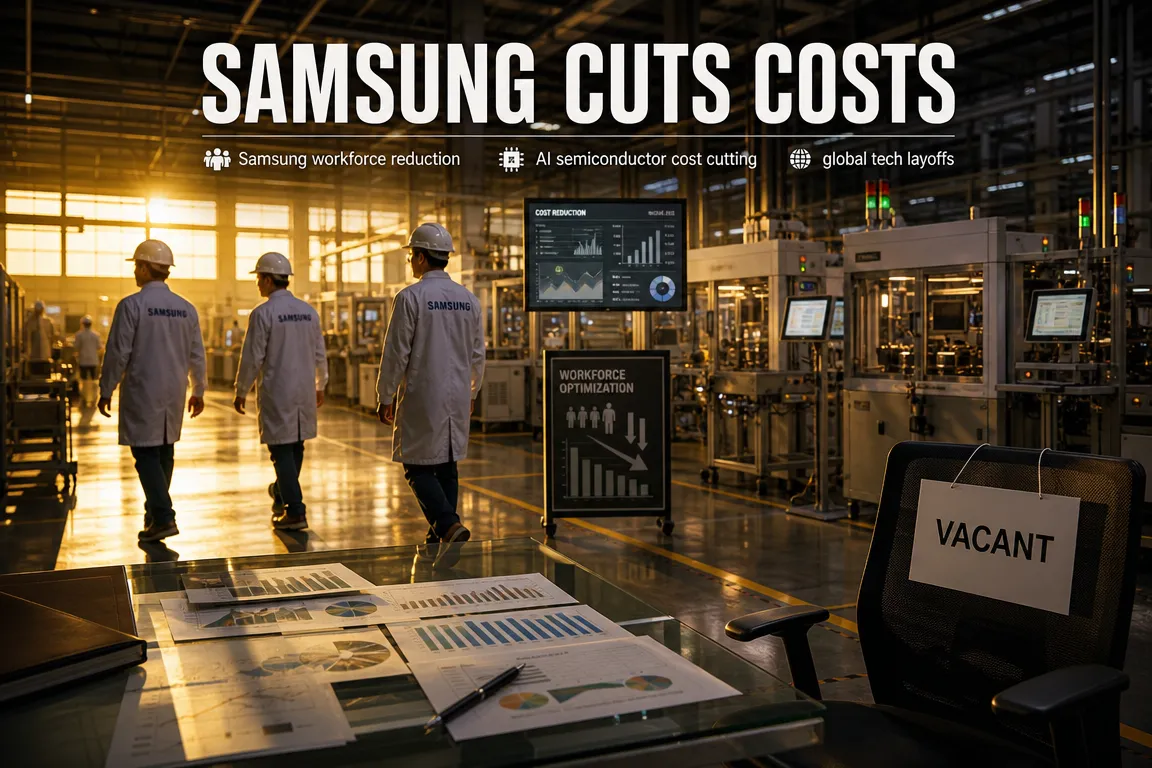
● Samsung to Cut Overseas Jobs Up to 30% to Slash Costs
Samsung Electronics Considers Cutting Overseas Workforce by Up to 30%… Cost-Cutting Signals Spread Again Across Global Electronics and Semiconductor Markets
Samsung Electronics is reportedly moving forward with a global workforce reduction of up to 30% in some overseas business divisions.
The core point is that this is not simply restructuring, but rather an effort to accelerate organizational efficiency to defend profitability as the pace of semiconductor industry recovery remains slower than expected and competition in the smartphone market intensifies.
This issue should not be viewed as a Samsung Electronics-only matter, but as news that must be read together with global economic slowdown, weak IT demand, AI industry restructuring, and changes in the electronics sector value chain.
In particular, there is an important point in this news that many other reports do not highlight well.
It is that the adjustment is centered not on production workers, but on sales, marketing, and administrative personnel.
Another key point is that, because market pressure differs by country, there is a high possibility that the scale of workforce reductions will also be applied differently by region.
This can be seen as a signal that global companies are shifting their competitive strategy from simply “reducing headcount” to deciding “where and which functions to reduce.”
1. News at a Glance
What happened
Samsung Electronics is reportedly planning to reduce personnel in some overseas business divisions across Asia, Europe, the Americas, and Africa.
Plans under discussion include reducing sales and marketing personnel by about 15% and administrative personnel by up to 30%.
When will it be implemented
This adjustment is reportedly targeted for completion by the end of the year.
Which divisions will be affected
The main targets are overseas sales, marketing, and support functions, not production workers.
This means the company is not cutting manufacturing lines, but instead making its sales and operating structure lighter.
How large is the scale
As of the end of 2023, Samsung Electronics had about 267,800 employees in total.
Of these, more than half, approximately 147,000, were based overseas.
In other words, this change could be large enough to affect the operating structure of the entire global organization.
2. Why Samsung Electronics Is Moving Toward Workforce Adjustment
First, semiconductor recovery has been slower than expected
Samsung Electronics’ core semiconductor business has been recovering more slowly than some competitors after the industry downturn.
Last year, profits fell to their lowest level in 15 years, and the aftermath has still not been fully resolved.
Second, competition in the premium smartphone market is extremely intense
Apple and Huawei are putting strong pressure on Samsung in the high-end smartphone market.
This is a phase where simply making good products is not enough to defend market share.
Third, the company is preparing for slowing global demand
As IT consumption around the world is no longer expanding as explosively as before, major electronics companies are reducing fixed costs.
This workforce reduction can be interpreted as a strategy to defend profitability in line with that trend.
Fourth, differences in business conditions by region have widened
In markets such as India and China, where competition is especially intense, cost efficiency has become even more important.
Samsung Electronics appears to be reorganizing its structure in response to these regional market changes.
3. The Changes Become Clearer When Viewed by Country
India
Samsung Electronics’ India unit is known to have around 25,000 employees.
A workforce reduction of up to about 1,000 people has been discussed.
India is a market with strong growth potential, but competition is intensifying rapidly, making cost management increasingly important.
China
In China, there have been observations that about 30% of sales organization personnel could be affected.
China is highly competitive in both premium and mid-to-low-end segments, and local companies are catching up aggressively.
The Americas, Europe, Asia, and Africa
This workforce reduction may not be limited to one specific country, but could proceed across global regions.
This means Samsung Electronics is applying stricter profitability standards by region.
4. Why This Issue Matters for the Global Economy
First, the “tightening mode” among major corporations is strengthening again
When a giant company like Samsung Electronics moves toward workforce adjustment, it is not simply an internal issue.
It is a signal that global economic slowdown and pressure on corporate earnings are still ongoing.
Second, semiconductors and smartphones are cyclical industries
These industries respond sensitively to global consumer sentiment and corporate investment.
That is why Samsung Electronics’ workforce adjustment can be seen as an indicator that reflects semiconductor market conditions, IT consumption, and global trade trends at the same time.
Third, cost structure optimization is becoming a core element of corporate competitiveness
In the past, companies only needed to increase revenue, but now maintaining profit margins has become more important than revenue growth.
Especially when the global economic outlook is uncertain, companies tend to adjust workforce and organizational structures first.
5. From an AI Trend Perspective, This Change Is Even More Meaningful
AI is changing organizational structures before it replaces workers
What matters in this case is not simply layoffs, but that efficiency improvements are beginning in areas where AI and automation can be applied.
Functions such as sales support, marketing operations, and administration have significant room for data-driven automation.
Going forward, companies are more likely to become “companies that reallocate human roles” rather than “companies that reduce people”
As AI adoption accelerates, repetitive tasks may decrease.
At the same time, the share of high-value tasks such as strategy, product planning, customer experience, and data analysis may increase.
The spread of AI will reshape semiconductor demand again
An interesting point is that workforce reduction news can also stimulate the expansion of AI demand at the same time.
The expansion of AI infrastructure is ultimately connected to demand for high-performance semiconductors, memory, and servers.
In other words, Samsung Electronics faces the simultaneous challenge of reducing costs while securing the next growth engine centered on AI.
6. Points Investors Should Watch
1) Pace of semiconductor industry recovery
Investors should watch memory prices, server demand, and customer inventory adjustment trends.
The direction of Samsung Electronics’ earnings will ultimately be determined by semiconductor market conditions.
2) Smartphone market share
It is important to see whether Samsung can maintain its premium phone strategy amid pressure from Apple and Huawei.
Samsung Electronics must create differentiation not only in hardware competitiveness, but also in software and AI experiences.
3) Efficiency of overseas operations
The key question is how much overseas workforce adjustment will actually contribute to cost savings.
What matters more than simple layoffs is improving organizational productivity.
4) Link between AI and memory recovery
As demand for AI servers, data centers, and high-bandwidth memory increases, it could be positive for Samsung Electronics’ mid- to long-term earnings.
Therefore, this news should be viewed from two perspectives: cost reduction in the short term and confirmation of AI semiconductor competitiveness in the medium term.
7. Core Points Often Missed by Other Reports
Core point 1. This reduction is closer to “preemptive restructuring” than “crisis response”
Rather than simply cutting jobs urgently because conditions have worsened,
Samsung Electronics appears to be redesigning its organization to match its future growth structure.
This distinction is very important.
Core point 2. The focus on support organizations rather than production workers is more symbolic
The fact that the company is adjusting sales and administrative lines rather than factory workers means
that it is prioritizing “operational efficiency” over “volume expansion.”
Core point 3. A full-scale efficiency competition among global companies has begun
This is not only a Samsung Electronics issue. Major technology companies such as Apple, Intel, Microsoft, and Amazon are also continuously reviewing their cost structures.
In other words, in the AI era, growth and restructuring are likely to move together more often.
Core point 4. There are also implications for the Korean economy
Samsung Electronics is connected to Korea’s exports, employment, and supplier ecosystem.
Even if overseas workforce adjustment does not directly reduce domestic employment,
it could lead to strategic changes in Korea’s manufacturing and IT value chains over the medium to long term.
8. In One Sentence
Samsung Electronics’ overseas workforce reduction is not simply cost-cutting news.
It is most accurately viewed as the result of four factors overlapping at once:
global economic slowdown,
delayed recovery in the semiconductor industry,
intensifying smartphone competition,
AI-centered industrial restructuring.
Going forward, corporate competitiveness is more likely to be determined by “how efficiently a company operates” rather than “how much it sells.”
< Summary >
Samsung Electronics is considering workforce adjustments of up to 30% in some overseas business divisions.
This issue can be interpreted as the result of slowing semiconductor market recovery, intensifying smartphone competition, and weak global demand.
The key point is that the efficiency drive is centered on sales, marketing, and administrative organizations rather than production workers.
The spread of AI could change both workforce structures and semiconductor demand over the long term.
Investors should watch not only Samsung Electronics’ earnings, but also the pace of semiconductor recovery, competitiveness in premium smartphones, and AI memory demand.
[Related Articles…]
How AI Is Reshaping the Global Job Market and the Next Stage of Corporate Restructuring
Semiconductor Recovery Signals and Cost-Cutting Strategies Among Global Companies
*Source: https://www.benzinga.com/news/24/09/40812318/samsung-to-reportedly-slash-global-workforce-by-up-to-30-in-certain-divisions-amid-intense-competiti