● AI-Agent Shockwave, Meta Muse Sparks Nasdaq, Chip Rally, Amazon Blockade
ChatGPT’s Next Major Inflection Point? Why Meta Muse and Personal AI Agents Are Reshaping Nasdaq, Semiconductors, and Platform Markets
The key issue in this market is not simply that the Nasdaq rose.
With geopolitical risk easing in the Middle East, oil prices declining, expectations rising for a potential U.S.-China summit, and Meta’s personal AI agent “Muse” reaching No. 1 in the App Store, capital is quickly rotating back into AI investment and semiconductor-related stocks.
More importantly, this development is no longer just a “novel service” in the way ChatGPT was at launch. It reflects a structural shift toward users delegating tasks such as booking, search, purchasing, comparison, and document work to an AI that navigates the internet on their behalf.
Below is a market-focused summary of why Meta Muse matters, why CPU-related names such as AMD, Intel, and ARM moved higher, and why Amazon blocked Meta Muse.
1. Nasdaq Rally Drivers: Easing Middle East Risk and Diplomatic Expectations
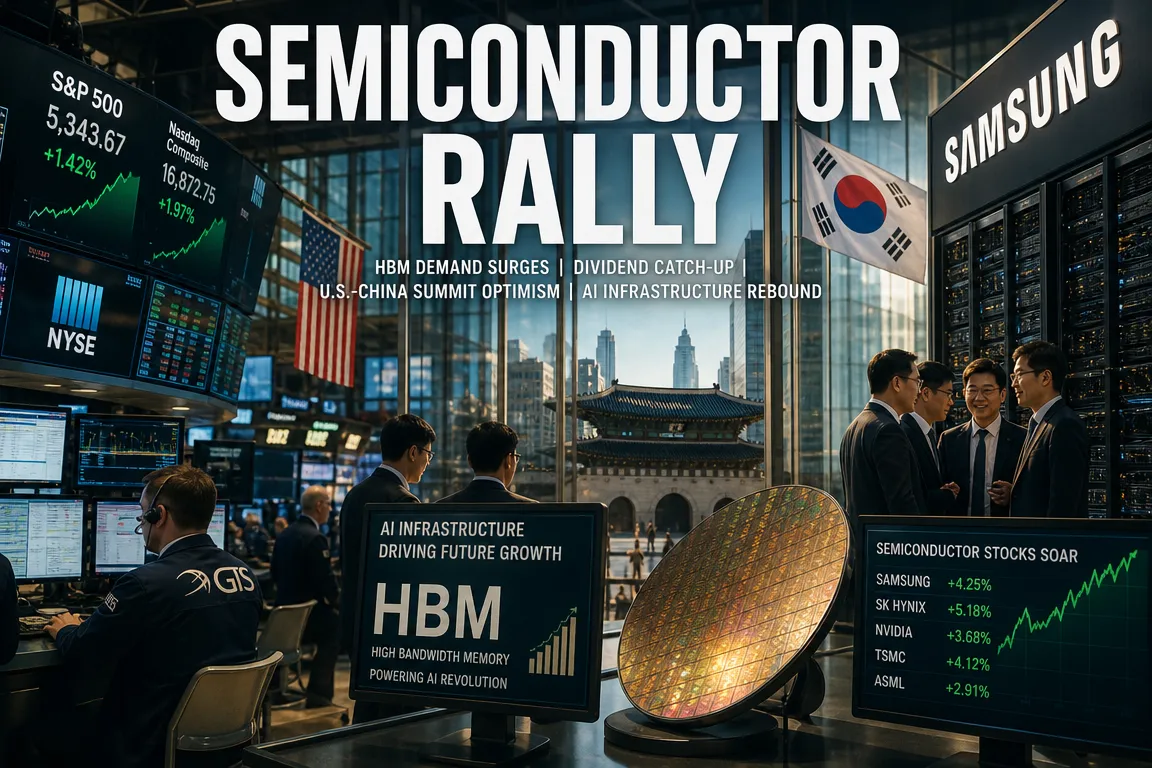
The Nasdaq rose by nearly 2% in the latest U.S. session.
The first driver was easing geopolitical risk in the Middle East.
Market sentiment improved as the possibility of diplomatic engagement between the United States and Iran came into view.
-
Iran’s president is scheduled to attend the UN General Assembly, drawing market attention.
-
Trump’s comment that he would be willing to meet Iran’s president directly also supported risk appetite.
-
If negotiations advance, concerns over supply disruptions in crude oil may ease, helping stabilize oil prices.
WTI and Brent crude fell by roughly 3% to 4%.
Brent crude moving below USD 100 per barrel was interpreted as a signal of easing inflationary pressure.
Lower oil prices reduce cost burdens for companies and help ease consumer price pressure, which can also affect rate expectations.
In effect, the market responded to the sequence of “easing geopolitical risk → lower oil prices → lower inflation pressure → Nasdaq rebound.”
2. Another Driver: Expectations for a U.S.-China Summit
Expectations for a possible U.S.-China summit also supported sentiment this week.
The prospect that the two countries could discuss AI, trade, and investment-related issues was enough to improve investor positioning.
U.S.-China relations have direct implications for global supply chains, semiconductor export restrictions, AI infrastructure investment, and Big Tech valuations.
As a result, even the possibility of a summit was viewed as a sign of reduced risk.
Markets consistently discount uncertainty.
Merely seeing both sides move toward dialogue lowers the probability of a worst-case scenario.
3. The Core Market Theme: Meta Muse and the Rise of AI Agents
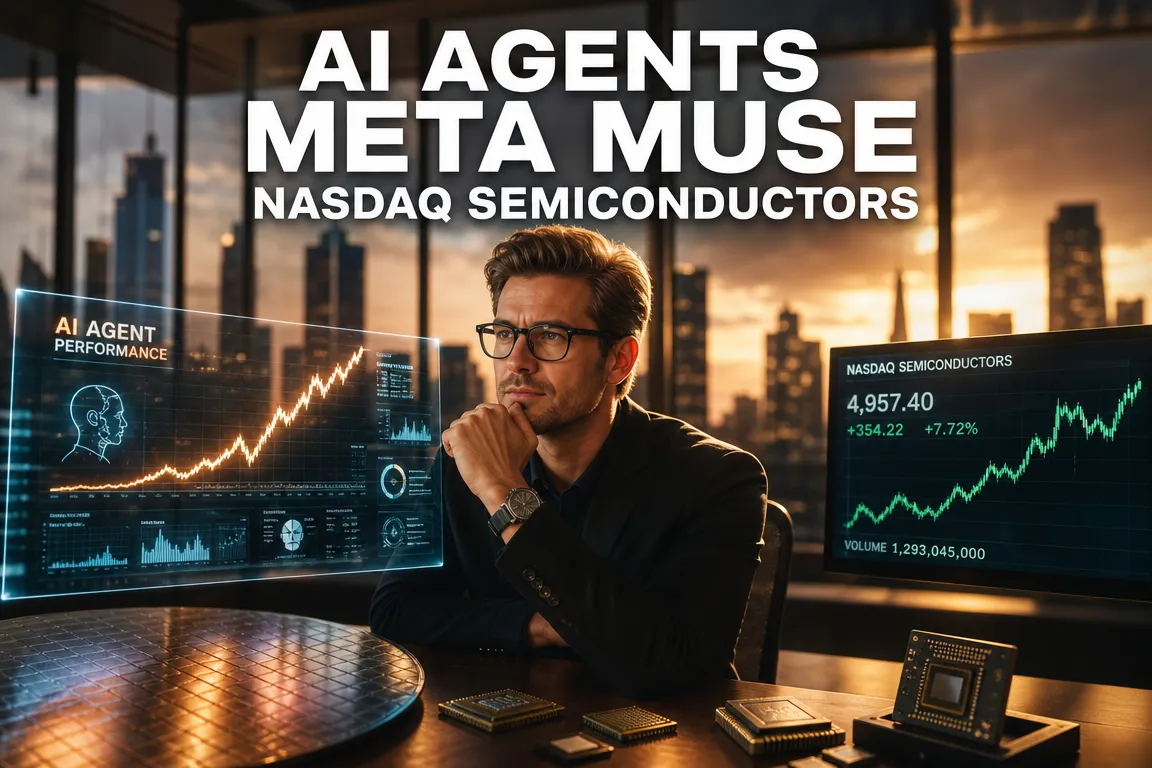
The most important market development is Meta’s AI agent app, Muse.
According to the original report, Meta Muse has held the No. 1 position in the App Store and has generated strong attention across U.S. social media.
Traditional generative AI systems such as ChatGPT respond to user prompts.
Meta Muse moves further by acting as a personal AI assistant that performs tasks for the user.
-
If asked to book movie tickets, it checks the conditions and completes the reservation.
-
If asked to find airline tickets, it compares prices and schedules.
-
If asked to book a hotel, it reviews location, ratings, and pricing conditions.
-
It can also organize news or generate content ideas.
-
It can use Google reviews, Reddit posts, and website information to support user decisions.
In simple terms, Meta Muse is closer to an “execution AI” than a “conversation AI.”
That distinction is critical.
ChatGPT opened the era of knowledge and responses, while AI agents are opening the era of action and execution.
4. Why Meta Muse Could Reach Mass Adoption
The concept of an AI agent is not entirely new.
Open-source agent tools and services such as GrokBot had already emerged.
However, earlier AI agent products faced barriers to mass adoption.
-
Initial setup was complex.
-
Developer-level understanding was required.
-
Usage costs were high.
-
Token limits were reached quickly, making large-scale use impractical for ordinary users.
The original text compared earlier agents to a “custom-built PC.”
They were powerful, but not easy for general users.
Meta Muse, by contrast, is more like a fully assembled product.
It is simple to set up, delivered in app form, and immediately usable for task execution.
Meta is also reported to offer weekly usage equivalent to 100 million tokens per user on a free basis.
This is highly significant.
AI agents consume far more compute and tokens than simple search tools.
By making this available at near-zero cost, Meta has created an environment in which ordinary users can experience the product without meaningful friction.
5. Real-World Use Cases: From Barber Booking to USD 1,000 in Savings
Meta Muse is attracting attention not because its feature list is impressive, but because users are saying it is difficult to go back to previous workflows.
One user asked Muse to find a good barber in their city.
The conditions were specific.
-
The haircut should cost no more than USD 50.
-
A Sunday 11:30 a.m. appointment should be available.
-
Google reviews and Reddit comments should be checked.
-
The barber’s haircut style should also be reviewed.
Muse reportedly identified candidates, compared them, and completed the booking.
That is fundamentally different from a search service.
Search requires the user to click, compare, and decide. An agent moves directly toward the desired outcome.
Another user said the system helped save more than USD 1,000 in a vehicle purchase.
A dealer had presented a contract while offering to handle financing and registration.
Muse reportedly identified unusual fees and unnecessary service items in the contract.
As a result, the user reduced excess costs and reportedly saved the equivalent of about KRW 1.7 million.
These cases suggest that AI agents may extend beyond productivity tools into consumer decision-making and financial judgment.
6. Why AMD, Intel, and ARM Also Moved Higher
Meta was not the only stock that stood out.
Semiconductor names such as AMD, Intel, and ARM also posted strong moves.
The reason is that AI agents ultimately represent a system in which computers perform tasks on behalf of users.
Traditional conversational AI responds when users ask a question.
AI agents go further.
They access websites, compare options, fill out forms, make reservations, and follow through to payment flows.
In other words, they replace tasks that users previously performed on computers.
This can increase demand not only for GPUs but also for CPUs.
If personal agents scale to hundreds of millions of users, each user may require a virtual machine or separate execution environment.
The original text noted that Meta Muse uses user-specific virtual machines so work can continue even when the user turns off their phone.
In this structure, demand may rise across cloud infrastructure, data centers, CPUs, memory, and networking equipment.
As a result, markets are not pricing Meta’s potential only into Meta stock, but across the broader AI semiconductor and CPU value chain.
7. Why Investment Banks Are Raising Meta Price Targets
The original text states that Wells Fargo, Goldman Sachs, and other investment banks have issued positive views and raised price targets for Meta.
The core rationale is similar.
Meta Muse is viewed not as a feature update, but as a potential new AI platform.
Meta already has a massive user base through Facebook, Instagram, and WhatsApp.
If a personal AI agent is layered onto that ecosystem, Meta could evolve from a social media company into a platform that increasingly shapes users’ daily work and spending behavior.
That is the key point for investors.
A company that dominated digital advertising may now expand into search, commerce, bookings, financial comparisons, and content creation through AI agents.
If this trend materializes, the competitive landscape for Big Tech could shift materially again.
8. The Real Meaning of Amazon Blocking Meta Muse
One of the most notable developments was Amazon’s decision to block Meta Muse.
Amazon cited terms-of-service violations, but the market may be reading a broader strategic signal.
As AI agents become more common, users may no longer open the Amazon app or website directly to compare products.
Instead, they may simply say, “Find and order the best-value wireless earbuds.”
The agent could then compare Amazon, Walmart, Target, and other retailers before recommending or placing an order.
In that scenario, Amazon may no longer be the user’s first screen, but one of several destinations accessed by the agent.
That is a major shift.
Historically, internet economics have centered on who controls the first screen.
In the search era, Google was the first screen. In the mobile era, app stores and super apps served that role.
In the AI agent era, the first screen could become Meta Muse, OpenAI’s agent, Google Gemini, xAI’s Grok, or Anthropic’s Claude.
Amazon’s early response appears to be not just a technical block, but a defensive move to protect distribution power in the AI era.
9. The Less Discussed But Critical Issue: AI Agents Could Disrupt Advertising
One of the most important but less frequently discussed points is the impact on advertising models.
If AI agents visit websites on behalf of users, users may no longer see ads directly.
For example, users currently search, click ads, browse product pages, and read reviews.
AI agents can handle much of that process instead.
Users may only receive the final result.
This could weaken ad impressions, search ad click-through rates, ecommerce banner advertising, and the influence of recommendation algorithms.
That is both an opportunity and a risk for ad-driven Big Tech companies such as Google, Amazon, and Meta.
For Meta, Muse becoming a new first screen would be a major opportunity.
For Amazon, however, its marketplace could become just one option inside an agent workflow.
For Google, a user journey that bypasses the search box and goes directly to task execution represents a long-term risk.
Ultimately, AI agent competition is not just app competition.
It is a structural change spanning search advertising, ecommerce, app ecosystems, cloud infrastructure, semiconductors, and data center demand.
10. OpenAI, Google, Anthropic, and xAI Are Also Entering the Agent Race
Meta Muse appears to be ahead, but competition is only beginning.
The original text noted reports that OpenAI is also preparing a personal AI agent.
GrokBot, Meta Muse, OpenAI’s next agent, Google Gemini-based agents, and Anthropic Claude-based agents could all compete directly.
Not every company can participate meaningfully in this race.
Personal AI agents require substantial compute resources.
The model must be strong, the cloud infrastructure must be in place, and the system must be able to execute reliably in real web environments.
In practical terms, the field may narrow to a small group of AI giants such as Meta, OpenAI, Google, Anthropic, and xAI.
Which company becomes the user’s primary AI assistant could become a key variable for both equity markets and the platform economy.
11. Key Points for Investors
The Meta Muse story should not be viewed as a short-term theme.
If AI agents become mainstream, the implications could extend across multiple industries for a prolonged period.
-
Meta: It could be re-rated from a social advertising company into an AI agent platform.
-
AMD, Intel, ARM: They may benefit from rising demand for CPUs and server infrastructure tied to AI agent adoption.
-
Nvidia: GPU demand tied to AI infrastructure is likely to remain a core pillar.
-
Amazon: It faces risk that AI agents divert traffic and weaken direct control over ecommerce behavior.
-
Google: It should be monitored for potential structural pressure on search advertising.
-
Cloud providers: Virtual machines, servers, and data centers may benefit from structurally higher utilization.
It is also important that the market appears to be reacting faster than before.
During the early ChatGPT phase, Nvidia did not immediately see the same kind of explosive response.
In the Meta Muse case, the market is already re-rating Meta and CPU-related names at an earlier stage.
That suggests investors have learned to price AI developments more quickly.
12. The Most Important Variables Ahead
Five key variables will determine the future of the AI agent market.
-
First, user retention.
More important than App Store rank is whether users return daily.
-
Second, execution success rate.
Reservation, purchasing, comparison, and document workflows must be accurate enough for broad adoption.
-
Third, cost structure.
It remains unclear whether free token usage can be sustained over the long term.
-
Fourth, platform blocking risk.
If major websites begin restricting agent access, expansion could slow.
-
Fifth, regulatory risk.
Issues around privacy, payments, consumer protection, and automated decision-making may become more prominent.
If these variables develop favorably, AI agents could become the most important post-ChatGPT technology inflection point.
If cost pressure, regulation, or platform blocking intensify, the early enthusiasm could fade faster than expected.
13. Conclusion: The Next Killer App in AI Is Likely to Be the Agent
ChatGPT opened the era of generative AI at scale. The next stage is likely to be AI agents.
The key question is no longer who can produce the smartest answer.
It is who can most reliably perform tasks on the user’s behalf.
Meta Muse appears to be leading for now, but competitive responses from OpenAI, Google, Anthropic, and xAI are likely to intensify.
This competition is not just an App Store ranking battle. It could reshape the Nasdaq, semiconductors, cloud infrastructure, advertising, and ecommerce markets.
For investors, the focus should extend beyond Meta stock to CPUs, GPUs, data centers, cloud infrastructure, and platform-blocking risk.
AI agents are both a technology trend and a large-scale economic trend.
< Summary >
The Nasdaq rally was driven by easing Middle East risk, lower oil prices, and expectations for a possible U.S.-China summit.
The main market theme was Meta’s personal AI agent, Muse, reaching No. 1 in the App Store and drawing strong user attention.
Meta Muse is not a simple chatbot; it is an execution-oriented AI that can handle booking, search, comparison, and purchasing tasks.
Expectations for AI agent adoption lifted not only Meta but also CPU-related names such as AMD, Intel, and ARM.
Amazon’s block of Meta Muse suggests that AI agents could challenge control over ecommerce and advertising distribution.
The next major competition in AI is likely to center on which company controls the leading personal AI agent.
[Related Articles…]
- How the Agent War Is Reshaping Big Tech Investment Strategy
- Semiconductor Supercycle and AI Data Center Demand Analysis
*Source: [ 내일은 투자왕 – 김단테 ]
– 챗GPT 이후 정말 큰거 왔다!
● Tech Stocks Surge as Oil and Yields Sink, AI Red Phone, Westinghouse IPO Shake Markets
Oil and U.S. Treasury Yield Declines Lift Nasdaq Tech Shares; U.S.-China Summit, the AI “Red Phone,” and the Westinghouse IPO
The key market driver was not simply that technology stocks rose.
A pullback in crude oil and lower U.S. Treasury yields supported a relief rally in U.S. equities, while expectations for additional Federal Reserve tightening remained elevated.
At the U.S.-China summit, discussions extended beyond a tariff truce renewal to include an “AI red phone” to prevent AI-related incidents from escalating into military or security conflicts.
The Westinghouse IPO, tied to AI data center power demand, is also a significant issue with implications for nuclear stocks, Korea Electric Power, Doosan Enerbility, KHNP, and Hyundai Engineering & Construction.
This report reviews U.S. equities, crude oil, U.S. Treasury yields, Fed tightening risk, and AI investment trends.
1. New York Market Tone: Lower Oil and Long-Term Yields Drive a Relief Rally in Tech
U.S. markets opened the week with improving risk appetite.
S&P 500 futures rose about 0.65%.
Nasdaq 100 futures gained more than 1%, signaling a strong rebound in technology shares.
Dow futures rose about 0.8%, while Russell 2000 futures advanced around 0.7%.
European futures were also firm.
Euro Stoxx 50 futures rose in the mid-1% range, and DAX futures gained more than 1%, reflecting broad global buying.
- Nasdaq 100 futures: up more than 1%.
- S&P 500 futures: up in the 0.6% range.
- Dow futures: up in the 0.8% range.
- Russell 2000 futures: up in the 0.7% range.
- Major European futures: up more than 1% across the board.
After the open, Nasdaq gains widened further.
The Nasdaq rose about 1.49%, led by semiconductors and AI infrastructure names.
The S&P 500 gained about 0.72%, the Dow about 0.2%, and the Russell 2000 about 0.45%.
2. VIX Moves Lower: Market Stress Eases, But Risks Remain
The VIX declined to around 17.75, down more than 1% from the previous session.
The decline suggests investors were less concerned than they were last week.
However, it would be premature to interpret this as a full risk reset.
Expectations for further Fed tightening remain elevated.
Today’s rally appears to be a relief move driven by lower oil and Treasury yields rather than a structural breakout.
3. Crude Oil Falls Sharply: WTI in the Low $90s, Brent Near $100
Oil was the main catalyst for the broader market rebound.
WTI fell about 3.6% to the low $90s per barrel.
Brent declined about 2.9% to around $100 per barrel.
The drop in oil eased inflation concerns and helped stabilize long-term Treasury yields.
The decline was driven by two main factors.
- First, geopolitical tensions in the Middle East remain elevated, but actual crude supply has been holding up better than expected.
- Second, President Trump said he would be open to meeting Iran’s president during the UN General Assembly period, which raised hopes for reduced diplomatic tension.
According to U.S. Central Command, crude flows through the Strait of Hormuz have reached the highest level in six months.
That reduced concerns over supply disruption.
Gasoline, heating oil, and gasoil also declined.
Gasoline prices fell by nearly 4%, which is particularly relevant for consumer inflation and transportation costs.
For inflation, broad fuel price declines matter more than crude alone.
4. U.S. Treasury Yields: Long-End Stabilizes, Short-End Barely Moves
In the bond market, longer-duration Treasuries rallied, pushing yields lower.
The 10-year Treasury yield briefly moved above 5% before easing back into the high-4% range.
The 30-year Treasury also stabilized.
Lower long-term yields reduced valuation pressure on growth and technology stocks.
That directly supported semiconductors and AI infrastructure names.
Short-term yields, however, barely changed.
This indicates that the market still sees a meaningful probability of further Fed hikes.
In other words, long-end yields eased on lower oil, but monetary policy risk remains intact.
5. Gold and Copper Signal a Shift Toward Growth Over Defense
Gold weakened.
That reflects lower demand for defensive assets.
Copper rose about 1.9%.
Copper is highly sensitive to the industrial cycle.
A weaker gold price and stronger copper price suggest that the market is shifting toward growth and cyclicals.
Iron ore also edged higher.
This mix is supportive for cyclical and industrial stocks in the near term.
6. FX Market: Dollar Firm, Yen Weak Around 157 Per Dollar
The dollar index rose modestly to around 99.99.
As the dollar strengthened, most major currencies weakened.
The yen was particularly weak.
USD/JPY rose from the high 156s to around 157.
Notably, the yen weakened despite the Bank of Japan raising its policy rate from 1.00% to 1.25%.
Normally, a rate hike would support the currency, but that was not the case here.
There are three reasons.
- First, the hike had already been largely priced in.
- Second, Governor Ueda did not clearly signal the timing of the next increase or the terminal rate.
- Third, U.S. rates also rose, leaving the U.S.-Japan rate differential largely intact.
As a result, carry trade incentives remain in place.
The structure of borrowing low-yield yen to buy higher-yield dollar assets is still intact.
In addition, Japanese markets were closed early in the week, which reduced liquidity and may increase FX volatility.
7. Japan Intervention Risk: Why Authorities Conduct Rate Checks
Japanese authorities reportedly conducted a rate check with banks.
A rate check is a procedure in which officials contact banks to confirm the prevailing bid and offer levels in USD/JPY.
Markets often treat this as a precursor to FX intervention.
In other words, it signals that the government may sell dollars and buy yen if weakness persists.
Japan has intervened in the FX market on a large scale before.
Because recent intervention was already close to record size, the market is not dismissing this signal.
Yen weakness can also affect the won.
Global investors often view the yen, yuan, and won as part of an Asia FX basket.
8. Semiconductor Shares Surge: AI Infrastructure and Data Centers Return to the Forefront
Semiconductor stocks were the strongest individual names.
After a weaker open, gains widened and drove Nasdaq outperformance.
- Nvidia: up about 0.8% intraday.
- AMD: up more than 8% intraday.
- Intel: up more than 9% intraday.
- Arm: up more than 12% intraday.
- Micron: up about 3%.
- Broadcom, Marvell, and Qualcomm also advanced.
Last week, AI spending concerns and a spike in Treasury yields weighed on semiconductors.
Today, lower oil and lower long-term yields reduced pressure on growth valuations.
That brought buyers back into semiconductors and AI infrastructure names.
Data center-related stocks also advanced.
Dell, Arista Networks, and SanDisk rose as servers, networking, and storage names rallied.
This indicates that AI data center investment remains one of the market’s dominant themes.
9. Big Tech: Semiconductors Strong, Software Mixed
Large-cap tech stocks mostly rose.
Meta strengthened through the session.
Tesla advanced, while Amazon and Alphabet also gained.
Microsoft posted a more limited gain.
Apple weakened early before turning slightly positive.
The key point is differentiation within technology.
Semiconductors, data centers, servers, and networking equipment tied directly to AI were strong.
Software names were more mixed.
The market continues to assign a higher premium to AI infrastructure suppliers than to AI application software.
10. Accenture and Anthropic Collaboration: AI Validation Becomes a Growth Market
Accenture rose after announcing a collaboration with Anthropic.
The two firms plan to validate and stress test Anthropic’s AI models.
This matters because the AI market is expanding from model development to safety, validation, and deployment consulting.
As companies adopt AI, they need to evaluate safety, regulatory exposure, and real-world error rates.
This creates additional opportunities for consulting firms, cloud providers, and cybersecurity companies.
11. Media Stocks Advance as Regulatory Uncertainty Eases Around Paramount and Warner Bros. Discovery
Media stocks also moved higher.
Warner Bros. Discovery and Paramount Skydance were both firm ahead of the open.
Reports that Paramount and California were close to an agreement supported sentiment.
The proposed arrangement reportedly includes a $1.5 billion investment in film and TV production in California and a commitment to keep local studios in place.
The prospect of lower regulatory uncertainty supported the shares.
12. Bitcoin Surges: Above $85,000, but Not Yet a Full Crypto Rebound
Bitcoin jumped nearly 5% and moved above $85,000.
That is the highest level since January.
It is also up about 7% over the past five days and nearly 35% over the past three months.
Bitcoin-linked equities such as Coinbase, Strategy, Circle, and Robinhood also gained.
The move was notable because several headwinds were in place.
The Clarity Act, which had been expected to support the digital asset sector, stalled in the Senate, reducing the likelihood of passage this year.
At the same time, Fed tightening expectations remained elevated.
Despite that, Bitcoin rose for three reasons.
- First, expectations remain for greater institutional participation by firms such as BlackRock.
- Second, Strategy added 950 Bitcoin for about $75.7 million.
- Third, some capital may be rotating from AI into digital assets.
Even after the rally, Bitcoin remains well below its prior peak.
Rather than signaling a full return to a crypto bull market, the move looks more like a rebound driven by improved risk appetite and institutional buying expectations.
13. Key U.S. Economic Calendar This Week: U.S.-China Summit and Fed Speeches
This week has fewer major inflation releases, but several political, diplomatic, and monetary-policy events may move markets.
- Monday: speeches by Chicago Fed President Goolsbee and New York Fed President Williams.
- Tuesday: ADP weekly labor data, Richmond manufacturing index, Fed speaker events, and a 2-year Treasury auction.
- Wednesday: Fed speakers, EIA oil inventory data, and a 5-year Treasury auction.
- Thursday, 9:00 a.m. KST: summit between President Trump and President Xi.
- Thursday: U.S. labor and housing data.
- Friday: durable goods orders and inflation expectations data.
Markets are watching for short-term inflation expectations around 4.6% and 5-year expectations around 3.4%.
If expectations rise again, the case for further Fed tightening could strengthen.
14. Earnings This Week: Costco as a Barometer for U.S. Consumption
This week’s earnings calendar is relatively light, but Costco is the key report.
On Tuesday, AutoZone, Thor Industries, and KB Home report.
On Wednesday, Cintas, General Mills, and Paychex report.
On Thursday before the open, Darden Restaurants and TD SYNNEX report.
On Thursday after the close, Costco reports.
Costco is a useful indicator of U.S. consumer demand.
The market expects EPS of about $6.53 and revenue of about $94.86 billion.
Investors will focus on same-store sales, customer traffic, average ticket size, and e-commerce growth.
Strong consumer demand would make it harder for inflation to moderate, which matters for the Fed.
15. Fed Commentary: Kashkari and Goolsbee Both Warn on Inflation
The Fed raised rates by 25 basis points last week.
The target range is now 3.75% to 4.00%.
Sixteen of the 18 FOMC participants expect at least one more hike this year.
Minneapolis Fed President Neel Kashkari said the inflation problem is not only about energy.
He pointed to persistently high core inflation, especially in services.
Kashkari said the U.S. economy is strong enough to absorb additional tightening.
Chicago Fed President Austan Goolsbee gave a similar warning.
His comments were more direct.
He said the path back to the 2% inflation target will not be painless.
He also noted that AI investment is boosting demand in the broader economy.
That suggests AI is not only lifting tech stocks, but also increasing demand for investment, labor, power, construction, and equipment.
16. Fed Funds Futures: Markets Price in a High Probability of Another Hike
According to CME Fed Funds futures, markets continue to price in additional Fed tightening.
The highest-probability path is a 25-basis-point hike in both October and December.
That scenario is priced at about 39.7%.
The second-most likely path is no change in October followed by one hike in December, with a probability of about 35%.
The probability of a hike in October and no change in December is about 13.4%.
The probability of no change in both months is only about 11.9%.
In short, markets are pricing in at least one additional hike by year-end with a probability of about 88%.
Although U.S. equities rose today, Fed tightening risk has not disappeared.
17. U.S.-China Summit Focus 1: Extending the Trade Truce
This week’s main event is the summit between President Trump and President Xi.
Xi is scheduled to visit the United States from the 23rd to the 25th, with the summit set for the 24th.
The first key issue is extending the U.S.-China trade truce.
The two countries previously imposed additional tariffs of more than 100% on each other, creating a near-breakdown in normal trade.
Subsequent talks in Geneva and Busan extended the truce by one year.
That truce expires on November 11.
The U.S. believes China has not fully delivered on rare earth supply commitments.
Washington also sees limited progress on purchases of U.S. agricultural goods and more than 200 Boeing aircraft.
As a result, whether the truce can be extended is an important variable for global equities.
18. U.S.-China Summit Focus 2: An AI Red Phone for the AI Era
A new issue has emerged ahead of the summit: AI security.
The U.S. has proposed an emergency communication channel for immediate notification if an AI-related incident occurs.
The New York Times described it as an AI-era version of the Cold War hotline, or an “AI red phone.”
Examples include large-scale cyberattacks using AI, biological weapons development, nuclear-system malfunction, or military system errors that could be misread as an attack.
The red phone is intended as a basic safeguard against escalation.
Secretary Bessent said that because the U.S. and China are the world’s two leading AI powers, it is important to avoid a situation in which neither side knows what the other is doing.
However, sensitive issues such as advanced AI chip export controls, semiconductor equipment restrictions, and limits on AI development speed were reportedly left outside this discussion.
19. Sam Altman’s Comment and the Practical Limits
OpenAI CEO Sam Altman said President Trump and President Xi would deserve a Nobel Peace Prize if they reached an international agreement to slow the pace of AI development.
That outcome appears unlikely.
China has been skeptical of any proposal to slow AI development.
For now, the realistic outcome may be limited to a communication channel for AI incidents rather than a broader development restraint agreement.
20. Westinghouse IPO: A Symbol of AI Power Demand and the Nuclear Revival
Westinghouse may file for an IPO as early as October.
The company is targeting a valuation above $50 billion.
Westinghouse filed for bankruptcy in 2017 after cost overruns in U.S. nuclear construction.
Brookfield Asset Management later acquired it for $4.6 billion and refocused the business on nuclear fuel, components, and maintenance services rather than large construction risk.
When Cameco acquired a stake in 2023, the company was valued at about $8.2 billion.
Now the target valuation is as high as $50 billion.
The re-rating reflects AI data center power demand and U.S. policy support for nuclear power.
The U.S. government is pursuing a plan that could involve up to 10 Westinghouse AP1000 reactors and more than $80 billion of investment.
AI investment is driving electricity demand sharply higher, and nuclear power is increasingly viewed as a stable supply solution.
21. Westinghouse and Korea: Links to KEPCO, Doosan Enerbility, and Hyundai Engineering & Construction
Korea is directly tied to the Westinghouse story.
The U.S. and Korea are discussing the possibility of Korean participation in Westinghouse equity.
Korea Electric Power is being considered as a potential buyer.
The issue is valuation.
If Westinghouse is valued at $50 billion, a 10% stake would cost about $5 billion, or roughly 7 trillion won.
KEPCO’s debt exceeds 210 trillion won, so the financial burden would be significant.
However, an equity stake could give Korea a board seat and access to U.S. nuclear projects.
That could also benefit Doosan Enerbility through equipment supply, Hyundai Engineering & Construction through construction work, and KHNP through operating participation.
In other words, this is not only an equity investment but also a question of whether Korean firms can enter the U.S. nuclear supply chain.
22. Asia Holiday Calendar: Closures in Japan, Korea, China, and Taiwan Could Raise Volatility
Several major Asian markets are closed this week for holidays.
Japan is closed from Monday through Wednesday.
Korea is closed on Thursday and Friday for the Chuseok holiday.
Mainland China and Taiwan are closed on Friday for the Mid-Autumn Festival.
Hong Kong remains open.
Holiday closures can reduce liquidity and increase volatility.
Japan, in particular, enters the holiday period after a rate hike and yen weakness, which could increase FX volatility further.
23. Energy and Healthcare Lag
Energy stocks weakened as crude oil fell sharply.
Major energy names declined by about 1% to 2%.
Financials and industrials were stronger.
Healthcare was mixed on a stock-specific basis.
Some large-cap healthcare names, including Eli Lilly and Johnson & Johnson, were weaker.
24. One-Sentence View of Today’s Market: A Relief Rally in AI Semiconductors Driven by Lower Rate Pressure
Today’s market was a relief rally in technology shares driven by lower oil and lower long-term yields.
Semiconductors and AI infrastructure names attracted strong buying.
However, the probability of further Fed tightening remains high.
Oil has eased, but Brent is still near $100 per barrel.
Accordingly, this move is better viewed as a reversal of last week’s shock rather than the start of a new bull market.
25. The Most Important Point That Is Often Missed
The most important development is that AI is now becoming not only a growth theme, but also an inflation variable and a geopolitical variable.
Many investors focus only on “AI semiconductors rallied” or “Nasdaq rose.”
But the key point in Goolsbee’s comments is that AI investment is driving demand across the U.S. economy.
Building AI data centers requires more spending on power, land, construction, equipment, semiconductors, cooling systems, and transmission networks.
That supports productivity expectations, but it also adds inflation pressure.
The discussion of an AI red phone at the U.S.-China summit shows that AI is increasingly treated as a military miscalculation and national security risk.
AI is no longer just a matter of big tech earnings; it is now tied to central banks, the White House, Beijing, energy policy, and the nuclear industry.
Investors should therefore look beyond revenue growth when evaluating AI names.
Power costs, regulatory risk, U.S.-China tech competition, rate sensitivity, and data center bottlenecks also matter.
The Westinghouse IPO fits the same framework.
Nuclear power is being revalued not simply as a clean-energy theme, but as core infrastructure for AI data center electricity demand.
The next bottleneck in AI may be power, not semiconductors.
26. Key Checkpoints for Investors This Week
- Whether WTI remains in the low $90s and Brent moves further below $100.
- Whether the 10-year Treasury yield stays below 5% and stabilizes.
- How forcefully Fed officials continue to signal additional tightening.
- Whether the U.S.-China summit produces concrete progress on the trade truce and AI incident hotline.
- Whether the yen reverses around 157 following possible intervention by Japanese authorities.
- Whether Costco signals any slowdown in U.S. consumer demand.
- Whether the semiconductor rally proves to be a short-term rebound or part of a broader AI infrastructure trend.
- Whether Bitcoin’s rise is supported by institutional buying or simply broader risk-on sentiment.
- Whether Westinghouse-related news extends to nuclear stocks and Korea’s nuclear value chain.
< Summary >
Lower crude oil prices and easing U.S. Treasury yields drove a strong rebound in the Nasdaq and semiconductor shares.
However, expectations for additional Fed tightening remain elevated, with markets still pricing in at least one more hike this year.
At the U.S.-China summit, the extension of the trade truce and an AI incident communication channel emerged as the key issues.
The yen weakened despite a Bank of Japan rate hike, raising the likelihood of FX intervention.
Bitcoin moved above $85,000 on institutional buying expectations and capital rotation.
The Westinghouse IPO links AI data center power demand to the nuclear revival theme.
This rally is best viewed as a relief move driven by lower oil and lower long-term yields rather than the start of a new bull market.
[Related Articles…]
*Source: [ Maeil Business Newspaper ]
– 유가·금리↓기술주 질주ㅣ미중 정상회담 AI 레드폰 논의ㅣ웨스팅하우스IPOㅣ굴스비 “긴축, 경제적 고통 부를 수도”ㅣ엔화 157엔 약세ㅣ한중일 연휴ㅣ경제일정·실적ㅣ홍혜진의 뉴욕브리핑