● Samsung Soars, SK Hynix Trails
Reasons Samsung Electronics Outperformed SK Hynix: KRW 30 Trillion Dividend Potential, HBM Catch-Up, and Treasury Share Cancellation Expectations
This move in Samsung Electronics is not simply a case of “semiconductor strength.”
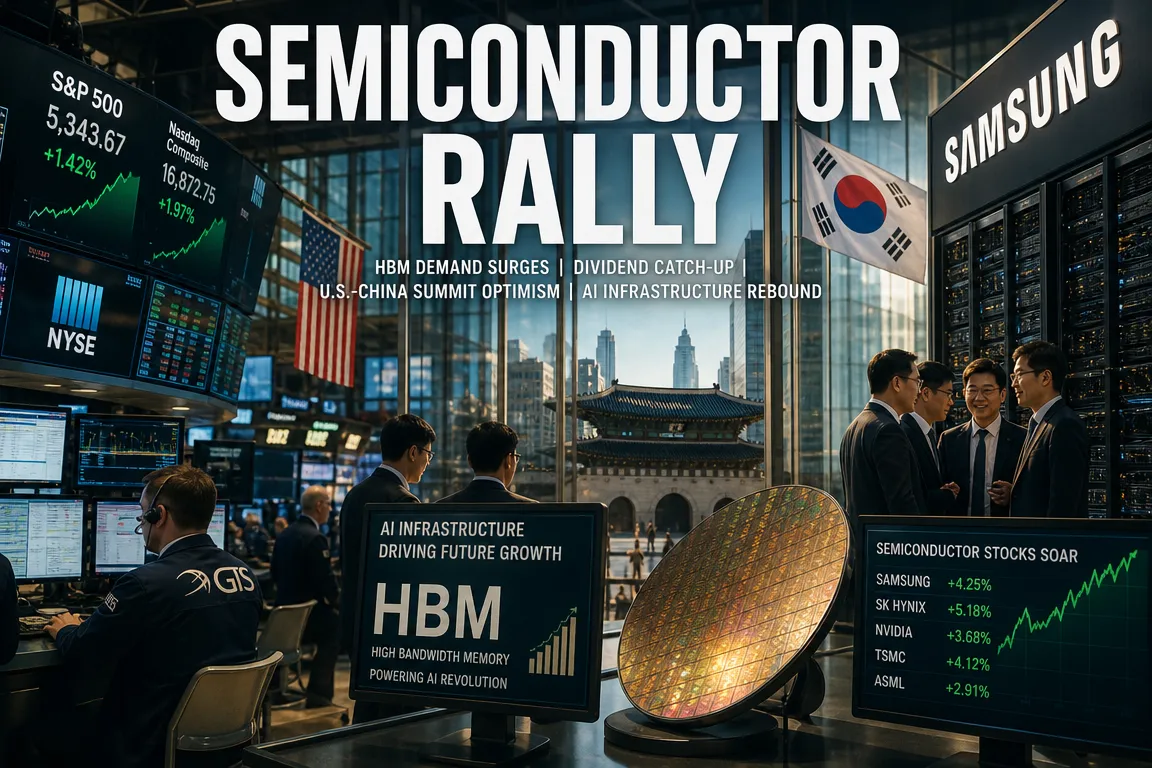
The key factors were a recovery in semiconductor exports, expectations for higher Samsung Electronics dividends, expanded HBM production, potential treasury share cancellation, and an improved outlook for the KOSPI.
In particular, the market is focused on why Samsung Electronics was stronger than SK Hynix on the day.
Although SK Hynix had been the clear leader in the HBM market, expectations that Samsung Electronics could meaningfully regain share have begun to be reflected in the stock price.
In addition, expectations tied to a potential KRW 30 trillion dividend and related tax incentives have led the market to view Samsung Electronics not only as a semiconductor name, but also as a dividend stock, an AI semiconductor stock, and a shareholder-return stock.
1. The main market driver today: semiconductor export data came in strong
The main reason for the KOSPI’s rebound was improved semiconductor export data.
In particular, stronger exports in both DRAM and NAND led the market to conclude that the semiconductor cycle recovery is now being confirmed by actual numbers.
Semiconductor stocks had previously advanced on expectations alone, but this time the export data provided support.
For investors, this suggests a higher probability of earnings recovery rather than a simple theme-driven move.
- DRAM export recovery: Improved demand expectations were supported by AI server and data center investment.
- NAND export improvement: Recovery potential in smartphone, PC, and server storage demand was reflected.
- Semiconductor cycle turnaround: Price recovery and inventory normalization expectations acted together.
- KOSPI support: Because semiconductors carry significant weight in the Korean market, Samsung Electronics and SK Hynix lifted the broader index.
In simple terms, the market responded to a signal that semiconductor exports are genuinely improving.
2. Why was Samsung Electronics stronger than SK Hynix?
In recent AI semiconductor trends, SK Hynix has been the primary beneficiary.
In particular, SK Hynix has earned a premium through its position in HBM, or high-bandwidth memory, and its link to Nvidia’s supply chain.
However, Samsung Electronics showed relatively stronger performance this time.
The main reasons were twofold.
- Expectations for higher Samsung Electronics dividends and tax benefits
- Expectations for expanded Samsung Electronics HBM production
Additional expectations around Samsung Electronics treasury shares also increased investor interest in both the common and preferred shares.
3. First reason: dividend potential of KRW 30 trillion and stronger dividend stock appeal
The market is discussing the possibility that Samsung Electronics could allocate roughly KRW 30 trillion to dividends.
Samsung Electronics is already viewed as a leading dividend name in Korea, but this issue goes beyond a standard dividend policy.
If large-scale dividends and shareholder-return policies are strengthened, Samsung Electronics could be re-rated as both an earnings-driven stock and a high-dividend stock.
The policy environment is also important.
Interest in corporate value-up initiatives, shareholder returns, and higher dividends remains strong.
If Samsung Electronics is more clearly positioned as a dividend stock and expected tax benefits are added, it could become more attractive to both institutional and retail investors.
- Higher dividend expectations: Samsung Electronics’ cash position and earnings capacity support discussion of larger distributions.
- Tax benefit expectations: Possible tax relief for dividend-oriented companies is supporting sentiment.
- Long-term investment appeal: The stock becomes more attractive to investors focused on cash flow, not just price appreciation.
- Value-up policy tailwind: This is also linked to efforts to narrow Korea’s valuation discount.
The important point is that Samsung Electronics is increasingly being viewed not only as a cyclical semiconductor stock, but also as a stronger shareholder-return story.
4. Second reason: expectations for expanded HBM production
HBM is the most important keyword in the AI semiconductor market.
HBM is essential high-bandwidth memory used in AI accelerators such as Nvidia GPUs.
SK Hynix has been the clear leader in this market.
However, expectations that Samsung Electronics will increase HBM production have shifted market attention.
Investors are returning to Samsung Electronics for a straightforward reason.
If the HBM market continues to expand and Samsung Electronics regains share, the stock could be re-rated.
- AI server demand expansion: Global big tech companies are increasing AI data center investment, driving HBM demand higher.
- Samsung Electronics’ production capacity: Its scale in memory semiconductors supports the possibility of larger HBM supply.
- Share gain potential: Although SK Hynix remains ahead, Samsung Electronics can narrow the gap if it secures quality certification and expands supply.
- Re-rating potential: Evidence of HBM competitiveness could raise Samsung Electronics’ AI semiconductor premium.
In other words, the market is betting that Samsung Electronics can still catch up despite being late.
5. Why are Samsung Electronics preferred shares stronger than the common stock?
Another notable point in the recent move is that Samsung Electronics preferred shares have been stronger than the common stock.
The reason is shareholder-return expectations.
Reports indicate that Lif Asset Management sent a shareholder letter to Samsung Electronics proposing treasury share cancellation among other measures.
This has raised expectations that a positive change may occur for Samsung Electronics preferred shares.
Preferred shares typically lack voting rights, but they can be attractive from a dividend perspective.
If treasury share cancellation or similar shareholder-return measures are implemented, the market could see both a reduction in the float and an increase in per-share value.
- Treasury share cancellation expectations: Fewer shares outstanding could support higher per-share value.
- Stronger dividend appeal: Preferred shares may attract investors focused on income.
- Narrower discount to common shares: The preferred share discount could decline.
- Shareholder activism impact: The asset manager’s letter has supported market expectations.
This factor is often overlooked, but it is an important variable for Samsung Electronics preferred share sentiment.
6. The key point often missed: Samsung Electronics is receiving three premiums at the same time
Most reports explain Samsung Electronics’ gains only through semiconductor exports or HBM.
However, the more important point is that Samsung Electronics is currently benefiting from three premiums at once.
1) Semiconductor cycle recovery premium
Improving DRAM and NAND export data has strengthened expectations for a recovery in the memory semiconductor cycle.
This supports expectations for earnings improvement at Samsung Electronics.
2) AI semiconductor HBM premium
The market expects Samsung Electronics to regain some share in HBM.
Although SK Hynix remains the leader, any evidence that Samsung Electronics is closing the gap could drive further upside.
3) Dividend and shareholder-return premium
Expectations for a KRW 30 trillion dividend, tax benefits, and treasury share cancellation are being priced in.
This is not only an earnings story, but also a shareholder-value improvement story.
In short, Samsung Electronics is being supported by three themes at the same time: earnings recovery, AI growth, and shareholder returns.
That combination is the core reason it moved more strongly than SK Hynix.
7. Is SK Hynix weak? Not at all
Samsung Electronics’ stronger performance does not mean SK Hynix is weak.
SK Hynix remains the most competitive company in the HBM market.
Its growth story remains intact given its position in Nvidia’s supply chain and AI server demand.
However, in the short term, investors may rotate toward Samsung Electronics because it has additional new catalysts, while much of the HBM premium is already reflected in SK Hynix.
- SK Hynix: It has already received a substantial premium as the HBM leader.
- Samsung Electronics: It now has multiple new catalysts, including HBM catch-up, higher dividends, and treasury share cancellation expectations.
- Market flow: Capital may move toward stocks with greater room for re-rating.
In the current market, the focus is less on which company is better and more on which company has greater room for fresh re-rating.
8. KOSPI outlook: the level after a move above 2,700 is more important
The original report noted that the KOSPI had broken above an important level.
In recent months, the index has repeatedly failed to sustain gains after moving through resistance, often due to negative news flow.
As a result, the key question is whether this rebound represents a real trend reversal or only a short-term rally.
For the KOSPI to extend gains, several conditions are needed.
- Continued improvement in semiconductor exports: One strong data point is not enough; the recovery must continue.
- Confirmation of Samsung Electronics earnings improvement: HBM progress and memory price recovery must translate into earnings.
- Sustained foreign inflows: Korea’s market tends to rise more strongly when foreign buying continues.
- Lower U.S. rate pressure: This remains important for global equities and technology valuations.
- Stable exchange rates: A steadier KRW/USD rate would support foreign investor sentiment.
Because Samsung Electronics and SK Hynix together carry substantial KOSPI weight, their performance largely determines broader market sentiment.
9. Key points investors should monitor
The focus now is not simply that Samsung Electronics rose.
Investors should examine why it rose and what must happen for further upside.
1) HBM certification and supply developments
The key issue is whether Samsung Electronics can secure stable HBM supply to global AI customers.
Any news related to Nvidia supply could have a direct impact on the stock.
2) Dividend policy announcements
Investors should monitor whether the KRW 30 trillion dividend potential becomes concrete and whether any formal dividend expansion policy is announced.
If tax benefits for dividends are added, Samsung Electronics’ investment appeal could rise further.
3) Treasury share cancellation
Samsung Electronics preferred shares are strong because of cancellation expectations.
Investors should watch for any formal shareholder-return policy from the company.
4) Sustainability of export data
It is important to determine whether the latest export improvement is structural or temporary.
DRAM and NAND pricing, inventory levels, and server demand recovery should all be monitored.
5) Whether the KOSPI can hold above 2,700
If the index fails to hold above a key level after breaking through it, volatility could rise again.
Conversely, stable trading above 2,700 could support stronger foreign inflows.
10. The real meaning of Samsung Electronics’ move
This move in Samsung Electronics should not be viewed as a one-day rebound.
It was supported by real improvement in semiconductor exports, expectations for higher HBM production, and shareholder-return themes such as dividends and treasury share cancellation.
This combination is significant enough to warrant a fresh reassessment of the stock.
If SK Hynix remains the HBM leader, Samsung Electronics may receive a larger re-rating as it works to narrow the gap.
However, investors should distinguish between expectations and reality.
Without confirmation of HBM supply progress, actual dividend policy, or treasury share cancellation, the stock could remain volatile.
Accordingly, the more prudent approach is to monitor whether the key catalysts are actually realized rather than chase the move immediately.
< Summary >
Samsung Electronics outperformed SK Hynix because improved semiconductor exports, expectations for a KRW 30 trillion dividend, HBM production expansion, and treasury share cancellation possibilities were all reflected at the same time.
SK Hynix remains the HBM leader, but Samsung Electronics is being re-rated as a dividend stock, an AI semiconductor stock, and a shareholder-return stock.
Samsung Electronics preferred shares have been particularly strong on shareholder letter and cancellation expectations.
Key factors to watch include HBM supply progress, dividend policy announcements, treasury share cancellation, the sustainability of export improvement, and whether the KOSPI can hold above 2,700.
[Related Articles…]
- Samsung Electronics Dividend Strategy and Valuation Outlook
- HBM Market Trends and AI Memory Investment Outlook
*Source: [ 내일은 투자왕 – 김단테 ]
– 삼전이 닉스보다 주가가 더 오르는 이유 #삼성전자 #하이닉스 #배당
● Trump, Xi, Stocks, AI, Rally
Trump’s Final Gamble: Could a US-China Summit Trigger a Market Rebound?
The core issue in this market is not simply that “rates have risen.”
The recent backdrop combines a US policy rate hike, concentrated AI infrastructure spending, semiconductor supply-chain realignment, crypto regulatory easing, and a US-China summit.
Capital is increasingly rotating toward growth sectors that can withstand higher interest rates.
AI data centers, semiconductors, power infrastructure, and crypto-related equities are being revalued as assets directly tied to US growth and policy direction.
By contrast, consumer staples, REITs, and dividend stocks are under relatively greater pressure from higher rates.
This report summarizes how the renewed rate-hike cycle may affect equities, why capital is flowing into AI infrastructure, and why a potential Trump-led US-China deal matters.
1. US Policy Rates Reenter a Tightening Cycle After About Three Years
The first issue to watch is the US policy rate increase.
According to the source material, the Federal Reserve raised the policy rate from 3.75% to 4.00% in a unanimous decision.
After the aggressive tightening cycle that began following the Russia-Ukraine war in 2022 appeared to be nearing completion, persistently elevated inflation has pushed policy back into a rate-hike phase.
The Fed’s message was clear.
The US economy remains strong enough to absorb higher rates, while inflation is not slowing sufficiently.
Despite geopolitical uncertainty, resilient economic data has made it increasingly difficult to delay further tightening.
Markets are already pricing in a possible additional hike in October and at least one more next year.
That said, the current path is seen as a more gradual tightening cycle than in 2022, which has helped equities absorb part of the impact.
The key point is that higher rates do not automatically imply a bear market.
As rates rise, capital becomes more selective and growth quality is scrutinized more closely.
As a result, capital tends to concentrate in industries with visible earnings growth and policy support.
2. In a High-Rate Environment, Capital Is Flowing Into AI Infrastructure
The strongest market theme this week has been AI infrastructure-related equities.
In a high-rate environment, cash and short-term Treasuries become more attractive, making speculative growth names less appealing.
However, AI infrastructure is being viewed as strong enough to offset rate pressure.
Nvidia, Intel, AMD, Arm, memory semiconductors, data centers, and cloud infrastructure companies have moved back to the center of the market.
In particular, demand for AI servers and data centers remains stronger than expected.
3. Nvidia Signals a Possible Doubling of Next Year’s Semiconductor Sales
Nvidia remains central to AI infrastructure.
CEO Jensen Huang said semiconductor sales could double next year.
That is a stronger outlook than the company’s earlier guidance suggesting revenue growth of around 70% next year.
The significance of this statement is that demand is no longer limited to big tech.
Historically, Microsoft, Amazon, Google, and Meta were the main drivers of AI spending.
Today, governments, research institutions, enterprises, and startups are all competing for AI computing capacity.
AI semiconductor demand is therefore evolving from a one-off cycle into strategic infrastructure tied to national competitiveness and corporate productivity.
4. Intel’s CEO Highlights CPU and Memory Shortages
Intel’s CEO also drew market attention.
Intel currently said CPU supply is meeting only about half of demand, and shortages may become more severe next year.
He also said memory semiconductor shortages could intensify.
This is not only Intel’s issue.
An AI server requires more than GPUs.
It also needs CPUs, HBM, DRAM, networking equipment, power systems, and cooling infrastructure.
As AI infrastructure investment expands, demand pressure spreads across the semiconductor supply chain.
Another important point is that the US wants to reduce dependence on TSMC.
Because reliance on Taiwan semiconductor production can create national security risk, US policymakers are likely to continue supporting domestic chipmakers such as Intel.
5. Arm’s Message: The Main Constraint Is Supply, Not Rates
Arm’s CEO also argued that supply constraints are a bigger issue than interest rates.
AI demand is strong enough that the market’s key limitation is no longer financing cost, but the physical supply of chips and computing resources.
This reflects the new investment framework in a high-rate environment.
If expected returns on AI infrastructure remain far above 4-5%, capital can continue to flow into the sector.
That is why AI semiconductors, data centers, and power infrastructure remain relatively resilient despite higher rates.
6. OpenAI and Anthropic Are Competing Aggressively for Computing Capacity
Another major development in AI is the competition between OpenAI and Anthropic for computing resources.
Anthropic reportedly aims to secure 5 GW of computing capacity by year-end and 10 GW next year.
That would represent a several-fold increase from roughly 1.5 GW at the end of last year.
OpenAI is also expanding its access to large-scale computing.
It is broadening contracts not only with large data centers but also with mid-sized facilities and smaller computing operators.
In practical terms, the industry is aggressively absorbing available computing supply.
This is also driving up data center rental costs.
Nebius said it will raise rental prices by 20% starting October 1.
The company had already increased prices once this year, and the latest move indicates continued strong demand.
7. Apple, Meta, and Alphabet Are Also Being Repriced on AI Infrastructure
This AI infrastructure cycle is not limited to Nvidia.
Apple, Meta, and Alphabet are also being re-rated on AI-related expectations.
Apple is reportedly considering reentering the AI server market for the first time in about 18 years.
This could become a new growth driver for the company.
Rising demand for in-house AI server buildouts, including systems based on Mac mini, is also viewed positively.
Meta drew attention after its AI assistant app Muse reached No. 1 on the US App Store.
Muse learns from users’ social media activity and conversation context to behave like a personal assistant.
It offers convenience, but also raises privacy concerns.
Meta has also launched Meta One, a subscription plan that moves the company further toward consumer subscription revenue.
Adding AI subscription income to an advertising-based model could improve cash flow visibility.
Alphabet benefited from expectations for its next-generation Gemini model.
The market is pricing in the possibility that Google may reassert itself in the AI model race.
8. Elon Musk’s Core Message: Space Data Centers Are Coming
Elon Musk warned again about the possibility of supply disruptions from Taiwan’s semiconductor industry.
He has long emphasized geopolitical risk and dependency on Taiwan.
The concern is that rising tensions between China and Taiwan could destabilize the global semiconductor supply chain.
Musk also argues that Tesla should develop its own chips.
He believes existing semiconductor supply chains may not be sufficient for robotics, autonomous driving, and data center demand.
He also pointed to the limits of terrestrial data centers.
Land acquisition, permitting, power access, and regulation are making ground-based expansion increasingly difficult.
For that reason, Musk sees the possibility of a new phase in space-based data centers starting in 2027.
SpaceX’s launch capability gives it an advantage that other companies may find difficult to replicate.
If AI computing rental businesses continue to expand, SpaceX could also be revalued as an AI infrastructure asset.
9. Why Trump Has an Incentive to Support AI
Trump’s comments also support the AI infrastructure theme.
He has spoken about the possibility of creating an AI force and appointing an AI czar.
He has dismissed AI crisis concerns as politically motivated.
Trump views AI and data centers as among the most powerful forces for economic expansion.
He has suggested they could have a larger impact than the industrial revolution, oil, gold, or the internet, and could be linked to as much as 25% of GDP.
While exaggerated, the direction is clear.
Because AI infrastructure spending is becoming increasingly important to US growth, it is difficult for any administration to slow it meaningfully.
If AI data center investment were to decline sharply, the impact would extend beyond tech equities to employment, capital spending, power infrastructure, and semiconductors.
10. Crypto Regulatory Easing Supports Related Equities Even in a High-Rate Environment
Crypto-related equities also strengthened on policy expectations despite higher rates.
This was driven by signs that the SEC and CFTC are moving toward regulatory easing.
The SEC has opened the door to a five-year limited allowance for crypto-based stock trading.
This could support higher trading volumes for tokenized equities, crypto exchanges, and digital asset platforms.
The CFTC is also moving to implement rules on its own authority after political delays in Congress.
This could broaden access to leveraged crypto products and other digital asset services in the US.
This development could benefit platforms such as Robinhood and Coinbase.
It shows that policy-supported sectors can move independently of the broader rate environment.
11. Biotech as the Next AI Expansion Theme
The source material also identifies biotech as a next-stage theme.
AI biotech is emerging as one of the key sectors following AI infrastructure.
AI is being applied to drug discovery, protein structure analysis, clinical data interpretation, and personalized treatment development.
Even investors not directly exposed to biotech should monitor this trend.
AI is expanding well beyond chatbots and image generation into healthcare, pharmaceuticals, and life sciences.
It may also create another round of demand for AI semiconductors and cloud computing.
12. The US-China Summit as the Key Event for a Market Rebound
The most important political event in this market is the US-China summit.
According to the source material, Chinese President Xi Jinping is scheduled to visit the US for talks and a White House dinner with Trump.
Markets are viewing the meeting not as a routine diplomatic event, but as a possible catalyst for a broader deal and a market rebound.
The main agenda items are likely to include AI, tariffs, rare earths, semiconductor supply chains, Chinese investment in the US, and job creation in the US.
Potential attendees are also significant.
Names mentioned include Nvidia’s Jensen Huang, Tesla’s Elon Musk, Apple’s Tim Cook, Qualcomm’s CEO, and OpenAI’s Sam Altman.
They share a common exposure to China, either through sales or supply chains.
If China offers major investment commitments, procurement, or supply-chain cooperation, Trump could present it as a politically favorable outcome.
That would allow him to frame the result as supportive of US jobs, manufacturing revival, AI leadership, and market stability.
By contrast, a lack of agreement or renewed focus on tariffs and rare earth disputes could trigger short-term selling.
13. Middle East Geopolitical Risk May Be Used as a Negotiating Tool
Over the weekend, concerns about conflicts involving the Middle East and Europe also increased.
Reports about attacks on Saudi territory, broader Middle East escalation, and the possibility of conflict in Europe added to market unease.
However, the source material suggests these geopolitical risks may also be used as leverage ahead of the US-China meeting.
In markets, fear-driven headlines often intensify over the weekend and then fade during the trading week.
That said, if such developments lead to higher oil prices or market interest rates, the situation changes.
If geopolitical shocks feed into inflation expectations, the Fed’s tightening burden becomes heavier.
Accordingly, these developments should still be treated as near-term risk factors.
14. Late September to Early October Is Seasonally One of the Most Volatile Periods
The source material notes that late September and early October are among the weakest seasonal periods in the second half.
Volatility tends to rise, sentiment weakens, and negative developments are magnified.
The fear index was cited in the 26-29 range, indicating significant investor caution.
Levels below 25 are often interpreted as extreme fear, which suggests sentiment remains fragile.
However, once this period passes, expectations for a year-end rally may reemerge.
In particular, once election uncertainty fades, markets may begin to assign more weight to positive catalysts.
15. Cash Management Strategy: Using SGOV and Similar Short-Term Treasury ETFs
For investors concerned about volatility, managing cash exposure remains important.
The source material references SGOV, a US ultra-short-term Treasury ETF.
SGOV invests in short-term US Treasuries and distributes income on a monthly basis.
In a rate-hike environment, short-term Treasury yields can rise as well.
As a result, the ETF can serve as a dollar-denominated parking vehicle for investors not yet ready to increase equity exposure.
However, ETFs still carry price volatility and currency risk.
Investors should consider both time horizon and foreign-exchange exposure when using them as cash equivalents.
16. Key Points That Are Often Overlooked
First, the market is now prioritizing policy-supported growth sectors over rates alone.
Even with higher US policy rates, sectors linked to government priorities such as AI infrastructure, crypto, and semiconductors can outperform.
Second, AI infrastructure is no longer just a theme; it is a macro variable.
As AI data center investment grows, it is increasingly affecting US GDP, employment, power infrastructure, and manufacturing investment.
If AI spending slows, the issue may extend beyond tech stock correction to broader growth concerns.
Third, computing capacity is being repriced like a strategic commodity.
OpenAI and Anthropic absorbing data center supply, and Nebius raising rental rates, suggest that computing power is being treated as a strategic asset similar to oil or electricity.
Fourth, the main issue in the US-China summit is AI supply chains, not tariffs alone.
Although tariffs may dominate headlines, the more important variables are semiconductors, rare earths, AI servers, US-bound investment, and Chinese revenue exposure.
Fifth, geopolitical risk must be separated into actual shocks and negotiation-driven fear.
Markets react to conflict headlines, but the key question is whether those headlines translate into real oil, rate, or supply-chain disruptions.
17. Checklist for Investors
1. US rate path
Monitor the number of additional hikes and the tone of Fed communication.
2. Market rates and oil
Assess whether geopolitical risks are translating into inflation pressure.
3. AI infrastructure demand
Track orders and shortage commentary from Nvidia, Intel, AMD, Arm, and memory companies.
4. US-China summit outcome
Watch for changes in tariffs, Chinese investment in the US, rare earth cooperation, and semiconductor policy.
5. Pace of crypto regulatory easing
Monitor whether SEC and CFTC actions materially affect exchanges and digital asset markets.
6. Year-end rally potential
Assess whether market sentiment improves after the late-September to early-October volatility window.
< Summary >
The US has reentered a policy rate hiking cycle after about three years.
In a high-rate environment, capital tends to move toward sectors with clear growth and policy support rather than into ambiguous assets.
The current market is centered on AI infrastructure, semiconductor supply chains, data centers, and crypto regulatory easing.
Nvidia has pointed to a possible doubling of next year’s semiconductor sales, while Intel and Arm have emphasized supply shortages.
OpenAI and Anthropic are competing for computing capacity, and data center rental rates are rising.
Trump is likely to continue supporting AI as a key driver of US growth.
The US-China summit is more important for AI supply chains, rare earths, semiconductors, and Chinese investment in the US than for tariffs alone.
Near term, geopolitical risk and seasonal volatility remain, but a positive summit outcome could support a relief rally in equities.
[Related Articles…]
AI Infrastructure Investment Cycle and Global Equity Outlook
US Rate Hikes and Year-End Equity Strategy
*Source: [ 소수몽키 ]
– 트럼프의 마지막 승부수? 미중회담 빅딜이 증시 살릴까