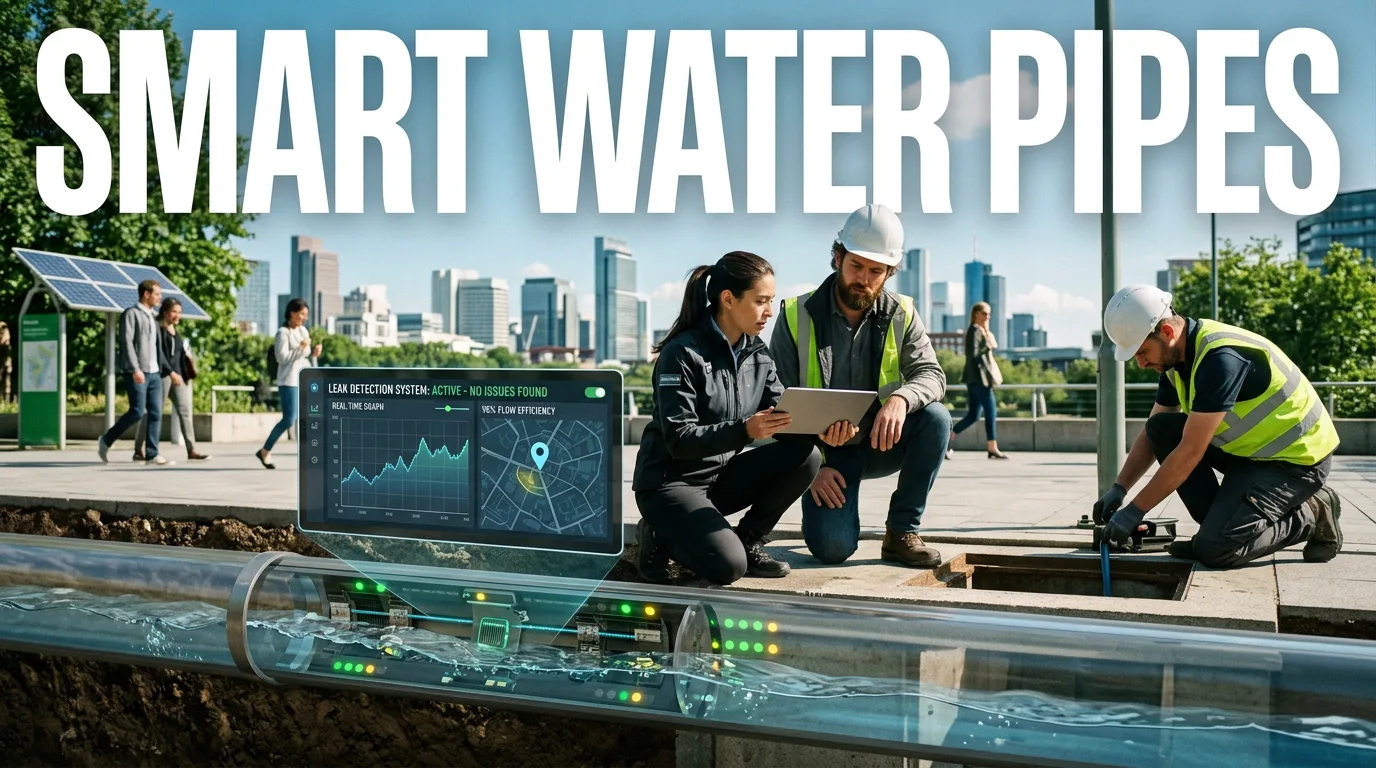
● AI Leaks Detection Breakthrough
AI Listens to the Sound of Leaking Water: The Real Meaning of Korea’s Smart Water Pipeline Technology SWNM, Spotlighted at MWC
The core point of this issue is not simply “finding leaks with AI.”
The fact that Korea’s water pipeline management technology was recognized at MWC, the world’s largest mobile exhibition, signals that the water industry is now transforming into a communications, data, and AI infrastructure industry.
In particular, with about 40% of the nation’s water pipes aging and roughly 670 million tons of water disappearing underground each year, this technology is a fairly significant shift not only in terms of improving public services, but also from the perspectives of climate tech, smart cities, carbon neutrality, and infrastructure investment.
Today, let’s organize in news format how K-water’s SWNM, or Smart Water Network Management technology, uses AI and IoT to manage water flow, stop leaks, and even change construction safety.
1. Why Did Water Pipeline Technology Win an Award at MWC?
MWC is usually an event that draws attention to smartphones, telecom equipment, semiconductors, 5G, and AI services.
But the reason Korea’s water pipeline management technology drew attention this time is that water pipes are no longer just simple plumbing; they are becoming a data network connecting the entire city.
-
Technology name: SWNM, Smart Water Network Management
-
Core organization: K-water
-
Applied technologies: AI, IoT sensors, real-time communications, flow and pressure data analysis, leak sound analysis
-
Award point: Using IoT and AI to reduce leaks and lower energy use and carbon emissions
The field recognized at MWC was not simply water management, but technology with a “Tech for Good” character.
In other words, the key evaluation points were how technology solves social problems and what impact it has on climate change response and carbon reduction.
If leaks are reduced, treatment plants do not need to produce extra water unnecessarily.
The electricity used in the process of producing and delivering water is also reduced.
As a result, both energy costs and carbon dioxide emissions are lowered.
K-water explains that the carbon reduction effect achieved through SWNM is equivalent to the replacement effect of about 1 million pine trees.
This is exactly the point MWC focused on.
2. The Reality of Korea’s Water Pipes: About 40% Nationwide Are Aging Pipes
About 40% of Korea’s water pipes are classified as aging pipes that are more than 21 years old.
On the surface, clean tap water seems to flow well, but in reality, a significant amount disappears between the treatment plant and households.
-
Aging pipe standard: Generally, water pipes older than 21 years
-
Nationwide water loss: Around 670 million to 700 million tons per year
-
Monetary loss: About 700 billion won
-
Social impact: Pressure to raise water rates, worsening water shortages, increased risk of road subsidence and water outages
Put simply, if a treatment plant sends out 100 tons of water but only 50 tons are counted as billable water, the water revenue ratio is 50%.
The remaining 50 tons are water lost for various reasons such as leaks, meter errors, or unauthorized use.
The water revenue ratio is a very important indicator in water supply management.
A low water revenue ratio means that even if high-quality water is produced at the treatment plant, there are large losses in the middle pipeline.
Especially as local drought problems worsen, leak reduction effectively creates an “invisible dam.”
There is even an explanation that properly catching the water that is already leaking out can have an effect similar to building two or three new dams.
3. What Is SWNM: Smart Water Network Management That Manages Water Flow as Data
SWNM is technology that manages the entire process by which water produced at a treatment plant moves to homes and businesses using data.
The key is that sensors and measuring devices are installed throughout the pipeline network, and AI analyzes data collected in real time.
| Category | Existing method | SWNM method |
|---|---|---|
| Leak detection | A person listens directly with a listening rod and judges by sound | Sensors collect leak sounds and AI analyzes them |
| Pressure management | Centered on maintaining a fixed pressure | Pressure is adjusted in real time according to demand and conditions |
| Pipe replacement | Replace old pipes in a blanket approach | Determine priorities by analyzing risk and economic efficiency |
| Construction safety | On-site personnel and CCTV checks | AI CCTV detects hazardous situations and sends alerts |
The essence of this technology is viewing water pipes as a single “city operations data platform.”
It means that the core of a smart city is expanding beyond transportation, power, and communications to include water infrastructure as well.
4. First Core Technology: Flow and Pressure Management That Divides the City into Blocks
To determine whether leaks are occurring across the city, you first need to know where and how much water is flowing.
So SWNM divides the water supply network into large blocks, medium blocks, and small blocks.
Each block is equipped with flow meters, pressure gauges, and pressure reduction facilities.
These devices measure in real time how much water and pressure are entering the area.
-
Flow data: Check how much water enters a specific area per hour
-
Pressure data: Check whether water pressure is at an appropriate level
-
Billing data: Calculate the water revenue ratio by comparing actual usage
-
Anomaly detection: If flow is excessive compared with usage, judge the possibility of a leak
For example, if 523 tons of water per hour is entering a certain area, but actual water use in that area is much lower, a leak can be suspected.
By combining flow data and water billing data in this way, it becomes possible to calculate the water revenue ratio by region.
This method is also important economically.
Because it is unrealistic to replace all aging pipes at once with a limited budget, investment must start with the most urgent areas based on data.
This is the core of improving the efficiency of public infrastructure investment.
5. Second Core Technology: Reducing Leaks Through AI Pressure Reduction
Water pressure is very important in water pipes.
If the pressure is too low, citizens cannot use water properly.
Conversely, if the pressure is too high, leaks become worse in gaps or weak sections of aging pipes.
Under Korea’s water supply facility standards, a certain level of pressure must be secured at the consumer’s tap.
SWNM operates in a way that satisfies this standard while lowering unnecessary excess pressure.
To put it simply, it is similar to a car’s cruise control.
Just as a car automatically adjusts acceleration and deceleration depending on the distance to the car ahead, road conditions, and speed, water pipes also adjust valves by looking at regional demand and pressure data.
-
If pressure is too high, the pressure reducing valve is adjusted to lower it.
-
If pressure is too low, the valve is opened to secure the necessary water pressure.
-
In the future, AI is expected to learn demand patterns and enable more precise automatic pressure reduction.
This technology is closer to what AI trends call “predictive operations” than simple equipment control.
It shifts from responding after a problem occurs to controlling pressure and flow before the problem grows.
6. Third Core Technology: AI Listens to Leak Sounds and Locates Them
In the past, workers would walk the roads at night to find leaks and listen with a listening rod.
This was a method of placing a listening rod on a water pipe or valve and directly judging whether there was a sound of leaking water.
Later, surface leak detection devices appeared.
Workers would wear earphones and move along the road to check for leak sounds.
But this method requires a very high level of expertise.
It is difficult for ordinary people to distinguish between the sound of flowing water and a leak, and it takes too long for a person to inspect an entire city one by one.
In SWNM, leak sound sensors take over this role.
The sensors collect sounds around the water pipe and send the data to a server through wireless communication.
The AI server learns whether the sound is a leak sound and makes a judgment.
-
Sensor collection: Collect sound and vibration data around the water pipe
-
Frequency analysis: Detect the frequency pattern unique to leaks
-
AI determination: Automatically judge whether it is a leak sound
-
On-site response: Check anomalous areas and repair them quickly
The important point is that AI is not merely recording sound; it continuously learns and improves judgment accuracy.
As enough data accumulates, it can even predict the likelihood of leaks occurring under specific regions, specific pipe types, and specific pressure conditions.
This is the most important part of digital transformation in the water industry.
That is because the moment data becomes more valuable than the physical water pipes themselves.
7. Fourth Core Technology: AI CCTV Manages Safety at Water Pipe Construction Sites
Once the leak location is found, the pipe must ultimately be repaired.
The problem is that most water pipes are buried under roads.
To replace pipes, roads must be dug up, and vehicle and pedestrian traffic must also be controlled.
K-water is installing mobile CCTV at construction sites and combining it with AI.
AI CCTV does not just record video; it detects hazardous situations.
-
It detects situations where a pedestrian falls near the construction site.
-
It detects situations where heavy equipment such as excavators comes too close to workers.
-
It identifies situations where citizens enter restricted zones.
-
When a dangerous situation occurs, it sends alerts to the construction supervisor and responsible personnel.
This technology changes how safety is managed at public construction sites.
Whereas in the past people judged danger by watching the site, now AI detects danger signals in real time to prevent accidents.
If it is expanded to all construction sites in the future, it could play a major role in preventing industrial accidents and ensuring citizen safety.
8. Fifth Core Technology: Trenchless Methods and AI Endoscopic Interpretation
Replacing water pipes does not always require digging up the road extensively.
In some sections, trenchless replacement methods are used, where the ground is minimally excavated, the existing pipe is broken up, and a new pipe is pushed in.
This method can reduce road control and inconvenience for residents.
It is especially useful in urban areas where excavation is difficult.
-
Existing method: Dig a long section of road, remove the aging pipe, and then bury the new pipe
-
Trenchless method: Dig only partial sections at both ends and replace the pipe by breaking the existing one while inserting the new one
-
Advantages: Shorter construction time, reduced traffic inconvenience, lower noise and dust
Endoscopic equipment is also used to check the condition inside pipes.
This involves inserting a camera and sensors into the pipe to check for corrosion, sediment, cracks, and damage.
K-water is developing technology that also applies AI to this pipeline endoscopic interpretation.
Once completed, instead of a person reviewing the video one by one and making a judgment, AI can analyze the pipe condition and provide the results in report form.
This is similar to how AI reads CT or MRI scans in the medical field.
The difference is that the target is not a human blood vessel but the city’s blood vessels, the water pipes.
9. Maintenance Systems and Asset Management Systems: AI Helps Decide Where to Spend Tax Money First
Replacing aging pipes requires a massive budget.
It is not realistic to replace all pipes at once.
So it is very important to decide which pipes should be replaced first.
In the past, the common method was simply to replace the oldest pipes first.
For example, pipes older than 30 years or pipes made of a specific material would be replaced first.
But an asset management system based on SWNM takes a more sophisticated approach.
-
It checks the installation year and material of the pipe.
-
It reflects leak history and accident history.
-
It combines flow, pressure, and water quality data.
-
It evaluates the pipe’s durability and risk.
-
It determines replacement priorities with the greatest impact relative to budget.
The economic meaning of this system is significant.
That is because in aging pipe replacement projects carried out with public tax money, investment can be made first in the places that are most dangerous and most effective.
From the perspective of the global economic outlook, water infrastructure investment is likely to become even more important going forward.
That is because climate change is intensifying water shortages, urban flooding, and drought at the same time.
Therefore, data-based water management technology could become a core investment area in the public infrastructure market.
10. Network Analysis Program: Simulates Which Valve to Close When an Accident Occurs
When a water pipe accident occurs, it is not enough to simply find the leak point.
It is also necessary to quickly determine which valve should be closed to minimize damage, which areas will experience water outages, and when water will be supplied again.
The network analysis program visualizes this process.
-
If an accident point is entered, the affected area is displayed.
-
It guides which valve needs to be closed.
-
It simulates the outage range and expected recovery time.
-
It makes citizen notifications and on-site response faster.
This program is being developed not as a complex analysis tool used only by experts, but in a form that on-site personnel can easily use.
It may also be applied to local governments and overseas cities in the future.
11. Why SWNM Is Drawing Attention Overseas
SWNM is already expanding into overseas projects.
K-water is pushing ahead with building monitoring systems in Tanzania, Ghana, and Cambodia, and is reportedly in discussions with Thailand on pilot projects and even city-level projects.
The reason this technology is drawing attention overseas is clear.
-
Many countries are facing aging water pipe problems.
-
Climate change is increasing the number of countries suffering from water shortages.
-
Countries with high leakage rates face sharply rising water production and electricity costs.
-
There are not many countries with experience managing water supply networks in a systematic way at the level of advanced economies.
-
Package solutions combining AI and IoT have the potential to develop into an export industry.
Especially in developing countries, reducing existing water loss can be far more economical than securing new water supplies.
In many cases, lowering the leakage rate is more cost-effective than building a new dam or treatment plant.
At this point, Korea’s SWNM can be seen not as a simple public technology, but as a global water industry solution.
12. Future Direction: Physical AI and Autonomous Exploration Robots
K-water is also planning to apply the concept of physical AI to SWNM in the future.
Physical AI refers to AI that does not only make decisions on a digital screen, but moves and operates in the real physical world.
For example, autonomous exploration robots could move through water pipes or construction sites and collect data.
This is a method in which AI robots inspect conditions in dangerous areas or narrow pipelines that are difficult for people to enter directly.
This trend is already appearing in manufacturing, logistics, construction, and energy infrastructure.
Water pipe management also has the potential to become a representative example of the physical AI era.
13. The Real Core Point That Other News Does Not Explain Well
The most important point in this technology is not the interesting scene where “AI listens to leak sounds.”
The real core point is that as water pipe data accumulates, K-water and domestic water industry companies will gain powerful data assets.
Core Point 1. Water Pipes Will Become City Data Infrastructure
Until now, water pipes have been seen as physical facilities that are replaced when they age.
But in the future, flow, pressure, water quality, leak sounds, pipe condition, and construction history will all be turned into data.
As this data accumulates, the predictive accuracy of city operations will increase.
Core Point 2. Leaks Are a “Hidden Driver of Price Increases”
If leaks are frequent, treatment plants must produce more water.
Electricity costs increase, maintenance costs increase, and this can eventually lead to pressure for higher water rates.
So reducing leaks is also an economic policy that lowers household burdens.
Core Point 3. The Water Industry Becomes a Core Pillar of the Climate Tech Market
In the era of climate change, water shortages, droughts, floods, and water quality deterioration all become more severe at the same time.
What matters as much as carbon neutrality is water security.
AI-based water management technology is highly likely to appear more often in the climate tech investment market going forward.
Core Point 4. Public Infrastructure AI Is Slower Than Private AI but Has Greater Impact
Chatbots and image generation AI are easy to see.
But AI used in public infrastructure such as water, power, transportation, and waste directly affects citizens’ daily lives.
Once introduced, it has long-term effects on city operating costs, safety, the environment, and tax efficiency.
Core Point 5. Korea’s Smart Water Management Technology Could Become an Export Industry
Semiconductors and batteries are not the only export industries.
In the future, digital infrastructure solutions such as water management, power grid management, and urban safety management could also become important export items.
SWNM is a case where Korea’s ICT competitiveness is combined with experience in operating public infrastructure.
< Summary >
K-water’s SWNM is a smart water network management technology that uses AI and IoT to monitor water pipe flow, pressure, leak sounds, and pipe conditions in real time.
With about 40% of the nation’s water pipes aging and roughly 670 million tons of water leaking out every year, this technology is a key solution for reducing water loss and energy costs.
AI analyzes leak sounds, controls pressure-reducing valves, and even detects dangerous situations through construction site CCTV.
The asset management system improves the efficiency of tax spending by judging, based on data, which aging pipes should be replaced first.
The reason it drew attention at MWC is that this technology is not just water pipe management, but a future-oriented urban technology connected to carbon neutrality, climate tech, smart cities, and AI infrastructure.
Going forward, SWNM has the potential to grow into an important export solution in overseas water-scarce countries and aging infrastructure markets.
[Related Articles…]
- Global Economic Outlook and Investment Trends Changed by AI Infrastructure
- Climate Tech Era: Growth Strategies for the Water Industry and Carbon Neutrality Market
*Source: [ 티타임즈TV ]
– AI가 물 새는 소리까지 듣는다. MWC가 주목한 K-수도관 기술