● Oracle Default Shock, AI Bubble Trigger
Why Oracle Default Could Be the True Trigger for the AI Bubble
The key point in this discussion is not simply that AI stocks are expensive.
The core issue is that the market is being supported by the corporate bond market financing AI investment, the cash flow of hyperscalers, circular financing centered on Nvidia, and the simultaneous risk of pressure on China’s semiconductor catch-up.
If Oracle’s credit risk materializes, the impact could extend beyond a correction in U.S. equities and ripple through data center investment, the OpenAI Stargate project, Nvidia GPU demand, and the semiconductor outlook.
What appears on the surface to be an ongoing AI investment boom may, beneath the surface, be accumulating negative free cash flow and large-scale bond issuance. That is the real focus of this discussion.
1. Core premise of the AI bubble: “AI investment will continue”
The market’s central assumption is that AI investment will continue for at least the next several years.
Expectations for sustained demand in GPUs, data centers, power infrastructure, HBM, semiconductor equipment, and cloud servers are supporting both U.S. equities and Korean semiconductor stocks.
The issue arises when this premise breaks down.
If the question shifts from the pace of AI investment to whether the investment can generate returns, market valuations may need to be recalibrated.
The market is now entering a phase in which AI investment ROI matters more than the scale of AI investment itself.
2. Why Oracle is being identified as a warning signal
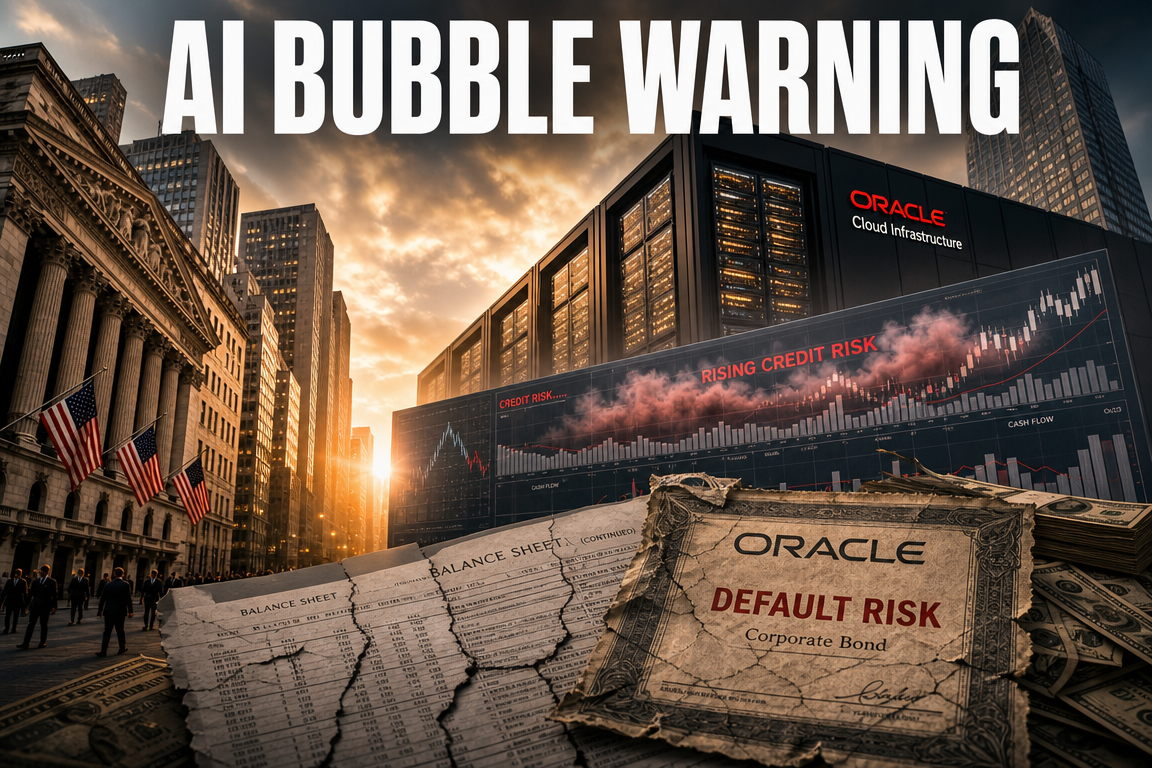
The most significant risk highlighted in the discussion is Oracle.
Oracle is one of the major U.S. hyperscalers and has pursued aggressive data center expansion.
Its credit rating has reportedly fallen to BBB-, the lowest investment-grade level.
Some market participants are already pricing Oracle more like a speculative-grade borrower than an investment-grade issuer.
The stock has also declined sharply from its peak, and widening CDS premiums have been interpreted as evidence that the market is pricing in credit risk.
CDS premiums are effectively insurance costs against default.
A rapid increase in these premiums indicates that investors are becoming materially more concerned about a company’s debt-servicing capacity.
3. What could happen if Oracle defaults
Oracle default is not the base case.
However, markets care less about probability than about the magnitude of the impact if an event occurs.
The first shock would be to the corporate bond market.
If a large bond issuer such as Oracle were to encounter distress, confidence across the corporate bond market could weaken.
This could resemble the kind of revaluation shock seen in past credit events, when firms previously regarded as sound were suddenly repriced for default risk.
The second shock would hit the data center investment ecosystem.
Oracle is linked to large-scale data center infrastructure used by OpenAI, and this flow is also connected to the Stargate project.
Problems at Oracle could affect OpenAI, SoftBank, data center construction firms, power infrastructure companies, and the GPU supply chain.
The third shock would be a slowdown in new AI investment.
If Oracle’s assets came under pressure, competitors might prefer acquiring existing assets at discounted prices rather than building new data centers.
In that case, the broader AI investment cycle could shift from capacity expansion to restructuring and M&A.
4. The real problem for hyperscalers: spending too much before generating cash
The biggest dilemma in AI is that investment cannot easily be slowed.
As the U.S.-China AI competition intensifies, large technology firms are compelled to keep increasing capex to avoid falling behind.
However, many hyperscalers are seeing free cash flow approach zero or turn negative.
In simple terms, they are spending more on AI infrastructure than they are generating from operations.
The gap is being financed through bond issuance.
The problem is that the high-rate environment has persisted, and both Treasury yields and corporate bond yields remain elevated.
In this setting, rising credit risk at one company could sharply increase funding costs across the corporate bond market.
As a result, AI investment could be constrained not by technology, but by finance.
5. Financial stress could accelerate rate cuts
When setting policy rates, central banks focus on price stability, employment stability, economic stability, and financial stability.
Inflation and employment usually receive the most attention, but severe financial stress changes the policy calculus.
If the corporate bond market weakens and signs of credit tightening appear, the Federal Reserve could move toward rate cuts, even through an emergency meeting if necessary.
In that sense, the risk of an AI bubble reversal is not just a technology-sector correction; it could also alter monetary policy.
The market must distinguish between rate cuts driven by improving conditions and rate cuts driven by credit stress.
The latter may support risk assets in the short term, but it also signals recession risk and systemic caution.
6. Why Nvidia’s large-scale financing is not automatically positive news
Nvidia is the core company of the AI era and the dominant supplier of GPUs.
However, the discussion emphasized that Nvidia’s large-scale financing should not be viewed uncritically as a positive development.
During the dot-com bubble, Lucent Technologies and Cisco faced a similar structure.
The supplier extended financing to customers so they could buy equipment, and customers were expected to generate enough returns to repay it.
This structure can accelerate revenue growth when market conditions are favorable.
But if customers fail to generate sufficient returns from the equipment, those sales can turn into credit losses.
This is the risk of circular financing.
If AI customers buy Nvidia GPUs but cannot generate enough cash flow from them, repayment and financing structures may eventually come under pressure.
7. GPU-backed financing and margin call risk
A further issue is that GPUs can be used as collateral.
Nvidia GPUs are currently highly valuable assets.
But in industries with rapid technological change, the resale value of expensive equipment can decline faster than expected.
If a new generation of GPUs is released or AI model efficiency improves rapidly, the collateral value of existing GPUs could fall sharply.
When collateral value declines, lenders may demand additional collateral or accelerate repayment.
In that process, margin calls could force some funds or data center operators into asset sales.
AI infrastructure assets could therefore become a new source of financial market volatility.
8. Key market variables in the second half of 2026: U.S.-China summit, midterm elections, APEC
Political events will also matter in the second half of 2026.
The U.S.-China summit in September, the U.S. midterm elections in November, and the APEC summit later that month are key turning points.
During this period, the U.S. and China may prefer managed stability rather than outright confrontation.
For markets, this could be interpreted as a reduction in uncertainty.
That would likely support risk appetite and draw more liquidity into equities.
However, the resulting liquidity may not be healthy liquidity driven by earnings improvement.
It may instead reflect a fragile environment in which firms are surviving through leverage and financial structuring.
9. The pressure Chinese AI and semiconductors place on the Korean market
One of the most important but less discussed points is China’s progress in AI and semiconductors.
Chinese AI models are closing the gap with the United States rapidly.
In AI services, Chinese firms are also showing strengths by offering multiple services simultaneously and improving user experience.
China is also expanding its presence in physical AI, including robotics and manufacturing applications.
In semiconductors, CXMT is a key factor.
CXMT’s DRAM market share was cited as rising from around 8% last year to around 12% this year.
This implies that even if Samsung Electronics and SK Hynix report strong earnings, their market share could still decline.
In HBM, the U.S. semiconductor value chain is being strengthened around Micron, while China continues pushing for domestic self-sufficiency.
Accordingly, Korean semiconductor outlooks should be assessed not only through demand growth, but also through market share, pricing power, and technology gaps.
10. Real economy and capital markets must be analyzed separately
A key point in the latter part of the discussion was that macroeconomic outlook and stock market performance are not the same.
Even when the semiconductor cycle is strong, semiconductor stocks do not necessarily keep rising.
Even when the AI industry grows, not all AI-related stocks will deliver strong returns.
Equities are driven not only by earnings, but also by supply and demand, valuation, rates, credit risk, sentiment, and crowded positioning.
Therefore, “the industry is strong” and “the stock is worth buying at this price” are two different questions.
11. The most important point that other coverage often misses
The hidden core risk is that the AI bubble may be driven not by equity valuation alone, but by stress in the credit market and collateral financing.
Much coverage focuses on Nvidia earnings, OpenAI growth, data center demand, and the HBM benefit for Samsung Electronics and SK Hynix.
But the true risk lies in the financing that made that investment possible.
If AI companies are investing faster than their cash flows can support and are financing the gap through bonds and structured financing, the market may eventually shift its concern from technology to credit risk.
In particular, Oracle CDS premiums, hyperscaler free cash flow, capex-to-ROI ratios, GPU collateral value, and customer repayment capacity are indicators that most retail investors rarely monitor.
Yet these measures may become more important than Nvidia’s share price in judging the sustainability of the AI investment cycle.
12. Key indicators investors should monitor
- Whether Oracle’s stock holds key support levels.
- Changes in Oracle CDS premiums and credit ratings.
- Whether spreads in the U.S. corporate bond market widen sharply.
- Whether hyperscaler free cash flow turns more negative.
- Whether AI companies’ capex-to-ROI ratios improve in practice.
- Whether Nvidia customers are generating sufficient revenue and cash flow from GPU investment.
- Whether GPU-backed financing and margin call risk are increasing.
- How CXMT, Micron, and other competitors affect Samsung Electronics and SK Hynix.
- Whether risk appetite becomes excessively concentrated around the U.S.-China summit, the U.S. midterm elections, and the APEC summit.
13. Strategy: stay invested, but be prepared to reduce exposure
The conclusion is not to become outright bearish on the market.
In the near term, liquidity, policy expectations, and AI growth sentiment could continue to support risk assets.
However, this is a market in which risk management matters more as prices rise.
That is why asset allocation matters.
It is important to have a strategy that can capture gains if the outlook is correct, while also preserving capital if it is wrong.
AI investment, U.S. equities, semiconductors, the corporate bond market, and rate-cut expectations should all be viewed as part of a single connected system.
The key question for the second half of 2026 is not whether AI will grow.
The real question is whether AI investment is growing within a financially sustainable structure.
< Summary >
The main risk in the AI bubble lies less in equity valuation than in the corporate bond market and credit risk.
Oracle’s credit rating, CDS premiums, and stock performance are key warning signals for the AI investment cycle.
Nvidia-centered GPU financing, weak customer ROI, and declining collateral values could translate into margin call risk.
China’s progress in AI and semiconductors may affect Samsung Electronics and SK Hynix more through market share than through reported earnings.
In the second half of 2026, a U.S.-China détente and a liquidity-driven rally are possible, but investors should distinguish carefully between healthy and fragile liquidity.
Investors should separate the real economy from capital markets and focus first on cash flow and credit-market indicators rather than on AI growth alone.
[Related Articles…]
*Source: [ 경제 읽어주는 남자(김광석TV) ]
– “오라클 디폴트 나면 회사채 시장 붕괴됩니다” AI 버블의 진짜 위험 신호 | 경읽남과 토론합시다 | 3자토론 김대호x홍춘욱x김광석 [6편]
● 22Billion-Portfolio-Secret
Key Summary of a Middle-Class Employee’s 6-Year Investment Strategy: U.S. Stocks, Real Estate, Asset Allocation, and MDD-Based Buying
This case is not a conventional “saved his salary and became wealthy” story.
The key is that he identified and acted on the core asset structure of each market: real estate in Korea and U.S. equities in the United States.
In addition, the strategy combines maximum drawdown (MDD)-based buying, a 60/40 asset allocation framework, access to large-cap growth stocks such as Tesla and Nvidia, use of Bitcoin and semiconductor equities, and tax management.
What matters most in this case is not which stock was purchased, but that a portfolio structure was built first to allow buying during market declines.
This structure appears to have been central to reaching approximately KRW 1.7 billion in net assets and KRW 2.2 billion in total assets in six years.
1. News Summary: How a Mid-Sized Company Employee Built KRW 2.2 Billion in Assets in 6 Years
-
Starting point: Failed the police officer exam for six years, then joined a mid-sized company.
-
Initial capital formation: Allocated 70% to 80% of monthly salary to savings and investment.
-
First investment: Accumulated about KRW 50 million over two years and invested in a small apartment in the Seoul metropolitan area.
-
Expansion method: Used rising jeonse deposits and stock gains to alternate between apartment purchases and U.S. equity investments.
-
Equity allocation: Focused on U.S. stocks rather than Korean stocks.
-
Core strategy: Asset allocation using S&P 500, Nasdaq, bonds, and gold.
-
Excess return strategy: Bought large-cap growth stocks such as Tesla after declines exceeded their average drawdown range.
-
Current assets: Approximately KRW 2.2 billion in total assets and KRW 1.7 billion in net assets.
-
Current posture: Reduced leverage as assets increased and shifted toward a target annual return of around 10%.
2. Investment Motivation: Choosing Asset Growth Over Stability
After six years of preparation for the police officer exam, he joined a mid-sized company following repeated failure.
At that point, the central question became how to recover lost time.
He addressed this through investing.
The key point is that he did not begin with substantial capital.
Even with a modest salary, he saved and invested 70% to 80% of monthly income to build seed capital.
The first lesson is clear:
During the early accumulation phase, the savings rate matters more than the return rate.
A 10% return on KRW 1 million produces only KRW 100,000, while the same return on KRW 50 million produces KRW 5 million.
He therefore built capital first, then expanded through real estate and U.S. equities.
3. Why Real Estate Came First: Understanding the Structure of the Korean Asset Market
His first investment was a small apartment in the Seoul metropolitan area rather than equities.
At the time, stock investing was widely viewed as risky, while real estate remained the center of household wealth in Korea.
He reviewed long-term data on Seoul apartment sale prices and jeonse prices.
He focused on the observation that Seoul apartment sale prices had risen at an average annual rate of around 6%, while jeonse prices had increased by about 5% over the long term.
Not all apartments appreciate, of course.
He therefore considered school districts, location, and sustained jeonse demand, and bought small apartments in areas such as the Seoul metropolitan region and Bundang.
He used lease-based investment, then reinvested the increase in jeonse deposits every two years.
Those funds were used to buy U.S. stocks, and stock gains were then recycled back into apartment purchases.
In effect, real estate served as the stability leg of the portfolio, while U.S. equities served as the growth leg.
4. Why U.S. Stocks Instead of Korean Stocks: Korea Is Real Estate, the U.S. Is Financial Assets
One of the most notable points is that he initially invested very little in Korean equities.
This was not simply because he preferred U.S. companies.
He examined the asset structure of households by country.
In Korea, a large share of household wealth is concentrated in real estate.
In the United States, by contrast, financial assets account for a larger share, and retirement assets such as 401(k) plans are closely tied to the equity market.
He drew a practical conclusion from this structure:
If real estate weakens in Korea, the Korean economy is under pressure; if the stock market weakens in the United States, the U.S. economy is under pressure.
From this perspective, apartments are the core asset in Korea and equities are the core asset in the United States.
This framework is also useful for understanding macro conditions.
Interest rates, exchange rates, liquidity, and government policy tend to move in ways that protect core assets, making it easier to read the broader market trend.
For example, if concerns over unsold units in large redevelopment projects create stress in the construction and financial sectors, government intervention becomes more likely.
The same applies in the United States.
When the Nasdaq or S&P 500 falls sharply, policymakers respond because consumer sentiment, retirement assets, corporate investment, and employment can all be affected.
5. Core Strategy: Using MDD, or Maximum Drawdown, as a Buying Framework
One of the strategies he emphasized was MDD.
MDD stands for Maximum Drawdown, meaning the decline from a peak to the lowest point.
For example, if a stock falls from 100 to 60, the MDD is -40%.
He reviewed long-term data to determine the typical annual decline range for certain companies and indices.
He noted that the S&P 500 typically experiences about one annual decline of 14%, while the Nasdaq experiences declines of around 20%.
For Tesla, based on data since 2015, he observed an average annual drawdown of about 38%.
He viewed such declines as buying opportunities.
However, he did not apply this to every stock.
He only applied it to companies with a low probability of failure.
The criteria included:
-
Very large market capitalization.
-
Strong cash flow and financial capacity.
-
Economic moat.
-
History of recovery after crises.
-
Maintained industry leadership.
For this reason, even well-known brands such as Nike were excluded if they did not meet his large-cap growth criteria.
In other words, the strategy is not “buy because it has fallen a lot,” but rather buy when a company unlikely to fail has fallen more than usual.
6. Portfolio Investing: Why the 60/40 Allocation Worked in Downturns
He did not begin with concentrated stock positions.
In the early stage, he used a 60/40 portfolio.
In general, this means 60% equities and 40% bonds.
Equities were primarily S&P 500 or Nasdaq exposure, while bonds were used as defensive assets in downturns.
Gold and cash-like assets were also included to improve resilience.
The key mechanism was rebalancing.
When equities rose above 60%, he sold part of the position and replenished bonds or gold.
When equities fell materially, he sold bonds or gold and increased equity exposure.
This created a natural sell-high, buy-low structure.
Many investors lack available capital during downturns and therefore miss opportunities.
Asset allocation solves this problem by ensuring that something can be sold when markets decline.
That is the real difference.
7. The Core Point Rarely Emphasized in News or Videos
The essence of this case is not stock selection, but building a structure that allows purchases when opportunities emerge.
Most investors focus on names such as Tesla, Nvidia, Bitcoin, Samsung Electronics, or SK hynix.
However, the more important point is that he had hedge assets available to monetize during downturns, including bonds, gold, cash, salary income, and rising jeonse deposits.
He also described employment itself as a hedge asset.
This is an important point.
Employment is a monthly cash flow asset.
When markets fall, salary income makes it easier to withstand fear and continue buying.
In this sense, his strategy was not merely aggressive.
It was a practical cash flow management framework.
Jeonse deposits, labor income, bonds, gold, index ETFs, and large-cap growth stocks were all connected.
This structure made the MDD strategy possible.
If all capital had been concentrated in a single stock, it would have been difficult to endure a -40% or -50% drawdown.
8. Tesla Strategy: Wait for Drawdowns, Reduce Exposure Near Prior Highs
He used Tesla as the main example.
Tesla is an extremely volatile stock.
It has often declined more than 30% to 40% from prior highs, and he viewed such declines as buying opportunities.
For instance, a purchase after a 50% decline from a peak would require only a return to the previous high to generate a 100% gain.
He reduced exposure near prior highs rather than trying to maximize every move higher.
This was based on the view that another major decline could follow statistically.
This approach is realistic.
Many investors give back gains by assuming prices will keep rising.
He instead identified recurring decline-and-recovery patterns and realized partial profits near prior highs.
He then recycled the capital into assets that were more depressed.
9. How He Evaluated Potential “Next Tesla” Candidates: Bitcoin, Semiconductors, and Platform Stocks
He did not identify a single asset as the “next Tesla.”
Instead, he looked for assets whose drawdowns had exceeded their historical averages.
He said he began accumulating Bitcoin in the USD 60,000 range.
He also considered Bitcoin-related assets and platform companies such as Robinhood when they had fallen sharply from prior highs.
In Korea, he also added Samsung Electronics and SK hynix when they had fallen more than their typical drawdown range.
This is relevant for semiconductor investors as well.
AI infrastructure spending, data center demand, HBM competition, and the expansion of the Nvidia ecosystem all support long-term growth in semiconductors, but the stocks remain cyclical.
Accordingly, semiconductor equities can be approached more effectively as “buy good companies after sufficient correction” rather than “buy anytime because the business is good.”
10. Leverage: Not a Permanent Position, but a Limited Tool in Extreme Drawdowns
He did not reject leverage entirely.
However, he did not hold it continuously.
He suggested that 2x leveraged products can be used in small size during extreme drawdowns, such as when Tesla falls more than 40% from its peak.
For example, a product such as TSLL may be considered when it has already fallen sharply, because a rebound can magnify returns.
That said, this is highly risky.
Leveraged ETFs can suffer rapid losses in sideways or further declining markets.
As his assets grew, he reduced leverage and lowered overall volatility.
When total assets become large, daily fluctuations of KRW 30 million to KRW 50 million are possible.
Accordingly, the investment approach for a small portfolio and a large portfolio should differ.
11. Lump Sum Investing vs. Dollar-Cost Averaging: Data Favors Lump Sum, But Conditions Apply
He referred to content from Nick Maggiulli’s Just Keep Buying.
Over the long term, because equity markets trend upward, lump sum investing tends to outperform staggered buying more often when cash is available.
Research suggests lump sum investing is superior in roughly 75% of cases.
The issue is the remaining 25%.
A major crash such as the 2008 financial crisis can occur immediately after deployment.
That is why he argued that even lump sum investing should be paired with a diversified portfolio.
If assets are split across equities, bonds, gold, and cash, it is possible to respond even in a sharp downturn.
For first-time investors, a 60/40 portfolio can serve as a starting point.
For a more defensive stance, Harry Browne’s Permanent Portfolio of 25% equities, 25% bonds, 25% gold, and 25% cash is an option.
This structure may reduce returns, but it is easier to hold through major declines.
12. Response to Downturns: Not Fear, but a Shift in What to Buy
He treated downturns as opportunities.
However, this was not simply a matter of mental toughness.
It was possible because he had hedge assets that could be sold during declines.
Bonds, gold ETFs, physical gold, cash, and labor income all served this role.
He noted that he has since sold gold ETFs but still holds physical gold.
If further declines occur, he may sell gold to buy more equities.
The key is not to ask “Should I cut losses?” during a downturn, but rather “What should I sell and what should I buy?”
That distinction drives long-term performance.
13. Tax Management: Essential as U.S. Equity Gains Increase
As U.S. equity profits increase, tax management becomes increasingly important.
In Korea, overseas stock capital gains tax applies at 22% after a basic deduction of KRW 2.5 million.
He said he generated about KRW 200 million in profit last year and paid about KRW 40 million in capital gains tax this year.
He mentioned spouse gifting and ISA accounts as tax mitigation tools.
Within statutory limits, spousal transfers can be used as part of a tax-efficient structure, subject to holding period and realization rules.
Because tax law changes frequently, and taxation may differ depending on the timing of gifting and sale, consultation with a tax professional is necessary.
For those without a spouse or those investing mainly in domestic-listed ETFs, ISA accounts may be considered.
ISAs offer tax-free limits and separate taxation benefits that may be attractive for long-term investors.
In particular, if using domestic-listed ETFs that track U.S. indices, ISA, pension savings, and IRP accounts may be worth considering together.
14. The Rule of 72: Estimating the Time Required for Assets to Double
He argued that wealth can compound faster than many expect.
He cited the Rule of 72.
The Rule of 72 estimates the time required for assets to double by dividing 72 by the annual return rate.
For example, if the annual return is 10%, then 72 divided by 10 equals about 7.2 years.
In other words, assets can potentially double every seven years or so.
If the long-term return of the S&P 500 is around 10%, long-term investors can benefit from the power of time.
Of course, returns are not a stable 10% every year.
Some years may post -20%, while others may return +30%.
The key is not leaving the market during downturns.
15. How to Apply This Case Today: Key Variables for the 2026 Outlook
For the 2026 outlook, investors should focus on interest rates, exchange rates, the U.S. economy, the AI investment cycle, and real estate liquidity.
If U.S. rates move lower, growth stocks and Nasdaq-oriented assets may regain favor.
If rates remain elevated, bonds and cash continue to matter.
When the won is weak, aggressive conversion into U.S. stocks increases foreign-exchange risk.
Accordingly, investors should consider the relative weight of dollar and won assets.
In AI, the key themes remain Nvidia, cloud computing, data centers, semiconductors, and power infrastructure.
However, strong industries do not guarantee rising stock prices.
When expectations are too high, even modest earnings disappointments can trigger sharp corrections.
Therefore, applying an MDD framework to AI-related large-cap stocks can support a more disciplined approach.
16. A Practical Portfolio for First-Time Investors
For first-time investors, it is preferable to start with index ETFs and asset allocation rather than individual stocks.
Examples include:
-
Base case: S&P 500 ETF 60%, bond ETF 40%.
-
Growth case: S&P 500 40%, Nasdaq 100 20%, bonds 30%, gold 10%.
-
Defensive case: 25% equities, 25% bonds, 25% gold, 25% cash.
-
Aggressive case: 70% index ETFs, 20% bonds/gold/cash, 10% large-cap individual stocks.
The main risk for beginners is starting with leveraged ETFs or concentrated positions in individual stocks.
Seeing MDD in numbers is very different from experiencing -30% or -50% in a live account.
Investors should first experience declines with small amounts and test their own risk tolerance and cash flow stability.
17. Core Investment Principles from This Case
-
First, build seed capital through a high savings rate.
-
Second, recognize that Korea and the United States have different core asset structures.
-
Third, downturns are only opportunities for those with cash and hedge assets.
-
Fourth, MDD-based buying should be applied only to companies unlikely to fail.
-
Fifth, as assets grow, volatility management becomes more important than return maximization.
-
Sixth, tax management is necessary to preserve net returns.
-
Seventh, employment and salary are also meaningful cash flow assets.
< Summary >
The key to building KRW 2.2 billion in assets in six years was not simply stock selection.
He understood the structural difference between real estate in Korea and financial assets in the United States, and used both real estate and U.S. equities in tandem.
He combined S&P 500, Nasdaq, bonds, and gold into an asset allocation framework that could withstand downturns.
He bought large-cap growth names such as Tesla only when drawdowns exceeded their historical average range.
During downturns, he used hedge assets such as bonds, gold, cash, and salary income to add exposure.
As assets grew, he reduced leverage and built a more stable compounding structure targeting around 10% annual returns.
In conclusion, the central lesson is not what was bought, but whether a structure was built to keep buying during market declines.
[Related Articles…]
-
U.S. Stocks Long-Term Investment Strategy and Asset Allocation Overview
-
Real Estate Investing and Interest Rate Cycles in the 2026 Outlook
*Source: [ Jun’s economy lab ]
– 6년 만에 22억 모은 중소기업 김대리 이야기(ft.김동면 작가 1부)