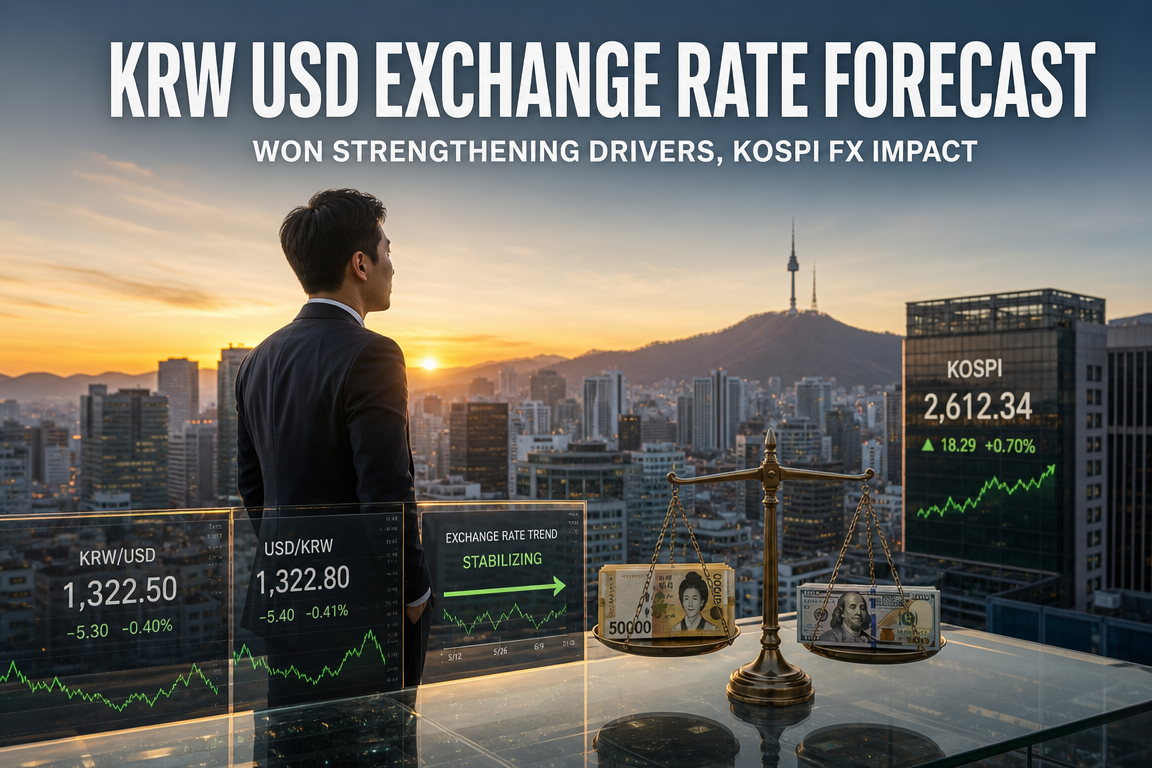
● Won-Rate Crash, Korea Shock, Dollar Rout
Won Strengthens Sharply as KRW-USD Rate Drops: Key Market Implications
The KRW-USD exchange rate has fallen by nearly 200 won from the 1,560 level within three months, marking a sharp shift in market sentiment.
The dollar has become relatively cheaper, while the won has moved as a stronger currency.
This move cannot be explained simply by a weaker dollar.
It reflects a combination of the Bank of Korea’s policy rate hike, 24-hour operation of the spot FX market, strong semiconductor exports, trade surplus growth, changes in foreign capital flows, and short covering in won positions.
The key issue is not only why the won strengthened, but that the market structure for the won is changing.
This development may affect KOSPI, semiconductor stocks, exporters, overseas investment, and dollar asset allocation.
1. Sharp decline in KRW-USD rate and the background behind won strength
The KRW-USD exchange rate has declined sharply over a short period.
A lower exchange rate means fewer won are needed to buy one dollar.
In simple terms, the dollar has weakened and the won has appreciated.
- The KRW-USD rate fell by nearly 200 won from the 1,560 level.
- Market sentiment on won weakness reversed rapidly.
- As dollar strength eased, the pace of won recovery accelerated.
- Domestic factors in Korea and global dollar weakness both contributed.
This move appears less like a technical rebound and more like the result of multiple macro variables aligning at the same time.
For investors, the key question is not only why the rate moved, but how it affects portfolios.
2. Bank of Korea rate hikes as the first driver of won strength
The first driver of won strength is the Bank of Korea’s policy rate increase.
At the time referenced in the source, the policy rate rose from 2.5% to around 3.0%.
Higher interest rates increase the attractiveness of a currency.
- Higher policy rates improve the yield appeal of won deposits and bonds.
- Foreign investors have more incentive to hold won-denominated assets.
- A smaller interest rate gap between the U.S. and Korea reduces pressure on the won.
- The source cited the Korea-U.S. policy rate gap at roughly 75bp.
The rationale for the rate hike also matters.
Growth was not materially weaker than expected, while inflation remained elevated.
When growth and inflation are both firm, rate hikes become difficult to avoid.
Household debt, Seoul housing prices, and broader financial imbalances also influenced the decision.
In that sense, the rate hike served both currency stabilization and financial stability objectives.
3. The most important change: 24-hour operation of the spot KRW-USD market
The most underappreciated factor in the recent won strength is the 24-hour operation of the spot KRW-USD market.
This is often treated as a simple procedural change, but it is a meaningful shift in FX market structure.
Previously, the NDF market traded 24 hours a day.
The NDF market does not involve the actual exchange of won and dollars; it settles only the exchange rate differential.
That structure made it easier for speculative players to move prices when liquidity was thin.
- In the past, overnight NDF trading could generate aggressive bets on won weakness.
- When the spot market opened, those prices were reflected, increasing volatility in the won.
- Won weakness positions often reinforced a broader bearish market tone.
- With a 24-hour spot market, the depth of the market involving actual won and dollar flows increases.
A deeper order book makes it harder to push prices decisively in one direction.
When banks, corporates, investors, and hedgers participate across the same time window, the influence of speculative flows declines.
This change may support not only short-term won strength but also long-term confidence in the currency.
A currency that can be traded continuously becomes more accessible to global investors.
That may also support the longer-term themes of won internationalization, capital market advancement, and potential MSCI developed-market inclusion.
4. Dollar conversion by exporters created real demand for won
FX rates do not move on expectations alone.
Real demand from dollar sellers and won buyers is required for the won to strengthen.
Recently, exporters’ dollar conversions played a major role in supporting the won.
- Corporate tax payments due in August required firms to convert dollars into won.
- Dividends, share buybacks, and domestic investment also require won funding.
- Large exporters such as Samsung Electronics and SK hynix can materially affect the market through FX conversion.
- SK hynix was noted as having converted part of the funds raised through U.S. ADR issuance into won.
The key point is that a trade surplus does not automatically produce a stronger won.
If exporters keep dollar earnings offshore, the impact on the FX market is limited.
However, when dollars are converted into won for tax payments, investment, dividends, or buybacks, actual won demand emerges.
The recent move reflects both stronger dollar inflows and a higher rate of conversion into won.
5. Semiconductor exports and the AI cycle as the core of the trade surplus
The expansion in Korea’s trade surplus is another core driver of won strength.
The source noted a significant year-on-year increase in cumulative trade surplus from January to August.
The main driver remains semiconductor exports.
Global AI data center investment, stronger demand for high-performance memory, and the HBM-led semiconductor cycle are supporting Korean exports.
Samsung Electronics and SK hynix hold key positions in the AI semiconductor supply chain.
- AI server expansion is increasing demand for high-value memory products.
- When both semiconductor prices and volumes improve, the trade surplus widens.
- This increases dollar inflows into Korea.
- When firms convert those dollars into won, upward pressure on the currency increases.
This is not only an FX issue.
It is also linked to KOSPI direction, semiconductor valuation, and foreign investor positioning.
For Korea equities to regain global investor attention, exchange-rate stability, semiconductor earnings strength, and foreign buying would need to improve together.
6. Improved foreign capital flows reduced selling pressure on the won
When the won weakens, foreign capital outflows are a major factor.
When foreign investors sell Korean equities and convert proceeds into dollars, they create selling pressure on the won and buying pressure on the dollar.
The source stated that foreign investors’ net selling in May and June reached roughly 40 trillion won per month.
However, net selling narrowed in July and August, easing pressure on the won.
- Lower net selling reduces pressure to sell the won.
- When concerns over the Korean equity market ease, the exchange rate tends to stabilize.
- Expectations for a KOSPI rebound can support renewed won demand.
- FX stability may encourage foreign investors to reconsider Korean equities.
Foreign flow is not only an equity-market issue; it is also directly linked to FX.
Therefore, monitoring the KRW-USD rate should include foreign net buying and KOSPI trends, not just the dollar index.
7. Weakening U.S. dollar amplified the won’s strength
Another reason for won strength is the weakening of the U.S. dollar itself.
After showing strength in July and August, the dollar lost momentum as CPI, PPI, and GDP data came in weaker than expected.
- A softer CPI reduces pressure for further rate hikes.
- Slower PPI growth eases inflation concerns.
- Weaker GDP increases concerns about U.S. economic slowdown.
- Expectations that the Fed may not need to raise rates further can weaken the dollar.
That said, the dollar did not move in a straight line lower.
After the Jackson Hole speech, the possibility of additional tightening was again discussed, and the dollar index rebounded at times.
Even so, the recent weakening trend in the dollar clearly supported the won.
8. Short covering in won positions intensified the decline in the exchange rate
One common FX trade for a period of time was a bet on won weakness.
As the won had been under pressure, investors became accustomed to selling won and buying dollars.
When the exchange rate suddenly moves in the opposite direction, that becomes problematic.
Investors betting on won weakness must close positions to limit losses.
- A short won position is a bet on won depreciation.
- When the won strengthens, the position incurs losses.
- To reduce losses, investors must buy the won back.
- This can amplify won demand and accelerate the decline in KRW-USD.
This is the short-covering process often seen during sharp FX moves.
The recent won strength reflects both fundamental change and position unwinding.
9. Benefits of a stronger won: lower inflation and improved consumption capacity
A stronger won is neither purely positive nor purely negative.
On the positive side, it helps stabilize import prices.
- Energy import costs may decline.
- Costs for food and raw material imports may ease.
- Domestic inflation may stabilize.
- Overseas travel, study abroad, and cross-border e-commerce become cheaper.
- The burden of dollar liabilities on companies may decline.
For a country like Korea, which relies heavily on energy and food imports, won strength can be supportive for inflation.
Consumers also benefit through lower foreign currency payment costs.
10. Drawbacks of a stronger won: pressure on exporters and tourism
On the other hand, a stronger won can weigh on exporters.
Revenue translated into won may decline even if export volumes remain stable.
- Exporters may face weaker price competitiveness.
- Foreign buyers may perceive Korean products as more expensive.
- Companies with high dollar revenues may see slower won-denominated earnings growth.
- For foreign tourists, travel to Korea may become more expensive.
- Tourism, duty-free, and some consumer sectors may face pressure.
Korea’s tourism sector has been strong, but an excessively strong won could reduce its value appeal for foreign visitors.
Export-oriented firms may also see valuation support weaken as the currency effect fades.
11. KOSPI and sector implications: FX alone is not sufficient for investment decisions
A decline in the KRW-USD rate can be positive for KOSPI.
Lower FX volatility reduces perceived risk for foreign investors in Korean equities.
However, the impact is not uniform across sectors.
- Semiconductors may offset currency headwinds if AI demand remains strong.
- Autos, shipbuilding, and machinery are generally more sensitive to a lower exchange rate.
- Airlines, travel, retail, and food sectors may benefit from lower import costs.
- Lower energy import costs can also support inflation and consumption.
- If foreign inflows improve, large-cap stocks may benefit first.
Ultimately, the exchange rate itself matters less than each company’s revenue and cost structure.
Investors should distinguish between firms with dollar revenues, dollar costs, and businesses whose demand is directly affected by won strength.
12. The key point often missed: the won market structure is changing, not just the price
The most important point is not simply that the won has strengthened.
More important is that the trading environment for the won is changing.
Twenty-four-hour operation of the spot KRW-USD market is more than an extension of trading hours.
It makes the won more accessible to global investors.
That may support the longer-term advancement of Korea’s capital market.
- Improved accessibility reduces FX conversion friction for foreign investors.
- Deeper liquidity may reduce speculative volatility.
- Global confidence in won assets may improve.
- It may also support expectations for MSCI developed-market inclusion.
- Some valuation discounts in the Korean equity market may narrow.
In other words, the recent won move may be both a short-term FX event and an early signal of structural change in Korea’s FX market.
That is the most important point for investors to monitor.
13. How investors should respond
FX forecasting is inherently difficult.
It is hard to know whether the won will strengthen further or reverse from here.
Therefore, a strategy that can withstand being wrong on FX is more important than trying to predict the exact level.
- Rather than exchanging funds all at once, it is better to do so in stages.
- Holding both won assets and dollar assets in a balanced allocation is preferable.
- Korean investors often already have a high concentration in won assets.
- Accumulating some dollar assets while the dollar is cheaper can be useful for long-term diversification.
- However, because the won may continue to strengthen, staggered conversion is appropriate.
For investors interested in overseas equities, U.S. ETFs, dollar deposits, or dollar bonds, a weaker dollar should not be viewed only as a risk.
It may also be an opportunity to rebalance into dollar assets over the long term.
At the same time, trying to time the exact FX low is risky.
Maintaining balance without being excessively early or late is more likely to produce better long-term results.
14. Key indicators to monitor going forward
To assess whether the won’s strength can continue, several indicators should be monitored.
- Track U.S. CPI and PPI trends.
- Monitor the Fed’s rate path and the dollar index.
- Watch the Bank of Korea policy rate and the Korea-U.S. rate gap.
- Check semiconductor exports and trade surplus data.
- Monitor whether foreign net buying in KOSPI resumes.
- Track whether major companies continue converting dollar earnings into won.
- Assess whether the 24-hour spot FX market reduces volatility in practice.
If these indicators move in favor of the won simultaneously, the decline in KRW-USD may continue.
Conversely, if the dollar strengthens again, foreigners continue selling Korean equities, and exporter conversion demand eases, the pace of won strength may slow.
< Summary >
The sharp decline in the KRW-USD rate reflects a combination of Bank of Korea rate hikes, dollar weakness, strong semiconductor exports, trade surplus expansion, and improved foreign capital flows.
The most important structural change is the 24-hour operation of the spot KRW-USD market, which is altering Korea’s FX market structure.
Exporter dollar conversions and short covering in won positions also accelerated the move.
A stronger won supports import-price stability and lowers overseas spending costs, but it can weigh on exporters and tourism.
For investors, a balanced allocation between won assets and dollar assets, together with staggered FX conversion, remains the more practical approach.
[Related Articles…]
- KRW-USD Exchange Rate Drop and Korea Equity Market Implications
- AI Semiconductor Cycle and KOSPI Flow Outlook
*Source: [ 내일은 투자왕 – 김단테 ]
– 원화가 미쳤습니다
● Dollar Peak Four Shifts to Crush KRW, Market Scenarios for 2026 H2
Has the Dollar Peaked? Four Changes That Could Lower KRW/USD and the H2 2026 Market Scenario
The key point of this article is not simply that the exchange rate will decline.
This note outlines why the KRW/USD exchange rate and equities were both volatile in June and July 2026, and what structural changes from August onward could support exchange-rate stabilization and a rebound in risk assets.
In particular, it focuses on four decisive variables that could pull the exchange rate lower: an expansion in U.S. M2 liquidity, narrowing Korea-U.S. policy rate differentials, easing geopolitical risk, and foreign-exchange conversion demand from exporters.
It also addresses a key point often missed in market coverage: “It is more important when exporters become willing to convert U.S. dollars into won than when exports merely remain strong.”
1. Background to the June-July 2026 market correction: four variables that pressured equities and the exchange rate
The market in June and July 2026 was a classic volatility phase.
Equities came under correction pressure, while the KRW/USD exchange rate remained elevated and resisted decline.
Four factors stood out during this period.
- National Pension Service rebalancing
- Concentration in single-name leveraged ETFs
- Geopolitical tensions and higher crude oil prices
- Uncertainty over future semiconductor earnings
1-1. National Pension Service rebalancing: a source of domestic equity selling pressure
The first factor was rebalancing by the National Pension Service.
To maintain target asset allocation, the fund reduces positions in assets that have appreciated strongly and restores exposure to assets that have fallen below target weights.
When this process requires adjustment in domestic equity exposure, it can create temporary selling pressure in the market.
In particular, rebalancing in large-cap stocks can weigh on overall sentiment in the KOSPI.
1-2. Single-name leveraged ETFs: an accelerator in rising markets, a destabilizer in falling markets
The second factor was the concentration in single-name leveraged ETFs.
These products can amplify buying in rising markets, but in downturns they can trigger rapid liquidations and increase volatility.
During June and July, excessive capital flowed into selected popular stocks, intensifying market concentration.
In such a structure, even minor negative catalysts can lead to sharp price swings.
1-3. War fears and higher crude oil prices: safe-haven demand supported U.S. dollar strength
The third factor was rising geopolitical tension.
Fears over renewed conflict in the Middle East, risks around the Strait of Hormuz, and broader war concerns lifted crude oil prices.
Higher oil prices raise inflation expectations.
Higher inflation expectations then put upward pressure on bond yields.
When bond yields rise, demand shifts away from risk assets toward the U.S. dollar and U.S. Treasuries.
As a result, geopolitical risk became a key driver of upward pressure on the KRW/USD exchange rate.
1-4. Semiconductor earnings concerns: weakening confidence in future cloud demand
The fourth factor was concern over future semiconductor earnings.
In July, earnings releases from major hyperscale companies drew market attention.
The market focused on whether these firms would continue increasing spending on AI semiconductors and data-center infrastructure.
However, signs that free cash flow was declining at some companies raised doubts about the sustainability of that investment cycle.
That concern translated into broader valuation pressure on the semiconductor sector.
2. Why sentiment could shift from August 2026 onward
From August onward, the factors that weighed on markets in June and July may begin to ease.
This matters not only for equities but also for the KRW/USD exchange rate.
Exchange rates should not be analyzed in isolation.
They move in connection with equities, liquidity, interest rates, geopolitics, and trade flows.
2-1. End of National Pension Service rebalancing: from selling pressure to potential buying support
If rebalancing created pressure on domestic stocks in June and July, the setup could improve from August onward.
As equity prices fall, the domestic equity share of the National Pension Service portfolio also declines.
That can eventually require renewed buying to return to target weights.
In other words, a factor that was a headwind in June and July could become supportive later.
2-2. Tighter regulation of single-name leveraged ETFs: easing excess speculation
Raising barriers to single-name leveraged ETFs may reduce the market’s dependence on excessive leverage.
This is not a complete solution.
However, it may partially ease the pattern of speculative inflows followed by abrupt outflows.
That would be constructive for volatility.
2-3. Easing war fears: stabilization in oil, yields, and inflation expectations
Geopolitical tension may moderate from the June-July peak.
If free passage through the Strait of Hormuz is preserved and crude oil prices stabilize, inflation expectations should also ease.
Lower inflation expectations should reduce upward pressure on bond yields.
Stable bond yields would ease concerns over further tightening and support risk appetite.
That would weaken the dollar’s bullish momentum.
2-4. A pause in semiconductor earnings anxiety: temporary relief from negative expectations
In July, repeated earnings releases from companies that drive semiconductor demand increased market tension.
From August through early October, there may be an earnings gap period.
During that window, negative expectations around semiconductor demand may stop intensifying and could temporarily stabilize.
As a result, the semiconductor sector may not face the same degree of adverse sentiment as in June and July.
3. KRW/USD outlook: short-term stabilization versus longer-term strong-dollar normalization
The central view here is that the KRW/USD exchange rate may still remain structurally elevated over the long term, but it could stabilize after peaking in the latter part of 2026.
Put differently, the strong-dollar regime may not be over on a long-term basis.
However, in the near term, the exchange rate may peak around 1,550 and then move into a 1,350 to 1,450 range.
One important point is that no one can forecast exchange rates with precision.
The key is not to guess a single number, but to understand which forces push the rate higher and which pull it lower.
4. First factor that could lower KRW/USD: U.S. M2 growth may overtake Korea’s
Liquidity is the first variable to monitor in foreign exchange.
In this context, liquidity refers to the pace at which money is being supplied into the system.
M2 growth is a useful gauge of that process.
Through the first half of 2026, Korea’s M2 growth exceeded that of the United States.
This meant Korea was expanding money supply more rapidly on a relative basis.
When money supply grows faster, the value of that currency can weaken.
That helped sustain KRW weakness and USD strength in the first half.
From mid-2026 onward, however, U.S. M2 growth may move ahead of Korea’s.
The United States may expand fiscal support and liquidity ahead of the midterm elections.
For the Trump administration, the November midterm election is a critical political event, and it may choose to support growth and equities through broader liquidity measures.
If U.S. M2 growth accelerates faster than Korea’s, dollar supply would increase on a relative basis.
That would weaken the dollar and create downward pressure on KRW/USD.
5. Second factor that could lower KRW/USD: narrowing Korea-U.S. policy rate differentials
The second key variable is interest rates.
Interest rates are the price of money.
U.S. policy rates are the price of dollars, while Korean policy rates are the price of won.
Through July 2026, the United States had kept rates unchanged for roughly one year.
Korea, by contrast, had cut rates and then held them steady before raising rates in July 2026.
That move narrows the Korea-U.S. rate differential.
A narrower differential means the won becomes relatively more attractive.
Previously, the higher U.S. rate level supported the appeal of holding dollars.
But if the Bank of Korea retains room for further tightening while the Federal Reserve remains reluctant to raise rates, pressure on the won should ease.
The United States is already operating at a high interest-rate level, so the case for additional hikes may be limited.
Korea, on the other hand, may still have room to consider further tightening for inflation and exchange-rate stability.
That would be a negative for KRW/USD.
6. Third factor that could lower KRW/USD: easing geopolitical tension
The third variable is geopolitical risk.
In June and July, war fears intensified again.
Middle East conflict concerns, higher oil prices, rising bond yields, and higher inflation expectations all appeared simultaneously.
In that environment, investors tend to avoid risk assets and prefer the dollar.
The dollar remains a core safe-haven currency.
From August onward, however, the tone may improve.
During periods shaped by events such as U.S.-China summits, the midterm election cycle, and APEC meetings, it becomes more difficult for geopolitical tensions to escalate aggressively.
Even the prospect of a U.S.-China meeting can signal easing tension to markets, regardless of the eventual outcome.
As fear declines, safe-haven demand also weakens.
That can reduce dollar buying pressure and support risk assets, including equities in emerging markets.
This would also help stabilize KRW/USD.
7. Fourth factor that could lower KRW/USD: exporters’ FX conversion demand
The most important variable is ultimately supply and demand.
Exchange rates do not move on macro data alone.
KRW/USD declines only when market participants actually sell dollars and buy won.
Korea recorded exceptionally strong exports and current-account surpluses through the first half of 2026.
Trade balances were also strong.
Even so, the exchange rate stayed high.
The reason was that export proceeds were not being converted into won at sufficient scale in the domestic market.
If exporters believe the dollar will strengthen further, they have little incentive to convert immediately.
This applies not only to large exporters such as Samsung Electronics, Hyundai Motor, LG Electronics, and SK hynix, but also to companies in sectors such as ramen, cosmetics, shipbuilding, and defense.
Corporations maximize profit, so when they expect further dollar strength, they tend to retain dollar exposure.
But if expectations shift toward dollar weakness and won strength, the behavior changes materially.
Even without policy pressure, exporters may choose to convert dollars into won voluntarily.
That is a powerful supply-side force that can push the exchange rate lower.
8. The most important point often missed in other market coverage
The key issue is not export strength itself, but whether exporters become inclined to convert dollars into won.
Many market comments suggest that strong exports automatically lead to a stronger won and a lower exchange rate.
In practice, the transmission is not that direct.
If exporters earn dollars but hold them offshore or in foreign-currency assets, the impact on the domestic FX market remains limited.
In other words, strong exports alone do not guarantee won appreciation if the dollars are not converted.
That was a defining feature of the first half of 2026.
Exports and the current account were both strong, yet KRW/USD remained elevated.
The market perceived dollar scarcity, and corporations were reluctant to release dollar holdings.
If U.S. liquidity expansion, narrowing rate differentials, and easing geopolitical risk begin to align from August onward, corporate behavior may change.
Once the market shifts from “the dollar may keep rising” to “the dollar may have peaked,” exporters may convert in size.
That could create stronger downward pressure on the exchange rate than macro data alone.
9. H2 2026 exchange-rate scenario: possible trading range of 1,350 to 1,450
The current view is that KRW/USD may have formed a peak around 1,550 and could stabilize in a 1,350 to 1,450 range through the second half of 2026.
This is not a fixed forecast.
Exchange rates reflect interest rates, inflation, oil prices, war risk, political events, FX flows, and global risk sentiment all at once.
The important task is therefore not to predict a single number, but to monitor the conditions under which the exchange rate can fall or rise again.
For KRW/USD to stabilize, the following conditions would be helpful:
- U.S. M2 growth must accelerate relative to Korea.
- The Korea-U.S. policy rate gap must narrow further.
- Crude oil prices and bond yields must remain stable.
- Geopolitical tension must continue to ease.
- Korean exporters must actually increase dollar conversion demand.
If these conditions weaken, the exchange rate could move back above 1,500.
In particular, renewed war risk, a sharp oil-price spike, renewed U.S. rate-hike expectations, or weaker Korean exports could revive dollar strength.
10. The link between equities and exchange rates: exchange-rate stability is positive for risk assets
KRW/USD stability is also constructive for the Korean equity market.
When the exchange rate rises sharply, foreign investors worry about currency losses.
Even if Korean stocks rise, dollar-based returns may be reduced by currency depreciation.
Conversely, if the exchange rate stabilizes or the won is expected to strengthen, foreign investors may have greater incentive to buy Korean equities.
In particular, export-oriented sectors such as semiconductors, autos, shipbuilding, defense, cosmetics, and food are sensitive to both currency moves and earnings trends.
A very weak won may support translated revenue, but it can also burden foreign flows and overall financial stability.
Accordingly, in H2 2026 the most favorable outcome for equities may be a gradual normalization in the exchange rate rather than a sharp decline.
11. Key indicators for investors to monitor
Going forward, investors should monitor the following indicators closely when assessing KRW/USD and global markets.
- U.S. M2 growth: to assess how quickly liquidity is expanding in the United States.
- Korea M2 growth: to compare Korea’s liquidity expansion rate.
- Korea-U.S. policy rate differential: to determine whether the gap is narrowing or widening.
- U.S. Treasury yields: especially the 10-year yield, a key gauge of risk appetite.
- Crude oil prices: rising oil can lift inflation expectations and strengthen the dollar.
- Current account and trade balance: to measure Korea’s dollar earnings.
- Exporter FX conversion activity: the most important driver of actual market supply.
- U.S.-China summit and APEC calendar: events that can affect geopolitical tension.
12. Final assessment: the direction of capital matters more than the debate over the dollar peak
The important question is not “How far can KRW/USD fall?”
The more important question is whether conditions are forming for capital to move away from dollars and into the won and risk assets.
In H2 2026, U.S. liquidity expansion, narrowing Korea-U.S. rate differentials, easing geopolitical risk, and potentially higher exporter FX conversion demand may align.
If these factors converge, KRW/USD could move down from its peak and stabilize.
At the same time, a long-term strong-dollar regime may not be fully over.
Global uncertainty, the structural strength of the U.S. economy, and the dollar-based international payments system still support dollar demand.
Accordingly, a dual scenario is most realistic: near-term exchange-rate stabilization, and a structurally elevated dollar level over the longer term.
< Summary >
The June-July 2026 market correction reflected a combination of National Pension Service rebalancing, single-name leveraged ETF concentration, geopolitical risk, and semiconductor earnings concerns.
From August onward, these pressures may ease, creating room for stabilization in both equities and the KRW/USD exchange rate.
The main factors that could lower KRW/USD are U.S. M2 liquidity expansion, narrower Korea-U.S. policy rate differentials, easing geopolitical tension, and stronger FX conversion demand from exporters.
The most important point is not export strength alone, but a shift in corporate behavior toward converting dollars into won.
KRW/USD may have peaked around 1,550 in H2 2026 and could stabilize in a 1,350 to 1,450 range, while a structurally strong-dollar backdrop still needs to be considered.
[Related Articles…]
*Source: [ 경제 읽어주는 남자(김광석TV) ]
– 달러 고점 지나갔다? 원·달러 환율 하락시킬 4가지 결정적 변화 | 클로즈업 | 머니트렌드 강의 [2편]