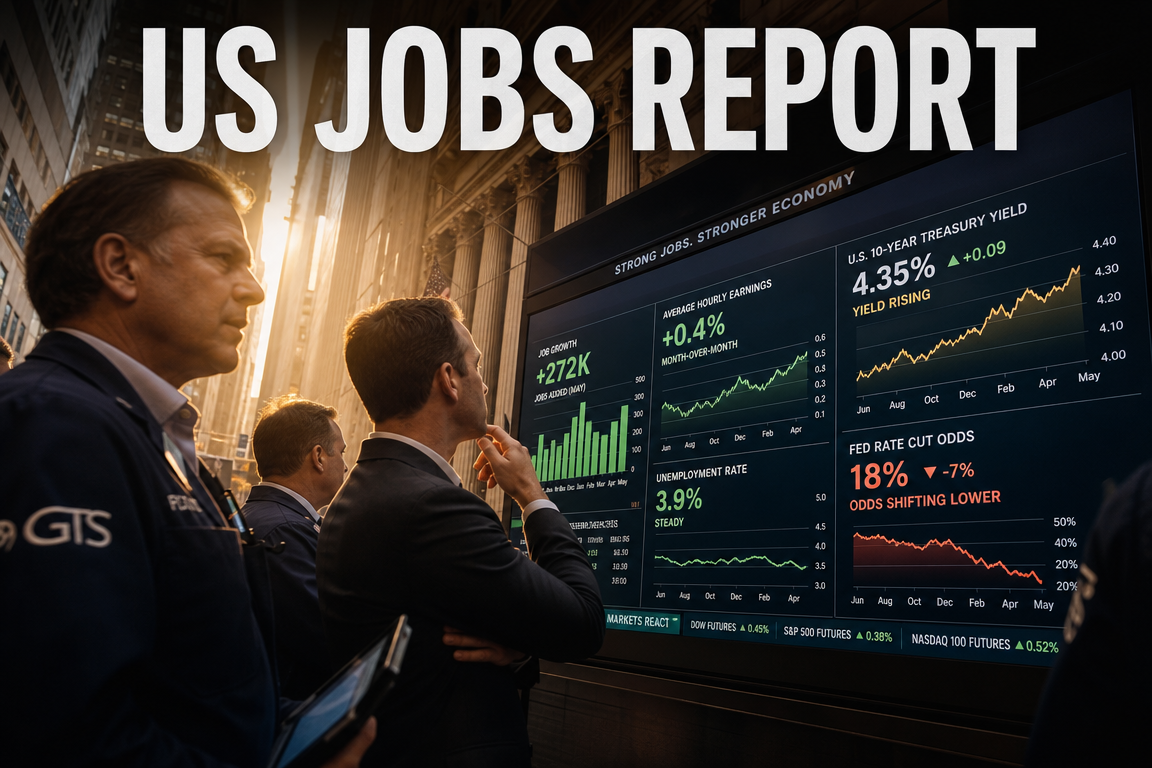
● Jobs-Surprise, Yields-Rock, Fed-Shaken
U.S. Employment Data Immediate Analysis: The Employment Surprise Recalibrates Treasury Yields and Rate Expectations
The key takeaways from this U.S. employment report are threefold.
The unemployment rate remained low, nonfarm payrolls rose far above expectations, and wage growth exceeded market forecasts.
On the surface, this combination indicates that the U.S. economy remains resilient.
For financial markets, however, it can be interpreted as reduced urgency for the Federal Reserve to cut rates.
As a result, this release should be viewed not as a routine jobs report, but as a data point with implications for Treasury yields, policy rates, CPI, and equity-market volatility.
1. Key Results from the August U.S. Employment Report
- Unemployment rate: 4.1%
The U.S. unemployment rate was reported at 4.1%.
This matched market expectations of 4.1%.
The reading suggests that the labor market remains broadly stable.
In practical terms, there is no clear sign of large-scale layoffs or a sharp deterioration in labor demand.
- Nonfarm payrolls: about 161,000
The most important indicator was nonfarm payroll growth.
Nonfarm payrolls increased by about 161,000 in the latest report.
That was well above the consensus estimate of roughly 56,000, representing a meaningful upside surprise.
Contrary to expectations for a slowdown, hiring accelerated again in August.
- Wage growth: 3.1%
Wage growth came in at 3.1%.
That was slightly above the market expectation of 3.0%.
While the trend remains one of gradual moderation, the latest reading still points to firm labor demand.
Stronger wage growth supports household spending and may continue to pressure services inflation.
2. What the Report Indicates About the U.S. Economy
The report reinforces the view that the U.S. economy remains solid.
Unemployment stayed low, job creation exceeded expectations, and wages rose faster than forecast.
For the Federal Reserve, this combination implies the following:
- The labor market is not yet weak.
- Consumer demand may remain supported.
- Rate cuts are harder to justify unless inflation clearly continues to ease.
With second-quarter GDP growth still estimated at around 1.5%, the economy does not appear to be in a recessionary phase.
If employment holds up and investment remains intact, the U.S. economy is still better characterized as undergoing moderate growth rather than contraction.
3. Why Strong Jobs Data Can Be Negative for Markets
The core market narrative is “Good is Bad.”
In this context, stronger economic data can be negative for financial markets.
When employment is strong, firms continue hiring.
When households have income, consumption remains resilient.
When demand stays firm, businesses face less pressure to lower prices.
As a result, inflation may decline more slowly than expected.
This makes it more difficult for the Fed to move quickly toward rate cuts.
If CPI or PPI were to reaccelerate, the possibility of further tightening could also re-enter the market discussion.
4. The Link Between Employment, Inflation, and Policy Rates
Employment, inflation, and policy rates do not move independently.
The Federal Reserve sets policy by evaluating the labor market and inflation together.
- Strong employment and elevated inflation
In this case, the Fed may keep rates high or consider additional hikes.
Robust labor conditions allow the Fed to focus more aggressively on price stability.
- Weak employment and easing inflation
In this case, the Fed may consider rate cuts.
Policy easing becomes more defensible if it is needed to offset labor-market weakness and slowing growth.
- Strong employment but mixed inflation signals
This is close to the current environment.
Employment remains firm, but it is still unclear whether inflation has fully stabilized.
That is why the next CPI and PPI releases have become especially important.
5. Why Did Treasury Yields React Immediately?
U.S. Treasury yields moved higher immediately after the release.
The reason is straightforward.
Stronger employment reduces the likelihood of near-term rate cuts.
When the market scales back rate-cut expectations, Treasury yields tend to rise.
Markets are particularly sensitive to nonfarm payrolls.
An expected gain of around 56,000 versus an actual increase of about 161,000 signaled that the labor market is stronger than anticipated.
In the near term, that can support higher Treasury yields, pressure equities, and strengthen the U.S. dollar.
6. What FedWatch Suggested About Market Sentiment
Following the report, market expectations for policy rates also shifted.
The original analysis indicated that the implied probability of a September rate increase moved from about 50.2% before the release to around 52.6% afterward.
The change may appear modest in absolute terms.
The direction, however, is what matters.
The market interpreted the report less as support for rate cuts and more as a reason to remain cautious about further tightening.
In other words, the data weakened the expectation that the Fed would soon pivot toward easing.
At the same time, it increased concern that stronger labor data could keep policy restrictive for longer if inflation remains sticky.
7. Fed Commentary and Its Relevance to the Report
Recent remarks from Federal Reserve officials should also be considered alongside the data.
- New York Fed President John Williams
He noted that the rise in Treasury yields reflects the view that the U.S. economy remains strong.
This suggests that higher yields should not automatically be interpreted as a stress signal.
Rather, they can reflect sustained demand and the risk that inflation pressures remain persistent.
- Fed Governor Christopher Waller
He said that some disinflation signals are becoming visible.
The key distinction is disinflation, not deflation.
The issue is a slowdown in the pace of price increases, not a broad decline in prices.
Overall, the Fed is likely to focus more on inflation than on employment at this stage.
If the labor market had been weak, the case for rate cuts would have been stronger.
This report points in the opposite direction.
8. The Next Key Events: CPI and PPI
After the employment release, market attention shifts quickly to inflation data.
According to the original schedule, U.S. PPI is due on September 10 and CPI on September 11.
These releases will be critical in shaping expectations for the policy path.
- If CPI and PPI cool further
This would strengthen confidence that inflation is still trending lower.
In that case, fears of additional tightening would likely ease.
Markets could begin to price in a more stable policy path and, eventually, rate cuts.
- If CPI and PPI reaccelerate
The combination with stronger employment data could add pressure to markets.
Strong labor conditions and persistent inflation would increase the likelihood of a more hawkish Fed stance.
That would likely support higher Treasury yields and weaker equity performance.
9. September FOMC Outlook: Why a Hold Still Appears More Likely Than a Hike
The base case remains that a rate hold is more likely than a rate hike at the September FOMC meeting.
The key reason is that the policy rate is already at a relatively restrictive level.
If the benchmark rate is around 3.75% and inflation is near 3%, real rates are already meaningfully tight.
In that environment, the Fed may not need to raise rates further unless inflation reaccelerates materially.
Strong employment alone is not enough to force an immediate hike if inflation continues to moderate.
That said, upside surprises in CPI or PPI would change the discussion.
10. Political Factors Should Not Be Ignored
The analysis also highlights political dynamics.
The Federal Reserve is institutionally independent.
In practice, however, markets cannot fully separate policy from political pressure and broader expectations.
Officials viewed as more dovish may prefer lower rates.
Others may prioritize inflation control and policy credibility.
Election cycles, fiscal standoffs, and broader political uncertainty can increase volatility.
Even so, political variables are harder to forecast than macroeconomic releases.
For investors, the more actionable focus remains on CPI, PPI, employment, and Treasury yields.
11. The Core Point Often Missed in Market Coverage
First, this report did not reduce the Fed’s options; it widened them.
Weak employment forces the Fed toward easing.
Strong employment gives the Fed more room to focus on inflation.
This data effectively gives policymakers more time.
Second, markets are more concerned about whether strong employment could re-ignite inflation.
Job growth is positive for the real economy.
But in an inflation-sensitive environment, it can also sustain wage pressure and support services inflation.
That is why the payroll surprise can be a headwind for equities.
Third, Treasury yields are unlikely to reverse meaningfully before CPI is released.
Because the employment data was strong, bond markets are likely to remain cautious until inflation confirms further disinflation.
A softer CPI could stabilize yields.
A stronger CPI could trigger another upward move.
Fourth, the report increased concern about higher rates for longer rather than recession risk.
The main market concern is not simply slower growth.
It is an economy that continues to expand while inflation falls too slowly, leaving rates elevated for an extended period.
That backdrop can weigh on growth stocks, real estate, and credit-sensitive sectors.
Fifth, CPI and PPI matter more than the September FOMC meeting itself.
Many investors focus on the policy meeting, but the inflation data released before it will likely determine the policy debate.
The jobs report was strong.
The remaining question is whether inflation can continue to decline under those conditions.
12. Key Indicators for Investors to Watch
- U.S. Treasury yields
They faced upward pressure immediately after the jobs surprise.
Volatility may persist until inflation data confirms disinflation.
- The U.S. dollar
Lower odds of near-term rate cuts can support dollar strength.
That may affect emerging markets and foreign-exchange trends, including KRW moves.
- U.S. equities
Strong employment is positive from a growth perspective.
However, it can be a negative for valuations if yields rise.
Growth and technology stocks are typically more sensitive to higher rates.
- Rate-cut expectations
This report reduced the near-term probability of rate cuts.
Still, a softer CPI could quickly change market pricing.
- Federal Reserve communication
Post-report commentary from Fed officials will matter.
Investors should watch whether officials signal confidence in disinflation or retain a tightening bias.
13. Conclusion: Treasury Yields Will Not Ease Unless Inflation Eases
This employment report was not sufficient to push Treasury yields lower.
Instead, stronger-than-expected job growth increased upward pressure on yields.
The combination of a 4.1% unemployment rate, about 161,000 nonfarm payroll gains, and 3.1% wage growth points to a labor market that remains firm.
However, markets are more focused on declining inflation than on strong growth.
For yields to stabilize, the next CPI and PPI releases need to confirm further disinflation.
If inflation continues to cool, rate-hold expectations should strengthen and rate-cut expectations could gradually return.
If inflation reaccelerates, the jobs surprise will reinforce concerns about a more restrictive policy environment.
For now, a rate hold at the September FOMC remains the most likely outcome.
However, the latest employment data has made markets more sensitive to incoming inflation figures.
Over the next several sessions, inflation will matter more than employment, Treasury yields more than inflation, and Fed interpretation more than any single release.
< Summary >
The U.S. unemployment rate remained stable at 4.1%.
Nonfarm payrolls rose by about 161,000, well above the consensus estimate of 56,000.
Wage growth also came in at 3.1%, slightly above expectations.
Strong employment signals resilience in the U.S. economy, but it also reduces the likelihood of near-term rate cuts and supports higher Treasury yields.
After the release, markets modestly increased the implied probability of a September rate hike.
Even so, policy rates are already elevated, so a hold remains the more likely near-term outcome.
The decisive variable is the next CPI and PPI releases.
Cooling inflation would help stabilize yields, while renewed inflation pressure could revive tightening concerns.
[Related Articles…]
*Source: [ 경제 읽어주는 남자(김광석TV) ]
– [생방송] 미국 고용지표 심층분석 : 국채금리 꺾일까? [즉시분석]