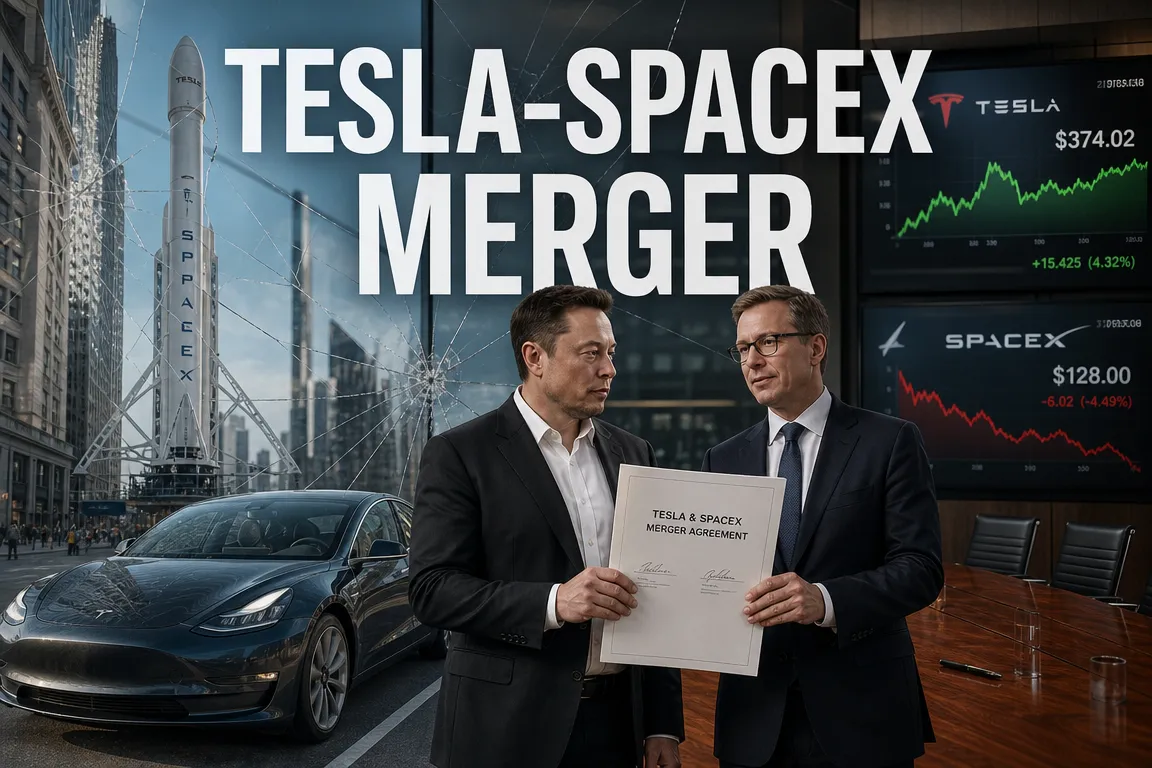
● Tesla Cybercab Shock, NHTSA Probe, 5.92 Percent Drop
Tesla Cybercab NHTSA Review: The Core Issue Is the Certification Basis, Not the Steering Wheel
The key issue in this case is not whether NHTSA is demanding that Tesla add a steering wheel to the Cybercab.
The central question is whether Tesla self-certified a Cybercab without a steering wheel, brake pedal, accelerator pedal, or mirrors as compliant with federal safety standards, and whether NHTSA is now requesting the supporting documentation.
Tesla shares closed at $354.08, down 5.92% on the day.
On the same day, the S&P 500 fell 0.38%, the Nasdaq declined 0.29%, and the Dow Jones Industrial Average lost 0.51%.
The move therefore appears driven more by company-specific developments, especially the Cybercab event and related regulatory risk, than by broader market weakness.
One important detail has received less attention in the media.
The current NHTSA action is not a recall and not a stop-sale or stop-operation order.
The proceeding appears closer to a certification review, and Tesla’s Austin robotaxi app reservations reportedly remain active.
More important for investors, the investigation is reportedly covering 1,000 vehicles, not just the 45 registered in Texas.
This suggests scrutiny of the broader Cybercab production and certification framework, not only the vehicles already on the road.
1. Why Tesla shares fell 5.92%: a clash between expectations and disappointment
Tesla shares closed at $354.08, with a 5.92% daily decline.
The move effectively reversed most of the gains from the prior day, when the stock had risen more than 5% on Cybercab-related expectations.
Broader U.S. markets were relatively stable as investors awaited labor data.
Given that the Nasdaq fell only 0.29%, Tesla’s decline appears to reflect company-specific concerns rather than a broad risk-off move.
- Tesla shares: $354.08, -5.92%
- S&P 500: -0.38%
- Nasdaq: -0.29%
- Dow Jones Industrial Average: -0.51%
- SpaceX implied share price: $147.95, -1.2%
The market reaction was not simply a negative reassessment of Tesla.
More precisely, investors appear to have been disappointed by the lack of concrete numbers at the Cybercab event.
Robotaxi services remain a major AI and autonomy theme from a growth-investment perspective.
However, the absence of clear disclosures on pricing, fleet size, service expansion, and revenue model increased volatility.
2. Why the Cybercab event was seen as falling short of expectations
The Austin Cybercab event was largely private and invitation-only.
It was not livestreamed, and Elon Musk did not appear in person.
Key investor questions were not fully answered, including when Tesla would begin charging fares, how quickly fleet size would scale, and how far the service area would expand.
Wells Fargo said in a report that the Cybercab launch event fell short of expectations.
The bank also said Tesla’s Austin robotaxi service appeared to face early execution issues.
- Some users reportedly said routes were incorrect.
- Some reported overshooting their destinations.
- Wait times were longer than expected.
- Ride times were also described as longer than expected.
However, these developments can also be interpreted as signs of early-stage demand pressure.
Tesla reportedly moved the general public access time earlier from 5:00 p.m. to 2:00 p.m., and wait times increased from around 5 to 10 minutes to more than an hour after launch.
Pricing also reportedly rose with demand.
This indicates that Tesla is using a dynamic pricing structure.
In practical terms, prices rise as demand increases and fall as supply improves.
Over time, this could support a more flexible pricing model than traditional taxi fares.
3. The substance of the NHTSA review: not “add a steering wheel,” but “show the basis for compliance”
The most widely misunderstood part of this issue is the NHTSA review.
Some reports have portrayed the U.S. safety regulator as if it were trying to block Cybercab operation because the vehicle lacks a steering wheel.
However, the key point is different.
NHTSA is reportedly asking Tesla not to add a steering wheel, but to provide the process and technical data that support Tesla’s certification of the Cybercab as compliant with safety standards.
- The investigation number was identified as AQ26002.
- The AQ prefix suggests a certification-audit type of review.
- The opening date is described as September 3, the date Cybercab began carrying passengers.
- The current stage is neither a recall nor an order to suspend operations.
- The Austin robotaxi app reportedly continued accepting reservations after the review became public.
The U.S. auto regulatory framework is based on self-certification.
Unlike some other markets, manufacturers in the United States may certify that their vehicles comply with Federal Motor Vehicle Safety Standards and then sell them.
The government does not inspect every vehicle in advance.
Instead, if questions arise later, regulators can request the underlying basis for that certification.
This NHTSA review appears to fall within that process.
4. Why Tesla became a focal point: certain standards were treated as not applicable
The Cybercab differs structurally from a conventional vehicle.
It does not have a steering wheel, brake pedal, accelerator pedal, or mirrors.
Tesla appears to have concluded that some safety standards do not apply to this vehicle design.
That is the core issue NHTSA is reviewing.
In simple terms, a conventional vehicle must answer every question on the exam.
Tesla appears to have treated some requirements as outside the scope of the Cybercab.
NHTSA is now asking for the basis on which those requirements were considered inapplicable.
This is not only a regulatory dispute. It also illustrates how safety standards may need to evolve as autonomous vehicles replace human-controlled ones.
5. FMVSS 135 and the brake-pedal issue: performance remains, but the mechanism changes
To understand the Cybercab issue, it is necessary to look at the Federal Motor Vehicle Safety Standards, or FMVSS.
FMVSS 135 relates to light-vehicle braking systems.
The standard was established in 1995 and was built around the assumption that a driver presses a brake pedal.
That assumption does not necessarily apply to a fully autonomous vehicle.
If there is no driver, a foot-operated pedal may not be required.
NHTSA has been working on updates for vehicles with and without manual controls.
According to the original text, manual-control concepts became important in a 2022 update involving crash-stability-related standards.
Exceptions for vehicles without manual controls have also been addressed in areas such as windshield wipers and tire labeling.
The key direction of FMVSS 135 reform is straightforward.
- Not every vehicle may need a brake pedal.
- However, the vehicle must still stop within the required distance.
- The regulatory focus is therefore shifting from whether a pedal exists to whether the vehicle can stop safely.
This is the critical point.
NHTSA’s review of Cybercab may not be a simple rejection of the vehicle because it lacks legacy controls.
It may instead be a request to formally verify how this new vehicle architecture meets existing safety objectives.
6. The core Cybercab technology: a vehicle without brake fluid or hydraulic lines
The Cybercab is not simply a car with the steering wheel and pedals removed.
Its design philosophy differs materially from that of conventional vehicles.
One of the most important technical points in the original text is the braking system.
The Cybercab does not use brake fluid.
It does not have brake lines or a master cylinder.
Instead, each wheel has an electronic actuator that provides braking directly.
This is a brake-by-wire architecture, or an electronic braking system.
Elon Musk has said that electric braking can reduce the complexity of hydraulic systems and eliminate the need for vehicle-wide fluid plumbing.
This is not merely a component change.
It is directly connected to Tesla’s Unboxed manufacturing process.
The Unboxed process assembles separate modules and joins them later, rather than building the car as a single integrated unit.
Removing hydraulic plumbing makes that production model easier to implement.
Combined with injection-molded body panels and the potential elimination of paint processes, this could materially reduce manufacturing and maintenance costs.
7. The economics of robotaxis: eliminating maintenance items is essential to profitability
For a robotaxi business, vehicle price is not the only variable that matters.
For a commercial vehicle running all day, maintenance time directly reduces revenue generation.
If a vehicle is in a service bay, it is not earning money.
Tesla is therefore designing Cybercab to eliminate as many maintenance requirements as possible.
- Removal of brake-fluid inspections
- Removal of hydraulic lines
- Reduction in complex mechanical components
- Electronic braking system
- Potential reduction in paint-related processes
This also explains why Tesla should be viewed less as a conventional automaker and more as an autonomy platform company.
The business model is not centered on a one-time vehicle sale, but on recurring revenue from vehicle operation.
From an AI-investment perspective, Cybercab is closer to physical AI infrastructure than to a standard EV.
8. A rare-earth-free motor: a strategy to reduce China supply-chain exposure
Another important technical point is the Cybercab motor.
Elon Musk has said the Cybercab motor contains no rare-earth materials.
Rare earths are strategic materials in which China has significant influence over global supply chains.
Whenever U.S.-China tensions intensify, rare earths tend to reemerge as a negotiation lever.
If Tesla has eliminated rare earths from Cybercab, the implication goes beyond cost reduction.
It also reduces supply-chain risk from a global macro perspective.
For a business model built on large-scale deployment, reducing exposure to country-specific raw-material constraints is strategically important.
One frequently overlooked aspect of the Cybercab story is that Tesla appears to be pursuing lower manufacturing cost, lower maintenance cost, and lower supply-chain risk simultaneously.
9. The significance of the 1,000-vehicle figure: future production matters more than the current 45 vehicles
The most notable number in the NHTSA filing is 1,000.
The original text says only 45 Cybercabs are registered in Texas.
Yet the review reportedly covers 1,000 vehicles.
That difference is important.
If the review were limited to the 45 vehicles currently operating, the target number would likely have been much lower.
The 1,000-vehicle figure suggests NHTSA may be reviewing the certification logic for future production as well.
In other words, the regulator is not only asking whether a crash has occurred on public roads today.
It is also asking what legal and technical basis supports Tesla’s claim that the vehicle meets safety requirements before mass production begins.
10. Tesla’s robotaxi network intake page: a quiet but meaningful signal
According to the original text, Tesla quietly opened a robotaxi network intake page on September 3.
The page appears to allow companies to express interest in purchasing multiple Cybercabs or deploying them in specific markets.
There was no pricing and no delivery schedule.
However, the existence of the page is meaningful.
It signals that Tesla is preparing to expand Cybercab beyond a concept vehicle into a networked commercial service.
This leads to the key question for investors.
Can Cybercab realistically be sold for less than $30,000?
Polymarket reportedly saw betting activity around whether Tesla could deliver a Cybercab below $30,000 by 2026, with expectations moving before the event and declining after the NHTSA review became public.
11. The $30,000 Cybercab debate: delivery timing matters more than price alone
Tech YouTuber Marques Brownlee previously joked that he would shave his head if Tesla delivered a Cybercab to customers under $30,000 before 2027.
After Tesla began carrying real passengers, the issue regained attention.
He reportedly maintained that his hair was still safe, arguing that the key issue is whether the vehicle is actually delivered to end customers.
Elon Musk responded with a remark suggesting Brownlee seemed eager to keep the bet alive.
The key point is not whether Cybercab can drive on public roads.
The real issue is whether it can be delivered to individual or commercial customers at an actual market price.
The next major catalyst for Tesla’s stock may therefore be the transition from experiment to commercialization.
12. The real market being changed by Cybercab: not vehicle sales, but the redefinition of travel time
One of the most important changes implied by the Cybercab story is the passenger experience inside the vehicle.
People who have ridden in Cybercab reportedly said they realized for the first time what they can do when they are no longer driving.
That observation matters.
Driving has long been treated as an ordinary part of life rather than labor.
Some people call it a pleasure drive, and others treat it as a hobby.
But once driving disappears, travel time becomes usable time.
The original text says Cybercab is expected to include Starlink.
That would enable uninterrupted 4K video streaming, gaming, music, and even sleeping with the seat reclined.
This is not just a convenience feature.
A robotaxi can turn travel time into media, gaming, commerce, advertising, and productivity time.
In an AI-driven economy, time capture is an important revenue asset.
That is why the debate over Tesla is really about whether it is an automaker or an AI platform company.
13. The erosion of car-loan economics: consumers may ask whether they need to own a car
If Cybercab scales successfully, consumer vehicle ownership patterns could change materially.
For example, suppose a person leaves a hotel to get coffee.
An app summons a Cybercab to the lobby.
The passenger rides for 10 minutes, watches a video, and exits at the destination.
No tip is required.
There is no need for small talk with a driver.
After coffee, another ride returns the passenger to the hotel.
In that scenario, the owned vehicle disappears from the equation.
So does the multi-year car loan.
If Cybercab becomes sufficiently affordable, fast, and convenient, the economics of car ownership could weaken for urban users.
This could affect not only EV demand, but also consumer finance, auto insurance, used-car pricing, urban mobility, and platform economics.
14. What Tesla investors should monitor next: vehicle-level economics, not just sales volume
Until now, Tesla has largely been evaluated using the metrics of a conventional automaker.
Quarterly deliveries, average selling price, automotive gross margin, and inventory levels have been the main focus.
Once Cybercab scales, the key metrics change.
Investors will need to focus less on how many vehicles Tesla sells and more on how many hours each vehicle operates per day.
What matters is how much each vehicle earns daily, how much maintenance costs, and how much idle time remains.
- Daily operating hours per Cybercab
- Daily and monthly revenue per vehicle
- Revenue per mile and cost per mile
- Maintenance downtime and utilization rates
- City-level demand and supply balance
- Average fares under dynamic pricing
- Cost structure of autonomous software
- Additional revenue from Starlink, content, and advertising
- Speed of regulatory approval across markets
What Tesla discloses in future earnings calls will be important.
If Tesla begins reporting vehicle-level revenue, utilization, and operating-hour metrics for Cybercab, the market may begin to value the company less as an EV manufacturer and more as a robotaxi platform.
Without those disclosures, investors will continue to apply the valuation framework of a traditional automaker.
15. The most important points other reports often miss
First, NHTSA is not currently asking Tesla to add a steering wheel; it is asking for the basis of certification.
That difference is substantial.
If the regulator were demanding a steering wheel, the Cybercab design itself would be in question.
But if the request is for certification support, Tesla may be able to defend its position with technical data and procedural evidence.
Second, the reference to 1,000 vehicles may indicate scrutiny of future production, not just the current fleet.
With only 45 vehicles registered in Texas, a 1,000-vehicle review suggests that regulators are examining the certification logic for scale production.
Third, Cybercab is not simply a car without pedals; it is a vehicle that removes the hydraulic braking architecture itself.
A simple “no brake pedal, therefore unsafe” analysis does not capture the full issue.
The key question is whether the electronic braking system meets established safety performance requirements.
Fourth, the rare-earth-free motor is a supply-chain strategy.
This is relevant not only as a technical detail, but also from the perspective of global supply-chain restructuring and macro risk.
Fifth, the real revenue model for Cybercab is vehicle utilization, not vehicle sales.
The central question is whether Tesla can be revalued from an EV manufacturer into an AI-enabled mobility platform.
16. What investors should watch at the $354 level
The latest decline is uncomfortable for Tesla shareholders.
However, the nature of the move matters.
Investors should distinguish between a decline caused by direct deterioration in fundamentals and a decline driven by expectations running ahead of available information.
The current situation contains elements of both.
- The event’s lack of a concrete price and timeline was clearly a negative factor.
- The timing of the NHTSA review weighed on sentiment.
- However, the review is not a recall or a stop-operation order.
- Cybercab demand appears to be outpacing supply.
- Long-term upside remains tied to cost reduction and supply-chain simplification.
Investors should therefore focus on more than short-term stock movement.
The more important variables are the timing of robotaxi commercialization, the regulator’s findings, and whether Tesla begins disclosing vehicle-level economics.
This is not investment advice, but rather an interpretive framework for the issue.
Tesla shares may continue to move sharply based on rates, U.S. equity valuations, EV demand, AI sentiment, and regulatory developments.
< Summary >
Tesla shares fell 5.92% to $354.08 after the Cybercab event.
The decline was larger than the move in the broader U.S. market and appears to reflect disappointment over the event and the NHTSA review.
However, the key issue in the review is not whether NHTSA wants Tesla to add a steering wheel, but whether Tesla can provide the basis for certifying Cybercab as compliant with safety standards.
The current review is a certification audit, not a recall or a stop-operation order.
The reference to 1,000 vehicles rather than 45 suggests regulators may be examining the certification framework for future production as well.
Cybercab removes brake fluid and hydraulic lines and uses an electronic braking system.
Rare-earth-free motors, lower maintenance requirements, and the Unboxed manufacturing process are all long-term efficiency drivers for robotaxi economics.
For investors, the key metrics ahead are vehicle operating hours, revenue per vehicle, utilization, maintenance cost, and regulatory approval speed, not unit sales alone.
Tesla’s long-term valuation may depend on whether the market begins to treat it less as an EV manufacturer and more as an AI-driven autonomous mobility platform.
[Related Articles…]
*Source: [ 오늘의 테슬라 뉴스 ]
– NHTSA가 사이버캡에서 요구한 건 핸들이 아니었습니다, 무엇을 봐야 하나? 테슬라 주가 $354 주주는?
● AI,Semis,K-Beauty,Shocking,Travel,Wealth
Reading 2026 Investment Signals from a Phuket Travel Vlog: Equities, Semiconductors, K-Beauty, and AI Trends
The core of this Phuket vlog was not simply travel content.
On the surface, it appears to be a leisure trip to Phuket with cast members from a reality show, but underneath it contains practical signals on how to view the stock market, the risks of leverage for beginners, the philosophy of buying breakouts, K-beauty global expansion, the creator economy, and AI-based global content strategy.
In particular, the view that investors should not buy falling stocks simply because they look cheap, but instead focus on stocks that the market has begun to favor, is highly relevant in a volatile market environment.
This perspective is also relevant for readers focused on macroeconomic issues such as the global economic outlook, interest rate outlook, and exchange rate outlook.
Ultimately, capital tends to flow first toward areas where attention, content, consumption trends, and brand expansion potential appear before the numbers fully confirm the move.
1. Surface-level content of the Phuket vlog: reality show cast, rest, exercise, and a group trip
The video follows a group trip to Phuket.
After arriving at the airport, the group stops at a convenience store for protein drinks, snacks, and fruit.
With help from a local contact, the trip progresses smoothly from transportation to hotel check-in.
The accommodation is presented as Twinpalms Resort, with a high-end resort atmosphere reflected in the reactions on screen.
Its duplex structure, pool, breakfast, palm trees, and relaxed vacation setting are emphasized.
The itinerary then continues with breakfast, gym workouts, swimming, poker, a boat club, night market visits, local restaurants, Lion Land, and a temple visit.
Overall, the video blends entertainment-style framing with a travel vlog format.
2. The real focus was investment philosophy, not travel
The most repeated theme throughout the video is investing.
Stocks, crypto, semiconductors, SK hynix, D’Alba, APR, Medicube, leverage, signal rooms, and breakout buying appear naturally in the conversation.
The most important investment message is that investors should not try to stand out from the market, but should focus on what the market is favoring.
In practical terms, if semiconductors are the dominant sector, there is no need to insist on overlooked crypto assets or lower-ranked stocks simply to be different.
One of the most common mistakes among inexperienced investors is excessive confidence in being contrarian.
The video frames this as a form of overconfidence similar to a “student syndrome” approach to investing.
Investors may believe they can identify hidden value, but the market is often less forgiving than expected.
3. Breakout investing: why stronger stocks deserve attention
One of the clearest messages in the video is the preference for new highs.
A new high does not simply mean a stock has risen significantly.
It can signal that the market is beginning to reassess the company.
Admittedly, stocks at new highs may feel expensive.
However, strong stocks can continue to rise when market expectations and narrative momentum remain intact.
SK hynix is cited as an example.
AI semiconductor demand, HBM, and data center investment expansion have driven capital into the semiconductor sector, and the market has continued to assign a positive outlook to SK hynix.
This logic is also relevant when evaluating the global economic outlook.
Even when the growth outlook, interest rate outlook, and exchange rate outlook remain complex, capital typically moves first to the sectors with the clearest future growth narrative.
4. Why new lows deserve caution
The video also notes that stocks making new lows should generally be approached cautiously.
Many novice investors assume that a large price decline means a stock is cheap.
In equity markets, however, stocks that appear cheap often continue to decline.
There is usually a reason for falling prices.
Common causes include weaker earnings, lower growth expectations, loss of market attention, intensifying competition, and valuation compression.
By contrast, a new high can indicate that the market is beginning to reassess a company’s future.
That does not mean investors should buy every breakout.
The key is to determine whether earnings, industry change, supply-demand conditions, story flow, and global expansion potential support the move.
5. For beginners, the most important skill is scaling capital gradually
The video also offers practical advice for beginners.
It warns against starting with capital that is too large to handle.
500,000 won, 10 million won, 50 million won, and 100 million won each feel very different in practice.
As investment size increases, emotional reactions to volatility also become stronger.
Beginners should therefore gain experience with small amounts first and increase their capital gradually.
The comparison to exercise is straightforward.
Attempting to lift too much weight at the start leads to injury.
Investing works the same way: starting with more capital than one can psychologically manage often leads to poor decisions.
6. Why leverage is especially dangerous for beginners
The video repeatedly emphasizes that leverage should not be used.
Borrowing money to invest is particularly risky for inexperienced investors.
Equity markets can move against an investor at any time.
Even high-conviction stocks can fall 20%, 30%, or 50% in the short term.
If an investor uses cash, such volatility may be manageable; with leverage, it can lead to forced liquidation or psychological breakdown.
The video mentions that some full-time traders operate with 120% or even 200% exposure.
However, it also emphasizes that such positions can be liquidated quickly.
For salaried workers or creators with other income sources, maintaining primary cash flow and investing only within manageable limits is more important.
7. The role of cash reserves: why one year of living expenses matters
Another notable point is the approach to holding cash.
The video says that at least one year of living expenses is kept in reserve.
For ordinary investors, keeping only one year of living expenses while allocating the rest to equities may still seem aggressive.
Within investment communities, however, this is sometimes seen as a disciplined approach to cash management.
The important point is that there is no single correct rule.
Investment behavior should reflect differences in occupation, income stability, family situation, experience, and risk tolerance.
That said, investing all capital without an emergency buffer or borrowing to invest should be avoided.
Markets can become volatile regardless of the global economic outlook, interest rate outlook, or exchange rate outlook.
8. The risks of signal rooms, impersonation accounts, and sensational investment content
The video also discusses signal rooms and impersonation accounts.
There are many cases in which scammers impersonate well-known investors or creators to drive users into comments, direct messages, or group chats.
Beginners are especially vulnerable to short-form content showing rapid gains.
Videos of young investors making large returns through leverage are highly provocative.
However, every success story represents many more who failed while attempting the same strategy.
The video implies that for every one visible success clip, many others have already lost money.
This is a realistic assessment.
Investment content tends to overrepresent winners.
Those who lose often disappear quietly, while those who succeed go viral.
Beginners should therefore prioritize risk management, position sizing, and cash flow before chasing high-return content.
9. Why the message “opportunities will come again” matters
One of the most constructive messages in the video is that opportunities will come again.
Missing the semiconductor rally does not mean the cycle is over.
There have been opportunities in Tesla, Palantir, and AI semiconductors, and new opportunities will continue to emerge.
The most dangerous mindset in investing is the belief that one trade must change everything.
That mentality leads to concentration, leverage, signal rooms, and speculative crypto bets.
The market does not end after one missed opportunity.
What matters more is building the ability to recognize the next one.
10. K-beauty investment signals: why D’Alba, APR, and Medicube were mentioned
Later in the video, D’Alba, APR, and Medicube are mentioned.
This appears incidental in the travel format, but it is a meaningful investment signal.
As market attention concentrates on semiconductors, consumer stocks have received less focus.
However, D’Alba continues to show operating strength and retains room for global expansion.
APR’s Medicube has already expanded rapidly across multiple countries, with further expansion potential in markets such as Latin America.
D’Alba is smaller than APR, but it still has many countries to enter and many product lines to expand.
The key point is not the individual names themselves.
When evaluating global consumer brands, investors should consider brand fandom, influencer marketing, community formation, and country-by-country expansion potential.
11. D’Alba’s community strategy: authenticity-driven marketing
The video suggests that D’Alba builds community differently from many other brands.
Rather than relying only on paid advertising, it encourages people who genuinely like the brand and its products to create content organically.
Consumers now identify advertising very quickly.
By contrast, when influencers appear to use a product in real life, conversion probability rises.
This applies not only to K-beauty, but also to global consumer brands more broadly.
Brand strength is increasingly built through TikTok, Instagram, YouTube Shorts, community reviews, and AI recommendation algorithms rather than traditional TV advertising.
For that reason, AI trends and consumer stocks are closely linked.
Recommendation systems increasingly influence which products are surfaced, and that can directly affect revenue growth.
12. The creator economy: another structural change visible in the Phuket trip
The video also reflects the realities of the creator economy.
During the trip, the participants continue discussing content ideas, food formats, signature gestures, short-form clips, and casting approaches.
At the boat club, they approach foreigners directly and use translation apps to produce content.
This is not merely an entertainment scene.
It shows that creators now need to function as planners, performers, producers, marketers, and salespeople at the same time.
The video explicitly notes that a true creator must operate across all of those layers.
This is also consistent with the broader shift in the AI content industry.
AI editing, AI translation, AI subtitles, AI thumbnails, and AI data analysis are enabling individual creators to pursue global audiences.
The use of translation apps to create content with foreigners at the boat club is a small example of where the creator economy is heading.
13. The key AI trend: language barriers are falling
The use of translation apps when approaching foreigners is presented naturally in the video.
Although this may seem minor, it is important from an AI trend perspective.
In the past, lack of English ability made global content production difficult.
Today, AI translation apps, automatic subtitles, and real-time interpretation tools are rapidly reducing language barriers.
Creators, brands, travel businesses, education businesses, and commerce companies will increasingly need to use these tools.
K-beauty brands working with overseas influencers, or Korean creators reaching audiences in Taiwan, Thailand, or the United States, can scale much more easily because of AI translation technologies.
In that sense, artificial intelligence is not only a big tech story.
It is reshaping local travel, consumer marketing, individual content creation, and global fandom formation.
14. Phuket consumption trends: convenience stores, resorts, boat clubs, and local dining
The video also reveals consumer trends in Phuket.
Convenience stores are well stocked with protein drinks, Japanese-brand products, and a wide range of ready-to-eat items.
This suggests that consumption levels in major Southeast Asian tourist destinations are rising quickly.
Mango, local noodle shops, modern night markets, premium resorts, and boat clubs coexist across different consumer segments.
Phuket appears to be more than a low-cost travel destination; it is a tourism economy combining wellness, luxury, content creation, dining, and nightlife.
These changes matter when evaluating Thailand’s tourism sector.
Recovery in Chinese tourism, growth in India’s middle class, demand from Korean and Japanese travelers, and long-stay demand from Europe could all keep Thailand’s tourism economy in focus.
15. Wellness and exercise: a new center of travel spending
Exercise is another visible theme in the trip.
After breakfast, the group goes to the gym and uses rowing machines, SkiErg equipment, swimming, and stretching.
Although the trip jokes about shifting from wellness to poker, wellness-oriented spending is clearly present.
Travel is no longer limited to eating and resting.
Consumers now want better lodging, better food, exercise facilities, pools, recovery, and mental refreshment.
This connects to the global travel industry, sportswear, health supplements, fitness platforms, and wellness resort markets.
It also links to AI trends.
Future services may increasingly recommend personalized fitness programs at travel destinations based on individual activity data.
16. Poker and investing: shared themes of probability, emotion, and capital management
Poker appears frequently in the video.
What is notable is how closely poker resembles investing.
Both are probability-based, require emotional control, and depend on capital management.
A strong hand does not guarantee a win.
Weak hands can be played aggressively, but repeating that behavior increases risk.
The same applies to investing.
A good stock can still be mistimed, and market conditions can change abruptly.
That is why no one should risk all of their capital on a single decision.
Survival over time is what allows investors to capture the next opportunity.
17. A message applicable to both careers and investing: response matters more than events
The video also touches on reality show exposure, limited screen time, online criticism, and how people respond to professional identity.
The key takeaway is that what happens to an individual cannot always be controlled, but how they respond to it can be.
This applies to careers and to investing.
A stock decline is an event that has already occurred.
Weak audience response to a piece of content is also an event that has already occurred.
What matters is the next decision: cut the position, hold it, add more research, revise the strategy, or try again.
That mindset is what separates long-term performers from the rest.
18. The most important points that are often underreported elsewhere
First, markets move on attention before they fully move on numbers.
Semiconductors are strong not only because of earnings, but also because the market’s imagination has attached to them.
K-beauty can regain attention for the same reason: not only revenue, but also global community formation and content distribution power.
Second, new highs are both a warning and a validation signal.
Most investors fear new highs, but for strong companies they may mark the beginning of a major re-rating.
The relevant question is not simply how much a stock has already risen, but why it rose and whether the market has reason to continue favoring it.
Third, a beginner’s real skill is not stock selection but position sizing.
Most people focus only on finding good stocks.
In practice, those who survive long term know how much capital their own psychology can handle.
This is one of the most underrated investment skills.
Fourth, AI translation and short-form content are changing the pace of global brand expansion.
The scene of using a translation app to create content with foreigners at a boat club may look small, but it reflects the direction in which creators and brands are heading.
As language barriers fall, the pace of overseas expansion for K-beauty, K-content, and Korean creators is likely to accelerate.
Fifth, the common thread between investing and content creation is not a single big win, but a structure that allows survival until the next opportunity.
The stock market, YouTube, and careers are not games with one decisive outcome.
Performance accumulates through continued observation, continuous adjustment, and repeated execution.
19. Investment checklist summary
-
Identify which sectors the market currently favors.
-
Capital tends to flow to sectors such as semiconductors for specific reasons.
-
New-high stocks should be analyzed, not automatically avoided.
-
New-low stocks may look cheap but can reflect structural weakness.
-
Beginners should increase capital exposure gradually.
-
Leverage and borrowed-money investing should be avoided until experience is sufficient.
-
Signal rooms, impersonation accounts, and exaggerated return content should be treated with caution.
-
K-beauty companies should be evaluated on brand fandom, global expansion, and influencer strategy.
-
AI trends affect not only big tech, but also consumer brands, travel, and content industries.
-
Missing one opportunity is not the end; the next one will come.
20. Key links to the economic outlook
First, AI infrastructure investment remains central to the market.
SK hynix, HBM, data centers, and the semiconductor sector remain important pillars of the stock market.
Second, consumer brands can be re-rated strongly when attention returns.
K-beauty, healthcare, and wellness consumer stocks that were overshadowed by semiconductors may regain attention once global expansion is confirmed.
Third, the interest rate outlook and exchange rate outlook matter for companies with overseas revenue.
Global expansion companies such as D’Alba and APR are affected by exchange rates, foreign consumer demand, logistics costs, and marketing expenses.
Fourth, AI translation and short-form algorithms are lowering the cost of global entry.
In the past, international expansion required large advertising budgets and local organizations.
Today, influencer networks, short-form virality, and AI automation tools can support early-stage expansion.
[Related Articles…]
- AI Semiconductor Supercycle and Global Equity Market Outlook
- K-Beauty Global Expansion and Consumer Investment Trends
*Source: [ 내일은 투자왕 – 김단테 ]
– 푸켓에 솔로지옥 찍으러 갔습니다.