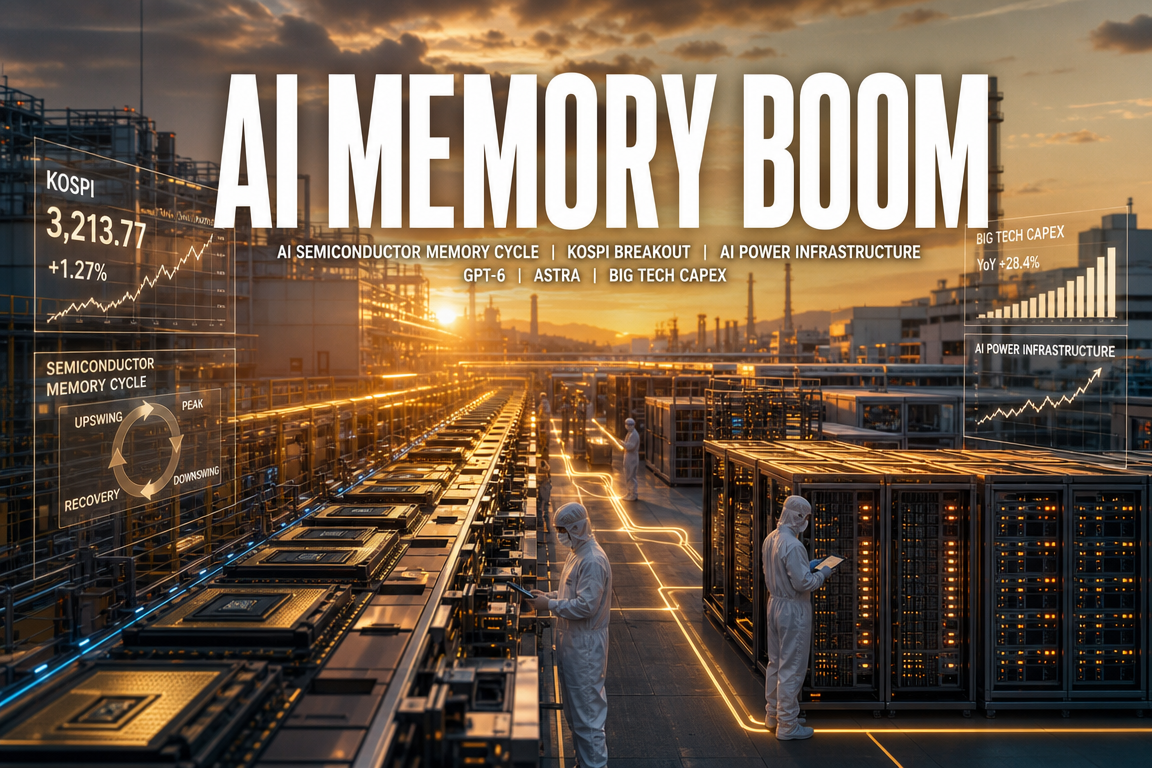
● AI-Fueled-Kospi-Breakout
Why This Week Matters for the KOSPI: AI Semiconductors, the Memory Cycle, and Power Infrastructure Are Moving Together
The key point in the current KOSPI move is not simply that Samsung Electronics and SK Hynix rose.
The main issue is that renewed competition in AI models, expectations for higher big-tech CAPEX, a recovery in memory semiconductor demand, simultaneous strength in nuclear power and power equipment, and the possibility of a breakout from the KOSPI trading range are all converging at the same time.
In particular, the market has begun to reprice expectations for next-generation AI, represented by terms such as GPT-6 and Astra.
If AI momentum strengthens again, the companies that will increase spending are likely to be global big tech names such as OpenAI, Google, Microsoft, Meta, and Amazon.
When big tech expands spending, the first assets to react are AI semiconductors, the memory cycle, and data center power infrastructure.
This is why the KOSPI outlook matters this week: the linkage is becoming active again.
1. Why the KOSPI Was Strong Today: AI Expectations Reconnected to Memory
The most important interpretation in the original text is that the market is reading this as a renewed improvement in AI activity.
As expectations rise for next-generation AI models and AI agents, investors are once again focusing on the AI infrastructure investment cycle.
The better AI models become, the more computation is required.
More computation requires more GPUs, HBM, DRAM, NAND, servers, and data centers.
In the end, competition in AI services leads to higher big-tech CAPEX, and the resulting benefits extend to semiconductors and power infrastructure.
- AI model advancement -> higher computing demand
- Higher computing demand -> more data center investment
- More data center investment -> higher demand for GPUs, HBM, and DRAM
- Higher memory demand -> improved investor sentiment toward Samsung Electronics and SK Hynix
- Higher power consumption -> stronger interest in nuclear power, power equipment, and transformer-related stocks
Accordingly, the strength in Samsung Electronics and SK Hynix should be viewed less as a simple rebound and more as a market response to expectations for a renewed AI CAPEX cycle.
2. Why Memory Semiconductors Reacted the Most
Memory semiconductors had been one of the most heavily pressured sectors in recent periods.
Although AI demand remains constructive over the long term, the sector had been weighed down by concerns over a slowdown in big-tech investment, debate over peak semiconductor earnings, and valuation pressure after a sharp rally.
When signs emerge that competition in AI models is intensifying again, the market first interprets this as a sign that big tech will resume spending.
The most direct beneficiary of that shift is memory.
In particular, SK Hynix is recognized as a leading AI semiconductor beneficiary because of its competitiveness in HBM.
Samsung Electronics has been seen as relatively lagging, but if memory upturn expectations and HBM supply prospects improve, the impact on the KOSPI index can be substantial.
This is due to the large market capitalization weights of Samsung Electronics and SK Hynix within the KOSPI.
As a result, expectations for a longer memory cycle are not merely a stock-specific issue but a factor that can alter the overall KOSPI outlook.
3. Why Goldman Sachs’ KOSPI 12,000 Forecast Is Drawing Attention Again
Another notable point in the original text is that Goldman Sachs has maintained its KOSPI target at 12,000.
While that level appears aggressive relative to the current index, the more important issue is the underlying rationale.
Goldman Sachs is centered on the view that the memory cycle may remain extended.
In other words, if AI demand develops into a structural investment cycle rather than a short-lived theme, Korean equities could justify a much higher valuation.
Korean equities have long been discounted under the so-called Korea discount.
However, as Samsung Electronics and SK Hynix become increasingly important within the AI semiconductor supply chain, global investors may begin to reassess the Korean market.
If memory semiconductors are re-rated not as a cyclical industry but as a core AI infrastructure asset, the KOSPI valuation ceiling may shift higher.
4. Why This Week Is Especially Important: The KOSPI Is Reaching the Upper End of Its Range Again
From a technical perspective, the KOSPI is entering an important zone this week.
The original text notes that the index had previously moved to the upper end of its trading range and that the key question is whether it can break through that level again.
In equity markets, the upper boundary of a range is a key psychological level.
If the index fails there, disappointment-driven selling may follow.
Conversely, if it breaks through with trading volume, investors may begin to view the move as a potential trend shift.
This attempt is especially important because it is being driven not only by technical factors, but also by AI semiconductors, the memory cycle, power infrastructure, and global investment bank forecasts.
- If the KOSPI breaks above the upper range, foreign inflows may strengthen.
- If Samsung Electronics and SK Hynix lead the move, index momentum could accelerate.
- If power equipment and nuclear power stocks also strengthen, the AI infrastructure theme may broaden.
- If the breakout fails, short-term profit taking pressure may increase.
5. Why Nuclear Power and Power Equipment Rose Together: AI Is a Power-Intensive Industry
Nuclear power and power equipment are another important part of this move.
Looking only at AI semiconductors would miss half of the picture.
AI data centers consume significant amounts of electricity.
As AI models scale up, server capacity expands, and electricity demand rises sharply.
As a result, global markets are also focusing on grid infrastructure, transformers, power distribution, nuclear power, renewable energy, and cooling systems alongside AI infrastructure investment.
The fact that nuclear power and power equipment moved together, as noted in the original text, is important.
It shows that the market is now viewing AI not just as a software theme, but as a physical infrastructure investment cycle.
As AI data center investment expands, power infrastructure companies may increasingly be re-rated not as a short-term theme, but as part of a medium- to long-term growth industry.
6. The Core Transmission Mechanism: GPT-6 and Astra Expectations -> Big-Tech CAPEX -> Memory and Power Demand
This move can be summarized in one sentence.
When expectations for AI strengthen, big tech spends more, and that spending flows into semiconductors and power infrastructure.
What investors are reacting to now is not AI services alone, but the infrastructure required behind them.
Even if AI models improve substantially, they cannot scale without GPUs, memory, data centers, and power supply.
That is why the market tends to react to next-generation AI model news by looking at NVIDIA, SK Hynix, Samsung Electronics, power equipment, and nuclear power-related stocks together.
In particular, messages interpreted as positive comments on AGI from Jensen Huang have further supported sentiment.
The perception that AGI may be approaching is not simply a technology headline; it can also imply that AI infrastructure investment may continue for several years.
7. The Most Important Point That Is Often Missed in Other Coverage
Most news coverage stops at statements such as “Samsung Electronics rose,” “SK Hynix was strong,” or “AI semiconductor expectations improved.”
What matters more is whether the market is beginning to re-rate memory not as a cyclical industry, but as a core AI infrastructure asset.
This distinction is significant.
If viewed as a cyclical industry, memory is an asset to sell near the top of the cycle.
But if viewed as a core AI infrastructure asset, memory can command a premium over a longer period.
This is one of the reasons a highly aggressive forecast such as KOSPI 12,000 can be discussed.
Another key point is the simultaneous strength in power infrastructure.
If only AI semiconductors rise and power equipment does not follow, the move may remain a short-lived theme.
But if memory and power infrastructure rise together, the market is effectively buying the entire AI CAPEX value chain.
In other words, for this move to be sustained, it is important to see whether the rally expands beyond Samsung Electronics and SK Hynix into nuclear power, transformers, power grids, and data center-related stocks.
8. Key Indicators Investors Should Watch This Week
This week, investors should focus on more than just whether the KOSPI rises or falls.
It is important to monitor which stocks are leading, where foreign investors are buying, and whether trading value is expanding.
- Whether Samsung Electronics and SK Hynix rise together: A joint advance would improve confidence in the index move.
- Whether foreign net buying continues: Global capital inflows are important for a breakout.
- Whether trading value increases: A rally without volume may remain short-lived.
- Whether power equipment and nuclear power stocks broaden the move: This would confirm the AI infrastructure theme.
- The performance of U.S. big tech stocks: NVIDIA, Microsoft, Google, and Meta directly affect investor sentiment toward Korean AI semiconductors.
- Exchange rate and interest rate trends: Excessive won weakness may weigh on foreign inflows.
9. KOSPI Upside Scenario and Risk Factors
The positive scenario is straightforward.
Competition in AI models re-accelerates, expectations for higher big-tech CAPEX improve, and memory pricing and demand outlooks strengthen.
If foreign capital then flows into Samsung Electronics and SK Hynix, the KOSPI may attempt a breakout above its trading range.
There are also clear risks.
If AI expectations are not confirmed by actual order growth, or if big tech signals slower CAPEX execution, semiconductor shares could weaken again.
In addition, many HBM-related stocks have already risen significantly, which may leave them vulnerable to elevated volatility if earnings expectations are not met.
Even if the KOSPI outlook remains constructive, investors should continue to monitor the risk of short-term overheating and profit taking.
10. The Main Takeaway at a Glance
The essence of this KOSPI move is that AI-related headlines are once again driving leadership in Korean equities.
Expectations for next-generation AI are not affecting U.S. technology stocks alone.
Korea is connected to global AI infrastructure investment through memory semiconductors, HBM, power equipment, nuclear power, batteries, and the materials, parts, and equipment supply chain.
Accordingly, if the AI industry re-enters an expansion phase, Korean equities could benefit more than expected.
This week matters because it is the first test of whether those expectations are being confirmed in price action.
If the index breaks above the range, the market is likely to interpret that as evidence that the AI semiconductor cycle is not over.
If it fails again, the market may conclude that expectations remain ahead of confirmation.
< Summary >
The key driver of the current KOSPI move is a renewed wave of AI expectations.
As anticipation builds around next-generation AI models, the prospect of higher big-tech CAPEX has re-emerged.
As a result, Samsung Electronics and SK Hynix, the leading memory semiconductor names, have reacted strongly.
The concurrent strength in nuclear power and power equipment suggests that the market is viewing AI as a data center and power infrastructure investment cycle.
Goldman Sachs’ KOSPI 12,000 forecast reflects an aggressive view based on the possibility of a prolonged memory cycle.
The main points to watch this week are whether the KOSPI can break above the upper end of its trading range, whether foreign inflows continue, and whether AI semiconductors and power infrastructure can sustain joint strength.
[Related Articles…]
*Source: [ 내일은 투자왕 – 김단테 ]
– 코스피 이번주가 특히 중요한 이유 #코스피 #아스트라 #하이닉스
● China Memory Shock, AI Power Race, Korea at Risk
CNXT Memory (CXMT) and the Chinese AI Model Counteroffensive: DRAM, HBM, Data Centers, Physical AI, and the U.S.-China Technology Power Struggle
The key point of this article is not simply that China has caught up with the United States.
The more important issue is that AI semiconductors, data center investment, power infrastructure, AI model market share, and DRAM market share are becoming increasingly interconnected, weakening the position of the Korean semiconductor industry.
In particular, the speed at which China’s CXMT is advancing in the DRAM market, why Chinese AI models are being used more widely than U.S. models, and whether the United States can sustain its large-scale AI infrastructure spending are the main variables to watch.
News coverage often focuses on “NVIDIA GPUs,” “Samsung HBM,” and “SK hynix earnings,” but the next phase will likely be shaped by power grids, low-cost AI models, super-app data, and physical AI robots.
1. The Core of the AI Power Competition: It Is Ultimately a Computing Power Race
The competition between the United States and China has moved beyond trade and tariffs into a technology power struggle centered on AI.
The core of AI leadership is the ability to secure more computing capacity.
Computing capacity requires advanced semiconductors.
Advanced semiconductors require data centers.
Data centers require substantial power infrastructure.
In the end, AI competition is a competition across the chain: semiconductors → data centers → power grids → AI models → AI services.
- The United States is maintaining an advantage through large capital expenditure and hyperscaler-led data center expansion.
- China is rapidly narrowing the gap through lower-cost AI models, power generation capacity, super-app data, and physical AI products.
- Korea retains strengths in DRAM and HBM through Samsung Electronics and SK hynix, but faces increasing pressure from CXMT’s rise.
2. AI Value Chain Structure: Why Platform Companies Became Hyperscalers
In the past, companies such as Naver, Google, Amazon, and Meta were described as platform companies.
As these firms began building AI models directly, investing in massive data centers, and purchasing semiconductors at scale, the label changed.
They are now best described as big tech and hyperscalers.
Hyperscalers operate large-scale AI infrastructure.
When they build data centers, demand rises for NVIDIA GPUs, HBM, DRAM, SSDs, networking equipment, and power systems.
As a result, hyperscaler capital expenditure is a key driver of the global semiconductor cycle.
- AI service companies improve model performance.
- Model development requires more data centers.
- Data center expansion creates demand for GPUs and HBM.
- GPU and HBM demand affects Samsung Electronics, SK hynix, and Micron earnings.
- Semiconductor earnings influence Korean exports, the KOSPI, the won, and investor sentiment.
3. AI Infrastructure Competition: The United States Is Still Ahead
Data centers are the most important component of AI infrastructure.
Global data center count is cited at approximately 12,259.
The United States is said to account for about 4,767 of those.
That means more than one-third of the world’s data centers are concentrated in the United States.
China is cited at around 376 data centers.
China is also a major global player, but the gap with the United States remains significant.
On these figures, the United States still holds a clear lead in AI infrastructure.
- U.S. strengths: data center scale, big tech capital expenditure, NVIDIA ecosystem, and cloud market dominance.
- China’s weakness: fewer data centers than the United States and limited access to advanced GPUs.
- Implication for Korea: increased U.S. data center investment is positive for Korean HBM and DRAM exports.
For this reason, the earnings improvement and share-price gains of semiconductor companies in recent years have been closely linked to U.S. hyperscaler data center spending.
4. Power Infrastructure Competition: Why China May Become More Formidable
Building data centers does not by itself complete AI infrastructure.
Data centers consume enormous amounts of electricity.
It is now widely understood that a single large AI data center can consume power comparable to that of a mid-sized city.
The problem for the United States is power infrastructure.
The country has many data centers, but grid expansion and transmission build-out face local opposition and political constraints.
In some regions, including New York State, power infrastructure and environmental issues frequently limit data center expansion.
China, by contrast, is aggressively expanding power generation capacity.
This is why some analysts argue that while the United States currently leads in AI infrastructure, China may gain an advantage in the long-term pace of expansion.
- AI data centers cannot expand without reliable power.
- The United States leads in data center count, but grid bottlenecks remain a constraint.
- China can mobilize power infrastructure through state-directed investment more quickly.
- Over time, the key bottleneck in AI infrastructure may shift from GPUs to power grids.
This is one of the most important points often missed in other coverage.
The next bottleneck in AI competition may be power rather than semiconductors.
Securing stable electricity supply may become more difficult than purchasing NVIDIA GPUs.
5. AI Model Competition: Why Chinese Models Are Gaining Market Share
In terms of top-end model performance, leading U.S. models remain stronger.
OpenAI, Anthropic, and Google DeepMind continue to release highly capable models.
However, markets are not driven by performance alone.
Chinese AI models are expanding rapidly on the basis of cost efficiency.
Models such as DeepSeek and the Kimi series have narrowed the performance gap while remaining competitively priced.
For enterprises, not every task requires the most advanced model.
For most repetitive work, summarization, translation, code assistance, and document processing, a lower-cost model with adequate performance is sufficient.
AI model gateways such as OpenRouter also support a multi-model usage pattern.
In this structure, users are not locked into a single model and can select the most efficient model for each task.
- Chinese AI model token usage share has reportedly reached around 60%.
- U.S. model dependence has reportedly declined to around 36%.
- This reflects a shift in importance from “best performance” to “market usage.”
Using a car analogy, a Ferrari may deliver the highest performance, but that does not make it the market leader.
The AI model market is moving in a similar direction.
Companies are increasingly using lower-cost Chinese models as default options and reserving premium U.S. models for specific high-value tasks.
6. AI Research Capability: China Is Improving in Citation Influence as Well
AI model competitiveness cannot be measured only by current performance.
Future competitiveness must also be assessed through research capability.
AI paper citation influence is a key indicator of national research standing.
China is rapidly increasing both the volume and influence of its AI research output.
The United States still leads in core foundational technology and the global AI ecosystem, but China’s pace of catch-up is difficult to dismiss.
- China produces a large volume of AI research papers.
- Its citation influence has also improved significantly.
- When low-cost models are combined with stronger research capacity, the performance gap may narrow further.
This should not be viewed as a political issue.
The focus should be on the data and on what risks Korean companies and investors should prepare for.
7. AI Service Competition: The Data Advantage of Chinese Super Apps
The AI service environment differs between the United States and China.
In the United States, services are relatively fragmented.
Facebook and Instagram are social platforms, Amazon is strong in e-commerce, and Uber is strong in mobility.
By contrast, Chinese services such as WeChat, Alipay, and DiDi integrate multiple functions into a single app.
Messaging, payments, shopping, food delivery, ride-hailing, finance, and public services are all connected.
This matters because of data completeness.
AI does not only benefit from large volumes of data; it also benefits from highly connected, multi-dimensional data.
- When a purchase was made.
- Where it was made.
- What was purchased.
- Which payment method was used.
- Subsequent mobility patterns.
- What content the same user viewed.
When this information is connected within a single app, AI services become more predictive.
This improves inventory management, logistics optimization, ride demand forecasting, consumer recommendation engines, and financial risk analysis.
In other words, the strength of Chinese AI services is not simply population size.
The key advantage is that data is accumulated in a more integrated and multi-layered way through the super-app structure.
8. Semiconductor Competitiveness: The United States and Its Allies Still Lead
Semiconductors are the hardware foundation of AI leadership.
China continues to export semiconductors, but it still imports more than it exports.
In other words, China is working to raise self-sufficiency, but full independence has not been achieved.
At present, semiconductor competitiveness remains stronger in the United States and its allied ecosystem.
The United States is strong in design, Japan in materials, the Netherlands in equipment, and Korea in memory production.
This global semiconductor value chain is difficult for China to replicate quickly.
- The United States: semiconductor design, GPUs, EDA, and big tech demand.
- Japan: materials, components, and selected equipment.
- The Netherlands: EUV lithography equipment.
- Korea: DRAM, NAND, and HBM manufacturing strength.
- Taiwan: foundry manufacturing capability.
China is trying to localize this chain.
However, advanced equipment, high-end design, yield, and mass-production experience remain major barriers.
9. DRAM Market Share Shifts: Samsung Electronics and SK hynix Are Losing Share
The most sensitive issue for Korea is DRAM.
Samsung Electronics and SK hynix have long dominated the global DRAM market.
However, the recent share trend is notable.
- In 1Q24, Samsung Electronics and SK hynix are estimated to have held about 75% of the DRAM market.
- In 1Q25, that share is cited at around 70%.
- In 2Q25, it is cited as declining further to about 65%.
The companies gaining share are Micron in the United States and CXMT in China.
At this stage, Micron’s progress appears more visible.
However, CXMT’s presence is also growing quickly.
China is advancing CXMT as part of its push for DRAM self-sufficiency.
CXMT’s share is cited at around 8% in 2025 and may rise to around 11% in 2026.
If this trend continues, CXMT could move into the global DRAM top-tier group.
The key point is not that CXMT will immediately overtake Samsung Electronics or SK hynix.
The more realistic risk is that it could disrupt the pricing structure of commodity DRAM.
If China supplies large volumes of low-cost DRAM, Korean firms will need to move even faster toward higher-value products.
10. HBM Competition: Korea Still Leads, but There Is No Room for Complacency
HBM is the most important memory product in the AI semiconductor market.
At present, SK hynix and Samsung Electronics are the key players in HBM.
Micron is also catching up quickly.
China has not yet established meaningful market traction in HBM.
However, the possibility of CXMT entering HBM investment continues to be discussed.
For China, HBM is necessary if it wants AI self-sufficiency beyond DRAM.
- Current HBM competitiveness still favors Korea and the United States.
- Micron is increasing its presence in the HBM market.
- CXMT remains a late entrant, but it can grow with government support and domestic demand.
- Korean companies must protect technology lead, yield, and customer trust simultaneously.
Going forward, the center of competition is likely to move from commodity DRAM toward HBM, high-bandwidth memory, advanced packaging, and the custom AI chip ecosystem.
11. Korea’s Survival Strategy: The Only Realistic Path Is Technology Differentiation
The United States is trying to build a semiconductor value chain centered on domestic capacity.
China is also trying to build a domestic AI and semiconductor value chain.
The challenge for Korea is clear.
Korea must continue selling to both the United States and China.
But as the U.S.-China technology struggle intensifies, both sides will increasingly prefer supply chains built within their own ecosystems.
In this environment, Korea’s most realistic strategy is technology differentiation.
- In commodity DRAM, the focus should shift from cost competition to higher-value products.
- In HBM, yield, thermal control, and customer-specific supply capability will be critical.
- Expansion into advanced packaging and the AI accelerator ecosystem is necessary.
- Long-term supply agreements, joint development, and strategic partnerships with U.S. big tech are becoming more important.
- Korean firms need a premium memory strategy that is less vulnerable to Chinese price competition.
To maintain leadership, Korea’s semiconductor industry must secure irreplaceable technological capability, not simply production scale.
12. Physical AI: Another Area Where China Is Already Strong
A new segment in the AI value chain is emerging.
This is physical AI.
Physical AI refers to the integration of AI into real products and machines, not just software services.
Robots, automobiles, home appliances, smartphones, industrial machines, medical devices, and drones can all become physical AI products.
Cobots are a representative example.
China already has a strong position in the collaborative robot market.
The gap may widen further over time.
- China has a strong manufacturing base.
- It has many real-world factory environments where robots can be deployed.
- Its ability to mass-produce low-cost hardware is strong.
- The integration of AI models and robotics hardware is advancing quickly.
The United States is strong in AI services and AI infrastructure, but China may move faster in physical AI products.
13. Summary of U.S.-China AI Competitiveness by Segment
| Category | Current Lead | Key Reason | Implication for Korea |
|---|---|---|---|
| AI infrastructure | United States | Data center scale and big tech capital expenditure are dominant. | Higher U.S. investment is positive for Korean HBM demand. |
| Power infrastructure | China has the edge in catch-up | Power generation and state-led infrastructure expansion are faster. | The AI infrastructure bottleneck may shift toward power grids. |
| AI models | U.S. leads in performance, China is gaining share | Chinese models are competitive on cost and usage. | Cost efficiency is becoming more important than peak performance. |
| AI services | Mixed competition | Chinese super apps have richer data integration. | Data connectivity is increasingly decisive for AI service quality. |
| DRAM | Korea leads, China is catching up | Samsung Electronics and SK hynix remain strong, but CXMT is advancing. | Price competition in commodity DRAM may intensify. |
| HBM | Korea leads | SK hynix and Samsung Electronics remain ahead technologically. | Maintaining the technology gap is essential. |
| Physical AI | China is strong | China is growing quickly in robotics and manufacturing integration. | AI competition is extending into manufacturing. |
14. Key Points Often Missed in Other Coverage
First, the next bottleneck in AI competition may be power grids rather than GPUs.
The United States has many data centers, but grid expansion remains difficult.
China may have an advantage in long-term infrastructure scaling because it can push power investment at the state level.
Second, Chinese AI models are pursuing usage share, not just performance leadership.
Companies do not rely only on expensive U.S. models.
The pattern is shifting toward using low-cost Chinese models by default and premium U.S. models when needed.
Third, CXMT’s risk is not immediate displacement of Samsung Electronics and SK hynix.
The more realistic risk is pressure on commodity DRAM pricing and margins.
Korean firms must move faster into HBM and higher-value memory products.
Fourth, the real strength of Chinese super apps is data integration, not simply data volume.
When payments, mobility, consumption, and social data are connected, AI services become more predictive.
Fifth, physical AI may be an area where China can move faster than the United States.
In markets such as robotics, appliances, automobiles, and smart devices, China’s manufacturing base is a major advantage.
< Summary >
The U.S.-China AI power struggle is not limited to AI models; it is a value chain competition spanning semiconductors, data centers, power grids, services, and robotics.
The United States remains dominant in AI infrastructure, but China is advancing quickly in power infrastructure and physical AI.
Chinese AI models are challenging U.S. model share by focusing on cost efficiency and usage scale rather than top performance.
CXMT has not yet surpassed Samsung Electronics or SK hynix, but it is rapidly expanding its DRAM share and may pressure the pricing structure of commodity memory.
Korea’s key strategy is to preserve technological differentiation in HBM, higher-value DRAM, and advanced packaging.
[Related Articles…]
- AI Semiconductor Market Repricing and Outlook for Korean Memory Producers
- U.S.-China AI Power Competition and the Global Investment Outlook
*Source: [ 경제 읽어주는 남자(김광석TV) ]
– 창신메모리(CXMT)가 D램 반도체 장악할까? 중국의 AI모델 시장점유율이 미국을 넘어섰다 [경읽남 261화]