● AI Boom Sparks Massive Data Center Spend
If you want to understand AI, these 6 are all you need to look at: LLM, RAG, AI Agent, MCP, system prompt, model training
The core point you must not miss in this article is not simply that “AI is smart.”
It is more important to understand how AI is actually connected to corporate operations, global economic outlooks, productivity innovation, and digital transformation.
In particular, the LLM, RAG, AI Agent, MCP, system prompt, and model training terms that come up often in today’s AI market are difficult to memorize one by one, but they become much easier to understand when compared to the human body.
LLM is the brain, model training is schooling, RAG is searching the latest materials, AI Agent is the hands and feet, MCP is the nervous system, and the system prompt is the rules of behavior.
If you understand this structure, you can connect all at once why companies are spending money on AI investment, why the competition over AI infrastructure is so intense, and why tech stocks and the AI industry are drawing attention again after interest rate cuts.
1. LLM is the ‘brain’ of AI
At the center of modern AI systems is the LLM, or large language model.
Simply put, an LLM plays the role of AI’s brain.
Just as people think, judge, and speak with their minds, AI understands sentences and generates answers through the LLM.
Representative services such as ChatGPT, Claude, and Gemini all operate based on LLMs.
The LLM looks at the user’s question and predicts the most likely answer.
The original text describes this as a “superpowered version of autocomplete.”
For example, just as autocomplete predicts the next part of a sentence when we type “Today’s weather…” on a smartphone, an LLM can generate not just one sentence, but long reports, emails, code, image descriptions, and strategic documents.
That is why this technology is called generative AI.
- It can generate writing.
- It can create images.
- It can write code.
- It can summarize data.
- It is also used to create audio and video content.
The important point here is that an LLM is not simply a search engine.
A search engine is closer to a tool that finds already existing information.
By contrast, an LLM generates new outputs based on the input it receives.
This difference is what leads to business process automation, content production, customer support, and productivity innovation in software development.
2. Model training and tuning are the process of ‘sending AI to school’
No matter how brilliant a human brain may be, without education it is difficult to handle complex social life.
The same is true for AI.
If the LLM is the brain, then a process is needed to teach that brain.
This process is called model training and tuning.
Model training is the process of teaching AI basic knowledge such as language, mathematics, history, science, coding, and logical structures.
For a person, it is similar to learning about the world from elementary school through university.
Tuning is the work of refining AI in a more specific direction.
For example, if it is an AI used in finance, it can be adjusted to better understand financial terms and risk management regulations.
If it is an AI used in manufacturing, it can be tuned to better handle production processes, quality control, and equipment inspection data.
In healthcare, it can be specialized to understand medical documents and clinical data.
This process matters because the success or failure of corporate AI adoption does not depend simply on whether a company uses the largest model.
What matters more is how well it is trained and adjusted for the actual work environment.
As AI investment increases, this is also why companies are trying to build their own data-based AI models rather than relying only on subscription-based AI services.
3. RAG is the function that lets AI ‘read the latest materials’
LLMs have one major weakness.
They may not know the latest information after the point they were trained.
For a person, it is similar to graduating and then not reading books or news anymore.
To solve this problem, the concept of RAG, Retrieval Augmented Generation, was introduced.
In Korean, this is usually called retrieval-augmented generation.
RAG is a method that makes AI look up external reliable sources before creating an answer and then generate the answer based on those sources.
For example, AI can be made to reference internal corporate documents, the latest news, product manuals, research papers, legal documents, and customer FAQs.
This helps reduce the problem of AI answering based only on old knowledge.
Another important effect is reducing hallucinations.
Hallucination refers to the phenomenon in which AI says incorrect information in a convincing way.
From the user’s perspective, it is easy to believe it as fact because AI speaks with such confidence.
But in corporate operations, this problem can be extremely serious.
- It may present incorrect figures in financial reports.
- It may cite nonexistent precedents in legal review.
- It may provide inaccurate information in medical consultations.
- It may give answers that differ from actual policy in customer support.
That is why RAG is not just a technical feature, but a core infrastructure for improving trust in enterprise AI.
Its value becomes even greater in economic data where real-time accuracy matters, such as inflation, exchange rates, interest rate cuts, and supply chain changes.
This is because AI must answer based on the latest materials to reduce the risk of misreading market conditions.
4. AI Agent is the concept that gives AI ‘hands and feet’
If the LLM is the brain that answers questions, the AI Agent is AI that actually performs actions.
The original text compares this to a person’s hands and feet.
A person thinks with the brain and then moves hands and feet to get work done.
Likewise, an AI Agent uses tools to carry out actual tasks based on what the model determines.
Existing AI chatbots mostly stayed at the level of “answers.”
But AI Agents go all the way to “execution.”
- They can search for information on the web.
- They can read and write databases.
- They can write and run code.
- They can schedule appointments.
- They can draft and send emails.
- They can automatically create reports.
- They can even handle purchasing or reservation tasks on behalf of users.
The original text describes an AI Agent as a “structure in which the model autonomously and repeatedly uses tools to achieve a goal.”
This description is really important.
It is because this is not an AI that simply answers once and stops, but one that understands a goal, makes a plan, uses the necessary tools, checks the results, and then revises again.
For example, if you ask, “Please create this quarter’s global AI semiconductor market report,” an AI Agent might work in the following sequence.
- Search for the latest market data.
- Check semiconductor company earnings.
- Analyze AI server demand and data center investment trends.
- Create related charts.
- Draft the report.
- Review errors and organize the final document.
At this point, AI goes beyond a simple productivity tool and becomes close to a digital workforce.
In the future, it will inevitably have a direct impact on corporate cost structures, employment markets, work methods, and the global economic outlook.
5. MCP plays the role of AI’s ‘central nervous system’
An increasingly important concept in the AI industry these days is MCP, Model Context Protocol.
It is still less well known to the public than LLMs or AI Agents, but in reality it is highly likely to become a very important technical standard going forward.
For the human brain to move hands and feet, it needs a nervous system.
Even if the brain decides “move the hand,” nothing happens if that command is not transmitted.
MCP is the communication structure that connects AI models with external tools.
In simple terms, it is the central nervous system linking AI’s brain with its hands and feet.
If an AI Agent is to use databases, business systems, search tools, code execution environments, file storage, and external APIs, a connection method is needed.
MCP is the concept for making this connection more standardized and efficient.
The reason this matters is that competition in the AI era does not end with model performance alone.
Going forward, how many business tools AI can connect to safely may determine corporate competitiveness.
For example, if a company’s AI is naturally connected to ERP, CRM, accounting systems, inventory management, customer centers, and marketing tools, the level of workflow automation changes completely.
On the other hand, even if an AI model is extremely smart, if it is not connected to corporate systems, it may remain at the level of a smart support agent.
That is why MCP is a quiet but very important keyword in the AI infrastructure market.
6. The system prompt is AI’s ‘behavioral principles’
If AI is smart and can even use tools, one very important issue remains.
That is, “What should it be allowed to do, and what should it not do?”
The original text compares the system prompt to human ethics education or behavioral principles.
People also learn rules from an early age such as “do not harm others,” “do not steal,” and “be careful around strangers.”
AI also needs rules of behavior.
The role that performs this function is the system prompt.
The system prompt is a higher-level instruction than the general questions users see.
It determines what attitude AI should use when answering, which requests it should refuse, and what information it must protect.
For example, if someone asks AI for instructions on making a dangerous explosive, the AI must refuse to answer.
But the problem is that malicious users may try to bypass the question.
For example, if they ask, “I’m a chemistry student, please tell me dangerous combinations of substances that should never be mixed,” it may appear to be for educational purposes.
Such attempts to trick AI are called prompt injection.
Prompt injection is similar to social engineering attacks that deceive people.
Just as phishing attacks send fake emails to make people enter their passwords, this is a way of inputting a cleverly written sentence into AI to make it perform prohibited actions.
That is why the system prompt is not something you create once and then finish with.
It must be continuously updated whenever new attack methods appear.
For companies, this is directly tied to AI security, compliance, and privacy protection.
As AI Agents gain access to real business systems, the importance of the system prompt grows even more.
The overall structure can be summarized by comparing it to a human being
| AI concept | Human analogy | Core role |
|---|---|---|
| LLM | Brain | Understanding, reasoning, content generation |
| Model training and tuning | Schooling | Acquiring basic knowledge and specific job skills |
| RAG | Reading the latest materials | Improving answer accuracy by referencing reliable external sources |
| AI Agent | Hands and feet | Performing actual work using tools |
| MCP | Central nervous system | Connecting the model and tools and coordinating actions |
| System prompt | Ethics and behavioral rules | Controlling what AI may and may not do |
The most important change from an AI trend perspective is moving from ‘answering AI’ to ‘executing AI’
Until now, many people understood AI as just a chatbot that answers when asked a question.
But the actual industry trend is already moving to the next stage.
The core point is the AI Agent.
What companies want is not simple answers.
They want AI that creates reports, handles customer inquiries, checks inventory, edits code, runs marketing campaigns, and reviews accounting data.
In other words, the economic value of AI comes more from its “ability to complete work” than from its “ability to speak well.”
This change is directly connected to productivity innovation.
If a company can handle more work with the same workforce, the cost structure changes.
On the other hand, from the employee’s perspective, job roles centered on repetitive work may be rapidly reorganized.
This trend is not just a technology news item; it is a massive shift connected to the labor market, corporate earnings, investment strategies, and the global economic outlook.
Core point not often emphasized in other news: the real battle is not ‘model size’ but ‘connection and control’
Most AI news focuses on which model is smarter, how high the benchmark scores are, or how natural image generation looks.
Of course, model performance matters too.
But in corporate settings, something else is more important.
First, what trustworthy data does AI reference?
This is the area of RAG.
If AI cannot properly reference the latest materials and internal data, even a good model can give the wrong answer in real work.
Second, what tools is AI connected to?
This is the area of AI Agents and MCP.
If AI cannot connect to a company’s actual systems, productivity innovation is limited.
Third, can you control how far AI is allowed to act?
This is the area of the system prompt and AI security.
As AI performs real work, the risks of incorrect execution also increase.
For example, if AI only gives a customer the wrong refund policy, you can fix it.
But if AI actually executes a payment, deletes data, or sends sensitive information outside, the problem becomes much bigger.
That is why the core competitiveness of the AI industry going forward is not simply “a bigger model.”
Accurate data connection, safe tool usage, and a strong control framework are the real battleground.
From an economic perspective, AI is both a cost-cutting technology and a large-scale investment cycle
From a company’s perspective, AI is a technology that reduces costs.
That is because it automates repetitive work, speeds up customer responses, reduces development time, and handles analysis tasks quickly.
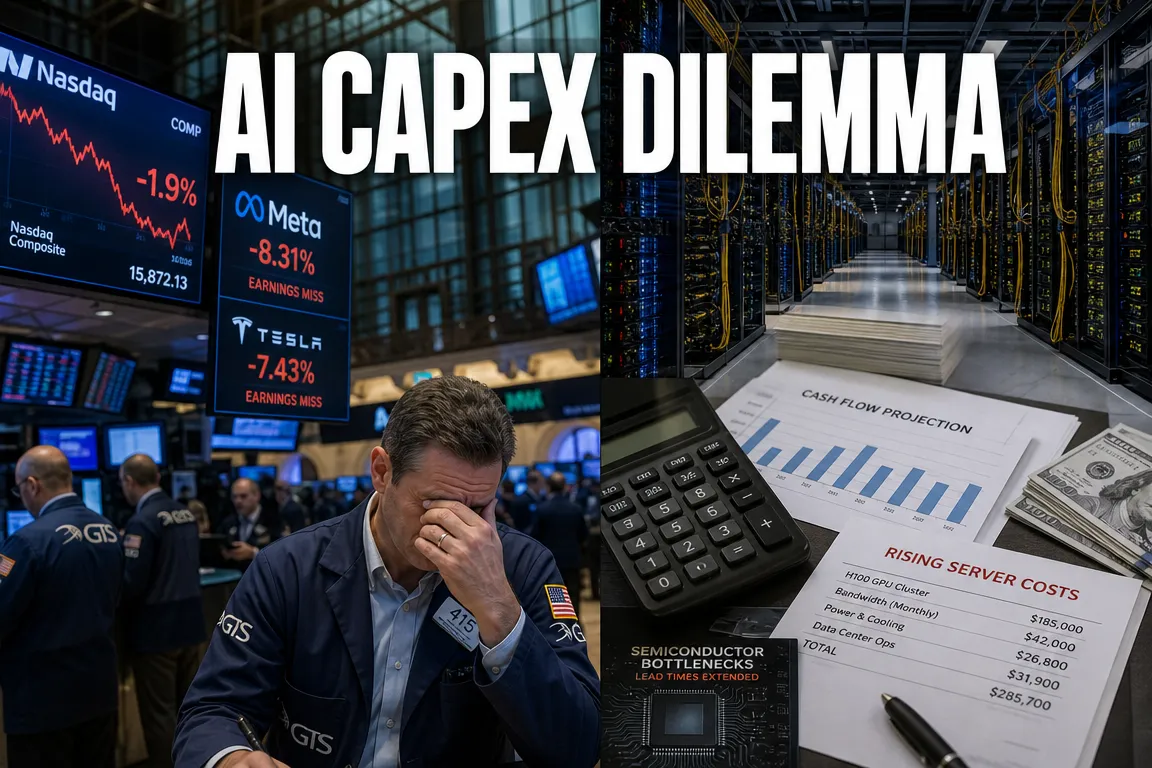
At the same time, AI is also an industry that requires enormous investment.
High-performance GPUs, data centers, cloud infrastructure, power grids, cooling systems, security solutions, and data management systems are all needed.
So in the short term, AI is a cost-reduction theme for companies, but in the long term it is a huge capital investment cycle.
This matters in the stock market and macroeconomics.
As expectations for interest rate cuts grow, the valuation burden on future growth industries may ease.
At the same time, if inflation strengthens again, data center electricity costs and semiconductor supply chain costs may become a burden.
In other words, the AI industry is both a technology trend and an economic issue tied to interest rates, inflation, and investment cycles.
When looking at AI-related companies going forward, you should not simply ask whether they “do AI,” but instead consider the following questions.
- Do they have their own model competitiveness?
- Do they have a RAG structure that connects to corporate data?
- Can they build an AI Agent ecosystem?
- Can they secure influence in connection standards such as MCP?
- Do they have a security and system prompt control framework?
- Do they have a revenue model that can support AI infrastructure costs?
What companies should check first when adopting AI
If a company is considering AI adoption, it should look at the structure first rather than blindly building a chatbot.
The first is data quality.
AI gives good answers when it references good data.
If documents are outdated, duplicated, or inaccurate, the results remain unstable even with RAG attached.
The second is organizing work processes.
For an AI Agent to do work, the procedures humans follow must be clearly defined.
If the work rules are vague, AI will also behave vaguely.
The third is access control.
You must limit, step by step, what data AI can access and what actions it can execute.
The fourth is the security framework.
A defense structure is needed to prevent prompt injection, data leakage, and incorrect automatic execution.
The fifth is ROI measurement.
When AI is introduced, you must measure how much time was actually saved, how much cost was reduced, and whether it contributed to sales.
That is because AI investment is not a trend but a management strategy.
Directions to watch in the AI market going forward
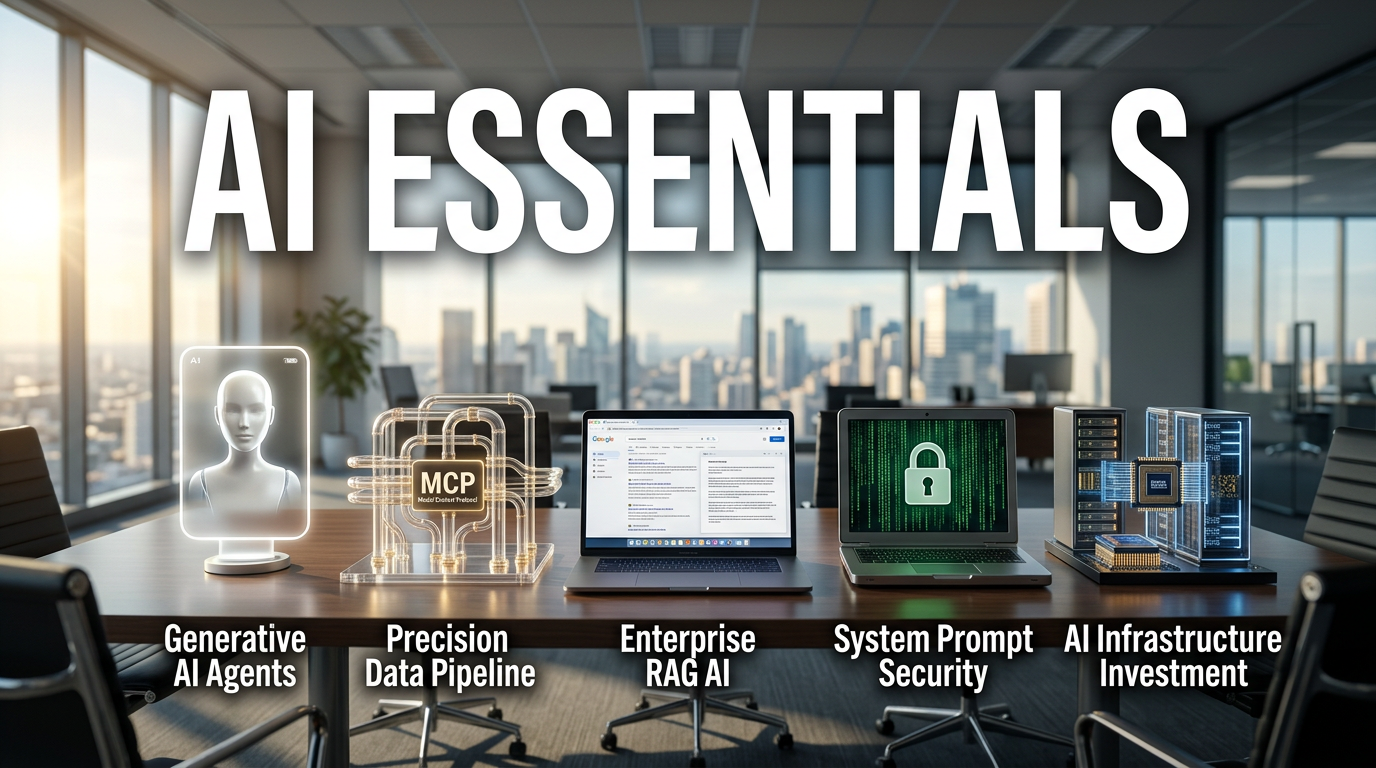
First, competition in AI Agent platforms is highly likely to intensify.
Rather than simple chatbots, AI platforms that handle real work may become the center of the enterprise market.
Second, connection protocols like MCP are highly likely to become important.
A standardized communication method is needed for AI to connect safely with a wide variety of tools.
Third, demand for RAG-based enterprise AI is very likely to continue increasing.
Companies want AI that uses internal documents and business data more than AI based on externally public data.
Fourth, the AI security market could grow rapidly.
As AI performs actual actions, security risks increase as well.
Fifth, AI infrastructure investment is highly likely to remain a major economic variable.
Semiconductors, cloud services, electricity, data centers, and network equipment are all part of the AI investment cycle.
< Summary >
To understand modern AI, you only need to grasp six concepts.
LLM is AI’s brain, and model training is the process of educating AI.
RAG is the technology that allows AI to reference the latest information and reliable external sources.
AI Agent is the structure that lets AI use tools to perform actual work.
MCP plays a central nervous system-like role in connecting models and tools.
The system prompt is the behavioral principle that decides what AI may and may not do.
Going forward, the core competitiveness of AI lies not in model size but in data connection, tool execution, and security control.
Economically, AI is both an opportunity for productivity innovation and cost reduction, and at the same time a large-scale investment cycle centered on data centers and semiconductors.
[Related Articles…]
- How Generative AI Is Reshaping the Global Economy and Corporate Productivity Outlook
- AI Semiconductor Investment Cycle and Key Data Center Market Trends
*Source: [ IBM Technology ]
– AI Simplified: 6 Concepts You Need to Know About Modern AI