● Tesla-SpaceX Merger Shock, Explosive Premium, Deadly Dilution, Musk Chaos
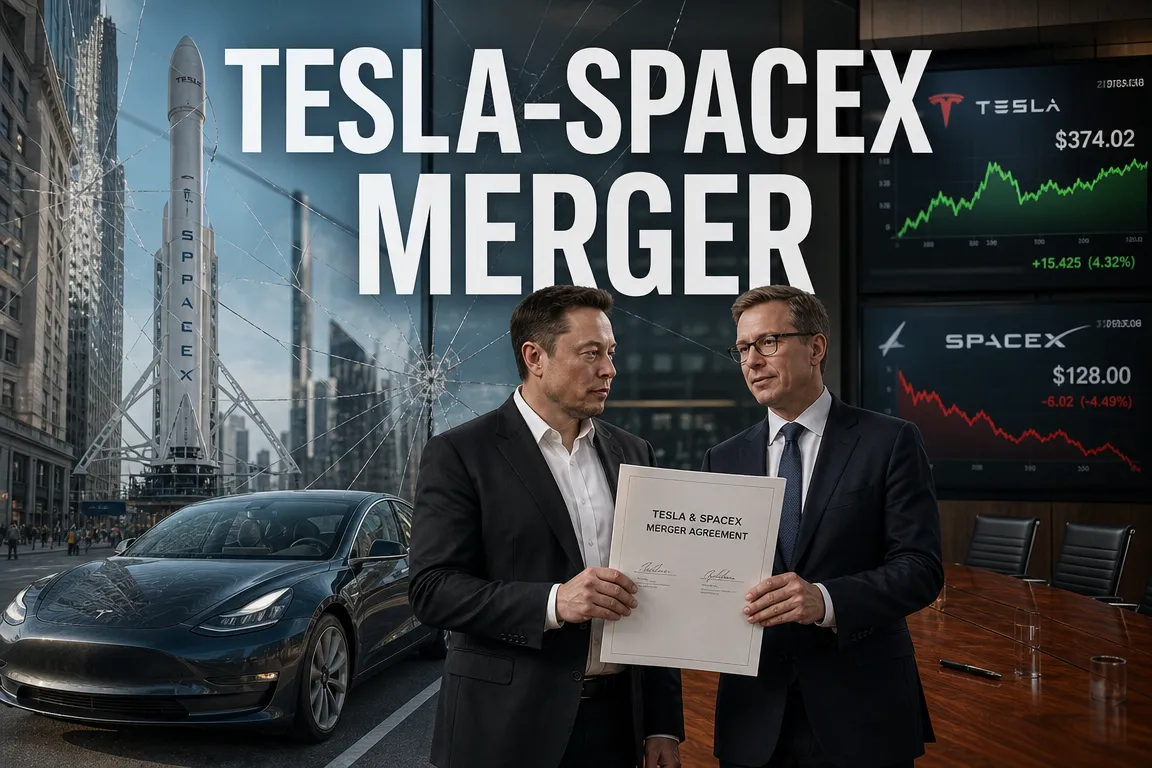
Tesla–SpaceX Merger Talks: For Tesla shareholders at $374, the key issue is not the premium, but the exchange terms
The central issue is not simply that Tesla shares have fallen to $374.
The Reuters exclusive that SpaceX approached Tesla first, the special committees established on both sides, internal views that Elon Musk’s public remarks complicated negotiations, and regulatory risks in China, Korea, and the United States are all now intertwined.
For Tesla shareholders, the more important question is not whether a merger is attractive, but how 1 Tesla share would be exchanged into SpaceX or a combined-company share.
Although the story appears to be about the future growth narratives of Tesla and SpaceX, it is in fact a major corporate transaction involving Tesla’s share price, a potential SpaceX merger, Elon Musk’s control structure, the EV market, and global antitrust review.
1. Market reaction: SpaceX moved more sharply than Tesla
Based on the source report, Tesla closed the regular session down 3.08% at $374.58.
SpaceX, by contrast, fell 9.14% to around $144.75.
After Tesla dropped 4.4% in after-hours trading the previous day, some investors argued that shifting into SpaceX would be preferable. The next day, however, SpaceX declined much more sharply than Tesla.
This matters because, if a transaction is structured as a stock-for-stock exchange, Tesla shareholders would be directly exposed to SpaceX share-price volatility.
Even if Tesla shareholders receive a 20% to 30% premium, that value could quickly disappear if the reference price and exchange ratio are unfavorable.
2. Tesla’s earnings were not weak, but the market responded to Musk’s comments
Tesla’s post-earnings backdrop was not negative on the surface.
Earnings per share beat expectations, and free cash flow turned positive.
However, sentiment changed during the earnings call.
In particular, Elon Musk lowered expectations for Optimus mass production, indicating that true high-volume production could still take at least another year.
Although there were positive figures related to FSD and robotaxi initiatives, investors reacted more sensitively to near-term expectations for Optimus commercialization.
Presentation format was also viewed as a factor.
SpaceX used video and simulation to create a strong impression, while Tesla relied more heavily on a voice-based earnings presentation.
Some investors described SpaceX’s presentation as “A+” and Tesla’s as “F-,” and Musk responded with a post indicating agreement.
The format of Tesla’s next earnings call may become significantly more aggressive.
3. Both Tesla and SpaceX have formally established special committees
The most important development in this report is Tesla’s formal disclosure in its quarterly filing that it has established a SpaceX-related special committee.
Tesla’s board formed a special committee of disinterested directors to review ways to deepen the relationship with SpaceX.
This may include a business combination, but it does not necessarily imply a merger.
The key points in Tesla’s filing are as follows.
- It is reviewing ways to strengthen the relationship with SpaceX.
- A business combination is included as a possibility, but not limited to it.
- There is no assurance that a transaction will occur.
- Any transaction would require a favorable recommendation from the special committee.
- If necessary, Tesla shareholder approval would also be required.
SpaceX has also disclosed a similar special-committee process.
However, the language differs in an important way.
Tesla refers to “ways to deepen the relationship with SpaceX,” while SpaceX states more directly that it is evaluating “a combination with Tesla.”
4. Tesla and SpaceX have different approval structures
On Tesla’s side, the special committee must first issue a favorable recommendation before the matter can proceed to a shareholder vote.
In this structure, Musk would need to step back from direct negotiations to reduce conflicts of interest.
By contrast, SpaceX requires approval from its special committee, board, and controlling shareholder.
Based on the source, SpaceX’s controlling shareholder is effectively Elon Musk.
In other words, Musk would need to recuse himself on the Tesla side while remaining the final decision-maker on the SpaceX side.
This creates a sensitive issue for future litigation and regulatory review.
5. Reuters exclusive: SpaceX initiated the approach
According to Reuters, SpaceX, not Tesla, initiated contact in recent weeks.
The two structures under discussion are reportedly as follows.
- SpaceX acquires Tesla
- A new holding company is created above both Tesla and SpaceX
The consideration is expected to be stock-for-stock rather than cash.
In other words, Tesla shareholders would likely receive shares in either a combined entity or a SpaceX-related structure rather than cash and exit the investment.
If completed, the combined enterprise value could be approximately $3.5 trillion, or about KRW 4,640 trillion.
This could become one of the largest corporate transactions in history.
6. A one-word internal assessment: “Mess”
The strongest Reuters characterization was that an interlocutor described Musk’s public remarks after the talks as a “Mess.”
In practical terms, that means the process became disordered.
Musk publicly suggested that a merger would be a good idea and directly referred to the existence of the special committee, which made the process more complicated.
In general, when independent directors are reviewing a conflicted transaction, the interested party is expected to avoid publicly signaling direction.
By making pro-merger comments first, Musk increased skepticism over whether Tesla’s special committee could negotiate independently.
As a result, the timeline could be delayed by several weeks.
7. Why the SolarCity precedent has resurfaced
The SolarCity acquisition remains a key reference point in this discussion.
At that time, Elon Musk held stakes in both Tesla and SolarCity, and SolarCity was founded by Musk’s cousins.
Shareholders argued that, although Musk’s formal ownership was limited, his board influence and managerial control effectively dominated Tesla.
A court ultimately found the transaction fair, but litigation continued for years.
Tesla directors later paid approximately $60 million in settlement value.
The same issues may arise again in the Tesla–SpaceX merger discussion.
In particular, Musk’s public comments may be interpreted in court as evidence that the committee’s independence was compromised.
8. Delaware is no longer the only relevant venue; Texas is now a factor
At the time of SolarCity, Tesla was incorporated in Delaware.
Today, Tesla is incorporated in Texas.
This distinction matters materially.
Delaware has extensive case law on U.S. corporate governance disputes.
Texas, by contrast, has less precedent on how to evaluate a large conflicted transaction of this type.
One Columbia University expert noted that the outcome is difficult to predict because Texas has limited experience handling such cases.
The core issue remains whether Tesla’s special committee can demonstrate that it negotiated solely in the interest of Tesla shareholders.
9. Key price levels for Tesla shareholders at $374: 420, 480, and 550
Using Tesla’s closing price of $374.58 as the reference point, CNBC guest Altimeter Capital’s Brad Gerstner said the special committee could seek a premium exceeding 30% to reduce litigation risk.
He cited a Tesla valuation range of $420 to $550 per share.
Relative to the current price, this implies the following.
- $420 represents about 12% upside from $374.58.
- $480 represents about a 28% premium.
- $550 represents about a 47% premium.
- A 30% premium would imply roughly $487 per share.
RBC also referenced the possibility of a premium around $480.
Gerstner argued that, once litigation risk is considered, a premium above 30% could be justified.
For Tesla shareholders, the near-term focus is the size of the premium.
However, the more important issue is whether that premium is paid in cash, SpaceX shares, or combined-company shares.
10. The most overlooked point: exchange-date risk
One of the least-discussed but most important issues is the exchange-date reference point.
If the transaction is structured as a stock exchange rather than a cash deal, Tesla shareholders would receive SpaceX or combined-company shares.
The timing used to determine the exchange ratio is therefore critical.
For example, even if a 30% premium is announced, the effective value can decline sharply if SpaceX shares fall afterward.
Given that SpaceX can drop more than 9% in a single day, the premium in a stock-for-stock structure is not as secure as it appears on paper.
In a prior SpaceX-related transaction, the share count was reportedly calculated using the average share price over the last seven trading days before closing.
That method can help reduce volatility.
By contrast, fixing the exchange ratio too early could leave Tesla shareholders exposed to significant changes in market value.
Accordingly, for a Tesla shareholder holding at $374, the key issue is not simply the percentage premium, but the reference price and number of shares received.
11. Tesla’s $45 billion cash position
Tesla is reported to hold approximately $45 billion in cash and short-term investments.
That is more than KRW 59 trillion.
SpaceX, meanwhile, is said to be able to spend $35 billion to $40 billion on capital expenditures in a single quarter.
Tesla’s cash balance is therefore large enough to cover a single quarter of SpaceX’s heavy investment spending.
This cuts both ways for Tesla shareholders.
On the positive side, Tesla’s financial strength could be rewarded in negotiations.
On the negative side, it may also be interpreted as a reason SpaceX would value Tesla’s cash-generating capacity.
How aggressively Tesla’s special committee monetizes that cash value will matter materially.
12. China risk: Tesla’s Shanghai factory is an unavoidable issue
Reuters also revisited the earlier Wall Street Journal report on a possible separation of Tesla’s China business.
Musk previously rejected that narrative as fake news.
This time, however, the issue is less about Tesla splitting off its China business and more about how such assets would be handled if Tesla and SpaceX were combined.
SpaceX conducts military and intelligence-related satellite business with the U.S. Department of Defense.
Starlink has also been used in the context of the war in Ukraine.
Tesla, by contrast, depends heavily on its Shanghai factory, which accounts for more than half of global production.
Chinese driving data has also not been transferred outside China since 2021.
If the two companies come under one roof, the structure would combine a U.S. defense-oriented space company with an EV manufacturer highly dependent on China.
This is not only a corporate governance issue but also one tied to U.S.–China technology competition.
13. Two possible solutions to the China issue
Experts see two broad approaches to the China risk.
- Build a firebreak between Tesla’s China business and SpaceX’s defense and space operations
- Spin off or sell Tesla’s China business
The first approach is the more realistic one.
It would resemble the structure used by companies such as Airbus or Honeywell, where China operations and defense business coexist under strict information controls.
The second approach would involve fully separating the China business.
However, finding a buyer would be difficult.
Chinese EV makers already have excess capacity, and overseas automakers have limited cash for major acquisitions.
As a result, Tesla is unlikely to give up the Chinese market or the Shanghai factory easily.
The Chinese government could also use this position as leverage.
China knows Tesla still depends on its manufacturing and sales presence there.
14. Why the Korea Fair Trade Commission was mentioned
It may seem unusual for the Korea Fair Trade Commission to be mentioned in a transaction between two U.S. companies.
Under Korean law, even a foreign-to-foreign transaction may require notification if each company’s Korean revenue exceeds certain thresholds.
Based on the source, Tesla Korea’s revenue last year was about KRW 330 billion.
Whether SpaceX’s Korea revenue exceeds the threshold is not clear from public information.
However, if Starlink, satellite communications, or space technology become tied to the Korean market, review remains possible.
Korea treats both automotive and aerospace industries as strategic sectors.
If Tesla were able to use SpaceX technology exclusively in a market where Hyundai and Kia compete, competition concerns could emerge.
Some analysts have suggested that countries such as Korea could request access rights or licensing commitments as part of approval conditions.
The actual terms remain uncertain.
15. U.S. politics and global antitrust review
Antitrust concerns are also emerging in the United States.
Senator Cory Booker said global antitrust authorities would likely review the deal.
A congressional investigation is also possible.
Review intensity may vary depending on political control and changes in administration.
Some analysts believe the current administration may not strongly restrict links between Tesla and SpaceX, while a future administration could revisit the issue.
At the extreme, the structure could be reconsidered after 2029.
For that reason, some investment banks have pointed to a possible announcement before the early December annual shareholder meeting.
However, merger-related items are reportedly not yet included in the current meeting agenda.
16. Five questions Tesla shareholders should ask
For Tesla shareholders, the question is not simply whether the share price will rise if a merger occurs.
The following five questions matter more.
- Who are the members of Tesla’s special committee?
- Who is advising the committee, and are those advisors independent of Musk?
- What premium is being assigned per Tesla share?
- Will that premium be paid in cash or stock?
- At what date will the exchange ratio be determined?
The independence of the special committee is particularly important for reducing litigation risk.
If the committee’s members and advisors are disclosed, the market will scrutinize their composition closely.
Musk’s posts on X will also remain a key variable.
His comments could influence both investor sentiment and legal exposure.
17. The most important issue not fully captured in other coverage
The core issue in this merger discussion is not simply that Tesla and SpaceX could combine into a stronger growth story.
The real issue is that Tesla shareholders’ control rights could change.
Musk’s ownership stake in Tesla is currently limited, while his stake in SpaceX is materially larger.
After a combination, his control over the combined company could become stronger.
As a result, Tesla shareholders would not merely be exchanging one stock for another; they would be entering a company with a different power structure.
In that case, Tesla shareholders could reasonably demand compensation for the change in control.
This is why some argue that a 20% premium would be insufficient and that more than 30% may be required.
Another key factor is Tesla’s cash balance.
Tesla is under pressure from EV price competition and demand softness, but it still has substantial cash and a global manufacturing base.
SpaceX is a critical company for the future of space, satellite, and AI infrastructure, but it also requires heavy capital spending.
Ultimately, this transaction would be both a strategic technology combination and a restructuring of cash-flow and capital-raising dynamics.
18. The AI-trend perspective on a Tesla–SpaceX combination
This issue is not only about an automaker and a space company.
From an AI-trend perspective, Tesla’s autonomous driving data, Optimus robotics, and robotaxi network could combine with SpaceX’s satellite communications, space infrastructure, and Starlink network to form a broader AI investment platform.
Tesla is a company that collects real-world data.
SpaceX and Starlink are infrastructure businesses that connect the planet.
If combined, autonomous vehicles, robots, satellite communications, energy, and AI computing infrastructure could be linked into a single ecosystem.
From that perspective, a Tesla–SpaceX combination could be highly significant for the long-term global economic outlook.
However, investors will still focus first on the transaction terms.
No matter how compelling the AI, space, and robotics vision may be, value could be diluted if Tesla shareholders receive an unfavorable exchange ratio.
19. Key upcoming signals to watch
The first signal to watch is whether Tesla discloses the members of its special committee and the names of its advisors.
The second is the form of any formal proposal from SpaceX.
The third is the exchange-ratio methodology.
The fourth is how China-related assets and operations are handled.
The fifth is the response from antitrust authorities in the U.S., Korea, Europe, and other major jurisdictions.
Finally, Musk’s public statements will continue to matter.
The more forcefully Musk speaks about a merger, the more investor attention may increase, but legal risk may also rise.
20. Investor interpretation by type
For short-term Tesla holders, the premium is the primary focus.
Investors holding near $374 will be evaluating the probability of $420, $480, and $550.
For long-term Tesla holders, the combined-company vision and governance structure matter more.
If SpaceX shares are received, investors may gain exposure to both space infrastructure and AI infrastructure growth, but volatility would also increase.
For SpaceX investors, Tesla’s cash and manufacturing capabilities are attractive.
At the same time, they would also inherit Tesla’s China exposure, EV pricing pressure, and global regulatory risk.
For institutional investors, legal certainty and the exchange ratio are the decisive variables.
To reduce litigation risk, pressure may increase to provide Tesla shareholders with a sufficiently large premium.
< Summary >
Tesla and SpaceX merger discussions have become more concrete following formal action by special committees on both sides.
According to Reuters, SpaceX initiated the approach, and the structures under review include either SpaceX acquiring Tesla or the creation of a new holding company.
Musk’s public remarks have intensified concerns over negotiation independence, and an internal source reportedly described the process as a “Mess.”
For Tesla shareholders, the exchange ratio and reference date matter more than a 20% to 30% premium alone.
At $374.58, $420 implies about 12% upside, $480 about 28%, and $550 about 47% premium.
China’s Shanghai factory, Korea Fair Trade Commission review, and U.S. antitrust scrutiny remain important variables.
The key checkpoints are the special-committee members, the advisors, the exchange-ratio methodology, the treatment of China operations, and any further statements by Musk.
[Related Articles…]
- Tesla share outlook and key shifts in the EV market
- AI infrastructure investment and global technology stock trends
*Source: [ 오늘의 테슬라 뉴스 ]
– 스페이스X가 먼저 테슬라를 찾아왔다 — 로이터 단독, 머스크 한마디에 협상 “엉망”, $374 주주는?
● AI Bubble Shock, Nasdaq Slips, Korea Sours
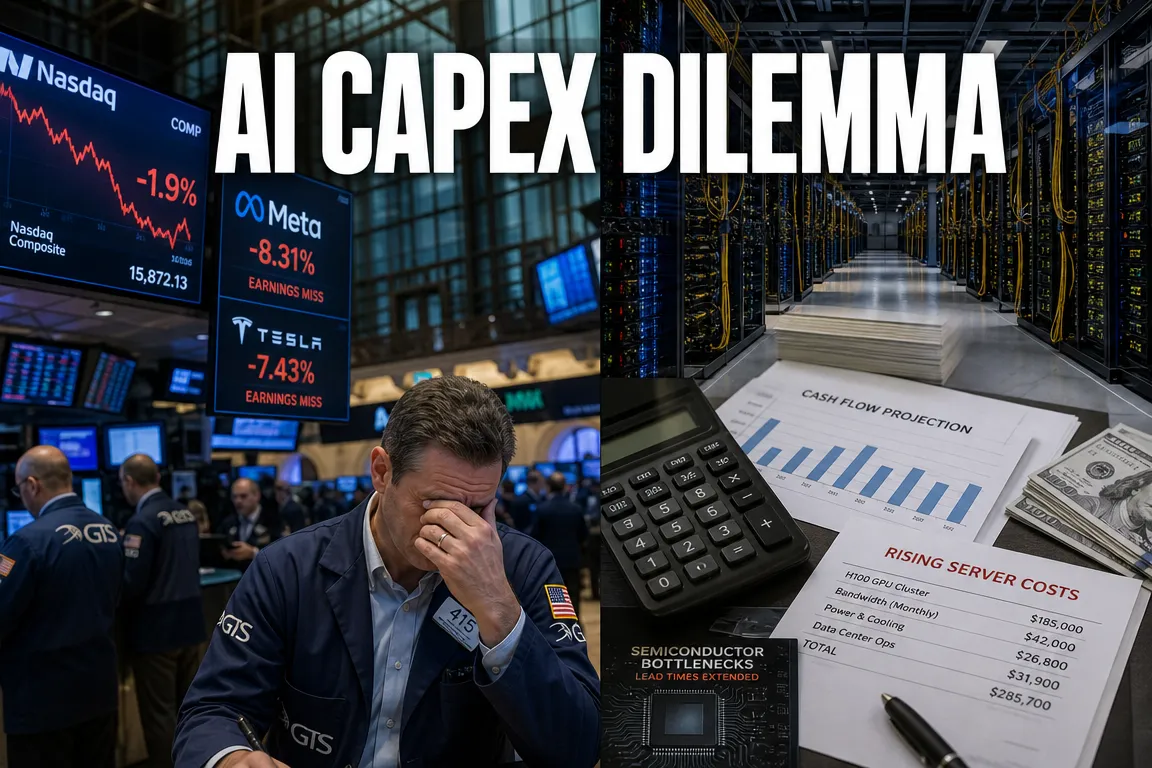
Meta Reignites AI Bubble Concerns, Pressuring Nasdaq, KOSPI, and Semiconductors
The key issue is not simply that Meta’s stock declined.
By indicating the possibility of large-scale fundraising to support AI investment, Meta revived market concerns that AI spending may be outpacing monetization.
This weighed on Nasdaq megacap technology stocks and semiconductor shares, while risk aversion pushed the U.S. 10-year Treasury yield back toward the 4% range.
The same sentiment carried into the Korean market, adding pressure to the KOSPI and leading semiconductor names such as Samsung Electronics and SK hynix.
SK hynix was relatively stronger than Samsung Electronics today, supported by news of a potential IPO for its subsidiary Solidigm.
However, this does not resolve the broader issue, which remains the timing of AI monetization relative to investment.
1. Why Meta’s Earnings Release Moved the Market
During its earnings release, Meta emphasized that continued AI investment is essential.
That was largely in line with market expectations.
The main issue was Meta’s openness to large-scale capital raising in the future.
In other words, the company signaled that it may use debt issuance or equity financing to support AI infrastructure spending.
Meta’s message can be interpreted as follows:
- AI competition requires continued investment.
- Data centers, GPUs, servers, and infrastructure require substantial capital.
- The company wants to secure funding before other AI players do.
- Debt or equity financing remains an available option if needed.
For investors, this raises a concern.
While AI is viewed as a long-term growth driver, the scale of eventual returns has not yet been fully validated.
At the same time, companies are already making substantial capital expenditures and may need to raise even more capital.
That gap is at the center of the current AI bubble debate.
2. The Market’s Concern: AI Spending Is Growing Faster Than AI Monetization
The market reaction was not driven by cost increases alone.
The main issue is that AI infrastructure investment is expanding much faster than AI monetization.
Large technology companies are spending aggressively on AI data centers, high-performance GPUs, cloud infrastructure, and power capacity.
They must purchase GPUs, build data centers, and secure power agreements.
These costs immediately weigh on financial statements.
At the same time, the market has not yet fully confirmed how much revenue and operating profit AI services will generate.
Meta may benefit over the long term through improved ad efficiency, recommendation systems, AI agents, and generative AI services.
However, equity markets are more focused on current earnings than on future potential.
Accordingly, the market reaction can be summarized as follows:
- The issue is not AI investment itself.
- The pace of investment has become too fast.
- Returns on that investment have not been fully demonstrated.
- Additional fundraising may create dilution or financial strain.
- This has revived concerns about an AI bubble.
3. The Link to Nasdaq Weakness and Big Tech Consolidation
Meta’s update quickly translated into pressure on the Nasdaq.
Sell-offs were concentrated in large-cap technology and semiconductor names.
AI spending has been one of the main drivers of Nasdaq’s recent gains.
However, once both cost pressure and monetization uncertainty became more visible, investors began trimming growth exposure.
When megacap technology stocks weaken, overall market sentiment can deteriorate quickly.
Apple, Microsoft, Alphabet, Amazon, Meta, and Nvidia are not simply individual names.
They are key drivers of U.S. equity direction.
When these stocks come under pressure, global markets tend to shift toward risk-off positioning.
The important point is not that AI optimism has disappeared.
Rather, investors are questioning whether expectations had become excessive.
Long-term AI growth remains intact, but the near-term valuation backdrop has become less supportive.
4. Why the U.S. 10-Year Treasury Yield Fell Back Toward 4%
As technology and semiconductor shares sold off, capital moved into safer assets.
As a result, the U.S. 10-year Treasury yield moved back toward the 4% range.
Bond yields move inversely to bond prices.
When investors buy Treasuries, prices rise and yields decline.
This move reflected more than just recession concerns.
AI bubble concerns increased risk aversion, which in turn boosted demand for safe-haven assets.
Normally, lower yields can support growth stocks.
When rates fall, the present value of future earnings rises, which is usually positive for technology shares.
In this case, however, concerns over AI spending and profitability outweighed the benefit from lower yields.
5. Why the KOSPI Is Under Pressure: The Nasdaq Effect
The weakness in the KOSPI primarily reflects the spillover from the Nasdaq.
Korea’s equity market is highly sensitive to global growth and U.S. technology trends.
Because semiconductors carry a large weight in the KOSPI, declines in U.S. semiconductor stocks tend to pressure Korean equities as well.
Samsung Electronics and SK hynix are core holdings for both the market and foreign investors.
Global investors often reduce Korean semiconductor exposure when they cut U.S. semiconductor positions.
That is the mechanism through which AI-related concerns at Meta have spread into the KOSPI.
Three pressures are currently weighing on the index:
- Weaker sentiment following Nasdaq technology corrections
- Renewed AI bubble concerns affecting semiconductor flows
- Foreign capital rotating out of risk assets
This is not simply a matter of domestic corporate fundamentals.
Global macro conditions and the AI investment cycle are now key drivers of the KOSPI.
6. Why SK hynix Outperformed Samsung Electronics: Solidigm IPO News
One notable development today was SK hynix’s relative outperformance versus Samsung Electronics.
The catalyst was news that Solidigm, its subsidiary, may pursue an IPO.
Solidigm was acquired through SK hynix’s purchase of Intel’s NAND business.
It plays an important role in NAND flash and enterprise SSD operations.
An IPO could offer several benefits to SK hynix:
- It may improve the market valuation of the subsidiary.
- It could strengthen capital-raising flexibility.
- It may ease some financial pressure.
- It could reduce uncertainty for shareholders.
This helped SK hynix hold up better than Samsung Electronics in the short term.
However, this does not eliminate the broader market concerns.
The main issue remains whether AI-related semiconductor demand can continue.
7. Samsung Electronics vs. SK hynix: Same Sector, Different Market Drivers
Samsung Electronics and SK hynix are both semiconductor leaders, but the market evaluates them differently.
SK hynix is more directly exposed to HBM demand and AI memory demand.
Its share price is closely tied to Nvidia’s supply chain and AI server demand.
Samsung Electronics is a more diversified company, with exposure to memory semiconductors, smartphones, consumer electronics, foundry services, and systems semiconductors.
As a result, its share price may respond less strongly than SK hynix’s, even when AI memory demand improves.
The market is also watching Samsung’s HBM competitiveness and the pace of its foundry recovery.
In this market phase, SK hynix has also benefited from the Solidigm IPO story.
Still, the semiconductor sector as a whole remains vulnerable to U.S. technology corrections and AI bubble concerns.
8. The Most Important but Less Discussed Point: A Capital-Raising Competition Has Begun
The most important underappreciated point in Meta’s update is that AI companies are entering a capital-raising competition.
Meta’s message that it wants to secure funding before other AI players is significant.
This suggests that AI competition is shifting from a technology race to a capital race.
Building better AI models remains important, but access to GPUs, data centers, and stable power supply is increasingly central to competitiveness.
AI is becoming a more capital-intensive industry.
That favors companies with strong balance sheets and abundant cash.
Companies with weaker profitability or higher funding costs may face increasing pressure.
From this perspective, the AI bubble debate is not just about overvaluation.
It is also a warning that winners and losers within the AI sector may separate more quickly.
The market is increasingly unlikely to reward AI exposure by itself.
Going forward, investors will focus more closely on monetization, financial capacity, and the impact of funding on shareholder value.
9. Key Indicators Investors Should Monitor
This is not a situation that can be understood through short-term price action alone.
Investors should monitor the AI cycle together with broader market conditions.
- First, the pace of AI capital expenditure among megacap technology companies.
- Meta, Microsoft, Alphabet, and Amazon all need to be tracked.
- If capex rises faster than revenue, markets may again become concerned.
- Second, evidence of actual AI revenue growth.
- Investors should watch for monetization through paid generative AI services.
- Measures such as ad efficiency and cloud revenue growth will be critical.
- Third, the direction of the U.S. 10-year Treasury yield.
- It is important to distinguish between yield declines driven by recession fears and those driven by risk aversion.
- In the current setting, lower yields may not support equities if risk-off sentiment dominates.
- Fourth, the performance of the Nasdaq and the Philadelphia Semiconductor Index.
- Korean semiconductor stocks remain closely linked to U.S. peers.
- For the KOSPI, U.S. technology trends remain the more relevant leading indicator.
- Fifth, the HBM competition between SK hynix and Samsung Electronics.
- Even if AI semiconductor demand remains firm, the distribution of benefits across companies will differ.
- HBM supply, customer wins, yield, and investment capacity are key variables.
10. The Bottom Line: AI Growth Remains Intact, but Valuations Are More Challenged
This decline should not be interpreted as the end of the AI investment theme.
AI remains a core force shaping global markets and the industrial landscape.
The issue is that equity markets have already priced in much of that optimism.
AI infrastructure spending, semiconductor demand, cloud expansion, and data center build-outs are likely to continue.
However, the market is becoming less forgiving.
In the past, AI-related exposure alone could justify premium valuations.
Going forward, companies will need to show actual revenue, earnings, cash flow, and payback periods.
Meta’s willingness to consider additional fundraising, despite being a highly profitable platform company, is an important signal.
It suggests that AI competition may be more expensive, longer, and more capital-intensive than expected.
11. Investment Implications for the KOSPI and Semiconductors
Korean investors should expect continued volatility in the near term.
As long as U.S. technology stocks remain under pressure, Korean semiconductor names are unlikely to move independently.
If foreign flows weaken, Samsung Electronics and SK hynix can weigh on the broader index.
From a longer-term perspective, however, corrections may create opportunities.
The key condition is that AI semiconductor demand must remain intact.
HBM and server memory demand must continue to be confirmed, and companies must avoid margin erosion from excessive investment.
Accordingly, this is a period for confirmation rather than aggressive positioning.
Investors should monitor AI-related revenue, cost guidance, and capital spending in major technology earnings reports.
For semiconductor companies, inventory trends, average selling prices, HBM supply outlook, and investment plans remain critical.
SK hynix has a positive catalyst in the Solidigm IPO story, but the core issue remains HBM competitiveness and AI server demand.
For Samsung Electronics, HBM recovery and foundry improvement remain the key drivers of re-rating.
12. Conclusion: This Is Not an AI Collapse, but a Phase of Validation
The latest AI bubble concerns do not imply that the AI industry has failed.
Rather, they indicate that the sector is entering a validation phase.
The market is no longer evaluating AI companies on growth narratives alone.
It is now also assessing spending, profitability, financing structure, and capital efficiency.
Nasdaq weakness, KOSPI pressure, lower U.S. Treasury yields, and semiconductor volatility are all linked.
The stronger the AI narrative has been, the more intense the scrutiny on monetization has become.
The key question remains the same:
Will AI investment translate into a new earnings cycle, or will it remain a cost burden?
Until that question is answered, global equities and Korean semiconductor stocks are likely to remain highly sensitive to new information.
[Related Articles…]
- AI Investment Cycle and Global Equity Market Shifts
- Semiconductor Cycle and KOSPI Outlook: Key Takeaways
*Source: [ 내일은 투자왕 – 김단테 ]
– 메타가 촉발한 AI 버블론! #메타 #코스피 #솔리다임