● Walmart Reinvents Work With AI Without Layoffs
Walmart AX Strategy Analysis: The Real Secret to Boosting Productivity with AI Without Cutting Jobs
The core point to see in Walmart’s case is not simply that “they trained a lot of people on AI.”
The real point is that they taught 1.6 million employees AI, embedded AI into the work apps they use every day, enabled frontline workers to build AI agents themselves, and created a structure where overlapping functions are controlled by headquarters.
On top of that, when AI reduces certain tasks, they are building internal pathways to move employees into in-demand roles such as automation technicians, data engineers, transportation managers, and pharmacists instead of laying them off.
This is not just a simple AI adoption case; it is closer to an experiment in which a global retail company is redesigning AI transformation, reskilling, labor market change, corporate productivity, and supply chain management all at once.
1. Key News: Walmart is using AI not as a “headcount reduction tool” but as “workflow reallocation infrastructure”
Walmart has set a direction that even if AI eliminates some jobs, it will not reduce its total employee count.
Instead, it is pursuing a strategy of retraining existing employees and moving them into newly created roles.
The core of this strategy has three elements.
-
First, it provides AI foundational training for all employees.
-
Second, it embeds AI inside existing work apps rather than using separate chatbots.
-
Third, it allows frontline workers to build automation tools and AI agents themselves.
Many companies approach AI adoption with headquarters or IT departments at the center.
But Walmart has brought store employees, distribution center workers, transportation staff, and hourly workers into the group of people actually using AI.
This difference is the biggest competitive advantage of Walmart’s AX case.
2. The Montreal Ice Storm Case: A ‘Storm Detour AI Agent’ Built Directly by Frontline Staff
This March, an ice storm hit Montreal, Canada.
Walmart’s transportation team learned of the storm only two to three days in advance.
To deliver products before the storm, trucks had to be rerouted and dispatch and delivery schedules had to be reorganized.
This took about 14 hours.
After experiencing this, Jeff Mackin, Walmart Canada’s transportation director, thought:
“Couldn’t we detect the risk earlier and respond in advance?”
He was not a professional software engineer.
But using Walmart’s AI coding agent, Code Puppy, he built a storm detour agent himself.
This agent does not respond only after a storm is imminent.
It analyzes weather forecasts, road conditions, delivery information, and internal operating data starting ten days in advance.
Then it detects possible delivery disruptions early so the transportation team can respond proactively.
The reason this case matters is clear.
AI is going beyond simply reducing clerical work and is directly changing supply chain management and logistics risk response.
3. AI Training for 1.6 Million People: What Walmart Put in Place First Was Not Technology, but a ‘Common Language’
Walmart announced that it will provide AI training opportunities to its 1.6 million employees in the United States.
This includes not only corporate office staff but also store and distribution center frontline workers.
OpenAI began an AI training pilot for Walmart office workers in December 2025.
The method was not a simple lecture.
It was structured so that ChatGPT served as the instructor, giving employees tasks similar to real work and providing feedback.
After completing the basic course, employees can earn certification.
They can then attempt higher-level certification tasks.
Starting this June, the OpenAI certification course was officially opened for free to all 1.6 million U.S. employees.
Google also launched a similar AI certification program in February 2026.
Walmart has also introduced that program into employee training.
That course was also designed as a hands-on, project-based exercise in which employees directly create outputs they can apply to real work.
What matters here is that Walmart is not trying to turn every employee into an AI expert.
The goal is to make employees unafraid of AI and able to instruct it in the language of their own work.
That is the first step in raising corporate productivity.
4. My Walmart App: AI Was Not Made Something Employees Had to Go Find; It Was Put Inside the Tools They Use Every Day
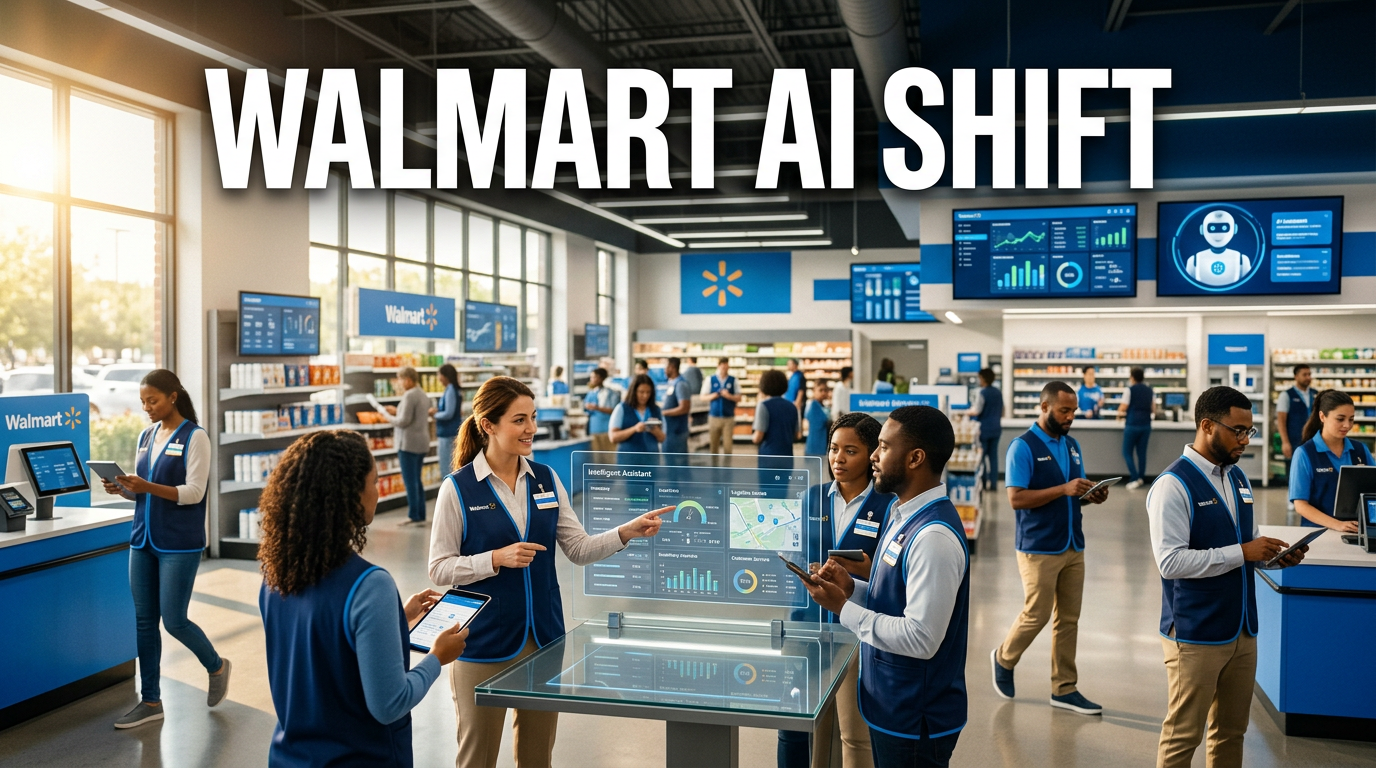
Walmart employees use the My Walmart app every day.
This app is used for clocking in and out, checking work schedules, requesting leave, and swapping shifts.
Walmart did not tell employees to “go access an AI site and try it.”
Instead, it embedded AI into the work app employees already use every day.
When employees log in after arriving at work, they can immediately see what they need to do that day in order of priority.
They can start working right away without waiting for a manager’s instruction.
If they have a question during work, they can ask in natural language.
-
“Which aisle is the hand sanitizer in?”
-
“What time is my shift tomorrow?”
-
“How should I handle a no-receipt return?”
Functions for searching product locations or work schedules already existed.
But with AI added, employees no longer need to search through complicated menus and can ask as if speaking naturally.
It also provides translation support across 44 languages for customer service.
By analyzing store camera and sensor data, it can also send alerts such as “there’s spilled juice on the store floor” or “the refrigerated display temperature has risen.”
This is not merely a chatbot deployment.
It is a case of embedding AI directly into the workflow itself.
5. Code Puppy: Walmart’s AI Coding Agent That Turns Even Non-Developers into Developers
Walmart has an AI coding tool that allows employees to create, modify, and test software.
That tool is Code Puppy.
Code Puppy is an internal AI coding agent built in 2025 by a Walmart engineer.
When employees give instructions in natural language, it can create automation apps, dashboards, and work agents.
It is also important that it is not tied to a single AI model.
It is not a structure that uses only models from specific companies such as OpenAI or Anthropic; it can call and use multiple models depending on the need.
Code Puppy reportedly had around 1,000 cumulative users in August 2025, and that number rose to the 750,000 range within a year.
An even more interesting point is that the number of non-developer users is roughly comparable to the number of developer users.
Merchandising, supply chain management, store managers, and hourly employees are all using Code Puppy to automate their own work.
This means the AI transformation did not stop at headquarters strategy documents and has moved into the field.
6. AI Use Cases from the Field: From Cake Decoration to Fraud Detection and Return Freight Recommendations
Inside Walmart, a variety of field-oriented AI tools are being created.
The first example is the bakery section.
A store employee created an app that lets workers follow photos to decorate cakes according to Walmart’s internal guidelines.
It can help reduce skill gaps and lower quality variation across stores.
The second example is fraud detection.
A manager responsible for fraud prevention built a fraud detection app and dashboard that analyzes transaction, return, and incident data.
This tool is used to identify stores where false returns or payment fraud are suspected and to help the investigation team decide which locations to visit first.
The third example is a return freight recommendation tool.
Leo Garcia, a former truck driver and now a transportation manager in Walmart’s Chicago region, built a return freight recommendation tool with Code Puppy.
When a truck delivers freight to another region and returns empty, costs are lost.
Usually, drivers wait in that region for several hours and then load another shipment before heading back.
This tool recommends, from among hundreds of shipments, the freight most likely to be ready fastest based on the truck’s current location and the driver’s route home.
It reduces the loss from empty return trips and helps drivers get home sooner.
Walmart is testing whether this tool can be applied in other regions as well.
These examples show that AI is being used not just as a cost-cutting tool but as a tool that expands frontline problem-solving capacity.
7. The Problem That Emerges When Employees Are Free to Build: Duplicate Development and Rising AI Costs
When employees start freely building AI tools, it is not all upside.
Different employees can separately create similar tools to solve the same problem.
Then duplicate development increases, and AI usage costs rise as well.
Walmart initially allowed employees to use Code Puppy with almost no restrictions.
But as usage surged, it began imposing per-employee token limits starting in June 2026.
It also encourages employees to check whether a similar tool already exists before creating a new one.
On the surface, this looks like cost control, but there is a more important purpose.
Walmart identifies which tool requests are repeated.
If the same request keeps appearing, it is a signal not of a personal issue but of a company-wide common workflow pain point.
In that case, Walmart can elevate that function into an official enterprise-wide capability.
In other words, it gives employees freedom to experiment, while centrally integrating repeated functions.
This structure is the core operating model of Walmart’s AX strategy.
8. Walmart’s AX Operating Model: Distributed Field Experiments, Central Control of Cost and Security
Walmart places a shared AI platform underneath Code Puppy to track usage and repeated work.
Employees can identify problems in the field and build prototypes directly.
But repeated functions, security, deployment, and cost management are controlled on the shared platform.
This approach is a very practical model for enterprise AI transformation.
A central AI team cannot know every field problem in advance.
Pain points on the store floor, bottlenecks in distribution centers, and anomalies in return workflows are best understood by frontline staff.
Walmart has acknowledged this.
So it gave frontline employees the right to experiment and created a structure in which headquarters standardizes successful experiments.
This is an important model many large companies can refer to when spreading AI.
If AI is pushed only from the center, field adoption drops.
Conversely, if everything is left to the field, cost, security, and duplication problems grow.
Walmart is finding the balance between these two.
9. Jobs Changed by AI: Walmart is Creating Internal Mobility Paths Rather Than Layoffs
Just learning and using AI does not automatically guarantee an employee’s job.
Some tasks will clearly be automated.
Especially repetitive, simple tasks are highly likely to be replaced by AI and automation equipment.
Walmart’s strategy is not to turn every employee into an AI expert.
Instead, while helping employees understand and use AI, it is building pathways for them to move into jobs that are growing in demand in the automation era.
Starting in 2024, Walmart set a goal of moving U.S. employees in low-wage, simple jobs into 100,000 in-demand roles over the next three years.
Target roles include store and distribution center managers, automation technicians, refrigeration technicians, HVAC technicians, truck drivers, pharmacists, and data engineers.
This July, Walmart said it had achieved the goal ahead of schedule.
By the originally planned third year, it was expected to fill a cumulative 200,000 in-demand roles.
Of course, this does not mean all 100,000 positions were filled by employees who received AI training.
But what matters is that when AI reduces certain tasks, a foundation has been built for employees to move within the company rather than being pushed outside it.
10. H2T Program: Internal Training That Converts Store and Distribution Center Staff into Technicians
Walmart also runs specific technical training programs for internal mobility.
A representative one is the H2T Associate Technician program.
This course teaches automation equipment, electricity, and facility maintenance skills to store and distribution center employees without technical backgrounds.
More than 600 people have completed the program so far.
Walmart aims to produce 4,000 technical employees by 2030.
This is extremely important from a labor market perspective.
When AI reduces repetitive tasks, demand for technical maintenance, automation operations, data management, and field systems management actually rises.
Walmart is responding to this change not only through external hiring but through retraining its internal workforce.
11. The Core Point Easy to Miss in Other Coverage: Walmart’s Real Asset Is Not the AI Model, but the ‘Field Problem Data’
Many reports focus on the fact that Walmart introduced AI training from OpenAI and Google.
But what is even more important is that Walmart is turning frontline employee problem statements into data.
What tools employees want to build with Code Puppy, which workflow automation requests repeat, and which department’s AI usage is surging are all important signals.
These signals tell the company where bottlenecks are.
For example, if transportation staff in multiple regions want to build similar return freight recommendation tools, that means there is a common inefficiency in the transportation network.
If multiple stores want to build return fraud detection tools, there is a strong chance the returns management process has structural problems.
In the end, Walmart is using AI tools to collect employee pain points and turn them into enterprise innovation projects.
That is the decisive difference between a simple chatbot rollout and Walmart’s AX strategy.
12. Economic Meaning: The Winners of AI Transformation May Be ‘Reallocation Companies,’ Not ‘Layoff Companies’
In the AI era, corporate competitiveness is unlikely to be determined simply by how much labor cost can be cut.
Instead, how quickly existing workers can be reassigned to new roles may become the more important factor.
Walmart is one of the largest private employers in the United States.
When a company like this approaches AI not as a layoff strategy but as a retraining and internal mobility strategy, it sends an important signal to the labor market.
It is true that AI raises corporate productivity.
But whether productivity gains will immediately lead to mass unemployment may depend on the choices companies make.
Walmart’s case shows that large companies can reduce employment shocks during AI transformation while still improving operational efficiency.
This model is especially important in industries with large workforces such as retail, logistics, manufacturing, finance, and healthcare.
A model may spread in which AI is adopted while preserving frontline workers’ know-how, automating repetitive tasks, and moving people into higher-value work.
13. The Investment Angle: Walmart Manages AI Costs Not as “Operating Expense” but as “Productivity Investment”
When companies adopt AI, the first issue they face is cost.
In particular, generative AI can see token costs rise rapidly as usage increases.
Walmart’s decision to introduce per-employee token limits starting in June 2026 is not merely a savings measure.
It is an operating system for measuring AI usage and integrating repeated requests into enterprise-wide functions.
From an investment perspective, the important question is this:
It is not “how much AI is used,” but “what business results AI usage leads to.”
If Walmart achieves both cost reduction and service improvement through tools such as return freight recommendations, fraud detection, and storm detour responses, the return on AI investment could be quite high.
In particular, supply chain management, inventory operations, returns management, and transportation optimization are areas that directly affect retailer profitability.
14. Risks Still to Watch: Walmart’s Promise Has Not Been Fully Verified
It is still too early to conclude that Walmart has fully upheld its promise to maintain employment in the AI era.
That is because employee AI training completion rates, actual work performance, post-mobility wage changes, and long-term retention rates have not been disclosed in enough detail.
Also, as AI becomes deeply embedded in work apps, issues of employee surveillance and data privacy may arise.
Store camera and sensor data may help with operational efficiency, but employees may feel it increases monitoring.
Security is also important when non-developers use AI coding tools to build apps.
There is also the possibility that improperly built automation tools could access internal data or make incorrect judgments.
Therefore, for Walmart’s model to succeed, AI training, security review, cost control, worker protection, and the quality of internal mobility must all be managed together.
15. Key Things to Watch Going Forward
-
AI training completion rate: It is important how many of the 1.6 million employees actually earn certification and use it in their work.
-
Quality of job mobility: The key is not just the number of moves, but whether wages, stability, and growth potential improve together.
-
AI cost versus results: We need to confirm whether productivity gains, logistics cost reductions, and fraud-loss reductions exceed the rise in token costs.
-
Frontline participation: The key is whether a culture in which non-developers continue building and improving AI tools can be maintained.
-
Balance between central control and field autonomy: Too much control can reduce innovation, while too much freedom can increase cost and security problems.
16. Conclusion: Walmart’s AI Strategy Is Closer to a Technology for “Reorganizing the Organization” Than for “Reducing People”
Walmart’s case shows that AI adoption should not end at simply adding a chatbot or purchasing a workflow automation tool.
Employee training, work app integration, field-led development, central platform management, and internal mobility pathways must all be designed together.
In particular, the most important message Walmart shows is this:
The core point of AI transformation is not the technology itself, but the change in how the organization operates.
The structure in which frontline employees identify problems, create prototypes with AI, and headquarters integrates repeated functions into enterprise systems is likely to be followed by many companies in the future.
It is difficult to avoid AI having an impact on the labor market, but depending on how companies respond, the transition can be centered on layoffs or centered on retraining and redeployment.
Walmart has not yet shown a complete answer.
But it is showing the most practical experiment yet in redesigning people and technology together for the AI era in a large organization.
< Summary >
Walmart is providing AI training to 1.6 million employees.
It has embedded AI inside the My Walmart app instead of making it a separate tool, so employees use it daily.
Through Code Puppy, even non-developers can build workflow automation apps and AI agents.
Tools created by frontline employees are solving real work problems such as logistics detours, fraud detection, return freight recommendations, and cake decoration support.
As usage surged, Walmart began managing cost and security with token limits and a shared AI platform.
It is also building internal pathways into in-demand roles such as automation technicians, data engineers, and transportation managers to respond to work reduced by AI.
The core point is not AI adoption itself, but an AX strategy that combines training, workflow redesign, field experimentation, central control, and reskilling all at once.
[Related Articles…]
*Source: [ 티타임즈TV ]
– AI 도입하고도 직원 수 유지하는 월마트의 비결은