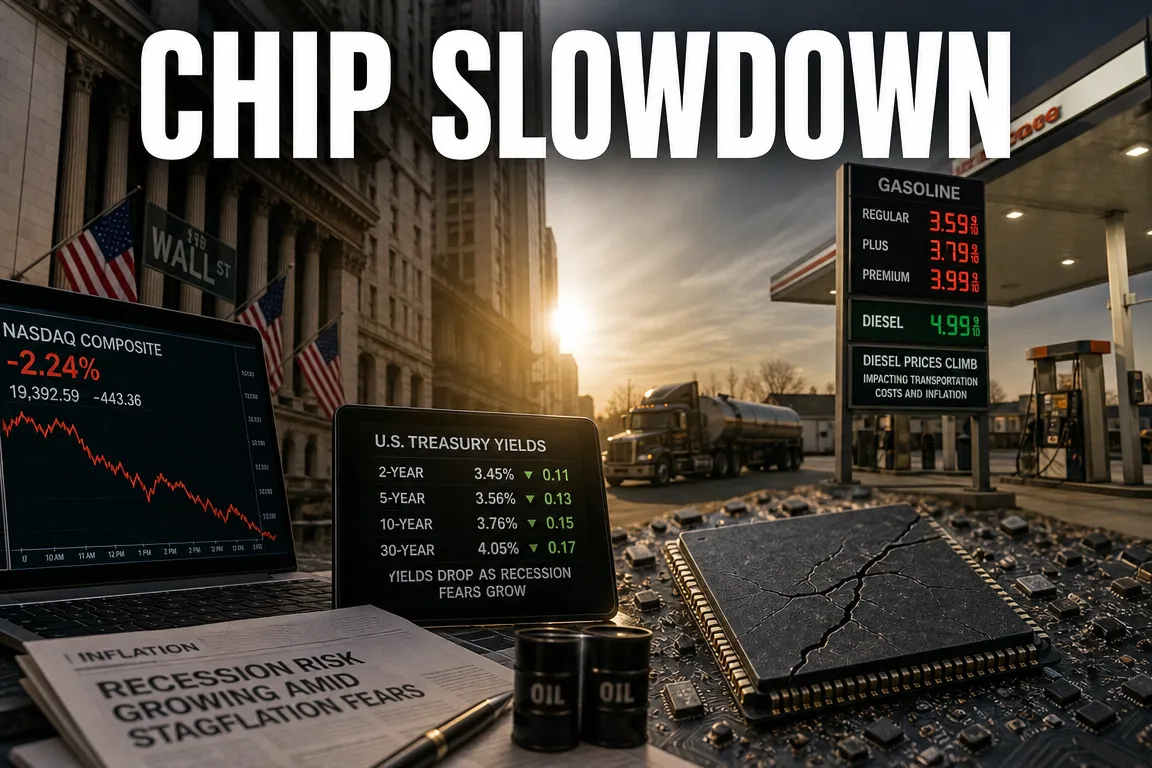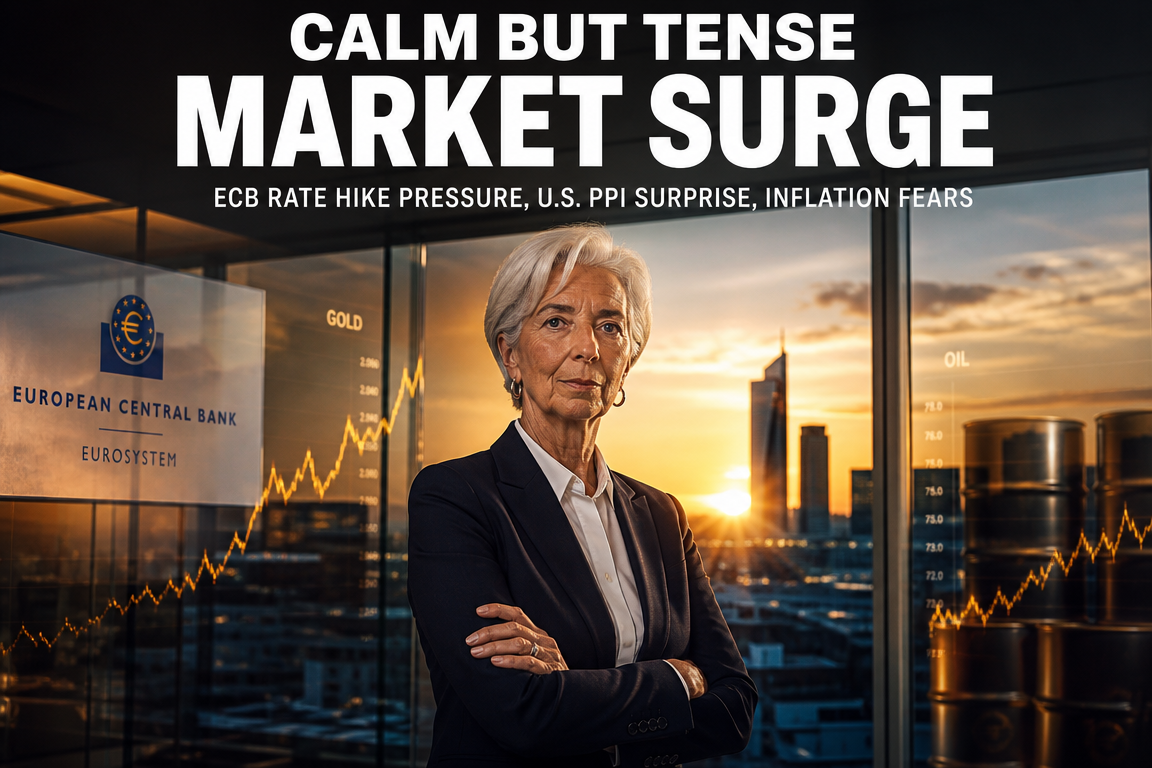
● ECB Rate Hike, US PPI Shock, Markets Jolt
ECB Rate Hike and U.S. PPI Surprise: The Market Focus Is Elsewhere
Today’s market had two key events.
The first was the ECB policy decision in the euro area, and the second was the U.S. producer price index (PPI) release.
In short, the ECB raised rates again, while U.S. PPI came in firmer than expected.
On the surface, this can be summarized as inflation reaccelerating, which increases the likelihood of further rate hikes.
However, the more important point is different.
This ECB rate hike is less about a 2022-style broad inflation shock and more about preemptive defense against an energy shock driven by surging crude oil prices.
The U.S. PPI print is also a short-term headwind for equities, but it is still too early to conclude that the disinflation path has been fully broken.
What the market often misses is that the sharp rise in U.S. Treasury yields, the direction of the dollar index, the KRW/USD exchange rate, the Fed policy outlook, Bitcoin, and gold are all connected through one broader macro trend.
1. ECB Policy Decision: The Euro Area Raises Rates Again
On September 10, the European Central Bank announced another rate hike.
The policy rate has moved up to 2.65%.
The euro area appeared to be entering a pivot phase when it lowered rates to 2.25% in 2025.
However, the Middle East conflict and the resulting surge in crude oil prices in 2026 disrupted the inflation path and forced policy to turn again.
As a result, the June 2026 rate hike was followed by another increase in September.
- ECB policy rate: raised to 2.65%.
- Policy direction: temporary shift from easing to renewed tightening.
- Key driver: higher crude oil prices and energy inflation.
- Market view: the hike was largely anticipated, but it may affect the medium-term dollar trend.
The important point is that this ECB hike is not a response to overheating demand.
The euro area economy is still far from strong.
Inflation is not being driven by a broad demand boom.
The main source of pressure is an energy supply shock.
2. Why Did the ECB Raise Rates Despite Slower Growth?
The ECB’s main reason for tightening is that the euro area already experienced severe inflation in 2022.
At that time, peak U.S. CPI inflation was around 9.1%.
Peak inflation in Korea was around 6.3%.
By contrast, euro area inflation exceeded 10%.
Given Europe’s high dependence on energy imports, shocks in crude oil and natural gas prices have a much larger impact.
For that reason, the ECB could not ignore renewed energy inflation even if current inflation is below 2022 levels.
For a central bank, the risk of letting expectations become unanchored again is significant.
- 2022 euro area inflation: a combination of energy, goods, services, and monetary policy effects.
- Current inflation: driven primarily by energy and crude oil.
- ECB response: preemptive tightening rather than a full-scale tightening cycle.
- Key variable: inflation should ease again if oil prices stabilize.
3. The 2022 Inflation Episode and the Current One Are Different
To understand the ECB decision, the euro area HICP should be considered.
HICP stands for Harmonised Index of Consumer Prices.
It is the common consumer price index used across euro area countries.
In 2022, inflation was driven by energy, goods, services, wages, and liquidity effects.
Both conventional and nonconventional monetary policy tools influenced prices.
Zero interest rates, asset purchase programs, forward guidance, and central bank lending programs were major nonconventional tools.
The current environment is different.
Most of the upward pressure now comes from energy.
Pass-through to other sectors remains limited.
- 2022 inflation: energy + goods + services + liquidity + war shock.
- Current inflation: largely an energy supply shock linked to crude oil.
- Policy implication: a large-scale rate hike cycle like 2022 is unlikely.
- Key factor: if oil prices fall, inflation could moderate again.
For that reason, this ECB hike is better interpreted as insurance against an energy shock rather than the start of a prolonged tightening cycle.
4. U.S. PPI Release: Headline 5.4%, Core 4.6%
The U.S. producer price index again pressured markets.
August U.S. PPI rose 5.4% year over year.
The market had expected around 5.3%, so the result was slightly above consensus.
Core PPI rose 4.6%.
Core producer prices were broadly in line with expectations.
- U.S. PPI headline: 5.4%.
- Market forecast: around 5.3%.
- Result: slightly above expectations.
- Core PPI: 4.6%.
- Result: in line with expectations.
These numbers are not a major shock by themselves.
However, the market had already been concerned about a rebound in PPI, and the data confirmed that concern.
In particular, the firmer headline print reinforced expectations that the Fed may need to keep the door open for further tightening.
5. Why PPI Matters: It Leads CPI
PPI measures prices at the producer level.
CPI measures prices paid by consumers.
In simple terms, PPI captures the cost shock faced first by companies, while CPI reflects the final price shock seen by consumers.
For example, when crude oil rises, refiners first pay more for input costs.
That lifts producer prices.
Over time, higher costs can move into gasoline, diesel, petrochemicals, logistics, and finished goods prices, eventually pushing up CPI.
- Higher crude oil prices → higher PPI.
- Higher PPI → higher corporate cost pressure.
- Higher costs → possible pass-through to CPI over time.
- Government intervention or price controls can slow the pass-through.
That said, a rise in PPI does not automatically mean CPI will rise immediately.
Still, a rebound in PPI is a warning that consumer inflation may reaccelerate later.
This matters more when crude oil is above $100 per barrel.
6. Short-Term Negative for Equities, Medium-Term Outlook Still Unclear
The latest U.S. PPI data is negative for markets in the short term.
The reason is straightforward.
If inflation comes in above expectations, the probability of further Fed tightening increases.
Higher rate expectations push up U.S. Treasury yields.
Rising yields weigh on growth stocks, technology shares, Bitcoin, and gold.
Medium term, however, the picture is less clear.
PPI did rebound, but it did not surge beyond previous peaks.
Inflation does not move in a straight line during disinflationary periods.
It often rises, then falls, then rises again before resuming a downward trend.
- Short term: a stronger-than-expected PPI is negative for equities.
- Medium term: it is too early to say that disinflation has fully broken down.
- Key variables: the next CPI release and crude oil prices.
- Policy variable: the balance between hawkish and dovish FOMC members.
In other words, the PPI data was clearly negative.
However, it is still too early to call this an inflation reacceleration without further confirmation from CPI and PCE data.
7. The Real Reason for the Treasury Yield Spike: The Buyback Was Too Small
Recently, the U.S. 10-year Treasury yield rebounded sharply to around 4.879%.
The market had expected the Treasury’s buyback program to support yields.
Instead, yields rose sharply.
The reason was that the announcement fell short of expectations.
The market had expected roughly $6 billion to $8 billion in long-dated bond repurchases, with around $7 billion seen as the central case.
But the announced size was perceived as insufficient to support the market’s expectations.
As a result, the market focused less on the fact that bonds were being bought and more on the fact that the scale was smaller than expected.
- Market expectation: about $7 billion in buybacks.
- Announced size: viewed as below expectations.
- Market reaction: yields spiked instead of stabilizing.
- Key lesson: markets react to deviations from consensus, not just absolute values.
The same applies to PPI.
Whether inflation rises or falls is important, but in the short term, markets are driven by whether the data beats or misses expectations.
8. Fed Policy Outlook: Higher Hike Odds, but a Pause Remains Possible
Following the PPI release, FedWatch pricing for another rate hike rose from about 62.2% to 64.2%.
Markets became more cautious.
U.S. Treasury yields rose, and the dollar index also moved higher.
Still, the final FOMC decision remains uncertain.
The U.S. is already operating with a relatively high policy rate around 3.75%.
Real rates are also elevated.
As a result, some Fed officials may argue that an additional hike is unnecessary.
- Hike probability: increased modestly after the PPI release.
- Pause probability: still relevant within the current policy framework.
- Key factor: CPI inflation.
- Political factor: the balance between more hawkish and more dovish policymakers.
The key variable is CPI.
If CPI remains stable, the case for holding rates steady strengthens.
If CPI reaccelerates sharply, the case for another hike becomes much stronger.
9. Strong Employment Also Supports the Case for Tightening
The U.S. labor market remains resilient.
Unemployment is low, and nonfarm payroll growth has remained firm.
For the central bank, strong employment gives more room to focus on inflation.
The Fed has two mandates: price stability and maximum employment.
If the employment objective is largely secure, the Fed can place greater emphasis on inflation and justify tighter policy.
- U.S. employment: still strong.
- Unemployment rate: remains low.
- Policy implication: the cost of tighter policy is relatively lower.
- Market view: strong employment plus firmer PPI increases the odds of a hike.
As a result, the PPI data is not only problematic on its own, but also more meaningful when combined with a strong labor market.
10. Dollar Index and KRW/USD: ECB Tightening Is a Dollar Negative
An ECB rate hike supports the euro.
The euro accounts for more than 50% of the dollar index basket.
Accordingly, euro strength can create medium-term pressure on the dollar index.
If Japan also raises rates and Korea follows with policy tightening, the relative appeal of the dollar decreases further.
When the U.S. holds rates steady while other countries tighten, the dollar tends to face downward pressure.
In that case, the KRW/USD exchange rate may stabilize.
- ECB rate hike → stronger euro.
- Potential Bank of Japan tightening → stronger yen.
- Potential Bank of Korea tightening → stronger won.
- Overall effect: dollar weakness and potential stabilization in KRW/USD.
In the short term, however, the U.S. PPI surprise may support the dollar.
Medium term, a tightening bias in major economies could weaken the dollar.
In other words, short- and medium-term dollar trends may diverge.
11. Crude Oil Is the Central Variable
The core issue in this market is crude oil.
When oil remains above $100 per barrel, PPI is likely to remain elevated.
Higher PPI increases the risk of pass-through into CPI.
Higher CPI raises the probability of further Fed tightening.
Higher tightening expectations push up Treasury yields and the dollar, while weighing on equities.
- Higher crude oil prices → higher producer prices.
- Higher producer prices → concerns about CPI pass-through.
- Higher consumer prices → stronger case for Fed tightening.
- Tighter policy expectations → higher yields and pressure on equities.
If geopolitical tensions in the Middle East ease and oil prices stabilize quickly, the picture changes.
PPI and CPI pressure would likely ease, and the Fed would have more room to remain on hold.
12. Why Are Gold and Bitcoin Holding Up Better Than Expected?
Normally, higher rate expectations pressure both gold and Bitcoin.
However, Bitcoin has held up better than expected despite higher yields and stronger oil prices.
The main reason is growing institutional and regulatory support.
Expectations around stablecoins, digital asset regulation, and institutional adoption continue to support Bitcoin.
Gold is also supported when medium-term dollar weakness remains a possibility.
- Bitcoin support: institutional adoption, stablecoin growth, and regulatory progress.
- Gold support: weaker-dollar expectations, geopolitical risk, and safe-haven demand.
- Short-term pressure: rising yields and renewed hike risks.
- Key variables: FOMC policy and CPI data.
If the Fed unexpectedly holds rates steady, suppressed demand for gold and Bitcoin could recover.
If a hike materializes, a short-term correction remains possible.
13. Stablecoins and Monetary Sovereignty: A Key Structural Issue
Most headlines focus on PPI, CPI, and the ECB decision.
However, the more structural issue is the interaction between stablecoins and monetary sovereignty.
As dollar-linked stablecoins expand in global payments, the autonomy of domestic monetary policy may weaken.
For example, if dollar stablecoin usage rises materially in Korea, the share of won-based transactions may decline.
That could reduce the transmission effect of Bank of Korea policy rates on the domestic economy.
In simple terms, monetary policy may not work as effectively as before.
- Expansion of dollar stablecoins → higher dependence on dollar-based payments.
- Reduced use of local currency → potential erosion of monetary sovereignty.
- Lower policy transmission → weaker effectiveness of domestic rate decisions.
- Policy response: consider local-currency stablecoin frameworks and regulation.
This is a structural issue larger than short-term equity market moves.
Over time, dollar stablecoins could affect exchange rates, capital flows, and interest-rate policy in global finance.
14. Key Points Often Missed in Other Coverage
The most important issue is not the headline number itself.
What matters is what the market expected and how the actual result differed from that expectation.
- For the U.S. Treasury buyback, the critical issue was not that purchases occurred, but that they were smaller than expected.
- For U.S. PPI, the key issue was whether the release beat consensus.
- For the ECB, the decision should be viewed less as a renewed tightening cycle and more as a response to an energy shock.
- Crude oil remains the central variable linking inflation, rates, FX, and equities.
- Stablecoins are not only a digital asset theme; they also affect monetary sovereignty and policy transmission.
In short, markets react more to deviations from expectations than to the direction of the data alone.
Central banks, in turn, focus less on inflation in isolation and more on whether inflation is spreading across the economy.
15. What Investors Should Watch Next
- The U.S. CPI release scheduled for September 11.
- Whether crude oil remains above $100 per barrel.
- Whether the U.S. 10-year Treasury yield moves above 4.9%.
- Changes in FedWatch expectations for another rate hike.
- The direction of the dollar index and KRW/USD.
- Policy moves from Japan, Korea, and other major economies after the ECB decision.
- Whether Bitcoin and gold continue to hold up under higher-rate pressure.
CPI is the most important near-term indicator.
PPI is a leading signal.
However, the Fed is likely to place greater weight on CPI and PCE inflation.
If CPI remains stable, the case for holding rates steady improves.
If CPI reaccelerates sharply, the case for a September FOMC hike becomes stronger.
< Summary >
The ECB raised its policy rate to 2.65%.
This move appears to be more of a defense against energy-driven inflation than a response to broad demand overheating.
U.S. PPI came in at 5.4% on the headline measure and 4.6% on the core measure.
The slightly stronger-than-expected headline reading increased the probability of further Fed tightening.
However, it is still too early to conclude that the disinflation trend has fully reversed.
The key variables remain the next CPI release and crude oil prices.
In the short term, higher U.S. Treasury yields, dollar strength, and pressure on equities are possible.
In the medium term, tightening by the ECB, Japan, and Korea could support dollar weakness and help stabilize KRW/USD.
Stablecoins are a structural issue, not just a digital asset theme, because they may affect monetary sovereignty and the effectiveness of central bank policy.
[Related Articles…]
*Source: [ 경제 읽어주는 남자(김광석TV) ]
– [생방송] (1)유로존(ECB) 기준금리 결정 (2) 미국 PPI 생산자물가 [즉시분석]
● Oil shock, inflation fear, market selloff
Oil Breaks $105, ECB Hikes Rates, U.S. PPI and FOMC Ahead: Markets Are Focused on Reaccelerating Inflation
The key issue in markets today is not simply that U.S. equities declined.
Brent crude moved above $105 per barrel, heightening concerns that inflation could reaccelerate, while the European Central Bank raised interest rates.
In the U.S., the Producer Price Index came in broadly in line with expectations, but ahead of the Federal Open Market Committee meeting, markets are leaning toward the view that additional rate increases remain possible.
Semiconductors declined despite TSMC reporting record monthly revenue, while Oracle’s earnings have become an important test of the sustainability of AI data center spending.
In other words, the market focus has shifted from “whether earnings are strong” to whether companies can absorb higher oil, rates, the dollar, and raw material costs.
1. Pre-market tone in New York: weakness in technology, strength in energy
U.S. equities were set up for a weak open from the start of the session.
Nasdaq 100 futures fell by nearly 1%, while S&P 500 futures declined by roughly 0.4% to 0.6%.
Dow Jones futures also edged lower, reinforcing a broader risk-off tone.
-
Nasdaq 100 futures: down about 1%
-
S&P 500 futures: down about 0.46% to 0.6%
-
Dow Jones futures: down about 0.14% to 0.35%
-
Russell 2000: down about 0.78% at the open
After the opening bell, the Nasdaq fell more than 1%, confirming pressure on growth stocks.
Energy shares outperformed on higher oil prices.
Healthcare also held up relatively well as defensive positioning gained traction.
2. Oil above $105: the starting point for inflation concerns
Brent crude rose above $105 per barrel during the session.
WTI also approached $100 per barrel, increasing pressure from energy costs.
Markets remained concerned about supply disruptions linked to Middle East tensions.
-
Brent crude: above $105 per barrel
-
WTI crude: near $100 per barrel
-
Drivers: supply disruption concerns, falling inventories, geopolitical risk
The issue is not only higher gasoline prices.
Rising oil can also lift transportation, logistics, airline, plastics, and food costs.
As a result, crude prices remain a key driver of both consumer and producer inflation.
Markets are reacting because the Federal Reserve meeting is approaching next week.
Higher oil prices increase the risk that the Fed will judge inflation as still too elevated.
That linkage supports expectations for tighter policy and weighs on U.S. equities.
3. U.S. PPI: the data were neutral, but markets remained cautious
U.S. August Producer Price Index rose 0.4% month over month.
This matched market expectations.
On a year-over-year basis, PPI increased 5.4%, slightly above the expected 5.3%.
-
August PPI m/m: +0.4%
-
August PPI y/y: +5.4%
-
Market forecast: +0.4% m/m, +5.3% y/y
-
Core PPI m/m: +0.2%
-
Core PPI forecast: +0.3%
On the surface, the report was not especially alarming.
Core PPI, excluding food and energy, was below expectations, which is constructive.
That suggests underlying price pressure at the producer level did not accelerate sharply.
However, markets remained uneasy.
Recent oil gains have not yet been fully reflected in the data.
Investors are therefore focused more on forward inflation risk than on the current print.
4. Tomorrow’s CPI is the key pivot: the final piece before the Fed decision
The next major release is the U.S. August Consumer Price Index.
It is scheduled for 8:30 a.m. Eastern Time, or 9:30 p.m. Korea time.
-
Headline CPI m/m expected: +0.4%
-
Headline CPI y/y expected: +3.4%
-
Core CPI m/m expected: +0.2%
-
Core CPI y/y expected: +2.4%
Markets expect headline inflation to rise due to higher oil prices.
At the same time, core inflation is expected to moderate.
Today’s PPI report also showed a softer-than-expected core reading, adding to interest in whether CPI follows a similar pattern.
If core CPI comes in above expectations, markets could face a sharper adjustment.
That would imply oil-driven inflation is spreading beyond energy into goods, services, and wages.
If core CPI remains contained, the Fed would have more room to justify holding rates steady.
5. ECB rate hike: Europe has already moved, and stagflation risk is in focus
The European Central Bank raised its policy rate by 0.25 percentage points.
The deposit rate increased to 2.5%.
This was the second rate hike this year.
-
ECB deposit rate: 2.5%
-
Hike size: 0.25 percentage points
-
Main driver: inflation pressure from oil and gas prices
The move was driven more by energy-led inflation than by overheating growth.
Rising oil and natural gas prices forced the ECB to revise its inflation outlook higher for next year and the year after.
Despite the hike, the euro weakened.
That suggests the move had largely been priced in.
Investors instead appeared more concerned about stagflation: higher rates alongside slower growth.
6. Federal Reserve FOMC: markets assign a higher probability to a 25 bp hike
The Federal Reserve’s FOMC meeting is scheduled for next week.
According to CME FedWatch, markets are pricing a 62.2% probability of a 0.25 percentage point rate hike.
The probability of a hold is 37.8%.
The probability of a rate cut is effectively zero.
-
0.25 percentage point hike probability: about 62.2%
-
Hold probability: about 37.8%
-
Cut probability: 0%
-
Current federal funds target range: 3.5% to 3.75%
-
If raised, expected range: 3.75% to 4.0%
The Fed’s challenge is clear.
Raising rates can help contain inflation, but it can also slow consumption and investment.
Holding rates steady reduces pressure on growth, but risks allowing energy-driven inflation to persist.
7. Fed debate: both hike and hold arguments remain valid
The case for a hike is that inflation should be addressed while labor conditions remain resilient.
Recent U.S. employment data have been stronger than expected, suggesting the economy still has some capacity.
Supporters of tighter policy argue that the Fed should act before higher oil prices feed into broader prices.
The case for holding rates is that higher policy rates do not increase oil supply.
The current oil rally is driven more by supply constraints and geopolitical risk than by excess demand.
Further hikes in that environment could weaken consumption and employment without solving the energy problem.
In short, the Fed faces a difficult trade-off.
At this meeting, the policy statement matters, but the dot plot and Chair Powell’s press conference may matter more.
Signals on how long rates may remain elevated could determine market direction.
8. Bank of Japan also weighs a hike: the global rate cycle may be turning higher again
The Bank of Japan is also approaching a policy decision on the 18th.
The current policy rate is around 1%.
Markets are discussing the possibility of a 0.25 percentage point hike.
If implemented, the policy rate would rise to 1.25%.
Europe, the U.S., and Japan are all facing the same issue.
Inflation is being pressured higher by energy prices, while rate hikes increase household and corporate financing costs.
From a global macro perspective, the coming week is a major policy event window across key central banks.
9. Copper drops sharply: the market reacts as U.S. tariff expectations fade
Copper prices fell sharply after a recent rally.
Prices dropped by about 3.6% intraday, while silver fell by nearly 5%.
Freeport-McMoRan also fell about 8% in premarket trading.
-
Copper prices: down about 3.62%
-
Silver prices: down about 5%
-
Freeport-McMoRan: down about 8% premarket
The recent copper rally had been driven by expectations that the U.S. might impose tariffs on imported copper.
Traders had been stockpiling metal in U.S. warehouses ahead of a possible tariff decision.
That created a tariff premium in prices.
Sentiment changed after reports that the White House has not yet decided on tariffs on refined copper imports.
A previously discussed plan called for 15% tariffs next year and 30% the following year, but those measures may be delayed or scaled back due to inflation concerns.
The hesitation is also politically understandable.
Tariffs would support U.S. miners and smelters, but would raise costs for power equipment, autos, grids, and data centers.
That creates a difficult policy trade-off ahead of elections.
10. Broad commodity pressure: not only oil, but also agriculture and metals
The Bloomberg Commodity Index has risen to its highest level since 2012.
That indicates rising costs across production, transportation, and distribution.
-
Sugar: higher on Brazilian production concerns and stronger imports by India
-
Soybeans: higher on Chinese demand and tighter global supply
-
Corn: higher on heat damage in Europe and the impact of the war in Ukraine
-
Energy: rising pressure from crude, diesel, and natural gas
-
Metals: linked to AI data centers, power grids, and electric vehicle demand
HSBC raised its forecast for average commodity price gains this year from 16% to 22%.
Its outlook for next year was revised from a 7% decline to roughly flat.
This suggests that recent commodity strength may not reverse quickly.
The trend is a burden for corporate margins.
Companies that pass on higher input costs risk adding to inflation.
Companies that do not pass them on face margin compression.
Either outcome is challenging for equities.
11. Semiconductor weakness: TSMC posted record revenue, but markets were not satisfied
TSMC reported record revenue for August.
Monthly revenue was about $16.3 billion, or roughly KRW 2.19 trillion.
That represented a 53% increase from a year earlier and a 10% increase from the prior month.
-
TSMC August revenue: about $16.3 billion
-
KRW equivalent: about KRW 21.9 trillion
-
Year over year: +53%
-
Month over month: +10%
Even so, semiconductor stocks were weaker across the board.
Nvidia, AMD, Micron, Intel, and equipment names mostly declined.
-
Nvidia: down about 1.4% to 2.2%
-
AMD: down in the low 2% range
-
Micron: down in the low 3% range
-
Intel: down about 4% to 5%
-
TSMC: weaker despite strong results
The main reason is elevated expectations.
Strong AI demand is already reflected in valuations to a significant degree.
Investors are now focusing more on margins, costs, and pricing power than on revenue growth alone.
TSMC’s plan to raise production prices by up to 10% next year may add pressure on customers.
Nvidia and AMD design chips but rely on TSMC for manufacturing.
Higher foundry costs can feed into their own cost structure.
If those costs cannot be passed on, margins may come under pressure.
12. Oracle earnings: a key test of the durability of AI data center investment
Oracle is scheduled to report after the close.
The company is a major provider of databases, servers, and cloud infrastructure.
It supports corporate data storage and management without requiring companies to run everything on their own systems.
Oracle has recently gained attention as a beneficiary of rising AI data center investment.
AI development and deployment require substantial computing capacity and infrastructure.
Oracle’s cloud business is expected to benefit from that demand.
-
Key check 1: cloud revenue growth
-
Key check 2: persistence of AI infrastructure demand
-
Key check 3: data center capital spending
-
Key check 4: debt burden and funding plans
-
Key check 5: forward guidance
Markets are expecting Oracle cloud revenue to have more than doubled year over year this quarter.
However, expectations are already high, so merely meeting forecasts may not be enough to drive a strong share price reaction.
Oracle’s capital spending has increased with its data center expansion, and debt concerns have also come into focus.
Investors are watching a debt load that could extend into the long term.
As a result, the key question is not only growth, but also how the company will finance that growth.
13. Apple was relatively stronger: the new product response supported the stock
While most major technology names weakened, Apple traded relatively better.
Positive reaction to its latest product launch supported the stock.
It rose about 0.47% in premarket trading and briefly gained more than 1% after the open.
Apple had recently been range-bound, but the new product response helped improve sentiment.
That said, in a market dominated by inflation and rates, company-specific positives have limited ability to lift indexes broadly.
14. The key market structure today: higher oil, inflation worries, rates, and pressure on technology
Today’s market can be summarized in one chain.
Higher crude prices raised concerns about inflation reaccelerating.
Inflation concerns increased the odds of higher rates.
Higher rates supported the dollar and pressured Treasury prices.
Rising rates and a stronger dollar weighed on growth stocks and semiconductors.
-
Step 1: higher oil and commodity prices
-
Step 2: rising inflation concerns
-
Step 3: ECB rate hike and Fed tightening concerns
-
Step 4: higher Treasury yields and a stronger dollar
-
Step 5: weakness in Nasdaq and semiconductor stocks
As a result, the macro backdrop is driving markets more than company-level earnings.
That is why TSMC’s record revenue did not prevent weakness across the semiconductor group.
15. The most important point that can be missed in other coverage
Many reports discuss oil above $105, the ECB rate hike, and the PPI release separately.
The key issue is that these developments are part of the same pressure chain.
First, current inflation is not purely demand-driven.
It reflects higher oil, power, raw materials, AI data center investment, and geopolitical risk.
That type of inflation is difficult to resolve through rate hikes alone.
Second, the AI investment boom is supporting semiconductor demand while also increasing demand for metals and electricity.
As AI data centers expand, demand rises for copper, power, cooling systems, servers, and chips.
That creates a long-term productivity story, but in the near term it raises cost and financing pressure.
Third, TSMC’s strong revenue does not automatically translate into a uniformly positive outcome for Nvidia and AMD.
If TSMC gains pricing power, customer cost burdens increase.
Investors should now focus not only on demand, but also on where margins are being captured.
Fourth, Oracle’s earnings are not just a cloud update but a test of the financing capacity behind AI infrastructure expansion.
Companies pursuing AI growth need to fund substantial capital expenditure.
In a higher-rate environment, cash flow and balance sheet management matter more than revenue growth alone.
In short, the market’s question is no longer simply whether AI will grow.
The real question is whether companies can absorb the energy, metals, equipment, and debt costs required to support that growth.
< Summary >
Brent crude moved above $105 per barrel, increasing concerns about a renewed inflation cycle.
U.S. August PPI rose 0.4% month over month, in line with expectations, while year-over-year growth remained elevated at 5.4%.
The ECB raised its deposit rate to 2.5% by 0.25 percentage points, and markets continued to weigh stagflation risks in Europe.
Ahead of next week’s FOMC meeting, markets are assigning about a 62% probability to a 0.25 percentage point Fed hike.
Tomorrow’s CPI release is the key data point for the Fed’s decision.
TSMC posted record August revenue, but semiconductor stocks fell on concerns over costs and margins.
Oracle’s earnings will serve as an important test of AI data center investment and debt capacity.
Copper fell on expectations that U.S. tariff decisions may be delayed, while broad commodity strength continues across agriculture and metals.
The central market issue is not earnings alone, but the extent to which oil, rates, the dollar, and commodity costs pressure corporate profits.
[Related Articles…]
*Source: [ Maeil Business Newspaper ]
– 유가 105달러 돌파ㅣECB 금리인상ㅣ美 PPI 꿈틀ㅣ구리 관세 앞에서 멈칫한 백악관ㅣ오라클 장후 실적ㅣ日 금리인상 저울질ㅣ美 연준 다음주 금리 결정ㅣ홍혜진의 뉴욕브리핑