● Crisis, Rates, Cashflow, Survival
Sales Are Declining and Rates Are Rising: Three Rules to Follow Before Starting a Business Now
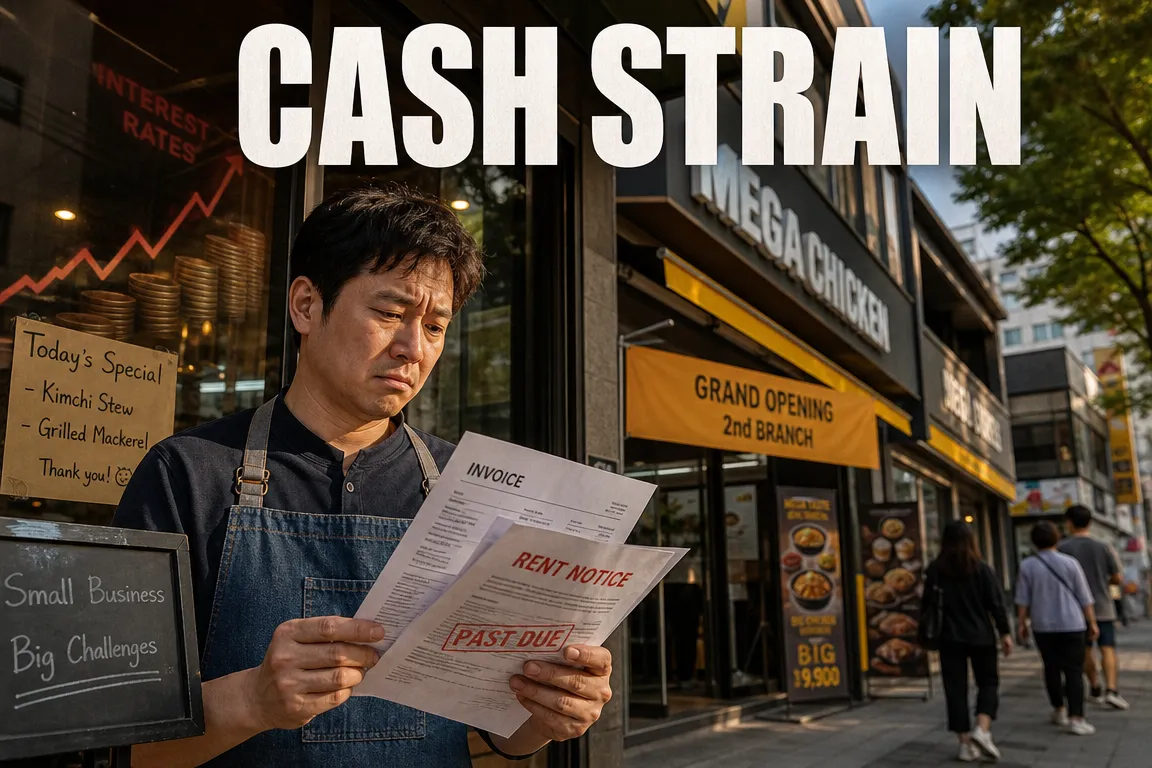
In the current startup environment, the key issue is not choosing a “good concept,” but building a structure that can withstand rising interest rates and weakening consumption.
This article summarizes the slowdown in the self-employed sector, the burden of small business debt, rising vacancy rates, restaurant startup strategy, and examples of brands that continue to grow.
The critical point that is often overlooked is this.
Today, the main criterion for startup success is no longer “how well it sells,” but “how long it can survive if sales fluctuate.”
1. Why does the self-employed sector feel so weak?
The main problem facing self-employed operators is not simply fewer customers.
Sales are declining, costs are rising, and higher borrowing rates are undermining the overall profit structure.
- Slowing growth in restaurant sales
- Rising labor costs
- Higher food ingredient prices
- Persistent rent pressure
- Greater interest burden on small business loans
- Severe hiring difficulties
- Higher vacancy rates even in good commercial districts
In the past, competition centered on securing prime locations first.
Now, even districts with foot traffic are experiencing slow absorption of vacant storefronts.
This does not simply mean entrepreneurs are becoming more cautious.
It reflects rising risk premiums as the outlook for the Korean economy becomes more uncertain.
2. The real threat is not lower sales, but fixed cost pressure
The mechanism behind the deterioration in self-employed businesses is straightforward.
Sales fall while fixed and variable costs rise at the same time.
- Even a gimbap shop faces higher ham, pickled radish, seaweed, and rice costs.
- Even a pork cutlet shop faces higher meat, oil, sauce, and packaging costs.
- Raising menu prices risks customer loss.
- Not raising prices reduces the owner’s margin.
As a result, operators are continuously pressured between price increases and declining traffic.
When labor costs, rent, and interest expenses are added, the room for survival narrows sharply.
3. Interest rate hikes hit self-employed operators harder
Interest rate increases raise financing costs for all borrowers, but the impact is greater for self-employed operators.
Salaried workers can respond by reducing borrowing or cutting consumption.
By contrast, self-employed businesses often rely on debt to fund operations.
In particular, self-employed borrowers typically carry more debt per capita than ordinary household borrowers.
This is because startup capital, interior build-out, deposits, operating funds, and inventory are all required at once.
- Sales decline.
- Operating funds become insufficient.
- Additional borrowing is taken on.
- Interest expenses rise.
- Net profit falls further.
- Operating funds become insufficient again.
When this cycle continues, borrowers become multi-debt borrowers.
Multi-debt borrowers are those who borrow from two or more financial institutions.
When low income or weak credit is added to that profile, they are classified as vulnerable borrowers.
Many vulnerable borrowers are in fact small-scale self-employed operators.
4. In a 3.0% base rate environment, the startup calculation must change
The base rate referenced in the original article is around 3.0%.
Further rate hikes remain possible.
When the base rate rises, market rates and loan rates also move higher.
This means the break-even point for a startup becomes higher.
In the past, a store could survive with monthly sales of KRW 30 million.
At the same sales level, it may now be difficult to remain viable because interest costs, labor costs, and ingredient costs have all increased.
Therefore, a startup should first evaluate the following:
- Monthly fixed costs
- Monthly loan interest expense
- Ability to survive if sales fall by 20%
- Whether the owner can operate the business directly
- Whether the business can run with minimal staffing
5. Growth is still possible: the Namnans Donkas case
Although the overall self-employed and restaurant startup environment is difficult, not all brands are weakening.
The Namnans Donkas example in the original text provides an important signal.
- Approximately 30 years of flagship store operation
- Approximately 15 years of franchise expansion
- About 111 operating locations
- Estimated cumulative visitors of about 20 million
- 160% growth in the previous year
- Expected growth of about 80% this year
Even in a weak market, certain brands continue to expand.
The difference is not simply marketing.
The key factors are product durability, operational simplicity, and capital efficiency.
6. Three rules to follow before starting a business now
First, choose a stable category rather than a trend-driven concept
Startup markets continue to produce short-lived trend concepts.
Items such as tanghulu, mala tang, brown sugar drinks, and Taiwanese castella spread rapidly.
However, concepts that scale quickly can also decline quickly.
In a high-interest-rate environment, trend-driven concepts are more risky.
If the trend weakens before the initial investment is recovered, losses are difficult to absorb.
By contrast, products such as pork cutlet have cross-generational demand.
Parents eat it, children eat it, and those children later return with their own families.
Such products are not just menu items; they become consumer memory assets.
- Does demand extend across generations?
- Is it less sensitive to seasonality and trends?
- Can demand hold even if the commercial district changes?
- Can it be sold to families, office workers, and tourists?
- Can the brand create stories and recall value?
The first criterion now is not whether a concept is hot.
It is whether it can still sell 10 years from now.
Second, the operating model must be simple
One of the biggest risks in food service today is the hiring shortage.
Workers are hard to find, labor costs are high, and training and management costs are rising.
For that reason, a startup concept must be more than tasty.
It must be easy to operate.
In the Namnans Donkas case, an important factor is the simplification of the pork cutlet production process.
Rather than preparing and processing the meat entirely in-store, the headquarters supplies a partially processed product.
Stores can then serve customers quickly.
- Can the system operate on a semi-finished product basis?
- Is cooking time short?
- Can a beginner operate it after training?
- Are side dishes and add-ons uncomplicated?
- Can table turnover be improved during peak hours?
If operations are complex, the owner becomes exhausted even when sales increase.
By contrast, a simple operating model reduces dependence on staff and lowers labor risk.
Third, the startup must remain capital-light
The most risky startup today is one that begins on too large a scale.
Heavy spending on interior construction, large deposits, and substantial borrowing can make recovery difficult after failure.
In a high-interest-rate environment, startup cost itself is a risk factor.
The more debt taken on, the higher the monthly interest expense and the higher the break-even point.
A capital-light startup matters because it preserves the ability to restart after failure.
This is especially important for first-time founders with limited operating experience.
- Initial investment must be kept low.
- Dependence on debt must be reduced.
- The model should be validated in a small store first.
- Operating experience should be built before expansion.
- Expansion should follow once profitability is confirmed.
The priority is not to scale immediately, but to build a structure that can survive.
7. The key point that is not emphasized enough in most media coverage
The core of the current self-employed crisis is not simply that “business is slow.”
The real issue is that the cost of failure for founders has become much higher.
In the past, there was room to restart after a setback.
Now, higher borrowing costs, rent, labor costs, and raw material prices can turn one failed attempt into a loss of financial stability.
Self-employment is not just an individual business issue.
It is closely tied to the structure of the Korean middle class.
When small business owners fall into debt traps, consumer spending weakens, and that reduction in consumption feeds back into lower sales for self-employed businesses.
For that reason, startup planning should begin with a worst-case scenario, not a sales forecast.
- Can the business survive if sales are 30% below plan?
- Can it absorb an additional 1 percentage point increase in rates?
- Can it operate if one employee quits unexpectedly?
- Can it remain profitable after platform fees and delivery commissions?
- How much support does the franchisor provide in supply, training, and staffing?
When selecting a franchise, brand awareness alone is not enough.
What matters is whether the headquarters simplifies operations, whether supply chains are stable, and whether training systems are in place.
The mention of a pork cutlet training academy and a multicultural family internship model is also significant.
In food service, competition is increasingly determined by labor systems rather than menus.
In an era of labor shortages, headquarters that can train and supply workers will have an advantage.
8. Reality checks before starting a business
If you are considering a startup now, you should be able to answer the following:
- Is this concept trend-driven or stable?
- Can I understand both kitchen and front-of-house operations myself?
- Can the business run with minimal staff?
- Is the franchisor’s supply and semi-finished product system stable?
- Will there still be destination demand if the commercial district weakens?
- Can I start with little or no debt?
- Can I survive for more than a year even if sales come in below target?
- Is the downside in a failure scenario manageable?
Starting without clear answers to these questions is closer to speculation than investment.
This is especially true for startups financed heavily through small business loans.
9. Conclusion: the answer now is not to start bigger, but to last longer
The current self-employed market is not an environment where growth alone should guide entry.
High interest rates, weaker consumption, rising vacancies, hiring shortages, and higher input costs are all present at the same time.
In this environment, brands that can survive longer are stronger than brands that can sell more in the short term.
Stable categories are more favorable than trend-driven ones, simple operations are more favorable than complex menus, and capital-light startups are more favorable than large upfront investments.
Starting a business can be a second chapter in life.
However, in the current economic environment, the wrong startup decision can become the beginning of middle-class decline.
What is needed now is not courage, but calculation.
And not intuition, but structure.
< Summary >
The current self-employed market is under pressure from declining sales, higher interest rates, rising labor costs, and higher ingredient prices.
Self-employed operators are more vulnerable to rate increases because they rely more heavily on debt.
If starting a business now, a stable category is preferable to a trend-driven concept.
A simple operating model with low staffing requirements is important.
A capital-light startup improves the likelihood of recovery.
Future competition in food service is likely to be determined less by menu items and more by operating systems, logistics, training, and labor supply capabilities.
[Related Articles…]
- Korean Economy Outlook and Investment Strategy in a High-Interest-Rate Environment
- Startup Strategy and Survival Framework for Small Businesses in the AI Era
*Source: [ 경제 읽어주는 남자(김광석TV) ]
– 매출은 줄고 금리까지 오른다… 지금 창업한다면 반드시 지켜야 할 3가지 | 경제 한 접시 | 자영업 [2편]
● Trump, K-Defense, Ukraine, Shock, Boom
The Real Meaning of Trump’s “Sell the Cheongung-II” Remark: A Potential Convergence of K-Defense Exports, Ukraine Support, and Hanwha Ocean’s Thailand Win
The core issue is not simply the remark “sell the Cheongung-II.”
Trump’s statement can be read as a signal linking South Korea’s defense burden-sharing pressure, support for Ukraine, expansion of K-defense exports, restructuring of Middle East air defense networks, and Hanwha Ocean’s competitiveness in naval procurement.
In particular, Cheongung-II’s profile in the UAE, the cumulative losses of Russia’s key strike assets, and Thailand’s selection of Hanwha Ocean indicate that South Korea’s position in the global defense market is changing.
This article summarizes the key points raised in the original video in a news-style format, focusing on the current opportunities for K-defense.
1. Why Trump’s “Sell the Cheongung-II” Remark Matters
The first key point in the video is Trump’s remark regarding Cheongung-II.
While it may appear to be a straightforward endorsement of exports for the Korean air-defense system, the message is materially more complex.
- Pressure on South Korea to take a more active role in supporting Ukraine
- A signal for allied countries to fill air-defense gaps that the U.S. cannot easily cover directly
- A potential large-scale export opportunity for Korean defense companies
- A corresponding increase in diplomatic burden for the South Korean government
Cheongung-II is a medium-range surface-to-air missile system, designed to intercept aircraft and ballistic missiles as part of Korea’s air-defense architecture.
While K-defense exports have primarily centered on the K2 tank, K9 self-propelled howitzer, and FA-50 light combat aircraft, Cheongung-II is significant as evidence that South Korea has entered the global air-defense market in a meaningful way.
The critical point is that, since the Ukraine war, air defense has become one of the most constrained capabilities globally.
Countries need systems such as Patriot, NASAMS, IRIS-T, and SAMP/T to counter Russian missiles, drones, and long-range strikes, yet supply remains limited.
Cheongung-II could emerge as an alternative in this environment.
2. Trump’s Dual Pressure: Defense Spending and Ukraine Support
The video interprets Trump’s statement as clear dual pressure.
This matters because it aligns with the core characteristics of Trump-style diplomacy.
Trump has consistently pushed allied countries to bear more of the security burden.
For South Korea, already facing pressure on U.S. forces cost sharing, direct investment in the U.S., trade balance, and supply-chain restructuring, this adds another layer of complexity.
If Ukraine support is added to the equation, Seoul’s policy options become even more constrained.
- Direct arms transfers could increase diplomatic friction with Russia
- Failure to support could intensify pressure from the U.S. and Europe
- Third-country exports may serve as a practical compromise
- This creates export opportunities for Korean defense firms while adding political risk for the government
In this context, Trump’s message can be read as an expectation that South Korea both spend more and supply more.
This is not only a military issue; it must also be assessed in terms of geopolitical risk and global economic implications.
3. Why Cheongung-II Gained Attention in the UAE: A Shift in Confidence Toward K-Defense
The video emphasized Cheongung-II’s operational visibility in the UAE.
The UAE is already recognized as a representative buyer of the system.
The Middle East remains a high-demand market for air defense due to threats from Iranian missiles, drones, and the potential for Houthi attacks.
When Middle Eastern countries purchase weapons, they focus primarily on three factors:
- Proven operational performance
- Fast delivery
- Reasonable cost relative to capability
K-defense has recently shown strengths across these criteria.
Compared with U.S. and European systems, which are often more expensive and slower to deliver, Korean systems benefit from faster production, a strong manufacturing base, and competitive pricing.
If Cheongung-II continues to build credibility in Middle Eastern air-defense networks, export opportunities could expand to Saudi Arabia, Qatar, Iraq, and Eastern European markets.
This suggests that K-defense exports are evolving from isolated contracts into a longer-term supply-chain role.
4. Ukraine’s War and the Surge in Air-Defense Demand
The Ukraine war has reshaped the global defense market.
Whereas tanks, armored vehicles, and fighter aircraft were once the main focus, air-defense systems have now become central to national security.
Russia has used cruise missiles, ballistic missiles, loitering munitions, and long-range bombers to attack Ukrainian cities and infrastructure.
As a result, Ukraine continues to request air-defense systems from the West.
The challenge is that Western air-defense inventories are being depleted quickly.
Patriot missiles are extremely expensive, and production capacity is limited.
European countries are also reluctant to reduce their own stockpiles.
In this context, Cheongung-II may become a practical alternative.
- It may offer lower cost than Patriot systems
- It has ballistic missile interception capability
- It can potentially be produced at scale through Korea’s manufacturing base
- It has gained credibility through Middle Eastern export cases
As the war continues, the valuation of air-defense systems in the global market is likely to remain elevated.
5. The Significance of Russia’s TU-95 Losses
The video also referenced losses and operational constraints affecting Russia’s TU-95 strategic bombers.
The TU-95 is a long-range strategic bomber with symbolic importance in Russia’s nuclear and standoff strike capabilities.
Losses in this category indicate more than the destruction of a few aircraft.
They suggest increasing pressure on Russia’s ability to sustain long-range strike operations.
Ukraine has increasingly combined drones, long-range strike systems, intelligence, and satellite data to target Russian rear bases.
This reflects a structural shift in the nature of the war.
- Conflict is no longer limited to the frontline
- Airbases and logistics networks in the rear have become legitimate targets
- The role of drones and AI-driven target analysis is expanding
- Traditional large-scale weapon systems are becoming more exposed to low-cost unmanned threats
This is also where the AI trend becomes relevant.
Future defense competitiveness will not be determined solely by missile performance.
Detection, tracking, interception, electronic warfare, data links, and AI-based threat classification will all be required.
In other words, air-defense systems such as Cheongung-II are likely to evolve into a broader competition centered on software and AI-enabled defense technology.
6. Why Thailand’s Choice of Hanwha Ocean Matters: Korea Is Advancing in Naval Procurement
The second key point in the video is Thailand’s selection of Hanwha Ocean.
Despite competition from countries with naval shipbuilding experience such as Spain, Singapore, and Turkey, Hanwha Ocean’s track record and execution capabilities were recognized again.
Naval procurement is not a simple shipbuilding contract.
It incorporates national trust, naval operating experience, maintenance systems, weapons integration, schedule reliability, pricing, and financing terms.
Hanwha Ocean’s appeal in Thailand can be understood through four factors:
- High-quality Korean shipbuilding capability
- Combined expertise in defense platforms and commercial ship construction
- Experience across submarines, destroyers, and logistics support vessels
- Cost and delivery advantages versus European competitors
Thailand’s selection of Hanwha Ocean suggests that South Korea’s position in Southeast Asian naval modernization could expand further.
Countries in the region are accelerating naval upgrades in response to South China Sea tensions, maritime disputes, illegal fishing, and the need to protect sea lanes.
This could become a core growth region for both Korean shipbuilding and K-defense.
7. Why Turkey Is Paying Attention
The video implied that Turkey is sensitive to Thailand’s choice of Hanwha Ocean.
Turkey has also been pursuing defense exports aggressively.
It has built momentum in drones, armored vehicles, naval platforms, missiles, and electronic warfare systems.
Following the Bayraktar drone’s success, Turkish defense exports have leveraged price competitiveness and battlefield experience to target emerging markets.
If Korea begins winning naval contracts in Southeast Asia, Turkey faces a stronger competitor.
Korea combines cost competitiveness with stronger manufacturing quality and delivery reliability.
This competition is likely to intensify.
- Southeast Asian naval modernization programs
- Middle Eastern air-defense replacement demand
- Eastern European rearmament projects
- Export competition in drones and electronic warfare systems
In practice, K-defense is not competing only with the U.S. and Europe.
It is also competing in a multipolar defense landscape that includes Turkey, Israel, India, and China.
8. The Mention of 6th-Generation Fighter Capability: The Next Stage for Korean Defense
Near the end of the video, it was stated that South Korea has the capability to pursue a 6th-generation fighter program.
However, the discussion also noted that key challenges remain.
A 6th-generation fighter is not simply an upgraded stealth aircraft.
It is a next-generation combat platform that combines manned-unmanned teaming, AI-assisted operations, unmanned wingmen, network-centric connectivity, electronic warfare, hypersonic weapons, and advanced sensor fusion.
South Korea is building systems-integration experience through the KF-21 program.
This experience could serve as a foundation for future 6th-generation development.
However, several hurdles remain:
- Independent engine technology
- Advanced AESA radar and sensor fusion
- Stealth shaping and materials technology
- AI-based combat software
- Data links for unmanned combat aircraft
- Large-scale defense budgets and long-term development funding
The key issue is that future value creation in defense will likely come less from hardware alone and more from AI, sensors, communications, electronic warfare, and data-processing capability.
For Korean defense companies to remain competitive globally, manufacturing strength must be combined with AI technology.
9. The Core Point Missing From Most Coverage: This Is Not Just Weapons Sales, but a Reconfiguration of the Defense Supply Chain
Many reports focus only on Trump’s remark or the export potential of Cheongung-II.
The more important issue is structural.
The world is entering a defense supply-chain reconfiguration phase.
After the Ukraine war, the U.S. and Europe have learned that their own production capacity is insufficient for a prolonged conflict.
At this point, South Korea stands out as one of the few manufacturing powers that combines fast production, high quality, cost competitiveness, and alliance alignment with the United States.
That is the real significance.
- The U.S. may use Korea as a defense production partner
- Europe may rely on Korean systems to close capability gaps quickly
- The Middle East needs operational air-defense systems
- Southeast Asia requires naval and maritime security assets
- Korean companies must evolve from manufacturers into AI-enabled defense platform providers
Cheongung-II and Hanwha Ocean should therefore not be viewed as isolated events.
They are part of a broader trend in which South Korea is taking on a more central role in the global security supply chain.
10. Economic Implications: K-Defense Could Become a Core Theme for Korean Equities and Industrial Policy
This issue is also important from an economic perspective.
As K-defense exports increase, the impact will extend beyond defense companies.
Steel, shipbuilding, electronics, semiconductors, batteries, precision machinery, software, AI semiconductors, and satellite communications could all benefit.
For companies such as Hanwha Ocean, naval contracts must be assessed alongside commercial shipbuilding cycles.
Naval orders provide long-term contracts and recurring revenue from maintenance and upgrades, creating more stable cash flow.
The same applies to systems such as Cheongung-II.
Missile systems generate recurring demand through launchers, radar, command-and-control, interceptor missiles, maintenance, training, and follow-on ammunition supply.
Once exported, they can produce sustained downstream revenue.
In this respect, defense may become a new export growth engine for the Korean economy.
- Expansion of the global defense market
- Prolonged geopolitical risk
- Rising defense budgets
- Supply-chain reallocation benefits
- Advancement of AI defense technologies
These five forces together suggest that K-defense is likely to remain an important investment theme.
11. Potential Scenarios for South Korea
Three broad scenarios may unfold.
Scenario 1: Expansion of Cheongung-II Exports to the Middle East and Europe
Based on the UAE case, additional Middle Eastern buyers may consider procurement.
Europe may also accelerate efforts to strengthen medium-range air defense in response to the Russian threat.
If this occurs, Cheongung-II could become a flagship export product for Korean defense.
Scenario 2: Greater Diplomatic Pressure Over Ukraine Support
A future Trump administration could ask South Korea to take on a larger role.
Seoul may need to consider direct support, third-country transfers, financing support, or non-lethal aid.
Each option would require balancing relations with Russia, the U.S. alliance, and domestic public opinion.
Scenario 3: Hanwha Ocean Expands Naval Export Momentum
If the Thailand case leads to further wins, expansion into Southeast Asia, the Middle East, and Latin America could follow.
Korean shipbuilding already has global competitiveness, and integration with defense could create a new growth axis.
12. Key Questions Investors and Readers Should Monitor
This issue should not be reduced to the question of whether defense stocks will rise.
The following questions are more important for understanding the trend.
- Which countries are the most likely next buyers of Cheongung-II?
- How does the U.S. intend to use Korean defense capacity?
- How will pressure to support Ukraine affect South Korea’s diplomacy?
- Is Hanwha Ocean’s naval order momentum a one-off event or a long-term trend?
- Can AI, drones, and electronic warfare alter the valuation framework for Korean defense companies?
Defense is a sector strongly influenced by politics and foreign policy.
Investors should assess not only contract announcements, but also delivery schedules, margins, follow-on orders, and intergovernmental cooperation structures.
< Summary >
Trump’s remarks on Cheongung-II can be interpreted as a signal that South Korea is being asked to play a larger role in both Ukraine support and defense supply.
Cheongung-II may gain additional opportunities in Middle Eastern and European air-defense markets, supported by the UAE case.
As the Ukraine war continues, global demand for air-defense systems is likely to remain elevated.
Thailand’s selection of Hanwha Ocean indicates that Korean shipbuilding and K-defense are being recognized in naval markets as well.
Over time, the core of defense competition is likely to shift from hardware alone to an ecosystem that combines AI, sensors, electronic warfare, and data links.
Ultimately, the issue is not simply weapons sales, but South Korea’s emergence as a more important node in the global defense supply chain.
[Related Articles…]
- Cheongung Exports and the Global Air-Defense Market
- Hanwha Ocean and Korea’s Naval Defense Growth Strategy
*Source: [ 달란트투자 ]
– “천궁2 팔아라” 트럼프의 충격 발언 곧 한국에 엄청난 일 생긴다 | 김대영 군사평론가 2부