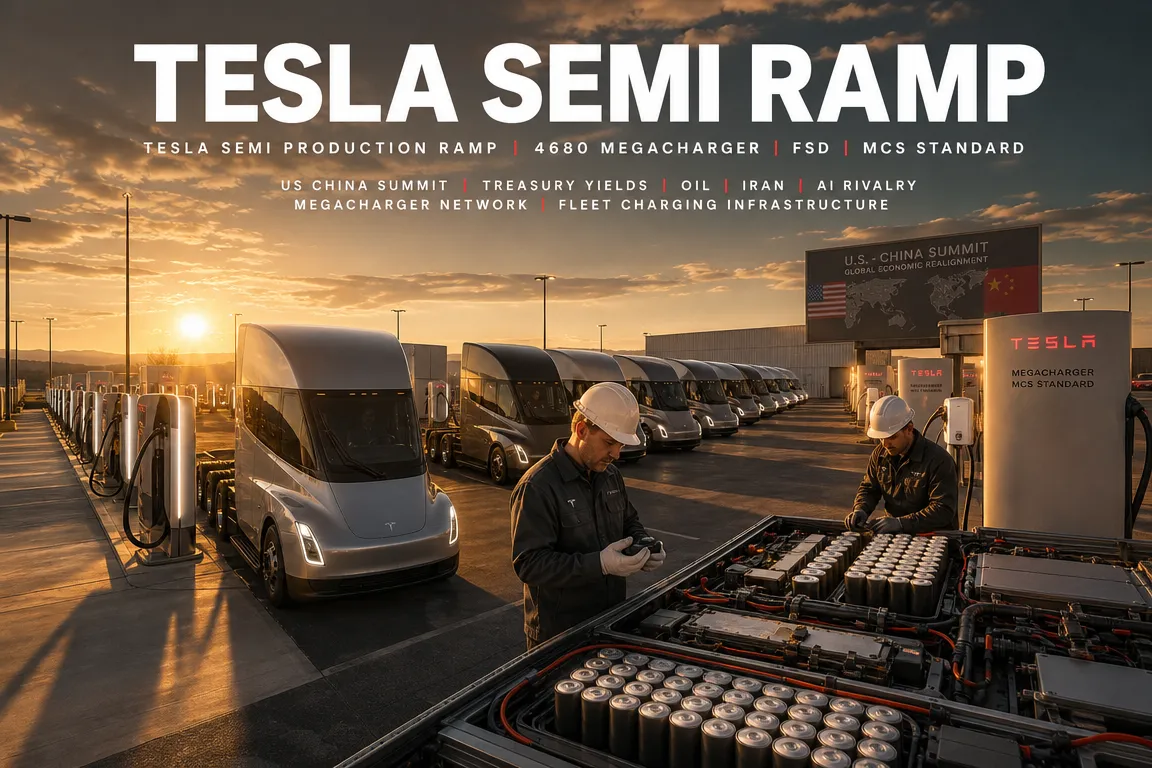
● Tesla Semi Shock, 50K, 4680, Megacharger, FSD
Tesla Semi Mass Production Event Key Takeaways: 50,000 Units, 4680 Batteries, Megachargers, and the Real Potential of Autonomous Freight
The most important point from Tesla’s Semi event is not simply that an electric truck has arrived.
Tesla disclosed a 50,000-unit annual production target, a weekly production system of 1,000 units, the use of 4680 batteries, Megacharging capable of delivering more than 60% charge in about 30 minutes, and the potential for future Semi FSD integration.
The event also signaled that the next major battleground in the EV market is shifting from passenger cars to logistics, commercial vehicles, and energy infrastructure.
Rather than viewing Tesla’s stock as a short-term event trade, the market should consider production capacity, charging infrastructure, battery cost, and the autonomous freight network that could emerge from the transition from diesel trucks to electric trucks.
1. One-Line Summary of the Tesla Semi Event
The core message of the event was a declaration that Tesla intends to move the Semi from pilot stage to mass production.
Tesla said it is preparing for large-scale Semi production at its Nevada-Reno manufacturing complex and set an annual target of 50,000 units.
On a weekly basis, Tesla referenced a production target of roughly 1,000 units.
However, no exact ramp-up completion date was disclosed.
In other words, the key issue is not the headline number itself, but when actual output begins to match that target.
2. Key Figures Announced at the Event
- Annual production target: approximately 50,000 units
- Weekly production target: approximately 1,000 units
- Facility size: approximately 1.7 million square feet
- New employment plan: more than 3,000 jobs referenced
- Charging performance: more than 60% charge in about 30 minutes
- Full charge time: approximately 50 minutes
- Efficiency: approximately 1.6 to 1.7 kWh per mile at full load
- Improvement versus prior target: roughly 25% better than the initial 2.0 kWh per mile target
- Utilization: approximately 98% for vehicles already in operation
These figures matter because in the commercial trucking market, total cost of ownership, utilization, charging time, and maintenance costs are more important than vehicle price alone.
Tesla is positioning the Semi not as a conventional EV, but as a cost-reduction tool for fleet operators.
3. Two Core Themes Emphasized by Elon Musk: Diesel Cost and Autonomy
Elon Musk highlighted the Semi’s economics at the start of the event.
The central point was that electricity costs per mile are significantly lower than diesel fuel costs.
With crude oil prices rising and inflationary pressure increasing, fuel cost volatility remains a major risk for logistics companies.
Tesla directly targeted that issue.
The other major theme was Semi autonomy.
Musk said autonomous features would be added to the Semi in the near future.
The goal is to reduce driver fatigue and improve safety in long-haul operations.
However, no specific launch date was given.
Because the Semi’s body structure and camera placement differ from the Model 3, Model Y, and Cybertruck, FSD integration may take longer.
4. Production Strategy: Vertical Integration and Automation
The event focused heavily on cost reduction rather than the truck itself.
Tesla said the Semi factory was designed not as a simple assembly plant, but as a highly integrated system that processes materials from raw input to finished vehicle shipment internally.
- Raw material coil input
- Cutting and stamping
- Battery cell input
- Battery pack assembly
- Powertrain assembly
- Final vehicle assembly
- Automated outbound logistics
Tesla also said the battery line is intended to operate with minimal human contact.
The company’s emphasis on automation and vertical integration reflects the need to achieve cost competitiveness in the commercial truck market.
Fleet customers focus on numbers, not branding.
They buy based on lower operating costs, reliability, and charging compatibility with route schedules.
5. 4680 Battery Adoption: More Range With Less Battery
One of the most important technical changes in the Semi is the transition from 2170 cells to Tesla’s in-house 4680 battery cells.
Tesla said it improved the design to reduce pack weight and capacity while preserving driving range.
This is significant.
In electric trucks, adding more battery improves range but hurts payload capacity and cost.
Reducing battery size improves price and weight, but creates range constraints.
Tesla is claiming that overall vehicle efficiency has improved enough to better balance that tradeoff.
An efficiency level of roughly 1.6 to 1.7 kWh per mile at full load is a key metric for the electric commercial vehicle market.
If that figure holds in real-world operation, it could materially change fleet economics.
6. Drivetrain Changes: Shared Technology With Cybertruck
Tesla also described major changes to the Semi’s drivetrain.
While the original prototype drew heavily from Plaid powertrain technology, the production version was redesigned to be cheaper, lighter, and more durable.
- New steel structure instead of a carbon-fiber sleeved rotor
- Improved motor efficiency and reliability
- Approximately 80 kg reduction in drivetrain weight
- Shared motor and stator technology with Cybertruck
- Reduced oil usage
- More than 250,000 miles of gear oil life referenced
The key point is that Tesla is integrating the Semi with Cybertruck, Cybercab, and passenger vehicle platforms rather than building it as a standalone project.
Greater parts sharing should lower production costs and simplify service infrastructure.
While often overlooked in coverage, this could have a meaningful effect on Tesla’s long-term margin structure.
7. Steering and Driving Experience: A Large Truck That Feels Closer to a Model Y
The event also emphasized the Semi’s driving experience.
Tesla said the truck is easier to operate than conventional heavy-duty trucks and offers an experience closer to Tesla’s passenger vehicles.
An electronic steering system, similar to steer-by-wire, was specifically referenced.
This appears consistent with the steering technology demonstrated in Cybertruck.
The system could materially improve turning radius and handling in a large truck.
Tesla also said the driver’s smartphone profile can automatically adjust the seat, mirrors, and settings when entering the vehicle.
That feature is practical in logistics operations where multiple drivers use the same truck.
8. Thermal Management: Shared Architecture Between Cybercab and Semi
One of the more important details in the event was thermal management.
Tesla said the Semi and Cybercab use a jointly designed indirect thermal management system.
The system avoids running refrigerant lines far across the vehicle and instead uses a factory-sealed structure to move heat efficiently.
This reduces energy loss by reallocating heat generated by the battery, drivetrain, and cabin where needed.
This matters because in electric vehicles, winter efficiency, fast-charging performance, battery durability, and cabin climate control all depend on thermal management.
For a vehicle with a large battery pack and long operating hours, thermal efficiency is directly tied to operating cost.
9. Charging Infrastructure: Megachargers and Fleet Depots
The biggest bottleneck for Semi deployment may be charging infrastructure rather than the vehicle itself.
Tesla addressed this by presenting both the Megacharger network and fleet-depot charging solutions.
- Megachargers planned along major routes and key regions
- More than 30 charging sites expected by year-end
- More than 200 megawatt-class charging posts referenced
- Dedicated chargers for corporate depots
- Low- and mid-speed charging options suitable for overnight use
- Emphasis on interoperability based on MCS standards
The event showed a charge from roughly 30 minutes reaching around 62%.
Because commercial drivers are legally required to take rest breaks, Tesla is trying to align charging with mandatory downtime.
In other words, the objective is not to stop operations for charging, but to charge while drivers are already paused.
10. Customers and Orders: Strong Demand, but Ramp-Up Remains the Constraint
The presentation referenced several customer groups tied to the Semi program.
Large logistics and retail-related companies such as Walmart, Pepsi, and Einride were mentioned.
Some customers reportedly placed orders in the hundreds of units, with total orders said to be in the thousands.
However, the more important issue is not order volume.
Even if demand is strong, revenue recognition will be delayed if delivery capacity remains limited.
The event also suggested that some large customer orders may not be delivered until around late 2027.
This implies that demand is not the issue; production ramp-up and charging infrastructure deployment are the real constraints.
11. What the Tesla Semi Could Change in Logistics
Heavy-duty trucks represent a small share of total vehicles on U.S. roads, but they account for a disproportionately large share of fuel consumption and emissions.
The event suggested that trucks make up roughly 1% of vehicles on the road, but a much larger share of emissions-related impact.
Replacing that fleet with electric trucks could reduce logistics costs, emissions, maintenance costs, and exposure to fuel-price volatility at the same time.
In a high-rate and high-oil-price environment, logistics companies face strong pressure to reduce operating costs.
The Tesla Semi is therefore not just an environmental product, but a vehicle tied to the cost structure of the U.S. logistics economy.
12. Market Context: Why the U.S. Equities, Oil, and Rates Environment Matters
Ahead of and after the event, U.S. equities showed a modest rebound.
The S&P 500 rose approximately 0.46%, the Nasdaq gained about 0.45%, and the Dow Jones Industrial Average increased by roughly 0.56%, according to the discussion.
Tesla closed at 357.01 dollars, up about 0.26%.
However, the broader macro backdrop remains challenging.
Geopolitical risk pushed oil prices higher, with Brent crude cited in the mid-90 dollar range per barrel.
Higher oil prices can revive inflation pressure and affect expectations for policy rates.
The discussion also noted that the market-implied probability of a 0.25% Federal Reserve rate hike in September had risen meaningfully from the prior week.
In that environment, the Semi’s economics become more relevant.
When diesel prices are volatile, the predictability of electric operating costs becomes a competitive advantage.
13. U.S.-China Relations and the Chinese EV Variable
The discussion also referenced reports that Chinese automakers could potentially be allowed to produce vehicles in the United States.
If companies such as BYD or Xiaomi enter the U.S. market through local production, competition in the EV sector could change materially.
Commercial EVs, however, are different from passenger EVs.
Pricing alone is not enough; charging infrastructure, service networks, software, autonomy, and fleet data are all required.
On that basis, Tesla still has a structural advantage.
At the same time, Chinese manufacturers with lower-cost EVs and strong battery economics could become a longer-term competitive threat.
14. Roadster Teaser: Brief but Relevant
Toward the end of the event, a brief teaser of what appeared to be a Roadster headlight was shown.
This was not a formal reveal, only a partial front-light design reference.
The discussion also mentioned a possible additional Roadster update on October 1.
The event’s core focus was the Semi, but Tesla used the closing segment to preserve interest across its broader product lineup.
15. The Real Point That Many Reports Miss
First, the Tesla Semi is not just a vehicle; it is a logistics platform.
When the Semi, Megachargers, corporate depot charging, OTA diagnostics, mobile service, parts distribution, and future FSD are connected, the result is not simply an electric truck, but an operating system for freight.
Second, parts sharing across Cybertruck, Cybercab, and Semi matters more than many headline numbers.
Shared motors, thermal systems, software, and manufacturing automation can reduce costs across the product portfolio.
That has direct implications for Tesla’s earnings and long-term margins.
Third, reducing battery capacity while preserving range is a key development.
Battery packs are the most expensive component in an electric truck.
If Tesla can do the same job with less battery, vehicle price, charging time, payload capacity, and profitability all improve.
Fourth, Semi FSD should be treated as a long-duration option rather than a near-term catalyst.
The Semi differs from passenger vehicles in size, sensor placement, and operating environment.
Autonomy is plausible, but commercial deployment will require validation time.
Fifth, the real bottleneck may be power infrastructure rather than vehicle production.
If hundreds of Semis charge simultaneously at a logistics hub, electricity demand will be substantial.
Vehicle production alone will not be sufficient; grid capacity, energy storage, solar, and charging software will become increasingly important.
16. Investment Checklist
- Production ramp-up: whether weekly output of 1,000 units becomes reality.
- Actual deliveries: quarterly deliveries matter more than order announcements.
- Total cost of ownership: diesel-versus-electric savings must be validated in real numbers.
- Megacharger expansion: deployment speed along major freight routes and at depots is critical.
- 4680 battery economics: production yield and cost reduction will shape margins.
- FSD timing: Semi autonomy could reshape freight productivity over the long term.
- Competitive response: Chinese EV makers and legacy commercial truck manufacturers remain relevant variables.
< Summary >
Tesla used its Semi mass-production event to set a 50,000-unit annual target and a 1,000-unit weekly target.
Key technical points included 4680 batteries, an improved drivetrain, parts sharing with Cybertruck, and shared thermal architecture with Cybercab.
Megacharging was presented as capable of delivering more than 60% charge in about 30 minutes, alongside fleet-depot charging plans.
Semi FSD remains strategically important, but the timing remains uncertain.
The event’s broader significance is that Tesla is extending beyond an EV manufacturer into a logistics, energy, and autonomy platform company.
[Related Articles…]
*Source: [ 오늘의 테슬라 뉴스 ]
– [오테뉴 LIVE] 테슬라 세미트럭 대량생산 이벤트 ( 라이브 생방송 중계 )
● US-China Deal Shock, Bond Yields, Oil, AI Power Play
After the U.S.-China summit: Where are U.S. Treasury yields, oil, and the AI rivalry headed?
The key issue in this U.S.-China summit is not simply that the two sides resumed dialogue.
The more important point is that U.S. Treasury yield stabilization, the possibility of renewed Chinese purchases of U.S. Treasuries, Taiwan, mediation in the Iran conflict, oil price stability, and the AI rivalry are all interconnected.
The most important point in the source is whether China could begin buying U.S. Treasuries again.
If that happens, long-term U.S. yields could ease, and the implications could extend to Big Tech AI investment, U.S. equities, dollar liquidity, and oil prices.
1. Why this summit matters
On the surface, the summit appears to be about improving bilateral ties, trade negotiations, and security talks.
In practice, it can be viewed as an attempt by both sides to address urgent issues through a broader deal.
- The United States needs to stabilize rising Treasury yields and oil prices.
- China wants to reduce the risk of direct U.S. military involvement in Taiwan.
- The United States needs to lower Middle East risk and inflation pressure linked to the Iran conflict.
- Both sides are seeking leverage over AI semiconductors and frontier AI governance.
- For the Trump administration, financial market stability is important ahead of the midterm elections.
In this context, the summit should be viewed less as a diplomatic event and more as a political and economic package negotiation with global macro implications.
2. Key points from Trump’s remarks: farms, trade, and AI security
Trump’s remarks can be summarized in three main points.
2-1. Emphasis on personal ties with Xi Jinping
Trump described his relationship with Xi Jinping as a “truly great friendship.”
This is not merely diplomatic language, but a political device intended to ease the negotiating environment.
Heightened U.S.-China confrontation would likely increase market volatility.
2-2. Reference to World War II history
Trump noted the shared U.S.-China role on the same side during World War II.
The message is that the two countries are not natural enemies and have cooperated in the past.
This can be read as an effort to create political room to reduce tensions in trade and technology disputes.
2-3. Market access for U.S. farmers and livestock producers
The most concrete issue is expanded Chinese access to U.S. agricultural and livestock products.
Soybeans, corn, and meat exports are the most relevant categories.
If China resumes large-scale purchases of U.S. soybeans, it would help ease pressure on Midwestern farm constituencies that are important to Trump politically.
This matters politically because the Corn Belt overlaps with the Republican voter base.
After the trade conflict, China reduced U.S. soybean imports and shifted demand toward South America, which hurt U.S. farmers.
A rebound in Chinese purchases would therefore have clear domestic political value for Trump.
2-4. AI and frontier technology security
Trump highlighted security, technology, and frontier AI issues.
This reflects the fact that AI is not only an industrial issue, but also a core driver of national security, semiconductor supply chains, and competitiveness.
For the United States, export controls on AI chips and the financing needs of large-scale AI investment must be managed at the same time.
3. Key points from Xi Jinping’s remarks: avoiding conflict, Taiwan, and AI controls
Xi’s remarks were aimed at avoiding direct confrontation while protecting China’s core interests.
3-1. Message to avoid the “Thucydides Trap”
Xi said that the United States and China should avoid conflict and confrontation and coexist peacefully.
This implies that even if the two countries compete for power, they should avoid a path toward war.
For markets, such language tends to support short-term risk sentiment.
3-2. Claim that MAGA and the great rejuvenation of the Chinese nation can coexist
Xi argued that “Make America Great Again” and the “great rejuvenation of the Chinese nation” are not necessarily incompatible.
The logic is that both countries can become stronger at the same time.
In practice, however, competition is likely to continue across AI, semiconductors, military power, dollar dominance, and supply chains.
3-3. Military dialogue and crisis management mechanisms
Xi called for regular dialogue between the two militaries and improved crisis management mechanisms.
This is intended to manage risks in the Taiwan Strait, the South China Sea, and on the Korean Peninsula.
Taiwan is likely the key issue China most wants addressed in this summit.
3-4. Panda diplomacy and youth exchanges
China said it would invite 100,000 American youth to China over the next five years and send two pandas to the Atlanta Zoo.
Panda diplomacy is a symbolic tool China often uses when it wants to reduce tensions.
Although cultural in form, it signals a shift toward managed relations.
3-5. Global AI governance and guidelines
Xi said the two countries should responsibly manage and develop guidelines for new technologies such as AI.
On the surface, this concerns AI safety norms.
At a deeper level, it suggests that both sides want to control the pace and cost of the AI race.
4. Why rising U.S. Treasury yields are the most important variable
The most important macro variable in the source is U.S. Treasury yields.
The fact that the 10-year yield is above 5% and the 30-year yield is at a long-term high places pressure on the financial system.
- The U.S. government faces higher borrowing costs.
- Corporate bond issuance becomes more expensive.
- Mortgage rates rise and pressure the housing market.
- Big Tech’s AI capital spending becomes more costly.
- Volatility rises across equities, crypto, and gold.
If Treasury yields remain too high, the Trump administration will find it harder to expand fiscal stimulus.
Ahead of the midterm elections, policy support becomes more difficult when borrowing costs are elevated.
For this reason, yield stabilization is a priority for Washington.
5. The possibility of renewed Chinese Treasury purchases
The most notable argument in the source is that China could resume buying U.S. Treasuries.
China previously accumulated large Treasury holdings on the back of trade surpluses.
Later, it reduced those holdings and increased its gold reserves.
If China were to buy U.S. Treasuries again, the likely effects would be as follows:
- U.S. Treasury prices could rise and yields could decline.
- The U.S. government’s financing burden would ease.
- Corporate bond issuance conditions would improve.
- AI infrastructure and data center investment could continue.
- U.S. equities and risk sentiment could recover.
This is the hidden core of the summit.
Even if “Treasury purchases” are not mentioned publicly, they can still be part of the behind-the-scenes agenda.
The fact that senior U.S. and Chinese economic officials reportedly coordinated the agenda in advance is important.
6. Why a decline in gold prices is also possible
If China shifts from selling U.S. Treasuries to buying them again, demand for gold may weaken.
If Treasury yields stabilize and dollar liquidity improves, gold could face short-term correction pressure.
That said, gold may retain safe-haven support if geopolitical risk remains elevated.
However, a meaningful shift toward renewed Chinese Treasury purchases would likely weigh on gold.
7. Taiwan: the key card China wants
From China’s perspective, the most important issue in the summit is Taiwan.
In particular, a slowdown or suspension of U.S. arms sales to Taiwan would be the most desirable outcome for Beijing.
As Taiwan’s military capabilities strengthen, China’s cost of pressure increases.
Conversely, if U.S. arms sales are delayed or reduced, China could intensify pressure across the Taiwan Strait.
For Washington, however, easing the Taiwan card is difficult.
Taiwan is central to the AI semiconductor supply chain and occupies an essential position in global chip production through TSMC.
Taiwan is therefore not only a security issue, but also a core part of the AI rivalry.
8. Iran and oil: the card the United States wants from China
The most realistic card Washington can seek from China is related to Iran.
The source suggests that China could help mediate the Iran conflict, or at minimum reduce Iran’s capacity to sustain prolonged conflict.
China has been a major purchaser of Iranian crude, and Tehran depends on Beijing economically.
If China applies pressure or acts as an intermediary, Middle East risk and oil prices could stabilize.
Lower oil prices would reduce U.S. inflation pressure.
Lower inflation would ease pressure on the Federal Reserve and support Treasury yield stabilization.
In this sense, the Iran conflict, oil prices, U.S. yields, and U.S. election strategy are all linked.
9. Possible deal structure: Taiwan for Iran
The most plausible scenario is a structure in which China gains room on Taiwan while the United States gains stability on Iran and Treasury yields.
- China wants slower U.S. arms sales to Taiwan.
- The United States wants China to stop selling Treasuries or resume purchases.
- The United States wants China to play a mediating role on Iran.
- China wants a longer trade truce and reduced technology pressure.
- Both sides may seek to slow the pace of competition through AI governance discussions.
If this structure holds, the short-term effect would likely be constructive for markets.
However, long-term Taiwan risk and AI supply-chain uncertainty would remain.
10. Why a two-month trade truce matters
The source refers to a two-month extension of the U.S.-China trade truce.
This is not just a matter of buying time.
For the United States, financial market stability is needed ahead of the midterms.
For China, there is an incentive to showcase technological progress and national strength at major international events.
China may also want to highlight capabilities in robotics, drones, physical AI, and semiconductors.
For both sides, an extension of the truce serves as a political buffer.
The United States gains market stability, and China gains diplomatic space.
11. AI rivalry: the real issue may be funding, not safety
AI regulation and frontier AI controls are often framed as safety issues.
However, the source places greater emphasis on financing conditions.
U.S. AI competitiveness depends heavily on large capital expenditures by Big Tech, including data centers and GPU investment.
The challenge is that this requires substantial funding.
- Microsoft, Google, Amazon, and Meta must continue large-scale AI infrastructure spending.
- Nvidia GPU demand depends on uninterrupted data center investment.
- If internal cash flow is insufficient, companies need bond issuance.
- Bond issuance costs are directly affected by U.S. Treasury yields.
- High yields can slow the AI investment cycle.
For this reason, Treasury yield stability is a key condition for the AI race.
If AI investment slows, U.S. GDP growth could also weaken.
As the source implies, if a meaningful share of U.S. growth depends on capital expenditure, the AI investment cycle becomes relevant to both growth and elections.
12. China’s AI rise: low-cost models are reshaping the market
The source notes that China’s AI usage has surpassed the United States on a token-volume basis.
This is important.
Global firms do not use only expensive U.S. AI models for all tasks.
For routine or high-volume workloads, they may choose lower-cost Chinese models, while reserving U.S. models for more complex tasks.
This creates pressure on U.S. AI companies that must recover large upfront investments.
China may be able to expand market share with a lower-cost structure.
The AI rivalry is increasingly about pricing power and financing capacity, not just technical capability.
13. The most important point that is often missed
The core issue in this summit is not only Taiwan or Iran.
The more important linkage is between possible Chinese Treasury purchases and the U.S. AI investment cycle.
Many reports view the summit only through trade, Taiwan, and security.
A deeper reading suggests the following sequence:
- China stops reducing U.S. Treasury holdings or begins buying again.
- Long-term U.S. Treasury yields decline.
- Corporate borrowing costs fall.
- Big Tech continues AI and data center investment.
- U.S. GDP and equities hold up.
- The Trump administration gains pre-election market stability.
In other words, the summit may function not only as a diplomatic event, but also as a liquidity mechanism that could extend the U.S. AI investment cycle.
This is the most important analytical lens.
14. Market implications by scenario
14-1. Positive scenario
- China stops reducing U.S. Treasury holdings or resumes selective buying.
- U.S. Treasury yields stabilize.
- Oil prices decline or stabilize.
- Sentiment toward AI semiconductors and Big Tech improves.
- U.S. equities and risk assets could rebound in the near term.
14-2. Neutral scenario
- Both sides only extend the trade truce.
- Taiwan and Iran are addressed only at a general level.
- Yields stabilize temporarily and then move based on macro data.
- Markets refocus on the Federal Reserve and inflation data.
14-3. Negative scenario
- Tensions around Taiwan intensify.
- China continues reducing U.S. Treasury holdings.
- The Iran conflict and Middle East risk worsen.
- Oil prices rise sharply again.
- Higher U.S. yields and slower AI investment become simultaneous concerns.
15. Conclusion: will Treasury yields stabilize after the summit?
In the short term, stabilization is possible.
However, several conditions would need to be met.
China would need to slow Treasury selling, support Iran-related de-escalation, or agree to extend the trade truce.
In the longer term, the U.S.-China rivalry is not over.
Taiwan, AI chip controls, the rise of Chinese AI models, and the financing burden on U.S. Big Tech remain unresolved.
This summit is therefore better understood as conflict management rather than conflict resolution.
The United States wants lower yields and oil prices to support the economy before elections.
China wants a stronger position on Taiwan and technology.
The summit is best viewed as a deal to address urgent pressures rather than a declaration of peace.
< Summary >
The main issues in this U.S.-China summit are U.S. Treasury yield stability, Taiwan, Iran, oil prices, and the AI rivalry.
The United States may want China to resume buying U.S. Treasuries or at least stop selling them.
China wants slower U.S. arms sales to Taiwan and reduced technology pressure.
If China plays a mediating role on Iran, oil prices and inflation could stabilize.
Lower Treasury yields are also important for sustaining Big Tech AI investment and U.S. equities.
Overall, the summit is not just a diplomatic event, but a major political and economic negotiation that could shape global markets and the AI investment cycle.
[Related Articles…]
*Source: [ 경제 읽어주는 남자(김광석TV) ]
– 미중 정상회담 이후 국채금리 진정될까? 대만문제와 이란전쟁 빅딜 있을까? [즉시분석]