● AI Human Verification Crisis, Deepfake Surge, Judgment Wins
In an era where a single individual can generate revenues in the billions using AI, the real competitive edge is not the tool itself, but human judgment.
The claim that people who use AI well will survive is only partially true.
This discussion is not simply about how to use ChatGPT, generative AI, or AI agents effectively.
To understand the economic outlook, AI trends, future jobs, the global economy, and investment strategy, a more important question must be asked than whether AI will replace humans.
Is this person real?
Is this output created by AI, or is it verified and accounted for by a human?
Does the person using AI have genuine expertise?
Does the person have the leadership to direct AI agents?
Without answering these questions, even extensive AI usage may leave performance stuck at 90 out of 100.
The issue is that the standard has already shifted from a 100-point system to a 500-point system.
In other words, even if AI makes an individual appear to improve from 80 to 90, that person may still be falling behind in the market.
1. The first survival keyword in the AI era: human verification
The first major market to expand in the AI era may not be better AI tools.
Instead, the more important category is likely to be human verification, or Proof of Personhood.
This refers to the process of confirming whether the account, content, or message was created by a real person.
In the past, a visible face was enough to establish trust.
A heard voice was enough to confirm identity.
Now, however, deepfakes, AI voice cloning, fake YouTube channels, and virtual influencers are highly convincing.
Something that looks human may not be human, and a voice that resembles a well-known figure may not belong to that person.
This is not only a technical issue; it has become an economic issue linked to financial fraud, investment fraud, identity theft, cybercrime, and wasted marketing spend.
2. Why human verification is becoming a new pillar of the global economy
AI-generated fake accounts and fake content are already creating substantial economic costs.
There are increasing cases of fraudulent channels impersonating financial YouTubers or economic commentators and soliciting investments.
Seniors in their 60s and 70s, especially those with retirement savings, are frequent targets.
The problem is that victims believe a well-known expert was speaking directly.
Consumers can no longer verify authenticity simply by what they see.
The same applies to companies.
When allocating marketing budgets, firms must determine whether a high-follower account represents a real person or an AI-generated identity.
Dating platforms must verify whether the other party is a real person or an AI bot.
Financial institutions and card issuers must confirm whether an account belongs to a genuine human user.
Human verification technology is likely to become a basic authentication layer for internet services.
3. Why World ID and Tools for Humanity have drawn attention
A frequently cited company in the human verification market is Tools for Humanity.
The company’s name reflects its stated mission to build tools for people.
Its core products include World ID and Worldcoin.
Interest increased further because Sam Altman is one of the co-founders.
The premise is that as AI expands, verifying genuine human identity becomes more important.
The service is reportedly used by tens of millions of people globally, but it is still early in broad adoption.
There have been legal issues in the United States, as well as regulatory and privacy concerns related to biometric authentication.
Even so, demand for human verification is likely to keep rising across financial services, card networks, social media, dating apps, and e-commerce.
4. The paradox of AI content abundance: verification costs rise faster than productivity
A similar pattern is already visible in corporate settings.
AI tools have made it much faster to produce reports, plans, videos, and text content.
However, because content is now easier to generate, low-quality output is proliferating.
Managers increasingly need to verify large volumes of AI-based reports submitted by their teams.
Productivity appears to be improving, but verification and judgment costs are rising at the same time.
The important person in an organization is no longer the one who produces the most with AI.
It is the person who can determine what is correct, what is wrong, and what is suitable for actual decision-making.
5. The 100-point era is over; the 500-point era has begun
Before AI tools became widespread, individual performance was measured on a 100-point scale.
With generative AI and AI agents now becoming standard, market expectations have shifted to a 500-point scale.
Previously, a person with an 80-point skill level who used AI to produce a 90-point output might have been seen as strong.
But once the entire market uses AI, 90 is no longer a high score.
Under a 500-point benchmark, 90 becomes a weak score.
This means that using AI effectively is not enough.
Professional expertise, problem definition, judgment, and accountability must improve as well.
6. The more important question is not whether AI will take jobs
Many people ask whether AI will eliminate their jobs.
Some roles will certainly be automated quickly.
However, a more important change is not the disappearance of jobs, but the changing profile of the people needed within the same job.
Large technology firms continue to announce layoffs.
Microsoft, for example, has announced cuts involving thousands of employees.
Yet total headcount often remains similar to levels seen a few years ago.
This suggests that the issue is not simply fewer people, but different people being hired and retained.
Those who work in outdated ways are being displaced, while those who create value in an AI environment are being added.
7. Why employees in their 40s and 50s should worry first
Parents often worry about their children’s future jobs.
But the more immediate concern may be employees in their 40s and 50s.
People are likely to work for much longer than before.
Many in their 40s and 50s may need to sustain economic value for another 20 to 30 years.
The problem is that companies are no longer willing to pay a premium for tenure alone.
With AI tools, a new hire and a 10-year employee may generate similar first-draft outputs.
That leads companies to ask:
Why should a 10-year employee be paid more?
To remain relevant, employees must answer that question.
The answer is not merely AI usage, but the verification and judgment developed through prior experience.
8. The real competitive advantage of experienced professionals comes from pre-AI experience
The advantage of experienced workers does not come only from their ability to use AI.
The more important factor is the experience gained from solving problems directly before AI existed.
People who already have their own hypotheses and answers before asking AI are different.
They can detect when AI produces something inconsistent or implausible.
By contrast, those with limited experience may accept a polished AI response without question.
In the future, the value of experience will be determined not by years of service, but by the ability to question and verify AI-generated results.
9. Why telling children to “just study hard” is becoming risky
In the past, academic success often led to good jobs, high pay, and stability.
In the AI era, however, strong study habits alone are not sufficient.
Global technology firms already employ many people who are highly educated, intelligent, and test well.
Yet many of those same people are affected by restructuring.
That makes “just study hard” an incomplete message for children.
The education needed now is not memorization, but the ability to define problems, make decisions, and accept responsibility.
In an era where AI provides answers, the more important person is not the one who asks questions well.
It is the person who can identify the real problem and decide what should be done.
10. Why the prompt engineer boom faded quickly
A few years ago, prompt engineers were widely described as a promising future profession.
This was because AI response quality depended on how questions were framed.
At the time, concise and structured prompting appeared to be a critical skill.
But prompt writing has since become broadly accessible.
As tools improved, most people could learn the basics of prompt design.
What matters now is not prompt technique, but the user’s expertise.
Highly skilled professionals ask better questions, choose better outputs, and make more accurate judgments.
11. What AI cannot replace: decisions and accountability
AI can support analysis.
AI can organize information.
AI can draft reports.
AI can also generate images and video.
But one thing AI cannot ultimately replace is decision-making and accountability.
Investment decisions, children’s education decisions, and corporate strategy changes are still made by people.
AI can provide probabilities and scenarios, but it does not bear responsibility for outcomes.
For that reason, leadership becomes more important in the future.
Leaders are those who make decisions under uncertainty and take responsibility for the results.
12. Core capabilities of future leaders: leadership and orchestration
In the AI era, leaders are not only managers of people.
They will also need to direct AI agents and automation tools.
Managing people remains traditional leadership.
Deploying AI tools and agents appropriately is orchestration.
The key talent of the future will therefore be someone who can lead both people and AI.
It is no longer sufficient to simply “know how to use AI.”
One must also know which AI to use, where to use it, which outputs to adopt, and where human intervention is necessary.
13. The real message from a one-person business generating billions in revenue
A widely discussed case in the United States involved one person using AI tools to generate very large revenue.
The business was an online commerce operation related to GLP-1 obesity treatments.
The company reportedly generated more than $400 million in revenue the prior year, with future revenue estimates reaching $1.8 billion.
That implies a scale of more than one trillion won.
Operating margins were reportedly around 16%, indicating high efficiency.
On the surface, this looks like success driven by AI tools.
But the core lesson is different.
The founder had previously run a shopping business with 60 employees and failed.
Through that experience, the founder learned the problems created by hiring, operational bottlenecks, marketing constraints, and failure itself.
In other words, success came not from AI alone, but from a person with business experience and failure lessons using AI as an organizational tool.
14. The tool is not the key issue; the user is
AI tools are powerful.
They can support video production, graphic design, marketing automation, customer service, data analysis, and content creation.
But a tool remains only a tool.
A weak user does not become exceptional simply by using a better tool.
By contrast, a skilled and experienced user can multiply productivity and impact dramatically with the same tool.
Failure to understand this leads to one of the most common mistakes in the AI era.
The mistaken belief is that AI alone makes competence possible.
The real questions are:
Could I understand this problem without AI?
Can I identify when AI is wrong?
Can I verify AI output enough to use it in decisions involving real money?
15. Industries that are likely to grow: human verification, AI validation, and deepfake defense
Many people focus only on generative AI models in the AI trend cycle.
But industries that solve AI-created problems are also likely to grow rapidly.
One example is human verification services.
AI content detection technology will also become important.
Deepfake video and voice-cloning detection will likely expand as a security category.
Financial fraud prevention solutions, identity verification platforms, AI watermarking, and content provenance tracking may become key infrastructure.
For companies, managing AI risk is as important as adopting AI itself.
For investors, AI-related opportunities should include not only model developers but also companies providing verification infrastructure for the AI era.
16. Key points often missed in other news and videos
First, AI tool usage is quickly becoming standardized.
Initially, people who used AI well appeared to have an advantage, but over time most users learn the basics.
At that point, expertise matters more than tool usage.
Second, the real cost in the AI era is verification, not production.
Content and reports are now cheap and fast to produce.
But confirming accuracy and taking responsibility has become more valuable.
Third, human verification is not just a security function; it is economic infrastructure.
It affects online finance, marketing, e-commerce, social media, dating, education, and hiring.
Fourth, employees in their 40s and 50s may be displaced not because of AI itself, but because they fail to demonstrate judgment.
Tenure matters less than verification ability, problem-solving skill, and accountability.
Fifth, the essence of the era where one person can generate billions in revenue is not full automation, but elevated individual capability.
AI did not operate the business on its own; a business-minded person used AI as an organizational extension.
17. Strategies individuals should prepare now
Step 1 is to rebuild expertise in your field.
You should be able to form your own hypothesis before asking AI.
You need a standard against which AI output can be judged.
Step 2 is to avoid blindly trusting AI results.
Any decision involving money, investment, health, law, or career should be independently verified.
Step 3 is to expand leadership capability.
Beyond managing people, you must learn to coordinate AI tools and AI agents.
Step 4 is to strengthen human capabilities.
Judgment, creative problem-solving, accountability, ethics, and persuasion will become more valuable.
Step 5 is to improve defenses against AI fraud and deepfakes.
If a famous figure requests money, asks for urgent transfers, or presents a confidential high-return opportunity, it should be treated with skepticism.
18. Strategies companies should prepare now
Companies should not compete only on the speed of AI adoption.
They need internal processes that verify AI-generated output.
Responsibility for reports, code, content, customer service, and marketing materials must be clearly assigned.
Employee evaluation criteria must also change.
Companies should reward not the person who uses AI the most, but the person who uses AI to improve outcomes and reduce risk.
Customer identity verification, deepfake defense, and AI fraud prevention systems should also be strengthened.
Corporate trust will no longer depend only on how well AI is used.
It will also depend on how effectively a company prevents AI-related errors and fraud.
19. Conclusion: in the AI era, human capability becomes more important
It is easy to assume that human roles will diminish as AI advances.
In practice, however, the opposite trend is also becoming clear.
As AI produces unlimited content, the need to verify whether something comes from a real human increases.
As AI makes answers easier to produce, the need to determine who is responsible for decisions becomes more important.
As AI standardizes tools, individual expertise and experience create greater differentiation.
The people who will remain relevant are not those who use AI the most.
They are the people who can direct, verify, and take responsibility for AI.
This may appear to be an era defined by tools, but in reality it is an era in which human capability is exposed more clearly and more rigorously.
< Summary >
The key issue in the AI era is not tool usage, but human verification, expertise, and judgment.
As generative AI spreads, fake accounts, deepfakes, and AI fraud are increasing, which is expanding demand for human verification.
In companies, the more AI-generated content increases, the more important verification costs become relative to productivity.
Employees should focus less on using AI and more on developing the expertise to question and verify AI output.
Future job competitiveness will come not from studying alone, but from problem definition, decision-making, and accountability.
The significance of the one-person billion-dollar revenue case is not AI itself, but the fact that a person with prior failure experience and business know-how used AI as an organizational extension.
In AI-related economic outlook and trend analysis, the most important sectors are not only generative AI, but also human verification, deepfake defense, and AI validation infrastructure.
[Related Articles…]
AI Economic Outlook and the Future of Work
Deepfake Defense and Human Verification in Digital Markets
*Source: [ 경제 읽어주는 남자(김광석TV) ]
– 한 사람이 AI로 조 단위 매출을 만든 시대… 그런데 ‘도구’가 핵심은 아니었습니다 | 경읽남과 토론합시다 | 김용섭 소장님 [1편]
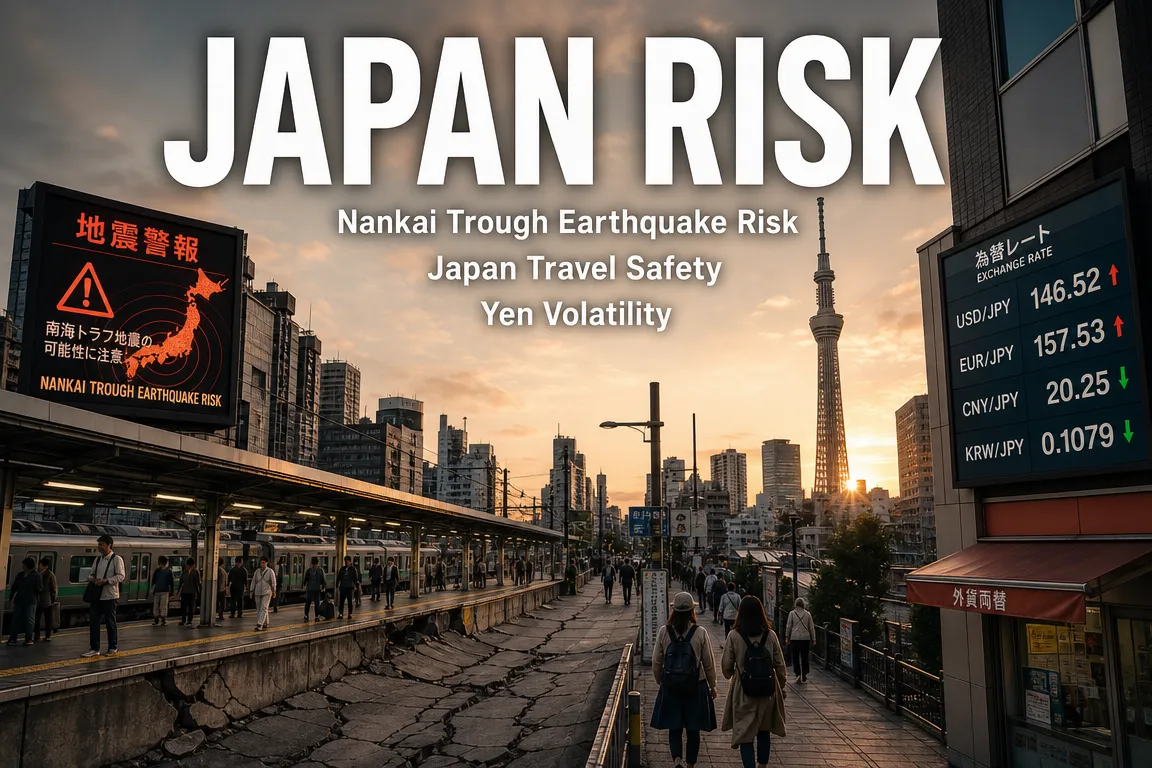
● Japan Earthquake Shock, Travel, Yen, Supply Chain Crisis
Nankai Trough Earthquake Risk and Japan Travel Exposure: Key Takeaways on Japan’s Economy, Yen Volatility, and Supply Chain Risk
The core issue is not simply that “a major earthquake may hit Japan.”
The more relevant point is that the potential for a Nankai Trough earthquake, Japan’s disaster response framework, tourism sector risk, yen volatility, and structural weaknesses in Japanese society are all linked.
For travelers, the key question is whether it is safe to visit Japan. For investors, the more important issue is whether Japan’s economy and global supply chains could face disruption.
Below is a news-style summary of the main risks, focusing on what should be verified rather than exaggerated fears.
1. Core message: Why concern over a possible Nankai Trough earthquake is rising
The video highlights rising anxiety in Japan following recent earthquakes and heavy rainfall events.
In particular, it notes that concern has again spread within Japanese society that a Nankai Trough earthquake may be approaching after the major earthquake in Kumamoto.
The Nankai Trough earthquake is a long-monitored high-impact scenario in Japan.
It refers to a major earthquake that could occur along the Nankai Trough, off Japan’s southern coast.
It is one of the country’s most widely recognized national disaster risks, long monitored by the government and seismologists.
- The video is stated to have been recorded on September 15.
- Accordingly, the situation on the ground and government response may have changed since then.
- Earthquakes cannot be accurately predicted with current scientific technology.
- References to “warning signs” can amplify anxiety, so official statements and actual data should be reviewed together.
The key point is not that a major earthquake is imminent, but that Japan structurally faces significant seismic risk.
That risk can affect travel, aviation, insurance, semiconductors, automobiles, supply chains, energy markets, and logistics.
2. Why the Nankai Trough earthquake is considered highly consequential
The Nankai Trough earthquake draws attention because the potential damage scope could be very broad.
Major areas along Japan’s Pacific coast could be affected, with indirect impacts also reaching major economic centers such as Tokyo, Osaka, and Nagoya.
Japan’s manufacturing and logistics infrastructure is highly interconnected.
If ports, roads, power grids, or factories in one region are disrupted, the impact can extend beyond Japan and affect Korea and the global economic outlook.
- Air travel and Shinkansen operations could be disrupted in the event of a major earthquake.
- Port and logistics center shutdowns could delay parts shipments.
- Risks to automobile, electronic component, and semiconductor material supply chains could increase.
- Tourism sector weakness could weigh on domestic consumption.
- The yen could become more volatile depending on safe-haven flows, Bank of Japan policy, and reconstruction cost expectations.
In this sense, the Nankai Trough issue is not only a natural disaster risk but also an economic risk.
For Korean companies, it is important to reassess exposure in sectors that still depend on Japanese parts and materials.
3. How to interpret the message that Japan should be avoided for the time being
The video title uses the strong phrase “do not come to Japan for the time being.”
However, rather than taking that literally, it is more practical to interpret it as a warning to strengthen pre-travel risk checks.
It would be inaccurate to claim that all of Japan is equally dangerous.
Still, if traveling to regions exposed to earthquakes, typhoons, heavy rain, volcanoes, or tsunami risk, preparation must be more rigorous.
- Check Japan Meteorological Agency updates and official travel safety notices before departure.
- Confirm whether the accommodation is near the coast, on higher ground, and how close it is to evacuation shelters.
- Know basic earthquake response rules, including avoiding elevators and staying away from windows.
- Prepare cash, a portable battery, passport copies, emergency medicine, and backup roaming or eSIM access.
- If traveling with children or elderly companions, predefine evacuation routes and communication methods.
The issue is not whether to cancel travel outright, but whether to avoid unplanned travel based solely on low prices.
In particular, as yen weakness increases demand for Japan travel, safety costs should be included in the travel budget.
4. Concerns over government response: criticism that policy action has been delayed
The original video questions current policy execution in Japan and argues that responses across multiple areas have been delayed or poorly managed.
This should be viewed not only as criticism, but also in the context of structural issues in Japanese society.
- Aging demographics may slow evacuation and disaster response.
- Regional depopulation has reduced response capacity in many local areas.
- Older infrastructure and aging housing stock can increase earthquake vulnerability.
- Administrative decision-making can slow emergency response.
- Tourist growth has outpaced multilingual disaster guidance in many areas.
Japan is widely regarded as a disaster-response leader.
However, having strong manuals is not the same as ensuring that every system works seamlessly in a large-scale disaster.
Foreign visitors are particularly vulnerable because they may not understand Japanese-language alerts.
5. The prostitution issue in Japan: more than a social issue, a signal of economic strain
The video also discusses prostitution in Japan.
It suggests that some people do not view prostitution as a crime and approach it casually.
This should not be treated only as sensational social commentary.
It is linked to youth poverty, women’s poverty, tourism, yen weakness, platform-based services, and public safety concerns.
- Japan’s prolonged economic stagnation has increased income insecurity among younger workers.
- Rising non-regular employment and low wages have narrowed options for vulnerable households.
- Yen weakness has boosted foreign tourism, while safety and sex-industry concerns have drawn attention in some areas.
- Online platforms and social media can facilitate illegal or gray-area transactions.
- Depending on whether policy emphasizes enforcement, protection, prevention, or welfare, outcomes can differ materially.
The issue matters because it signals growing economic pressure on lower-income groups.
Even when economic indicators suggest recovery, lived conditions may still reflect substantial insecurity.
6. Japan’s tourism dilemma: yen-driven demand and rising safety risk
Japan has seen a sharp increase in foreign visitors due to yen weakness.
South Korean travelers have also become an important part of the market.
The challenge is that more tourists also mean more people to manage in the event of a disaster.
- Crowding at airports and rail stations can complicate movement control during emergencies.
- Accommodation shortages can increase disruption in evacuation scenarios.
- Foreign visitors may not understand local emergency broadcasts.
- Tourism-led consumption supports regional economies, but risk rises if safety infrastructure investment does not keep pace.
From Japan’s perspective, tourism supports economic recovery.
However, if a major earthquake or heavy-rain event occurs, demand could fall quickly.
In that case, aviation, hotels, duty-free retail, food service, and transportation could all be affected.
7. Investor perspective: market implications of Nankai Trough risk
Natural-disaster risk is also relevant for financial markets.
Rising earthquake concern can affect Japanese equities, insurance companies, construction firms, infrastructure-related stocks, and the yen.
- Insurers may face higher volatility due to expected claims exposure.
- Construction and reconstruction-related companies may see expectations of higher post-disaster demand.
- Airline, travel, and hotel stocks may weaken on tourism slowdown concerns.
- Disruption to semiconductor and automobile supply chains could have indirect effects on Korean companies.
- Bank of Japan policy and possible fiscal expansion are also market variables.
The key is to look beyond short-term “disaster theme” trading and assess supply chain exposure and industry vulnerability.
From an AI trend perspective, disaster prediction, smart-city systems, satellite data, logistics optimization, and insurance risk modeling may become increasingly important.
8. AI and disaster response: the area Japan most urgently needs to strengthen
Large-scale disasters such as a Nankai Trough earthquake cannot be managed effectively with experience and manuals alone.
The most important area for Japan to strengthen is AI-based disaster response systems.
- AI-based earthquake damage prediction models are needed.
- Integrating satellite and weather data is essential for flood and landslide risk analysis.
- Real-time multilingual disaster alerts for foreign visitors are necessary.
- Platforms showing shelter congestion, transport restrictions, and hospital capacity in real time would be valuable.
- Companies should use AI-based supply chain risk systems to secure alternative procurement channels in advance.
This is one of the most overlooked aspects in other coverage.
What matters more than the earthquake itself is how quickly institutions can gather data, make decisions, and respond once it occurs.
Disaster response capability is likely to become part of national competitiveness.
9. The most important point often missed in other coverage
The most important point in this issue is not fear, but the concentration of multiple risks.
The potential for a Nankai Trough earthquake, tourism growth, yen weakness, aging demographics, prostitution-related concerns, and policy distrust are not separate events.
They all reflect structural pressure within Japanese society.
- Japan may appear strong on the surface, with high tourist traffic and active consumption.
- However, aging demographics, deteriorating regional infrastructure, youth poverty, and delayed policy response are accumulating underneath.
- Yen weakness benefits tourists, but it also raises import costs for Japanese households.
- Disaster risk is not only a safety issue but could also affect confidence in the overall economy.
- For Korea, the implications extend beyond travel safety to industrial supply chains, foreign exchange, and portfolio allocation.
Japan remains a major economy, but it is also entering a phase in which long-standing structural risks are becoming more visible.
An earthquake could act as a trigger that brings those risks to the surface.
10. Checklist for travelers planning a trip to Japan
- Check official travel safety notices before departure.
- Review Japan Meteorological Agency information on earthquakes, typhoons, and heavy rain.
- Confirm nearby evacuation shelters and higher ground around the accommodation.
- If staying near the coast, verify tsunami evacuation routes.
- Carry passport copies, cash, a portable battery, and emergency medication separately.
- Establish emergency contact procedures with family or travel companions.
- Review travel insurance coverage for natural disasters, flight delays, and lodging cancellations.
- If you do not speak Japanese, install translation apps and offline map apps in advance.
Japan remains an attractive destination for many travelers.
However, rather than making a last-minute decision based only on the weak yen, travel planning should incorporate safety and risk management.
11. Implications for Korea’s economy and corporate sector
The Nankai Trough risk has direct relevance for the Korean economy.
Korea and Japan are closely linked industrially.
Japan still plays an important role in materials, components, equipment, auto parts, specialty chemicals, and semiconductor process inputs.
- If Japanese ports or factories are disrupted, Korean manufacturing schedules could also be delayed.
- Higher logistics costs in Japan may feed into higher import prices in some categories.
- Increased reconstruction spending could affect Japanese government debt and the yen.
- Korean companies should review alternative suppliers for Japan-dependent components.
- AI-based supply chain monitoring and disaster risk simulation may become more important.
In that sense, this issue is both a travel safety matter and a signal for the global economic outlook.
Compared with the past, the speed at which natural disasters become economic risks is much faster.
< Summary >
The Nankai Trough earthquake is a major seismic risk that Japan has monitored for years.
Its timing cannot be predicted precisely, but both travelers and investors should prepare accordingly.
Travelers to Japan should review earthquake, heavy-rain, and tsunami evacuation information, as well as travel insurance coverage.
Yen weakness has boosted tourism, but a major disaster could materially affect the tourism industry and the broader Japanese economy.
The prostitution issue should be understood not only as a social problem but also as a structural issue tied to youth poverty, low wages, and policy failure.
Korean firms should review their Japan supply chain exposure and pay closer attention to AI-based disaster response and logistics risk management.
The core issue is not fear, but the combination of structural risks facing Japanese society and its economy.
[Related Articles…]
- Japan Economy and Yen Volatility: Implications for Korean Markets
- AI Trends in Disaster Response and Supply Chain Risk Management
*Source: [ 달란트투자 ]
– “난카이 대지진 전조 증상?” 당분간 일본 오지 마세요 다급해진 일본 초비상 상태 | 나리카와 아야 기자 2부