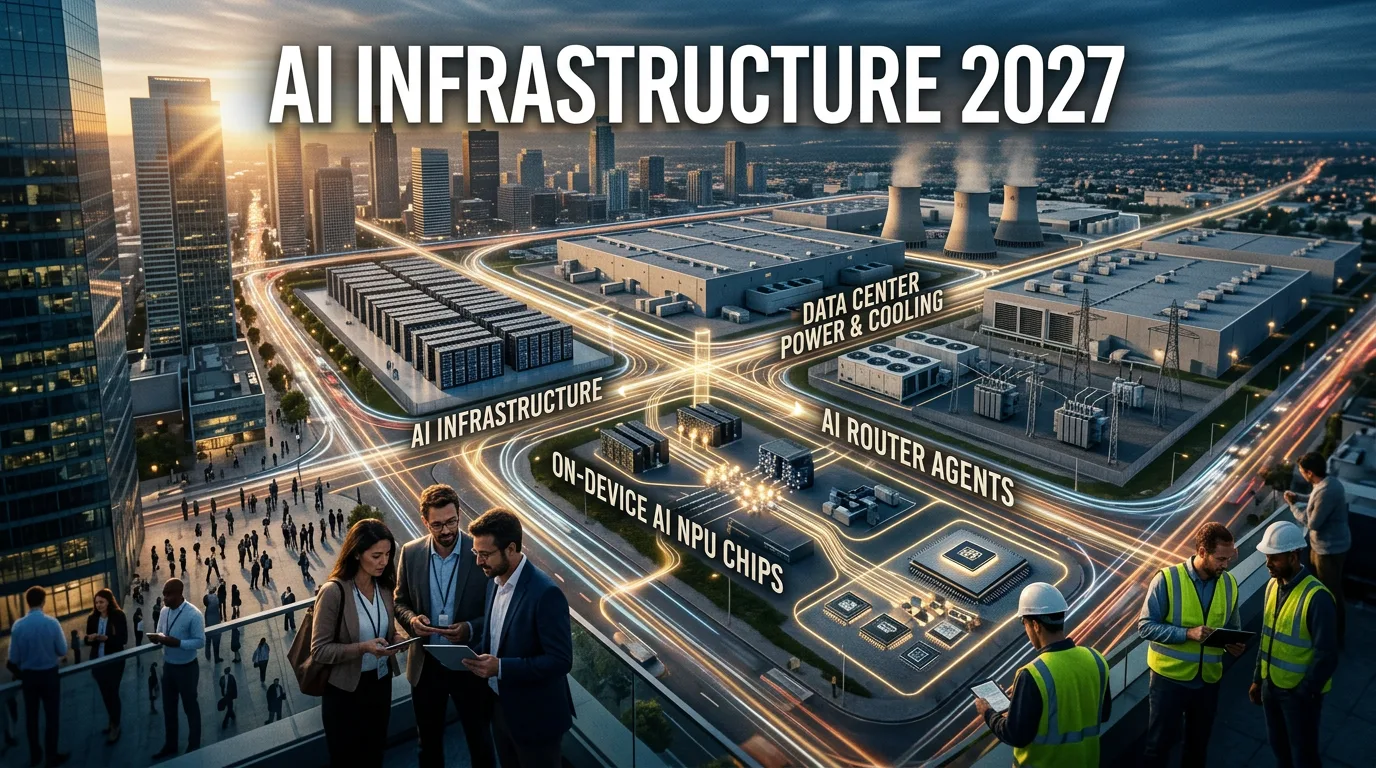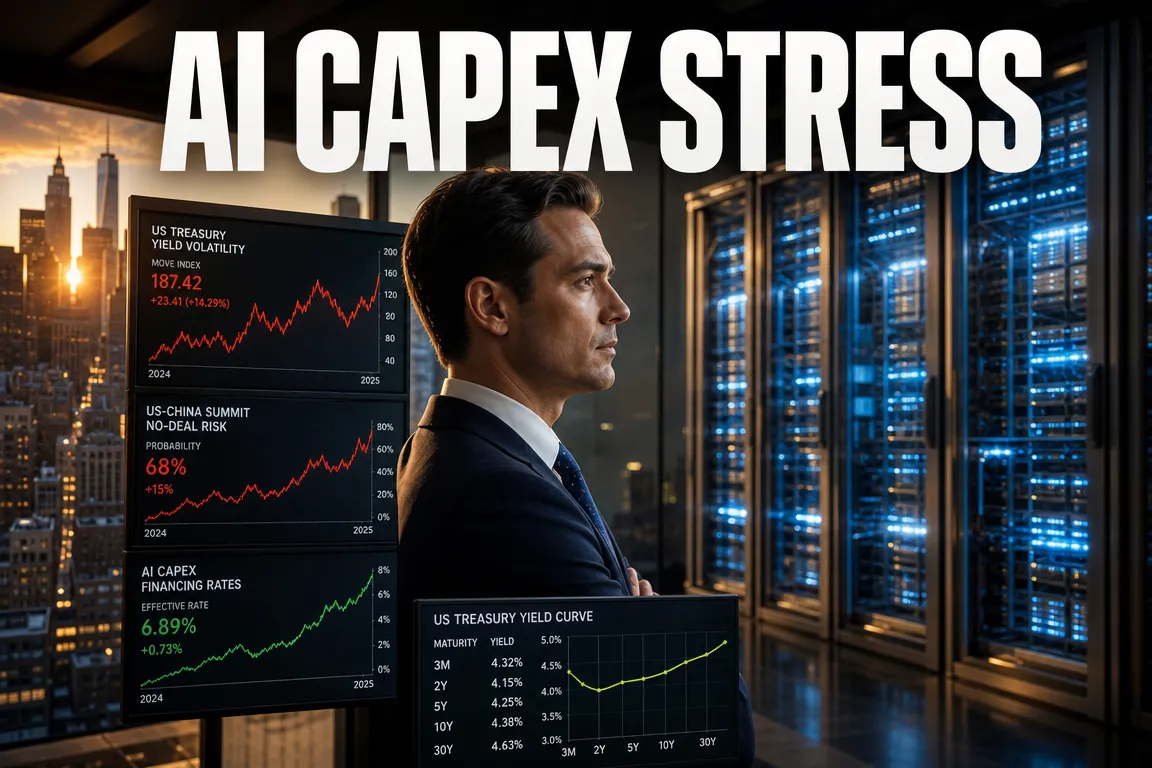
● Treasury Shock, China Deadlock, Market Jolt
U.S. Treasury Yield Shock and the Risk of a U.S.-China Summit No-Deal: The Key Issue the Market Must Watch Is Not Rates Alone, but Who Is Buying Treasuries
This issue cannot be reduced to “U.S. Treasury yields rose” or “the U.S.-China summit ended inconclusively.”
The more important point is that the buyer base for U.S. Treasuries is shifting, which could significantly increase global market volatility.
This also intersects with rising crude oil prices, renewed inflation pressure, expectations of further policy tightening, expansionary fiscal policy, U.S.-China strategic competition, and a possible slowdown in the AI investment cycle.
Many reports frame the U.S.-China summit as a discussion limited to tariffs or a temporary trade truce. In reality, it is connected to Treasury demand, the Taiwan issue, China’s rare earth controls, U.S. farm-state politics, and the AI power competition.
This report summarizes why the Treasury-driven volatility matters, why the U.S.-China summit can be interpreted as effectively a no-deal outcome, and the most important variables the market may be overlooking.
1. U.S. Treasury Yield Shock: The 10-Year and 30-Year Tenors Have Entered Unfamiliar Territory
The first key point is the sharp rise in long-term U.S. Treasury yields.
The U.S. 30-year Treasury yield reached around 5.5%, the highest level since 2004.
The U.S. 10-year Treasury yield also rose to around 5.22%, entering its highest range since 2007.
The issue is not simply that yields are high.
What matters more is that the market has entered a rate regime it has not experienced for a long time.
The 10-year U.S. Treasury yield serves as the global benchmark rate.
In practical terms, when U.S. Treasury yields rise, government bond yields in markets such as Korea, Japan, and Germany also come under pressure.
Investors have less incentive to buy lower-yielding foreign sovereign bonds when U.S. Treasuries offer higher returns with lower credit risk.
As a result, rising U.S. Treasury yields function as a global benchmark shock, not merely a U.S.-specific event.
2. Rising Treasury Yields Mean Falling Treasury Prices
One common misconception is that rising Treasury yields and rising bond prices can occur together.
In fact, higher Treasury yields mean lower Treasury prices.
Bond prices and yields move in opposite directions.
When demand for Treasuries increases, bond prices rise and yields fall.
When demand weakens or holders sell Treasuries, prices fall and yields rise.
The current issue is that governments, including the U.S. government, are issuing large volumes of debt, while the buyer base has not kept pace.
In other words, supply is abundant while demand is insufficient.
This supply-demand imbalance is the core driver behind the rise in U.S. Treasury yields.
3. First Driver of Treasury Stress: Middle East Conflict and Higher Crude Oil Prices
The first driver is geopolitical risk.
If the Middle East conflict persists, crude oil prices are likely to remain elevated or fail to normalize.
Higher oil prices increase energy, transportation, and production costs.
These effects ultimately feed into consumer prices and can reignite inflation.
The report notes that the conflict is showing no clear signs of ending and that higher oil prices are increasing inflation concerns.
When inflation expectations rise, markets begin to price in the possibility of additional rate hikes or a prolonged period of restrictive policy.
That, in turn, puts upward pressure on long-term Treasury yields.
In short: Middle East conflict → higher oil prices → renewed inflation concerns → tighter policy expectations → higher U.S. Treasury yields.
4. Second Driver of Treasury Stress: Tightening Conditions and Rate-Hike Expectations
The second driver is monetary tightening.
The report indicates that even earlier in 2026, major central banks, including the Federal Reserve, were still considering when they might begin cutting rates.
However, the combination of Middle East conflict, higher oil prices, and rising inflation pressure has changed the outlook.
The U.S., Europe, Japan, and Korea are again confronting the possibility of higher rates or a more restrictive policy stance.
When markets price in additional rate hikes, both short-term and long-term yields are affected.
The 10-year U.S. Treasury yield, in particular, reflects expectations for growth, inflation, and the policy path.
Accordingly, concerns that the Fed may need to tighten further translate directly into upward pressure on Treasury yields.
5. Third Driver of Treasury Stress: Fiscal Expansion and Fiscal Dominance
One of the most important concepts in this analysis is fiscal dominance.
Fiscal dominance refers to a situation in which fiscal policy exerts a stronger influence on markets than monetary policy.
Historically, monetary and fiscal policy often moved in the same direction.
When growth weakened, rates were cut and governments expanded spending.
When inflation was high, rates were raised and fiscal spending was reduced.
That pattern is now more complicated.
Central banks are considering tightening because of inflation, while governments continue to expand spending for growth support, industrial policy, defense, energy transition, and AI infrastructure investment.
Monetary policy is restrictive, but fiscal policy remains expansionary.
This means liquidity continues to be injected into the market.
As a result, asset prices may remain supported even when policy rates and Treasury yields are high.
However, expansionary fiscal policy also requires greater Treasury issuance.
When the government spends more, it must issue more debt.
If issuance rises faster than demand, bond prices fall and yields rise.
This is the core supply structure behind the current rise in Treasury yields.
6. The Key Point Missing from Many Reports: A Structural Shift in Treasury Buyers Has Begun
The most important issue in the report is the shift in who is buying U.S. Treasuries.
Many reports stop at saying that Treasury yields have risen.
However, the more important question is who is absorbing the supply.
In the past, the Federal Reserve absorbed Treasuries through quantitative easing.
After the pandemic, the Fed was a major buyer of government bonds.
Since 2022, however, quantitative tightening has reduced the Fed’s role as a buyer.
As the Fed steps back, the private sector must absorb more issuance.
The problem is that private investors are far more rate-sensitive than the Fed.
They require higher yields to buy bonds.
That implies lower bond prices and higher yields.
In other words, the market has shifted from a stable, central-bank-led buyer base to a more rate-sensitive private buyer base.
This structural change is a key reason why yield volatility may increase further.
7. External Treasury Demand Is Also Changing: A Shift from Public to Private Holders
This shift is not limited to the U.S. domestic market.
Foreign investor composition is also changing.
Historically, public-sector buyers such as foreign central banks and government institutions held large amounts of U.S. Treasuries.
Public-sector holders are generally less rate-sensitive.
They hold Treasuries for reserve management, geopolitical reasons, and financial stability purposes.
More recently, however, private foreign investors have increased their share of Treasury holdings.
Private investors are much more sensitive to returns.
The report also cites BIS research showing that private-sector demand is far more rate-sensitive than public-sector demand.
This implies that the U.S. Treasury market may become more volatile.
Even modest changes in inflation expectations, policy outlook, or fiscal concerns could trigger large moves in yields.
8. Why Equities Continue to Hold Up: Fiscal Liquidity Is Stronger Than Monetary Tightening
Many investors ask why the equity market remains resilient despite rising Treasury yields.
Higher yields usually weigh on stocks because they increase discount rates applied to future cash flows.
Growth stocks and AI-related stocks are especially sensitive to rate increases.
Yet equities can still rise or hold steady in this environment.
The report explains this through fiscal dominance.
Monetary policy may be restrictive, but large-scale fiscal spending continues to inject liquidity into the system.
This fiscal-driven liquidity can support equity valuations.
That said, the structure is not stable.
As Treasury issuance increases, upward pressure on yields also rises.
The result is a market environment where liquidity support and rate pressure coexist, creating an unstable equilibrium.
9. The U.S.-China Summit: Why It Can Be Interpreted as a No-Deal Outcome
The second major issue is the U.S.-China summit.
The market had expected the possibility of a significant deal.
Scenarios included an extension of the trade truce, tariff relief, relaxation of rare earth export controls, increased purchases of U.S. farm products, and resumed Treasury purchases by China.
However, the report interprets the meeting as falling short of expectations and effectively close to a no-deal outcome.
While official statements must still be confirmed, the market did not see a major agreement matching earlier expectations.
If the trade truce was extended only for a short period rather than a longer horizon, that would be viewed as a disappointment by markets.
10. Differences in Public Messaging: Personal Friendship vs. Bilateral Relations
The report highlights the difference in the opening remarks by President Trump and President Xi.
President Trump used language emphasizing “great friendship” and personal ties.
President Xi focused on bilateral relations, peaceful coexistence, and constructive competition.
Trump’s message was more short-term and political, while Xi’s message reflected a longer-term state-to-state perspective.
This difference matters.
Trump needs near-term outcomes because of midterm politics, approval ratings, inflation, and farm-state support.
Xi is focused on Taiwan, long-term strategic competition, and constraints on U.S. policy toward China.
11. Why Trump Is Under Pressure: Falling Approval and Inflation
The first reason Trump is under pressure is approval ratings.
The report notes declining approval and elevated unfavorable sentiment.
For U.S. voters, the most visible issue remains inflation and the cost of living.
High inflation reduces real purchasing power.
Rising food, energy, housing, and healthcare costs increase political dissatisfaction.
Historically, high inflation has imposed significant political costs on incumbents.
Trump therefore has a strong interest in stabilizing prices and rates.
That may require cooperation from China.
12. Why Trump Is Under Pressure: China’s Reduced Treasury Holdings
The second factor is U.S. Treasuries.
China was once among the largest holders of U.S. government debt.
It recycled dollar trade surpluses into Treasuries.
Since the U.S.-China trade conflict intensified, China’s Treasury holdings have declined.
The report notes that China’s U.S. Treasury holdings fell sharply after May, which may indicate a strategic use of Treasury selling ahead of negotiations.
For the U.S., that is problematic when yields are already rising and Treasury demand is unstable.
Washington may want China to resume buying Treasuries.
However, China has little reason to do so without concessions.
It may demand progress on Taiwan, sanctions relief, or easing of technology restrictions in exchange.
That may be where the real bargaining in the summit lies.
13. Why Trump Is Under Pressure: Taiwan and the Possibility of a Middle East Trade-Off
The report also suggests that Taiwan and the Middle East could become elements of a broader deal.
China views Taiwan as a core strategic interest.
It strongly opposes U.S. arms sales and military support to Taiwan.
If China raised Taiwan in the summit, that would signal a demand for a major concession rather than a small trade adjustment.
What could the U.S. ask in return?
The report suggests that China could be asked to play a mediating role in the Middle East or otherwise help reduce geopolitical tensions.
If the conflict eases, oil prices could stabilize.
Lower oil prices would reduce inflation pressure.
That would also reduce expectations for further rate hikes and help stabilize Treasury yields.
From Trump’s perspective, easing Middle East tensions would be a valuable political and economic outcome.
14. Why Trump Is Under Pressure: China Is Narrowing the AI Gap
The third major axis is AI competition.
The report states that the performance gap between U.S. and Chinese AI models has narrowed significantly.
Models such as Claude, GPT, and Grok remain leaders, but Chinese models such as Kimi, Qwen, and DeepSeek are advancing rapidly.
The issue is not performance alone.
Companies do not always use the best model available.
For most tasks, cost-efficient models are sufficient, while premium models are reserved for complex work.
As a result, Chinese AI models could expand their share of actual usage and token consumption.
The report notes that China’s AI token share has already surpassed that of the U.S. in some areas.
AI competition is therefore not only about model quality, but also pricing, power supply, data centers, semiconductors, cloud infrastructure, and ecosystem scale.
15. The Hidden Variable in the AI Investment Cycle: Capex and Free Cash Flow
U.S. AI leaders have maintained their position through massive capex spending.
Capex refers to capital expenditure.
This includes building data centers, purchasing GPUs, and securing power infrastructure.
Large U.S. tech companies have invested aggressively in AI infrastructure using strong free cash flow.
That spending has also supported semiconductor companies such as Nvidia, Samsung Electronics, and SK Hynix.
However, the report warns that free cash flow among major AI firms is weakening.
When cash flow declines, the pace of capex growth may also slow.
Rising U.S. Treasury yields further increase corporate borrowing costs.
That makes it more difficult to sustain AI investment through external financing.
If AI investment growth slows, the semiconductor cycle could also weaken.
16. Another Key Variable in AI Competition: Power Generation Capacity
Many investors focus only on semiconductors in the AI race.
The report argues that power supply is the more important variable.
AI data centers consume very large amounts of electricity.
Even with sufficient GPUs, a shortage of power limits operational capacity.
The U.S. already has substantial data center capacity, but power supply constraints are increasing.
China, by contrast, has expanded power generation capacity rapidly.
This could give China an advantage in AI infrastructure expansion beyond 2027.
Accordingly, AI competition is not only about chips but also about grids, power plants, transmission lines, cooling systems, and data center land supply.
17. Why the Trade Truce Fell Short: The U.S. Wants More Chinese Purchases
The U.S. wants to reduce its persistent trade deficit.
Its deficit with China has been especially large.
Accordingly, Washington wants China to buy more U.S. goods.
Key products include soybeans, Boeing aircraft, LNG, crude oil, and other energy exports.
The report interprets Trump’s emphasis on farmers and livestock producers as politically motivated.
The U.S. Midwest, especially the Corn Belt, is central to soybean and corn production.
This region is also linked to Trump’s political base.
If China reduces soybean purchases, the impact would be felt by U.S. farmers and by Trump’s approval ratings.
So the request that China buy more soybeans is not merely a trade issue; it is tied directly to election strategy.
18. Rare Earths and Sanctions: Why Chinese Firms Skipped the White House Dinner
The U.S. has continued to expand sanctions on Chinese firms.
The report notes that the number of sanctioned Chinese companies has increased significantly compared with earlier periods.
In this context, the absence of major Chinese firms from the White House dinner is symbolically important.
China may view the U.S. as unreliable if sanctions continue while cooperation is being discussed.
At the same time, China can use rare earth export controls as leverage.
Rare earths are essential for electric vehicles, defense, semiconductors, AI hardware, and renewable energy industries.
If the U.S. uses technology restrictions as leverage, China can respond with supply-chain pressure.
Accordingly, the summit is not just about tariffs; it is also about supply-chain power competition.
19. Market Impact: How to View Equities, Bonds, FX, Gold, and Real Estate
First, bond-market volatility may remain elevated.
If the main driver of higher U.S. yields is supply and buyer-base rotation, stabilization may be difficult in the near term.
Second, equities may remain supported by liquidity effects, but rates will continue to weigh on valuations.
AI growth stocks are especially sensitive to capex growth and Treasury yields.
Third, currencies may reflect continued dollar strength if U.S. rates remain elevated.
The Korean won is also likely to remain sensitive to U.S. Treasury yields and global risk sentiment.
Fourth, gold does not necessarily benefit from higher Treasury yields.
Gold typically strengthens when real yields fall or geopolitical risk rises.
Persistently high yields may remain a headwind for gold prices.
Fifth, real estate may benefit from fiscal liquidity, but high rates and funding costs will continue to create significant differentiation by region and asset type.
20. Implications for Korea: U.S. Treasury Yields Directly Affect Domestic Rates and Asset Markets
Korea is not insulated from rising U.S. Treasury yields.
Higher U.S. yields can also push Korean sovereign yields upward.
That raises the cost of government borrowing.
Corporate bond issuance also becomes more expensive.
Households face greater loan repayment burdens.
In equities, growth stocks and high-valuation names may come under pressure.
At the same time, opportunities may remain in sectors supported by fiscal spending, AI investment, and the semiconductor cycle.
For Korean investors, the key is to view U.S. Treasury yields, inflation, the policy path, the U.S.-China summit, and AI competition as one integrated set of variables.
The Most Important Point Rarely Emphasized in Other Media
The first key point is that the rise in U.S. Treasury yields is driven not only by inflation, but by a shift in the buyer base for government debt.
The market is moving away from a system in which the Fed and foreign public-sector buyers provided stable demand toward one dominated by more rate-sensitive private buyers.
This structural change can significantly increase yield volatility.
The second key point is that the real subject of the U.S.-China summit is not just tariffs, but also U.S. Treasuries, Taiwan, the Middle East, rare earths, and AI competition.
If China resumes buying Treasuries or cooperates on Middle East issues, the U.S. may face pressure to make concessions on Taiwan or sanctions.
The third key point is that the bottleneck in AI competition is shifting from semiconductors to power.
GPUs alone do not determine AI leadership.
Power generation, data centers, transmission networks, and cooling infrastructure are becoming the new competitive frontier.
The fourth key point is that Trump’s trade demands are tied not only to economics, but also to election strategy.
Chinese purchases of soybeans affect U.S. farm-state support, while LNG and crude purchases are linked to U.S. energy policy and industrial interests.
The fifth key point is that the market may remain both fragile and supported because of fiscal dominance.
Monetary tightening is a headwind, but expansionary fiscal policy continues to provide liquidity.
This combination may produce both strong rallies and abrupt corrections.
Key Indicators Investors Should Monitor
- U.S. 10-year and 30-year Treasury yield trends
- Crude oil prices and geopolitical developments in the Middle East
- U.S. CPI and PCE inflation data
- Fed signals on rate hikes or policy holds
- U.S. fiscal deficit and Treasury issuance plans
- Changes in China’s U.S. Treasury holdings
- Post-summit statements and the duration of any trade truce
- China’s rare earth export controls
- Any agreements on soybeans, LNG, crude oil, and aircraft purchases
- AI capex growth and free cash flow trends among major tech firms
- Power generation capacity and data center investment pace in the U.S. and China
< Summary >
The sharp rise in U.S. Treasury yields reflects not only higher inflation expectations, but also a structural shift in who is buying government debt.
As the Federal Reserve and public-sector foreign buyers step back, private investors must absorb more issuance, increasing yield volatility.
Middle East conflict, higher crude oil prices, renewed inflation pressure, and tighter policy expectations are also supporting higher yields.
The U.S.-China summit should be viewed as a multi-layered negotiation involving Treasuries, Taiwan, rare earths, soybeans, LNG, and AI competition.
Trump faces pressure from weak approval ratings, inflation, Treasury volatility, and AI competition, all of which increase the need for Chinese cooperation.
In AI, power supply and data center infrastructure are becoming as important as semiconductors.
Investors should focus on U.S. Treasury yields, inflation, summit follow-up measures, and the pace of AI capex moderation.
[Related Articles…]
- U.S. Treasury Yields and Global Market Volatility
- AI Competition and the Next Phase of the Semiconductor Cycle
*Source: [ 경제 읽어주는 남자(김광석TV) ]
– [생방송] (1)국채금리발 변동성 온다 (2)미중 정상회담 노딜로 끝났나? [즉시분석]
● AI Bubble, Rate Shock, Tesla, Nvidia, SK Hynix, Nasdaq Crash
In a 5% Rate Environment, the Real Risk Comes Before the AI Bubble Debate: Tesla, SK Hynix, Nvidia, and U.S. Equity Trends
The main point of this report is not simply whether AI is a bubble.
The more important issue is where the financial system is tightening after the policy rate moved above 5%, and how that pressure is transmitted into asset prices such as Oracle data center investment, Nvidia, SK Hynix, Tesla, and the Nasdaq.
What many headlines and video commentators miss is not the growth potential of AI, but who can finance that growth.
AI is difficult to stop, but if the debt, bond market, semiconductor pricing, and data center costs required to build AI infrastructure come under pressure, equity markets can react sharply.
This report summarizes the key links between rates, the AI bubble debate, semiconductors, data centers, and the Nasdaq for U.S. equity investors.
1. The market still starts with interest rates
The most important variables remain U.S. policy rates and long-term Treasury yields.
The key issue is less the fact that rates are above 5% than the speed of the increase.
Equity markets fear faster-than-expected rate hikes more than high rates themselves.
The same applies to oil.
Markets react more strongly to a rapid surge than to a high but stable price.
- Higher rates increase corporate borrowing costs.
- Higher borrowing costs raise the burden of data center, AI server, and semiconductor investment.
- Debt repayment concerns increase risk management pressure on banks and funds.
- Risk reduction weighs on growth stocks and technology equities.
Most of the current market concerns originate here.
The AI bubble debate, data center funding pressure, bank lending risk, and semiconductor pricing all begin with rates.
2. Why Oracle’s data center borrowing matters
A key issue to watch is Oracle’s large-scale data center investment and related borrowing.
Oracle is expanding data center spending aggressively for the AI era.
The issue is that this is not primarily a “build with current cash flow” model, but rather a build first and monetize later structure.
Banks typically try to lend, then distribute part of the loan exposure to other institutions to diversify risk.
In the United States, mortgage loans are often securitized and sold through similar channels.
Banks originate the loan, earn interest, and then sell part of the loan exposure to reduce risk.
That mechanism is not functioning as smoothly now.
The reason is simple.
Rates are too high.
- Higher rates increase repayment burdens.
- Greater repayment burdens reduce demand for loan exposure.
- If loan exposure cannot be sold, the originating bank retains the risk.
- When this process slows, AI infrastructure investment also slows.
Oracle’s data center financing issue is therefore not limited to Oracle.
It is a signal of whether financial markets can continue absorbing AI infrastructure spending.
3. Commercial funds, bond losses, and the bottleneck in AI capital flows
Banks are not the only buyers of Oracle-related loans.
Commercial funds, private equity, and institutional investors also play a role in purchasing such loan exposure.
However, these investors now have limited capacity.
The main reason is bond losses.
When rates rise, existing bond prices fall.
Funds with large bond holdings face significant mark-to-market losses.
In that environment, adding new loan exposure is difficult.
Some funds may have reduced bond positions and rotated into equities to limit losses.
That transition may have contributed to market strength through short covering or covered-call strategies.
The key point is straightforward.
Higher rates are not only a bond-market issue; they affect the entire AI financing ecosystem.
4. AI may not stop, but some bubble characteristics may still exist
Whether AI is a bubble remains one of the most common questions among investors.
However, the issue should be separated into several parts.
- Is AI technology itself a bubble?
- Are AI-related stock valuations inflated?
- Is AI infrastructure investment excessive?
- Are AI semiconductor prices and margins unusually high?
These are not the same question.
AI technology itself is difficult to stop.
The U.S., China, corporations, and governments all remain engaged in the AI race.
Stopping AI would mean giving up a core future industry.
From a stock market perspective, the answer is different.
AI sector growth does not automatically justify every AI-related stock at current valuations.
In particular, some semiconductor and AI infrastructure companies currently benefit from supply shortages that support elevated pricing and margins.
That does carry bubble-like characteristics.
Technology-driven earnings and supply-shortage-driven earnings are not the same.
If China expands mass production and competition intensifies, pricing pressure could lead to valuation resets.
5. U.S. and China are pursuing AI through different models
AI competition cannot be understood simply as “the U.S. versus China.”
The two countries approach AI differently.
- The U.S. is strong in creativity, software, advanced chip design, and platform-based business models.
- China is stronger in manufacturing, mass production, robotics hardware, and physical AI implementation.
The U.S. has advantages in AI models, chip design, cloud infrastructure, and software ecosystems.
China is stronger in scaling robots, low-cost hardware production, and rapid industrial execution.
China is already entering a price-competition phase in robotics and AI hardware.
The strategy is to cut prices, expand output, and pressure competitors that cannot sustain losses.
By contrast, U.S. companies are more accustomed to managing supply and sustaining higher prices and margins.
In that structure, China’s mass-production model can pressure the high pricing and margin structure of U.S. AI companies.
Ultimately, the AI race is not only about technology.
It is also about who can produce more cheaply, at greater scale, and for longer.
6. China’s price competition could affect AI semiconductor pricing
China’s strategy is clear.
It aims to retain manufacturing leadership.
Whether in semiconductors, robotics, or AI hardware, the goal is to lower unit costs through scale and dominate the market.
This pattern has appeared before in the semiconductor industry.
Japan was once a major semiconductor power, but lost momentum when profitability deteriorated.
South Korea later became a dominant player.
Japan is now trying to re-enter the industry, but the gap has already widened.
A similar pattern could emerge in AI semiconductors.
If China lowers prices and expands volume, companies that are currently enjoying high margins may face margin compression.
That does not mean the AI industry ends.
In fact, AI may become more widely adopted.
However, the stock market will interpret this differently.
Once margins compress, valuations can be repriced.
7. U.S. political risk also affects AI infrastructure investment
Unlike China, the U.S. cannot push policy in a single direction without friction.
Republicans and Democrats diverge, and regional interests also differ.
Data center construction, power usage, environmental concerns, local opposition, and human-rights issues are all intertwined.
AI data centers consume substantial electricity.
Local communities naturally worry about grid strain, water usage, and environmental impact.
If regulatory pressure increases, the pace of AI infrastructure investment could slow.
China can move faster because of state-led coordination.
The U.S. may move more slowly because of its democratic system.
That difference could become an important factor in the long-term AI competition.
8. Interpreting Boeing: Trump, the Dow, and the optics of the U.S. economy
One notable point in the source material is the discussion of Boeing.
The question of why Trump focuses on Boeing sales is not only about employment; it is also about market symbolism.
Boeing is linked to the Dow Jones Industrial Average.
In the U.S., the Dow is symbolically associated with overall economic sentiment.
When the Dow rises, it becomes easier to frame the economy as improving.
Even if household conditions remain weak, rising equities can create the impression that the economy is healthy.
This is similar to how CPI and core CPI are interpreted.
What directly affects household budgets is food and energy, but policymakers often emphasize core inflation because it excludes more volatile components.
Equities operate in a similar way.
Visible market indicators shape investor sentiment and perceptions of the economy.
As a result, Boeing, the Dow, and inflation expectations should be seen as part of broader market psychology, not as isolated company-specific issues.
9. What investors should avoid: selling in reaction to fear
One of the strongest messages in the source material is this.
Equities become difficult when investors are pulled too quickly into negative narratives.
AI bubble concerns, carry-trade unwinding, rate hikes, recession fears, and semiconductor peak-cycle arguments always emerge.
The problem is that acting too early on those narratives can cause investors to miss gains in an ongoing rally.
Markets can remain stronger than expected.
Bad news does not always lead to immediate declines.
If liquidity, earnings, and sentiment remain supportive, markets can absorb negative headlines and continue rising.
Investors should therefore focus less on claims that the market will collapse and more on where the risk thresholds are.
This is the core of technical analysis.
It is not only about drawing chart lines; it is about defining levels that preserve discipline.
10. Nvidia: more likely to consolidate than to be shorted aggressively
Nvidia is the leading AI semiconductor name.
However, the source material argues against treating Nvidia as a straightforward short candidate.
The reason is that each stock has a different market structure.
Some names are highly volatile.
Some have strong trends.
Some move after extended consolidation.
Nvidia is interpreted as being more likely to consolidate than to fall sharply.
Another important point is that if Nvidia weakens materially, the issue is not limited to Nvidia alone.
As the flagship AI stock, a major decline would affect sentiment across the entire AI complex.
If AI is the core growth driver of U.S. equities, Nvidia weakness could extend into the Nasdaq more broadly.
Therefore, Nvidia should be analyzed not only as an individual company, but also in the context of AI spending, data center demand, semiconductor supply, rates, and the Nasdaq.
11. Tesla, Microsoft, Google, and Costco: selected stock-level observations
The source material also referenced technical views on several large-cap stocks.
The exact price points are retained here as market observation markers rather than investment recommendations.
- Tesla: A reference was made to 360 and the low-300 range as accumulation zones, with 390 as a short-term watch level.
- Microsoft: Entry interest was noted in the 360s and 400s, with the view that the company remains structurally durable despite software-related concerns.
- Google: A clear supply zone was seen as less obvious, requiring a more cautious approach, with 335 mentioned as a psychological reference level.
- CRDO: A 150-160 entry area was mentioned, along with caution about chasing strength after a sharp move.
- Costco: A 885-level supply zone was cited, with caution around earnings-related volatility.
The main issue is not the price level itself.
The key is having a defined rationale and framework before entering a position.
Without a framework, it is difficult to hold through volatility.
With one, downside moves can be managed more effectively.
12. Meta, Micron, SanDisk, SK Hynix, and Samsung Electronics
Meta has moved strongly on AI expectations, but the technical view suggests that more time may be needed for additional upside.
In the wording of the source material, the stock is in a “waiting” phase.
In other words, the move has been driven more by expectations than by a fully confirmed chart structure.
Micron Technology is viewed through the lens of upcoming earnings.
A 1,000-level entry reference was mentioned, with the post-earnings direction seen as the key variable.
The important point is that weaker results from Micron do not automatically imply a collapse in the AI industry.
SanDisk was described as having already moved through its main supply zone.
In such cases, it may be better to wait rather than chase strength.
SK Hynix and Samsung Electronics remain highly sensitive to the semiconductor cycle and AI memory demand.
The source material suggests that, despite short-term volatility, these companies are not viewed as structurally fragile names.
As long as AI semiconductors, HBM, and data center demand remain intact, major Korean semiconductor names are likely to stay in focus.
13. Bitcoin, gold, and bonds: avoid overstatements about correlations
Bitcoin was interpreted as moving with equities to some extent.
However, it is risky to assume that gold and Bitcoin always move in the same direction.
Gold has not risen enough to justify a strong trend conclusion.
That is because exchange rates, rates, real yields, dollar strength, and geopolitical risk are all involved.
The rise in bond yields is also difficult to reduce to a single cause.
AI corporate bond issuance, inflation concerns, U.S. fiscal deficits, foreign selling of Treasuries, and shifts in dollar demand all play a role.
For that reason, it is not sufficient to explain higher yields solely through AI or inflation.
What matters is that rates remain difficult to bring down in the current environment, which continues to weigh on markets.
14. Key points often missed in other news and video commentary
First, the real risk in AI is financial structure, not technology.
The growth of AI technology and the ability to finance AI infrastructure are separate issues.
If large-scale funding structures such as Oracle’s data center loans are not absorbed cleanly by financial institutions, the pace of AI investment could slow.
Second, the high margins of semiconductor companies may not be permanent.
Current pricing in AI semiconductors and memory benefits in part from supply shortages.
If China launches a price competition through mass production, pricing and margins could be repriced.
Third, the U.S. equity market still lacks an obvious replacement for AI as a growth theme.
When companies in sectors such as Apple, Robinhood, and automakers move into financial services, that can also be read as a sign that traditional industries have limited new growth drivers.
For now, the U.S. equity market is likely to continue relying on AI, semiconductors, and data centers.
Fourth, the risk is not negative narratives themselves, but selling without a framework.
AI bubble concerns, carry-trade unwinds, and rate shocks always sound plausible.
But if investors sell too early without defined criteria, re-entry becomes difficult when the market resumes its advance.
Fifth, China’s AI competition is both a threat to the U.S. and a potential stabilizer for costs.
China’s scale can pressure U.S. margins, but it can also reduce AI infrastructure costs and accelerate broader adoption.
15. What investors need now: see the cycle, define the framework, and respond accordingly
The market is no longer simple enough to be assessed through company analysis alone.
Tesla will not rise simply because of robotaxi plans, and Nvidia will not move in a straight line indefinitely just because it is a strong company.
Likewise, the presence of AI bubble concerns does not automatically imply an immediate market collapse.
Investors need to monitor three levels.
- The macro picture: rates, the Nasdaq, liquidity, the AI investment cycle, and semiconductor demand
- The individual stock level: earnings, technology, valuation, and supply zones
- The decision framework: what level represents risk, and what level supports the position
News changes every day.
Investment criteria should not.
This is especially important for U.S. equities and Korean semiconductor stocks, which are simultaneously influenced by rates and the AI cycle.
< Summary >
The key market variable is interest rates.
Higher rates affect Oracle’s data center borrowing, bank risk, bond losses at commercial funds, and the cost of AI infrastructure.
AI is difficult to stop, but some bubble characteristics exist in AI semiconductor pricing and elevated margins.
The U.S. is stronger in creativity and software, while China is stronger in manufacturing and scale production.
China’s price competition can lower AI costs while pressuring U.S. margins.
Nvidia, SK Hynix, Samsung Electronics, Tesla, and Microsoft should be analyzed in the context of both rates and the AI cycle.
Investors should avoid reacting too early to negative narratives and instead set a framework and respond systematically.
Investment Notice
This report is an informational summary and reinterpretation of the original material.
It does not constitute investment advice or a recommendation to buy or sell any specific security.
All investment decisions should be made at the individual’s discretion and risk, and professional advice should be sought where appropriate.
[Related Articles…]
- AI Infrastructure Investment and the Changing U.S. Equity Landscape
- Semiconductor Cycle and Key Investment Points for SK Hynix and Samsung Electronics
*Source: [ 미국주식은 훌륭하다-미국주식대장 ]
– 이걸 모르면 계속 손해 보실 겁니다. 테슬라 SK 하이닉스 스페이스X 한국주식