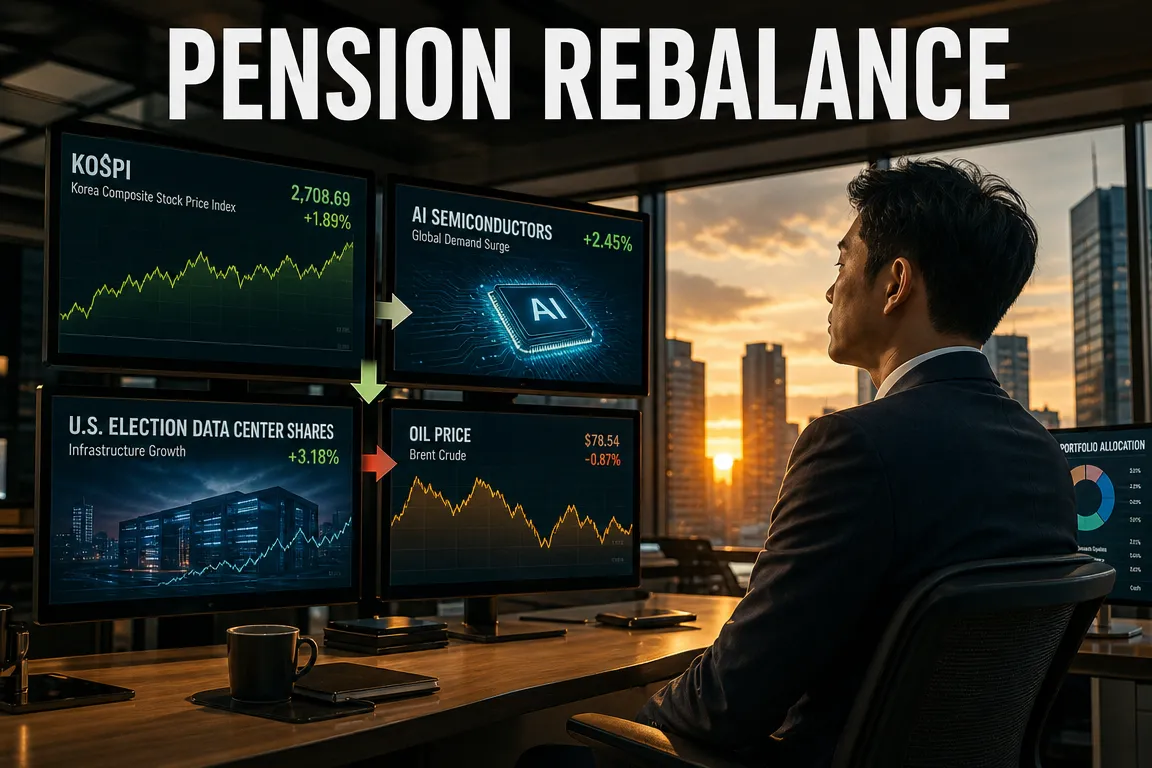
● Panic-Sell, KOSPI-Crash-Fear
Key Takeaways from the National Pension Rebalancing Debate: Does Selling by the National Pension Fund Really Weaken the KOSPI?
The central issue is not simply whether the National Pension Fund is buying or selling domestic equities.
The more important points are the fund’s asset-allocation framework, the actual drivers of KOSPI volatility, the AI semiconductor cycle, pension fund independence, and the possible entry into the retirement pension market.
A common misconception is that the National Pension Fund has absolute control over the KOSPI, when in fact its share of KOSPI market capitalization is estimated at around 6%.
In other words, the claim that “if the National Pension Fund sells, the KOSPI collapses” may affect market sentiment, but it is an overstated interpretation in structural terms.
The following is a news-style summary from the perspectives of economic outlook, pension fund management, the domestic equity market, overseas investment, and retirement planning.
1. The starting point of the rebalancing debate: not selling for the sake of selling, but aligning portfolio weights
To understand National Pension Fund rebalancing, one must first look at medium-term asset allocation.
The fund allocates assets across domestic equities, overseas equities, domestic bonds, overseas bonds, and alternative investments according to predetermined weightings.
This allocation is not a short-term trading strategy, but a core framework designed to balance long-term returns and stability.
The National Pension Fund reviews its five-year medium-term asset allocation plan around the end of May each year and adjusts its one-year implementation plan accordingly.
A key concept here is strategic asset allocation, or SAA.
For example, if the target allocation to domestic equities is 15%, market gains may naturally push the actual weight to 15.5% or 16%.
If the fund mechanically buys and sells every time this happens, transaction costs rise and the market may suffer unnecessary disruption.
For that reason, a tolerance band is set, and rebalancing is considered only when the range is breached.
Rebalancing, therefore, is not a market-moving trade designed to influence prices, but a process to restore asset weights to the intended allocation.
2. The most common misunderstanding: rebalancing is not the core of fund management
One of the most important points in the discussion was that rebalancing is a subordinate function, not the center of the fund’s management.
The core of the National Pension Fund’s management is medium-term asset allocation.
Within that framework, tolerance bands are set, and rebalancing is triggered only when those bands are exceeded.
However, market commentary often interprets all of the fund’s buying and selling as rebalancing.
This creates the impression that the National Pension Fund is a dominant market force capable of moving equities at will.
In reality, the fund’s share of the KOSPI market capitalization is about 6%.
That is significant, but not enough to control the market on its own.
3. “Was rebalancing delayed for election reasons?” A response to the political interpretation
One of the most sensitive issues in the discussion was whether the delay and resumption of rebalancing were linked to the political calendar.
The chairman stated that the decision had no connection to politics.
According to the explanation, the KOSPI had risen very rapidly, and the fund was considering two options.
One option was to sell domestic equities in line with the existing asset-allocation framework.
The other was to wait longer and assess whether the rally reflected temporary overheating or a structural shift in the Korean market.
The environment was complicated by the AI semiconductor boom, improving earnings at Samsung Electronics and SK hynix, and the possibility of a reduced Korea discount.
As a result, rebalancing was temporarily deferred and then resumed after the medium-term asset allocation was adjusted.
The discussion also noted that the allocation to domestic equities increased from 14.9% to 20.8%.
The key point is that the delay was presented as an investment judgment based on market structure, not as an attempt to support the market for electoral purposes.
4. The real driver of KOSPI volatility: the AI semiconductor cycle matters far more than the National Pension Fund
Attributing KOSPI volatility primarily to National Pension Fund trading is too simplistic.
The main driver identified in the discussion was the AI semiconductor cycle.
The Korean equity market has a high concentration in Samsung Electronics and SK hynix, both of which are closely tied to global AI infrastructure investment.
As demand grows for AI data centers, high-bandwidth memory, and server semiconductors, global investor interest in Korean chipmakers rises as well.
Conversely, concerns about overinvestment in AI semiconductors can weigh on the entire Korean market.
The KOSPI has therefore become a market that reflects the global AI investment cycle, not just domestic conditions.
Oil prices, interest rates, and geopolitical risks also matter.
The discussion cited events such as tensions between Iran and Israel as factors that can affect oil prices and global financial markets, thereby increasing KOSPI volatility.
5. Market structure: a three-pillar market made up of foreign investors, retail investors, and institutions
The KOSPI is not a market driven by the National Pension Fund alone.
The discussion described the KOSPI as a three-pillar structure composed of foreign investors, retail investors, and institutions.
Foreign ownership is around 40%, retail investors account for roughly 35% to 40%, and domestic institutions were cited at about 27%.
The National Pension Fund is one institutional investor among others.
Its share of total KOSPI market capitalization is about 6%.
Because it is a long-term investor, its influence differs from that of short-term traders who buy and sell daily.
On a daily trading-value basis, foreign and retail flows may have a much larger impact.
Accordingly, explaining KOSPI declines or sharp rallies solely through National Pension Fund rebalancing does not align with market structure.
6. Fund size: 1,800 trillion won is not all invested in domestic equities
Many investors misunderstand the size of the National Pension Fund.
Although the fund manages approximately 1,600 trillion won to 1,800 trillion won, that capital is not all allocated to the KOSPI.
The portfolio is divided among domestic equities, overseas equities, domestic bonds, overseas bonds, and alternative investments.
The discussion stated that the historical allocation of 70% domestic and 30% overseas has shifted to roughly 40% domestic and 60% overseas.
This indicates that the fund is no longer focused primarily on the domestic market, but operates as a global asset allocator.
It was also noted that equities account for more than 50% of the total portfolio.
This reflects a strategy to increase risk asset exposure and improve long-term returns, as bond-heavy allocations alone may be insufficient to generate strong performance over time.
7. The National Pension Fund is already a global investor: investment in 80 countries and about 1,000 trillion won overseas
The chairman described the fund not as a “big fish in a small pond,” but as a global investor operating across the world.
The National Pension Fund reportedly invests in about 80 countries, with overseas investments totaling roughly 1,000 trillion won.
This means the fund exists not to support the Korean stock market, but to grow public retirement assets through long-term global investment.
The discussion also noted that global investment banks and large asset managers are eager to work with the fund.
Because of its scale, the National Pension Fund is regarded as an important participant in global financial markets.
The discussion claimed that among the world’s top five pension funds, the National Pension Fund has delivered the strongest performance over the past three years.
It also stated that first-half investment returns exceeded 27%.
These figures should be verified through year-end disclosures and official reporting, but the message was that the fund is actively pursuing higher returns.
8. The pension sustainability debate: returns, contributions, and the state’s role
The question most frequently asked by younger generations is whether they will actually receive pension benefits in the future.
The discussion argued that since the National Pension Fund is a state-created social security system, the government cannot avoid responsibility as long as the Republic of Korea continues to function.
The 2025 pension reform was said to have delayed the depletion date by about eight years.
Additional delays may be possible if strong investment returns continue.
The chairman argued that citizens have accepted higher contribution burdens and the pension service has worked to improve returns, so the state should also contribute to the fund in various ways.
The key point is that pension sustainability is not simply a matter of “pay more and receive less.”
It is a complex policy issue involving investment returns, contribution rates, replacement ratios, fiscal support, and demographic change.
The discussion also suggested that sustained annual returns of around 10% could materially delay depletion through compounding effects.
It further expressed confidence that a pension system with no depletion concern through 2100 could be built.
9. Pension fund independence: the most sensitive and most important investment principle
Independence is the most important principle in pension fund management.
The discussion referenced the Samsung C&T and Cheil Industries merger case as an example in which pension fund decision-making was influenced by political power.
This case was presented as a clear illustration of why independence matters.
The chairman stressed that the pension fund is neither the property of the president nor of corporate owners, but the retirement savings of citizens.
Accordingly, no one should intervene in individual investment decisions.
It was explained that the current chair does not receive prior reports on individual investment cases, and that the investment committee makes decisions before electronic approval is processed afterward.
Even at meals or meetings, the chair reportedly avoids making comments such as why a particular investment was made or how it should be handled in the future.
The reason is that even informal comments can be perceived as pressure on investment professionals.
10. Decision-making structure: no single person can decide unilaterally
The fund’s major investment directions are not decided in a single step.
According to the discussion, proposals are first reviewed by the Investment Policy Expert Committee, composed of private-sector experts.
This committee is structured in a 3-3-3 format, with experts recommended by the government, labor, and employer groups.
The proposal then goes through the Fund Management Evaluation Committee before final approval by the Fund Management Committee.
The process can take two to three weeks, or longer than a month.
In other words, the government cannot simply issue an order and expect the fund to immediately move assets in a specific direction.
This procedural independence is a key mechanism for maintaining the fund’s credibility as a long-term investor.
11. The relocation debate: global investors go where the capital is
Some have argued that housing the fund management headquarters in Jeonju is a disadvantage in terms of access to global financial institutions.
The discussion presented the opposite view.
If the National Pension Fund manages capital on a global scale, it is natural for global investment banks and asset managers seeking that capital to come to Jeonju.
It was even noted that CEOs of global financial firms visit Jeonju, with some arriving by private jet and helicopter.
This was cited as evidence of the fund’s elevated standing.
Like Berkshire Hathaway in Omaha, which is not a major metropolitan center, a global investor does not necessarily need to be based in central Seoul or Yeouido to matter.
From this perspective, if the fund has sufficient competitiveness, its location does not prevent it from functioning as a global financial hub.
12. Entry into the retirement pension market: would the National Pension Fund crowd out private providers?
A major issue later in the discussion was the possible participation of the National Pension Fund in the retirement pension market.
Such participation is not a confirmed policy decision.
It would require legislation by the National Assembly.
However, the chairman said the fund should participate if the National Assembly opens the door.
The rationale is that Korea’s elderly poverty rate remains among the highest in the OECD.
Because the National Pension Fund alone cannot provide sufficient retirement income, retirement pensions need to function properly as a second pillar.
Current average pension benefits are not enough to support a stable retirement.
The discussion argued for a structure in which the National Pension provides 1 million won and the retirement pension adds 500,000 won, or the National Pension provides 1.5 million won and the retirement pension contributes at least another 500,000 won.
13. The real problem with retirement pensions: low returns and high fees
The chairman said existing retirement pension providers fear the fund’s entry into the market.
Banks, insurers, and securities firms worry that they could lose customers if the National Pension Fund enters the sector.
However, the discussion emphasized that the fund is not seeking to dominate the market.
Rather, as a public institution, it could establish a standard model for retirement pensions through low fees and long-term investment expertise.
It was also noted that if the fund were to gather retirement pension assets, a significant portion of the management work would likely still be delegated to private financial firms.
In that case, private firms could reduce sales costs and focus more on asset management.
Accordingly, the fund’s participation could improve the overall efficiency and return profile of the retirement pension market rather than eliminate private-sector players.
14. What other reports often miss
First, the core of the rebalancing debate is not a sell-off, but a misunderstanding of asset-allocation discipline.
Many reports focus on how much the fund sells, but the real issue is how the domestic equity allocation is defined and when the tolerance range is adjusted.
In other words, the framework matters more than the number.
Second, the main source of KOSPI volatility is the AI semiconductor cycle, not the National Pension Fund.
Because Samsung Electronics and SK hynix are central to the global AI supply chain, the Korean market is highly sensitive to AI infrastructure investment expectations.
Global semiconductor demand, data center spending, HBM competition, and US technology stock trends may have a greater impact on the KOSPI than pension fund trading.
Third, the National Pension Fund’s real objective is not to defend the domestic market, but to sustain the fund.
Changes in domestic equity buying or selling can affect the KOSPI in the short term.
However, the fund’s core objective is to grow retirement assets and delay depletion.
From this perspective, it is a long-term compounding investor, not a market-support mechanism.
Fourth, the retirement pension debate is about the structure of retirement income, not a fight over market share.
If the National Pension alone cannot provide adequate retirement income, retirement pensions must become a genuine second pillar.
But if low returns and high fees persist, retirement planning will remain fragile.
The issue is how to design a Korean retirement-income system, not how private financial firms compete with the National Pension Fund.
Fifth, pension fund independence is a more important trust asset than short-term performance.
Even strong returns will not sustain trust if the fund is seen as vulnerable to political influence or corporate interests.
Independent governance is not just an administrative principle; it is a core infrastructure for the system’s long-term viability.
15. What investors should focus on
Individual investors should not assume that a single rebalancing headline will determine the direction of the KOSPI.
Changes in the National Pension Fund’s domestic equity allocation are worth monitoring, but they are not the decisive market variable.
Investors should instead track the AI semiconductor cycle, global interest rates, the dollar, foreign inflows, and corporate earnings forecasts.
Because the Korean market remains highly dependent on semiconductors, changes in earnings estimates for Samsung Electronics and SK hynix have a major impact on market outlook.
The fund’s rising overseas allocation also carries an important message for individuals.
A long-term asset-allocation strategy that includes overseas equities, bonds, and alternative assets is becoming increasingly important.
16. One-sentence summary of the discussion
National Pension Fund rebalancing is not a sell-off intended to destabilize the KOSPI, but an asset-allocation adjustment designed to protect retirement assets over the long term.
At the same time, because of the fund’s scale, market communication needs to become more precise.
For investors, it is more important to understand the underlying asset-allocation framework and the global macro backdrop than to react excessively to National Pension Fund trading headlines.
< Summary >
The National Pension Fund’s share of KOSPI market capitalization is about 6%, so it cannot be viewed as the sole force determining the market.
Rebalancing is not a sell-off shock, but a weight adjustment based on medium-term asset allocation and tolerance bands.
The main drivers of KOSPI volatility are the AI semiconductor cycle, foreign flows, global rates, and geopolitical risk, rather than the National Pension Fund alone.
The fund is not a domestic market-support institution, but a global long-term investor managing retirement assets.
Its overseas allocation has increased significantly, and its role as a global pension investor has expanded.
Pension sustainability requires a combination of investment returns, contribution rates, state support, and structural reform.
The retirement pension debate should be understood as part of a broader effort to strengthen Korea’s retirement-income system.
Investors should focus on asset allocation, the semiconductor cycle, and global macro conditions rather than a single National Pension headline.
[Related Articles…]
- KOSPI Outlook and Pension Fund Rebalancing: Core Analysis
- AI Semiconductor Cycle and Korea Equity Strategy
*Source: [ 경제 읽어주는 남자(김광석TV) ]
– [풀버전] 국민연금이 팔면 코스피 무너진다? 리밸런싱의 진실 | 경읽남과 토론합시다 | 국민연금 김성주 이사장● Election Shock Rocks AI, Oil, Wall Street
Why the U.S. Midterm Elections Could Move AI Data Centers, Crude Oil, and the U.S. Stock Market
The key issue in this midterm election is not simply which party wins more seats in Congress.
Depending on the outcome of 35 Senate seats, all 435 House seats, and 36 governor’s races, U.S. economic policy, AI data center permitting, power infrastructure investment, crude oil policy, agricultural subsidies, and the direction of the U.S. stock market could all shift at once.
In particular, Ohio and Iowa are not just battleground states. They should be viewed, respectively, as a frontline hub for AI data centers and a barometer of U.S. agricultural and energy sentiment.
This report reviews why the United States adopted a bicameral legislature, the 2026 midterm election outlook, the Ohio and Iowa battlegrounds, the impact of AI data centers and oil prices on the election, and the key risks investors should monitor.
1. Why the United States Created a Senate and a House
To understand the U.S. Congress, it is necessary to go back to the 1787 Constitutional Convention in Philadelphia.
At the time, the newly independent United States was debating how to design its national system.
The central issue was straightforward.
Should larger states receive greater representation, or should all states be treated equally?
-
Virginia Plan
Led by James Madison, this proposal argued that states with larger populations should receive more representatives.
It favored large states such as Virginia.
-
New Jersey Plan
Proposed by William Paterson, this plan argued that each state should have equal voting power regardless of population.
It favored smaller states such as New Jersey.
-
Connecticut Compromise
Roger Sherman ultimately proposed a compromise.
The House would be based on population, while the Senate would give each state two seats.
This compromise became the basis of the current U.S. bicameral system.
In short, the bicameral legislature is not merely a structural feature.
The House represents popular representation, while the Senate reflects state sovereignty and federalism.
For that reason, U.S. politics cannot be understood through a simple majority-party model.
Because the House, Senate, state governments, and federal government all check one another, passing legislation is often complex and slow.
2. The Dark History of the Bicameral System: Slavery and the Three-Fifths Compromise
Slavery was also a central issue in the constitutional debates.
Southern states wanted enslaved people counted toward representation.
That would increase House seats and expand their political influence.
Northern states opposed this, arguing that it was unjust to count people who had no voting rights.
The result was the historically significant Three-Fifths Compromise.
Five enslaved people were counted as three free persons for purposes of representation.
This compromise shows that deep conflict was embedded in the U.S. political system from its origins.
Although slavery was later abolished through the Civil War, Lincoln’s Emancipation Proclamation, and the 13th Amendment, regional conflict and disputes over federal power remain central to American politics.
3. How the Senate and House Differ
Both chambers make laws and handle budgets, but their structures and powers differ.
-
House of Representatives
Total seats: 435.
Term length: 2 years.
Seats are allocated by population.
Revenue-related bills must originate in the House.
The House has the sole power to impeach the president.
-
Senate
Total seats: 100.
Each of the 50 states receives two seats.
Term length: 6 years.
Approximately one-third of seats are renewed every two years.
The Senate has strong powers over impeachment trials, confirmation of senior officials, and treaty ratification.
One important point is the Senate filibuster.
For many major contentious bills, 60 votes are usually required.
Even if one party holds a bare majority, such as 53 seats, it still may not be able to advance legislation on AI regulation, energy policy, tax policy, or digital asset legislation.
4. The 2026 Midterm Election Outlook: 35 Senate Seats Are the Core Battleground
In this midterm election, all 435 House seats are up for election.
In the Senate, 35 seats are on the ballot.
Normally, 33 seats would be scheduled for regular turnover, but two additional special elections were created by the vacancies left when JD Vance became vice president and Marco Rubio became secretary of state.
-
Current Senate composition
Republicans: 53 seats.
Democrats: 47 seats.
-
Seats up for election
Republicans defending 22 seats.
Democrats defending 13 seats.
-
Democratic path to victory
Democrats must defend all 13 of their seats.
They also need to flip at least four Republican seats.
-
Republican path to victory
If Republicans defend at least 20 of the 22 seats, they can retain Senate control.
On paper, Republicans appear to have the advantage.
However, the number of competitive races is expanding.
Ohio, Iowa, Texas, Maine, Michigan, Alaska, Georgia, and North Carolina are emerging as key variables.
Ohio and Iowa, in particular, were once considered safely Republican but are now showing tighter races, and in some polls Democrats are closing the gap or leading.
5. The Midterm Election and the U.S. Stock Market: Why Investors Care
The midterm election is a political event, but it is also viewed as a meaningful seasonal event for the U.S. stock market.
Historical data suggest that in midterm-election years, the market often bottoms around late September and rebounds in October and November.
-
The S&P 500 has historically risen about 4.6% on average from July 1 in midterm-election years.
-
In non-midterm years, the comparable increase is about 4.0%.
-
From October onward, midterm-election years have shown an average gain of about 5.6%, versus about 2.9% in typical years.
-
From 1994 to 2022, October reportedly rose in 7 of 8 midterm-election years.
-
November also showed a generally favorable pattern, with 6 gains and 2 losses.
These figures reflect seasonality rather than a guaranteed strategy.
However, when policy uncertainty declines after the election, risk appetite often improves.
For that reason, investors typically monitor market conditions closely from late September through late November.
6. Why Ohio Matters: A Key Hub for AI Data Centers and Power Infrastructure
Ohio is not only a political battleground.
It is also a strategic location for the AI data center buildout.
Ohio is reported to have around 240 operating data centers, placing it among the leading U.S. markets for data center concentration.
Ohio stands out for three main reasons.
-
First, it offers relatively accessible power and land.
AI data centers require massive electricity supply.
For large-scale AI infrastructure projects by companies such as Nvidia, OpenAI, and SoftBank, stable power availability is critical.
-
Second, it has a strong manufacturing and logistics base.
Ohio has long had an industrial foundation and retains advantages in inland logistics and infrastructure.
-
Third, political change can affect permitting risk.
Depending on the outcome of the governor and Senate races, regulation and approval speed for data centers, gas-fired power plants, and transmission investments may change.
The key Ohio project cited in this context involves AI data center development.
OpenAI-related large-scale data center plans, SB Energy’s power investment, and Japanese corporate investment in U.S. energy infrastructure are part of the same broader framework.
This should be viewed not only as a technology investment, but also as a convergence of U.S. AI competition and Japanese capital deployment strategy.
7. The Ohio Senate Race: Why a Republican Stronghold Is Becoming Uncertain
Ohio delivered strong results for President Trump in 2016, 2020, and 2024.
It has also been a long-standing Republican stronghold in gubernatorial politics.
This year, however, the picture is less stable.
-
Republican candidate Jon Husted
He is the former lieutenant governor of Ohio.
He was appointed to the Senate seat left vacant when JD Vance became vice president.
He is running to complete the remaining term in the special election.
-
Democratic candidate Sherrod Brown
He served as a U.S. senator from Ohio for 18 years.
He lost to Bernie Moreno in the 2024 election but is seeking to return to the Senate through this special election.
Recent polling shows Sherrod Brown narrowly ahead of Jon Husted.
Ohio is becoming a concern for Republicans because a seat once seen as safe is now genuinely at risk.
8. The Ohio Governor’s Race: Amy Acton Versus Vivek Ramaswamy
The Ohio governor’s race is also highly competitive.
-
Democratic candidate Amy Acton
She is a public health expert.
She gained national attention as Ohio’s health director during the COVID-19 pandemic.
Notably, she was appointed by Republican Governor Mike DeWine.
This creates an unusual race in which a former official under a Republican administration is now running as a Democratic candidate.
-
Republican candidate Vivek Ramaswamy
He is an Indian-American entrepreneur.
He studied biology at Harvard and earned a law degree from Yale.
He built substantial wealth through biotech investment and asset management.
He is one of the best-known younger figures connected to the conservative camp and linked to Peter Thiel.
Ramaswamy has strong national name recognition and substantial personal wealth.
However, recent polling and prediction markets have also shown Acton ahead in some surveys.
If Democrats were to win both the Senate and governor’s race in Ohio, it would represent a significant shock to Republicans.
9. The Ohio AI Data Center Debate: The Core Issue Investors Should Watch
On the surface, the Ohio data center debate is about electricity prices.
Democratic candidate Sherrod Brown has argued that data centers could raise household power bills.
For investors, however, the key issue is different.
The bottleneck for AI data centers is not only semiconductors, but also power, permitting, and transmission capacity.
Even if Nvidia GPUs are secured, data centers cannot operate without electricity.
If grid connection is delayed, infrastructure projects worth tens of billions of dollars can be postponed.
As a result, the midterm election could affect Nvidia, utilities, natural gas generators, transmission companies, and data center REITs.
That said, Brown previously signaled support for data center development in Ohio during his time in the Senate.
His current opposition may therefore be partly election-driven messaging.
If elected, a full rejection of data centers is unlikely; more probable outcomes include rate protections, local hiring conditions, or cost-sharing mechanisms.
10. Why Iowa Has Become a Battleground: Agriculture and Diesel Prices
Iowa is a major U.S. agricultural state.
It is highly important in the production of corn, eggs, pork, and beef.
Traditionally, it has been classified as a Republican-leaning state.
President Trump has also enjoyed strong support there.
This time, however, Iowa is also becoming less predictable.
The reason is deteriorating farm-level sentiment.
Rising diesel prices are a central factor.
-
Farm machinery depends heavily on diesel.
-
When diesel prices rise, farm operating costs increase immediately.
-
Higher fertilizer, transport, and feed costs further pressure farm profitability.
-
Crude oil prices, Middle East risks, and refinery structure all affect diesel prices.
The United States is the world’s largest oil producer, but a large share of its output is light shale oil.
U.S. refineries were historically designed to process heavier crude grades.
For that reason, the U.S. still imports heavy crude from Canada, Venezuela, and Saudi Arabia for refining.
This structure means that higher crude prices or weaker refining margins can quickly put pressure on diesel prices.
11. The Iowa Senate Race: Ashley Hinson and Josh Turek in a Tight Contest
In Iowa’s Senate race, Republican Ashley Hinson faces Democrat Josh Turek.
-
Republican candidate Ashley Hinson
She is a U.S. House member.
She has at times distanced herself from the MAGA wing.
She has also taken independent positions on issues such as certain tariff measures and beef tariff exemptions.
-
Democratic candidate Josh Turek
He is a former wheelchair basketball player.
He is known as a Paralympic gold medalist.
He has also served in the House, giving him local name recognition and a strong personal narrative.
Prediction markets once gave Hinson a strong lead, but Turek has been closing the gap quickly.
Some polls have shown Turek ahead.
Iowa was once expected to be an easy Republican win, but diesel prices and farm sentiment are reshaping the race.
12. Iowa’s Agricultural Issues: When Corn, Eggs, and Ethanol Become Political
Iowa is one of the largest corn-producing states in the United States.
It is also among the top states for egg production.
Because agriculture is central to the state economy, energy prices and trade policy become electoral issues.
In particular, corn-based ethanol plays an important role in Iowa politics.
Issues involving seasonal fuel regulations, smog rules, and federal approval have long complicated the market for E15 fuel.
Even if the House passes legislation allowing nationwide sale of E15, the bill can still be blocked in the Senate without 60 votes.
This is a structural bottleneck in U.S. politics.
Even when a policy is highly important to the regional economy, passage can be delayed by the filibuster and partisan conflict.
For farmers, this often becomes evidence that Washington cannot solve their cost pressures.
13. The Iowa Governor’s Race: A Possible Democratic Breakthrough After Two Decades
The Iowa governor’s race is also showing signs of competitiveness.
Democratic candidate Rob Sand has posted polling leads over the Republican nominee.
If Democrats win the governor’s race in Iowa, it would mark a significant shift after roughly 20 years.
This would be more than a change in one office.
It could affect agricultural subsidies, ethanol policy, energy infrastructure, public education budgets, and state tax policy.
Iowa’s shift would also signal weakening political sentiment across the Midwestern farm belt.
14. The Key Point That Many Reports Miss
The real issue in this midterm election is not just partisan control, but control over permitting and infrastructure approvals.
Most coverage focuses on the number of Senate and House seats.
For investors, however, the more important issue is the permitting authority held by state governments.
-
For AI data centers, state approval and grid interconnection may matter more than federal policy.
In Ohio, Texas, and Virginia, governors and state regulators can determine project timelines.
-
Projects with identified power buyers face a very different risk profile from those without them.
The Ohio project has been described as having a clear end user such as OpenAI.
By contrast, some Texas power projects are seen as riskier because the final power buyer is not yet clear.
-
Diesel prices are not just an inflation indicator; they are a political variable that can shift farm votes.
In Iowa, higher diesel prices directly reduce farm profitability.
This issue is tied to tariffs, crude prices, Middle East conflict, and refinery structure.
-
The 60-vote filibuster threshold limits the practical passage of AI, energy, and digital asset legislation.
Even if either party holds a simple majority, key bills may still be blocked.
Investors should therefore focus not only on election outcomes, but also on whether 60 votes are reachable.
-
Midterm-election seasonality may support equities, but this cycle also includes AI infrastructure and oil-price risks.
In past cycles, reduced political uncertainty helped equities rebound.
This time, however, power bottlenecks and crude prices are also in play.
15. Investor Checklist
-
Monitor whether the Senate result moves closer to a 60-vote configuration.
The key issue is not simple majority control, but the ability to pass contentious legislation.
-
Track the Ohio governor’s and Senate races as variables for AI data center investment.
They could affect permitting, electricity rates, and gas-fired power plant approvals.
-
View the Iowa races as a gauge of agricultural inflation and energy-price sentiment.
Diesel prices, ethanol legislation, and crop prices may remain central political issues.
-
Also watch Texas and Virginia.
They are core regions for the U.S. AI data center industry, and changes in grid policy and regulation could affect valuations across related companies.
-
U.S. equities may benefit from the typical October-November seasonal pattern, but geopolitical risk must also be considered.
Middle East tensions involving Iran, crude oil, and interest-rate trends may all influence markets simultaneously.
< Summary >
The U.S. midterm election is more than a presidential midterm assessment. It is an event that can reshape U.S. economic policy and the global macro outlook.
The outcomes in 35 Senate seats, 435 House seats, and 36 gubernatorial races could directly affect AI data centers, power infrastructure, crude oil, agricultural policy, and the U.S. stock market.
Ohio is a key battleground for AI data centers and power infrastructure.
Iowa is a key battleground where diesel prices, corn, ethanol, and farm sentiment can alter the election outcome.
Investors should look beyond the simple Republican-Democratic result and track the 60-vote Senate threshold, state-level permitting authority, whether power buyers are secured, and the debate over data center electricity costs.
The real investment issue in this election is not politics alone, but who controls AI infrastructure and energy costs.
[Related Articles…]
-
AI Data Center Investment Cycle and Power Infrastructure Changes
-
How the U.S. Midterm Election Affects Global Equities and Economic Policy
*Source: [ Maeil Business Newspaper ]
– [빅머니 스페셜] 미국은 왜 양원제를 선택했을까 | 중간선거 격전지 오하이오 & 아이오와 | 최대이슈는 AI, 데이터센터, 유가