● AI-Rally-Still-Alive
Is the AI Cycle Still Intact? Why U.S. Equities Could Reaccelerate in Q4 2026 on Big Tech Leadership
The core message is straightforward.
Concerns about oil, inflation, rate hikes, and an AI bubble have not yet undermined the main drivers of the U.S. equity market.
This AI cycle cannot be assessed solely through the lens of consumer demand, as the market structure has shifted.
The current market is being led by AI infrastructure, data center investment, semiconductors, power, servers, and Big Tech earnings rather than consumer sectors.
More importantly, the market is now in a phase where investors are questioning whether the uptrend has already peaked.
If that skepticism is resolved, a final strong rally could extend into the first half of 2027, which is the key message of this report.
Rather than relying on simplified headlines such as “AI is a bubble” or “higher rates have ended the cycle,” the real focus should be on AI funding structures and the earnings resilience of Big Tech.
1. Bottom line: the bull market remains intact, and the leaders may continue to lead
The key conclusion from Shinhan Investment analyst Kim Seong-hwan’s report is clear.
The bull market remains valid into next year, and the existing leaders are likely to continue driving the market.
These leaders are not simply the stocks that have risen the most.
They include semiconductors, memory, CPUs, servers, power, data centers, cloud platforms, and Big Tech companies directly tied to AI infrastructure investment.
In other words, even if the market pauses, capital may continue to flow in the same direction.
Rather than broad rotation into laggards, the market may remain in a K-shaped environment where strong names continue to outperform.
- No clear signal yet that the bull market has ended
- Corporate earnings have not broken down
- AI infrastructure investment is relatively less sensitive to rates and oil
- Big Tech has strong cash generation and limited leverage risk
- A renewed advance by the leadership group appears more likely from Q4 2026
2. Market pressure that fails to break equities can make the market stronger
One of the most notable points in the report is the idea that market stress that does not break the market can ultimately strengthen it.
In equities, market reaction matters more than the news itself.
If negative headlines accumulate but the market does not break materially, much of the bad news may already be priced in.
Conversely, if positive news fails to lift prices, that can be a warning sign of exhaustion.
Recently, the market has absorbed higher oil prices, inflation concerns, higher rates, geopolitical risk, and renewed debate over an AI bubble.
Even so, the leading U.S. equity names have not fully broken down.
That is the key point.
The market has not held up because the risks disappeared, but because it remained resilient despite them.
If these headwinds ease even modestly, suppressed risk appetite could return quickly.
3. The three major headwinds: oil, rates, and the AI bubble debate
The market is currently facing three primary concerns.
First is rising oil prices and inflation.
Second is rate hikes and higher U.S. Treasury yields.
Third is the debate over AI valuation and monetization.
However, the report argues that these factors have not yet derailed the core AI cycle.
4. Oil and inflation pressure consumers, but AI infrastructure behaves differently
When oil rises and inflation becomes a burden, consumption weakens.
Indeed, consumer staples, retail, apparel, and luxury-related stocks have recently underperformed.
Companies such as Nike, and even European luxury names, have lost momentum.
U.S. consumer leaders such as Walmart, Costco, and Target have also failed to lead the market as they once did.
In the past, this kind of pattern would have been read quickly as a sign of economic slowdown or recession risk.
That was because the U.S. economy was seen primarily as consumption-driven.
Today, the cycle is different.
The center of the market has shifted from consumption to AI infrastructure investment.
Even if consumption slows, data center investment does not automatically stop.
Higher oil prices do not immediately halt demand for AI servers, GPUs, power infrastructure, or cloud expansion.
For that reason, interpreting consumer weakness as a signal that the entire market has ended could miss the current market structure.
5. Higher rates are a headwind, but Big Tech is less rate-sensitive than many assume
Markets often argue that higher rates are negative for Big Tech as well.
The logic is that AI investment requires large amounts of capital, and higher rates increase financing costs.
On the surface, that is reasonable.
However, the balance sheets of Big Tech tell a more nuanced story.
Global Big Tech companies have reduced leverage and accumulated substantial cash since the global financial crisis.
Many also locked in long-term fixed-rate debt during the low-rate period.
As a result, even with market rates above 5%, the actual interest burden remains relatively contained.
The report notes that average corporate interest expense ratios in the U.S. remain historically low, around 1.2% to 2.0%.
In other words, higher rates alone are not enough to destabilize the AI leadership group.
That said, a much sharper rate increase would create more pressure.
At current levels, however, rates do not appear sufficient to break the AI-led cycle.
6. The AI bubble debate has shifted from technology skepticism to financing skepticism
The nature of the AI bubble debate has also changed.
In the past, the questions were whether AI was useful, whether it could generate profits, and whether China might catch up.
Today, investors are less skeptical about the technology itself.
With the spread of AI agents, generative AI, and enterprise adoption, the direction of the technology is increasingly accepted.
The question has changed.
It is now whether the large-scale data center buildout can be financed.
In other words, the bottleneck in the AI cycle is no longer technology; it is funding.
That point is often overlooked in market commentary.
When assessing an AI bubble, the key issue is not simply valuation multiples or share price performance.
The real question is whether a financing structure exists that can sustain continued AI infrastructure investment.
7. A key point often missed: Nvidia is building an AI financing ecosystem, not just selling chips
One of the most important developments is that Nvidia should not be viewed only as a semiconductor company.
In addition to selling GPUs, Nvidia is helping expand the financing framework that supports continued AI infrastructure investment.
That includes engaging Wall Street institutions, proposing structures that use GPUs or AI infrastructure assets as collateral, and bringing long-duration capital such as insurers into the ecosystem.
This is not merely sales activity.
It is closer to building a financial system that can sustain AI investment.
The market worries that AI requires too much capital.
If new funding sources continue to emerge, that concern may ease in the near term.
That is the point at which skepticism could fade and capital could return to the AI leaders.
This is the core logic behind the late-cycle strength scenario in the report.
8. The market is still in a “trend skepticism” phase before a possible late-stage advance
The report describes the market as being in a phase of questioning within a powerful AI cycle.
In simple terms, investors are asking:
“Has the market already gone too far?”
“Is the AI cycle peaking?”
“Can equities go higher with rates this high?”
“Is data center investment becoming excessive?”
These concerns have accumulated in the market.
However, in the later stage of a bull market, a final strong rally often emerges despite such skepticism.
Similar patterns appeared in prior speculative and innovation-led cycles, including the late 1920s, the late stage of the dot-com era, and the post-pandemic liquidity rally.
The pattern is typically the same: skepticism first, then capital reenters as doubts fade, and finally the advance becomes steeper.
The report argues that the final stage has not yet fully arrived.
Instead, the window for that phase may open from Q4 2026 onward.
9. Why the cycle could extend into the first half of 2027
The report sees two main reasons for the potential extension of the AI cycle.
The first is the rate cycle.
Historically, major bull markets have typically ended after several rounds of rate hikes.
The report suggests that market peaks often followed roughly six to eight hikes.
By that standard, it is too early to say the current cycle has ended.
It also argues that while the U.S. 10-year yield above 5% can pressure markets, historical bull market exhaustion has generally required yields closer to 5.5% to 6%.
The second is the technology investment cycle.
Past major technology cycles have usually lasted around five years or longer.
The dot-com cycle lasted about 5.5 years, and the cloud cycle extended for more than six years in some cases.
If the current AI cycle began in earnest in 2023, it is only about three and a half years old.
From a technology capex-cycle perspective, that is still relatively early.
For that reason, the report sees room for additional upside at least through the first half of 2027.
10. What counts as leadership: investors need to look across the full AI infrastructure value chain
In the current market, leadership is not limited to companies that provide AI services.
The full AI infrastructure value chain matters.
- GPUs and AI semiconductors
- HBM and high-performance memory
- CPUs and networking equipment
- AI servers and cooling systems
- Data center construction and operations
- Power infrastructure and power management companies
- Cloud platform providers
- AI agents and enterprise software
These segments may appear to move independently, but they are part of the same investment cycle.
More data centers require more servers, which require more GPUs and memory, while rising power demand requires more electricity infrastructure.
For that reason, the AI cycle is better understood as an industrial capex cycle rather than a single-theme trade.
That is the main difference from a typical speculative rotation.
11. Why the market can rise even if consumer sectors remain weak: the deepening of a K-shaped economy
One of the most common points of confusion is why equities can remain strong while consumer-facing stocks weaken.
The answer is K-shaped dispersion.
The upper side of the market, driven by AI infrastructure and Big Tech, remains strong.
By contrast, consumer goods, some dividend names, traditional industrials, and rate-sensitive sectors remain weak.
As a result, the index can appear strong even as many portfolios experience a very different reality.
The report suggests that this divergence could continue into next year.
In that environment, buying weak names simply because they are cheap may be a mistake.
In this market, what matters more than cheap valuation is earnings growth.
12. Why investors should focus on existing leaders rather than rotation into laggards
The report’s investment stance is clear.
Rather than expecting a broad rotation into underperformers, investors should continue to focus on the existing leaders.
A market built around AI infrastructure investment is not necessarily one in which capital rotates smoothly from winners to losers.
Because the capex cycle is large, capital-intensive, and concentrated around Big Tech, liquidity tends to remain focused in specific areas.
In that setting, corrections in leaders can be viewed as opportunities to re-enter rather than signs of a trend break.
This does not mean chasing stocks indiscriminately.
It means that waiting for a broad-based catch-up move in laggards may lead to further relative underperformance.
13. Why Q4 2026 matters
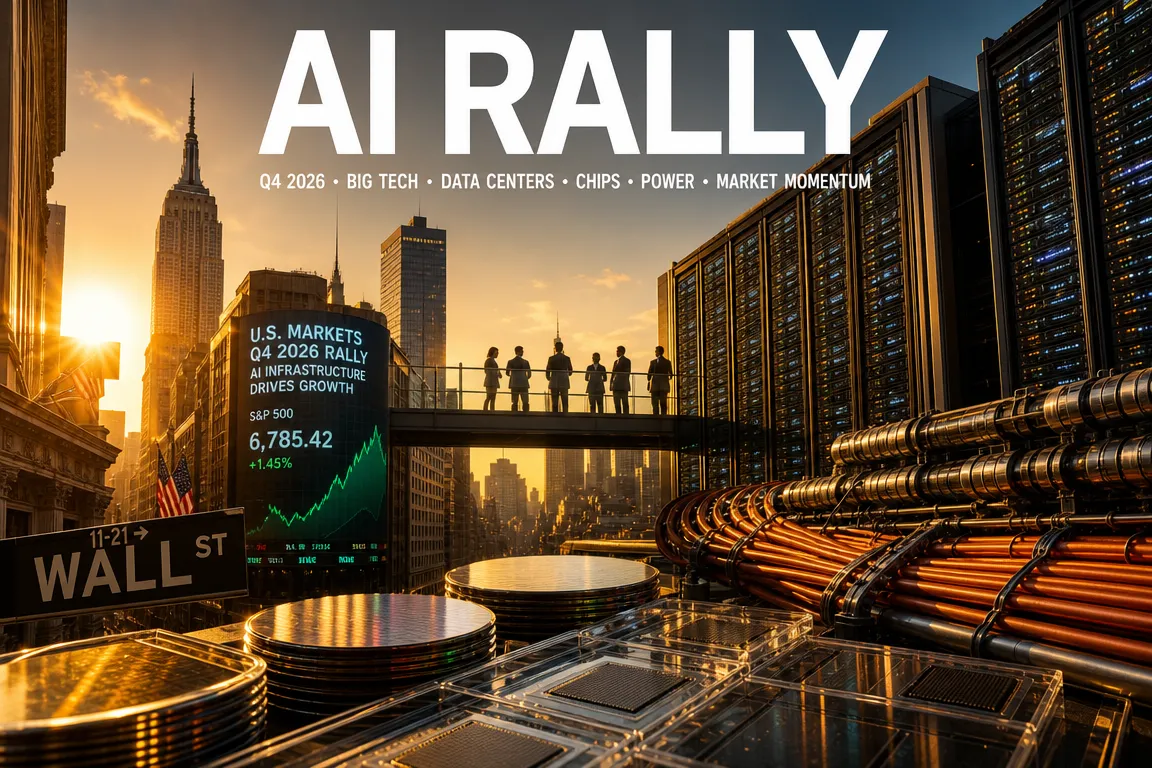
Q4 2026 could be an important turning point in the AI cycle.
After the summer correction and weakness in August and September, the market has already priced in one round of skepticism.
If the leadership group breaks to new highs in the fourth quarter, that could mark the start of a stronger trend extending into next year.
In particular, if Big Tech reports resilient earnings, AI capex guidance remains firm, and funding concerns around data centers ease, the market could react strongly.
By contrast, if leaders fail to break higher and guidance weakens, the case for cycle extension would weaken.
At this stage, the key question is not simply whether the index rises or falls, but whether the leadership group still has the power to pull the market higher.
14. Corporate earnings matter most: the real bear market begins when earnings weaken
The most practical benchmark in the report is corporate earnings.
Oil, rates, inflation, and geopolitical risk all matter.
But for a bull market to become a genuine bear market, earnings eventually need to roll over.
At present, the earnings profile of AI leaders has not broken down.
Big Tech is still benefiting from cloud growth, advertising efficiency, software productivity, and the monetization potential of enterprise AI.
As long as earnings expectations remain intact, corrections are unlikely to become a structural bear market.
Accordingly, the key metrics to monitor are earnings, not only prices.
- Big Tech revenue growth
- AI-related capex
- Cloud segment growth
- Continued data center investment
- Monetization speed of AI services
- Operating margins and cash flow
15. A particularly important issue: the end of the AI bubble may come through IPO exuberance
The original commentary notes that IPOs from large private AI companies such as Anthropic and OpenAI could become signs of market excess.
That is an important observation.
In previous bubbles, the final stage often featured intense retail and institutional attention on the hottest theme, followed by very large valuations for flagship private companies at listing.
If an OpenAI or Anthropic IPO were to combine with extreme speculative appetite, it could be interpreted as a late-cycle overheat signal.
At present, however, listing timelines remain delayed and market enthusiasm has cooled somewhat after the summer correction.
For that reason, it is still difficult to describe the market as being in a fully euphoric phase.
In fact, the delay itself may help prolong the cycle.
16. Key signals investors should watch going forward
From this point on, a checklist is more useful than optimism.
To assess whether the AI cycle can continue, investors should monitor the following signals:
- Whether the U.S. 10-year yield quickly rises into the 5.5% to 6% range
- Whether Big Tech cuts AI capex plans
- Whether data center financing begins to tighten
- Whether demand guidance from Nvidia and other major semiconductor names weakens
- Whether AI agents and enterprise AI services translate into actual revenue
- Whether weaker consumer spending spills into Big Tech earnings
- Whether IPOs from major private AI companies create signs of excess
The most important variable is not rates alone, but whether AI investment is being reduced.
Rates can remain elevated if Big Tech continues to invest.
But if AI capex plans are cut, the core market narrative weakens even if rates are stable.
17. How to interpret this report from an investment standpoint
The report is not saying that the market will rise without interruption.
Its message is that the risks currently weighing on the market have not yet broken the core AI cycle.
It also argues that once skepticism is resolved, sidelined capital could reenter the leadership group.
This is therefore not a market in which investors should simply buy anything that looks cheap.
It is a market in which sectors tied to AI infrastructure investment and corporate earnings deserve primary attention.
In U.S. equities, Big Tech earnings, data center investment, and AI semiconductor demand remain the most important variables.
By contrast, consumer stocks, dividend names, and traditional cyclicals may continue to diverge from the market average.
In this environment, stock selection matters more than the index, and leadership matters more than sector averages.
18. Risks remain clear
For the bull-market extension scenario to remain valid, several conditions must hold.
First, Big Tech earnings must remain solid.
If AI spending continues to rise without corresponding revenue and profit growth, valuation concerns could return.
Second, a faster-than-expected rise in rates could increase financing stress.
Third, prolonged oil and inflation pressure could eventually weaken consumer demand and corporate earnings more broadly.
Finally, signs of overcapacity in AI infrastructure could pressure valuations in data center and semiconductor stocks.
This is therefore a constructive view, but not a risk-free one.
The key point is that the risks have not yet overwhelmed the earnings base of the market leaders.
19. The most important point often missed in other coverage
The most important issue is not simply that AI is attractive.
The market already knows that.
The real issue is where the capital for AI infrastructure investment will continue to come from.
The AI cycle is both a technological innovation cycle and a massive capital expenditure cycle.
Data centers, power grids, GPUs, servers, cooling systems, and networking equipment all require significant funding.
That is why the next phase of the cycle may be determined not only by technology, but by financial structure.
Nvidia’s growing links with Wall Street, insurers, and large financial institutions in building an AI infrastructure financing ecosystem is a more important development than a typical product headline.
If this funding structure remains intact, the AI cycle could last longer than many expect.
If it weakens, even strong technology fundamentals may not be enough to prevent sharp equity volatility.
In the end, analyzing AI stocks now requires more than semiconductor fundamentals.
Investors also need to track capital markets, credit conditions, and long-duration funding flows.
< Summary >
The main conclusion of this report is that the AI cycle is not over and that the bull market may continue into next year.
Oil, inflation, rate hikes, and AI bubble concerns have pressured the market, but they have not yet broken the earnings cycle or investment cycle of the AI leaders.
The market is currently in a phase of trend skepticism, and if that skepticism fades, a final strong rally could extend into the first half of 2027.
Consumer stocks remain weak, but the center of the market is now AI infrastructure, including data center investment, AI semiconductors, servers, power, and Big Tech earnings.
The most important variable is not AI technology alone, but the funding structure behind AI infrastructure investment.
Accordingly, investors should focus less on rotation into laggards and more on the AI leaders and the infrastructure value chain.
Key risks to monitor include sharp rate increases, weaker Big Tech earnings, reduced AI capex, and IPO excess.
[Related Articles…]
- AI Infrastructure and Semiconductors: What’s Driving the Next Equity Cycle
- How Higher Rates Are Reshaping Big Tech and U.S. Equities
*Source: [ 소수몽키 ]
– AI사이클 더 큰 한 방 남았다? 증시 의심의 벽 뚫고 올라갈까
● Rate-Hike, Cash-Flood, AI-Rally
Interest Rates Rise While Liquidity Expands: The Real Reason Markets Are Moving Strangely in 2026
The core issue in the current market is the contradiction of monetary tightening alongside a liquidity-driven rally.
In a normal cycle, rate hikes weigh on equities, while liquidity support lifts them.
At present, central banks are keeping pressure on rates to contain inflation, while governments are expanding fiscal spending to support growth and strategic industries.
As a result, U.S. Treasury yields are rising even as U.S. equities and certain Nasdaq names remain firm.
This report reviews the post-2020 economic cycle by interest-rate regime and explains why 2026 may feature an unusual combination of higher rates, fiscal expansion, and AI-led concentration.
It also examines why Korean equities and the KOSPI may remain relatively subdued versus the U.S. market, and where investors may want to look within AI semiconductors and the broader AI value chain following Nvidia.
1. 2020-2021: The era of pure liquidity expansion
From 2020 through 2021, policy priority was economic stabilization during the pandemic.
The policy framework was straightforward.
Rates were cut, and governments injected cash into the economy.
- The U.S. lowered policy rates to near zero.
- Korea also implemented aggressive easing.
- Governments deployed large-scale fiscal support, including emergency transfers, supplementary budgets, and business assistance.
- Households and companies expanded borrowing at low rates.
Monetary and fiscal policy were aligned in the same direction.
Central banks reduced borrowing costs, while governments directly pushed liquidity into the economy through spending.
This was a classic liquidity-led rally.
Ample liquidity, lower discount rates, and stronger expectations for future growth drove asset prices higher.
Equities, real estate, growth stocks, technology, crypto assets, and ESG-related names all advanced sharply.
2. 2022 to mid-2024: The tightening phase focused on inflation control
From 2022 onward, the environment changed materially.
Excess liquidity from the pandemic period had already built inflationary pressure.
Russia-Ukraine war shock lifted energy and commodity prices.
Supply-chain disruptions further reinforced price instability.
Inflation control became the primary policy objective.
The central bank message was clear:
Inflation had to be contained, even at the cost of weaker growth.
- The Federal Reserve raised policy rates from near zero to above 5%.
- 0.75 percentage point hikes were repeated in successive meetings.
- The Bank of Korea raised its policy rate to around 3.5%.
- Europe also moved into a high-intensity tightening cycle.
Rate expectations became the dominant market variable.
Rising Treasury yields increased discount rates applied to future earnings.
Growth and technology stocks, whose valuations rely more heavily on distant earnings, came under greater pressure.
As a result, 2022 was a difficult year for U.S. equities, the Nasdaq, and Korean equities alike.
This was a clear tightening cycle centered on inflation suppression.
3. Mid-2024 to early 2026: The pivot and normalization phase
From mid-2024 onward, the picture began to shift again.
Inflation had passed its peak and moved closer to target ranges in several major economies.
That did not mean a return to 2020-style aggressive easing.
The key theme was normalization rather than renewed stimulus.
Policy rates that had been raised sharply were gradually being moved back toward neutral levels.
Neutral rates refer to a level that neither overheats nor excessively restrains the economy.
For example, if the U.S. policy rate had been raised to 5.5%, that level could not be viewed as normal.
It was an intentionally restrictive policy setting designed to suppress inflation.
Once inflation stabilized, a gradual move back toward a more neutral range was required.
- The U.S. began a cautious pivot toward lower rates.
- Korea also started to assess room for gradual cuts from the 3.5% range.
- Europe proceeded with rate normalization amid slower growth and easing inflation.
This phase was not a broad-based easing cycle.
It was a controlled transition back toward neutral conditions.
Accordingly, this period is better described as a pivot and normalization phase rather than a full monetary expansion cycle.
4. The key shift in 2026: Tight monetary policy and expansionary fiscal policy at the same time
The critical issue from 2026 is that the market can no longer be described as purely tight or purely loose.
Central banks may keep a restrictive stance to contain inflation, while governments expand spending to support growth, industry, and strategic capacity.
Monetary and fiscal policy are moving in different directions.
This is the main reason markets may appear inconsistent.
- Central banks may keep rates elevated or raise them again if inflation pressures reappear.
- Governments may expand fiscal spending for growth, defense, energy security, power infrastructure, and AI investment.
- Higher fiscal spending requires more government bond issuance.
- Greater bond supply puts upward pressure on long-term Treasury yields.
- At the same time, government spending flows into corporate revenues and investment demand, creating a liquidity effect.
This is where many investors become confused.
They ask how a liquidity-led rally can exist when rates are rising.
But liquidity is not determined by policy rates alone.
Liquidity can also be created through fiscal spending and public investment.
The defining feature of 2026 may be the rise of fiscal liquidity as a market driver.
5. Why the market can hold up even as Treasury yields rise
Normally, rising Treasury yields are negative for equities.
Higher bond yields make risk-free income more attractive relative to stocks.
That reduces the relative appeal of equities.
Growth stocks, especially in the Nasdaq, are more sensitive because their valuations depend heavily on future cash flows.
However, the current environment is different.
The rise in yields is driven not only by monetary tightening, but also by larger fiscal issuance and bond supply.
If governments issue bonds to fund spending on infrastructure, defense, power grids, AI data centers, and semiconductor incentives, specific industries receive direct revenue support.
In other words, rising yields remain a headwind, but fiscal spending can simultaneously support corporate earnings.
The result is not a broad-based rally, but selective strength in industries that benefit from both public spending and private investment.
That is the essence of the current liquidity environment.
This is no longer a period in which all assets rise together.
It is a selective liquidity cycle in which only companies with earnings resilience and policy support can outperform.
6. Why the U.S. market may remain more favorable than Korea
One of the key points is that the U.S. market may remain relatively stronger than Korea in the second half of 2026.
This does not mean Korean equities should be avoided entirely.
Rather, in a high-rate environment, capital may continue to favor markets with stronger earnings visibility and clearer structural growth stories.
The U.S. market has four advantages.
6-1. U.S. fiscal spending primarily benefits U.S. companies
U.S. expansionary fiscal policy tends to flow into domestic industries and companies.
Semiconductors, defense, power grids, data centers, AI infrastructure, and energy security are areas where U.S. firms can capture direct benefits.
Fiscal spending can translate more directly into corporate revenue in the U.S. market.
6-2. The Nasdaq includes many companies that can withstand high rates
In a high-rate environment, companies with heavy debt and weak cash flow are disadvantaged.
By contrast, firms with strong balance sheets, high margins, and global pricing power are more resilient.
Many U.S. large-cap technology companies fit this profile.
As a result, capital can continue to flow into AI, cloud, semiconductor, and software leaders even when Treasury yields remain elevated.
6-3. Global capital tends to move toward the U.S. during periods of uncertainty
When bond markets are unstable, geopolitical risk rises, inflation reaccelerates, or currency volatility increases, global capital tends to move toward safe assets and the world’s deepest equity market.
The U.S. dollar, U.S. Treasuries, and U.S. large-cap equities can be preferred simultaneously.
In that scenario, markets with emerging-market characteristics, including Korea, may see weaker inflows.
6-4. The U.S. is the center of the AI value chain
AI leadership extends far beyond Nvidia.
It includes GPUs, memory semiconductors, HBM, data centers, power equipment, cooling systems, networking hardware, semiconductor equipment, AI software, robotics, and physical AI.
A significant share of this AI value chain is concentrated in the U.S. corporate and capital markets ecosystem.
That gives the U.S. market greater resilience when AI investment remains strong despite elevated rates.
7. Why the Korean market and the KOSPI may remain range-bound
This does not imply that Korean equities are weak.
In fact, a stronger memory semiconductor cycle could benefit Korean companies meaningfully.
However, there are several reasons why the broader KOSPI may struggle to sustain a strong trend.
- High Treasury yields may cause foreign investors to reduce exposure to emerging-market assets.
- The Korean market remains highly sensitive to the semiconductor cycle.
- After sharp rallies and corrections, investors may sell into rebounds.
- Won volatility can amplify foreign fund-flow sensitivity.
- Korea has a less direct combination of fiscal spending, platform companies, and AI infrastructure than the U.S.
Investor sentiment is also important.
When a market has experienced a deep correction, investors tend to question every rebound.
Concerns about another decline can lead to profit-taking on strength.
As a result, the market may remain in a range rather than develop a durable uptrend.
If the KOSPI advances, it may do so in a selective manner, led by semiconductors, power equipment, and materials-related names rather than the broader index.
8. The evolution of AI leadership: What follows Nvidia?
Market leadership changes over time.
In 2020-2021, ESG and renewable energy were strong.
In 2022, metaverse and NFT themes briefly attracted attention.
That was followed by a phase dominated by electric vehicles and secondary batteries.
In 2025, AI semiconductors, especially GPUs and Nvidia, became the center of market attention.
In 2026, leadership may begin to broaden.
As GPU shortages ease and AI infrastructure investment enters its next stage, the market is likely to focus on new bottlenecks.
Those areas may include memory semiconductors, HBM, semiconductor equipment, power infrastructure, data-center power grids, cooling systems, and physical AI.
8-1. Memory semiconductors and HBM
As AI servers proliferate, demand for advanced memory should continue to rise.
AI workloads do not depend on GPUs alone.
HBM and high-performance DRAM are critical for processing large-scale data efficiently.
Korean companies remain strategically important in this area.
8-2. Semiconductor materials, parts, and equipment
Higher AI chip demand also requires more production capacity.
Advanced packaging, inspection tools, deposition systems, etching equipment, and materials suppliers may benefit.
As the market broadens beyond Nvidia itself, investor attention may extend to the semiconductor supply chain.
8-3. Power infrastructure
AI data centers consume significant amounts of electricity.
Power grids, transformers, cables, distribution systems, and energy storage demand are all likely to increase.
This suggests that the bottleneck in AI could shift from semiconductors toward power.
8-4. Physical AI and robotics
AI is moving beyond software and data centers.
Robotics, autonomous vehicles, smart factories, and defense automation are likely to become increasingly relevant.
These areas remain less crowded than other popular AI themes and may deserve long-term attention.
9. The most important point that is often missed in market commentary
The key issue is not the total amount of liquidity, but the direction of liquidity.
Many market discussions focus only on whether rates are being raised or cut.
However, in the current environment, the allocation of government spending may matter more than the policy rate itself.
When governments issue bonds, yields rise.
That is typically seen as negative for equities.
But if those funds are directed toward defense, AI infrastructure, power grids, semiconductors, and energy security, they can support earnings in the relevant industries.
Rising bond yields are therefore a drag on the overall market, but a positive catalyst for policy-sensitive sectors.
That is the central framework for interpreting 2026.
The simple rule that lower rates automatically justify buying equities may no longer apply cleanly.
Instead, investors should focus on which companies can grow earnings despite higher rates.
This is a market in which liquidity is no longer broadly distributed across all assets.
It is increasingly concentrated in sectors where both public spending and private investment converge.
Even if U.S. equities and the Nasdaq remain strong, the rally may not be broad-based.
AI semiconductors, power infrastructure, defense, data centers, and high-performance memory are likely to remain key areas where capital concentrates.
10. Key indicators investors should monitor
- U.S. 10-year Treasury yield: Continued increases would pressure equity valuations, especially for growth stocks.
- Fiscal spending levels: The direction of government spending matters as much as the total size.
- AI capital expenditure: Data-center and semiconductor investment plans from major technology firms remain important.
- Memory semiconductor pricing: HBM and DRAM pricing are critical for Korean semiconductor earnings.
- FX rates: KRW volatility affects foreign flows and the KOSPI directly.
- Earnings outlook: In a high-rate environment, actual earnings matter more than narrative.
In conclusion, the 2026 market is neither a conventional easing cycle nor a conventional tightening cycle.
Central banks remain restrictive, while governments remain expansionary.
Yields are high, but fiscal liquidity is also strong.
In this environment, distinguishing between the index and the leading sectors becomes more important than tracking the market as a whole.
Investors should focus not only on Nvidia, but also on the next bottlenecks in the AI value chain.
Memory semiconductors, power infrastructure, semiconductor equipment, and physical AI are likely to remain important themes.
< Summary >
2020-2021 was a classic liquidity expansion cycle, with rate cuts and fiscal support moving in the same direction.
2022-2024 was a tightening phase driven by aggressive rate hikes to control inflation.
From mid-2024 to early 2026, policy shifted toward a pivot and normalization process back toward neutral rates.
From 2026 onward, central banks may remain restrictive while governments expand spending, creating a structurally unusual policy mix.
That environment can support selective liquidity, even as Treasury yields stay elevated.
The U.S. market may remain relatively stronger because it sits at the center of fiscal spending and the AI value chain.
Korean equities may benefit from memory semiconductor strength, but the broader KOSPI could remain range-bound due to foreign flow and sentiment constraints.
Investors should look beyond Nvidia and monitor HBM, semiconductor suppliers, power grids, data centers, and physical AI.
[Related Articles…]
- AI Semiconductor Cycle and the Next Market Leaders
- How Rising U.S. Treasury Yields Affect Equities and Currencies
*Source: [ 경제 읽어주는 남자(김광석TV) ]
– 금리는 올리는데 돈은 푼다…지금 시장이 이상하게 움직이는 이유 | 클로즈업 | 국채불안 [2편]