● KOSPI, Plunge, Shock, Panic, Selloff
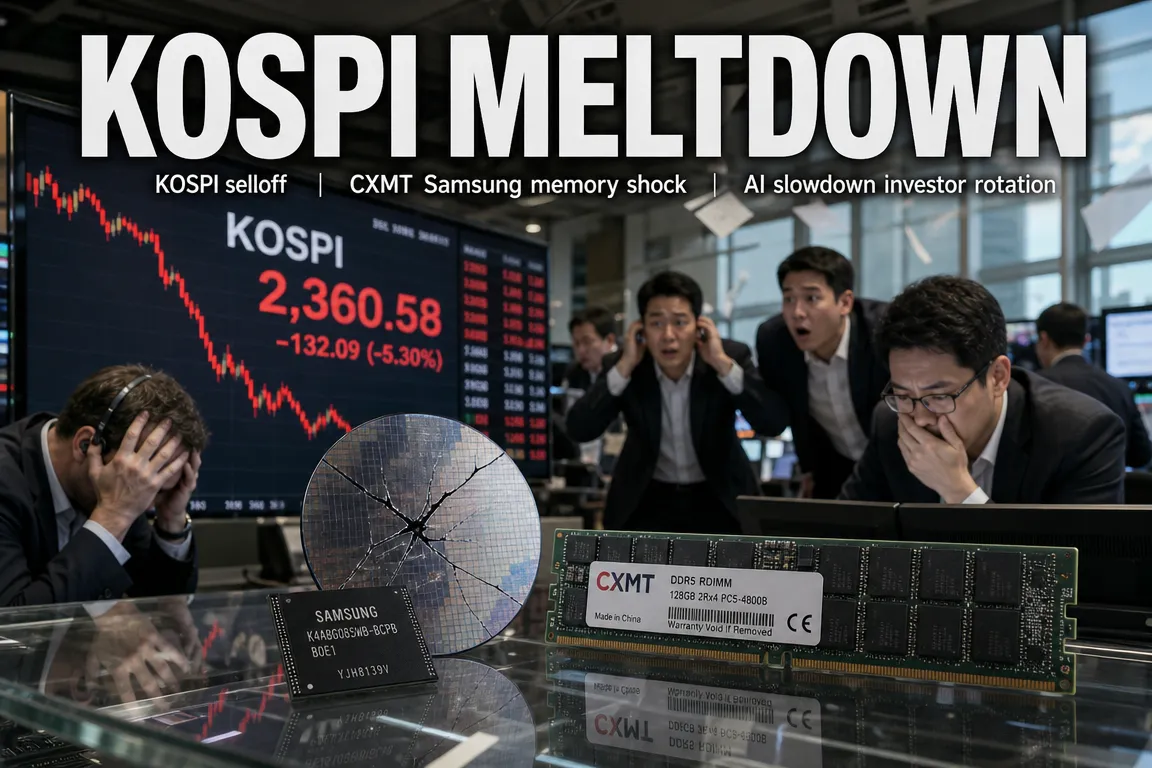
Three Main Drivers Behind the Sharp KOSPI Selloff: CXMT Shock, Samsung Electronics Concerns, and Foreign Net Selling
The key driver behind today’s KOSPI decline was not simply that a Chinese semiconductor company made an announcement.
The market began to question the competitive position of Samsung Electronics and SK Hynix after CXMT disclosed server memory semiconductor news, while technical support breakdowns in the KOSPI, foreign net selling, and the exhaustion of retail buying capacity all occurred at the same time.
In other words, this was a classic fear-driven selloff triggered by a combination of semiconductor news, weak market liquidity, and deteriorating investor sentiment.
At this stage, the market is reacting less to earnings figures for Samsung Electronics or SK Hynix and more to the fear that prices could fall further.
1. The first driver of today’s KOSPI decline: CXMT’s server memory semiconductor announcement
The first shock came from CXMT, a Chinese memory semiconductor company.
Reports spread that CXMT plans to launch a new server memory chip by year-end.
The issue is that it remains unclear whether the announcement refers to mass production, a prototype, or an early-stage technology milestone.
Even so, the market reacted before confirming the details.
In particular, some headlines suggested that CXMT was two years ahead of Samsung Electronics, which sharply increased investor concern.
-
It is still unclear whether CXMT has reached a level suitable for large-scale production.
-
Product quality, yield, and customer acquisition for server memory remain unverified.
-
Nevertheless, the market first reacted to concerns that China may be catching up with Samsung Electronics.
-
As AI server demand expands, even minor news can have a large impact on Samsung Electronics and SK Hynix shares.
The key point is that CXMT’s technology leadership over Samsung Electronics has not been confirmed.
The market is pricing in possibility and fear before confirmed facts.
Because semiconductors are a future-driven industry, headlines suggesting a shift in competitive dynamics can significantly increase volatility.
2. Why Samsung Electronics and SK Hynix weakened together: a reverse effect from AI semiconductor expectations
This year, the main investment case for Samsung Electronics and SK Hynix has centered on AI semiconductors and server memory demand.
Expectations that AI data centers would expand rapidly and increase demand for HBM, DDR5, and server DRAM helped drive the shares higher.
CXMT’s announcement directly challenged that narrative.
When concerns arise that a Chinese company may enter the server memory market in earnest, investors naturally begin to consider pricing pressure and potential market share loss.
-
The expansion of the AI semiconductor market remains a structural positive for Samsung Electronics and SK Hynix.
-
However, news of a faster-than-expected Chinese catch-up raises valuation risk.
-
Investors are concerned less with near-term earnings and more with the possibility that long-term market dominance may weaken.
-
When the semiconductor cycle is strong, news about new competitors tends to be priced in more aggressively.
Today’s selloff was not driven by evidence that CXMT has already surpassed Samsung Electronics.
Rather, it reflected a decline in the AI semiconductor expectations already embedded in the share prices of Samsung Electronics and SK Hynix.
3. The second driver: KOSPI broke below its existing trading range support
The second factor is important from a technical perspective.
The KOSPI had been holding within a defined range.
Many investors viewed that level as a buying zone.
Today, however, that support level gave way.
When the lower boundary of a trading range is broken, two things typically happen at once.
-
First, investors who bought for a rebound are left with unrealized losses.
-
Second, stop-loss orders are triggered, accelerating the decline.
A similar pattern appears to have occurred in today’s KOSPI selloff.
Investors who bought near the prior support level were unable to hold their positions, and automated selling added to downward pressure.
In particular, forced selling linked to index ETFs, leveraged products, and margin positions can deepen a market decline.
4. The third driver: foreign net selling and the absence of fresh buying
The third driver was supply-demand imbalance.
When markets fall, a buyer must step in to stabilize prices.
Today, that support was largely absent.
Foreign investors continued to sell, institutional buying was limited, and retail investors appeared to have little remaining capacity to add exposure.
-
Persistent foreign net selling places direct pressure on the KOSPI, which is heavily weighted toward large-cap stocks.
-
When Samsung Electronics and SK Hynix, which carry significant index weight, weaken, the broader index tends to fall sharply.
-
Retail investors have already deployed substantial capital, limiting additional buying power.
-
High use of margin and leveraged positions increases the risk of forced selling in a downturn.
In this environment, even positive news has difficulty triggering an immediate rebound.
Fear of further declines tends to outweigh the view that prices are becoming attractive.
5. Why today’s market looked unusual: fear outweighed fundamentals
The most notable feature of today’s KOSPI session was that investors largely ignored earnings fundamentals.
Market participants focused less on Samsung Electronics’ profit level, SK Hynix’s HBM margin outlook, or the ongoing recovery in the semiconductor cycle, and more on fear.
In such conditions, traditional valuation metrics such as PER, PBR, and operating profit forecasts lose short-term influence.
During fear-driven markets, the following patterns are common.
-
Headlines are priced in before facts are confirmed.
-
Downside scenarios receive greater weight than positive earnings.
-
Foreign selling further weakens retail sentiment.
-
Technical selling accelerates after support breaks.
-
Cash preference increases, reducing trading volume and buying demand.
In short, today’s market was not a normal earnings-driven session, but one dominated by uncertainty and weak market structure.
6. The less discussed issue: the deeper concern is the weakening resilience of the Korean market
Many reports focus on the competitive narrative between CXMT and Samsung Electronics.
However, the more important issue is that the Korean equity market’s buying power has weakened.
The fact that the KOSPI moved sharply on a single Chinese semiconductor headline suggests that internal market defenses are limited.
When foreign investors sell, domestic capital needs to absorb the flow, but retail investors are already heavily invested and institutions have limited capacity to defend aggressively.
In such a structure, even minor negative developments can lead to outsized declines.
-
Korean equities have a high concentration in semiconductors, creating significant dependence on Samsung Electronics and SK Hynix.
-
When large-cap semiconductor names weaken, overall market sentiment deteriorates quickly.
-
Foreign capital flows are highly sensitive to exchange rates, interest rate expectations, and global liquidity conditions.
-
High retail leverage can intensify selling pressure during market declines.
In that sense, this decline was driven not only by concern over CXMT, but also by the market’s limited capacity to absorb negative news.
7. The global context: the semiconductor race is increasingly about supply chains, not just technology
This issue extends beyond the Korean market.
It is part of the broader global semiconductor supply chain competition involving the U.S., China, Korea, and Taiwan.
As AI server demand rises, the strategic importance of memory semiconductors increases further.
China continues to build its domestic semiconductor ecosystem despite U.S. export restrictions.
Korean companies retain advantages in technology, yield, and customer trust, but the speed of Chinese progress remains a market concern.
Investors should focus on the following points going forward.
-
Whether CXMT’s announcement is supported by actual mass production capability.
-
Whether the yield and quality of its server memory products meet global customer standards.
-
Whether Samsung Electronics and SK Hynix can sustain their HBM competitiveness.
-
How U.S. restrictions on China may limit the growth trajectory of Chinese semiconductor firms.
-
How global interest rate expectations and dollar strength affect foreign capital flows.
8. Key indicators investors should monitor now
At this stage, the focus should be on whether market conditions are stabilizing enough to support more rational pricing.
-
Foreign selling moderation should be monitored.
-
Recovery in trading volume for Samsung Electronics and SK Hynix should be confirmed.
-
Reclaiming KOSPI support levels is important.
-
Stabilization in the KRW/USD exchange rate may influence foreign inflows.
-
U.S. interest rate expectations and global risk appetite should be tracked together.
-
AI semiconductor demand outlook should also remain under review.
For semiconductors, medium- to long-term demand matters more than short-term headlines.
If investment in AI data centers continues, demand for server memory is likely to remain structurally strong.
However, even fundamentally strong sectors can experience significant price declines when market structure weakens.
9. One-sentence summary of today’s KOSPI decline
Today’s sharp KOSPI decline was the result of simultaneous fear over CXMT, a breakdown in technical support, and foreign net selling combined with fading retail buying power.
It is more reasonable to view this as a period of excessive uncertainty pricing than as a sudden deterioration in the fundamentals of Samsung Electronics or SK Hynix.
That said, in a fear-driven market, valuation arguments alone are unlikely to drive an immediate rebound, making foreign flows and index stabilization critical to watch.
< Summary >
The first driver of today’s KOSPI decline was CXMT’s server memory semiconductor announcement, which increased concerns about competition with Samsung Electronics and SK Hynix.
The second driver was the breakdown of the KOSPI’s existing range support, which triggered broad stop-loss selling.
The third driver was continued foreign net selling, coupled with weak buying capacity from retail investors and institutions.
This was a market dominated by fear and liquidity pressure rather than earnings fundamentals.
The key issue is less CXMT itself and more the weakening defensive capacity of the Korean equity market.
Going forward, investors should monitor foreign flows, exchange rates, U.S. interest rate expectations, AI semiconductor demand, and the competitive position of Samsung Electronics and SK Hynix.
[Related Articles…]
*Source: [ 내일은 투자왕 – 김단테 ]
– 코스피 역대급 대폭락의 3가지 이유 #코스피 #CXMT #삼성전자
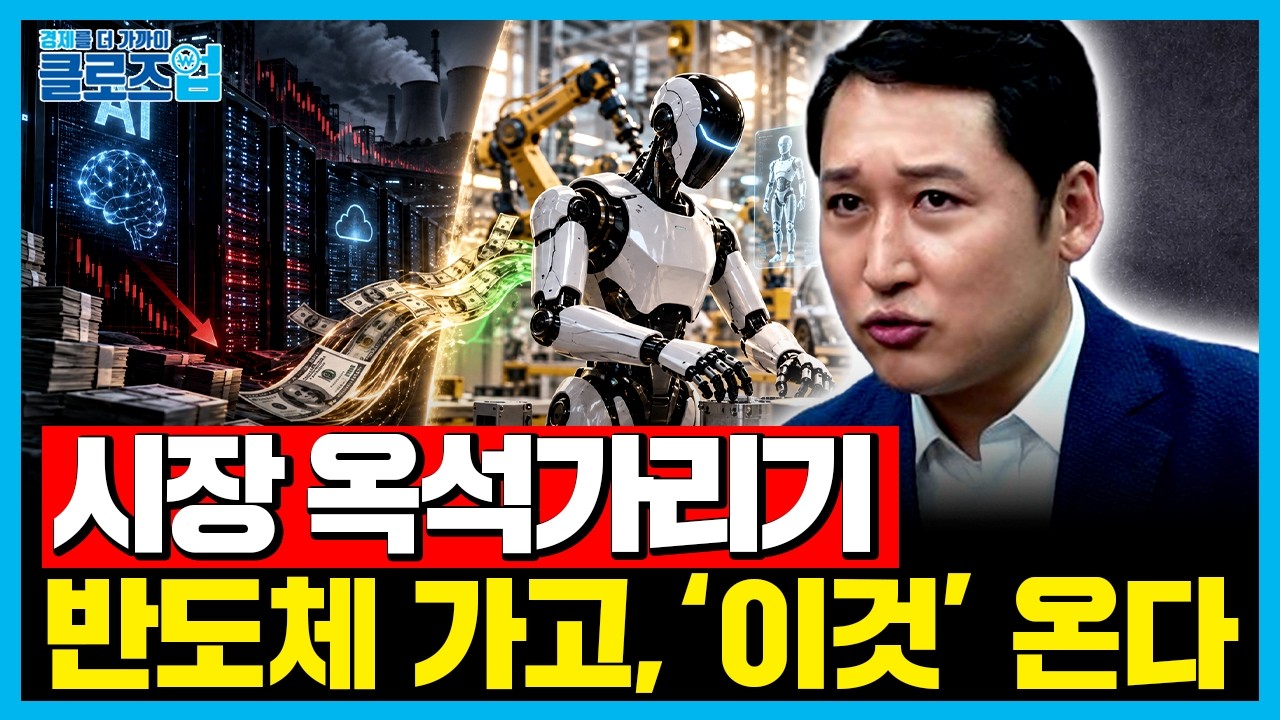
● AI-CAPEX-Squeeze,Physical-AI-Shakeup,Sensor-Winner-Take-All
The Real Meaning of AI Slowdown: More Important Than the AI Bubble Debate Is Sector Leadership Rotation
The most important point in today’s AI market is not simply the call to “slow down because AI is moving too fast.”
The real issue is who is calling for a slowdown, and why.
On the surface, the argument centers on AI safety, existential risk, and concerns over excessive competition. In practice, it also reflects mounting capital intensity and deteriorating cash flow across large-scale AI infrastructure investment.
As this cycle matures, leadership may shift from pure AI model competition to physical AI, robotics, humanoids, sensors, e-skin, and data center power infrastructure.
This development is better understood as a process of differentiation between companies that can sustain funding and those that cannot, rather than as a full-scale AI bubble collapse.
Accordingly, investors should assess the global macro outlook, interest rates, semiconductor cycle, data center investment, and AI commercialization pace together.
1. Is the AI slowdown argument really about safety?
AI industry leaders have increasingly argued that AI development should be slowed.
Executives at OpenAI, Anthropic, and xAI have cited the possibility that AI could threaten humans or create social disruption through robotics and automation.
AI safety is clearly an important issue.
However, viewing the argument purely at face value may obscure the underlying market structure.
The key point in the original analysis is that the slowdown narrative may also signal that some AI companies are approaching financial limits under heavy infrastructure commitments.
In simple terms, AI companies are competing in an endurance test.
Companies with sufficient capacity continue to support rapid expansion.
Companies under pressure begin to argue for moderation and slower execution.
The slowdown debate may be emerging from that point.
2. Anthropic’s challenge: Take-or-Pay contract obligations
Anthropic’s main burden is its Take-or-Pay structure.
Under Take-or-Pay agreements, a minimum payment must be made regardless of actual usage.
In other words, fixed costs remain high whether or not cloud and semiconductor infrastructure is fully utilized.
The original text cites the following major infrastructure commitments for Anthropic:
- Approximately $11.1 billion in Google Cloud TPU and data center infrastructure commitments
- Approximately $110 billion in AWS chip and cloud resource commitments
- Approximately $16.12 billion in Broadcom and equipment lease commitments
- Approximately $31.4 billion in Microsoft-related commitments
The key issue is that most of these contracts are long-term and difficult to cancel.
If a company secures GPUs, TPUs, data centers, and cloud infrastructure in advance for model development, but revenue does not keep pace, cash flow can deteriorate sharply.
In that context, a call for “AI slowdown” may be a rational corporate response.
Publicly, the rationale is safety; internally, the incentive is to ease infrastructure cost pressure.
3. OpenAI’s issue: revenue is rising rapidly, but costs are rising faster
OpenAI differs from Anthropic.
Its revenue growth has been extremely strong.
With ChatGPT, the company has secured a dominant position in the AI services market and continues to expand its enterprise customer base.
The problem is that costs are increasing even faster than revenue.
Continual model upgrades require very large training and inference expenditures.
Maintaining leadership in the next generation of models requires sustained investment in data centers, GPUs, power, network capacity, and talent.
The original text describes this as a structural gap that must be closed.
OpenAI generates significant revenue, but much of it is reinvested into AI infrastructure and model development.
This type of capital consumption is commonly referred to as cash burn.
OpenAI remains a market leader, but it faces a trade-off between growth and the cost of maintaining leadership.
4. xAI’s issue: a monthly $1 billion spending model
xAI should also be considered in the context of the slowdown discussion.
According to the original text, xAI is spending roughly $1 billion per month.
At that level, the company is heavily dependent on continuous external fundraising.
Interest rates are the key variable.
If U.S. Treasury yields continue to rise in the second half of 2026 and beyond, funding conditions for growth companies may become significantly tighter.
Higher rates tend to push investors toward safer assets such as bonds, reducing capital flows into AI startups and other high-growth businesses.
xAI appears to be financing AI operations through revenue generated by other Musk-related businesses.
However, if spending grows too quickly, further capital raising becomes unavoidable.
In that sense, xAI’s slowdown narrative is also linked to financing conditions and operating cost pressure, not only AI safety.
5. The more important question than the AI bubble: Can hyperscalers keep buying semiconductors?
The central question in AI is not whether AI is a bubble.
The more important question is whether hyperscalers can continue purchasing semiconductors at the current pace.
Hyperscalers refer to large-scale cloud and platform companies such as Microsoft, Amazon, Google, and Meta.
AI semiconductor demand depends on their continued investment in GPUs and data centers.
For that reason, AI infrastructure spending is directly tied to the semiconductor cycle.
The original text suggests that major semiconductor companies such as Samsung Electronics may continue to benefit through 2027.
Demand for AI servers, HBM, and high-performance memory remains strong.
However, beyond that period, hyperscalers’ free cash flow will need close monitoring.
Current market consensus appears to assume that data center CAPEX growth will slow from around 62% this year to roughly 19% by 2027.
The important point is that this implies slower growth, not a decline in investment.
The AI slowdown argument, by contrast, implies a push to reduce that growth rate further, potentially to 10%, 5%, or even negative territory.
If the slowdown narrative spreads, AI semiconductors and data center-related equities may face near-term valuation pressure.
At the same time, capital may rotate toward companies with stronger balance sheets, creating a more selective market.
6. The real industry shift: from service AI to physical AI
The key issue is not whether AI disappears.
The key issue is where the center of gravity moves.
So far, AI has mostly been delivered as a service.
Users interact with systems such as ChatGPT, while the underlying value chain consists of models and cloud infrastructure.
In that structure, the main value drivers have been AI services, AI models, AI infrastructure, telecom infrastructure, and power infrastructure.
In the physical AI era, the structure changes.
Rather than simply using AI, customers will buy products that contain AI.
Examples include AI refrigerators, AI PCs, AI smartphones, AI vehicles, AI robots, and AI factory equipment.
AI therefore expands from software services into physical products.
This shift increases demand for robotics, sensors, batteries, actuators, advanced materials, e-skin, precision components, and power control systems.
That is the core of the physical AI transition.
7. Physical AI timeline: 2025 conceptualization, 2026 planning, 2027 commercialization
The original text outlines the following timeline:
- 2025: conceptual stage for physical AI
- 2026: product planning and rising interest in robotics
- 2027: commercial rollout
Based on this view, investor attention on robotics and humanoids may increase from 2026 onward.
However, robotics is only one part of physical AI.
Physical AI is a broader category that includes appliances, mobile devices, automobiles, machinery, and manufacturing equipment.
The major change is that AI becomes embodied in physical products.
In the service AI era, model performance and user adoption were central.
In the physical AI era, durability, safety, sensor performance, price competitiveness, manufacturing capability, and supply chain stability become more important.
8. What will robots wear? The answer is sensors and e-skin
One of the most interesting questions in the original text is: “What will robots wear?”
In the 19th-century gold rush, miners wore denim, and the denim industry expanded as a result.
So what will physical AI products such as robots, AI refrigerators, AI vehicles, and AI PCs wear?
The answer is sensors.
And one form of sensor integration is e-skin.
Autonomous vehicles already rely on lidar, cameras, radar, and ultrasonic sensors across the body of the vehicle.
Cars are effectively “wearing” sensors through adhesive systems and modular integration.
By contrast, robots and humanoids require electronic skin that can detect pressure, contact, friction, temperature, and vibration in a manner similar to human skin.
E-skin is not just another component.
It is a core interface that enables robots to grasp objects, avoid collisions, regulate force, and interpret tactile feedback.
If humanoid robots are to operate in shared human environments, e-skin becomes close to essential.
9. The e-skin market: healthcare remains dominant, but robotics and humanoids are the next growth area
Various institutions project growth in the global e-skin market.
While estimates differ, the consensus is that the market will expand.
Currently, the largest share of the e-skin market is in medical and healthcare patches.
The original text states that healthcare patches account for more than 60% of the overall e-skin market.
Companies such as MC10, V-LNK, and Gentex are cited as examples.
These companies have strengths in biometric monitoring, wearable patches, and medical sensing.
They are therefore well positioned in medical e-skin applications.
However, tactile e-skin for robotics and humanoids has different requirements.
Key priorities include flexibility, ultra-thin electronic layers, resistance to repeated bending, friction tolerance, shock recovery, and tactile accuracy.
If AI robots are to operate like humans, they require skin-like sensor systems.
10. Why Lumia Technologies is drawing attention
The original text presents Lumia Technologies through the lens of physical AI and e-skin.
This is not presented as an investment recommendation, but as a case study in the physical AI landscape.
Lumia Technologies focuses on tactile sensor-based e-skin for robots and humanoids.
As robots move, joints bend repeatedly and are exposed to impact and friction.
This can cause micro-cracks and create durability issues for sensors.
Accordingly, e-skin must be more than thin and flexible.
It must also recover from micro-cracks quickly and preserve performance under repeated deformation.
Technologies that convert mechanical energy from movement, heartbeat, or vocal cord vibration into electricity are also relevant because they can reduce battery dependence.
Lumia is described as having stronger relevance to robotics and humanoid tactile e-skin than to the broader medical e-skin market.
Its potential collaboration with robotics companies is identified as a key strength.
11. HAND-C and HAND-ERC: an important signal for the e-skin ecosystem
One of the most underreported elements in the original text is NSF HAND-C and HAND-ERC.
This is important for understanding the future ecosystem of physical AI.
NSF refers to the U.S. National Science Foundation.
HAND-ERC appears to be a tactile engineering research center initiative.
The original text cites a roughly $25 million initiative.
Universities such as Northwestern University, Carnegie Mellon University, and MIT are described as participating.
On the industry side, companies including Meta, Amazon Robotics, and Boston Dynamics are described as being involved in a humanoid tactile sensing consortium.
This matters because physical AI is difficult for any single company to build alone.
AI models, robot hardware, sensors, materials, power management, manufacturing processes, and safety standards must all work together.
Companies that participate in consortiums and research networks may gain an advantage in shaping technical standards and the industry direction.
12. The Unichem and Lumia acquisition case: a domestic example of entry into physical AI
The original text also discusses the reported acquisition attempt by Korean Kosdaq-listed Unichem of Lumia Technologies.
This is presented as an example of how a domestic company may enter the physical AI space, not as an investment recommendation.
Unichem reportedly signed a term sheet with Lumia Technologies.
A term sheet is a preliminary agreement that defines key terms such as valuation, investment size, equity stake, and control rights before a definitive contract is signed.
A final agreement was later signed on October 12, and the acquisition payment process was reported to be under way.
The board composition is also notable.
Monroe Kennedy III, who leads a research lab at Stanford University, was reportedly appointed as an outside director.
The text also mentions an extraordinary general meeting notice involving the appointment of Lumia founder Madison Maxey as an inside director.
Based on DART filings, Lumia Technology is described as a robotics and tactile sensing solutions specialist, with 100% equity acquisition referenced in the filing.
This suggests that Unichem is pursuing expansion beyond its existing business into robotics and physical AI.
13. The key point missing from most coverage: the next AI bottleneck is not the model, but perception
Most coverage focuses on model performance, GPU supply, data center investment, and power shortages.
These issues remain important.
However, in the physical AI era, a more important bottleneck may be how accurately robots can perceive the real world.
Text-based AI reads data and generates responses.
Vision AI sees screens and makes judgments.
Robotic AI, however, must grasp objects, interact with humans, regulate pressure, detect slippage, and absorb impact.
That requires tactile sensors and e-skin.
For humanoid robots to enter industrial and household environments at scale, tactile intelligence is needed across fingers, arms, torsos, and joints.
In this framework, the AI model is the brain, e-skin is the skin, and sensors are the nervous system.
This suggests that the next leadership group in AI may not be limited to software companies.
Sensors, robot components, e-skin materials, power control, ultra-thin electronic devices, and industrial robot platforms may emerge as the next area of focus.
14. Key factors for investors
This is not an investment recommendation for any specific company.
However, the following factors are important when assessing AI industry rotation:
- Determine whether cash burn is growing faster than revenue growth for AI companies.
- Assess whether infrastructure commitments such as Take-or-Pay contracts create non-cancellable cost burdens.
- Monitor how slower hyperscaler CAPEX growth affects semiconductor demand.
- Evaluate the impact of higher interest rates on AI startups and growth-stage funding conditions.
- Check whether physical AI companies have entered genuine commercialization rather than remaining in R&D.
- For robotics, humanoids, and e-skin companies, assess whether they have actual customer collaborations and not just technical programs.
- For domestic companies, review the existing business base, balance sheet strength, post-acquisition integration capability, and disclosure filings.
15. Possible market scenarios ahead
The first scenario is a slowdown in AI infrastructure spending.
Data center and GPU investment may continue, but lower growth rates could put pressure on highly valued AI infrastructure stocks.
The second scenario is market concentration among stronger players.
Companies with strong cash flow, proprietary cloud, proprietary chips, and dedicated data centers may continue gaining share.
The third scenario is a rotation toward physical AI leadership.
If model competition becomes constrained by cost, the market may shift toward robotics, automobiles, manufacturing, logistics, and healthcare AI products that generate actual revenue.
The fourth scenario is a revaluation of power infrastructure and semiconductor supply chains.
Data center power demand, cooling systems, grid investment, and advanced semiconductor packaging may remain important growth areas.
The fifth scenario is the rise of e-skin and tactile sensing.
As humanoid robots move closer to commercialization, the ability for robots to “feel” the world may become a key competitive advantage.
< Summary >
The AI slowdown debate is not only about safety. It also reflects financial pressure and the limits of infrastructure expansion among AI companies.
Anthropic faces long-term infrastructure commitments, OpenAI faces rapid cost growth, and xAI depends heavily on ongoing fundraising.
Hyperscaler CAPEX growth may slow, but semiconductor demand could remain resilient through 2027.
AI is shifting from service AI to physical AI, with robotics, humanoids, sensors, and e-skin emerging as the next growth areas.
E-skin may become a critical bottleneck because it enables robots to perceive the physical world.
In Korea, Unichem’s reported acquisition of Lumia Technologies illustrates how domestic companies may enter the physical AI space.
Going forward, investors should evaluate AI models alongside data center investment, interest rates, semiconductor cycles, power infrastructure, and robotics sensor ecosystems.
[Related Articles…]
- Physical AI and the Next Investment Themes in Robotics
- E-skin Technologies and the Humanoid Robot Supply Chain
*Source: [ 경제 읽어주는 남자(김광석TV) ]
– ‘AI 속도조절론’의 진짜 이유…옥석 가리기 끝나면 주도주가 바뀐다 | 클로즈업 | AI 산업 재편