● Chinese DRAM Shock Claims vs Reality
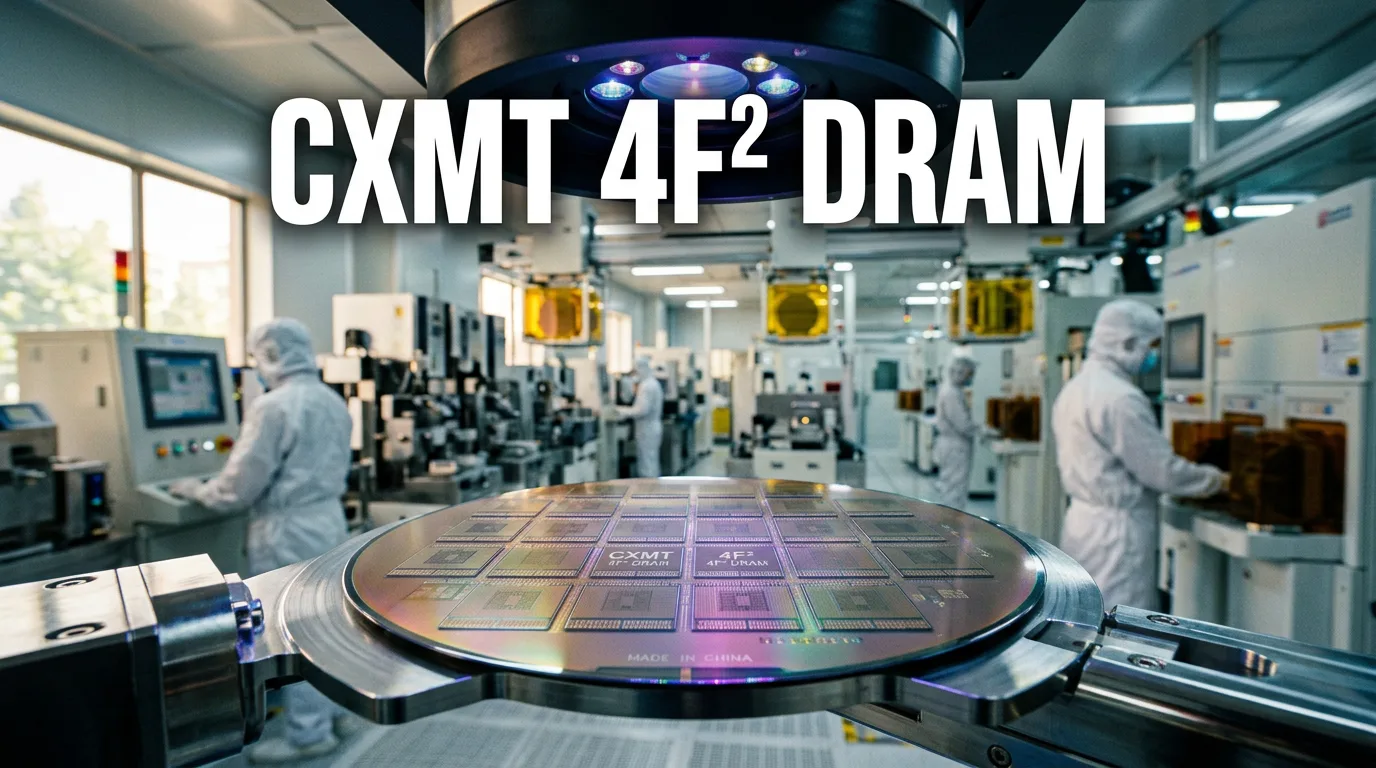
CXMT 4F² DRAM Shock: Has China Really Overtaken Samsung by 2 Years?
The real core point to watch in this issue is not “China beat Samsung.”
The important question is whether CXMT’s announced 4F² DRAM technology is truly ready for mass production, or whether it is just another market-moving headline.
In particular, this news is connected not only to memory semiconductors but also to AI semiconductors, HBM, the DRAM market, semiconductor equipment regulations, and the global semiconductor supply chain, so looking at it as simply “China’s tech is amazing” makes it easy to miss the key takeaway.
To begin with the conclusion, CXMT’s announcement has technical significance, but there is still insufficient evidence to say it has actually overtaken Samsung, SK Hynix, or Micron.
1. The core point of this news: why did the market shake over CXMT’s announced 4F² DRAM?
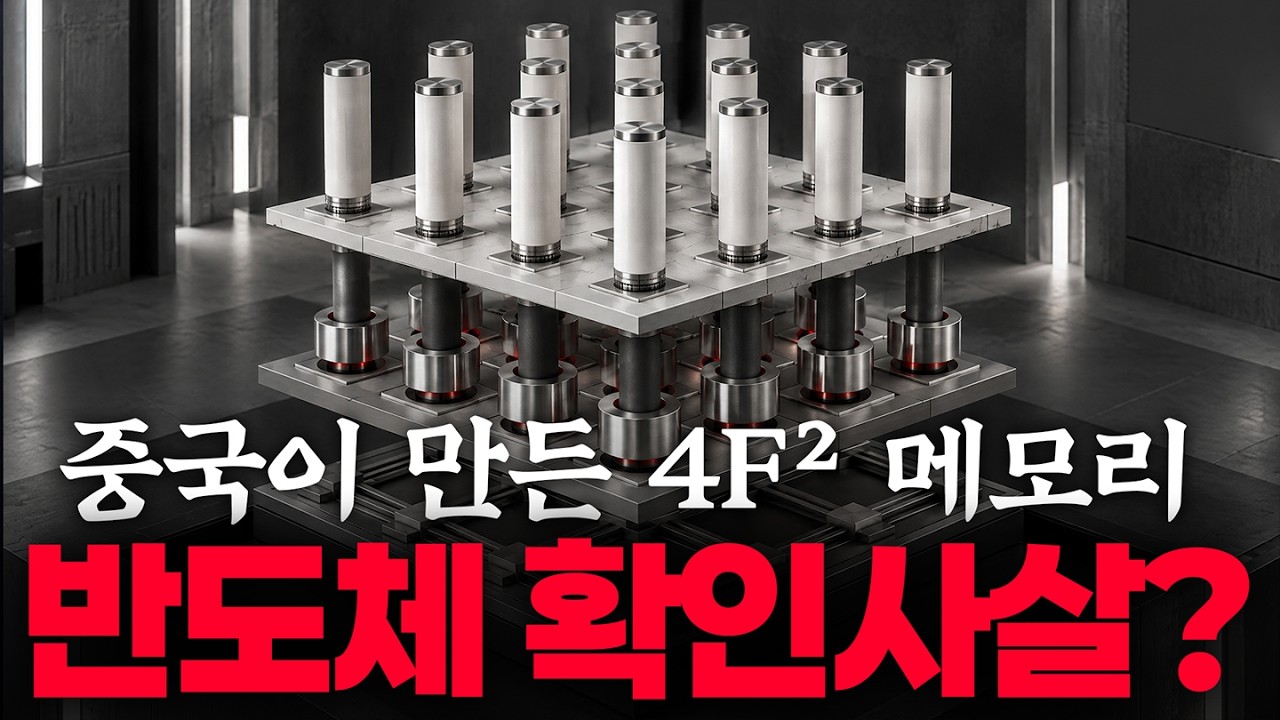
CXMT, China’s largest DRAM company, announced that it will launch server DRAM using a 4F² structure by the end of this year.
The market interpreted this as meaning “China is two years ahead of Samsung.”
That is because Samsung is targeting 2028 for mass production of a similar DRAM structure.
- The current mainstream DRAM structure is generally based on 6F².
- The 4F² structure is a technology that can reduce cell area further at the same feature size.
- In theory, it can fit 30% to 50% more memory into a chip of the same size.
- It is a very attractive technology in a market where demand for server DRAM, AI servers, and data centers is growing.
Simply put, conventional DRAM is like a room with a bed and a desk placed side by side.
The 4F² structure is more like a bunk-bed setup with the desk tucked underneath the bed.
Because space is used more efficiently, chip area can be reduced and storage capacity increased.
2. But why aren’t Samsung and SK Hynix mass producing it right away?
Many people misunderstand this point.
They ask, “If it’s such a good technology, why are Samsung and SK Hynix waiting until 2028?”
The answer is simple.
It is not that they cannot make it; it is that stable mass production at a commercially viable level is difficult.
Samsung, SK Hynix, and Micron have already unveiled 4F²-related structures or prototypes years ago.
The problem is that building something in a lab and mass producing it in millions of units are completely different games.
- In the semiconductor industry, the most important thing is not “it is possible,” but “the yield is there.”
- If yield is low, costs explode even if the technology is good.
- If costs are high, customers have no reason to buy the expensive product.
- In the end, semiconductor competitiveness requires technology, yield, cost, and supply stability to align together.
3. The core challenge of 4F² DRAM: hybrid bonding and yield issues
Because the 4F² structure packs cells very densely, there is not enough room to place circuits the usual way.
So the circuits must be made separately on another wafer, and then the two wafers must be bonded together.
This technology is called hybrid bonding.
Hybrid bonding has recently emerged as a very important technology in AI semiconductors and HBM as well.
But the problem is that, because it bonds entire wafers, defect management becomes extremely difficult.
For example, imagine making a sandwich by sticking together two slices of bread.
If even one slice has mold, you have to throw away the entire sandwich.
Wafers are similar.
If either of the two wafers is defective, that chip must be discarded.
- If wafer A has a 90% yield and wafer B has a 90% yield, the combined yield is 81%.
- That is because 90% × 90% = 81%.
- If either one has only a 60% yield, it can fall to 36%, since 60% × 60% = 36%.
- At that point, commercial mass production is effectively difficult.
So even if CXMT says it will “launch” 4F² DRAM, that does not necessarily mean stable mass production.
That is the most important point in this news.
4. Announcement and mass production are completely different
CXMT said it will launch server memory by the end of this year, but it did not disclose specific capacity, speed, customers, yield, or production scale.
In the semiconductor industry, “launch” and “mass production” are entirely different terms.
| Category | Meaning | Market Interpretation |
|---|---|---|
| Technology announcement | Concept or sample-level disclosure | Confirmation of technical direction |
| Product launch | Possibility of small-volume supply or limited sales | Early stage of commercialization |
| Mass production | High yield, low cost, stable supply possible | Actual competitiveness secured |
This CXMT news is still hard to view as proof of “mass production competitiveness.”
It is more realistic to interpret it as closer to a technology development announcement.
5. The biggest wall Chinese semiconductors face: EUV equipment restrictions
The reason CXMT is finding it hard to quickly catch up with Samsung and SK Hynix is semiconductor equipment regulation.
In leading-edge semiconductor processes, ASML’s EUV lithography equipment is essentially the core tool.
Samsung and SK Hynix are introducing EUV into advanced DRAM processes.
But Chinese companies have difficulty acquiring EUV equipment because of U.S. export controls.
Chinese firms instead use DUV equipment and multi-patterning, where the pattern is drawn in several steps.
The problem is that if a circuit that could be drawn in one step is divided into multiple steps, alignment errors accumulate.
- The number of process steps increases.
- The likelihood of errors rises.
- Defect rates go up.
- Production costs increase.
- The final yield is more likely to decline.
This is similar to an issue previously mentioned in SMIC’s 7nm process.
If it can be made, but the yield is lower than TSMC’s and the cost is higher, it is difficult to secure price competitiveness in the global market.
6. The report that CXMT once tried to supply mobile DRAM to Apple also deserves another look
The original text mentions a report that CXMT once tried to supply mobile DRAM to Apple, but the price was similar to or even higher than Samsung’s or SK Hynix’s.
This part is quite important.
Chinese semiconductors are usually perceived as strong in low-cost mass production.
But if the price is similar to, or even higher than, the world’s leading companies, it may mean cost competitiveness is still insufficient.
In other words, just because CXMT made a technology announcement does not mean it will immediately dominate the DRAM market.
At present, it is more realistic to say it is still one to two generations behind Samsung and SK Hynix.
7. Why the market is shaking so much: caution over an AI semiconductor bubble
The reason this news reacted so strongly may be more about market psychology than about Chinese technology itself.
Stocks related to AI semiconductors, HBM, and data center infrastructure have already risen a lot, so investors are reacting sensitively even to small negative signals.
There have already been many similar cases.
- During the DeepSeek shock, Nvidia’s stock dropped 17% in a single day.
- But afterward, Nvidia hit an all-time high again.
- In 2024, it even became the first company to reach a market capitalization of $4 trillion.
- When China’s Moonshot AI announced the Kimi K3 model, the Philadelphia Semiconductor Index also swung sharply.
- Similar patterns repeated when CXMT went public and when China announced its own DUV equipment development news.
In the end, the market seems to be projecting onto this news the anxiety that “AI semiconductor stocks may have risen too much,” rather than the view that “China has really overtaken us.”
8. The real core point that other reports often miss: CXMT’s threat is not HBM, but general-purpose DRAM
There is another most important point in this issue.
Rather than immediately threatening Samsung and SK Hynix in HBM or leading-edge server DRAM, CXMT is more realistically positioned to launch a volume assault in the general-purpose DRAM market.
China is blocked by equipment restrictions in advanced processes, but it has strength in mass production of mid- to low-priced general-purpose products.
It is also hard to ignore the fact that CXMT’s market share has recently approached 10%.
- HBM depends on advanced stacking, packaging, and yield management.
- General-purpose DRAM has a relatively lower technical barrier.
- If government support and domestic demand in China combine, supply can expand quickly.
- If oversupply occurs, it could put pressure on global DRAM prices.
- For Samsung and SK Hynix profitability, falling prices in general-purpose products could become a more direct burden.
In other words, the real risk is not “China becomes the HBM leader.”
The real risk is “China floods the market with general-purpose DRAM and shakes up the memory price cycle.”
9. Key checkpoints from an investment perspective
It is premature to conclude from this one piece of news that the technology competitiveness of Samsung, SK Hynix, or Micron has collapsed.
Still, since China’s semiconductor industry is clearly continuing to catch up, several indicators should be monitored continuously.
- Watch whether CXMT actually discloses the capacity and speed of its 4F² DRAM.
- Distinguish whether this is sample supply or mass production.
- Check whether there are clues about yield and cost competitiveness.
- Watch how much China’s general-purpose DRAM supply increases.
- Check whether it can receive certification from Nvidia, AMD, and major cloud companies in the HBM market.
- Watch whether U.S. semiconductor equipment regulations are eased or tightened.
In particular, as long as the AI investment cycle continues, demand for HBM and high-performance memory is likely to remain strong.
But general-purpose DRAM is more sensitive to economic cycles and supply changes, so the impact of expanded supply from China on prices should be watched closely.
10. Final judgment: CXMT’s news is shocking, but it has not yet overturned the board
CXMT’s 4F² DRAM announcement is a technically noteworthy piece of news.
But interpreting it as “China is two years ahead of Samsung and SK Hynix” is closer to an exaggeration.
In the semiconductor industry, the most important thing is not the announcement but mass production.
In mass production, the most important thing is yield.
In yield, the most important thing is equipment and process stability.
Judging by these three factors, CXMT still has many mountains to climb.
That said, expansion in China’s general-purpose DRAM volume could become a real threat.
So when viewing this news, it is more accurate to think not “China will dominate HBM,” but “China could shake the DRAM price cycle.”
< Summary >
As CXMT announced plans to launch 4F² server DRAM, some interpreted it as China being two years ahead of Samsung.
However, for the 4F² structure, the core point is not the technology announcement but the yield of hybrid bonding and the stability of mass production.
Samsung, SK Hynix, and Micron have already been researching related technologies, and the reason mass production is delayed is not a lack of technology but a commercialization issue.
China must rely on DUV multi-patterning because of EUV equipment restrictions, and this can increase yield and cost pressure in the process.
The real core point of this news is not that CXMT is immediately threatening HBM, but that expanded general-purpose DRAM supply could shake the global memory price cycle.
[Related Articles…]
- DRAM Market Cycle and Memory Semiconductor Investment Strategy
- HBM Competition and Changes in the AI Semiconductor Supply Chain
*Source: [ 월텍남 – 월스트리트 테크남 ]
– “또 시작이네…”