● Marriage Shock, Long-Term Hold
Kim Dante Announces Marriage and Long-Term Investment Message: The Meaning of an “All-Time Long-Term Investment” in a Difficult Stock Market
The key point in this announcement is not simply the marriage news, but that Kim Dante framed a major life event in the language of long-term investing.
Released during a period of weak market sentiment, the announcement can also be read as a reminder to reconsider market volatility, long-term investing, asset allocation, and investment philosophy.
In particular, the expressions “I have started the longest long-term investment of my life” and “I will hold it until the end” are not merely humorous remarks, but are closely aligned with the long-term perspective that defines his content.
1. Key News Summary: Kim Dante Announces Marriage on October 25
YouTuber Kim Dante announced his marriage through his channel.
In a video titled “I have something to tell you,” he said he would be getting married on October 25, the following day relative to the video date.
He said he felt sorry for delivering personal good news during a difficult period for the stock market.
He added that he wanted to share one of the most important events in his life with subscribers and explained the reason for uploading the video.
He identified his spouse as a private individual unrelated to YouTube and said he would not disclose specific details to protect privacy.
This also reflects the growing importance of separating personal branding from private life in the creator economy.
2. Meaning of the Key Statements
“I am sorry to share this news while the stock market is in a difficult state.”
This suggests that Kim Dante is aware that most of his subscribers are investors.
Given the current uncertainty in global economic conditions, with expectations of rate cuts and recession concerns moving at the same time, investor sentiment remains highly sensitive.
He began by cautiously asking for understanding in that context.
“I am getting married.”
The core announcement is marriage.
Kim Dante said directly that he would be getting married on October 25, the following day relative to the video date.
The announcement was brief and direct, but it was made to the subscribers with whom he has built a relationship over seven years on YouTube.
“My spouse is a private individual unrelated to YouTube.”
He did not disclose details about his spouse.
This is a significant decision from the perspective of privacy protection for a well-known creator.
As the content industry expands, family members and acquaintances of creators are increasingly exposed to unwanted public attention.
“I believe the most ideal form of investment is long-term investing.”
This sentence most clearly reflects the identity of Kim Dante’s channel.
He connected a personal life event to his investment philosophy.
Long-term investing is not merely holding stocks for a long period of time; it is a posture that withstands volatility through time and trust.
“This time, I have started the longest long-term investment of my life.”
This is the most symbolic line in the announcement.
By describing marriage as the longest long-term investment of his life, he communicated his sincerity in terms familiar to investors.
“I will hold it until the end.”
Investors will immediately understand this expression.
In the market, buying and selling, cutting losses and taking profits occur repeatedly, but here the phrase conveys a commitment to responsibility and perseverance in marriage.
3. Why This Is More Than a Marriage Announcement and Is Read as Investment Philosophy Content
This video is a short personal update, but it aligns closely with the content direction Kim Dante has established over time.
He has consistently emphasized long-term perspective, asset allocation, and rational investment decisions over short-term trading.
This marriage announcement can be interpreted as an extension of that same framework.
In investing, the most difficult task is often not selecting a good asset, but holding a good asset over time.
Marriage is similar in that it cannot be sustained by short-term emotion alone; trust, time, and responsibility must accumulate.
For that reason, the phrase “I will not sell and will hold” may sound light, but it is in fact a strong commitment.
4. Why This Announcement Resonates More Strongly in a Difficult Stock Market
Kim Dante deliberately began by referring to the “difficult state of the stock market.”
This detail is more important than it may appear.
In investor communities, when markets decline or volatility rises, every message is received more sensitively.
During market corrections, investors tend to focus on losses, uncertainty, rates, exchange rates, and the possibility of recession.
In that environment, it was understandable that a personal celebration might be delivered cautiously.
At the same time, this is precisely when the message of long-term investing becomes more powerful.
Stock markets, real estate markets, AI investment trends, and global economic outlooks can all fluctuate in the short term.
What ultimately matters is which assets an investor chooses to trust and hold over the long term.
5. The Most Important Point Often Missed in Other YouTube or News Coverage
The real core of this video is not the marriage news itself, but the creator’s trust capital.
Many news reports or YouTube summaries would likely focus only on the fact that Kim Dante is getting married.
However, the more important issue is how he manages the relationship he has built with subscribers over seven years.
He directly informed them of an important life change while withholding his spouse’s identity.
In other words, he clearly distinguished between what should be shared and what should be protected.
This is becoming an increasingly important standard in the creator economy.
In the AI era, anyone can create content, and the pace of information production continues to accelerate.
However, the creators who endure are not those with the most information, but those who have built trust.
Kim Dante’s announcement can therefore be viewed as an example of managing trust as an asset.
Another important point is the normalization of investment language in everyday life.
He described marriage using language investors understand.
Terms such as long-term investing, holding, and not selling are part of the investor community’s vocabulary.
This approach is effective from a branding perspective.
He applied his core message consistently to a personal event.
6. Message for Investors in the AI Era
This announcement can also be linked to AI investment trends.
Markets are currently moving around themes such as generative AI, semiconductors, data centers, and power infrastructure.
However, AI-related stocks remain exposed to significant short-term volatility.
The key issue is not following short-term headlines, but identifying sectors with structural growth potential over the long term.
In that sense, Kim Dante’s long-term investing message remains relevant for investors in the AI era.
The AI industry is not a short-lived theme; it is closer to a multi-year cycle that may reshape global economic activity and corporate earnings.
Accordingly, investors should assess not only near-term price movements but also technology adoption, corporate cash flow, market position, and the interest rate environment.
7. The Significance of This Announcement from a Blog Perspective
This video is short, but its message structure is clear.
First, it shows awareness of market conditions.
Second, it shares a personally significant event directly.
Third, it protects the spouse’s privacy.
Fourth, it connects his investment philosophy to the marriage announcement.
Fifth, it reaffirms that he will continue making videos.
This is a strong example from a content communication perspective.
In particular, an economic and investment YouTuber is not only an information source but also a figure who connects emotionally with subscribers when markets are unstable.
Through this video, Kim Dante spoke not only as a content producer but also as a member of the community he has built over seven years.
8. Lessons Investors May Draw from This Announcement
First, long-term investing is a matter of attitude, not words.
Even if an investor selects a good asset, long-term performance is difficult to achieve without the discipline to endure volatility.
The comparison of marriage to long-term investing ultimately emphasizes responsibility and continuity.
Second, uncertain markets require a clear framework.
If an investor changes their principles every time the stock market becomes volatile, long-term results are unlikely to be strong.
Even as rate-cut expectations, recession concerns, and corporate earnings updates continue to emerge, a personal investment framework must remain intact.
Third, trust is the most durable asset.
Whether creator or investor, the people who last are those who do not lose trust.
This announcement shows how privacy protection and subscriber communication can coexist.
Fourth, human communication remains powerful in the AI era.
Even though AI can summarize information quickly and generate content at scale, a sincere message still moves people.
Economic content also requires more than data and forecasts; it requires trust and consistency.
9. What to Watch Next
Kim Dante said he will continue to meet subscribers through his videos after marriage.
There is no indication of a major change in the channel’s direction.
However, given this major personal transition, it is possible that future content will more naturally connect life experience with investment philosophy.
He is also likely to continue covering topics that matter to investors, including the global economic outlook, stock market trends, and AI investment themes.
For Kim Dante, this is a turning point in his personal life, and for subscribers it is a reminder of the long-term investing philosophy he has emphasized.
< Summary >
Kim Dante announced that he will be getting married on October 25, based on the video date.
His spouse is a private individual unrelated to YouTube, and specific details were not disclosed to protect privacy.
He expressed gratitude for the support he has received over seven years on YouTube.
He described this marriage as the “longest long-term investment of my life” and said he would “hold it until the end.”
The key point is not the marriage news itself, but that Kim Dante connected his long-term investing philosophy to a major life event.
The announcement reinforced the importance of long-term perspective, trust, and responsibility during a difficult stock market environment.
[Related Articles…]
Long-Term Investing and Market Survival Strategy
AI Investment Trends and the Global Economic Outlook
*Source: [ 내일은 투자왕 – 김단테 ]
– 드릴 말씀이 있습니다.
● Dollar Drain, Korea Squeezed
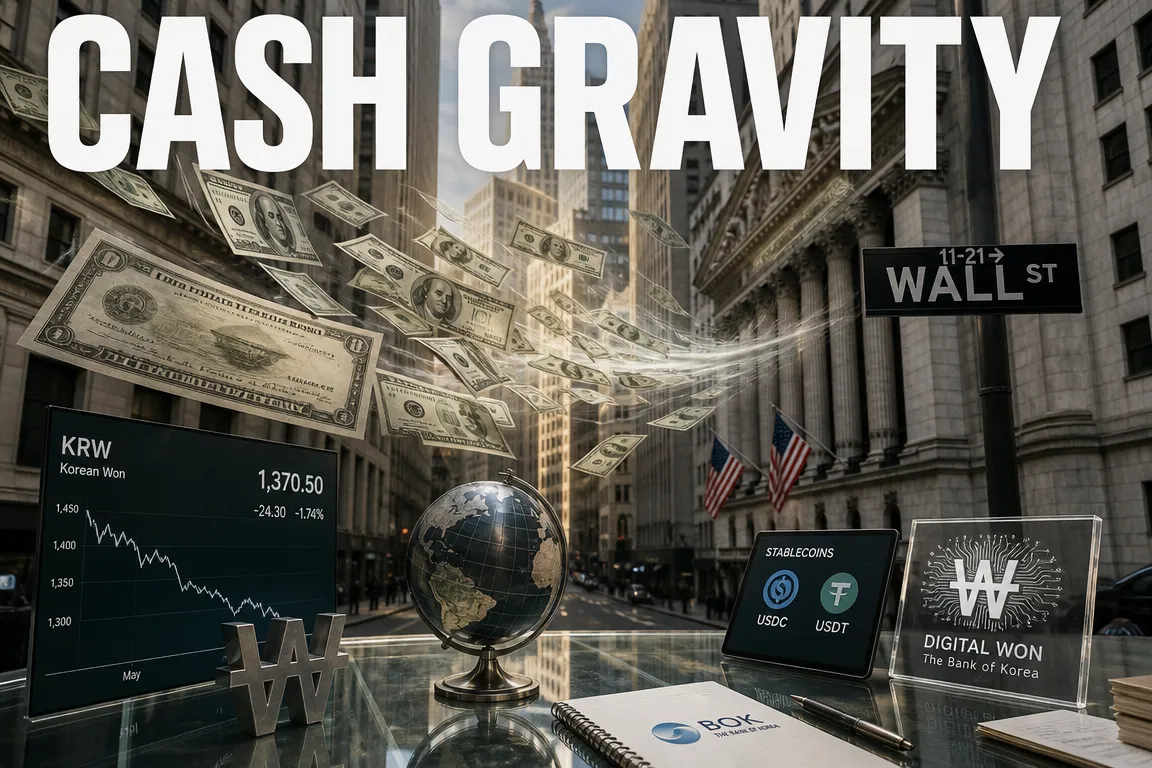
Global Capital Flows Toward the U.S.: How KRW Weakness and Dollar Stablecoins Are Reshaping FX Dynamics
The core issue here is not simply that the dollar is strong.
Capital now moves across borders much faster, and increasingly flows into the U.S. capital market, where liquidity is deeper and valuations are often more favorable.
This trend is linked to dollar stablecoins, demand for U.S. Treasuries, the preference of leading Korean companies for U.S. listings, China’s digital asset restrictions, and Trump-style weak-dollar strategy.
The conclusion is that the KRW/USD exchange rate is increasingly difficult to anchor near the historical 1,050 level, with 1,300 emerging as a new structural equilibrium.
Moreover, if structural shifts continue, downside pressure on the won could extend to 1,500, 1,600, or even 1,700 in certain scenarios.
A key point often missed in market coverage is that dollar stablecoins are not merely a crypto-related issue; they are becoming a new global distribution network for U.S. Treasuries and an extension of dollar hegemony.
1. The starting point for the current FX debate: strong-dollar conditions are less cyclical and more structural
Historically, Korea’s long-term KRW/USD average has been regarded at around 1,050.
However, recent discussions suggest that 1,050 no longer functions as a meaningful equilibrium rate.
Even if the exchange rate temporarily declines after specific events, the structural range is increasingly viewed as 1,300 to 1,350.
This reflects a new strong-dollar normal.
The key issue is that the dollar has remained resilient despite large-scale U.S. liquidity creation.
During the COVID-19 period, the U.S. expanded liquidity materially, yet global demand for dollars increased.
As business activity slowed and financial markets became unstable, investors and corporations preferred dollars over risky assets.
This dynamic cannot be explained by the simple assumption that more dollar supply automatically weakens the currency.
The dollar is not only a currency but also the global safe-haven asset of choice in periods of stress.
2. Why KRW weakness is difficult to avoid: capital is moving toward larger markets
The most practical issue in this discussion is capital mobility.
Today, the cost and time required to move capital are far lower than in the past.
Capital tends to flow, like water, toward markets that offer higher returns and greater liquidity.
At present, that destination is the United States.
The U.S. capital market is the deepest and largest in the world and has access to the broadest global investor base.
Even for the same company, valuation in Korea can differ materially from valuation in the U.S. market.
As this gap widens, leading Korean firms increasingly see the U.S. market as more attractive than the domestic market.
This trend weakens demand for KRW and supports demand for USD over the long term.
3. Samsung Electronics and SK hynix: the premium attached to the U.S. market
The discussion cited Samsung Electronics and SK hynix as representative firms supporting the Korean economy.
Both are central to exports and the semiconductor sector.
From a global investor’s perspective, however, the listing venue matters significantly.
Samsung Electronics is said to face structural constraints on issuing ADRs, including governance-related issues.
By contrast, SK hynix has issued ADRs, and the possibility of U.S. listings for subsidiaries or related businesses has also been discussed.
From a corporate perspective, this is a rational choice.
If the same equity stake can receive a higher valuation in the U.S. market, the case for remaining solely in Korea weakens.
This is the premium offered by the U.S. financial system.
The challenge is that the more successful Korean companies become, the stronger the incentive to seek a larger market in the U.S.
As a result, Korean firms that move into U.S. capital markets may reduce the relative attractiveness of the domestic market.
This can translate into structural pressure on the won and upward pressure on the exchange rate.
4. Why dollar stablecoins matter: they are a dollar distribution layer, not just a crypto product
Dollar stablecoins are digital assets typically pegged to one U.S. dollar.
At first glance, they appear to be a payment tool used in crypto markets.
From a macroeconomic standpoint, however, their significance is much broader.
As dollar stablecoins spread, global users can hold, transfer, and transact in dollars more easily in digital environments.
In effect, access to dollar-based financial activity becomes possible without a U.S. bank account.
This is a powerful instrument for dollar hegemony.
When individuals, companies, platforms, AI agents, and blockchain services operate in dollar terms, the usage of the dollar expands further.
The more the dollar is used, the more the U.S.-centered financial system is reinforced.
5. Two views on dollar stablecoins and FX
An important point raised in the discussion is whether dollar stablecoins strengthen or weaken the dollar.
On the surface, wider adoption of stablecoins increases demand for dollars.
If users around the world want dollar-pegged tokens, that implies stronger preference for the dollar.
Under this view, stablecoins reinforce the strong-dollar environment.
However, there is also a counterargument.
Stablecoins are generally issued on the basis of 1:1 dollar backing.
As dollar demand rises, the corresponding dollar supply also expands.
In other words, supply does not remain fixed as demand increases.
From a pure FX perspective, therefore, stablecoins cannot automatically be treated as a one-way bullish driver for the dollar.
They may also act as a mechanism that rapidly spreads dollar liquidity, creating downward pressure on the currency in relative terms.
6. The key issue is U.S. Treasuries: stablecoins create a new class of Treasury buyers
One of the most important functions of dollar stablecoins is their link to U.S. Treasury demand.
Stablecoin issuers do not simply hold user deposits in cash.
A substantial portion is invested in short-term U.S. Treasuries or cash-equivalent assets.
As stablecoins grow, a new source of demand for U.S. government debt emerges.
For the U.S. government, this is highly attractive.
This matters because fiscal deficits are widening and Treasury issuance is increasing, requiring steady demand from buyers.
Whereas foreign central banks, pension funds, and global financial institutions have traditionally been major buyers of Treasuries, stablecoin issuers may become an increasingly important buyer base.
This is the central point often overlooked in standard crypto coverage.
Dollar stablecoins may function not only as a payment rail for digital assets, but also as a new financial infrastructure supporting U.S. fiscal capacity and dollar dominance.
7. Trump-style weak-dollar strategy and its connection to stablecoins
The discussion also referred to the policy direction associated with the Trump administration.
Trump-style economic strategy is linked to tariffs, manufacturing reshoring, and greater domestic production.
For the U.S. to raise tariffs and bring foreign companies into the country, U.S.-made products must remain competitive abroad.
That becomes harder when the dollar is excessively strong.
A stronger dollar reduces the price competitiveness of U.S. exports.
From this perspective, Trump-style policy may favor a weaker dollar.
At the same time, the U.S. wants to expand the global use of the dollar.
Dollar stablecoins align with that objective.
They expand global dollar liquidity while also generating demand for U.S. Treasuries.
Stablecoins therefore have a dual role: they can support dollar usage globally while also contributing to liquidity expansion that may, in relative terms, weigh on the dollar.
8. Will the dollar strengthen or weaken? The answer depends on relative speed
FX is always a relative price between two currencies.
Even if dollar supply expands, the dollar will remain strong if non-U.S. currencies weaken faster.
This is a critical point in the current debate.
Stablecoin expansion may be a theoretical headwind for the dollar because it increases dollar liquidity.
However, if the competitiveness of other currencies erodes more quickly, the market will still show a strong-dollar outcome.
The won is no exception.
Korea’s growth rate, export competitiveness, capital market appeal, foreign investment flows, household leverage, rate differentials, and geopolitical risk all interact.
If these variables weaken relative to the dollar, the KRW/USD rate will rise.
9. Why China has strictly constrained crypto: capital flight risk
China has regulated cryptocurrency trading and mining aggressively from an early stage.
The discussion interpreted this as a response to capital outflow risk.
If blockchain and digital assets are freely connected, capital can leave China more easily.
This is especially sensitive when linked to dollar stablecoins or bitcoin.
For China, this is a major concern.
An important point is that China is also exploring digital currency and digital payment infrastructure suited to the AI era.
As AI systems conduct economic activity and automated payments and transactions become more common, digital currency becomes essential infrastructure.
However, China is more likely to prefer a state-controlled model rather than the open, private-sector-led structure associated with U.S. dollar stablecoins.
This is also why China resists direct integration with decentralized assets such as bitcoin.
10. Why Korea is exposed: without preparation, the won-based financial ecosystem may weaken
If dollar stablecoins expand and Korea does not respond, several structural issues may emerge.
First, the use of the won in the digital economy may decline.
If dollar stablecoins become the default settlement currency for global platforms, gaming, content, AI services, and blockchain payments, the won’s relevance will diminish.
Second, domestic capital may move abroad more easily.
As it becomes simpler for individuals and companies to convert KRW into dollar-based digital assets, the speed of capital movement increases.
Third, Korean companies may increasingly raise capital in the U.S.
If successful firms choose the U.S. market for higher valuations, Korea’s capital market may struggle to retain growth companies.
Fourth, monetary policy transmission may weaken.
If economic agents prefer dollar-based assets over the won, the impact of Bank of Korea policy on the real economy and financial markets may decline.
Fifth, a weaker won may raise import prices and inflation.
When the KRW/USD rate rises, the cost of imported energy, raw materials, food, and intermediate goods also rises.
This can feed into corporate costs and consumer inflation.
11. Why Korea may need a KRW stablecoin
This discussion naturally leads to the question of whether Korea should prepare a KRW stablecoin.
This is not simply an argument that Korea should follow the U.S. because the U.S. is doing so.
If the won is to remain relevant in the digital economy, Korea needs a KRW-based payment and settlement infrastructure.
In a future where AI agents automatically purchase goods, subscribe to services, buy data, and pay for content, dollar stablecoins may become the global standard.
If that happens, the won could become peripheral in digital transactions.
A KRW stablecoin is therefore not only about payment convenience; it is also connected to monetary sovereignty and financial data sovereignty.
That said, issuance alone is not sufficient.
Detailed design is required across reserve management, bank integration, anti-money-laundering controls, foreign exchange regulation, consumer protection, and payment stability.
12. Tourism and K-content can support KRW demand, but the effect has limits
The discussion also referred to rising tourism into Korea.
Seoul has received global recognition as a destination, and the influence of K-pop and Korean content continues to expand.
When foreign visitors spend in Korea, demand for the won increases.
In theory, this supports the currency.
However, Korea’s inbound tourism volume is still cited as roughly half of Japan’s.
In other words, cultural appeal is improving, but it remains unclear whether the scale is sufficient to alter the broader FX trend.
Tourism receipts are positive, but offsetting dollar demand leaving the country through capital markets and digital finance would require a much larger structural expansion.
13. The most important points often overlooked by other coverage
First, FX is driven by the relative pace of currency weakening, not the absolute value of the dollar.
Even if dollar supply expands, the KRW/USD rate rises if the won weakens more quickly.
This is why the simple argument that “more U.S. money printing will weaken the dollar” often fails in practice.
Second, the real power of stablecoins lies in Treasury demand, not just payments.
As stablecoin issuance grows, issuers are likely to hold more U.S. Treasuries as reserve assets.
This can become an important support mechanism for U.S. fiscal financing.
Third, the structure in which leading Korean companies receive higher valuations in the U.S. is linked to won weakness.
If successful firms increasingly choose U.S. listings, Korea’s capital market may face persistent valuation and liquidity disadvantages.
Fourth, digital assets are a battlefield in the competition for monetary power.
The U.S. is broadening dollar usage through stablecoins, while China is considering controlled digital currency structures to limit capital flight.
If Korea moves too slowly, the won-based digital financial ecosystem may weaken further.
Fifth, KRW weakness is not only an FX issue; it is also a platform competitiveness issue for the Korean economy.
How capital is raised, where payments are made, where investment occurs, and which currency sets prices will matter more over time.
14. Key indicators to monitor going forward
-
Whether the KRW/USD rate remains in the 1,300 range
If the 1,300 range is sustained over time, the market is effectively accepting a new strong-dollar regime.
-
The pace of growth in dollar stablecoin market capitalization
As the stablecoin market expands, dollar-based digital payments and demand for U.S. Treasuries may increase in parallel.
-
Progress on U.S. stablecoin legislation
Faster regulatory integration could encourage greater participation by institutions and corporations.
-
Whether Korean companies increase U.S. listings and ADR issuance
If leading firms increasingly prefer the U.S. market, structural weaknesses in Korea’s capital market may become more visible.
-
Korea’s policy on KRW stablecoins and digital won infrastructure
Delayed response could further reduce the won’s utility in the digital economy.
-
China’s digital currency strategy
How China links AI to digital payment infrastructure may also shape the global monetary order.
15. Practical implications for investors and corporates
For individual investors, it is worth reassessing the risk of concentrating only in KRW assets.
If the strong-dollar regime becomes structural, overseas equities, dollar assets, U.S. Treasuries, and global ETFs may play a larger role.
That said, aggressively buying dollars after the exchange rate has already risen carries volatility risk.
A phased approach and diversified asset allocation are more appropriate.
For companies, FX hedging is becoming more important.
Import-dependent firms face immediate cost pressure from KRW weakness, while exporters may benefit in the short term but also face higher input and capital expenditure costs.
Companies considering global fundraising should also assess the relative valuation gap between U.S. and Korean capital markets.
Policymakers should consider KRW-based digital payment infrastructure, capital market valuation reform, FX stability, and corporate governance together.
FX defense alone is unlikely to offset structural capital migration.
Ultimately, the won must become more attractive if it is to remain relevant.
< Summary >
Global capital is moving toward the U.S. capital market, which offers deeper liquidity and higher valuation potential.
This trend can create pressure on the won and support a higher KRW/USD exchange rate.
The historical 1,050 level is increasingly difficult to regard as a normal equilibrium, while 1,300 is emerging as a strong-dollar new normal.
Dollar stablecoins are not merely crypto products; they are a dollar distribution network and a mechanism that generates demand for U.S. Treasuries.
Stablecoins increase dollar demand, but they also expand dollar supply, making the FX impact non-linear.
The key issue is that if non-U.S. currencies, including the won, weaken faster than the dollar, a strong-dollar regime can persist even amid expanded dollar supply.
Korea risks falling behind in the digital financial order unless it develops KRW stablecoins, digital payment infrastructure, and stronger capital market competitiveness.
[Related Articles…]
*Source: [ 경제 읽어주는 남자(김광석TV) ]
– 세계 돈이 미국으로 빨려간다…원화 약세 피하기 어려운 이유 | ���읽남과 토론합시다 | 3자토론 정구태x김동환x김광석 [3편]