● AI-Rebound-Shock
Why Current Price Levels Matter for Samsung Electronics and SK Hynix: AI Semiconductor Cycle, Foreign Selling, and China Supply Risks
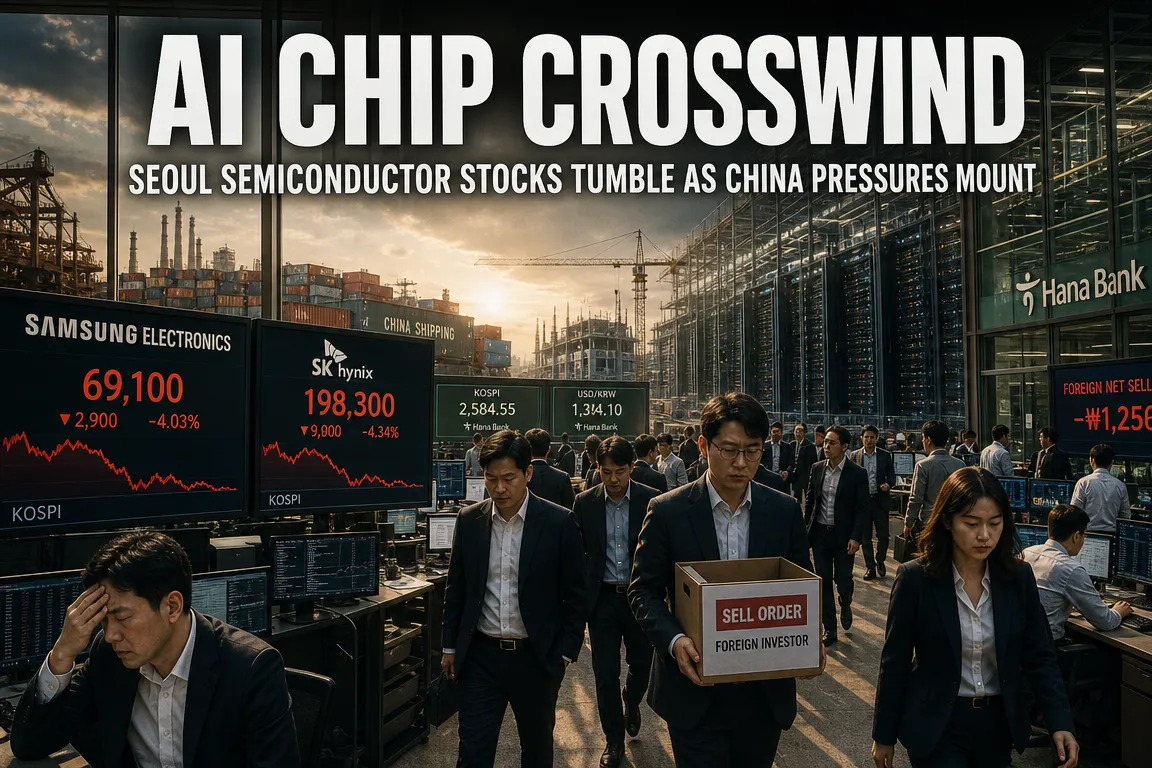
The key issue is not simply that Samsung Electronics and SK Hynix have fallen sharply.
The market is now pricing in the sustainability of AI data center investment, funding pressure at vulnerable players such as CoreWeave, China’s memory semiconductor expansion risk, foreign outflows, and concerns that the semiconductor cycle may be peaking.
Accordingly, when assessing Samsung Electronics and SK Hynix, investors should not rely only on PER or PBR. The key questions are whether AI demand is actually weakening, whether big tech is reducing CAPEX, and whether China’s supply expansion will materially affect the market.
This report summarizes the main investment checkpoints based on comments from Kim Jang-yeol.
1. Why Samsung Electronics and SK Hynix rebounded today: Elon Musk’s comments on AI compute demand
Samsung Electronics and SK Hynix have recently shown extreme volatility.
The shares have repeatedly posted sharp declines followed by strong rebounds the next day.
The immediate driver of this rebound was remarks made after the U.S. market close regarding AI compute demand.
Elon Musk stated that the computing resources required for his AI business could expand much faster than expected.
He said the company is currently preparing around 3GW of computing capacity, but future needs could rise to 10GW, 13GW, or even 20GW.
The exact figures may be fluid or overstated, but the market focused on one clear message:
AI compute demand has not yet weakened.
More important was his comment on payback period.
Musk suggested that AI compute infrastructure investment could be recovered within one year.
This was seen as similar to Amazon’s past remarks that AI infrastructure payback periods were shorter than expected, which helped shift market sentiment.
The message that AI data center investment can translate into cash flow relatively quickly is highly relevant for semiconductor stocks.
In addition, Supermicro raised its earnings outlook by about 27% compared with its previous forecast.
This was interpreted as a sign that server demand remains firm.
As a result, AI semiconductor-related stocks rose in U.S. after-hours trading, and that sentiment carried over to Samsung Electronics and SK Hynix in Korea.
2. Why are foreign investors still selling Korean semiconductor stocks?
From a fundamental perspective, the semiconductor sector remains reasonably healthy.
Both Samsung Electronics and SK Hynix still benefit from expectations tied to HBM, DRAM, and AI server memory demand.
If HBM price increases proceed as expected, earnings improvement through early next year remains visible.
However, stock prices have moved differently.
Foreign investors have continued to sell Korean semiconductor names, while domestic investors have shown a tendency to sell into rebounds.
There are three main reasons.
- First, liquidity in the Korean market is structurally weak.
Domestic investors have focused more on taking profits on rebounds than on long-term accumulation, weakening the buy side. - Second, there are concerns that share buyback support may end.
When an event that supported stock prices comes to an end, concerns grow over who will step in to absorb supply. - Third, doubts about AI infrastructure investment have increased.
AI demand may be strong, but converting that demand into revenue requires data centers, power, land, GPUs, HBM, and financing.
If any of these elements are constrained, the outlook for semiconductor demand can weaken.
In short, the market is questioning not whether AI demand exists, but whether the capital and infrastructure are sufficient to convert that demand into revenue.
That is the core reason behind the recent decline in semiconductor stocks.
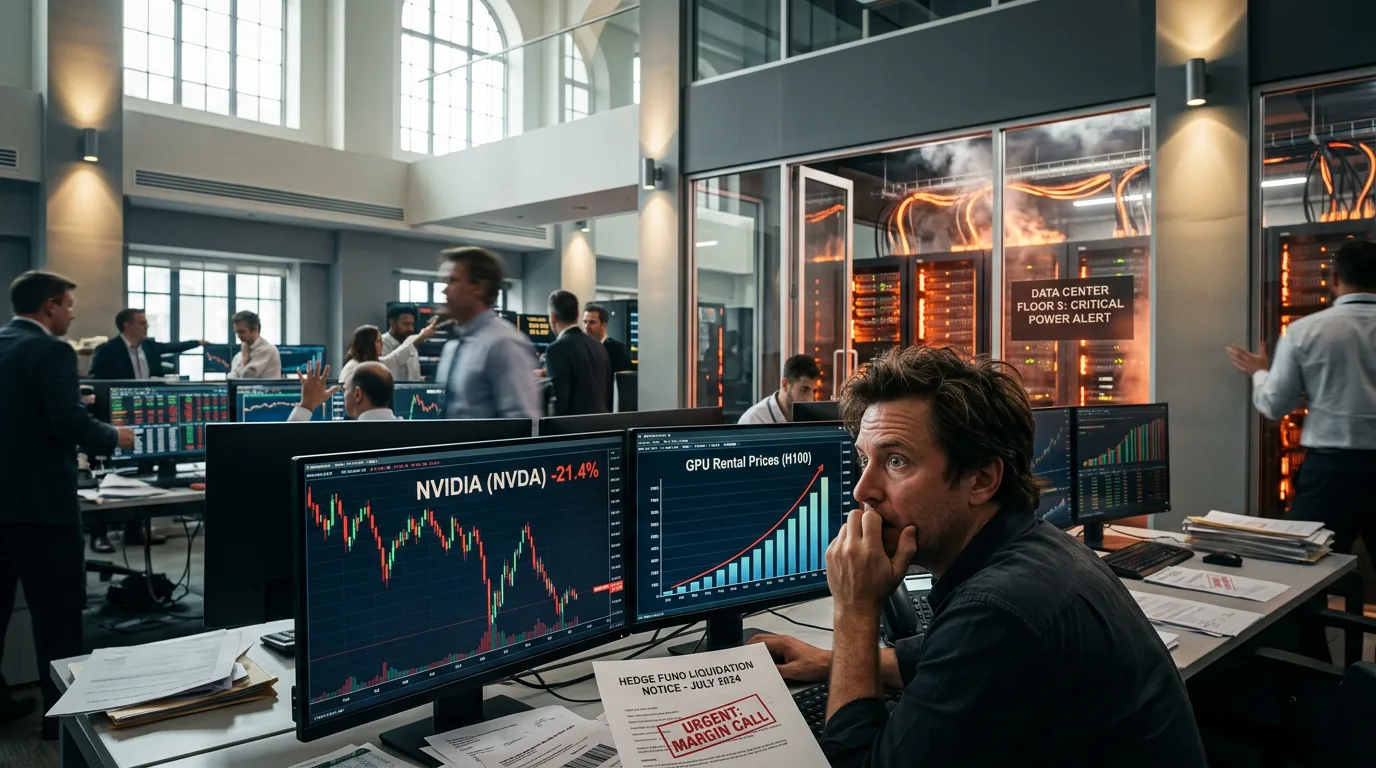
3. The key variable is CoreWeave: the weak link in the AI data center cycle
One of the companies the market is watching most closely is CoreWeave.
CoreWeave provides GPU-based cloud and AI computing infrastructure.
It plays an important role in the AI data center investment cycle, but it is also viewed as a company with significant debt burden.
Higher interest rates have significantly increased CoreWeave’s funding costs.
In the interview, it was noted that interest expenses are much higher than before, and the market has become increasingly concerned about whether the company can sustain large-scale investment.
This matters because the issue is not limited to CoreWeave alone.
Building AI data centers requires massive CAPEX.
If a weak link such as CoreWeave comes under pressure, the market quickly interprets it as a sign that AI infrastructure investment may be slowing.
That would also weigh on expectations for GPU, HBM, and DRAM demand.
However, the view was also expressed that CoreWeave is unlikely to fail easily.
The reason is straightforward.
There is demand.
AI compute capacity remains in short supply, customers exist, and if Nvidia or major tech partners see strategic value, funding support, equity investment, or acquisitions can help sustain the ecosystem.
If CoreWeave were to face serious difficulty, competitors such as Nebius could potentially benefit.
As in prior memory semiconductor cycles, the exit of weaker players has sometimes improved profitability for the remaining firms.
A historical example cited was the improvement in memory conditions after Qimonda’s bankruptcy.
4. The real market concern: what happens if big tech cuts CAPEX?
The central question for semiconductor investors is simple:
Will big tech continue expanding AI investment?
If Microsoft, Amazon, Alphabet, and Meta continue increasing AI data center investment, demand for HBM and high-performance DRAM should remain intact.
If, however, they slow CAPEX growth, reduce new orders, or if backlog growth decelerates, semiconductor stocks will face immediate pressure.
The key point, according to the interview, is that investors should focus not only on CAPEX itself but also on backlog and revenue growth.
Even if CAPEX growth slows, the market may remain constructive if order books are still strong and backlog continues to expand into future revenue.
By contrast, if both CAPEX and backlog growth weaken, concerns about a turning point in the AI investment cycle will intensify.
For that reason, upcoming earnings releases from Amazon and Alphabet will be particularly important.
Amazon has previously influenced market sentiment by discussing the payback period of AI infrastructure investment.
This time as well, comments on AI payback, backlog, cloud growth, and data center investment plans could directly affect Samsung Electronics and SK Hynix.
5. China semiconductor risk: how should CXMT and YMTC be viewed?
Another recent headwind in the semiconductor market is China’s supply risk.
The market is increasingly pricing concerns that Chinese memory makers could begin large-scale expansion around 2028.
In particular, reports that CXMT may reduce costs by 20% to 30% through a new DRAM structure triggered significant market concern.
However, the interview emphasized that this should be interpreted cautiously.
The structural changes being pursued by CXMT are technically difficult.
Narrowing cell spacing and changing the architecture may improve density and cost competitiveness in theory.
But in actual mass production, etching, heat, yield, and equipment complexity remain major issues.
This is an area where even Korean manufacturers have not easily achieved commercialization, so whether Chinese firms can scale quickly remains uncertain.
Based on the expected timeline, samples may emerge around year-end, and customer qualification could take at least six months to more than a year.
Accordingly, the actual market impact may come later than next year, rather than immediately.
The market may have reacted too quickly to the risk.
That said, YMTC was described as a somewhat more concerning variable.
YMTC has established technological capabilities in NAND, and the market is sensitive to the possibility that it could expand into HBM or other high-performance memory categories.
If a listing event increases emphasis on technology promotion, it could create another source of volatility for Samsung Electronics and SK Hynix.
6. What do the 200,000 won Samsung Electronics and 1.1 million won SK Hynix scenarios imply?
One important set of figures mentioned in the interview was 200,000 won for Samsung Electronics and 1.1 million won for SK Hynix.
According to the analysis, those prices would require a very severe earnings decline scenario to be justified.
The interview assumed an extreme case in which operating profit for both companies falls sharply.
In that scenario, ROE could decline to around 12% for Samsung Electronics and 15% for SK Hynix, while the market might apply PBR multiples of roughly 1.0x and 1.3x, respectively.
Under those assumptions, stock prices could fall toward around 200,000 won for Samsung Electronics and 1.1 million won for SK Hynix.
However, to justify much lower prices, such as around 70,000 won for Samsung Electronics or 500,000 won for SK Hynix, conditions close to operating losses would be required.
That would imply an extreme scenario in which DRAM prices collapse by 80% to 90%, volumes do not grow, and fixed-cost burdens remain high.
While this is not impossible, it is viewed as excessively pessimistic given the current presence of AI demand.
HBM is also structurally different from legacy memory used in PCs or smartphones.
Customer qualification, long-term supply agreements, quality validation, and packaging capability are all required, making the pricing structure less vulnerable to a simple oversupply shock.
7. The most important point not emphasized in many reports: the market is questioning cash flow, not demand
The most important takeaway from the interview is this:
The market is not denying AI demand; it is questioning the cash flow and financing structure needed to support that demand.
Many reports describe the situation simply as China being a threat, foreign investors selling, or Samsung Electronics and SK Hynix being at a peak.
But the real issue is the funding flow across the AI data center ecosystem.
AI models require tokens.
Tokens require GPUs.
GPUs require HBM.
Operating all of this requires data centers, power, cooling, networks, land, and financing.
In other words, Samsung Electronics and SK Hynix are not driven solely by memory prices.
Their valuations also reflect the payback period of the broader AI ecosystem, big tech CAPEX, cloud revenue growth, data center funding costs, and the survival of weaker players.
Therefore, investors should not focus only on memory price charts.
They should monitor whether Amazon, Alphabet, Meta, and Microsoft continue to increase AI investment, whether payback periods are shortening, and whether backlog continues to grow.
If these indicators remain strong, the recent decline in Samsung Electronics and SK Hynix may be excessive.
If they weaken, the move may represent more than a temporary correction and could signal a cycle turn.
8. Key events to monitor going forward
- Amazon earnings release
AI infrastructure payback, AWS growth, and data center investment plans will be important. - Alphabet earnings release
Google Cloud growth and AI CAPEX commentary may influence semiconductor demand expectations. - Meta earnings release
AI investment scale and advertising revenue growth should be assessed together. - Funding conditions for CoreWeave and Nebius
Investors should watch whether weak links in AI infrastructure are under real stress or can continue operating with partner support. - Sample development at CXMT and technology expansion at YMTC
It remains important to determine whether China’s supply risk becomes a real production challenge. - IR and shareholder return policy at Samsung Electronics and SK Hynix
Share buybacks, cancellations, investment plans, and long-term supply contract disclosures are important for sentiment recovery. - Interest rate outlook and USD/KRW exchange rate
A prolonged high-rate environment increases AI data center financing costs and may pressure foreign inflows.
9. Investment view: this is a period for verification rather than simply buying because it is cheap
The interview’s view is not a simple call to buy aggressively.
The negative factors are largely known, but the market needs time to absorb them.
Earnings should be confirmed through the fourth quarter and into the first quarter of next year.
Investors need to verify whether AI demand is translating into actual revenue, whether HBM price increases are holding, and whether big tech CAPEX remains intact.
Accordingly, rather than chasing short-term rebounds, investors should allow for a five- to six-month period of earnings confirmation.
From a long-term perspective, it is still too early to conclude that the semiconductor cycle has ended.
AI semiconductor demand, HBM supply constraints, and expanded data center investment remain intact as major structural themes.
However, the market has already priced in elevated expectations, and the focus has now shifted from growth to cash flow and investment payback.
In the end, investors in Samsung Electronics and SK Hynix must answer three questions.
- Will AI data center investment continue despite higher financing costs?
- Will China’s memory supply expansion translate into actual production competitiveness?
- Can Samsung Electronics and SK Hynix reduce valuation discounts through shareholder returns and clearer IR communication?
If the answers are favorable, the current correction may become a medium- to long-term opportunity.
If, however, weaker backlog growth, lower CAPEX, and China supply realities are confirmed together, further downside in semiconductor stocks would be difficult to avoid.
< Summary >
The key driver of volatility in Samsung Electronics and SK Hynix is not a collapse in AI demand, but doubts about the sustainability of AI infrastructure investment.
Elon Musk’s comments on rising compute demand and short payback periods helped trigger a short-term rebound.
However, debt pressure at AI data center players such as CoreWeave, high interest rates, and the possibility of slower CAPEX growth by big tech remain risks.
Concerns over Chinese supply expansion at CXMT and YMTC are also weighing on the stocks.
That said, actual mass-production competitiveness and customer qualification will take time, so the market may have reacted too aggressively.
Going forward, the most important indicators will be AI investment plans and backlog growth at Amazon, Alphabet, and Meta.
For Samsung Electronics and SK Hynix, the outlook depends not only on memory prices, but also on interest rates, AI data center investment, foreign flows, and China’s semiconductor risk.
[Related Articles…]
- AI Semiconductor Cycle and Investment Strategy for Samsung Electronics and SK Hynix
- AI Data Center Investment and Global Big Tech CAPEX Outlook
*Source: [ Jun’s economy lab ]
– 삼전, 하이닉스 지금 자리가 정말 중요합니다(ft.김장열 센터장 1부)
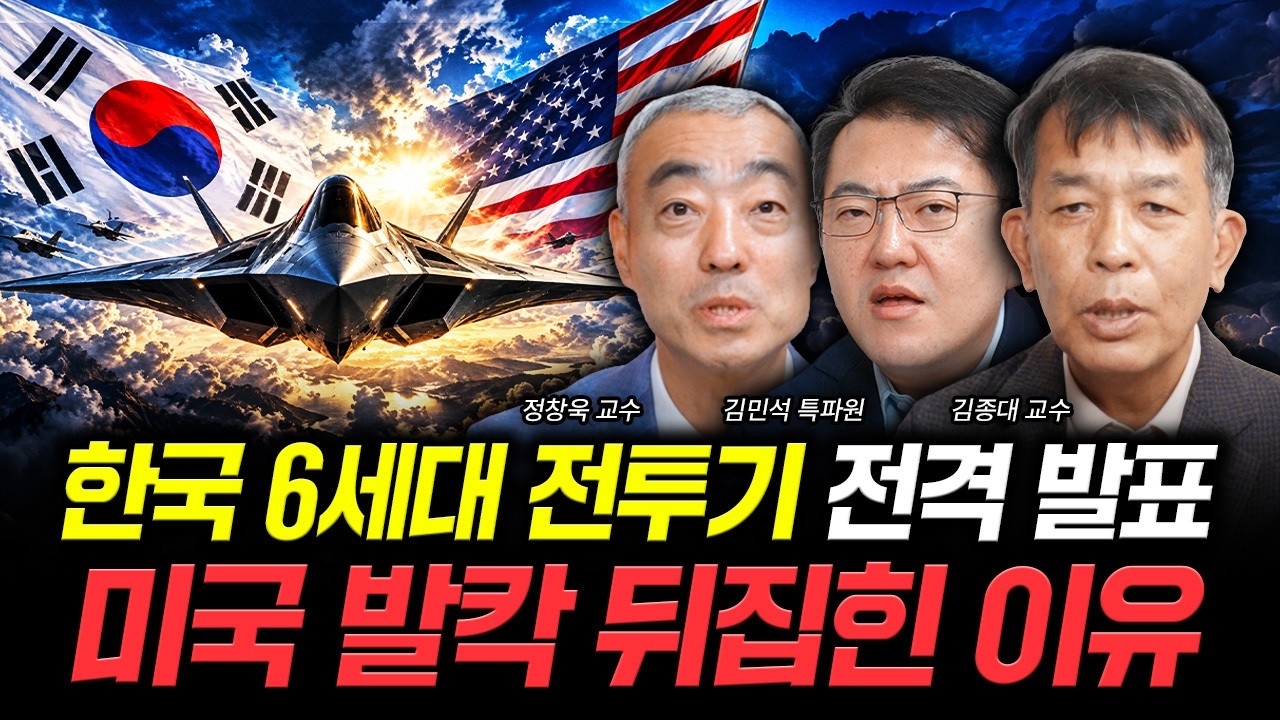
● Korea-6th-Gen-Fighter-Scares-Global-Defense-Market
The Real Message Behind South Korea’s Sixth-Generation Fighter Announcement: How KF-21, AI Drones, and Hypersonic Missiles Are Reshaping the Defense Industry
The core issue is not simply that South Korea is building a sixth-generation fighter.
The more important point is that, based on the systems integration capability developed through KF-21, South Korea’s defense industry is moving toward a model that combines fighters, missiles, radar, AI drones, and export packages into a single integrated offering.
What matters more than the sixth-generation fighter itself is the broader shift toward manned-unmanned teaming, hypersonic missiles, domestic long-range air-to-air missile development, ITAR compliance avoidance, and global defense export competitiveness.
Although the headline appears to be about a fighter aircraft, the underlying story connects South Korea’s advanced manufacturing base, aerospace industry, AI capabilities, and global supply chain strategy.
This article summarizes why the discussion around a Korean sixth-generation fighter may be regarded as sensitive in the United States and in the global defense market.
1. The key point of South Korea’s sixth-generation fighter program is “exploration,” not “completion”
The most important starting point is that the current sixth-generation fighter concept should be viewed as an exploratory development program.
This does not mean that South Korea has already secured all required sixth-generation technologies.
Rather, it reflects an effort to directly design the next generation of fighter architecture using conceptual design, configuration design, and systems integration capabilities.
The significance lies in preserving and extending the infrastructure and technical workforce built through the KF-21 Boramae program.
Fighter development programs lose personnel, equipment, and supplier ecosystems quickly when they are interrupted.
Accordingly, exploratory development of a sixth-generation fighter also functions as an industrial policy measure to sustain South Korea’s defense ecosystem over the long term.
Through KF-21, South Korea has accumulated substantial experience in radar, avionics, mission computers, weapons integration, flight control, and systems integration.
This program aims to elevate that capability to a higher level.
2. The real challenges of a sixth-generation fighter are stealth shaping and manned-unmanned teaming
One of the most emphasized technologies is stealth shaping.
Stealth is not simply a matter of applying special coatings.
It requires integrated design of the airframe, engine intakes, exhaust nozzles, wings, tail structure, internal weapons bays, and radar-reflective surfaces.
In sixth-generation aircraft, a configuration without a clearly defined tail may become more important than in previous generations.
Such designs can reduce radar cross section, but they are significantly more difficult to stabilize and control in flight.
Ultimately, the challenge is not to create an attractive shape, but to integrate stealth, maneuverability, sensors, weapons, AI, and networked communications into one system.
South Korea’s experience with KF-21 creates a basis for pursuing that objective.
3. However, AI drones may take priority over the sixth-generation fighter itself
The most practical question raised in the source material is whether a sixth-generation fighter should come before low-cost mass-produced drones.
Recent conflicts in Ukraine, the Middle East, and Iran-related military incidents indicate that drones and missiles have become more important than traditional manned fighter aircraft in many combat scenarios.
The center of gravity in warfare is shifting rapidly from expensive manned platforms to low-cost drones, loitering munitions, reconnaissance drones, and AI-enabled unmanned systems.
Against this backdrop, a Korean sixth-generation fighter should likely be developed within a manned-unmanned teaming framework rather than as a standalone manned platform.
In practical terms, the manned fighter would serve as the command aircraft, while unmanned systems would conduct the most dangerous missions.
The U.S. CCA program, Australia’s Loyal Wingman concept, and Europe’s Future Combat Air System are moving in a similar direction.
South Korea may not be able to compete efficiently by focusing only on the sixth-generation fighter itself, but a model centered on KF-21 with AI drone formations would be far more realistic.
This is one of the most important intersections between South Korea’s defense industry and AI technology.
4. HGV and HCM differ materially: the hypersonic missile landscape is changing
Another important point is the distinction between HGV and HCM.
HGV refers to a Hypersonic Glide Vehicle.
It first achieves high speed through strong propulsion and then glides toward the target.
By contrast, HCM refers to a Hypersonic Cruise Missile.
It continues generating energy in flight through propulsion systems such as ramjets or scramjets.
The source material compares HGV to a bicycle and HCM to a motorcycle.
The comparison is useful.
HGV can be very fast initially, but its energy may decline over time, and it may have limits on rapid direction changes and altitude variation.
HCM, by contrast, can sustain propulsion during flight and is therefore more capable of evasive maneuvering, reacceleration, and altitude changes.
From an interceptor’s perspective, HCM is more difficult to defend against than HGV.
Its flight path is harder to predict up to the final phase of engagement.
5. Hyundai Rotem’s HCM concept matters
The source material notes that Hyundai Rotem has presented a design concept for a next-generation hypersonic missile in HCM form.
The key point is that research is reportedly targeting operational deployment in the mid-2030s.
At this stage, however, it should be understood as a development target rather than a confirmed operational system.
Even so, the strategic direction is important.
The United States, China, and Russia have not yet reached a fully stable operational phase in hypersonic cruise missile deployment.
In that context, South Korean companies entering research on ramjets, scramjets, and hypersonic propulsion systems is a meaningful signal in global defense technology competition.
Air-launched hypersonic missiles are strategically more valuable than ground-launched systems.
Ground-launched missiles can often be anticipated based on launch location and direction.
By contrast, missiles launched from an aircraft such as KF-21 make it harder for an adversary to predict the launch axis.
For North Korea, this means that threats must be considered from the south, east, west, and rear as well.
This substantially increases the defender’s burden.
That is the strategic effect created when hypersonic missiles are combined with fighter platforms.
6. Domestic long-range air-to-air missiles are the key to removing KF-21 export bottlenecks
KF-21 is currently expected to operate with Europe’s Meteor missile.
Meteor is widely regarded as one of the most capable long-range air-to-air missiles in service.
However, cost, supply, and export approval remain constraints.
Because multiple European fighters, including Gripen and Rafale, also use Meteor, demand is high and supply cannot be assumed to be flexible.
In addition, exporting KF-21 to third countries would require approval from the missile manufacturer and relevant governments.
That process could take years rather than months.
For that reason, domestic development of a long-range air-to-air missile is not simply a weapons program.
It is a prerequisite for export autonomy for KF-21.
The development budget cited in the source is approximately KRW 1.9 trillion, with development completion targeted for 2033 and production beginning after 2035.
The program is understood to involve the Agency for Defense Development, LIG Nex1, Hanwha Aerospace, and other domestic defense companies in roles related to systems integration, propulsion, and warhead development.
If successful, KF-21 would become an export product in which the fighter, radar, missile, and weapons package are all controlled by South Korea.
That would represent a major shift in global defense industry competitiveness.
7. More important than Meteor is AESA-based weapons integration
The source material suggests that South Korea’s long-range air-to-air missile could incorporate seeker-related technologies derived from the KF-21 AESA radar.
This is highly significant.
A fighter is not effective as a standalone platform.
The radar must detect the target, the datalink must transmit information, and the missile seeker must track the target in the terminal phase.
In other words, the fighter and the missile function as one integrated system.
If South Korea develops an AESA radar and a long-range air-to-air missile together, it can build a weapons system optimized for KF-21.
This has greater significance than simple localization.
Instead of adapting imported missiles to the aircraft, South Korea could design the entire weapons ecosystem from the outset around KF-21.
The source also mentions a claim that tracking performance may improve by more than 30% versus Meteor.
However, this should be treated as a development target or projection until formal test results are released.
Even so, the direction is clear.
For KF-21 to be successfully exported, package competitiveness must include not only the aircraft, but also radar, missiles, maintenance, delivery timelines, and training support.
8. Why ducted ramjet technology matters: same size, longer range
Ducted ramjet propulsion is often discussed in connection with long-range air-to-air missiles.
Conventional rockets carry both fuel and oxidizer.
The oxidizer provides the oxygen required for combustion.
Ramjet-type propulsion, by contrast, draws in atmospheric air and uses its oxygen supply.
This reduces the space required for oxidizer and allows more room for fuel.
As a result, a missile of the same size can burn longer and achieve greater range.
The source material notes that burn time and range could increase significantly under this approach.
Actual performance, however, depends on design, altitude, speed, aerodynamic characteristics, and guidance methods.
Even so, ramjet-based long-range air-to-air missiles are clearly a core technology for the next phase of air combat.
9. The real significance of weapons localization is freedom from ITAR and export licensing constraints
From an industrial and economic perspective, the most important issue is export regulation.
When core U.S. components or technologies are involved, the International Traffic in Arms Regulations, or ITAR, may apply.
In addition, weapons exports to certain countries require export licenses.
This is not merely an administrative issue.
It can determine the speed and feasibility of defense contracts.
Even if KF-21 is highly capable, reliance on foreign engines, missiles, or avionics can limit export flexibility.
By contrast, if the aircraft platform, radar, mission computer, air-to-air missile, and air-to-ground weapons contain a high proportion of South Korean technology, negotiating leverage improves significantly.
This is the key condition for South Korea’s defense industry to move from assembly-oriented production to systems export.
Defense exports are not driven by price alone.
Purchasing countries also assess delivery timelines, maintenance, logistics support, weapons options, and political risk.
If South Korea can provide these elements as a package, its position in the global defense market would improve materially.
10. KF-21 export competitiveness: delivery and package structure matter more than price alone
One advantage of KF-21 is its price competitiveness relative to comparable aircraft.
However, price alone will not be sufficient going forward.
Delivery reliability and package composition will matter more.
Countries purchasing fighter aircraft are buying not just a platform, but also a timetable for force readiness.
If operational capability is needed in five years, an aircraft delivered in ten years may be less attractive than a slightly less advanced platform delivered on time.
If Korea Aerospace Industries can demonstrate production capacity and delivery reliability, KF-21’s export competitiveness will improve significantly.
When paired with a domestic long-range air-to-air missile, air-to-ground weapons, AESA radar, and maintenance support, the product becomes a complete power package rather than a single aircraft sale.
This structure is consistent with South Korea’s established defense export strengths, as seen in K2 tanks, K9 self-propelled howitzers, and FA-50 exports.
11. The largest technical barrier remains the engine and single-crystal superalloy materials
That said, the most difficult part of Korean fighter development remains the engine.
Aircraft engines are among the most difficult manufacturing systems in the world.
The key challenge lies in single-crystal superalloy materials.
Turbine blades inside the engine must withstand extreme temperature, pressure, and rotational speed.
Ordinary metals cannot survive these conditions.
Accordingly, single-crystal superalloys, precision casting, cooling design, heat treatment, and coating technologies are all required.
The source material identifies these materials and related processing capabilities as the most important bottleneck.
South Korea has strengths in precision machining and manufacturing processes, but the aerospace engine materials base and long-term reliability validation still require more time.
Therefore, engine independence may be the final gate for a Korean sixth-generation fighter.
If the engine is also localized, export constraints on the KF-21 family would decrease substantially.
12. The core point missed by many reports: this is not just about fighter development, but about weapons ecosystem independence
Most coverage focuses on the sixth-generation fighter, hypersonic missiles, and KF-21 performance.
However, the real issue is that South Korea is moving from producing a single aircraft to controlling an entire weapons ecosystem.
A fighter is a platform.
Without control over the radar, missile, datalink, and export permission structure, the platform’s export value remains limited.
If South Korea can integrate KF-21, AESA radar, long-range air-to-air missiles, air-to-ground weapons, AI drones, and hypersonic missiles into one system, the competitive landscape changes.
This is not only about national defense.
It also reflects the expansion of South Korea’s advanced manufacturing export base from automobiles, semiconductors, and batteries into aerospace and defense.
As global geopolitical risks increase, many countries are seeking to diversify their weapons suppliers.
U.S. weapons offer strong performance but are often tied to political conditions and export controls.
Russian weapons face credibility and supply-chain issues after the war in Ukraine.
European systems are high-performing but often expensive and slower to deliver.
South Korea can potentially occupy a position defined by reasonable cost, fast delivery, compatibility with Western standards, and package-based exports.
That is the point most likely to draw U.S. attention.
13. From an AI trend perspective, the sixth-generation fighter will ultimately become an airborne AI network
The essence of a sixth-generation fighter is not simply greater speed or lower observability.
Future fighters will function as nodes in an airborne AI network.
The manned aircraft will not be a platform where the pilot makes every decision independently.
It will serve as a command hub connecting multiple unmanned aircraft, missiles, satellites, ground radars, and naval platforms.
AI drones can conduct reconnaissance, electronic warfare, deception, loitering attacks, missile carriage, and forward deployment into high-risk areas.
In this structure, software, communications security, data processing, and autonomous flight algorithms become more important than airframe performance alone.
This aligns with South Korea’s strengths in semiconductors, communications, batteries, AI software, and precision manufacturing.
As a result, the sixth-generation fighter discussion is linked not only to aerospace but also to AI industrial strategy.
The boundary between defense companies and AI companies is likely to become increasingly blurred.
14. Economic outlook: South Korea’s defense industry has entered a structurally expanding phase
South Korea’s defense industry should not be viewed as a short-term theme.
Global security uncertainty, European rearmament, Middle Eastern arms competition, tensions in Asia, and efforts by allied countries to diversify procurement are all unfolding simultaneously.
In this environment, South Korean defense products are being revalued as a long-term growth sector.
If KF-21, K2 tanks, K9 howitzers, Chunmoo, submarines, naval vessels, missiles, radar systems, and drones are integrated into a single portfolio, export volumes could expand further.
From an investment perspective, however, expectations must be separated from actual production timelines.
Sixth-generation fighters, hypersonic missiles, and domestic engine programs are all long-duration projects.
Development success, budget continuity, test results, export approvals, and production capacity remain key variables.
Accordingly, investors should monitor not only short-term share price movements, but also order backlog, localization rates, overseas customer expansion, and government budget trends.
Defense is a high-growth sector, but it also carries political, diplomatic, and technical risks.
15. Key checkpoints
- South Korea’s sixth-generation fighter program should be understood as exploratory development rather than a completed system.
- KF-21 development has created a foundation for stealth shaping, systems integration, and weapons integration.
- The future of warfare is shifting from single manned fighters to AI drones and manned-unmanned teaming.
- HCM hypersonic cruise missiles may offer better maneuverability and survivability than HGV glide vehicles.
- Domestic long-range air-to-air missile development is central to improving KF-21 export autonomy.
- Integration of AESA radar and domestic missiles has greater significance than simple component localization.
- Reducing dependence on ITAR and export license constraints would improve South Korea’s defense export leverage.
- Engine technology and single-crystal superalloy materials remain the most difficult technical barriers.
- KF-21’s competitiveness will depend on price, delivery, weapons packages, and maintenance support.
- South Korea’s defense industry is evolving into a structurally growing sector linked to AI, aerospace, and advanced manufacturing.
< Summary >
South Korea’s sixth-generation fighter discussion remains at the exploratory development stage.
However, it is significant because it extends the systems integration capabilities developed through KF-21.
The future of warfare is centered more on AI drones and manned-unmanned teaming than on manned fighters alone.
Hypersonic missiles, long-range air-to-air missiles, AESA radar, and domestic weapons integration can materially improve KF-21’s export competitiveness.
The most important point is that South Korea is moving toward independence not only in fighters, but in the broader weapons ecosystem.
However, engines, single-crystal superalloy materials, and stealth shaping remain major technical barriers.
Economically, South Korea’s defense industry is being re-rated as a long-term growth sector as it converges with AI, aerospace, and advanced manufacturing.
[Related Articles…]
- Why South Korea’s Defense Exports Are Gaining Global Competitiveness
- How AI Drones Are Reshaping Aerospace and Future Warfare
*Source: [ 달란트투자 ]
– 한국 6세대 전투기 전격 발표. 미국 발칵 뒤집힌 이유|김종대 교수, 정창욱 교수, 김민석 특파원 특집