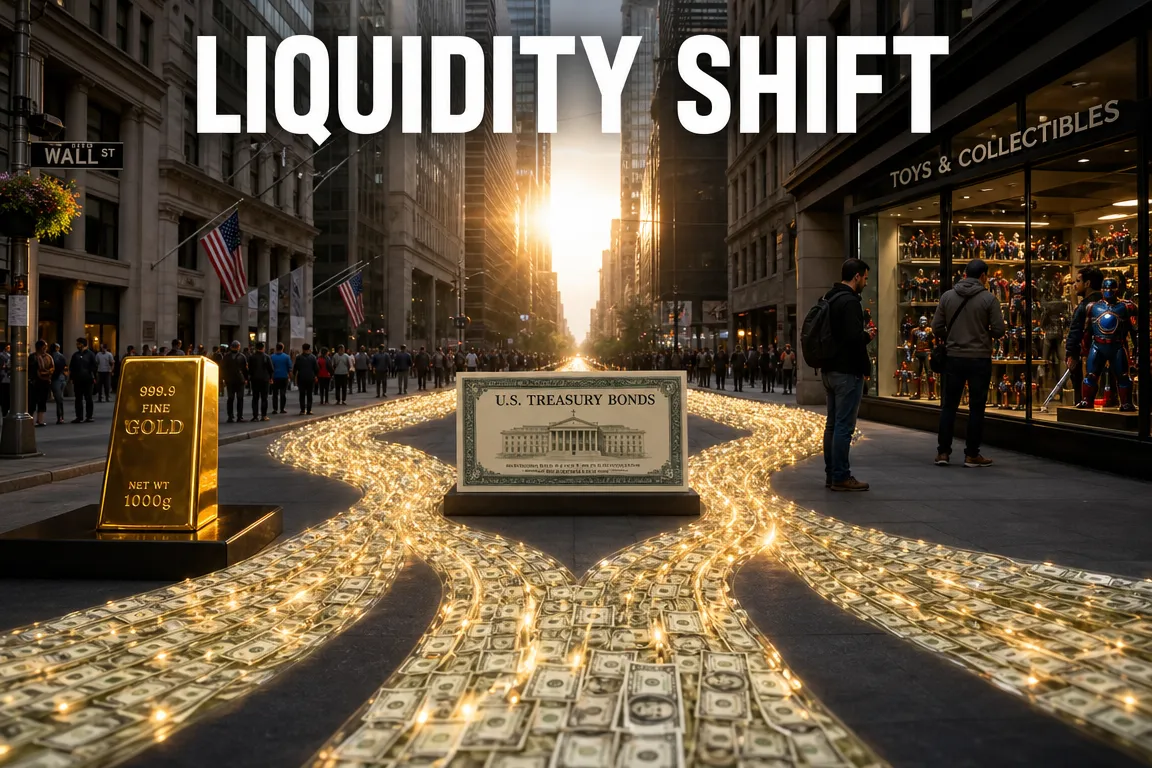
● Liquidity Crunch, Billionaire Tax, Kidult Boom
How Markets React When Funding Dries Up: Wall Street Risk Warnings, Billionaire Taxes, and the Kidult Economy
Four issues require close attention.
First, investors should assess whether market funding conditions, which often move before policy rates, are deteriorating.
Second, the conditions that could trigger the period of peak uncertainty forecast by a reclusive Wall Street veteran should be evaluated.
Third, the controversy surrounding billionaire taxes that may apply even when shares have not been sold requires examination.
Fourth, the reasons toy companies are recovering through demand from adult consumers despite declining birth rates should be analyzed.
Although these issues appear unrelated, they are linked by a common theme: the reallocation of liquidity and the repricing of assets.
1. What Does a Sudden Funding Freeze Mean for Markets?
Market funding conditions involve more than the total amount of money in circulation.
They also reflect banks’ willingness to lend, companies’ ability to issue bonds, and investors’ appetite for risk assets.
Financial conditions can therefore tighten even when central banks reduce policy rates.
If banks raise lending standards because of recession or default concerns, borrowing conditions for businesses and households may deteriorate.
Under these conditions, smaller companies, high-yield bonds, and unprofitable growth stocks typically face pressure before large companies, investment-grade bonds, and businesses with stable cash flows.
Key Indicators of Funding Stress
-
Wider corporate credit spreads: A larger yield gap between government and corporate bonds indicates that investors are pricing in greater default risk.
-
Tighter bank lending standards: Lower policy rates do not support the real economy if banks continue to restrict credit.
-
Higher short-term funding rates: Sudden increases in repo or commercial paper rates may indicate stronger demand for cash among financial institutions.
-
Higher corporate cash balances: When companies prioritize liquidity over investment and hiring, economic uncertainty is likely increasing.
-
Weak high-yield issuance: Restricted access to capital for lower-rated companies increases default and restructuring risks.
Investors should assess not only official interest-rate cuts but also whether actual borrowing conditions are improving.
If credit spreads widen while policy rates decline, markets may be assigning greater weight to economic weakness than to the benefits of monetary easing.
How a Liquidity Crisis Spreads Through Equity Markets
Liquidity shocks generally do not affect every asset simultaneously.
Selling pressure usually begins in less liquid and lower-quality assets.
Investors may then sell large-cap and high-quality stocks to cover losses or meet margin requirements, increasing overall volatility.
In the final stage, weaker earnings forecasts, employment, and consumption can transmit financial stress to the real economy.
Investors should distinguish between declines caused by temporary funding shortages and those caused by a deterioration in long-term corporate competitiveness.
Assets affected by temporary liquidity pressure may rebound quickly when funding conditions recover. Businesses with structurally impaired fundamentals may require significantly longer to recover.
2. When Does Market Uncertainty Reach Its Peak?
The source refers to a forecast by a reclusive Wall Street expert but does not identify the individual or provide the forecast’s specific terms.
Rather than assuming that a particular forecast will prove accurate, investors should focus on the conditions under which market uncertainty could reach an extreme.
The most unstable period is not always the moment when negative information first becomes public.
Risk premiums often rise when the policy outlook, the economic trough, and corporate earnings expectations are simultaneously unclear.
The critical factor is not only the size of market declines but also the sudden expansion in the range of plausible outcomes.
Four Combinations That Increase Uncertainty
-
High inflation and slowing growth: Central banks face a difficult trade-off between price stability and economic support.
-
Repeated earnings revisions: Valuation multiples may appear low even when earnings estimates remain overstated.
-
Diverging fiscal and monetary policies: Conflicting policy directions can increase interest-rate and currency volatility.
-
Geopolitical disruption to supply chains and energy markets: Simultaneous effects on inflation and growth make economic forecasting more difficult.
During these periods, a resilient portfolio is more useful than reliance on a single forecast.
Investors should review cash allocations, bond duration, equity-sector diversification, and currency exposure.
How to Evaluate Whether a Forecast Was Accurate
A correct directional call alone does not constitute an accurate market forecast.
The timing, target price, forecast horizon, and underlying assumptions must also be evaluated.
A prediction that equities will eventually decline has limited strategic value if it provides no time horizon.
Forecasts tied to measurable conditions, such as rising unemployment, wider credit spreads, or declining corporate earnings, can be assessed objectively.
U.S. equity investors should focus on whether the forecast’s assumptions and supporting data apply to current market conditions rather than relying on the forecaster’s reputation.
3. What Is a Billionaire Tax on Unsold Assets?
Conventional capital gains taxes apply when an investor sells an asset and realizes a profit.
By contrast, policies described as billionaire taxes or minimum taxes on ultra-high-net-worth individuals may include taxation of unrealized gains above specified wealth thresholds.
Under such a framework, an increase in the value of shares could be treated as income even if the shares have not been sold.
Multiple proposals are described as billionaire taxes, and their thresholds, tax rates, and payment structures differ.
Because the source does not identify a specific bill or its legislative status, the proposal should not be treated as an enacted policy.
Why Billionaire Taxes Are Proposed
Ultra-high-net-worth individuals often accumulate wealth through appreciation in equities and business ownership rather than through salaries.
By retaining these assets, they can defer capital gains taxes for extended periods.
They may also borrow against their shares to fund consumption or additional investments while retaining control of their businesses.
Supporters of billionaire taxes argue that this structure creates a significant effective-tax-rate gap between wage earners and asset owners.
Challenges of Taxing Unrealized Gains
The first challenge is valuation.
Publicly traded shares have observable market prices, but private companies, artwork, intellectual property, and complex derivatives can be difficult to value annually.
The second challenge is limited liquidity.
Taxpayers whose assets have appreciated but who lack sufficient cash may need to sell shares or business interests to meet their obligations.
The third challenge is the treatment of subsequent losses.
If tax is paid on unrealized gains and asset values decline the following year, credits and refunds can become administratively complex.
The fourth challenge is legal uncertainty.
Disputes may arise over whether unrealized gains qualify as income and whether the tax effectively operates as a wealth tax.
The fifth challenge is capital mobility.
Taxpayers may change their residency or asset-holding structures, potentially reducing actual revenue below initial projections.
Potential Effects of a Billionaire Tax on Financial Markets
If the tax applies to only a small number of individuals, direct market-wide selling pressure may be limited.
However, at large technology companies with substantial founder ownership, share sales used to fund tax payments could become a short-term supply factor.
Valuation methods would be a greater concern in private equity and venture capital markets.
Founders and early investors could face significant tax liabilities if taxes are imposed on higher estimated valuations before their companies generate cash flow.
The policy’s effect would therefore depend less on the headline tax rate than on valuation rules, deferral provisions, installment options, and loss-offset mechanisms.
4. Why Toy Companies Can Recover Despite Declining Birth Rates
The toy industry was historically viewed as dependent on child populations and birth rates.
Its structure is now shifting from children’s toys toward adult collectibles and intellectual property.
The term “kidult” combines “kid” and “adult” and refers to adults who purchase characters, toys, and collectibles associated with childhood interests, supported by higher disposable income.
Factors Supporting Growth in the Kidult Market
-
Nostalgia-driven consumption: During periods of economic or social uncertainty, consumers may favor products associated with familiar and positive memories.
-
Growth in single-person households: More adults are allocating discretionary income to personal hobbies rather than purchasing toys exclusively for children.
-
Expansion of social media: Unboxing, assembly, and collection displays serve as both user-generated content and product promotion.
-
Limited-edition strategies: Restricted quantities and sales periods create scarcity and encourage repeat purchases.
-
More IP partnerships: Collaborations involving films, games, sports, and animation attract adult consumers.
The Toy Industry’s Core Asset Is Not Plastic
A toy company’s competitive position increasingly depends on its ability to develop and monetize durable characters and brands rather than on production volume alone.
Successful intellectual property can expand beyond toys into films, games, apparel, exhibitions, theme parks, and digital content.
Higher licensing revenue may also generate better margins than direct manufacturing.
Investors should therefore assess proprietary IP exposure, licensing costs, inventory turnover, and the share of revenue generated by adult consumers.
Risks Associated With the Kidult Trend
Limited-edition products and collectible markets remain sensitive to changing consumer preferences.
Rapid increases in secondary-market prices can attract speculative demand rather than end-user demand.
If manufacturers increase production excessively, scarcity may disappear, forcing inventory discounts and weakening brand value.
Companies dependent on films or games also face the risk that weak content performance will reduce related toy sales.
The kidult economy represents a significant consumer trend, but its benefits will not be distributed equally across all toy companies.
5. The Common Theme Connecting the Four Issues
Funding stress reduces the prices investors are willing to pay for risky assets.
Greater uncertainty increases the discount rates applied to corporate earnings and asset values.
Billionaire taxes could alter existing strategies that allow wealthy investors to retain appreciated assets without realizing taxable gains.
The kidult market shows that consumers may continue spending on products offering emotional value and strong intellectual property even during an economic slowdown.
The key issue for the global economic outlook is therefore not only how much liquidity exists, but also where that liquidity is being allocated.
Companies with stable cash flows, pricing power, loyal customers, and strong intellectual property may remain relatively resilient during broad market volatility.
6. Practical Investor Checklist
Evaluate policy rates and market rates separately.
Even if central banks signal monetary easing, rising corporate bond yields and lending rates indicate that effective financial conditions remain restrictive.
Monitor the direction of earnings expectations.
Lower share prices do not necessarily indicate undervaluation if expected earnings are declining faster than valuations.
Distinguish tax proposals from enacted legislation.
Political statements, government budget proposals, introduced bills, and enacted laws have materially different market implications.
Assess the quality of consumer-sector revenue.
Revenue generated through discounting is less sustainable than revenue supported by proprietary brands and repeat purchases.
Avoid building portfolios around a single macroeconomic forecast.
Portfolios should be tested against recession, soft-landing, and renewed-inflation scenarios to limit losses under adverse conditions.
7. Critical Issues Often Overlooked in Market Coverage
First, lower policy rates do not automatically increase liquidity.
If banks and bond investors remain risk-averse, monetary easing may not result in greater credit availability for businesses and households.
Second, peak uncertainty does not necessarily coincide with the market bottom.
Equity markets may begin pricing in policy changes and economic recovery before economic indicators reach their weakest levels.
Third, the main challenge of a billionaire tax is not the political objective but the mechanics of valuation and liquidity.
Any workable framework would need to address private-asset valuation, refunds or credits following price declines, and installment payments.
Fourth, the most important asset in the kidult industry is the IP ecosystem rather than manufacturing capacity.
Companies that control content and consumer communities may generate more durable returns than those relying on individual products.
Fifth, funding structures can matter more than asset prices during a crisis.
A growth company with limited debt and substantial cash may withstand high interest rates, while a company dependent on external financing could require an equity issuance or restructuring after a relatively modest shock.
8. Issues Requiring Additional Verification
The source provides headlines on four economic issues but does not include a full transcript, supporting statistics, the identity of the forecaster, or the timing of the forecast.
The accuracy of the market prediction and the legislative status of any billionaire-tax proposal cannot therefore be confirmed from the available information.
Paid subscriptions and investment-course promotions should be evaluated separately from the underlying economic analysis.
Investment decisions should be supported by primary sources, including central bank publications, legislative documents, and corporate filings.
< Summary >
Funding conditions can be assessed through bank lending standards, corporate credit spreads, and short-term funding markets before changes become visible in policy rates.
Market forecasts should be evaluated using their timing, assumptions, and measurable conditions rather than the forecaster’s reputation.
Billionaire-tax proposals often focus on unrealized capital gains but face practical challenges involving valuation, liquidity, legal authority, and loss treatment.
Toy companies can offset demographic pressure through adult demand and strong intellectual property, although trend, inventory, and content-performance risks remain.
In uncertain markets, companies with stable cash flow, low leverage, pricing power, and loyal customers are generally better positioned.
[Related Articles…]
*Source: [ 소수몽키 ]
– 갑자기 자금줄 뚝? 불확실 최고조 구간 올까/월가 은둔 초고수의 예언, 또 적중할까/주식 안팔아도 세금 낸다? 억만장자세 실현될까/키덜트 덕에 부활한 장난감 회사들
● Gold-Silver-Rates-Stock-Surge
Where Capital May Flow as U.S. Treasury Yields Decline: Gold, Silver, Bonds, and U.S. Equity Strategies
The central issue is not simply whether stocks rise when interest rates decline.
This report assesses the potential sequence in which bonds, gold, silver, U.S. equities, and emerging markets may respond as U.S. Treasury yields pass their peak.
Gold is analyzed through real interest rates, the U.S. dollar, central-bank purchases, and geopolitical uncertainty.
The report also examines the effects of the U.S. fiscal deficit, Treasury supply, AI data-center investment, and power-infrastructure demand on interest rates and commodities.
Risk-management principles and asset-allocation strategies using pension savings accounts, IRPs, and ISAs for investors aged 50 and older are also addressed.
1. Why U.S. Treasury Yields Remain High
High U.S. Treasury yields remain one of the most direct constraints on financial markets.
When Treasury yields rise, deposits and bonds offer relatively attractive returns, reducing the appeal of volatile assets such as equities and gold.
Corporate borrowing and bond-issuance costs increase, while investors apply higher discount rates to future earnings.
Growth stocks, emerging markets, and commodities are generally among the most rate-sensitive assets.
-
Persistent Inflation
If energy, housing, and service prices remain elevated, the Federal Reserve has limited scope to reduce policy rates quickly.
-
Oil Prices and Geopolitical Risk
An escalation of conflict in the Middle East could disrupt oil supply, increase transportation and production costs, and raise the risk of renewed inflation.
-
Expansion of AI Infrastructure Investment
AI data-center investment by major technology companies and hyperscalers increases demand for semiconductors, electricity, cooling systems, copper, and construction equipment.
In the short term, this investment cycle may place upward pressure on capital-goods and electricity prices.
-
U.S. Fiscal Deficits and Treasury Supply
Large-scale Treasury issuance is becoming as important as inflation in determining long-term yields.
As the volume of debt that markets must absorb increases, investors may demand higher yields, keeping long-term rates elevated even when policy-rate cuts are expected.
-
Term Premium and Quantitative Tightening
A higher term premium, which compensates investors for inflation and fiscal uncertainty over the life of a long-duration bond, may limit the decline in long-term yields.
Federal Reserve quantitative tightening may also increase the private sector’s Treasury absorption burden.
2. Assets Most Likely to Move First When Treasury Yields Decline
Financial markets typically move before actual policy-rate cuts occur.
Capital rotation may begin once inflation moderates, employment weakens, and investors become more confident that interest rates have peaked.
| Expected Sequence | Primary Asset | Upside Rationale | Key Risk |
|---|---|---|---|
| 1 | Long-Term U.S. Treasuries | Bond prices rise as yields decline | Fiscal deficits and increased Treasury supply |
| 2 | Gold | Lower real yields and opportunity costs | A stronger dollar and renewed increases in real yields |
| 3 | Silver | Precious-metals appreciation and recovery in industrial demand | Weaker industrial demand during a recession |
| 4 | U.S. Growth Stocks | Lower discount rates and stronger earnings expectations | Elevated valuations and earnings weakness |
| 5 | Emerging and Non-U.S. Markets | A weaker dollar and improved global liquidity | Persistent dollar strength and country-specific fundamental risks |
Bonds are the most direct beneficiaries of declining interest rates.
Long-duration bonds typically experience larger price movements when yields fall.
However, persistent U.S. fiscal deficits and heavy Treasury issuance could prevent long-term yields from declining as quickly as policy rates.
Gold may price in expectations of a rate peak before policy easing begins.
Because gold generates no interest income, it is relatively less attractive when real yields are high.
As real yields decline, the opportunity cost of holding gold falls and investment demand may strengthen.
Silver may deliver stronger upside than gold, but with greater volatility.
Silver is both a precious metal and an industrial input used in solar power, electronics, and electricity infrastructure.
If declining rates coincide with an economic soft landing, precious-metals demand and industrial demand may improve simultaneously.
If rates fall because of a severe recession, weaker industrial demand could cause silver to underperform gold.
3. Four Key Drivers of Gold Prices
Interest rates alone are insufficient for analyzing gold.
Real yields, the U.S. dollar, central-bank purchases, and geopolitical uncertainty must be assessed together.
1. Real Interest Rates
Real interest rates are generally defined as nominal interest rates minus expected inflation.
Lower real rates increase the relative attractiveness of non-yielding gold.
However, if inflation expectations decline faster than nominal yields, real rates may rise.
Investors should therefore compare movements in nominal Treasury yields with changes in expected inflation rather than assume that lower inflation will automatically support gold.
2. U.S. Dollar Direction
Because international gold prices are denominated in U.S. dollars, dollar weakness is generally supportive of gold.
However, if the U.S. economy remains stronger than other economies and global capital continues to flow into U.S. assets, the dollar may remain firm even as interest rates decline.
Under that scenario, gains in gold could be more limited than expected.
3. Central-Bank Gold Purchases
Central banks are purchasing gold to diversify foreign-exchange reserves and reduce dependence on individual currencies.
This source of demand is potentially more structural and persistent than short-term retail investment flows.
Because official reporting dates may differ from actual purchase dates, the broader trend is more informative than any single data point.
4. Geopolitical Uncertainty
Wars, elections, and trade disputes can generate safe-haven demand for gold.
However, gold gains may be constrained if real yields and the U.S. dollar rise simultaneously.
Safe-haven demand alone is therefore insufficient for forecasting gold prices.
4. Why U.S. Equities Remained Resilient Despite High Interest Rates
Corporate earnings and industry composition have been the primary sources of U.S. equity-market strength.
The U.S. market includes semiconductors, cloud computing, software, digital platforms, financials, healthcare, defense, and consumer companies.
This diversified structure allows other industries to support major indices when leading semiconductor stocks consolidate.
AI investment has also supported revenue and earnings expectations for U.S. companies.
However, if AI capital expenditure does not translate into higher productivity and cash flow, depreciation and electricity costs could pressure earnings.
AI investment competition supports near-term growth expectations, but long-term returns on invested capital remain subject to validation.
Some EPS and index calculations in the source material should not be used directly for investment decisions.
For example, a 29% increase from EPS of 402 produces approximately 518, while EPS of 412 represents growth of about 2.5%.
Applying a price-to-earnings multiple of 20 to EPS of 412 produces an implied index level of approximately 8,240.
S&P 500 targets should use consistent periods for forecast EPS, earnings growth, and valuation multiples.
5. Why Strong Korean Semiconductor Earnings May Not Translate into Broader Market Strength
Strong earnings from Samsung Electronics and SK Hynix do not guarantee that the broader Korean equity market will perform like the U.S. market.
Korea has relatively high exposure to semiconductors and export-oriented manufacturing, resulting in greater industry concentration.
Foreign capital flows are also sensitive to the Korean won and global dollar conditions.
Even when corporate earnings are strong, weak investor sentiment can generate profit-taking after modest price gains.
Fundamentals and investor sentiment do not always move in the same direction.
Investors should monitor foreign flows, exchange rates, memory-chip prices, and whether market leadership is broadening beyond semiconductor earnings.
A shift in market leadership does not necessarily indicate deteriorating results at previous market leaders.
Earnings may continue to rise, but if optimistic expectations are already reflected in valuations, capital may rotate into software, power equipment, robotics, biotechnology, or financials.
6. Will U.S. Equities Strengthen After the Midterm Elections?
Historical data show that U.S. equities have often performed relatively well during the year following midterm elections.
Once election results are confirmed, part of the political uncertainty priced into markets may dissipate.
Historical seasonality does not guarantee future returns.
Control of Congress can affect taxes, tariffs, industrial subsidies, fiscal spending, and energy policy.
Divided government may limit aggressive policy changes but could intensify disputes over budgets and the federal debt ceiling.
Contested election results and political conflict could delay the reduction of uncertainty.
A major escalation in the Middle East could require a comprehensive revision of existing rate and equity-market scenarios.
Rather than attempting to predict election results, investors may be better served by phased positioning and predetermined asset-allocation limits.
7. Critical Factors Often Overlooked in Market Coverage
First, lower policy rates do not necessarily produce lower long-term Treasury yields.
Even if the Federal Reserve cuts rates, rising fiscal deficits and Treasury supply could keep 10-year and 30-year yields elevated.
Gold and long-duration bond investors should focus on long-term real yields and the term premium rather than policy-rate decisions alone.
Second, gold and silver are not equivalent commodities.
Gold has stronger monetary and safe-haven characteristics, while silver is more exposed to industrial demand.
Gold may perform better when rates decline because of a recession, while silver may offer greater upside under a soft-landing scenario.
Third, AI investment may stimulate both growth and inflation.
AI data-center construction increases demand for semiconductors, electricity grids, natural gas, nuclear power, copper, and cooling systems.
This may raise commodity and electricity costs in the short term, although productivity improvements could become disinflationary over the longer term.
Fourth, central-bank gold purchases may represent a structural shift that extends beyond the interest-rate cycle.
If reserve diversification and geopolitical fragmentation continue, gold demand may remain firm independently of short-term rate movements.
Fifth, waiting for confirmation of a rate peak may mean that asset prices have already adjusted.
Because markets discount future conditions, a peak in Treasury yields and evidence of moderating inflation may matter more than the formal announcement of a rate cut.
8. Risk-Management Principles for Volatile Markets
The primary investment objective is to avoid a permanent loss of capital that forces an exit from the market.
Maximum tolerable losses and position limits should be established before return targets.
-
Set exit thresholds before entering a position.
Once prices decline, fear and loss aversion often cause investors to move their exit thresholds lower.
-
Distinguish between individual-position losses and portfolio losses.
In addition to security-level exit rules, investors need a framework for reducing overall risk exposure when portfolio drawdowns exceed predetermined levels.
-
Avoid immediate re-entry after selling.
If a sold asset rebounds, fear of missing out may lead to impulsive repurchases. Temporarily removing the asset from the active watchlist can reduce this risk.
-
Use commodities primarily as diversification tools rather than core holdings.
Gold and silver can be volatile, making target weights and rebalancing rules essential.
The proposed practice of buying and selling at the closing price is not a strategy for purchasing at the lowest price.
It is an execution framework intended to reduce the stress of tracking intraday movements and to use the official closing price as a reference point.
Closing-price execution does not guarantee returns, and investors should also consider trading volume, volatility, and order size.
9. A Practical Interpretation of Buying Fear and Selling FOMO
During periods of concentrated fear, including major tariff announcements, wars, financial crises, and pandemics, equity prices may decline faster than underlying corporate value.
Investors with available liquidity may gain opportunities to acquire high-quality assets at lower long-term valuations.
However, elevated fear alone does not justify investing all available capital at once.
Investors should distinguish between the initial stage of market stress, the beginning of policy intervention, and the stabilization of credit markets.
A phased purchasing strategy across several stages of market stress is generally more prudent.
When equity discussions become widespread and inexperienced investors begin using debt, markets may be entering a liquidity-driven FOMO phase.
Increases in credit-card and borrowing limits may indicate that financial institutions are expanding credit against favorable asset-market conditions.
However, an individual credit-limit increase is not sufficient to identify a market peak.
Margin balances, trading volume, new brokerage accounts, overheated initial public offerings, and flows into leveraged ETFs should also be monitored.
10. Why Investors Aged 50 and Older May Need a Barbell Allocation
A barbell strategy separates retirement assets into stability and growth buckets.
Large losses immediately before or after retirement may force investors to sell depressed assets to fund living expenses.
This is known as sequence-of-returns risk.
Stability Bucket
This bucket funds essential expenses such as housing, food, healthcare, insurance, and utilities.
It should generally be allocated to deposits, cash equivalents, and short-term bonds with high liquidity and relatively low volatility.
Certainty of access is more important than high returns.
Growth Bucket
This bucket supports discretionary expenses, including travel, vehicle replacement, leisure activities, and protection against inflation.
Equity ETFs, target-date funds, and dividend-oriented assets may provide long-term growth.
The allocation should remain consistent with the investor’s risk tolerance and predetermined rebalancing rules.
11. Integrating Pension Savings Accounts, IRPs, and ISAs into Retirement Cash Flow
The central objective of retirement planning is sustainable cash flow rather than a single large pool of capital.
A retirement-income gap of approximately five years may arise between leaving employment and becoming eligible for the national pension.
Account functions should be differentiated to manage this income gap.
-
ISA
An ISA may serve as a bridge account for living expenses between retirement and the start of national pension payments.
-
Pension Savings Account
A pension savings account generally provides greater flexibility for holding risk assets and can support the growth bucket.
Target-date funds and global equity ETFs may be used according to the investor’s retirement horizon and risk profile.
-
IRP
Because IRPs are subject to limits on risk-asset exposure, they may be used to balance stable and diversified assets.
This does not mean that the account must consist entirely of principal-protected products; the allocation should reflect the account’s overall purpose.
-
Dividend ETFs and Income-Producing Assets
These assets may support recurring retirement cash flow.
Investors should evaluate total return, dividend growth, volatility, and fees rather than dividend yield alone.
-
Target-Date Funds
Target-date funds automatically adjust risk-asset exposure as the target retirement year approaches.
Funds with the same target year may differ in equity allocation, currency hedging, and fees, requiring direct comparison.
Risk-asset limits, taxation, and withdrawal requirements may vary with regulatory changes and individual circumstances.
Investors should verify current requirements with financial institutions and tax authorities before implementation.
12. Emergency Reserves Should Precede Investment
The first asset in a retirement strategy should be an emergency reserve rather than equities or ETFs.
Unexpected medical expenses, accidents, unemployment, or family obligations may otherwise force the sale of long-term investments at unfavorable prices.
A reserve equal to 12 to 24 months of living expenses may be appropriate in some cases.
The required amount depends on employment stability, insurance coverage, dependents, and fixed monthly expenses.
Liquidity is more important than return, making cash, deposits, and short-term financial instruments generally more suitable.
13. Key Indicators Investors Should Monitor Weekly
-
U.S. 10-year Treasury yields and 10-year real yields
-
Consumer Price Index and core Personal Consumption Expenditures inflation
-
Inflation expectations and international oil prices
-
U.S. Dollar Index and the U.S. dollar exchange rate
-
U.S. Treasury issuance plans and auction demand
-
Central-bank gold-purchase trends
-
The gold-to-silver ratio and the outlook for industrial silver demand
-
Investment in electricity, copper, and cooling infrastructure for AI data centers
-
U.S. corporate earnings forecasts and valuations
-
Margin balances, leveraged flows, and other liquidity-driven FOMO indicators
< Summary >
High U.S. Treasury yields reflect not only inflation but also fiscal deficits, Treasury supply, the term premium, and expanding AI infrastructure investment.
If Treasury yields pass their peak, long-duration bonds may receive the most direct benefit, followed by gold, silver, U.S. growth stocks, and emerging markets.
Gold should be evaluated through real yields, the U.S. dollar, central-bank purchases, and geopolitical uncertainty.
Because silver has substantial industrial exposure, it may perform better during a soft-landing rate-cut cycle than during a recession-driven decline in rates.
In volatile markets, investors should establish exit thresholds and asset-level exposure limits in advance while avoiding debt-financed FOMO trades.
Investors aged 50 and older may benefit from separating stability and growth buckets and coordinating ISAs, pension savings accounts, and IRPs to support retirement cash flow.
Adequate emergency reserves remain essential to avoid forced sales of long-term investments.
[Related Articles…]
*Source: [ 경제 읽어주는 남자(김광석TV) ]
– [풀버전] 국채금리 꺾이면 돈은 어디로 갈까…금·은이 먼저 움직일 수 있다 | 경읽남과 토론합시다 | 박재훈 전무님