● SpaceX Tesla Merger Frenzy
Tesla Roadster’s “Flying Car” and Its Real Meaning: Exhaust Gas, the Upside-Down Principle, and the SpaceX Merger Scenario
The real point to notice in this Roadster reveal is not simply that “the car flew.”
The key takeaway is what the white gas actually was, what physical principle allowed the car to hang upside down, and why Elon Musk chose to make a car fly at this exact moment.
In particular, this event was less a new Tesla vehicle launch and more an investor-focused demonstration of Musk’s full-stack empire connecting SpaceX, Tesla, xAI, and Optimus.
As the electric vehicle market faces slowing growth and margin pressure, Musk is effectively showing a plan to tie rocket technology, autonomous driving, AI semiconductors, robots, and space data centers into one vast value chain.
In other words, this Roadster was less a car than a moving presentation of what kind of company Tesla and SpaceX could become if merged.
1. The revealed Roadster was not one car but three versions
The Tesla Roadster shown at this event can largely be divided into three versions.
- A performance version for normal road driving
- A thrust version equipped with rear propulsion devices
- A rocket version with propulsion devices placed around the body for brief aerial maneuvers
The important point is that not every stunt in the video was performed by a single vehicle.
It is more accurate to see the road driving, acceleration, jumping, airborne attitude control, and upside-down hanging scenes as results shown by versions designed for each specific purpose.
Through this, Tesla showed not so much “the commercial appeal of one Roadster” as “how boldly Musk’s companies’ technologies can be transplanted into an automotive platform.”
2. Three moments that shocked people: hanging upside down, jumping, and 0.8-second acceleration
The most striking moments from the reveal were three in particular.
The first was the Roadster driving up a semicircular ramp and stopping while hanging upside down at the top.
Cars normally move by relying on gravity, friction, and tire grip.
But the Roadster turned the old assumption that “a car has to stay stuck to the ground” completely upside down.
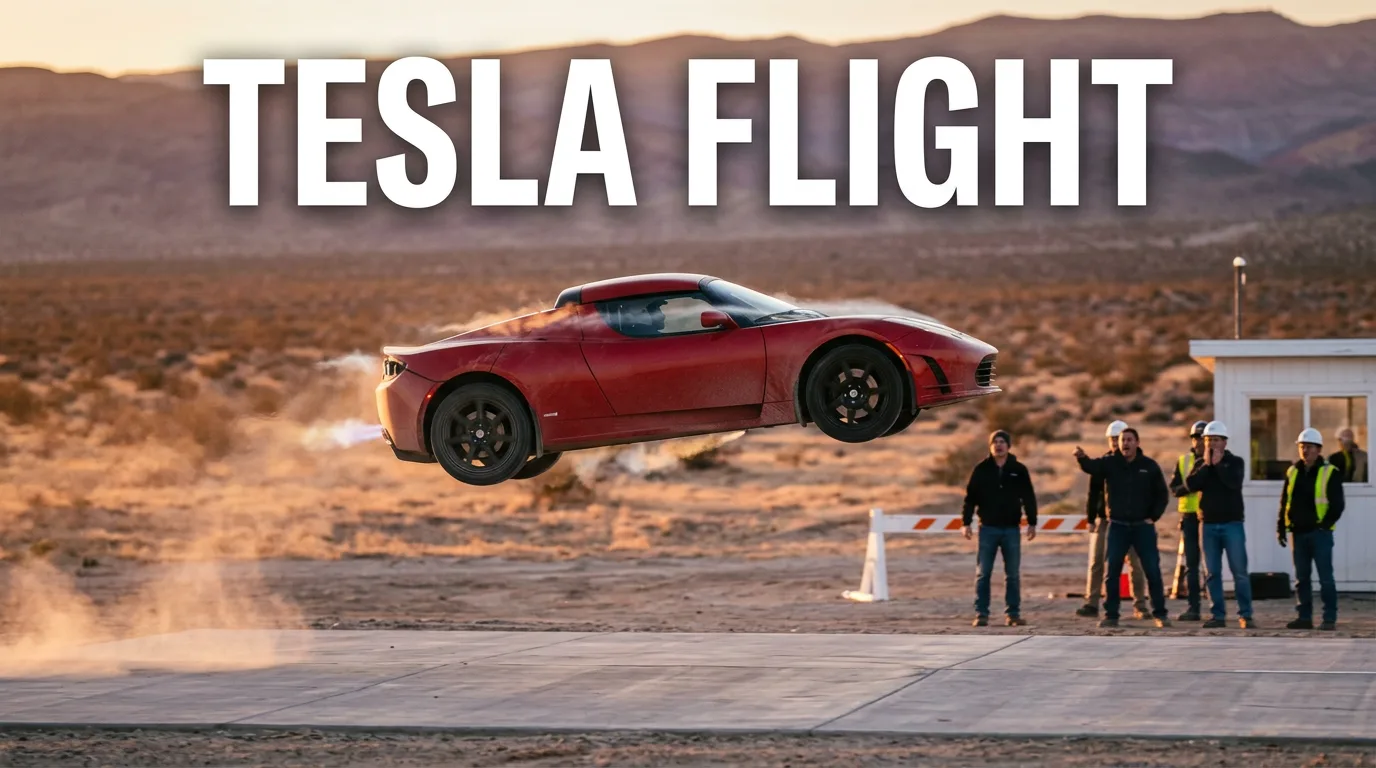
The second was the scene in which it jumped over several Tesla vehicles.
It twisted its body in midair and performed a motion like a skateboard kickflip, emphasizing not just a jump but airborne attitude control technology.
The third was the acceleration scene in which it blasted out strong gas from the rear and reached about 100 km/h in roughly 0.8 seconds.
Considering that even a typical high-performance sports car is praised for being very fast at 3 to 4 seconds from 0 to 100 km/h, a 0.8-second figure goes beyond the usual standards of car performance.
3. The white gas was not exhaust gas but high-pressure nitrogen
In the video, when the Roadster jumped or held its posture, a white vapor-like substance burst strongly from various parts of the body.
At first glance it looks like rocket exhaust, but there is no flame.
The core point of this device is the cold gas thruster.
As the name suggests, a cold gas thruster is a propulsion device that gains reaction force by spraying cold gas under high pressure.
Simply put, it works like releasing the mouth of a fully inflated balloon and watching the balloon fly in the opposite direction.
According to the original text, some media described it as compressed air, but Tesla engineering vice president Lars Moravy explained that it was nitrogen.
The nitrogen is stored in a carbon-fiber-wrapped high-pressure tank.
The pressure was reported to be around 690 atmospheres, which is about 300 times the air pressure in a typical car tire.
So the white gas coming out of the Roadster is closer to a high-pressure nitrogen release than to a fuel-burning exhaust plume.
4. Thrust version structure: a 200L nitrogen tank instead of a trunk
The thrust version is built by placing a roughly 200L nitrogen tank in the space where a trunk would normally be.
Four nozzles are mounted above the rear bumper.
The holes that look like a normal car’s muffler are actually not exhaust pipes but thrusters.
When high-pressure nitrogen is released from these nozzles, the vehicle receives strong thrust in the opposite direction.
This method is completely different from the acceleration generated when wheels push against the road surface.
Conventional cars cannot accelerate any further once tire grip reaches its limit.
But because a thruster pushes the car via gas-ejection reaction rather than through the wheels, it can theoretically bypass some of the limits of tire grip.
5. Rocket version structure: passenger seat removed, 600L total tank, 10 nozzles
The rocket version, which comes closest to the flying scene, was modified even more aggressively.
It removes the passenger seat and adds extra tanks to carry a total of 600L of nitrogen.
It also adds nozzles across the body, bringing the total number of thrusters to 10.
At that point, it is closer to a special one-seat vehicle for a flight demonstration than to a normal mass-produced car.
This is the important point.
This Roadster is less “a flying car consumers can buy right now” and more a showcase of how far rocket technology can be transplanted into an automobile.
6. The fatal limitation: use it for 5 seconds, then charge for hours
It is impressive technically, but from a commercialization perspective, the limitations are clear.
For the thrust version, nitrogen ejection time is reportedly about 5 seconds.
Tesla is said to have answered a question about how many times it can be used by essentially saying once.
To recharge it, dedicated charging equipment is needed, and under current conditions it could take more than 2 hours.
Even if that can be reduced to 30 minutes as a target, the structure still requires waiting 30 minutes for 5 seconds of use.
It is hard to expect a realistic scene of blasting nitrogen and taking off from a traffic light on the commute.
That is why some foreign media called it “an engineering flex with little commercial value” or a “party trick.”
But that assessment alone does not fully explain the real intention behind this event.
7. The upside-down principle: suction system and powerful fans
The core reason the Roadster could stop upside down on the ramp is the suction system.
Tesla explained that it used four fans, each around 200 kW, beneath the body.
When these fans strongly suck air out from between the car and the ground, the pressure under the body drops.
As a result, the car effectively adheres to the ground.
The principle is similar to a vacuum cleaner.
If the air between the floor and the body is removed, outside air pressure pushes the vehicle toward the surface.
If that force is strong enough, the car may not fall even while hanging upside down.
The point Tesla emphasized is not merely a show.
This kind of technology can be connected to downforce systems that keep a car from lifting at high speeds.
Traditional supercars generate downforce through spoilers and aerodynamic design.
By contrast, the Roadster showed a method of actively sucking air to press the car against the road.
8. Why did people cheer for the thruster? Because it broke the car’s basic assumptions
The reason this Roadster matters is that it touched the traditional limits of cars.
Conventional car performance is determined by the combination of engine or motor output, tire grip, vehicle weight, aerodynamic drag, and braking power.
No matter how powerful the motor, if the tires slip, acceleration is limited.
But the thruster does not rely solely on friction between the road and the tires.
When gas is blasted backward, the car is pushed forward.
When gas is blasted downward, the body can lift upward.
When sprayed from the side, it can even change attitude in midair.
This is a movement style closer to a rocket, drone, or spacecraft than to a car.
That is exactly why this Roadster looks less like a mere competitor in the EV market and more like Tesla’s attempt to broaden the definition of mobility.
9. Why reveal it now? It feels closer to convincing people about a merger than to launching a new Tesla model
The most important question is this.
Why bring out a technology that is expensive, has low practical usability, and poor charging efficiency after nearly nine years, and reveal it now?
The core interpretation here is the Tesla-SpaceX merger scenario.
This event was less an announcement that Tesla built a cool sports car and more visual evidence of “what kind of synergy appears if Tesla and SpaceX merge.”
Wall Street tech analyst Dan Ives described the event as putting the Tesla-SpaceX relationship on the table in a visible way.
In other words, instead of explaining a complicated merger logic to investors, Musk showed them a flying car.
There probably couldn’t have been a more powerful presentation deck than that.
10. The technological map of Musk’s empire inside the Roadster
If you break down the Roadster by technology, it becomes much clearer why Musk treated this event as important.
- SpaceX: cold gas thrusters, high-pressure tanks, valve design, rocket attitude control technology
- Tesla: batteries, powertrain, body design, heat pump and compressor technology
- Optimus: robotic joint actuator technology and control technology
- xAI: the AI software base that will go into future autonomous driving, robots, and space data centers
Tesla’s engineering vice president also explained that SpaceX handled the flight package, while Tesla built the battery, powertrain, body, suction system, and more.
Musk also said it was the result of close cooperation between Tesla and SpaceX engineers.
In the end, the Roadster is not the product of one company but a catalog of technologies from multiple Musk companies.
The fact that the event was held at a SpaceX rocket test site is also symbolic.
The mannequin in the driver’s seat wearing a SpaceX spacesuit was part of the same context.
11. The key takeaway is that SpaceX technology was transplanted into a car
Some interpret this technology as a preliminary experiment for a Mars transportation vehicle.
The argument is that on the Moon or Mars, where gravity is weaker, wheels may have difficulty gripping the ground properly, so a movement method using fans and thrusters could be useful.
Musk has encouraged such imagination by calling it a SpaceX package in the past.
But this interpretation is somewhat exaggerated.
This technology is less a totally new future space technology than a transplant of SpaceX’s already proven rocket technology into a car.
The device used when a SpaceX Falcon rocket’s first stage stabilizes in midair and lands is part of the same cold gas thruster family.
The carbon-fiber high-pressure tank called COPV is also a technology SpaceX has used for a long time.
SpaceX also acquired a related tank manufacturing company in 2016.
So the core point of this event is less “an experiment in space technology” and more “a conversion of proven rocket technology into an automotive platform.”
12. What Musk is building is not a car company, but a full-stack mobility and AI empire
The reason Musk wants to combine Tesla and SpaceX is not simply to cut costs or create brand synergy.
The picture he is aiming for is a full-stack infrastructure spanning from Earth to space.
Rockets lift things into space.
Starlink connects space and Earth.
xAI develops artificial intelligence models.
Tesla builds autonomous cars and robots and mass-produces them.
Optimus is physical-world AI labor.
When AI semiconductors, proprietary data centers, battery storage systems, and energy management technologies are added, a vast AI industrial ecosystem is created.
From this perspective, the Roadster is not a sports car but a symbol of Musk’s vertically integrated strategy.
13. After the SpaceX-xAI combination, the missing piece was Tesla
According to the original text, Musk had already combined SpaceX with xAI and also brought X, the social platform, into the structure.
The key reason given for that was the space data center.
As AI models grow larger, power and cooling costs increase explosively.
On Earth, problems with the power grid, land, environmental regulation, and cooling infrastructure are becoming increasingly severe.
Musk is interpreted as believing that space-based AI is the only long-term way to scale.
The structure is one where solar power is generated in space with no night or clouds, data is exchanged through Starlink, and xAI runs AI on top of it.
In that picture, the key company still standing apart was Tesla.
Tesla has autonomous driving AI, Optimus robots, batteries, manufacturing capacity, and a large consumer network.
In other words, Tesla needs to join for space AI and ground-based AI to be connected.
14. If the merger becomes real, it could become a giant company worth about $3.5 trillion
If SpaceX and Tesla merge, the original text says the company could be worth about $3.5 trillion.
In Korean currency, that is nearly 5,000 trillion won.
This would not be a simple merger of large tech stocks, but a massive restructuring of the global industrial landscape that could affect economic forecasts themselves.
That is because electric vehicles, the space industry, artificial intelligence, robots, telecommunications, energy storage, and AI data centers would all come under one roof.
A company of that scale would inevitably affect investment cycles, supply chains, demand for AI semiconductors, and energy infrastructure investment.
15. The merger is also important to Musk personally in terms of control and cash flow
The merger matters not only at the company level but also for Musk personally.
The first factor is cash flow.
Tesla is in a period of shrinking auto margins, and its annual investment burden is also large.
SpaceX, by contrast, has secured a stable revenue base through Starlink.
If Tesla is to transform into an AI and robotics company, it will need enormous capital.
SpaceX’s cash-generating power becomes a resource that can support that transition.
The second factor is control.
According to the original text, Musk owns about 20% of Tesla, but at SpaceX he is said to hold more than 80% of the voting rights.
Musk has said in the past that if Tesla is to grow into an AI robotics company, he needs about 25% voting power.
There are also estimates that after a merger, the voting power of the integrated company could be around 56%.
This means a structure in which Musk can push his long-term strategy more forcefully.
16. Internal transaction controversies can also become a rationale for the merger
There are already multiple transactions between Tesla and SpaceX.
Tesla is said to have invested about $2 billion in SpaceX.
SpaceX is purchasing Tesla’s large-scale battery storage system, Megapack.
If the two companies remain separate entities, these transactions can always lead to internal transaction controversies.
But if they become one company, such dealings can be treated as internal resource allocation within the group.
Of course, for Tesla shareholders, the merger terms with SpaceX, valuation, voting structure, and profit allocation become highly sensitive issues.
So Musk may be interpreted as having shown the powerful symbol of the Roadster first, rather than trying to persuade people with numbers and documents alone.
17. The core point other news outlets do not explain well: the Roadster is not a product, but a “scene for winning merger approval”
The most important thing about this event is not the Roadster’s sales volume or price.
The key takeaway is that it imprinted on Tesla shareholders the message that “if Tesla merges with SpaceX, Tesla is no longer just a car company.”
In a normal new-car launch, price, release date, driving range, charging speed, and production volume should be the main points.
But in this reveal, rocket technology, nitrogen propulsion, airborne attitude control, suction systems, and SpaceX collaboration were emphasized more than such details.
This made it feel more like a presentation for investors than for consumers.
How well the Roadster actually sells on the road may not be the main issue.
What matters is whether Tesla can move beyond intense competition in the EV market and be revalued as an AI, robotics, and space infrastructure company.
That is the real investment point of this event.
18. Key variables to watch from an investment perspective
If you look at this issue as only a technology show, you will miss a lot.
From an investor’s perspective, the following variables should be checked.
- Whether the Tesla-SpaceX merger review actually moves into a board approval stage
- Whether it can overcome the very high hurdle of majority Tesla shareholder approval
- At what ratio Tesla and SpaceX valuations would be set in a merger
- How Musk’s expanded voting power would affect ordinary shareholders
- Whether Starlink cash flow can be used as funding for Tesla’s AI and robotics investments
- Whether the space data center concept can have real economic viability
- Whether autonomous driving and Optimus can move to the center of Tesla’s valuation
In particular, as expectations for rate cuts rise, valuations for long-term growth stocks and AI infrastructure companies can become sensitive again.
If Tesla is recognized not just as a car manufacturer but as an AI infrastructure platform, the multiple assigned by the market could change as well.
19. Key variables to watch from a technology perspective
Technically, there is something more important than the Roadster’s flight capability.
That is the fact that SpaceX’s high-pressure tanks, valves, and propulsion control technologies were integrated with Tesla’s vehicle control systems.
Cars are increasingly becoming software-defined vehicles.
When rocket-level sensor control, pressure control, and real-time attitude control technologies are added, a new form of mobility platform can emerge.
However, installing thrusters in a mass-produced road car is not easy because of safety regulations, charging infrastructure, maintenance costs, and accident risk.
So the possibility that the Roadster’s flight technology will become mainstream right away is low.
Instead, this technology is more likely to expand into high-performance vehicles, special-purpose mobility devices, military platforms, vehicles for space and low-gravity environments, and robot control technologies.
20. From an AI trend perspective: Musk’s ultimate goal is an “AI operating system for the physical world”
This Roadster becomes even more interesting when viewed through the AI trend lens.
AI is no longer limited to chatbots or image generation.
The next step is AI that moves in the physical world.
Autonomous vehicles are AI agents on the road.
Optimus is an AI agent moving in factories and homes.
Starlink is the communications network connecting these AIs.
SpaceX is the transport system that lifts AI infrastructure into space.
xAI is the brain operating on top of it.
Tesla handles mass production, energy storage, and robot hardware.
In the end, what Musk seems to be building is close to a “full-stack operating system for AI to move in the real world.”
The Roadster was a symbolic scene showing that operating system could move between vehicle, rocket, and robot.
21. If this Roadster reveal is summarized in one sentence
This Roadster is less a preview of the car we will drive tomorrow and more a trailer for the integrated AI, space, and mobility empire Musk wants to build.
Technically, the core elements are the cold gas thruster, high-pressure nitrogen tank, and suction system.
Strategically, the core point is persuading people toward a Tesla-SpaceX merger.
From an investment perspective, the key takeaway is whether Tesla can be revalued from an EV manufacturer into an AI, robotics, and space infrastructure company.
So when looking at this event, the question is not “Did a real flying car appear?” but “Why did Musk bring this technology before shareholders and the market now?”
< Summary >
The white exhaust-like gas from the Tesla Roadster is not combustion exhaust but high-pressure nitrogen.
The vehicle moves by spraying nitrogen through cold gas thrusters and using the reaction force.
The upside-down principle is a suction system in which fans beneath the body draw in air and press the vehicle against the ground.
The thruster can be used for about 5 seconds and then requires a long charging time, so it is difficult to use as a commercial vehicle right away.
The essence of this event is closer to an investor demonstration of the technological synergy between Tesla and SpaceX than to a new car launch.
Musk is envisioning a full-stack empire that unites rockets, electric vehicles, autonomous driving, robots, AI semiconductors, and space data centers.
The Roadster is the symbolic product that most directly shows that enormous merger scenario.
[Related Articles…]
*Source: [ 티타임즈TV ]
– ‘하늘 나는 자동차’ 배출 가스의 정체는? 거꾸로 매달린 원리는?