
● AI Benchmark Shock
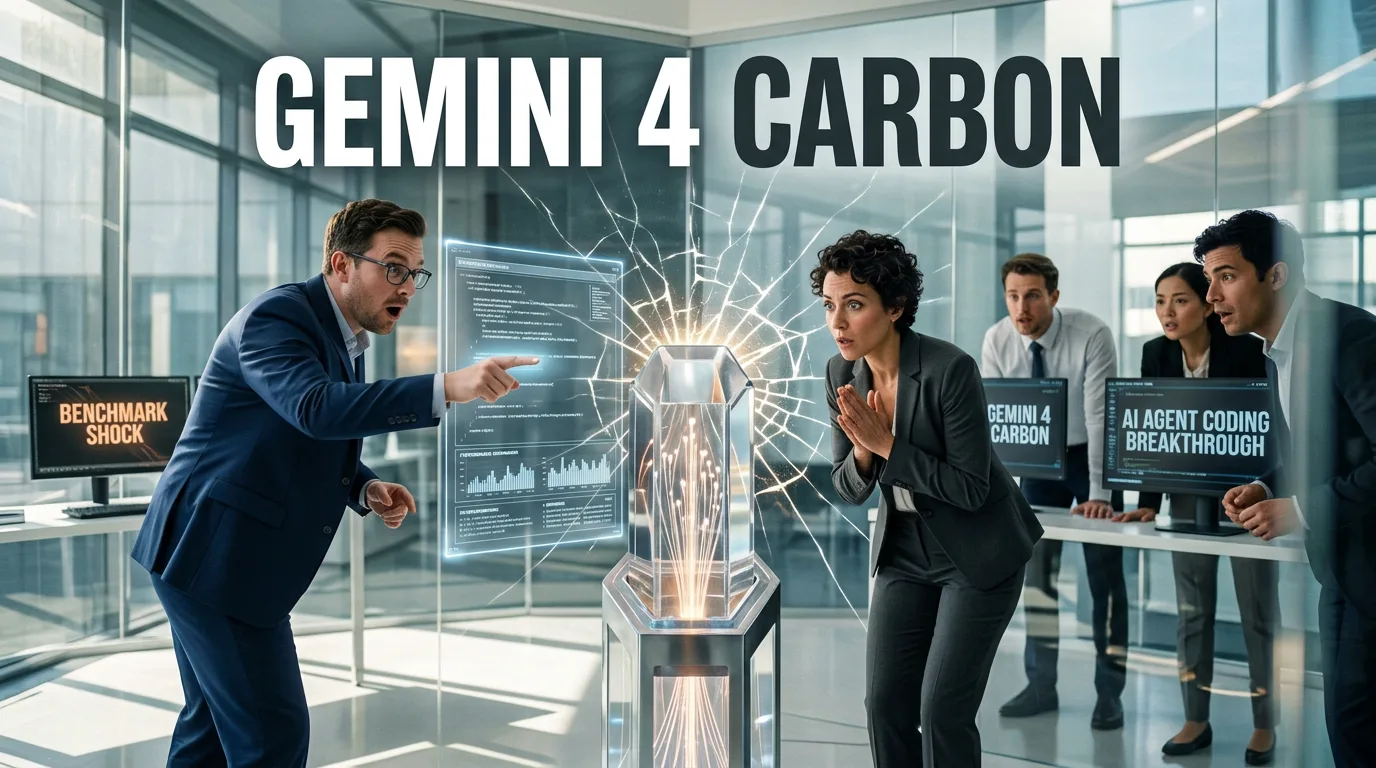
Gemini 4 Carbon Announced: Google Shakes Up the Market Again in Just Two Weeks, with 15 Benchmark Wins, Cybersecurity, Long-Horizon Task Handling, and Overwhelming Price Competitiveness
Google has come in strong once again.
The newly unveiled Gemini 4 Carbon is not just another new model. It appears to be a model that could reshape the AI competitive landscape, cloud cost structures, agentic coding, and cybersecurity itself.
In this article, we will summarize in a news-style format why Gemini 4 Carbon is attracting attention, why the market is reacting so strongly, and the core points that other news coverage often misses.
In particular, this article brings together the following topics in one place.
- Why Gemini 4 Carbon is being called “Google’s strongest model”
- What improved compared with Argon, and by how much
- What it means to rank first in 15 out of 17 benchmarks
- Why security and long-running tasks have become core points in the agent era
- The price competitiveness that matters most for real enterprise adoption
- Core risks and watch points that other YouTube videos or news reports cover less often
1. Google Releases Carbon Just Two Weeks After Argon: This Is Not a Speed Race, but a Strategy Race
Google first unveiled Argoon, or Argon, on September 30.
Even then, it was not immediately opened to everyone. It was first deployed in the cyber defense field and later released to general users.
About 13 days later, it became publicly available through the Gemini app. Now, just two weeks after that public release, Google has introduced Gemini 4 Carbon.
The important point in this sequence is not simply that “a new model has been released.”
Google is not just trying to release models quickly. It is differentiating the roles of its models.
In other words,
- Argon was closer to general productivity, multimodal tasks, and office-style work
- Carbon is focused on cybersecurity, long-running tasks, and agentic automation
This is a very important signal showing where the AI industry is heading right now.
It means the competition is moving beyond simple chatbot battles and into a stage where agents actually carry out real work to completion.
2. Gemini 4 Carbon’s Core Positioning: “Security” and “Long Horizon”
When Google introduced Carbon, it emphasized two things most strongly.
- Cybersecurity
- Long Horizon, meaning the ability to handle tasks that continue over a long period of time
These two pillars are core points that will determine the practical value of AI models going forward.
That is because future AI will not simply answer questions. It will need to:
- carry out multiple stages of work on its own
- avoid mistakes along the way
- remember long contexts
- identify security vulnerabilities
- complete fixes as well
Simply put, AI now needs to become not just “a helpful assistant that answers well,” but a digital practitioner that can be trusted with actual work.
From that perspective, Carbon should be seen as a model with which Google is directly targeting the agent era.
3. Benchmark Results: First Place in 15 Out of 17 Tests, a Monster-Level Result Based on the Numbers
Google compared Carbon side by side with Argon, Astra, Claude Opus, and Fable-family models.
The comparison covered a total of eight areas.
- General capability
- Agentic coding
- Computer use
- Knowledge work
- Multimodal capability
- Long context
- Science
- Mathematics
- Cybersecurity
There were 17 detailed categories in total, and Carbon ranked first in 15 of them.
This is not merely a case of “it got better.”
It means Carbon has reached a level where it is nearly on par with current frontier models, and in some areas even ahead of them.
What stands out most are the two areas Google directly emphasized.
- Security
- Long context
These two areas are likely to be where enterprises feel the biggest difference when adopting the model.
4. There Are Areas Where It Did Not Rank First, but Even Those Were Extremely Close
Carbon did not win every category.
Two representative areas were led by competing models.
First, FrontierSWE 2
This is a benchmark related to agentic coding, and Astra and Opus scored higher than Carbon here.
In other words, Carbon is not yet completely dominating the top-tier coding agent competition.
Second, some agent-related evaluations
In this area, Opus 5.5 ranked first with 87.2%, while Carbon ranked second with 81.5%.
This once again shows that Opus remains very strong.
However, the important point is that Carbon still surpassed Astra and entered the very top of the second-place tier.
In other words, this was not a one-sided defeat, but a close competition among the highest-performing models.
5. Why Do the Categories Where Carbon Ranked First Matter?
The areas where Carbon performed especially strongly are likely to become much more important in actual use.
The following benchmarks stand out in particular.
- AA Index: Carbon scored 59 points, while Opus 5.5 scored 58 points
- VALS Index: Carbon took a narrow first place by a margin of 0.2% over Opus 5.5
- SWE-sweep: Carbon took first place by an extremely narrow margin of 0.1%
This ultimately means that Carbon has reached a level where it can compete meaningfully in the same tier as frontier GPT-family models and Claude frontier models.
More importantly, the core point of model evaluation is no longer just simple intelligence.
Going forward, these questions will matter more.
- How smart is it?
- How long can it work?
- How few mistakes does it make?
- How cheaply can it be used?
- How safe is it?
Carbon touches almost all five of these points at the same time.
6. The Biggest Change Is Long Context, and This Is Likely to Be Strongly Felt in Real Work
The most dramatically improved area in Carbon is long context.
The figures presented by Google are as follows.
- Previous Argon: 84.2%
- Gemini 4 Carbon: 96.2%
This is a fairly large jump.
Long-context benchmarks typically deal with problems ranging from 256K to 1 million tokens and evaluate how well a model handles very long inputs.
Simply put, they measure how well a model can deal with things like:
- long documents
- huge codebases
- projects involving many interconnected files
- long-running work contexts
The important point here is not simply “being able to read a lot of context.”
The core point is whether the model can properly connect the beginning and end of what it has read and carry out work without mistakes.
This is extremely important for actual enterprise users.
That is because in real workplaces, there are far more tasks that require the model to:
- read an entire report
- understand an entire codebase
- consider multiple stakeholders
- finish the work without omissions
than there are short, simple questions.
7. Google’s “Long Horizon” Claim Is the Real Main Game of the Agent Era
Google explained that its internal teams ran Carbon directly and found that it produced fairly stable results even in tasks that continued for several days.
The core point is this.
- It did not stop even as tasks became longer
- It found detours when reaching dead ends
- It identified the causes of bugs inside complex codebases
- It proceeded all the way to actual patches
This point matters more to development organizations, data teams, and security teams than to general users.
That is because the future value of AI will be determined less by “the ability to answer in one shot” and more by the ability to finish the job.
However, one thing must be noted here.
The information disclosed by Google is still based on its own internal test results.
In other words, strong published numbers do not necessarily mean the same results will always appear in real workplace environments.
That is why real-world usage evaluations may matter more than the announced figures for this model.
8. Cybersecurity Is This Model’s Strongest Weapon
The area where Carbon was designed to be especially strong is cybersecurity.
Google presented security in three stages.
1) Detection
This is the stage of finding hidden flaws inside real software.
- In SEC Bench Pro
- Astra scored 85.4%
- Carbon scored 88.2%
In other words, detection capability has improved.
2) Verification
This is the stage of determining whether a discovered vulnerability is actually exploitable.
This is not simply saying, “This looks like a bug.” It involves determining:
- whether it is actually dangerous
- whether it should be fixed first
- whether it can be attacked
In this area, Carbon outperformed previous models by a fairly large margin.
3) Remediation
This is the stage of fixing the issue with working code.
- In the CWE benchmark
- Carbon ranked first with 71%
This is highly meaningful.
That is because in security, “fixing” is harder than “finding.”
In that sense, Carbon is being positioned not merely as a detection-focused model, but as a model that can enter the entire security workflow.
9. Hallucinations Have Also Been Reduced, and This Matters a Lot in Actual Use
There is one area in Carbon that many people may easily overlook, but it is actually very important.
That area is hallucination reduction.
According to Google’s announcement:
- Cheating attempts in TerminalBench 4.0 were 0%
- Attempts themselves decreased to 0.4%
- Task deviation decreased by 80%
- Unsupported claims were reduced to about half the level of the previous Argon model
This matters because, in real work, how little nonsense a model produces is often more important than how smart it is.
This is especially true for agentic AI, because one mistake in the middle can ruin everything that follows.
If the model:
- repeats unnecessary verification
- skips required steps
- goes in the wrong direction for too long
- reaches unsupported conclusions
then humans ultimately have to fix everything again.
That is why Carbon’s hallucination improvements should not be seen as a minor extra feature, but as a core point that increases the possibility of real-world adoption.
10. The Most Important Point That Other News Covers Less: In the End, This Is a Battle of “Performance + Cost”
Here is one real core point to focus on.
Model competition no longer ends with performance alone.
Going forward, companies will mainly look at two things.
- How well does it perform?
- How cheaply can it be used?
Carbon is quite strong in this area.
Google presented the pricing as follows.
- Input: $2 per 1 million tokens
- Output: $10 per 1 million tokens
- Cached input: 95% discount
This is quite aggressive pricing.
Especially compared with competing frontier models, this structure could allow enterprises to significantly reduce large-scale usage costs.
Simply put:
- the performance is frontier-class
- while the cost is far more realistic
This combination matters.
That is because enterprises do not necessarily want to use “the best model.” They want a model that is good enough and can be run at scale.
11. It Is Not Publicly Released Yet, but the Defender-First Deployment Is Meaningful
Carbon is not currently available directly to general users.
Google is first deploying it through a defender-focused program.
More than 650 partners worldwide can participate in this program, mainly including organizations such as:
- government agencies
- national cyber authorities
- healthcare organizations
- telecommunications companies
- energy companies
- financial institutions
- critical infrastructure operators
- academic institutions conducting security research
In other words, this is not a consumer-oriented model that individuals can use right away. It is a strategic model that first targets security and infrastructure.
This is a fairly important signal.
What Google is aiming for with Carbon is not simply expanding app users, but securing the high-value enterprise market first.
12. From a Market Perspective, This Announcement Means the Focus of AI Competition Is Changing
Looking at the Carbon announcement, the direction of the AI industry becomes clearer.
In the past, the important questions were:
- Who is smarter?
- Who speaks more naturally?
- Who handles multimodal tasks better?
But now, things are different.
Going forward, the core points will be:
- Can it reliably complete long-running tasks?
- Can it actually reduce security problems?
- How much can it reduce hallucinations?
- Can enterprises use it at scale without excessive cost?
In other words, AI is now moving beyond the era of “flashy demos” and into the era of practical work automation.
Carbon appears to be quite far ahead in that transition.
13. Conclusion: Gemini 4 Carbon Signals That Google Has Finally Built a Truly Practical Frontier Model
To summarize, Gemini 4 Carbon is not just a simple follow-up model.
This model means three things.
- Google has returned to the center of frontier AI competition
- The core value of AI is shifting from intelligence to execution capability
- Security, long context, long-running tasks, and price competitiveness have all become important at the same time
Based on benchmarks alone, the results are almost overwhelming.
But the real evaluation starts now.
- How well will it hold up in real development environments?
- How stable will it be in enterprise environments?
- How much will users feel the difference after general release?
These three factors will determine the final outcome.
Personally, I see Carbon as closer to a model ready to enter real workplaces than simply “a model with good numbers.”
Of course, the final judgment requires direct use.
Still, at this stage, it is clear that Google has once again sent a strong signal to the AI market.
< Summary >
Gemini 4 Carbon is a practical frontier model that Google introduced just two weeks after its previous release.
The core points are cybersecurity, long context, and long-horizon task handling.
Its benchmark performance is extremely strong, ranking first in 15 out of 17 categories.
It is especially strong in long documents, large codebases, and agentic workflows.
Its pricing is also highly competitive, at $2 for input and $10 for output per 1 million tokens.
However, it is still in a pre-public-release stage, so its actual performance needs to be verified after broader availability.
[Related Articles…]
- Google AI Model Race: Who Comes Next?
- Cybersecurity in the AI Era: What Enterprises Should Prioritize First
*Source: 성공지식백과