● Tesla FSD Bombshell, Seoul Court Slams Refunds, HW3 Shock, China Risk, Stock Holds 403
Seoul Court Defines the Scope of Tesla FSD | China-Built Vehicles, Overseas HW3 Litigation, and the Implications of Tesla at $403.3
The significance of the ruling extends beyond the dismissal of refund claims by 89 Tesla owners.
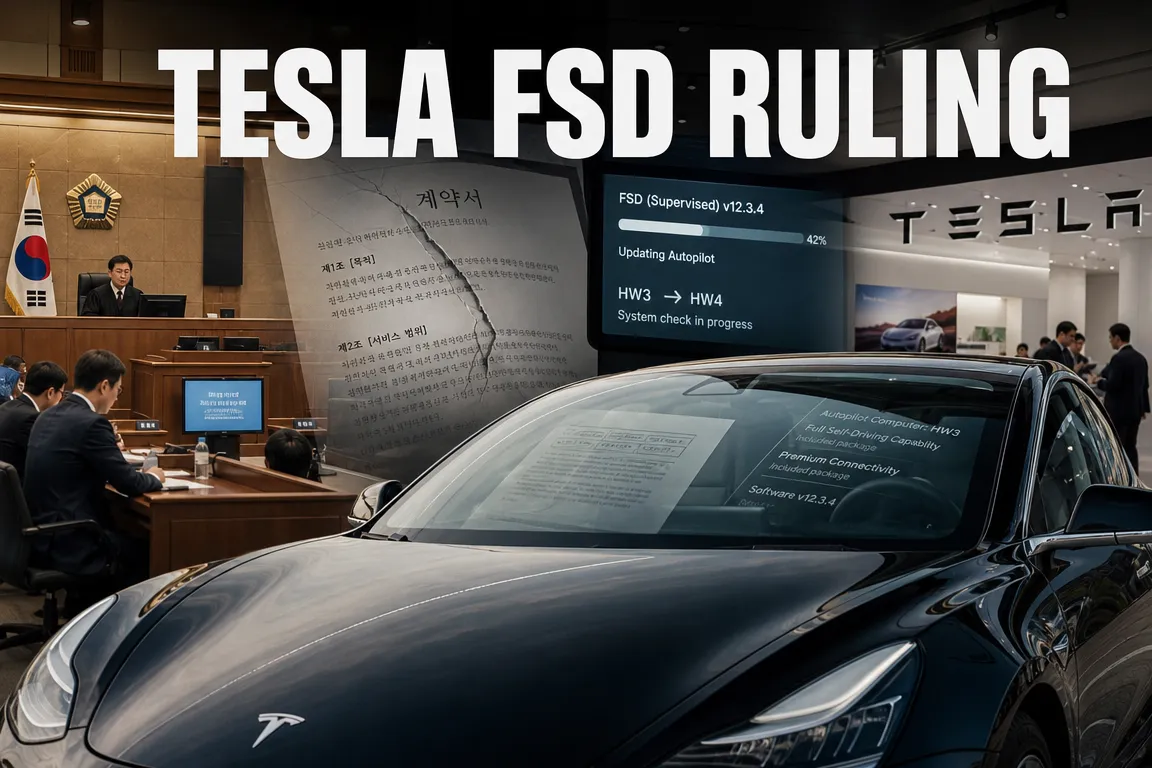
The Seoul court interpreted FSD as a driver-assistance package with features delivered incrementally, rather than fully autonomous driving requiring no driver intervention.
For HW3 vehicles, the court indicated that delivering functions within HW3’s technical capabilities may satisfy the contract, even if performance differs from HW4 vehicles.
If upheld, this reasoning could reduce Tesla’s refund exposure in South Korea. However, disputes involving China-built Model 3 and Model Y vehicles without FSD activation, as well as overseas HW3 class actions, remain unresolved.
Investors should evaluate not only Tesla’s $403.3 share price but also the judicial definition of contractual performance, potential HW3 replacement costs, and the timing of regulatory approvals in Europe and the United States.
1. Seoul Court Ruling on Tesla FSD Refund Claims
Why the Claims of 89 Tesla Owners Were Dismissed
A civil division of the Seoul Central District Court rejected claims seeking refunds of FSD option payments from Tesla Korea.
The plaintiffs reportedly purchased FSD between 2019 and 2022 for approximately KRW 6 million to KRW 9 million.
They argued that Tesla had failed to deliver functionality consistent with the Full Self-Driving name and that the HW3 computer was incapable of supporting the originally promised features.
They also viewed Tesla’s adoption of the term “FSD Supervised” and the introduction of subscriptions as a retreat from earlier representations regarding full autonomy.
Tesla Korea argued that substantial elements of the package had already been delivered, including basic Autopilot, automatic lane changes, parking assistance, and vehicle summoning.
It also maintained that contract cancellation would require restoration of benefits already used by consumers, making the software package materially different from a wholly undelivered product.
The Court Did Not Interpret FSD as Level 5 Autonomy
The court reportedly prioritized the contractual terms and purchase disclosures over the product name.
It interpreted FSD as a partially automated system requiring driver readiness and as a software package combining multiple driver-assistance functions.
The FSD name alone was therefore insufficient to establish a binding commitment to deliver Level 5 driverless operation.
Tesla’s website disclosures that regulatory approval could take substantial time in certain jurisdictions also appear to have influenced the decision.
The court found that purchasers were aware that some functions would not be available immediately and could be introduced incrementally.
Meaning of a Contract with an Indefinite Performance Date
The court reportedly treated the FSD agreement as a contract requiring future performance without a fixed completion date.
Accordingly, an extended delay alone did not automatically establish breach of contract or grounds for termination.
The court also recognized that delays caused by regulatory approval and domestic safety standards were not entirely within Tesla’s control.
If upheld on appeal, this interpretation could influence future disputes involving AI software and autonomous-driving options sold in South Korea.
2. The Central Issue: Contractual Performance for HW3
Must HW3 Owners Receive the Same Functions as HW4 Owners?
The most consequential element of the ruling was the conclusion that Tesla’s obligations to HW3 owners should be assessed against HW3’s technical capabilities rather than HW4 performance.
The court reportedly found that a failure to deliver functions identical to those available on newer HW4 vehicles did not, by itself, constitute breach of contract.
One factor was the deployment of a limited FSD Version 14 update to domestic HW3 vehicles.
The addition of traffic-light and road-sign recognition, along with limited urban driving assistance, was recognized as partial contractual performance.
The plaintiffs argued that delivering reduced functionality should not be sufficient to satisfy an agreement for full FSD.
The court nevertheless declined to conclude that every hardware generation sold under the same product name must provide identical performance.
Why the HW3 Finding Is Favorable to Tesla
- Tesla may face less pressure to replace all HW3 computers with HW4 hardware immediately.
- Software updates delivering functions within HW3’s capabilities may qualify as contractual performance.
- The risk of broad refunds or free hardware replacements for domestic FSD purchasers may decline.
- Differences in functionality between hardware generations do not automatically establish breach of contract.
HW3 Risk Has Not Disappeared
Contractual delivery of some functions is separate from the technical feasibility of unsupervised autonomous driving.
If statements by Elon Musk indicate that HW3 cannot support unsupervised FSD, overseas litigation may focus on the accuracy of prior advertising and sales representations.
Any higher-performance computer upgrade for HW3 owners would generate component, service-center labor, and supply-chain costs.
Investors should therefore monitor the number of eligible vehicles and the replacement cost per vehicle, not only litigation outcomes.
3. Does the Ruling Apply to China-Built Model 3 and Model Y Vehicles?
Why Domestic FSD Availability Remains Limited
Of approximately 180,000 Teslas registered in South Korea, only 4,292 vehicles, or about 2.4%, were identified as legally eligible to use FSD.
Vehicles manufactured in the United States may benefit from certification procedures under the Korea-U.S. Free Trade Agreement, while China-built Model 3 and Model Y vehicles may require separate domestic safety certification.
As a result, some owners of China-built Teslas have purchased FSD without being able to activate it.
The Key Difference Between Existing Plaintiffs and Owners of China-Built Vehicles
The plaintiffs in the current litigation reportedly received limited FSD updates and some driver-assistance functions.
Owners of China-built vehicles who cannot activate FSD at all may therefore present materially different facts regarding contractual performance.
The existing ruling could support the argument that regulatory delays are not solely Tesla’s responsibility.
However, separate issues include whether Tesla adequately disclosed certification uncertainty, the expected delivery schedule, and whether any paid functionality was made available.
Key Issues in Potential Litigation Involving China-Built Vehicles
- Whether Tesla specifically disclosed certification restrictions when selling FSD for China-built vehicles.
- Whether consumers knew that FSD could not be used on those vehicles at the time of purchase.
- Whether collecting advance payment was appropriate when regulatory approval remained uncertain.
- Whether a contract’s purpose can be considered fulfilled when no relevant functionality has been delivered.
- Whether Tesla clearly explained certification differences between U.S.-built and China-built vehicles.
The first-instance ruling does not eliminate the possibility of refunds for owners of China-built Model 3 and Model Y vehicles.
4. Investigation of 80 Owners Who Used Unauthorized Devices to Activate FSD
The Seoul Metropolitan Police Agency’s traffic crime investigation unit reportedly investigated approximately 80 owners who installed unauthorized devices to activate FSD.
Some devices were purchased from China or Europe, while others were reportedly assembled using publicly available online materials.
Similar devices were said to be available through overseas marketplaces for approximately $20.
South Korea’s Motor Vehicle Management Act restricts unauthorized modifications to automotive software and devices that may affect safe operation.
Violations may result in imprisonment of up to 2 years or a fine of up to KRW 20 million.
Liability may arise from bypassing safety systems even if no accident occurs.
Tesla can reportedly review vehicle software status and feature-activation records through its servers.
Removing a device or deleting local records may not prevent detection.
Unauthorized activation may also affect vehicle warranties, insurance coverage, and accident liability.
5. Overseas HW3 Class Actions and the Korean Ruling
Contractual Performance in South Korea Versus Advertising Accuracy Overseas
The Korean litigation focused on whether Tesla delivered enough of the purchased functionality to satisfy the contract.
Litigation in the United States and other jurisdictions may instead focus on whether advertising claims and management statements concerning FSD and HW3 were accurate.
HW3 owners have reportedly filed class actions in the United States, while consumers in Beijing, Australia, and the Netherlands are also pursuing compensation or accountability.
If Tesla relied primarily on HW4 vehicles during the European approval process, questions may arise over whether HW3 vehicles can ultimately receive comparable functionality.
Why the Korean Ruling Is Unlikely to Control Overseas Cases
- Consumer-protection and advertising laws differ by jurisdiction.
- Tesla’s sales language and disclosures may vary across markets.
- Purchase dates and vehicle hardware versions differ.
- The Korean case focused on cancellation and refunds, while overseas cases may emphasize misleading advertising.
- Regulatory approvals and delivered functionality vary by country.
The Korean first-instance ruling may support Tesla’s defense strategy, but it will not determine the outcome of overseas class actions.
6. European FSD Approval and the “Tesla Assisted Driving” Strategy
Tesla has reportedly begun using the term “Tesla Assisted Driving” in Europe instead of FSD.
The change appears intended to address regulatory concerns that the Full Self-Driving name could imply operation without a driver.
An Italian transport official was reported to support accelerated approval of Tesla’s driver-assistance technology, while Germany was also described as receptive.
France has maintained concerns regarding system safety and product terminology.
European Union approval may require thresholds based on both the number of member states and their share of the EU population.
The positions of large markets such as Germany, France, and Italy could therefore be decisive.
Approval would allow Tesla to expand software and subscription revenue across its installed vehicle base.
Continued delays or approval limited to HW4 vehicles could increase both HW3 customer dissatisfaction and upgrade costs.
7. U.S. Cybercab Regulation Is a Separate FSD Risk
The U.S. National Highway Traffic Safety Administration reportedly asked Tesla to explain how the Cybercab, which lacks a steering wheel and pedals, would comply with existing Federal Motor Vehicle Safety Standards.
If current rules assume a foot-operated brake pedal, Tesla may require an exemption or regulatory amendment before commercial sales can begin.
Submitting a response to a regulator is not equivalent to receiving sales approval.
Authorities may request additional documentation, testing, or safety measures.
Management’s Cybercab delivery targets should therefore be evaluated separately from the regulatory approval schedule.
Commercial deployment could extend Tesla’s business model from electric-vehicle sales to a robotaxi platform.
Before deployment, Tesla must address technical reliability, regulatory approval, insurance liability, and remote-operations costs.
8. Investment Considerations at a Tesla Share Price of $403.3
Tesla shares closed at $403.3, down 0.23% for the day.
With the Nasdaq declining 1.38% during the same session, Tesla demonstrated relative resilience.
However, one day of market outperformance does not eliminate legal risks surrounding FSD or valuation pressure from interest rates.
| Key Variable | Potential Positive Impact | Potential Negative Impact |
|---|---|---|
| Seoul FSD ruling | Potential reduction in domestic refund and litigation exposure | Appeals and additional litigation involving China-built vehicles |
| HW3 upgrades | Customer retention and stronger confidence in FSD | Potentially substantial component and service costs |
| European approval | Expansion of software and subscription revenue | Approval delays and country-specific limitations |
| Cybercab | Higher potential valuation for the robotaxi business | Uncertainty surrounding U.S. safety rules and commercialization timing |
| Interest rates and inflation | Lower rates could support growth-stock valuations | Persistently high rates could increase valuation pressure |
Potentially Favorable Factors for Shareholders
- The court did not interpret FSD as a definitive commitment to deliver Level 5 autonomy.
- The argument that HW3 vehicles must provide performance identical to HW4 vehicles was rejected.
- The near-term risk of broad domestic refunds for FSD options has declined.
- Software updates may qualify as contractual performance.
Risks Shareholders Should Not Underestimate
- The reported decision is a first-instance ruling and is not final.
- An appeal could result in a different legal interpretation.
- China-built vehicles without any FSD access present materially different facts.
- Overseas litigation may focus on misleading advertising rather than contractual performance.
- A broad HW3 replacement program could generate substantial one-time costs.
9. U.S. Economic Conditions and Tesla’s Valuation
U.S. third-quarter annualized GDP growth was reported at 3.4%, while personal consumption expenditure inflation was stated at 3.6% year over year.
Strong growth combined with elevated inflation could weaken expectations for Federal Reserve rate cuts.
Forecasts of additional rate increases would create further pressure on growth-stock sentiment.
Tesla’s valuation reflects substantial expectations for future cash flow and autonomous-driving revenue.
Higher interest rates reduce the present value of future earnings and may pressure Tesla’s valuation multiple.
Higher auto-loan rates also increase monthly payments for Model 3 and Model Y buyers, potentially affecting demand.
Oil prices were reported near $101 per barrel.
High oil prices may improve the relative operating-cost case for electric vehicles, but sales also depend on vehicle pricing, financing costs, charging infrastructure, and subsidies.
Quarterly deliveries and inventory levels remain more informative than oil prices alone.
10. Implications of AI Semiconductors and Memory Prices for Tesla
Intel reported higher data-center and AI-related revenue, but its shares declined after the subsequent quarterly outlook fell below market expectations.
The market continues to place greater weight on forward growth and profitability than on current AI-related revenue alone.
Amazon and Google are also making substantial capital investments in cloud and AI infrastructure.
AI revenue growth may be accompanied by even faster increases in spending on data centers, GPUs, memory, and power infrastructure.
Tesla faces similar cost dynamics.
FSD training and inference, data centers, Dojo, and Optimus development require significant semiconductor and memory capacity.
Higher memory prices could increase both vehicle-computer costs and AI training infrastructure expenditure.
Semiconductor availability and memory pricing may therefore affect vehicle costs, autonomous-driving development, and cash flow simultaneously.
11. Key Issues Often Overlooked
First, the Court Prioritized Contractual Terms and Disclosures Over the FSD Name
The “Full Self-Driving” name alone did not establish an obligation to deliver Level 5 autonomy.
In future AI product disputes, contractual terms, feature descriptions, and disclosed limitations may carry more legal weight than marketing terminology.
Second, HW3’s Technical Limitations Did Not Automatically Constitute Breach of Contract
If upheld, the ruling may allow Tesla to satisfy contractual obligations by delivering reduced functionality within HW3’s capabilities.
Consumers may nevertheless continue to challenge differences in functionality among vehicles sold with the same FSD package.
Third, Hardware Replacement Costs May Be More Material Than Refund Exposure
Even if Tesla prevails in litigation, replacing HW3 computers to support unsupervised operation could require substantial cash expenditure.
The key variables are the number of eligible vehicles and the replacement cost per vehicle.
Fourth, China-Built Vehicles Require Separate Analysis
HW3 owners who received limited functionality are not directly comparable to owners of China-built vehicles that have never been able to activate FSD.
The ruling should not be applied uniformly to every Tesla owner in South Korea.
Fifth, FSD’s Commercial Value May Depend More on Regulatory Timing Than Technical Demonstrations
Technology cannot generate broad revenue unless European approval, U.S. Cybercab regulation, and Korean vehicle certification are resolved.
Investors evaluating Tesla as an AI company should monitor the number of approved markets and paying users rather than relying primarily on demonstrations.
12. Key Events and Metrics to Monitor
- Whether the plaintiffs appeal the domestic FSD refund ruling and how higher courts respond.
- Progress toward domestic FSD certification for China-built Model 3 and Model Y vehicles.
- Tesla’s official HW3 upgrade process and allocation of related costs.
- European Union approval of Tesla’s driver-assistance system.
- Further NHTSA inquiries regarding Cybercab and potential regulatory amendments.
- FSD paid-user numbers, subscription conversion rates, and recognition of related deferred revenue.
- The impact of semiconductor and memory-price increases on Tesla’s capital expenditure.
- The effects of U.S. growth, inflation, and interest rates on electric-vehicle financing costs.
< Summary >
The Seoul court interpreted Tesla FSD as a software package with incrementally delivered driver-assistance functions, rather than a definitive commitment to Level 5 autonomy.
It also indicated that providing functions within HW3’s capabilities may satisfy the contract, even if HW3 does not match HW4 performance.
The first-instance ruling may reduce Tesla’s domestic refund exposure, but it does not directly resolve disputes involving China-built vehicles without FSD access or overseas HW3 class actions.
At a Tesla share price of $403.3, investors should assess litigation outcomes alongside HW3 replacement costs, European approvals, Cybercab regulation, interest rates, and AI infrastructure expenses.
[Related Articles…]
*Source: [ 오늘의 테슬라 뉴스 ]
– 서울 법원이 세계 처음으로 정한 FSD의 범위 — 중국산 차주와 해외 HW3 소송까지, $403 테슬라 주주는?
● Tech Shock, KOSPI Plunge
KOSPI Plunges on Big Tech Earnings Shock: Why Intel, Amazon, and Google Moved the Korean Market
The key driver of the sell-off was not simply the decline in U.S. technology stocks.
Investors became concerned that weakness in Big Tech’s core businesses, including Google’s search advertising, Amazon’s e-commerce operations, and Intel’s semiconductor business, could reduce both the cash available for AI investment and market confidence.
Because semiconductor companies such as Samsung Electronics and SK Hynix carry significant weight in the Korean equity market, even a modest deterioration in the AI capital expenditure outlook of U.S. technology companies can have a substantial impact on the KOSPI.
The source text does not specify the exact earnings announcement dates or KOSPI trading session.
The analysis therefore focuses on how Big Tech earnings shocks are transmitted to Korean equities and the variables investors should monitor, rather than on real-time market conditions for a specific trading day.
1. The Primary Cause of the KOSPI Decline: Concerns About Big Tech’s Core Businesses
Market attention in the AI sector has largely focused on the scale of Big Tech capital expenditure.
However, investment in AI data centers and semiconductors depends on the cash generated by established businesses such as advertising, cloud services, and e-commerce.
Big Tech’s AI investment is ultimately supported by cash flow from its core operations.
- Google: Search and YouTube advertising are its principal sources of cash generation.
- Amazon: The profitability of e-commerce and AWS determines its investment capacity.
- Microsoft: Cloud and enterprise software revenue supports AI infrastructure investment.
- Meta: Digital advertising revenue funds AI servers and recommendation-system development.
- Intel: Demand for server and PC processors, together with manufacturing competitiveness, remains central to performance.
The market’s principal concern is not that Big Tech will stop AI investment entirely.
The greater risk is that core-business growth slows while AI spending continues to rise, weakening profitability and cash flow.
Under this scenario, management teams could delay data center construction or moderate the pace of semiconductor orders.
As these concerns increase, weak Big Tech earnings in the United States can quickly translate into lower earnings expectations for Korean AI semiconductor companies.
2. Why Google’s Search Business Matters
Google’s search advertising business is a core earnings driver for Alphabet.
Cash generated from search advertising is reinvested in generative AI models, data centers, proprietary AI accelerators, and cloud infrastructure.
When search growth falls below expectations, the market considers a broader risk than a temporary slowdown in advertising revenue.
The structural concern is that generative AI could disrupt conventional search traffic and advertising monetization.
However, a one-quarter slowdown in search revenue growth does not necessarily indicate an immediate deterioration in Google’s competitive position.
Key indicators include absolute search revenue, advertising prices, search volume, and the monetization rate of AI-powered search services.
If Google expands AI search while preserving advertising profitability, investment in data centers and semiconductors is likely to continue.
If AI search operating costs rise rapidly while monetization remains delayed, concerns over the efficiency of AI capital expenditure could intensify.
3. What Matters More Than E-Commerce in Amazon’s Earnings
When Amazon’s e-commerce performance falls below expectations, concerns over weaker consumer spending typically emerge first.
Lower consumer expenditure can affect seller fees, advertising revenue, and logistics-related sales.
For Korean semiconductor companies, however, AWS growth and Amazon’s capital expenditure plans are more important than e-commerce revenue alone.
AWS is a major investor in AI servers and data centers and a significant contributor to Amazon’s profitability.
Even if e-commerce weakens, resilient AWS growth and operating income could support continued AI infrastructure investment.
Conversely, slower AWS growth combined with lower capital expenditure could weaken the demand outlook for memory and server components.
Investors should assess the following indicators:
- AWS revenue growth and new contract volume
- AWS operating margin
- Demand and supply capacity for AI services
- Data center capital expenditure plans
- E-commerce operating income and logistics costs
- Next-quarter revenue and operating income guidance
4. The Market Impact of Intel’s Share-Price Decline
The source text states that Intel shares fell approximately 23% in after-hours trading after the company issued guidance below market expectations.
The market reaction was significant because Intel’s weakness could be interpreted as evidence of broader demand problems across the PC, server, and foundry markets.
Even if Intel attributes production disruptions to a specific facility or a temporary event, investors may interpret them as evidence of weaker manufacturing competitiveness and execution.
Repeated guidance shortfalls can lead investors to view the issue as structural rather than temporary.
However, any direct connection between the reported explosion at an Israeli facility and Intel’s production disruption requires verification through official earnings materials and company disclosures.
The event, scale of damage, and impact on production lines should not be treated as decisive causes of weak performance without confirmation.
5. Implications of Intel’s Weakness for Samsung Electronics and SK Hynix
Intel primarily produces CPUs, while Samsung Electronics and SK Hynix have substantial exposure to memory semiconductors.
Although their business models differ, they share exposure to the PC and server end markets.
Weak Intel guidance can lead investors to reduce expectations for PC shipments, server replacement demand, and corporate IT investment.
Lower PC and conventional server demand can negatively affect DRAM and NAND consumption.
Following an Intel earnings shock, foreign investors may reduce broad semiconductor exposure before formally lowering earnings estimates for Korean memory producers.
This helps explain why Samsung Electronics and SK Hynix shares can decline simultaneously.
However, Intel’s weakness should not be treated as equivalent to weaker demand for high-bandwidth memory, or HBM.
Demand for AI servers based on Nvidia GPUs may remain strong even when the PC and conventional server markets weaken.
The memory cycle should therefore be assessed separately for conventional DRAM and NAND versus HBM.
6. Why Samsung Electro-Mechanics and Semiconductor Substrate Companies Are More Sensitive
The source text states that shares of Samsung Electro-Mechanics, a semiconductor substrate supplier, declined more sharply following Intel’s share-price drop.
Semiconductor package substrates are critical components connecting CPUs, GPUs, and server processors to mainboards.
Higher-performance semiconductors generally require larger, more complex, and multilayered substrates.
A weaker outlook for CPUs and servers can therefore create simultaneous concerns over lower shipment volumes and reduced factory utilization at substrate suppliers.
Component manufacturers are often more sensitive to demand changes because of customer concentration and high fixed costs.
Actual performance, however, depends on customer mix, product-level revenue exposure, long-term supply agreements, and factory utilization.
A decline in a customer’s share price does not imply that a supplier’s earnings will deteriorate at the same rate.
7. How a U.S. Big Tech Shock Reaches the KOSPI
The transmission of a U.S. technology-sector decline to the KOSPI can be divided into five stages.
- Big Tech earnings or guidance fall below market expectations.
- Concerns increase that AI investment and data center demand could slow.
- Valuations of U.S. semiconductor and server-related companies decline.
- Foreign investors reduce exposure to Korean semiconductor leaders and component suppliers.
- The heavy index weightings of Samsung Electronics and SK Hynix amplify the decline in the broader KOSPI.
A stronger U.S. dollar against the Korean won, yen volatility, and concerns over a U.S. recession can intensify foreign selling.
For this reason, any KOSPI outlook should consider not only Korean corporate earnings but also Big Tech cash flow and capital expenditure.
8. Why the Sell-Off Does Not Necessarily Indicate the Collapse of an AI Bubble
Sharp market declines often generate claims that the AI investment cycle has ended.
However, AI industry growth and AI-related equity valuations are separate issues.
AI service demand may continue to expand while share prices decline if valuations already reflect excessively high growth expectations.
Conversely, weaker short-term earnings do not necessarily end the industry’s long-term growth trend if data center investment and HBM orders remain intact.
The key issue is not whether AI continues to grow, but whether investment growth is outpacing monetization.
Big Tech AI capital expenditure is increasing rapidly, while the direct revenue and profit generated by AI services often remain difficult to isolate.
As this gap widens, investors are likely to demand higher profitability and more measurable returns.
9. Key Factors That May Be Overlooked
First, investors should focus not only on the scale of Big Tech’s AI spending but also on the source of funding.
Long-term AI investment depends on sustained cash generation from established businesses such as Google’s search advertising and Amazon’s e-commerce and cloud operations.
Second, slower AI investment must be distinguished from weakness in conventional semiconductors.
HBM and AI accelerator demand may remain resilient even if PC and conventional server demand weakens.
Even when Samsung Electronics and SK Hynix shares decline together, their HBM competitiveness and product mixes should be evaluated separately.
Third, position reductions can amplify a KOSPI decline beyond the change in corporate fundamentals.
During periods of uncertainty, foreign investors may reduce Korean market exposure through index futures and large-cap stocks before completing detailed company-level analysis.
Share prices can therefore decline faster and further than underlying earnings expectations.
Fourth, Intel’s weakness should not be extrapolated to the entire AI semiconductor industry.
Intel has substantial exposure to PCs, conventional servers, and foundry competitiveness, while the Nvidia-led AI accelerator market has a different demand structure.
Fifth, customer order data is more important than corporate explanations following a sharp sell-off.
Companies may emphasize temporary production disruptions or one-time costs, but market direction will be determined by shipments, inventories, order cancellations, and capital expenditure plans.
10. Indicators Investors Should Monitor
- Big Tech capital expenditure: Whether investment in data centers and AI servers continues to increase.
- Cloud growth: Comparative growth rates for AWS, Google Cloud, and Microsoft Azure.
- HBM shipments and pricing: Whether AI memory demand remains resilient independently of conventional memory.
- DRAM and NAND inventories: Whether memory price increases are supported by underlying demand.
- Intel’s server and PC guidance: Whether demand weakness is temporary or structural.
- Foreign investor flows: A return to net buying in Samsung Electronics and SK Hynix could signal a KOSPI recovery.
- U.S. dollar-Korean won exchange rate: Continued won weakness could increase foreign capital outflow pressure.
- U.S. employment and consumption: Whether recession concerns are confirmed by economic data.
- U.S. monetary policy: How economic weakness and expectations for interest-rate cuts affect technology-sector valuations.
11. Three Scenarios Investors Should Distinguish
Scenario 1 is a temporary earnings shock.
Big Tech’s core businesses slow, but cloud growth and AI investment remain intact.
Under this scenario, the semiconductor sell-off may represent a valuation adjustment rather than a collapse in earnings.
Scenario 2 is a downturn limited to conventional semiconductors.
PC and smartphone demand weakens while AI server and HBM demand remains strong.
Companies with competitive positions in HBM and the AI server supply chain could outperform diversified semiconductor producers.
Scenario 3 is a reduction in Big Tech AI capital expenditure.
Weakness in core businesses and delayed AI monetization lead companies to lower data center investment plans.
This could result in broad earnings estimate reductions across HBM, server DRAM, AI accelerators, and package substrates.
The probability of the third scenario should be assessed through Big Tech capital expenditure guidance and semiconductor order data rather than share-price movements alone.
12. Implications for the Global Economic Outlook
The current situation extends beyond the AI industry and reflects the interaction of U.S. consumption, corporate investment, semiconductor demand, and exchange rates.
If weaker Amazon e-commerce performance indicates slower consumption and weaker Google advertising growth reflects lower corporate marketing expenditure, the possibility of a broader U.S. economic slowdown requires assessment.
If weaker Intel guidance occurs simultaneously, investors may conclude that corporate IT investment and manufacturing demand are both deteriorating.
However, if employment and consumption remain resilient and cloud demand continues to expand, weak results from individual companies should not automatically be interpreted as evidence of a global recession.
The global economic outlook may increasingly depend on Big Tech cash flow, the efficiency of AI investment, and the sustainability of U.S. consumer spending rather than headline revenue growth alone.
< Summary >
The principal reason Big Tech earnings shocks affect the KOSPI is concern over the cash-generating capacity of the core businesses funding AI investment.
Investors should monitor Google’s search advertising, Amazon’s AWS and e-commerce operations, and Intel’s PC and server demand and manufacturing competitiveness.
Intel’s weakness may affect expectations for conventional memory demand at Samsung Electronics and SK Hynix, but it should not be treated as direct evidence of weaker HBM or AI server demand.
The KOSPI decline also reflects foreign investor risk reduction and the heavy index weightings of major semiconductor companies.
Key indicators include Big Tech capital expenditure, cloud growth, HBM orders, foreign investor flows, and the U.S. dollar-Korean won exchange rate.
[Related Articles…]
- AI Semiconductors and the Next Growth Drivers for the HBM Market
- KOSPI Outlook: Key Signals from Foreign Investor Flows
*Source: [ 내일은 투자왕 – 김단테 ]
– 빅테크 쇼크에 코스피도 폭락!