● Tesla Crash, Musk Value Wiped Out
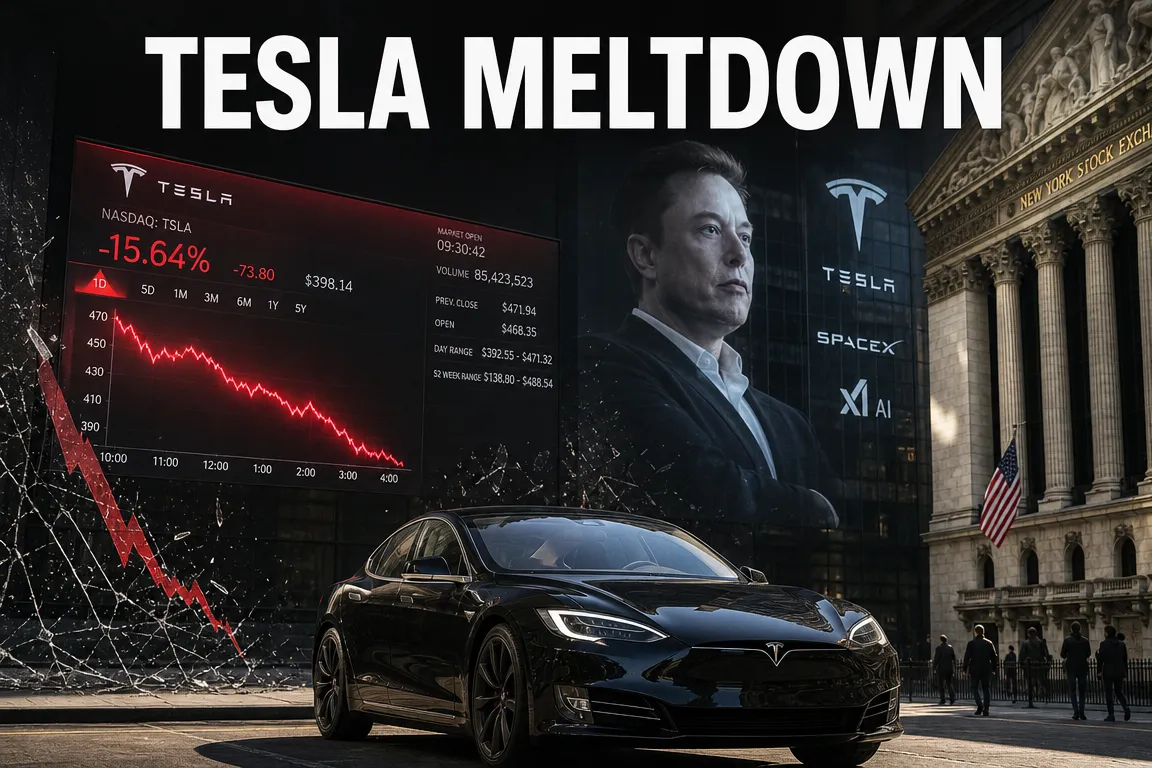
Why Tesla Fell Twice as Much as the Nasdaq: The Significance of the $380 Billion Decline in Musk-Related Company Valuations
Attributing Tesla’s sharp share-price decline solely to weaker electric vehicle sales or a broader technology-sector correction would overlook key factors.
The decline reflects concerns about automotive growth, potential integration among Elon Musk’s companies, political risk, and the capital burden of AI data centers.
Reuters’ estimate of $380 billion does not represent an actual cash outflow. It indicates a reduction in the market valuations assigned to Musk-related companies.
This report examines why Tesla underperformed the Nasdaq and how investors assess Tesla, SpaceX, and xAI as part of a broader corporate ecosystem.
Key Development | Valuations of Musk-Related Companies Declined by More Than $380 Billion
The central figure cited from Reuters is approximately $380 billion.
It represents a substantial one-week decline in the market capitalization or estimated valuations of companies associated with Elon Musk, including Tesla and SpaceX.
However, Tesla is publicly listed, while SpaceX and xAI are privately held. Their valuation declines therefore cannot be calculated using identical methods.
Tesla’s market capitalization is determined by its real-time share price. Private-company valuations are generally estimated using recent funding rounds, secondary share transactions, or disclosed equity values.
The $380 billion figure should not be interpreted as an actual loss of cash.
- No $380 billion cash outflow occurred from corporate bank accounts.
- The figure reflects lower market valuations assigned by investors.
- Lower valuations and deteriorating cash flow can be related, but they are not equivalent.
- Elon Musk’s personal net worth can also fluctuate substantially based on the value of his equity holdings.
Why Tesla Fell Approximately Twice as Much as the Nasdaq
According to the source, Tesla fell more than 3% on the day after the election and subsequently declined approximately 10%, more than twice the Nasdaq’s loss.
An exact comparison requires confirmation of the election date and type, the relevant benchmark, and whether identical trading periods were used.
Nevertheless, the structural reasons for Tesla’s larger decline are relatively clear.
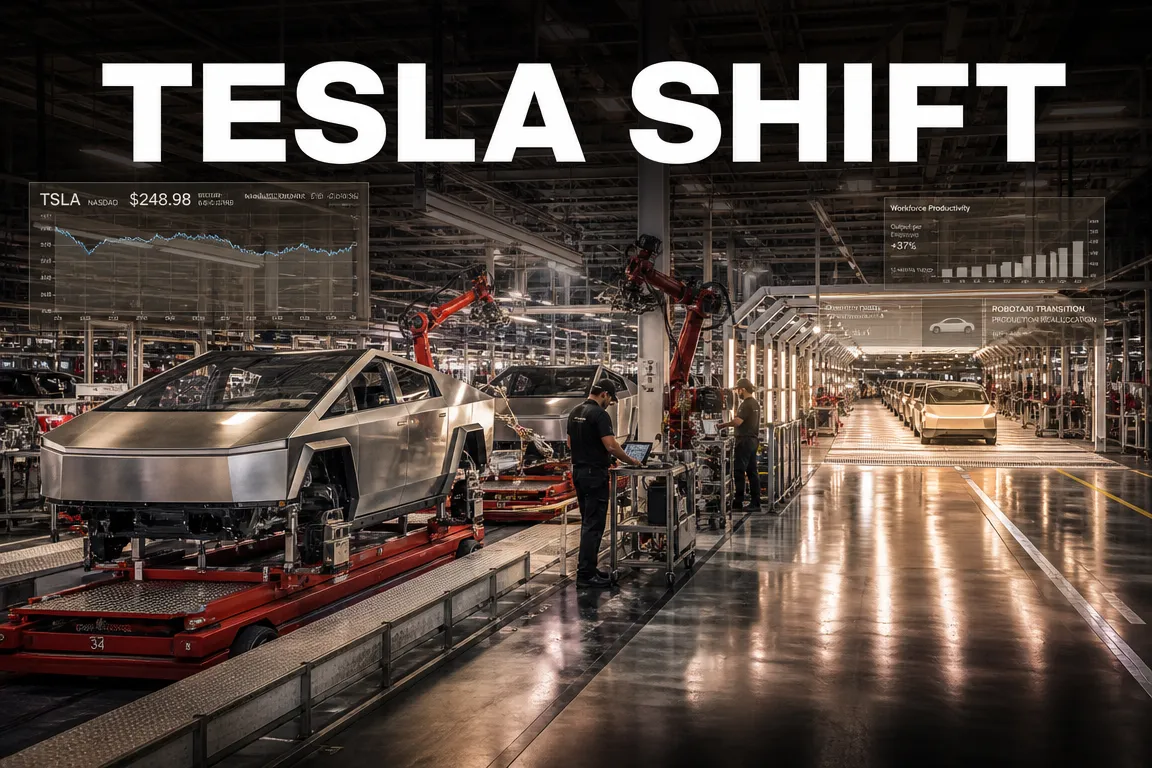
Tesla is valued not only as an automaker but also as a high-multiple growth company with exposure to AI, robotics, energy, and autonomous driving.
Such stocks can outperform during rising markets but often decline more sharply when investors reduce exposure to risk assets.
First Factor | A Valuation Driven More by Future Expectations Than the Automotive Business
Tesla’s valuation cannot be explained solely by its current electric vehicle sales.
Investors have priced in potential earnings from full self-driving technology, robotaxis, the Optimus humanoid robot, energy storage, and AI training infrastructure.
This creates risk when the earnings visibility of those businesses weakens.
If electric vehicle growth slows or price reductions compress automotive operating margins, investors may also reduce the premium assigned to future businesses.
Tesla is therefore particularly sensitive to changes in long-term assumptions.
- EV demand: High interest rates and economic uncertainty can increase the cost of vehicle ownership.
- Price competition: Chinese EV manufacturers and established automakers can pressure vehicle prices and profitability.
- Product cycle: Delays in new models or insufficient upgrades to existing products can increase growth concerns.
- Autonomous driving: Regulatory approvals and commercialization timelines remain uncertain despite technological progress.
- AI investment: Large infrastructure expenditures may not produce revenue within a clearly defined period.
Tesla’s share price reflects both automotive performance and expectations for AI-related growth.
If both factors weaken simultaneously, the stock can decline substantially more than the broader US equity market.
Second Factor | Integration and Governance Risks Across Tesla, xAI, and SpaceX
A second concern is the potential operational integration of Musk-related companies.
Tesla, xAI, SpaceX, and social media platform X are legally separate entities, but they are connected through AI, data, communications infrastructure, and personnel.
These relationships could generate long-term synergies.
However, Tesla shareholders may be concerned that Tesla’s cash, employees, semiconductors, or computing resources could be used to support privately held affiliates.
Key investor questions include:
- Which company receives the economic benefits from AI technology and data developed by Tesla?
- How are costs allocated when xAI and Tesla share computing infrastructure?
- Are intercompany transactions conducted on fair terms for Tesla’s public shareholders?
- Would a future merger or equity exchange dilute Tesla shareholders?
- How does Musk allocate his time and management attention among the companies?
Corporate collaboration is not inherently negative.
However, insufficient transparency or the possibility that Tesla shareholders could bear disproportionate costs may create a governance discount.
Merger expectations also do not necessarily support share prices.
If investors interpret a transaction as financial support or a transfer of risk rather than a growth opportunity, the market response may be negative.
Third Factor | Elon Musk’s Political Influence as a Corporate Risk
Tesla is particularly exposed to the effect of its chief executive’s political statements and activities on corporate brand value.
Greater political influence may support expectations of regulatory relief or improved policy access.
However, changes in election outcomes or the political environment can quickly reverse those expectations.
Political risk can affect several operational areas:
- EV tax credits and clean-vehicle subsidies may change.
- Autonomous-driving regulation and safety investigations may shift.
- US government contracts involving space, communications, and defense may face political scrutiny.
- Musk’s political statements may divide Tesla’s customer base.
- Brand preference may weaken in European and Asian markets.
Tesla vehicles are consumer products, making brand perception relevant to sales.
As political polarization increases, Musk’s public positions may have a greater effect on Tesla’s revenue and valuation.
Why SpaceX’s Infrastructure Expansion Can Affect Tesla
The source compares SpaceX’s data-center leasing activity with Tesla’s share-price decline.
However, the entities responsible for expanding AI data centers and using large-scale computing capacity should be identified separately for each transaction, particularly xAI and Tesla.
SpaceX also operates extensive infrastructure for satellite communications and space operations, but its contractual obligations and cost structure are not identical to those of other Musk-related companies.
Tesla can still be affected because investors do not assess the companies as entirely independent entities.
Tesla is the only major publicly traded company within Musk’s corporate ecosystem.
Investors unable to trade the risks of privately held SpaceX or xAI directly may use Tesla shares to express their broader expectations or concerns regarding the Musk ecosystem.
Tesla consequently trades partly as a publicly listed proxy for that ecosystem rather than solely as an automaker.
Indirect Effects of AI Data-Center Investment on Tesla
Global AI competition is increasing spending on data centers, AI semiconductors, electricity, and cooling infrastructure.
Training large AI models at xAI requires high-performance chips, including Nvidia GPUs, and substantial power capacity.
Tesla also requires significant computing investment to develop autonomous driving, robotaxis, and Optimus.
These investments may strengthen long-term technological competitiveness.
In the near term, however, they can pressure cash flow and profitability.
If capital expenditure rises while revenue from autonomous driving and robotics is delayed, Tesla’s valuation risk may increase.
Structural Reasons for Tesla’s Higher Volatility
Nasdaq indices include diversified exposure to semiconductors, cloud computing, software, e-commerce, and platform companies.
Weakness in one company can be partially offset by gains elsewhere in the index.
Tesla is a single company directly exposed to company-specific risks involving earnings, management, regulation, and product launches.
Factors contributing to Tesla’s higher volatility include:
- Substantial future growth is already reflected in the share price.
- High retail participation and options activity can amplify price movements.
- News involving Elon Musk can affect investor sentiment immediately.
- Tesla is valued simultaneously as an automotive and AI company.
- Valuation multiples of high-growth stocks can contract rapidly during technology-sector corrections.
A 10% decline in Tesla when the Nasdaq falls 5% is therefore not inherently unusual.
High-beta stocks that outperform in rising markets often experience larger losses during market downturns.
The Most Important Issue Often Overlooked
The central issue is not only Tesla’s vehicle sales but also the simultaneous erosion of the confidence premium previously assigned to Musk-related companies.
Investors historically assigned high valuations based on expectations that Musk could connect multiple industries and create new markets.
However, as resource allocation becomes more complex and political uncertainty increases, those corporate connections can become a valuation discount.
The sharing of technology and personnel may create ecosystem-level advantages while also appearing to public shareholders as a potential conflict of interest.
Another critical issue is that risks originating in private companies may be reflected disproportionately in Tesla’s public share price.
SpaceX and xAI do not have continuously quoted market prices.
Tesla can be traded immediately, making it the first asset to adjust when negative developments affect the broader Musk ecosystem.
This helps explain why Tesla shares can move substantially more than changes in the automotive business alone would suggest.
Five Indicators for Investors to Monitor
First, automotive operating margin.
Higher sales volumes may not produce meaningful earnings growth if price reductions and rising costs compress margins.
Second, free cash flow.
Investors should assess whether Tesla generates sufficient cash after spending on AI, robotics, and new manufacturing facilities.
Third, commercialization of autonomous driving and robotaxis.
Regulatory approval, paid-service coverage, accident rates, and revenue per vehicle are more relevant than demonstrations or announcements.
Fourth, transactions among Musk-related companies.
Investors should monitor whether investments, contracts, and personnel transfers among Tesla, xAI, and SpaceX are disclosed transparently.
Fifth, the financial impact of political risk.
The focus should be on changes in brand preference, vehicle orders, regulation, and government contracts rather than political headlines alone.
Connection to the Global Economic Outlook
Tesla’s decline is both a company-specific development and an indicator of global risk appetite in US equities.
Persistently high market interest rates increase the discount rate applied to future earnings.
This generally has a greater effect on technology companies whose valuations depend more on future growth than current profits.
Economic slowdown concerns can reduce EV demand, while high interest rates increase vehicle financing costs.
At the same time, AI competition is increasing capital expenditure, requiring Tesla to manage growth and investment burdens simultaneously.
Tesla’s future performance is likely to depend on the interaction of interest rates, AI spending, autonomous-driving regulation, political uncertainty, and vehicle deliveries.
Important Considerations When Interpreting the Data
The $380 billion figure is significant, but its calculation methodology must be reviewed.
Combining Tesla’s market-capitalization decline, changes in estimated private-company valuations, and reductions in Musk’s personal net worth could result in double counting.
The statement that Tesla fell twice as much as the Nasdaq also requires consistent measurement periods and closing prices.
The Nasdaq Composite and Nasdaq-100 have different constituents and may produce different comparisons.
Investors should verify the relevant trading dates, benchmark index, and valuation methodology before using such figures in investment decisions.
< Summary >
The $380 billion decline in the value of Musk-related companies represents lower market valuations, not an actual cash outflow.
Tesla underperformed the Nasdaq because of its elevated valuation, slower automotive growth, AI investment requirements, potential intercompany conflicts, and political risk.
Tesla trades both as an automaker and as a publicly listed proxy for the broader Musk corporate ecosystem.
Expectations and risks involving SpaceX and xAI can therefore be reflected first in Tesla’s share price.
Investors should monitor automotive operating margins, free cash flow, autonomous-driving commercialization, intercompany transactions, and the financial effects of political risk.
[Related Articles…]
*Source: [ 오늘의 테슬라 뉴스 ]
– 테슬라는 왜 나스닥의 2배 빠졌나? #테슬라 #shorts
● AI Boom, Wealth Gap, Korea 2027 Shocks
Why Capital Is Concentrating in AI: The 190-Fold Wealth Gap and South Korea’s 2027 Economic Outlook
Three factors are essential to understanding the economic outlook for 2027.
The government is seeking to support growth and future industries through fiscal expansion, while the Bank of Korea is maintaining a relatively restrictive monetary stance due to inflation and household debt risks.
Meanwhile, global capital is rapidly concentrating in AI semiconductors and major technology companies, widening disparities across industries and household wealth.
This report examines the divergence between fiscal and monetary policy, South Korea’s need to secure technological leadership centered on high-bandwidth memory, investment strategies amid widening wealth inequality, and the measures individuals and companies should take to remain competitive in the AI era.
Particular attention is given to the composition of government expenditure, the statistical interpretation of the 190-fold wealth gap, and the strategic importance of controlling critical bottleneck technologies in the AI value chain.
1. The Central Economic Issue for 2027: Fiscal Expansion and Monetary Restraint
A primary issue is the simultaneous implementation of expansionary fiscal policy and restrictive monetary policy.
The government intends to increase expenditure to support economic growth, develop future industries, and expand financial assistance.
By contrast, the Bank of Korea must account for inflation, household debt, potential overheating in the property market, and exchange-rate volatility, resulting in a more cautious policy stance.
At first glance, the government appears to be stimulating the economy while the central bank is seeking to restrain it.
This may lead markets to question policy coordination.
However, the policy mix can also be interpreted as a division of responsibilities among institutions managing different risks.
- The government is responsible for growth and investment in future industries.
- The Bank of Korea is responsible for price and financial stability.
- Financial authorities oversee household debt and capital-market risks.
- Industrial policy supports strategic sectors such as semiconductors, AI, robotics, and space technology.
The structure is comparable to increasing heating while a window remains open during winter.
Monetary restraint reduces demand, while fiscal policy prevents economic activity from weakening excessively.
For this policy mix to succeed, government expenditure must move beyond short-term consumption support and increase productivity and potential growth.
2. The Allocation of Fiscal Spending Matters More Than Its Scale
Large excess tax revenues have been cited as a potential basis for fiscal expansion.
However, estimates of excess revenue and the fiscal balance can vary significantly depending on revenue assumptions, the inclusion of special funds, and the timing of final accounts.
The figure of approximately KRW 150 trillion should therefore not be treated as a confirmed single-year result without determining whether it represents a forecast or a cumulative estimate.
The growth rate of the 2027 budget may also change during preparation, parliamentary review, and final approval.
The central issue is how additional fiscal resources are allocated.
Short-term cash transfers and one-off programs may support consumption but are unlikely to increase long-term productive capacity.
Investment in research and development, workforce development, power grids, data centers, and advanced manufacturing infrastructure could attract private investment and expand the future tax base.
Investors should examine expenditure growth by major policy category and the efficiency of individual programs rather than focusing only on the overall budget growth rate.
- R&D budget: The allocation should support technological independence and foundational research.
- AI infrastructure: Investment in data centers, power grids, GPUs, and computing capacity should translate into measurable industrial competitiveness.
- Workforce development: Policy should establish a sustainable pipeline of advanced researchers and field engineers rather than rely on short-term training programs.
- SME support: Assistance should prioritize AI adoption, automation, and export expansion rather than stand-alone subsidies.
- Debt management: A portion of any excess fiscal resources could be used to reduce government debt and interest costs.
The economic impact of fiscal policy depends more on the fiscal multiplier and the duration of its effects than on the nominal amount spent.
The long-term impact of KRW 1 trillion in one-off consumption support can differ substantially from the same amount invested in advanced industrial infrastructure.
3. Why the Bank of Korea May Find It Difficult to Cut Rates Rapidly
The Bank of Korea does not determine monetary policy solely on the basis of economic growth.
It must also consider consumer inflation, housing prices, household borrowing, the won-dollar exchange rate, and the policy path of the U.S. Federal Reserve.
A significant increase in government spending could add liquidity to domestic demand and asset markets.
If the Bank of Korea cuts its policy rate rapidly under these conditions, inflation could reaccelerate and the property market could overheat.
Because South Korea has a high level of household debt, lower interest rates may initially stimulate mortgage borrowing rather than consumption.
A policy mix in which the government supports growth while the central bank manages inflation and financial stability may therefore be unavoidable.
However, excessive divergence between fiscal and monetary policy could increase market-rate volatility and weaken policy credibility.
Authorities should provide clear guidance on the duration and scale of fiscal expansion, government bond issuance, and household debt management.
4. AI as Both a Growth Engine and a Driver of Wealth Inequality
AI provides a new source of growth for South Korea while also accelerating economic inequality.
On the positive side, AI can support growth through semiconductor exports, capital investment, corporate earnings, and an improved current-account balance.
South Korea is a critical supplier in the global AI value chain, particularly in memory semiconductors and high-bandwidth memory.
Training and inference for generative AI models require substantial computing capacity, while advanced GPUs depend on HBM to process large volumes of data efficiently.
As AI investment expands, demand for HBM and advanced packaging is likely to increase.
However, the direct benefits of AI investment remain concentrated among a limited number of major technology, semiconductor, data-center, and power-infrastructure companies.
Capital flows toward companies with rapidly increasing productivity and earnings, raising the value of their shares and related assets.
Existing asset owners benefit from this appreciation, while households with limited financial assets may remain excluded.
AI-driven growth is therefore likely to accrue first to companies and individuals that already control technology and capital.
5. Why Capital Is Concentrating in AI Companies and Related Assets
Capital markets are assigning premium valuations to companies that can demonstrate revenue growth and cash flow rather than relying solely on future growth expectations.
AI model developers, cloud providers, semiconductor manufacturers, data-center operators, and electrical equipment companies can use strong growth prospects to issue bonds and attract large-scale investment.
Financial institutions and investors are consequently more inclined to allocate capital to AI-related businesses than to slower-growing traditional industries.
This creates a reinforcing cycle in which strong performance attracts capital, new capital increases investment and technological differentiation, and greater competitiveness further raises corporate value.
- Demand for AI increases.
- Revenue and earnings at related companies rise.
- Share prices and corporate valuations increase.
- Debt and equity financing become more accessible.
- Companies expand investment in data centers and R&D.
- The competitive gap between market leaders and late entrants widens.
Biotechnology and selected defense and energy industries are also considered growth sectors, but capital concentration remains strongest across the AI ecosystem.
This trend may deepen polarization across both industries and equity markets.
6. Interpreting the 190-Fold Wealth Gap
One analysis indicates that while the income gap is approximately ninefold, the asset gap between the top and bottom 20% may be as high as 190 times.
The figure suggests that wealth inequality can be substantially greater than labor-income inequality.
However, interpretation requires clarification of whether the data measure gross or net assets, households or individuals, and how property and financial assets are valued.
If the net assets of lower-income households are minimal or negative because of debt, the ratio can rise sharply.
The 190-fold figure should therefore be evaluated alongside asset composition and debt levels.
Nevertheless, the underlying conclusion remains relevant.
Labor income alone is increasingly insufficient to keep pace with asset appreciation among households that already own substantial wealth.
Owners of equities, property, bonds, and pension assets can capture part of economic growth and inflation through capital appreciation.
Households with high cash holdings and debt exposure may instead face both declining purchasing power and increased interest burdens.
7. The Most Important Structural Issue
The central conclusion is not simply that investors should purchase AI-related equities.
The more significant development is that AI is changing both income distribution and capital allocation.
Historically, securing stable employment and increasing wages were central to household wealth formation.
Going forward, households may need to combine higher labor income with diversified exposure to assets benefiting from productivity growth.
Income redistribution alone is unlikely to resolve wealth inequality.
Transfers to low-income households can provide short-term financial stability but do not automatically reduce disparities in financial-asset ownership.
Long-term policy should combine pensions, long-term savings, tax incentives, and financial education to broaden participation in capital markets.
Institutional support is also required to help younger and non-homeowning households accumulate long-term assets without excessive leverage.
Policies addressing wealth inequality must therefore move beyond income transfers and expand access to sustainable asset formation.
8. South Korea Must Secure Chokepoint Technologies Beyond HBM
A core industrial strategy is to secure control over chokepoint technologies.
These are technologies that occupy indispensable bottlenecks within an industry’s value chain.
Control over such technologies makes it difficult for global companies to manufacture final products without South Korean participation.
HBM is a representative example.
Memory bandwidth is critical to the performance of advanced AI accelerators, and HBM is a key component in resolving this constraint.
If South Korean companies maintain their advantage in HBM and advanced memory, the country can retain substantial bargaining power within the global AI industry.
However, the current competitive advantage is not permanent.
Companies in the United States and China are investing aggressively in memory semiconductors and advanced packaging.
South Korea should protect its existing HBM position while expanding into the following areas:
- Next-generation HBM: Key capabilities include 3D stacking, thermal management, energy efficiency, and higher bandwidth.
- Advanced packaging: Stronger capabilities are required to integrate GPUs, memory, and interposers efficiently.
- Non-memory semiconductors: Selective investment is needed in AI accelerators, automotive chips, power semiconductors, and sensors.
- AI software: Hardware strength alone may allow overseas platforms to capture a significant share of value creation.
- Robotics and physical AI: Integration with South Korea’s manufacturing base could create a comparative advantage.
- Space industry: Policy should target selected segments such as satellites, communications, and observation data.
South Korea should prioritize technologies in which it has existing capabilities and that are indispensable to global markets rather than attempt to develop every industry simultaneously.
Concentrating R&D funding and talent in a limited number of strategic technologies may be more effective than distributing resources broadly.
9. Industrial Transformation Across the Stages of AI Development
AI remains at an early stage of economy-wide adoption.
The technology has progressed from predictive and classification systems to generative AI, and is now moving toward agentic AI capable of planning and executing tasks independently.
The next stage is physical AI, in which robots and autonomous systems operate in the real world.
- Predictive AI: Analyzes data to make forecasts and classifications.
- Generative AI: Produces text, images, video, code, and other original outputs.
- Agentic AI: Interprets objectives and uses multiple tools to complete complex tasks.
- Physical AI: Enables robots, vehicles, and industrial equipment to make decisions and operate in physical environments.
Large-scale adoption of physical AI could transform production systems across manufacturing, logistics, automotive, defense, and healthcare.
South Korea’s manufacturing and semiconductor base may provide stronger opportunities in physical AI than in software-centered generative AI alone.
10. Companies Must Decide Whether to Be Replaced by AI or Use It
In the AI era, adoption speed and organizational transformation may become more important than company size.
Companies that preserve repetitive administrative processes without redesigning their workforce and operations may experience a rapid decline in relative productivity.
AI should be used not merely as a chatbot or document-generation tool, but as a means of restructuring business processes.
- AI can analyze customer-service and sales data.
- Generative AI can support design and R&D.
- Companies can improve supply-demand and inventory forecasting.
- Repetitive accounting, legal, and administrative tasks can be automated.
- Manufacturers can improve defect detection and predictive maintenance.
The relevant measure is not whether a company has adopted AI, but whether adoption produces lower costs, higher revenue, and faster decision-making.
Without measurable performance indicators, AI projects may become an additional operating expense rather than a source of productivity.
11. Asset-Management Strategy for Individuals in the AI Era
As wealth inequality increases, holding excessive cash may result in a sustained loss of purchasing power.
However, leveraged concentration in AI-related equities is not an appropriate response.
The AI industry has strong growth potential, but companies with excessively high expectations embedded in their valuations may experience significant volatility if results disappoint.
A practical investment framework consists of financial resilience, diversification, and measured participation in structural growth.
- Establish financial resilience.
Maintain emergency reserves and appropriate insurance coverage, and prioritize the repayment of high-interest debt. - Use long-term diversified investment.
Pension accounts and periodic investment can reduce exposure to short-term market timing. - Participate indirectly in AI growth.
Assess the full AI value chain, including semiconductors, cloud services, data centers, power grids, cooling systems, and networks. - Limit concentration risk.
A promising industry is not necessarily an attractive investment at every valuation. Corporate fundamentals and pricing must be assessed together. - Treat skills development as an investment in human capital.
Using AI tools to improve workplace productivity can support long-term income and wealth formation.
Even when an industry has substantial growth potential, investment returns may be limited if assets are purchased at excessive valuations.
Investors should evaluate revenue growth, operating profit, cash flow, leverage, and valuation together.
These principles are general observations on structural economic change and do not constitute a recommendation to purchase any specific financial product.
12. Key Indicators for Assessing South Korea’s Economy in 2027
The 2027 outlook should be assessed through interconnected policy, industrial, and asset-market indicators rather than through economic growth alone.
- Tax revenue and fiscal balance: Determine whether excess revenue has materialized and whether it reflects temporary factors.
- Budget composition: Distinguish welfare-related spending from productivity-enhancing investment.
- Policy and market interest rates: Monitor government bond yields and lending rates in addition to the Bank of Korea’s policy rate.
- Household debt: Assess whether mortgage lending and property prices are accelerating again.
- Semiconductor exports: Determine whether HBM demand and higher memory prices are supporting broader export growth.
- Corporate earnings: Verify whether AI expectations are translating into actual revenue and profit.
- Current account and exchange rate: Assess whether export growth supports currency stability and domestic investment.
- Labor market: Monitor whether AI-driven productivity gains are accompanied by the displacement of middle-skill jobs.
Even if AI-related exports increase, weak domestic demand and employment could limit improvement in the economy experienced by households.
Conversely, excessive fiscal stimulus intended to support domestic demand could renew inflation and debt pressures.
The success of economic policy in 2027 will depend on balancing growth, inflation, leverage, and industrial transformation.
13. Two Policy Priorities for the Government
The first priority is to capture the growth opportunities created by AI.
Regulation and infrastructure should support sustained private investment in semiconductors, robotics, power grids, data centers, and advanced manufacturing.
The second priority is to reduce the concentration of growth benefits among a limited number of companies and existing asset owners.
Income support should be combined with policies that facilitate long-term asset formation.
- Expand matching support for long-term savings by younger and lower-income households.
- Improve the returns and management structure of retirement pension plans.
- Reduce exposure to high-interest debt among financially vulnerable households.
- Expand financial and AI education in schools and workplaces.
- Provide data and computing infrastructure that enables SMEs and regional companies to adopt AI.
AI growth policies and measures to reduce wealth inequality are not mutually exclusive.
The objective should not be to restrict growth, but to broaden participation in the growth process.
< Summary >
South Korea’s economy in 2027 may operate under a combination of fiscal expansion and relatively restrictive monetary policy.
The composition of expenditure will matter more than the headline budget growth rate, particularly allocations to R&D, AI infrastructure, workforce development, and debt management.
AI is a growth engine for semiconductor exports and corporate earnings, but it may also intensify wealth inequality by concentrating capital in a limited number of companies and assets.
The reported 190-fold wealth gap requires careful interpretation, but it highlights the increasing difficulty of keeping pace with asset appreciation through labor income alone.
South Korea must maintain its HBM competitiveness while securing chokepoint technologies in advanced packaging, non-memory semiconductors, robotics, and physical AI.
Individuals should strengthen their ability to use AI while managing debt and obtaining diversified, long-term exposure to productive assets.
Government policy should move beyond income support and provide financially vulnerable households with sustainable opportunities for long-term asset formation.
[Related Articles…]
*Source: [ 경제 읽어주는 남자(김광석TV) ]
– AI로 돈이 한쪽에 몰린다…자산 격차 190배 시대가 온 이유 | 경읽남 콜라보 | 조세일보 인터뷰 [3편]