● Next Platform War
AI Glasses Created by Samsung, Google, and Gentle Monster: The Competition for the “Next Platform” After Smartphones Has Begun
Today’s Key Takeaways at a Glance
The AI glasses jointly created by Samsung Electronics and Google will begin pre-orders on November 12.They are scheduled for official release in December, with Gentle Monster handling design and Warby Parker handling sales.The core point of this product is that it is not AR glasses that project a display onto the lens, but a voice-based AI communication device using a camera, microphone, and speakers.In other words, a new consumer experience is beginning, combining AI search, wearables, smartphone connectivity, real-time translation, navigation, and photography in one device.This issue matters even more because it is not just a simple new product announcement, but a signal that helps gauge the next growth engine for the global economy and the AI industry.In particular, it is an event that could move semiconductors, wearables, fashion tech, platform ecosystems, and the global consumer goods market all at once.
First, Let’s Summarize the News
Samsung Electronics and Google have officially entered the AI glasses market.Gentle Monster announced through its official website that pre-orders for “Intelligent Eyewear” will begin on November 12, with a December launch planned.U.S. eyewear brand Warby Parker will also begin pre-orders on the same day and prepare shipments for the year-end holiday season.This product is an AI wearable that combines Samsung’s hardware, Google’s Android XR platform and Gemini, and Qualcomm’s Snapdragon chipset.It is designed not as a device that displays information on the lens, but as a camera-based AI assistant centered on voice interaction.In other words, Samsung and Google have now launched a direct challenge to the smart glasses market that Meta has been developing with Ray-Ban.
Why This News Matters
If you see this issue merely as “a new pair of glasses,” you will miss a lot.The core point is where the leadership after smartphones will shift.Until now, AI has mostly operated inside apps.But when AI enters a device that people wear all the time, such as glasses, it becomes not just something that responds when the user asks, but an always-present interface attached to daily life.This changes the frequency of AI usage, the way data is collected, advertising and commerce structures, and even hardware replacement cycles.That is why we need to look at the global economy, technology stocks, semiconductors, consumer goods, and platform competition together.
The Structure of These AI Glasses Is Not Difficult to Understand
1) They Are Different from AR Glasses That Display Information on the Lens
This product is not a typical augmented reality, or AR, pair of glasses.Rather than displaying a screen in front of the eyes, it focuses on sound and voice.The camera sees the surroundings, the microphone listens to the user’s questions, and the speaker delivers the answer.In other words, it is closer to a “voice-based AI assistant” than a “screen-viewing device.”The reason this difference matters is adoption speed.Voice-based AI can enter everyday life much earlier and more easily than complex display-based devices.
2) The Features Are More Practical Than They May Seem
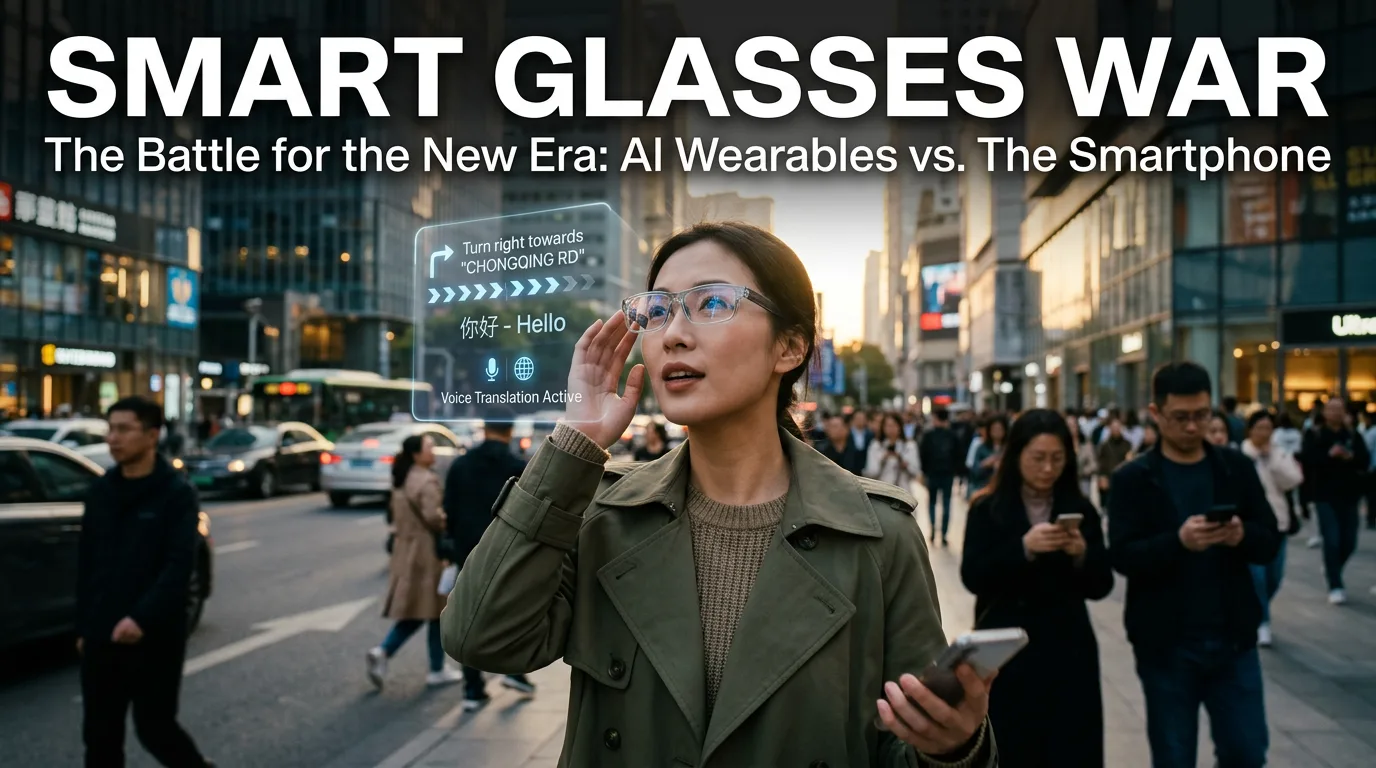
These glasses can provide information about nearby objects or places.They also support real-time translation and navigation.Photography is also supported.They connect to a smartphone and can be controlled through voice commands or touch controls on the frame.In other words, this is a product that combines a “fashion item, camera, AI assistant, translator, and navigation device” into one.From the consumer’s perspective, this is quite intuitive.Instead of taking out a device from your hand or pocket, you simply wear the glasses and speak.
3) They Are More Likely to Sit Beside Smartphones Than Replace Them
At this stage, it is unlikely that AI glasses will immediately replace smartphones.Instead, they are more likely to establish themselves as an auxiliary interface connected to smartphones.This is realistic.Considering battery life, screen size, input methods, and privacy issues, the auxiliary model makes more sense for now.However, even if they begin as a supporting device, if user habits change, they could eventually become a central platform.This is the point that investors and the industry are watching closely.
Who Has Entered This Market?
1) Samsung Electronics: Hardware and Manufacturing Strength
Samsung Electronics is a company with experience in wearables, displays, semiconductors, and mobile connectivity.AI glasses can essentially be seen as a small smartphone ecosystem, and Samsung has almost all the components and technologies needed to build it.This is not just manufacturing; it is closer to gaining entry into a platform.For Samsung, this means securing the next-generation mobile form factor in advance after foldables.
2) Google: Android XR and Gemini
Google is the software pillar of this product.Through the Android XR platform and Gemini, Google plays the role of providing a voice-centered AI experience.Google has strengths in search, maps, translation, voice recognition, and multimodal AI.This means it is one of the companies best suited for AI glasses.In fact, this product can also be seen as Google’s attempt to evolve from a “search engine” into a “real-world-aware AI engine.”
3) Qualcomm: The Core Chipset Supplier
Qualcomm provides the Snapdragon chipset.In wearable devices, heat management, power efficiency, and connectivity are more important than raw performance.Because AI glasses must be small and lightweight, the key is not simply inserting high performance, but designing efficiency well.The presence of Qualcomm means this product is structured with actual commercialization in mind, not merely as an experimental concept.
4) Gentle Monster and Warby Parker: Turning Technology into Fashion
Gentle Monster is well known for design, emotional appeal, and spatial experiences.Warby Parker is a brand that grew through a D2C model and innovation in online distribution.What the two companies have in common is that they have turned glasses from a simple vision-correction tool into a consumer experience product.That is why this collaboration matters.AI glasses do not sell just because their performance is good.People must want to wear them.Making that possible is the role of fashion brands.
Why the Competition with Meta Ray-Ban Has Greater Meaning
Meta opened the smart glasses market early through its collaboration with Ray-Ban.Its strength was combining a camera with voice-based AI.Now, with Samsung Electronics and Google entering the market, the competitive landscape has completely changed.Meta emphasizes social platforms and AI as its strengths,while Samsung and Google use hardware, Android XR, and the Gemini ecosystem as their weapons.Ultimately, this market is less about “who makes the prettiest glasses” and more about “who can insert AI into daily life most naturally.”This competition could spread to AI search, location information, payments, advertising, and the digital advertising market.
Points to Watch from a Global Economic Perspective
1) The Wearables Market Could Grow Again
After smartwatches, the wearables market had felt somewhat stagnant for a while.However, if AI glasses become mainstream, a new growth engine could emerge.In particular, if translation, navigation, camera, search, and work-assistance functions are combined, the range of use cases will expand significantly.This is also positive for global consumer goods demand.
2) Semiconductor Demand Could Be Reorganized Around Devices
If AI glasses spread, demand for low-power semiconductors, sensors, memory, and communication chips could move together.Although it may not be as large as AI data centers, if device demand becomes broad and long-lasting, it can change the structure of the industry.In other words, AI investment does not end with servers; it eventually expands into everyday devices.
3) The Center of Gravity in AI Ecosystem Competition Is Moving from “Conversational” to “Real-World”
Until now, AI has been centered on chat windows.Going forward, it will move toward recognizing real-world spaces and responding on the spot.As this trend strengthens, search advertising, local advertising, map services, shopping recommendations, and voice commerce markets will grow together.AI is moving beyond simply answering questions and toward a structure that connects directly to actual consumption.
The Most Important Points That Other News Often Misses
1) The Core Point Is Distribution, Not AI
Many articles talk only about AI features, but what truly matters is distribution.The fact that Gentle Monster and Warby Parker were brought in means these AI glasses will be sold not as a technology product, but as a lifestyle product.Consumers look at design and comfort before they look at the chipset brand.In other words, this competition depends not only on AI performance, but on “who can make people wear the product naturally in everyday life without resistance.”This is a much bigger point than it may seem.
2) The Next Stage of Smartphones Is Not the Screen, but Context
People may easily think the next device will simply have a bigger screen, but in reality, contextual awareness matters more.A device that knows where I am, what I am looking at, and what question I am asking right now is more powerful.AI glasses are the beginning of this direction.That is why this announcement should be read as a signal of platform transition rather than just a product announcement.
3) Ecosystem Matters More Than Price in This Market
The price has not yet been disclosed, but the success or failure of this product will not be determined by price alone.What matters is how naturally it connects with Google services,how well it works with Samsung smartphones,and how smoothly the camera, translation, search, maps, and messaging functions operate.This is a classic ecosystem industry.In the early stage, connectivity matters more than price.
4) Privacy Issues Will Determine the Speed of the Market
Glasses equipped with a camera and microphone always come with privacy controversy.How this issue is designed and handled will determine the speed of adoption.Trust-based design is needed, including user indicator lights, recording notifications, and data processing methods.If this problem is solved well, the market will open; if not, mass adoption will be delayed.
Where This Is Heading from an AI Trend Perspective
The direction of this trend is clear.AI will no longer remain only inside PCs or smartphones.It is spreading into wearables, cars, home appliances, and body-worn devices such as glasses.Among them, glasses are the most natural next target because they combine vision, voice, mobility, and connectivity.The future AI trend can be summarized in three points.First, multimodal AI.Second, on-device AI.Third, real-world spatial awareness AI.This collaboration among Samsung, Google, and Gentle Monster is a moment where all three come together at once.
Checkpoints for Both Investors and Consumers
1) Semiconductors and Component Stocks
It is worth watching potential beneficiaries among companies related to low-power chips, sensors, camera modules, communication chips, and displays.
2) Platform Companies
Companies like Google, which possess search, maps, voice, translation, and AI assistant capabilities at the same time, have an advantage.Going forward, actual action conversion rates will matter more than simple search volume.
3) Fashion Tech and Consumer Goods
Brands like Gentle Monster show the power to turn technology into consumer goods.AI must become aesthetically appealing to become mainstream.This is a more important formula than many people think.
4) The Competitive Landscape with Meta
If Meta Ray-Ban opened the market first, Samsung and Google are responding with ecosystem expansion.The key question is who can keep more users engaged for longer.
Final Summary
These AI glasses are not just a simple new product.They are a signal that the interface war after smartphones has officially begun.As Samsung Electronics’ hardware, Google’s Gemini and Android XR, Qualcomm’s chipset, and the brands of Gentle Monster and Warby Parker come together, the first stage has opened for AI to enter daily life as a fashion item.Going forward, what matters more than how smart AI is will be how natural, attractive, and frequently used it becomes.If this trend grows, wearables, semiconductors, platforms, consumer goods, and advertising markets could all change in a chain reaction.Ultimately, the real core point of this news is not the “launch of glasses,” but “a change in the way AI enters everyday life.”
< Summary >
Samsung and Google have entered the AI glasses market in partnership with Gentle Monster.This product is closer to a voice-centered wearable AI device than screen-based AR, and it can be seen as the starting point of the interface competition after smartphones.The key beneficiary areas are semiconductors, wearables, platforms, and fashion tech.The real point that other articles often cover less is ecosystem over distribution, wearing experience over features, and mainstream adoption design over performance.
[Related Articles…]
How AI Glasses Are Reshaping the Wearable Market
Gemini and the Next Generation of AI Platform Competition
*Source: https://www.edaily.co.kr/News/Read?newsId=01095526645643752&mediaCodeNo=257