● Nvidia Shock, Nasdaq Surge, AI Rotation
Why the Nasdaq Surged Amid Unverified Jensen Huang Allegations: Oil Prices, a Potential Anthropic IPO, and Rotation in AI Semiconductors
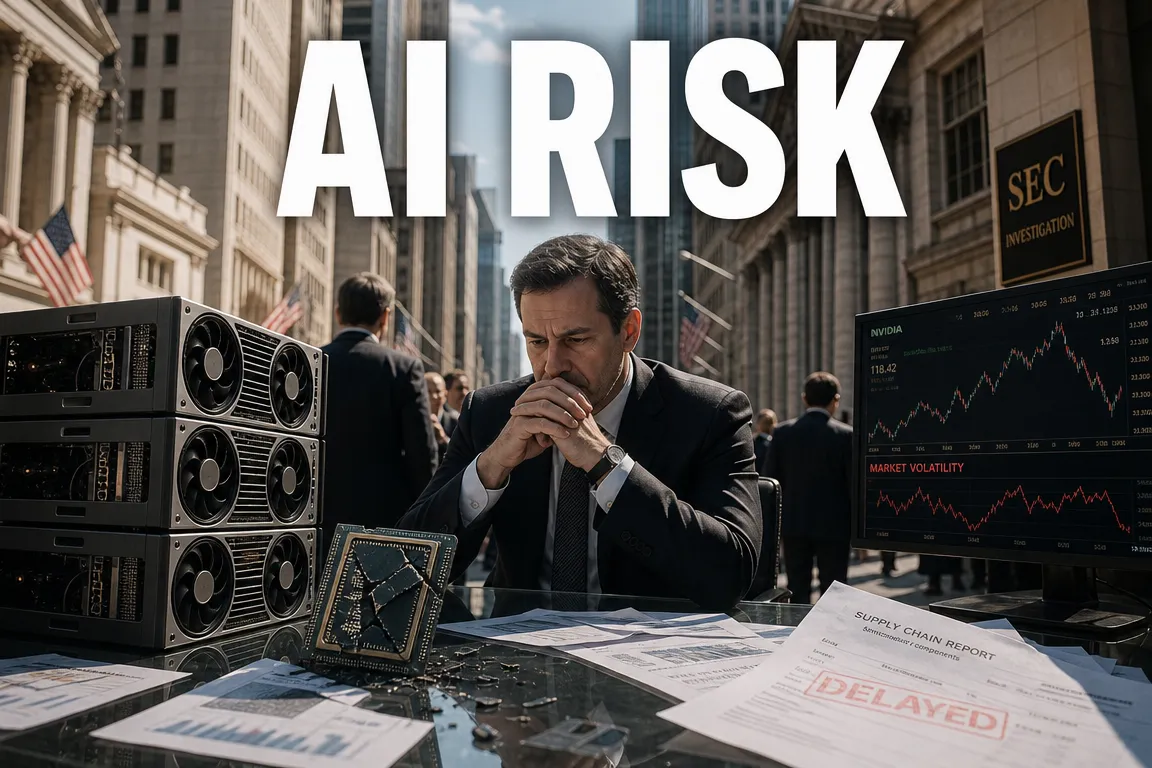
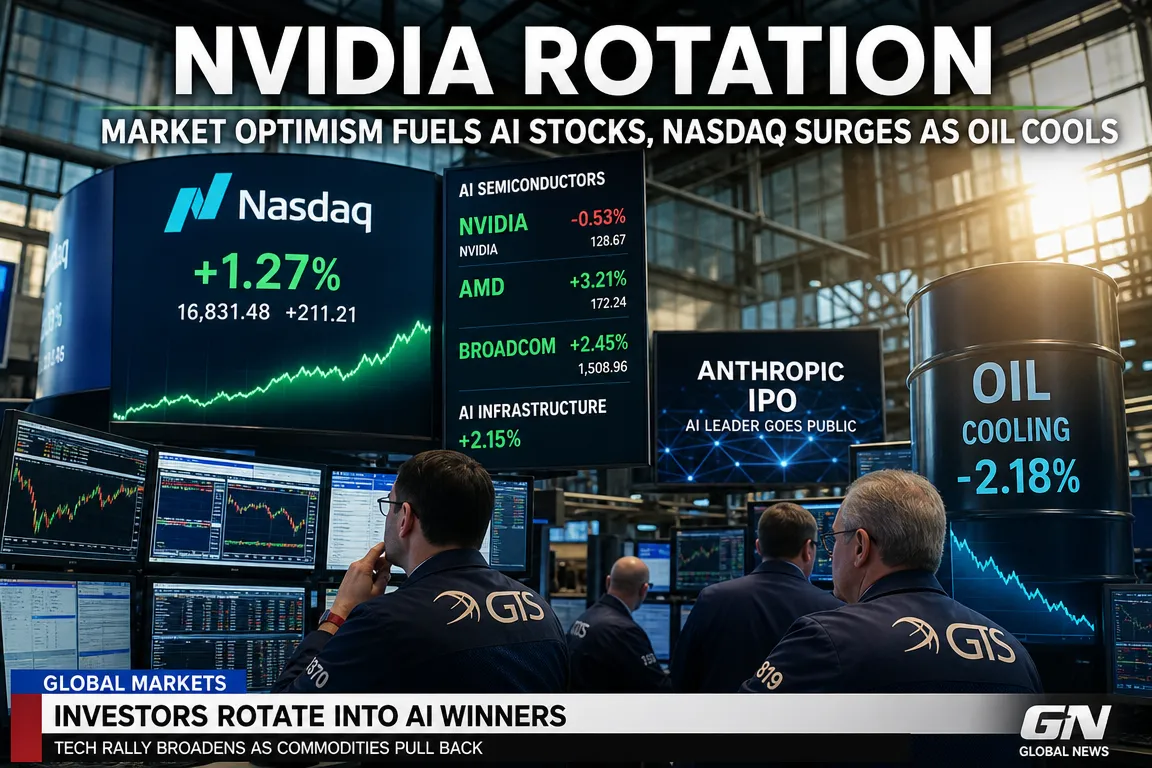
The key drivers of the Nasdaq rally were not allegations involving a specific individual, but lower oil prices, the AI investment cycle, bargain buying in oversold stocks, and changes in Nvidia’s competitive environment.
The central question is whether the reported 2.6% increase in the Nasdaq and 4.7% rise in KOSPI overnight futures signaled a trend reversal or merely a technical rebound within a broader downtrend.
This report also examines why a potential Anthropic IPO could support AI semiconductor demand and how weakness in Nvidia could create opportunities for AMD, Broadcom, and neocloud providers.
However, the personal and national security allegations concerning Jensen Huang cited in the source material have not been substantiated by official statements or multiple reputable news organizations.
Because treating unverified claims as facts could damage an individual’s reputation and distort investment decisions, they are addressed below only as an unconfirmed market variable.
1. What Changed Market Sentiment and Drove the Nasdaq Rally?
According to the source material, the Nasdaq rose approximately 2.6% intraday, while KOSPI overnight futures advanced about 4.7%.
These figures appear to reflect intraday prices at the time of recording. The relevant trading date, official closing prices, and final market data require verification.
The rebound can be attributed to four primary factors:
-
Expectations that geopolitical risks involving Iran would ease
-
Lower inflationary pressure following a decline in international oil prices
-
Expectations for a potential Anthropic IPO and a recovery in the AI investment cycle
-
Bargain buying in stocks that had recently experienced sharp declines
The Nasdaq’s advance is therefore better interpreted as the combined effect of several macroeconomic and AI industry catalysts rather than a reaction to a single development.
2. Why Easing Iran Risk and Lower Oil Prices Matter
The source material attributes part of the improvement in investor sentiment to comments by Donald Trump suggesting a lower probability of renewed military action against Iran.
Whether such comments lead to an actual policy change remains uncertain. Financial markets, however, can react quickly to indications that the risk of geopolitical conflict is declining.
Reduced tensions in the Middle East can lower concerns over oil supply disruptions and reduce the geopolitical risk premium embedded in crude oil prices.
The source material states that West Texas Intermediate and Brent crude declined by approximately 3% to 4%.
Lower oil prices can support technology stocks through three channels:
-
Lower energy costs can reduce consumer price inflation.
-
Expectations for interest-rate cuts by the Federal Reserve may strengthen.
-
A lower discount rate increases the present value of future earnings, reducing valuation pressure on growth and technology stocks.
The Nasdaq is particularly sensitive to changes in U.S. interest rates and oil prices because it has a high concentration of companies valued on long-term growth expectations.
The most direct macroeconomic explanation for the rebound was therefore likely the shift in oil prices and interest-rate expectations rather than unverified allegations.
3. How a Potential Anthropic IPO Could Affect the AI Market
The source material does not indicate that Anthropic has confirmed an initial public offering. It refers instead to reports that the company could begin formal IPO marketing.
These statements should be clearly distinguished.
Potential IPO marketing may indicate progress in listing preparations, but it does not confirm the timing or size of an offering.
An IPO by a generative AI company such as Anthropic would matter for more than the addition of another technology company to the public market.
If an AI company raises substantial capital through an IPO, it could increase investment in GPUs, data centers, power infrastructure, and cloud capacity.
That capital could flow to Nvidia, AMD, Broadcom, memory manufacturers, server vendors, and data center operators.
The market’s expected investment cycle can be summarized as follows:
-
AI companies secure capital through IPOs and private investment.
-
They use the proceeds to purchase AI semiconductors and cloud infrastructure.
-
Revenue increases for semiconductor and data center companies.
-
Growth in AI services generates additional infrastructure investment.
Conversely, delays in major AI company listings or weaker access to capital could reduce expectations for AI infrastructure demand.
Reports concerning a potential Anthropic IPO may therefore have been interpreted as evidence that the AI investment cycle could remain intact, even without a confirmed offering.
4. Why Nvidia Declined While AMD Advanced
The source material states that Nvidia declined approximately 6% intraday while AMD rose about 10%.
These figures may also represent intraday movements on a specific trading date and should be checked against official closing prices.
If the two stocks moved in opposite directions, the market may not have been reducing exposure to the entire AI industry. Instead, investors may have been reallocating capital away from Nvidia-specific risks and toward competitors.
If uncertainty emerges around Nvidia’s leadership or supply policies, customers may seek alternative suppliers.
AMD would be one of the most immediate potential beneficiaries.
AMD competes with Nvidia in data center GPUs and AI accelerators. It could benefit as customers adopt broader multivendor procurement strategies.
Broadcom could also benefit because it supplies custom AI chips, including application-specific integrated circuits, as well as networking equipment.
This pattern would indicate supplier diversification within a growing AI semiconductor market rather than the end of the industry’s expansion cycle.
5. Could Nvidia’s Challenges Benefit Other AI Companies?
One notable argument in the source material is that weakness at Nvidia could have positive implications for the broader U.S. AI ecosystem.
If Nvidia faces restrictions on overseas sales or weaker demand in certain international markets, more GPU supply could become available to U.S. customers.
Greater availability and less competition for hardware could stabilize GPU purchase prices and rental rates.
This could reduce costs for hyperscalers, neocloud providers, and AI startups that require substantial computing capacity.
Neocloud companies such as CoreWeave and Nebius purchase GPUs directly and lease computing resources to customers.
Their profitability depends not only on GPU prices but also on equipment acquisition costs, financing expenses, utilization rates, and customer contracts.
More favorable GPU supply conditions could therefore reduce the capital burden associated with new neocloud investment.
This argument does not apply in all circumstances.
If Nvidia’s difficulties reflect declining overall AI demand, lower GPU prices would not necessarily be positive.
If aggregate demand remains strong while market share shifts because of company-specific or supply-chain issues, AMD, Broadcom, and cloud infrastructure providers could benefit.
The critical indicator is therefore not Nvidia’s share price alone, but whether total demand for AI computing continues to expand.
6. Bargain Buying Amplified the Nasdaq Rebound
A practical explanation for the rally is that investors purchased technology stocks that had become oversold following recent declines.
After a rapid correction, long-term and institutional investors often identify stocks whose prices have fallen more sharply than their underlying earnings outlooks.
Short covering by investors closing profitable bearish positions can also amplify the advance.
This process can produce index gains of more than 2% in a single session.
However, an oversold rebound should not be confused with the beginning of a sustained uptrend.
A genuine trend reversal would typically involve broader market participation, rather than gains concentrated in a small number of large-cap stocks, as well as stronger trading volume.
Investors should also confirm whether earnings estimates and revenue guidance are improving.
7. Outlook for Micron, SanDisk, and Memory Semiconductors
The source material states that Morgan Stanley viewed the risk-adjusted return potential of memory semiconductor companies such as SanDisk and Micron favorably.
AI data centers require not only GPUs but also substantial volumes of high-bandwidth memory, enterprise solid-state drives, and server DRAM.
If AI infrastructure investment remains strong, demand for memory semiconductors could increase over the medium to long term.
A central component of the bullish case is the potential use of future free cash flow for share repurchases and other shareholder returns.
Repurchasing and retiring shares reduces the number of shares outstanding and can increase earnings per share even if total earnings remain unchanged.
The source material cites projections that SanDisk could allocate an amount equivalent to approximately 50% of revenue to share repurchases and retire a substantial number of shares by the end of 2028.
These figures should be verified through company disclosures and the original investment bank report.
Revenue and free cash flow are distinct financial metrics and should not be conflated when assessing share repurchase capacity.
The positive outlook for the memory cycle depends on several conditions:
-
AI data center demand must remain resilient through 2028.
-
Memory prices must not collapse because of significant oversupply.
-
Sufficient land, power capacity, and cooling infrastructure must be available for data center construction.
-
Long-term customer contracts and advance payments must translate into actual orders.
Delays in data center completion caused by power-grid and substation constraints could also postpone semiconductor orders.
Investors in memory semiconductors should monitor not only AI demand but also capacity expansion, inventories, and average selling prices.
8. Why the Rally May Not Represent a Trend Reversal
Trader Mark Minervini, cited in the source material, characterized the advance as a snapback rally within a broader downtrend.
A snapback rally is a rapid technical rebound following an excessive decline over a short period.
He noted that although the index advanced, relatively few individual stocks had established constructive technical setups for new purchases.
Some of the largest daily gains can occur during bear markets.
A sharp one-day advance is therefore insufficient evidence that a new bull market has begun.
The following indicators may help determine whether a sustainable trend reversal is developing:
-
Whether the Nasdaq holds above its major moving averages
-
Whether advancing stocks consistently outnumber declining stocks
-
Whether semiconductor, software, and cloud sectors rise together
-
Whether U.S. Treasury yields and international oil prices avoid another sharp increase
-
Whether corporate earnings forecasts undergo further downward revisions
Investors should therefore avoid interpreting a single session’s rally as a definitive buying signal and should assess whether index performance and corporate fundamentals recover together.
9. Key Points That May Be Overlooked
First, the market is distinguishing between risks to the overall AI industry and risks specific to individual companies.
If AMD, Broadcom, and selected neocloud companies advance while Nvidia declines, capital may be rotating among AI beneficiaries rather than leaving the sector.
Second, capital and electricity are more significant constraints on AI growth than technology alone.
A potential Anthropic IPO, data center financing, and long-term semiconductor purchase agreements matter because AI infrastructure requires substantial capital expenditure.
Third, lower GPU prices could be negative for Nvidia but positive for AI service providers.
GPU and cloud expenses are major operating costs for AI model developers. Lower computing costs could accelerate the path toward commercialization and profitability.
Fourth, lower oil prices are not merely an energy-market development; they can affect the discount rate applied to technology stocks.
If lower oil prices reduce inflation and U.S. interest-rate expectations, they can directly support Nasdaq valuations.
Fifth, investors should focus on corporate governance and management continuity rather than unverified personal allegations.
The factors with direct market relevance are executive performance, board responses, regulatory investigations, customer contracts, and changes in capital investment.
10. Indicators Investors Should Monitor
International oil prices and U.S. Treasury yields are the first variables to monitor when assessing whether the rebound can continue.
If oil prices and Treasury yields rise sharply again, valuation pressure on growth stocks could return.
A potential Anthropic IPO would become a more substantive catalyst only after confirmation of a regulatory filing, underwriter selection, valuation, and offering timetable.
For Nvidia and AMD, investors should compare data center revenue, product supply schedules, customer acquisition, and operating margins rather than focusing only on share-price movements.
For Micron and other memory manufacturers, key indicators include HBM shipments, long-term supply agreements, inventory trends, and capital expenditure plans.
For the KOSPI, investors should assess the won-dollar exchange rate, foreign investor positioning in futures, and capital flows into Samsung Electronics and SK Hynix alongside Nasdaq performance.
< Summary >
The Nasdaq rally was more likely driven by easing concerns over Iran, lower international oil prices, expectations surrounding a potential Anthropic IPO, and bargain buying than by unverified allegations concerning Jensen Huang.
Weakness in Nvidia alongside strength in AMD and Broadcom may indicate supplier diversification and sector rotation rather than a collapse in AI demand.
More stable GPU supply and pricing could reduce costs for neocloud providers and generative AI companies.
Memory semiconductor companies such as Micron and SanDisk could benefit from AI data center demand and potential shareholder returns, but this outlook depends on favorable industry conditions through 2028.
Whether the rally represents a trend reversal or a technical rebound will depend on market breadth, trading volume, corporate earnings, U.S. interest rates, and international oil prices.
The intraday price movements, corporate projections, and personal allegations cited in the source material should be independently verified through official disclosures and multiple reputable sources.
[Related Articles…]
*Source: [ 내일은 투자왕 – 김단테 ]
– 젠슨황 스캔들에도 나스닥이 떡상하는 진짜 이유