● AI Bubble Faces Tariff Shock
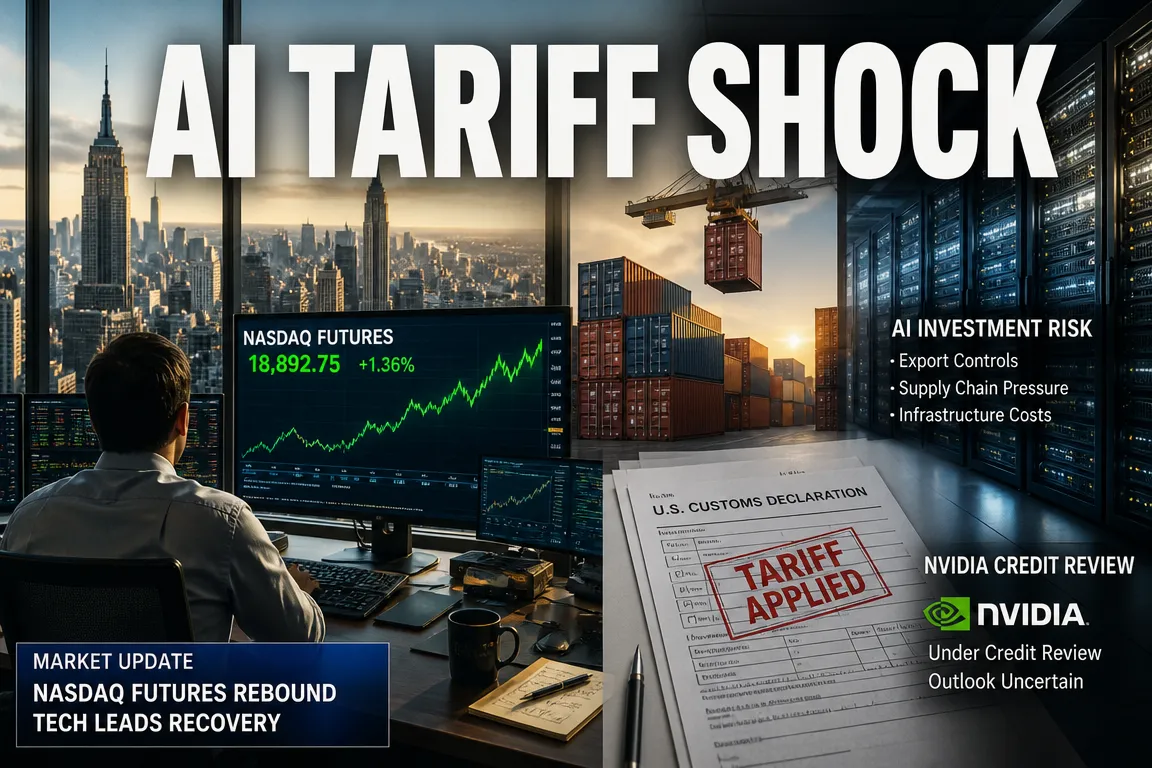
Nasdaq Futures Rebound During U.S. Market Holiday: Key Variables in Korean Tariffs, Nvidia, and AI Investment
A rebound in Nasdaq futures does not eliminate AI investment risks.
Key variables include the implementation of tariffs on South Korean goods, AI companies’ financing costs, and the transmission of export restrictions to data center revenue.
Oil prices, interest rates, and Bitcoin ETF flows provide additional context for the post-holiday U.S. equity outlook.
1. U.S. Markets Closed for Thanksgiving: Limited Significance of the Futures Rebound
Trading conditions matter more than the percentage gain.
November 26, 2026, is Thanksgiving in the United States, when U.S. stock exchanges are closed.
Under the customary post-Thanksgiving schedule, equities close early at 1 p.m. Eastern Time on November 27, equivalent to 3 a.m. Korean Standard Time on November 28.
Futures and bond trading schedules vary by product and venue and should not be inferred from equity market hours.
- Market movements in the supplied materials: Nasdaq-100 and S&P 500 futures were reported to be up approximately 0.6%.
- Interpretive limitation: Broad institutional buying is difficult to assess while cash equity markets are closed.
- Holiday conditions: Lower volume and reduced order-book depth can amplify price movements from relatively small orders.
Short covering alone can lift futures.
Rather than concluding that an uptrend has resumed, investors should assess whether buying persists after normal trading resumes.
2. Interest Rates and Oil: Common Risks to the Technology Rebound
Higher discount rates and financing costs can pressure valuations despite strong AI growth prospects.
The supplied materials cite U.S. GDP growth of 4.3%, PCE inflation of 3.8%, and an approximately 98% probability of a 0.25-percentage-point Federal Reserve rate increase in December.
The GDP reference quarter and annualization basis, the distinction between headline and core PCE, and the timing of the rate-probability estimate remain unverified. These figures alone do not establish the policy outlook.
The claim that the Bank of Korea raised its policy rate to 3.25% also requires confirmation from its official monetary policy decision.
How Higher Rates Affect AI-Related Equities
- Higher discount rates reduce the present value of distant earnings.
- Borrowing costs rise for data center construction and GPU purchases.
- Reduced customer investment capacity can delay equipment orders and project starts.
Oil prices add complexity to this relationship.
The materials cite WTI near $84, Brent near $95, and concerns over Middle Eastern supply disruptions. Prices and specific attack claims require separate verification.
Supply-driven oil price increases can raise both inflation pressure and corporate costs.
However, data center electricity costs may be influenced more directly by regional power markets, natural gas prices, and power purchase agreements than by crude oil prices.
3. Potential Tariffs of Up to 25% on South Korean Goods: Implementation Matters More Than the Headline Rate
Tariff reports must distinguish between consideration, proposal, finalization, and implementation.
The supplied materials state that the United States proposed new tariffs under Section 301 of the Trade Act, with a potential 25% rate on South Korean goods depending on consultations.
Without verification of the relevant USTR documents and Federal Register notices, a 25% tariff cannot be described as finalized.
Four Questions for South Korean Exporters
- Additional or combined tariff: The impact differs substantially depending on whether the rate is added to existing duties or represents the total.
- Product coverage: Automobiles, steel, and semiconductors require review of separate measures and exemptions.
- Effective date: Hearings and public comment periods are distinct from implementation.
- Cost allocation: The importer legally responsible for paying duties may differ from the businesses or consumers ultimately bearing the economic cost.
Earnings exposure may depend more on U.S. production capacity, pricing power, and customer contracts than on the tariff rate alone.
Chinese material and component exposure requires assessment of rules of origin and specific regulatory requirements, not simply input shares.
Tariff effects can vary substantially within the same industry depending on supply chains and production locations.
4. Nvidia Credit Rating Claims: Equity Performance and Credit Risk Are Distinct
A downgrade review is neither an actual downgrade nor evidence of an imminent financial crisis.
The supplied materials claim that S&P maintained Nvidia’s AA rating while placing it under review for a downgrade over governance concerns.
This claim requires confirmation through S&P’s official rating announcement and Nvidia’s disclosures.
Related claims concerning the chief executive’s resignation, return, and an internal investigation also remain unverified.
Credit assessments generally focus on three areas.
- Financial capacity: Cash holdings, debt maturities, and operating cash flow.
- Business stability: Customer concentration and revenue exposure to export restrictions.
- Governance: Board oversight and internal controls.
Higher credit risk can raise bond yields or tighten financing terms, but it does not necessarily imply immediate funding stress for a cash-rich company.
AI semiconductor investors should monitor credit spreads, customer financing conditions, and receivables collection alongside equity prices.
5. Southeast Asian AI Server Restrictions: Installation and Cash Collection Matter More Than Orders
AI server orders do not automatically translate into revenue and cash flow.
The supplied materials claim that AI server shipments to Malaysia, Singapore, Thailand, and Indonesia have been suspended.
Without verification of announcements from Nvidia and server manufacturers or regulations from the U.S. Bureau of Industry and Security, the affected countries, products, companies, and scope remain uncertain.
If such restrictions take effect, potential consequences include:
- Licensing delays: Completed servers may remain undeliverable.
- Delayed data center operations: Facilities with secured power may be unable to operate without computing equipment.
- Tighter lending terms: Delayed revenue may prompt lenders to require additional collateral or equity.
- Greater supplier pressure: Inventory, receivables, and working capital requirements may increase.
Shipment delays do not necessarily imply order cancellations.
Revenue may be recognized after regulatory approval, or supply may be redirected to other customers or regions.
The central distinction is between permanent demand loss and a temporary shift in revenue timing.
6. Chinese AI and Huawei: The Value of Available Computing Capacity
Tighter export controls can change the basis of AI competition.
Restrictions on advanced GPUs and overseas cloud services may force Chinese AI companies to adjust training schedules, model designs, and development budgets.
Specific model launch delays and Huawei’s next-generation semiconductor timelines require confirmation through official company announcements.
- Near-term impact: Limited computing capacity may reduce large-scale training runs and experimentation.
- Medium-term response: Model compression, training efficiency improvements, and domestic accelerator adoption may increase.
- Long-term development: A separate AI ecosystem integrating hardware and development tools could emerge.
For domestic suppliers such as Huawei, reliable supply and technical support may become competitive advantages alongside performance.
Chip availability alone does not complete an ecosystem transition.
Software compatibility, developer tools, multi-chip scaling efficiency, and performance per watt remain essential.
7. Gold, Copper, and Bitcoin: Simultaneous Gains Do Not Convey the Same Signal
Assets can rise together for different reasons.
| Asset | Key Variables | Interpretive Caution |
|---|---|---|
| Gold | Real yields, the U.S. dollar, safe-haven demand | Gains do not necessarily signal an improving economy. |
| Copper | Manufacturing demand, Chinese economic activity, inventories, mine supply | AI data center demand alone cannot explain price movements. |
| Bitcoin | Spot ETF flows, leverage, dollar liquidity | A short-term rebound differs from sustained new capital inflows. |
The supplied materials report continued substantial outflows from U.S. spot Bitcoin ETFs. Exact figures are omitted because of transcription inconsistencies in monthly totals and price quotations.
ETF flows are better assessed cumulatively across several trading sessions than through a single daily figure.
Smaller outflows do not imply a shift to net inflows, and ETF activity does not capture all cryptocurrency market flows.
8. Space-Based AI Data Centers: Economic Viability Remains Unproven
Regulatory approval and commercial viability are separate considerations for space-based data centers.
Claims concerning conditional approval for a large SpaceX AI satellite network, its project name, satellite count, and deployment deadlines have not been verified against FCC documents.
They therefore cannot be treated as an approved investment timetable.
Key Technical Challenges
- Launch and replacement costs: Deploying equipment and replacing aging GPUs in orbit incur costs.
- Heat rejection: The vacuum of space prevents air convection, making radiative cooling design critical.
- Power reliability: Generation and storage requirements depend on orbit and sunlight availability.
- Communications and reliability: Ground-link capacity, latency, radiation, and failure response require assessment.
The investment test extends beyond technical feasibility to whether equivalent workloads can be processed at a lower total cost than on Earth.
Claims that SpaceX shares will be distributed to U.S. children require official company announcements and securities documentation.
References to SpaceX closing prices and lockup schedules, and to Anthropic’s listing and share price, require verification of listing status first.
New share issuance can dilute existing ownership, whereas a major shareholder’s transfer of existing shares does not itself increase shares outstanding.
9. AI Hedge Fund Losses: Industry Growth and Investment Returns Are Different
Excessive leverage can generate losses even when the underlying industry growth thesis is correct.
The supplied claims of a particular fund’s 65% third-quarter loss, 88.5% year-to-date return, margin calls, and asset sales require verification through investor letters or equivalent records.
The amplifying effect of leverage on volatility is nevertheless well established.
- Price decline: Portfolio asset values fall.
- Collateral shortfall: Lenders may demand additional collateral.
- Forced selling: Assets may need to be sold regardless of their long-term outlook.
A 65% investment loss requires a subsequent gain of approximately 186% to recover the original capital.
A forecast of $1 trillion in AI revenue at a future date is assumption-sensitive, not an established market size.
Even as the AI market expands, competition and falling prices may compress the margins of current leaders.
10. Additional Analysis: Three Connections Beyond the Headlines
① AI investment constraints may shift from GPUs to operations and cash recovery.
GPU procurement, power connections, export licensing, customer acceptance, and payment collection must all be completed before investment produces realized returns.
Growing backlogs warrant separate cash-flow scrutiny if receivables and inventories rise faster.
② Tariffs, interest rates, and export controls can affect the same project simultaneously.
Tariffs can raise equipment costs, interest rates can increase financing costs, and export controls can delay operations.
Project returns may deteriorate even if AI demand remains intact.
③ Long-term contracts do not eliminate investment risk.
The stability of long-term data center leases depends on customer credit quality, early termination provisions, and minimum usage commitments.
Contract value must be assessed alongside who pays, when payment occurs, and under what conditions.
11. Post-Holiday Investor Checklist
- U.S. equities: Assess whether market breadth improves as trading volume recovers.
- Tariffs: Verify covered products, tariff stacking, and effective dates through USTR announcements and the Federal Register.
- Nvidia: Prioritize rating agency announcements, corporate disclosures, and official export regulations.
- AI infrastructure: Monitor utilization, capital expenditure, and free cash flow alongside orders.
- Interest rates and oil: Assess whether long-term Treasury yields and inflation expectations rise together.
- Bitcoin: Review cumulative ETF flows across multiple sessions alongside leveraged position liquidations.
Premature directional conclusions should be avoided.
Distinguish verified policy changes from temporary price reactions, and assess whether AI growth expectations translate into cash flow.
< Summary >
- A holiday futures rebound alone does not establish a U.S. equity trend reversal.
- Korean tariff exposure requires verification of policy status, product coverage, tariff stacking, and effective dates.
- Claims involving Nvidia and Southeast Asian server restrictions should not be treated as established facts before official confirmation.
- AI investment analysis extends beyond GPU procurement to power, financing, operations, and payment collection.
- Space-based data centers require separate assessments of technical feasibility and commercial viability.
- Long-term industry growth does not guarantee returns on individual securities.
[Related Articles…]
*Source: [ Maeil Business Newspaper ]
– 추수감사절 美증시 휴장 나스닥 선물 0.7% 상승ㅣ트럼프 한국 관세 25% 인상 가능성ㅣ엔비디아 신용등급 강등 검토, 동남아 AI 서버 출하 중단ㅣ홍혜진의 뉴욕 브리핑