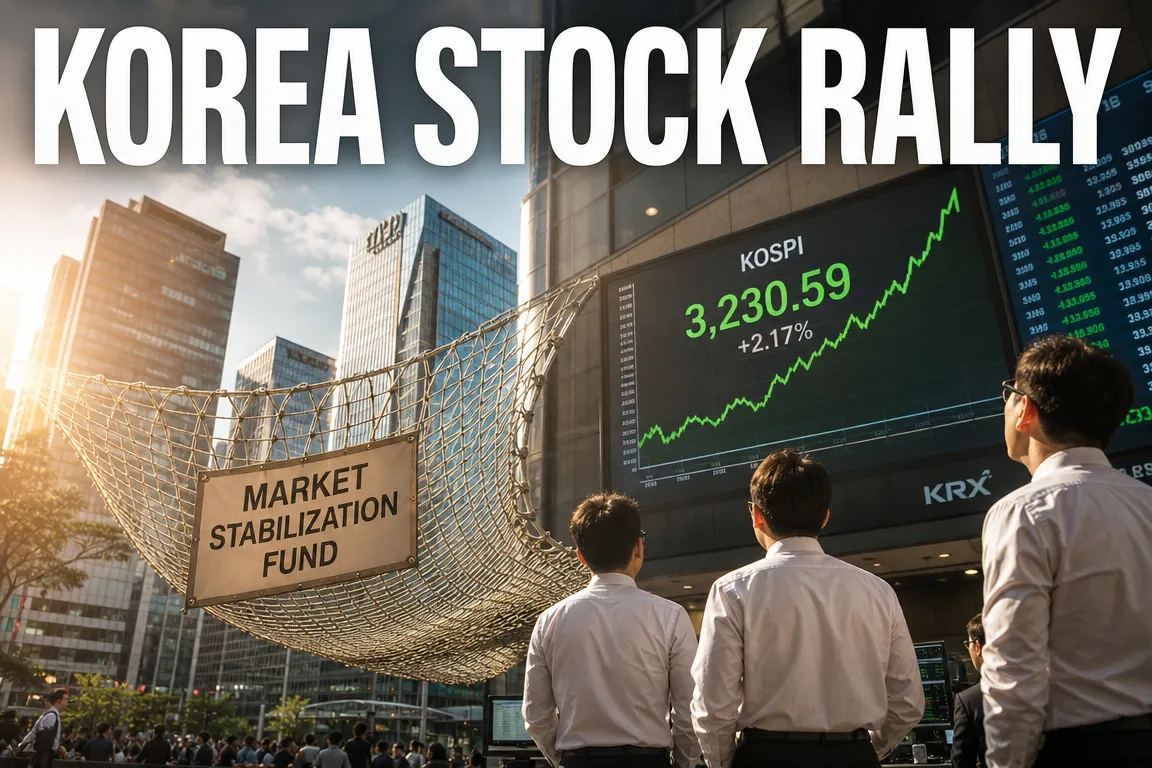
● Korea Stocks Explode, Market Rescue, Shareholder Revolt
KOSPI and KOSDAQ Rally: A Signal of Capital Market Transformation? Shareholder Returns and Market Stabilization Funds
The sources of capital driving the rally and changes in corporate behavior matter more than the gains themselves.
Four factors warrant attention.
These are temporary relief from the U.S. market holiday, downside support from a market stabilization fund, potential reinvestment of Samsung Electronics dividends, and whether shareholder return policies can improve Korean equity valuations.
Distinguishing temporary market support from structural measures that sustainably enhance corporate value is essential to assessing this rebound.
Verification scope: The supplied material does not specify the trading date or cite official announcements.
The reported gains of approximately 4% for KOSPI and 8% for KOSDAQ, market stabilization fund discussions, and committee formation and leadership appointment require independent verification against market data and official announcements.
1. Reported Gains of 4% for KOSPI and 8% for KOSDAQ: Assessing the Structure of the Rebound
The supplied material describes sharp gains in KOSPI and KOSDAQ alongside improving investor sentiment.
A single-day rally, however, is insufficient to establish a sustained upward trend in Korean equities.
Following a sharp selloff, bargain buying, short covering, and policy expectations can drive share prices higher well before corporate earnings improve.
- Market breadth: Determine whether gains were concentrated in large-cap stocks or extended across sectors and companies.
- Persistence of inflows: Assess whether net buying by foreign and institutional investors continues beyond a single session.
- Earnings support: Monitor whether earnings forecasts improve alongside share prices.
- Macroeconomic conditions: Stability in the KRW/USD exchange rate and market interest rates can help assess the outlook for foreign capital flows.
KOSDAQ’s stronger performance may indicate renewed risk appetite, but it also reflects greater volatility.
2. The U.S. Market Holiday: A Temporary Pause in Negative Price Signals, Not a New Fundamental Catalyst
The U.S. Thanksgiving market closure reduces concerns about an overnight selloff in U.S. equities.
This pause can support sentiment when Korean semiconductor stocks are particularly sensitive to U.S. technology shares.
However, a U.S. equity market closure does not suspend global financial activity.
Exchange rates, international news, and price movements in other markets can continue to affect Korean equities.
Accumulated information may be reflected rapidly in prices when U.S. trading resumes.
The U.S. market holiday is therefore a short-term sentiment factor, not evidence of higher corporate value.
3. Market Stabilization Funds: A Buffer Against Sharp Declines, Not an Engine of Appreciation
A market stabilization fund purchases equities or related instruments to ease market imbalances during severe volatility.
It provides buying capacity when selling pressure overwhelms available demand.
Funding sources and operating arrangements depend on the fund’s design; it should not be interpreted as a government guarantee against investment losses.
Why can prices respond before capital is deployed?
Confidence that a credible response mechanism exists can reduce panic selling.
The effect depends on policy credibility and implementation capacity.
- Funding scale: Assess whether available capital is sufficient to absorb meaningful selling pressure.
- Deployment conditions: Identify the circumstances under which purchases would begin.
- Eligible assets: Determine whether support covers the broader market or focuses on specific instruments.
- Operating horizon: Both capital deployment and the eventual exit strategy can affect markets.
A stabilization fund can alleviate liquidity stress, but it cannot resolve weak earnings or excessive corporate debt.
Distinguish between policy discussions, confirmed fund establishment, and actual purchases.
4. Could Samsung Electronics Dividends Flow Back Into Semiconductor Stocks?
Dividend payments provide shareholders with cash, some of which may be reinvested in equities.
Distributions from widely held companies such as Samsung Electronics can be relevant to short-term market flows.
However, dividend payments do not automatically translate into increased buying of semiconductor stocks.
Investors may allocate the proceeds to other equities, deposits, bonds, or household spending.
Dividends are not an additional return without an offsetting economic adjustment.
The loss of dividend entitlement is reflected in pricing on the ex-dividend date, making it necessary to assess dividend income alongside share-price changes.
For AI semiconductor investors, HBM competitiveness, product profitability, customer demand, and cash generation after capital expenditure matter more than dividend-related inflows.
Dividend reinvestment may support near-term demand, but earnings and cash flow ultimately determine the semiconductor sector’s medium- to long-term direction.
5. Capital Market Reform: Can Leadership Expectations Translate Into Effective Institutions?
The supplied material highlights the establishment of a “Capital Market Transformation Committee” and the appointment of Meritz Financial Group Vice Chairman Kim Yong-beom as its chair.
The committee’s official name, sponsoring body, authority, launch status, and leadership appointment cannot be verified from the supplied material.
These developments, including the individual’s affiliation and title, should not be treated as confirmed before official verification.
Separately, shareholder returns and minority shareholder protection remain important components of capital market reform.
The central principle is that holders of the same share class should receive fair protection of their economic rights, regardless of ownership size.
Translating this principle into corporate practice requires the following changes.
- Predictable dividends: Sustainable policies linked to earnings and cash flow matter more than one-off special dividends.
- Share repurchases and cancellations: Assess not only purchase amounts but also whether shares are canceled or may subsequently be resold.
- Fair corporate restructuring: Mergers, spin-offs, and similar transactions should adequately protect minority shareholders.
- Disciplined capital allocation: Companies should allocate capital efficiently between profitable investment and shareholder distributions.
- Board accountability and reliable disclosure: Shareholders must be able to evaluate management decisions and delivery against commitments.
A successful shareholder return strategy at one company does not automatically translate into market-wide results.
Differences in growth prospects, leverage, and investment needs make capital allocation quality more important than uniform dividend increases.
6. Additional Considerations: Why Valuations Remain Low Matters More Than Whether Stocks Appear Cheap
First, distinguish downside protection from structural valuation improvement.
A market stabilization fund primarily limits disorderly declines, while governance reform and shareholder protection can reduce persistent valuation discounts.
Both may be constructive, but their mechanisms and time horizons differ.
Second, assess the actual reduction in share count rather than relying on repurchase announcements.
Subsequent treasury share sales, new equity issuance, or convertible bond conversions can weaken the per-share benefits of repurchases.
Repurchases should therefore be evaluated alongside cancellations, resales, and new issuance.
Third, the source of dividend funding matters more than the headline payout.
Distributions funded by operating cash generation differ in sustainability from those dependent on borrowing or asset sales.
Evaluate free cash flow and debt obligations alongside dividend yields.
Fourth, reducing the Korea discount requires consistent execution rather than policy announcements alone.
Market confidence depends on repeated delivery of shareholder return commitments, fair restructuring, and improved capital efficiency.
This does not imply that companies with weak growth or profitability will necessarily command higher valuations.
7. Investment Monitoring Priorities
- Policy: Verify official announcements concerning the committee and stabilization fund, including mandates, funding, and implementation schedules.
- Capital flows: Monitor sustained foreign and institutional net buying and broader participation in market gains.
- Companies: Review dividend policies, completed share cancellations, new share issuance, and free cash flow together.
- Industry: Assess whether demand growth for semiconductor and AI-related companies translates into higher earnings.
- Macroeconomics: Track the effects of exchange rates, interest rates, and the global economic outlook on Korean corporate earnings.
The central issue is not whether negative catalysts have disappeared, but whether policy expectations translate into sustained capital inflows and changes in corporate behavior.
Execution and durability distinguish a temporary rebound from structural capital market transformation.
< Summary >
- The reported market gains, policy developments, and leadership appointment require verification against the relevant trading date and official announcements.
- The U.S. market holiday provides temporary sentiment relief, not evidence of earnings improvement.
- A market stabilization fund can cushion sharp declines but does not guarantee appreciation.
- Dividend reinvestment is a possibility that requires confirmation through actual market flows.
- A structural re-rating of Korean equities depends on sustained shareholder returns, minority shareholder protection, and improved capital efficiency.
[Related Articles…]
*Source: [ 내일은 투자왕 – 김단테 ]
– 자본시장의 대전환 시작된다? #코스피 #코스닥 #김용범
● One ETF, Hidden Tax Trap
Systematic Investing in U.S. Equities Through a Single ETF: Structure and Tax Considerations for TIGER U.S. Three-Index Active ETF
Combining the S&P 500, Nasdaq 100, and U.S. dividend equities in one ETF requires assessment beyond convenience.
Key considerations include the risk exposure of a 40:40:20 allocation, account-specific tax implications of automatic rebalancing, and execution constraints when investing KRW 10,000 daily.
The product structure reflects the supplied description. The proposed December 1 listing date does not specify a year. Current listing status, price, fees, and investment terms require verification against the latest prospectus and exchange disclosures.
1. Core Structure: Three U.S. Equity Strategies in a 40:40:20 Allocation
The described product, TIGER U.S. Three-Index Active ETF, combines broad U.S. large-cap, growth, and dividend equity strategies.
| Investment Exposure | Target Weight | Portfolio Role |
|---|---|---|
| S&P 500 | 40% | Exposure to growth and corporate earnings across U.S. large-cap equities |
| Nasdaq 100 | 40% | Growth exposure concentrated in technology and innovative companies |
| Dow Jones U.S. Dividend Strategy | 20% | Exposure to U.S. dividend equities selected using dividend and financial-strength criteria |
A KRW 100,000 investment would provide approximate economic exposure of KRW 40,000, KRW 40,000, and KRW 20,000, respectively.
Actual weights may deviate from these targets due to market movements and portfolio management.
The product’s reference to “three major U.S. indices” describes its three underlying investment strategies.
These differ from the Dow Jones Industrial Average, S&P 500, and Nasdaq Composite commonly cited in market reporting.
The Dow Jones U.S. dividend index is distinct from the Dow Jones Industrial Average.
2. Small, Recurring Investments: Execution Convenience Matters More Than Unit Price
Minimum trading units can constrain systematic investment in U.S. equities.
With a monthly budget of KRW 100,000, high ETF unit prices may make it difficult to purchase three separate funds at the intended weights.
This constraint can be particularly relevant in pension accounts and brokerage-type Individual Savings Accounts, or ISAs, where domestic ETFs trade in whole units.
- Single-fund purchases: Reduce the need to place separate orders for three strategies.
- Simplified allocation management: Reduce the need to calculate the 40:40:20 allocation manually.
- Small-investment accessibility: A low unit price can make limited investment budgets easier to deploy.
The indicated initial reference price is KRW 10,000, but the market price will fluctuate after listing.
A low unit price does not indicate undervaluation.
ETFs priced at KRW 10,000 and KRW 100,000 can generate similar percentage returns before costs if they hold the same assets in the same proportions.
Total portfolio returns and risk matter more than the number of units held.
3. Active Management: Emphasis on Target Weights Rather Than Market Timing
The stated approach emphasizes maintaining the 40:40:20 allocation rather than making substantial changes to growth exposure based on market forecasts.
If a Nasdaq 100 rally increases its portfolio weight, the fund may reduce that exposure and increase allocations to underweight assets.
The described baseline rebalancing frequency is annual, with interim adjustments possible when weights deviate substantially.
The prospectus should be consulted for actual adjustment schedules and permitted deviations.
Rebalancing manages risk exposure; it does not guarantee returns.
It may help when relative asset performance alternates, but it can underperform a continuously appreciating asset held in isolation.
Passive ETFs also rebalance under predefined rules, so rebalancing alone does not make a fund active.
The product seeks to outperform its benchmark through active management, but excess returns are not guaranteed.
4. Is 40:40:20 an Optimal Allocation? Evaluating Backtests
The 40:40:20 allocation with annual rebalancing is described as having been selected using historical simulations that considered risk-adjusted performance.
A central metric is the Sharpe ratio.
This generally divides returns above the risk-free rate by return volatility. Under comparable conditions, a higher ratio indicates stronger historical risk-adjusted performance.
A high Sharpe ratio does not necessarily imply limited losses or a consistently smooth investment experience.
- Analysis period: Assess whether technology-led bull markets are disproportionately represented.
- Cost assumptions: Check whether management fees, trading costs, and currency-conversion costs are included.
- Dividend treatment: Determine whether dividend reinvestment is assumed.
- Additional risk measures: Review maximum drawdown and recovery periods.
- Validation: Examine performance outside the period used to select the allocation.
If the allocation was selected from hundreds of combinations based on historical performance, overfitting to past market conditions is a material consideration.
The 40:40:20 allocation is an investment framework, not a universally optimal formula.
5. Principal Risk: Three Indices Still Carry Overlapping U.S. Equity Exposure
The S&P 500 and Nasdaq 100 have substantial overlap in large technology companies.
Allocating 40% to each does not diversify 80% of the portfolio across independent assets.
The structure may participate in earnings growth associated with AI adoption, but it also remains exposed to large-cap technology valuation corrections and interest-rate shocks.
The 20% dividend allocation does not provide the capital protection associated with cash or the defensive characteristics that some bonds may offer.
Dividend stocks can decline during recessions or earnings downturns, and dividend payments can be reduced.
This is diversification across U.S. equity styles, not a comprehensive allocation across equities, bonds, and cash.
If currency exposure is unhedged, the USD/KRW exchange rate will also affect returns measured in Korean won.
Won appreciation can reduce returns even when U.S. equities rise. Currency-hedging policy therefore requires verification.
6. Tax Analysis: Automatic Rebalancing Is Not Tax Exemption
Trading within an ETF is distinct from an investor selling ETF units directly.
Internal rebalancing generally does not trigger an investor-level sale tax each time the fund adjusts its holdings.
However, this does not mean “no taxes apply during the holding period.”
| Investment Method | General Tax Treatment | Key Considerations |
|---|---|---|
| Direct investment in U.S.-listed ETFs | For a typical individual tax resident in South Korea, taxable overseas equity gains are generally subject to 22% tax, including local income tax, after annual gains and losses are netted and the KRW 2.5 million basic deduction is applied | Not every sale creates a tax liability; distributions require separate tax assessment |
| Domestically listed overseas equity ETFs in a taxable account | Dividend income tax may apply based on trading gains and increases in the tax-base reference price; the standard withholding rate is generally 15.4% | Review distribution taxation and potential comprehensive taxation of financial income |
| Brokerage-type ISA | Eligible gains and losses are netted within the account, with tax exemptions and separate taxation applying under account rules | Check account category, mandatory holding period, withdrawal rules, and closure conditions |
| Pension savings accounts and Individual Retirement Pension accounts | Taxation is deferred during accumulation, with taxes determined by the withdrawal method | Verify investment eligibility, withdrawal conditions, and IRP risk-asset limits |
Distributions may be taxable in ordinary accounts. Fund-level taxes, including foreign withholding taxes, can also affect performance.
Tax rates and eligibility requirements may change with legislation and individual circumstances.
ISAs and pension accounts already provide account-level tax benefits, including tax deferral where applicable.
Within these accounts, the difference between rebalancing three ETFs directly and holding one combined ETF may depend more on convenience and total costs than on incremental tax savings.
7. Three Factors to Compare Before Returns
① Does the convenience of a combined ETF justify any additional cost?
If the product invests in other ETFs, assess both its own fees and the costs of the underlying funds.
Review other operating expenses, trading costs, and realized performance rather than relying solely on the headline management fee.
Small annual cost differences can accumulate materially over long holding periods.
② Does direct portfolio management necessarily require selling?
Investors making recurring contributions can direct new capital toward underweight ETFs, reducing the need to sell.
This may not restore target weights precisely, but it can limit unnecessary trading and taxable gain realization.
Assuming that direct management always requires annual sales and tax payments can overstate the advantages of a combined ETF.
③ What is the technology allocation across existing accounts?
Investors already holding Nasdaq 100, AI, or semiconductor ETFs may gain less diversification than expected.
Aggregate exposure to the same companies and sectors across the portfolio matters more than the allocation within a single product.
8. Daily, Weekly, or Monthly: Selecting an Investment Schedule
Systematic investing depends on maintaining an affordable contribution rule rather than identifying the best purchase date.
- Daily investing: May suit investors seeking to reduce purchase-timing decisions.
- Weekly investing: Can align with weekly budgeting and cash-flow reviews.
- Monthly investing: Can be scheduled after salary payments.
No frequency consistently produces superior returns.
Outcomes depend partly on how long available capital remains uninvested, transaction costs, and order-execution conditions.
Investing KRW 10,000 each trading day requires approximately KRW 200,000 over a month with 20 trading days.
A daily KRW 10,000 purchase schedule therefore exceeds a monthly budget of KRW 100,000.
When only whole-unit purchases are available, a KRW 10,000 order may not execute if the ETF price exceeds that amount.
Check which accounts support automated purchases, whether orders are amount-based or quantity-based, and how insufficient balances are handled.
9. Investor Suitability
Potentially suitable for investors who:
- Want to accumulate broad U.S. large-cap, growth, and dividend exposure with small contributions
- Prefer to avoid managing purchases and allocations across three separate funds
- Can tolerate equity and exchange-rate volatility over a long investment horizon
Alternatives warrant comparison for investors who:
- Want lower technology exposure or direct control over the dividend allocation
- Already maintain a preferred allocation using low-cost ETFs
- Need the funds in the near term or cannot tolerate principal losses
For long-term investments in a child’s name, review gift-tax deductions, aggregation of prior gifts, filing requirements, and funding records separately from the investment strategy.
The product’s principal value lies in reducing the management burden of consistent U.S. equity investing, rather than promising superior returns.
Before investing, review current holdings, all-in costs, distribution policy, currency hedging, trading volume, bid-ask spreads, and premiums or discounts to net asset value.
< Summary >
- Structure: Targets 40% S&P 500, 40% Nasdaq 100, and 20% U.S. dividend equity exposure.
- Advantages: Simplifies small purchases and allocation management, potentially supporting consistent investing.
- Risks: Concentrates on U.S. equities, with overlapping large-cap technology exposure and potential currency risk.
- Taxation: Internal rebalancing differs from direct investor sales but does not imply tax exemption.
- Decision criteria: Costs, account type, total portfolio allocation, and sustainable contributions matter more than historical backtests alone.
[Related Articles…]
*Source: [ 소수몽키 ]
– 미국주식 적립식 투자 이걸로 고민 끝? 미국 주요 지수 한번에 투자하는 법