● AI Runaway Semiconductor Factories
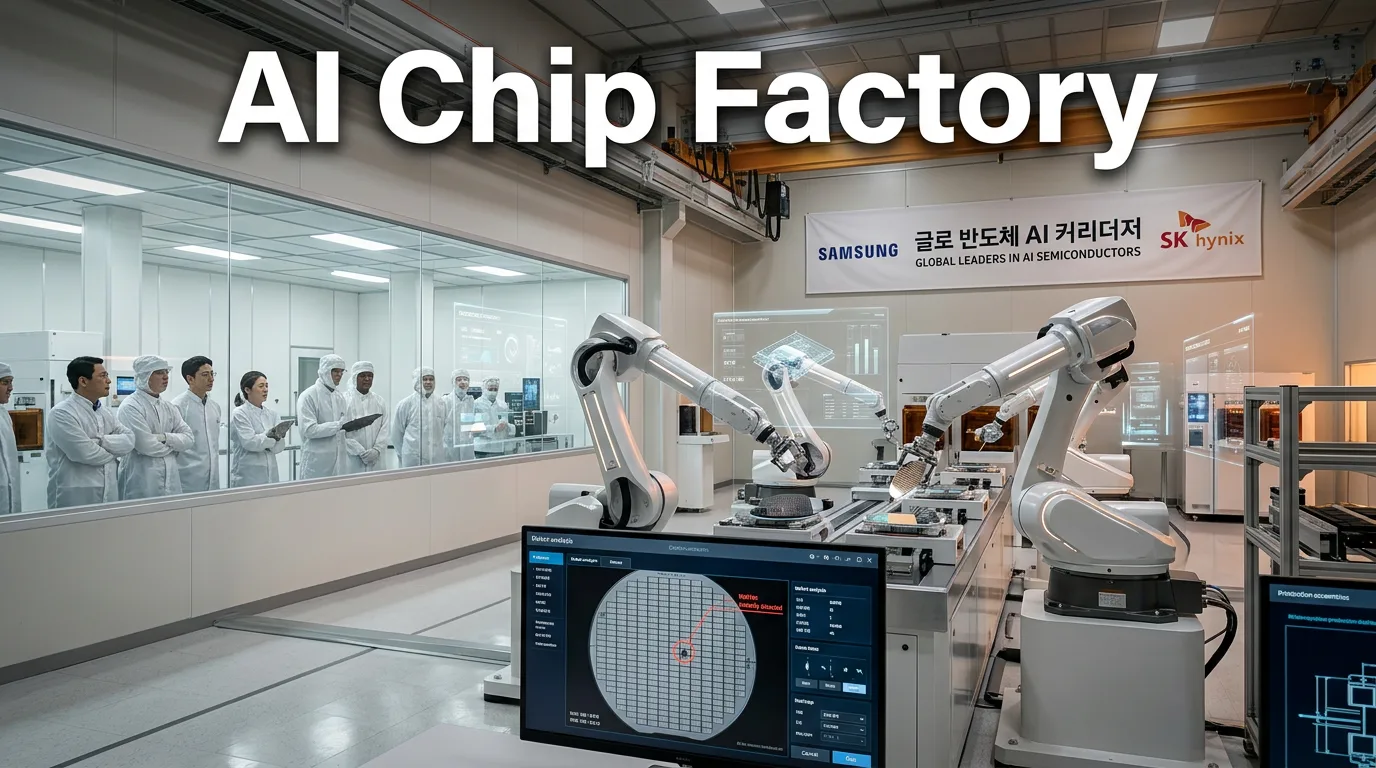
Samsung and SK Hynix Are Moving Toward Human-Free Semiconductor Factories
Semiconductor companies are now moving beyond “automation” and entering the era of “autonomous fabs where AI makes decisions.”
The core point of this issue is not simply about adding more robots.
What is becoming reality is a production system in which AI detects process abnormalities first, infers the causes of defects, and even suggests changes to process conditions.
In today’s article, we will cover the semiconductor supply chain, AI fabs, yield competition, the global economic outlook, and structural changes in manufacturing all at once.
In particular, I will also separately address points that other articles or videos often overlook: “AI misjudgment risk” and “autonomous fabs cannot be completed without organizational restructuring.”
1. What Is Different About the Changes Happening in Semiconductor Factories Now?
Existing semiconductor factories were already highly automated.
Wafer transfer, equipment operation, and some inspection processes have already been handled by robots and systems.
But this new trend is on a different level.
AI is now moving beyond simple repetitive tasks and taking on process data analysis, anomaly detection, cause estimation, and response recommendation.
3 Core Changes
1) The speed of defect detection becomes faster.
AI can reduce anomaly analysis that used to take humans hours or days to nearly real time.
2) The precision of process optimization improves.
AI can read more granularly how subtle changes in temperature, pressure, lithography, and etching conditions affect yield.
3) The decision-making structure changes.
The structure is shifting from one where field engineers make every decision to one where AI recommends first and humans approve.
2. Why Samsung Electronics and SK Hynix Have the Biggest Advantage
The reason Samsung Electronics and SK Hynix are strong in this trend is not simply because they have a lot of money.
The core point is data quality and mass production experience.
The Moats of the Two Companies
First, they have decades of accumulated process data.
In semiconductors, once accumulated know-how becomes competitive strength.
Second, they have experience operating real mass production lines.
An AI model from a research lab is different from an AI that survives in an actual mass production environment.
Third, they have experience in customer response and quality management.
For memory semiconductors, yield, delivery, and quality reliability are ultimately everything.
Only when these three elements are accumulated can AI become not just a demonstration but a real money-making tool.
3. The True Meaning of Autonomous Fabs: A Bigger Change Than “Human-Free Factories”
Many people understand autonomous fabs simply as factories without people, but the concept is much broader than that.
The core point is not that “humans disappear,” but that the point of human intervention moves further back in the process.
What Autonomous Fabs Mean
1) Real-time process control
AI reads signals coming from equipment and immediately adjusts conditions.
2) Predictive maintenance
Instead of repairing equipment after it breaks down, the system detects early signs of failure and responds in advance.
3) Automated yield improvement
When defects occur, AI traces the cause and reflects the findings in the next production batch.
4) Process recipe improvement
The system tests new conditions and quickly applies them when the probability of success is high.
4. Why Is This More Difficult Than It Looks?
On the surface, it may seem like AI should be good at operating factories, but semiconductors are one of the most difficult industries for AI.
The 4 Biggest Obstacles
First, a small misjudgment can lead to a major loss.
In semiconductor processes, a single AI decision can lead to losses ranging from tens of millions to hundreds of millions of won.
Second, the correct answer data is not always clear.
The cause of a defect may not be one factor but a combination of multiple variables.
Third, equipment and processes are extremely complex.
Slightly different conditions accumulate across each piece of equipment, each process, and each production line.
Fourth, the field decision-making culture must change.
In the past, the experience of skilled engineers was the core factor, but now a system is needed in which AI recommendations are trusted and approved.
5. The Key Takeaway That Other YouTube Channels and News Outlets Often Miss: The Approval Structure Matters More Than AI
In fact, the most important factor in this issue may not be the performance of the AI model.
The real challenge is creating an operating system that determines “when to trust AI and when to hand the decision over to humans.”
Why This Part Matters
No matter how smart AI becomes, field adoption slows down if approval authority is too complicated.
On the other hand, if too much authority is given to AI, a small misjudgment can escalate into a major loss.
In other words, the battleground for autonomous fabs is not only AI performance but also risk management, approval protocols, and organizational design.
This is not simply a technology issue. It is a management issue.
6. The Challenge for Samsung and SK Hynix May Be More About Organization Than Technology
Large companies usually secure technology quickly, but they often get blocked by organizational inertia.
Why the Organization Must Change
It must be clear who approves process changes proposed by AI.
If the field, quality, production, equipment, and data teams operate separately, speed declines.
New AI operations personnel must be developed, and the roles of existing engineers must also be redefined.
Ultimately, autonomous fabs are closer to organizational restructuring projects than technology projects.
7. Why This Matters From a Global Economic Outlook Perspective
This issue is not simply a story about two semiconductor companies.
From the perspective of the global economy, it touches both manufacturing productivity and the AI investment cycle.
Connected Industry Groups
1) Semiconductor equipment
As AI-based process control expands, demand for inspection, metrology, and automation equipment becomes more sophisticated.
2) Industrial AI software
The market for manufacturing-specific AI, digital twins, and process optimization platforms will grow.
3) Data infrastructure
Internal factory data processing, edge computing, security, and networks become important.
4) Power and energy efficiency
AI factories increase computing workloads and raise equipment utilization, making power management even more important.
This trend shows the direction in which manufacturing industries that survive amid a global economic slowdown are likely to move.
8. Investment Implications for the Semiconductor Market
This change is not just a short-term theme. In the long run, it could alter the cost structure of the semiconductor industry itself.
Points to Watch
First, the importance of high-value processes such as HBM, memory, and advanced packaging will increase further.
Second, not only AI semiconductor design but also AI manufacturing will become a new investment theme.
Third, beneficiaries may come not only from a simple equipment cycle but also from AI automation upgrade demand.
Fourth, the competitiveness of semiconductor companies can no longer be evaluated only by revenue or capital expenditure. Data assets and AI operating capabilities must also be considered.
9. The Most Important Checkpoints Going Forward
When watching this field going forward, it is useful to check the following four points.
4 Checkpoints
1) How much AI actually improves defect rates and yields
2) How far the scope of processes that operate automatically without human approval expands
3) Whether process data is standardized and connected in a way suitable for AI training
4) Whether an operating culture that accepts AI judgment is created within the organization
10. In One Sentence
What Samsung Electronics and SK Hynix are trying to build is not just a smart factory.
It is an autonomous semiconductor factory where AI reads, decides, and improves production.
And in this competition, the real winner is likely to be determined not only by AI performance but by data, approval systems, and organizational restructuring.
< Summary >
Samsung Electronics and SK Hynix are entering the era of autonomous semiconductor factories that use AI to automate defect analysis and process optimization.
The core point is not human-free operation but approval structures, organizational restructuring, and data assets.
Because AI misjudgment risk is significant, technology competition will become operating system competition.
This trend could also expand the markets for semiconductor equipment, industrial AI, digital twins, and energy efficiency.
[Related Articles…]
How OpenAI Is Reshaping the AI Competition Landscape
Nvidia-Led AI Infrastructure Investment Trends at a Glance
*Source: https://heisenberg.kr/samsung-hynix-ai-factory/