● Fear, Nasdaq, AI, Liquidity, Musk, Bets
Why Is the Nasdaq at a Record High in a Fear Zone? The Market Is Being Driven by AI, Liquidity, and Political Positioning
At first glance, U.S. equities look inconsistent.
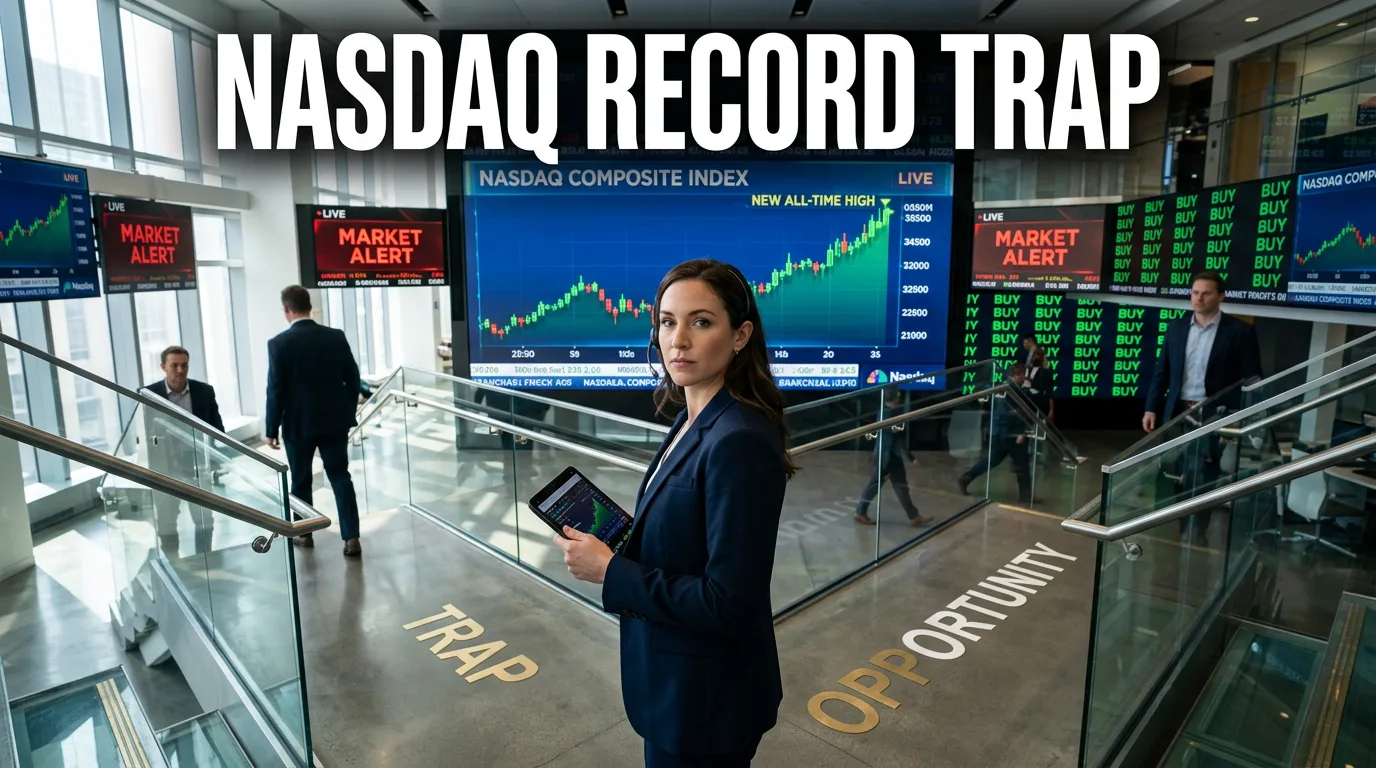
Investor sentiment is approaching fear-zone levels, yet the Nasdaq is moving back toward record highs.
Retail investors are holding cash due to uncertainty, while large-cap technology and AI-related stocks are strengthening again.
At the same time, AI tools such as GPT and Claude are increasingly being used to support investment decisions, and Elon Musk’s political and industrial positioning ahead of the U.S. midterm elections is drawing renewed attention.
The key point is straightforward.
This rally is not being driven by broad optimism, but by a combination of a narrow set of leading stocks, AI investment, rate expectations, and political event risk.
1. Why the Nasdaq Can Reach New Highs in a Fear Zone
The first point to understand is that the market is not broadly strong.
When the Nasdaq reaches or approaches record highs, it does not mean all stocks are advancing together.
Current U.S. equity performance is being led by a small group of large technology companies, especially those tied to AI infrastructure, semiconductors, cloud services, and data centers.
In practical terms, this is a market where:
- The index is strong.
- The economic backdrop remains mixed.
- Returns are highly polarized across individual stocks.
- Investor sentiment remains fragile.
- Institutional capital continues to favor leading stocks.
This pattern is being driven by four main factors.
First, the AI investment cycle has not yet rolled over.
Large technology companies continue to invest in AI data centers, GPUs, and cloud infrastructure despite concerns about slowing growth.
These expenditures are being interpreted as strategic investment to secure future revenue rather than as ordinary operating costs.
As a result, the market is placing more weight on the durability of the AI investment cycle than on short-term earnings pressure.
Second, expectations for rate cuts are supporting growth valuations.
As the probability of lower rates rises, the present value of future earnings increases.
In that environment, the Nasdaq, large-cap technology, software, and semiconductors tend to benefit.
Interest-rate direction remains one of the most important variables for U.S. equities.
Third, passive capital continues to flow into large-cap names.
ETF, pension, and institutional portfolio allocations automatically direct more capital to companies with larger market capitalizations.
When the Nasdaq 100 and S&P 500 rise, capital tends to flow back into mega-cap technology stocks.
This dynamic strengthens the leaders while leaving non-leaders behind.
Fourth, fear itself can trigger short covering.
When many investors are positioned for lower prices, a rally forces them to buy back hedges or short positions quickly.
That is short covering.
It is one reason the Nasdaq can rebound sharply in a fear zone.
2. Is This a Genuine Bull Market or a Late-Stage Rally
The main analytical error is to assume that rising indices automatically mean a healthy bull market.
The quality of the advance matters.
A healthy rally typically shows:
- Broader participation across stocks.
- Strength in small- and mid-cap names.
- Support from cyclical sectors such as financials, industrials, and consumer discretionary.
- Rising volume in a stable pattern.
- Upward revisions to earnings expectations.
By contrast, a late-stage rally often shows:
- Continued gains concentrated in a small number of mega-cap names.
- Late buying driven by FOMO.
- Prices rising despite weak news, followed by abrupt reversals.
- Expectations moving faster than earnings.
- Increasing valuation pressure.
Current market conditions contain elements of both.
AI infrastructure spending is still translating into actual revenue and earnings, which makes it difficult to describe the move as a pure bubble.
At the same time, gains in some leaders have become extended, and sentiment is turning optimistic again too quickly.
Accordingly, this is neither a clean bubble nor a healthy broad-based bull market.
It is best described as a high-valuation growth rally supported by AI spending and rate-cut expectations.
3. How Far Can GPT and Claude Go in Stock Investing
One of the fastest-changing areas is AI-assisted investing.
Generative AI tools such as GPT and Claude can already support investors in several ways.
For example, they can be used for:
- Summarizing earnings releases
- Extracting key points from conference calls
- Analyzing SEC filings
- Comparing competitors
- Summarizing industry trends
- Reviewing portfolio risk
- Analyzing news sentiment
- Generating investment ideas
For individual investors, AI reduces information asymmetry.
Previously, the advantage often belonged to investors who could read analyst reports and institutional research quickly.
Now, AI can extract the key points from lengthy earnings materials within minutes.
There are, however, important limitations.
- AI may not always reflect the most recent market data in real time.
- It can produce plausible but incorrect outputs.
- It does not fully capture market microstructure such as volatility, liquidity, and options positioning.
- Even when AI identifies a strong company, it does not guarantee an attractive entry price.
- The investment decision and its consequences remain the investor’s responsibility.
In other words, AI is better understood as a research assistant than as an investment manager.
Rather than replacing investors, GPT and Claude should be used to support faster and broader analysis.
A practical workflow is as follows:
- Use AI to summarize earnings releases for target companies.
- Compare revenue growth, operating margins, and cash flow trends.
- Compare valuations with peers.
- Build both bullish and bearish scenarios.
- Verify the risks that AI may overlook.
AI investment tools are likely to evolve from simple chat interfaces into personalized portfolio management systems.
However, the key differentiator will not be whether AI is used, but how the user frames the questions and validates the output.
4. Why Musk’s Positioning Matters Again One Month Before the Midterms
As the U.S. midterm elections approach, the market begins to price political events more actively.
Elon Musk’s actions matter because they extend beyond personal commentary into industrial policy, regulation, EVs, space, and AI.
Musk is important to markets for four reasons:
- Tesla is a key proxy for EV and autonomous-driving sentiment.
- SpaceX is a major player in private space and defense-related contracts.
- xAI is gaining visibility in the generative AI competitive landscape.
- X influences political discourse and information flow.
As the midterms approach, stronger political messaging from Musk is often interpreted through the lens of regulatory relief, tax policy, pro-business policy, and energy policy shifts.
Tesla and AI-related companies are especially sensitive to government policy.
Issues such as EV subsidies, China tariffs, autonomous-driving regulation, data center power infrastructure, and space budgets can have direct effects on earnings.
For that reason, Musk-related headlines are often treated as signals for broader industrial-policy expectations rather than as isolated media events.
That said, investors should evaluate these developments in terms of policy impact, not headline momentum.
Stock prices may react to a statement, but long-term returns are still determined by earnings and cash flow.
5. Sectors Investors Should Watch in a Market Led by Large Caps
The core sectors attracting attention in this rally are AI, semiconductors, cloud, power infrastructure, defense, and space.
First, AI semiconductors.
As AI models scale, demand rises for GPUs, HBM, networking equipment, and servers.
This segment sits at the front end of the AI investment cycle.
However, names with high expectations can become highly volatile if earnings disappoint even modestly.
Second, cloud and data centers.
Operating AI services requires substantial computing capacity.
Cloud revenue growth is therefore a useful indicator of AI demand.
Investors should focus on the extent to which AI contributes to reported revenue growth.
Third, power infrastructure.
AI is often discussed as a software theme, but the real bottleneck is power.
Data centers consume large amounts of electricity.
That is why transformers, power grids, nuclear power, natural gas generation, and cooling systems are increasingly being re-rated as AI beneficiaries.
Fourth, autonomous driving and robotics.
As AI moves from text and image generation into the physical world, autonomous driving, robotics, and automation become the next growth vector.
This area remains uncertain, but the addressable market is large if execution succeeds.
Fifth, defense and space.
As geopolitical risk rises and satellite communications and space infrastructure gain strategic value, related industries are also emerging as long-term themes.
Government budgets and private space-sector growth are increasingly linked.
6. The Real Point Often Missed by Mainstream News and Video Commentary
The most important issue is not the Nasdaq’s record high itself.
The real issue is that the market is becoming increasingly dependent on the capital expenditure decisions of a small number of large companies.
In the past, the market was driven more broadly by consumption, manufacturing, employment, rates, and oil prices.
Today, how much a few large technology companies invest in AI data centers can affect semiconductors, power, cloud services, real estate, commodities, and even bond markets.
In this structure, the following questions matter more:
- Will large technology companies continue increasing AI capital expenditure?
- Are AI services being converted into actual revenue?
- Will data center power constraints become a bottleneck?
- Could AI infrastructure spending shift into excess capacity?
- Can high-valuation growth stocks hold up if rate cuts are delayed?
Many investors focus on price charts, but in the current cycle, CAPEX matters more.
Capital expenditure reflects a company’s future investment plans.
If large technology companies keep increasing CAPEX, the AI infrastructure rally can continue.
If they begin signaling a slower pace of investment, the logic supporting the leading stocks could weaken quickly.
In short, the real driver of this rally is not sentiment but big-tech CAPEX.
7. Key Indicators Investors Should Monitor
In this type of market, intuition alone is not enough.
The following indicators are useful for assessing market direction more objectively:
- U.S. 10-year Treasury yield: Directly affects growth-stock valuations.
- Dollar index: Indicates global liquidity and capital flows into and out of risk assets.
- VIX index: Measures market fear and expected volatility.
- Nasdaq advance/decline ratio: Shows whether the rally is broadening.
- Big-tech earnings guidance: Critical for AI revenue and cloud growth expectations.
- Semiconductor inventory cycle: Helps determine whether AI demand is reaching the supply chain.
- U.S. consumption data: Helps gauge recession risk.
- Federal Reserve commentary: Helps assess whether rate-cut expectations are too aggressive.
In the U.S. market, a durable rally generally requires both lower rates and strong earnings.
A market supported only by rate-cut expectations can weaken quickly if inflation reaccelerates or the Fed turns more hawkish.
By contrast, strong earnings can help the market withstand higher rates.
8. Mistakes Individual Investors Should Avoid
First, do not assume that a record high automatically means the market is overextended.
Strong leaders can continue to rise after reaching new highs.
The key issue is not the level itself, but whether earnings and growth justify the valuation.
Second, do not avoid the market entirely just because sentiment is weak.
Fear zones can create opportunities to buy high-quality companies at reasonable prices.
However, investors must distinguish between index-level conditions and individual stock fundamentals.
Third, do not treat all AI stocks as one trade.
AI semiconductors, cloud services, power infrastructure, software, and robotics each have different business models and risk profiles.
Companies within the same theme can differ significantly in profitability and valuation.
Fourth, do not use GPT and Claude outputs as direct buy signals.
AI is a research tool, not the party responsible for investment losses.
Any AI-generated thesis should be verified against primary sources and numerical data.
Fifth, do not view political events only as short-term trading catalysts.
Midterms, regulation, and industrial policy may affect short-term volatility, but they can also alter the long-term trajectory of specific sectors.
9. Forward Scenarios: Rally Extension vs. Transition to Correction
There are two broad market scenarios.
Positive scenario.
- Inflation remains contained.
- Expectations for Fed rate cuts are preserved.
- Big-tech earnings remain stronger than expected.
- AI investment continues to expand.
- Nasdaq leadership broadens into the wider market.
In this case, expectations for year-end strength or a seasonal rally could increase.
If leadership expands from semiconductors into cloud, power infrastructure, and software, market breadth would improve.
Negative scenario.
- Inflation reaccelerates.
- Rate-cut expectations retreat.
- Big-tech CAPEX slows.
- Questions emerge about AI monetization.
- Policy uncertainty rises around the midterms.
In that case, highly valued leaders could correct first.
Stocks that have already run up significantly are especially vulnerable to small disappointments.
The practical conclusion is that investors should prepare for both upside and downside conditions.
It is too early to move entirely into cash, but it is also risky to chase extended names aggressively.
Position sizing, rebalancing, and cash management matter at this stage.
10. Investment Strategy: The Depth of AI Benefit Matters
Not every company labeled as an AI beneficiary is exposed in the same way.
Investors should classify AI beneficiaries into three layers:
Layer 1: Direct beneficiaries.
These include GPUs, HBM, servers, networking equipment, and data center infrastructure, where AI spending translates directly into revenue.
Many of the current market leaders are in this group.
Layer 2: Platform beneficiaries.
These include cloud providers, AI model companies, and software firms.
The key question is whether AI can increase customer revenue per user.
Layer 3: Productivity beneficiaries.
These are companies that use AI internally to reduce costs and improve margins.
This area may still be underappreciated by the market.
Many investors focus only on Layer 1.
Over time, however, new leaders may emerge from Layers 2 and 3.
That is likely to be an important differentiator in the next phase of the equity cycle.
< Summary >
The Nasdaq is making new highs in a fear zone because the market is being driven not by broad optimism, but by AI investment and capital concentration in large technology stocks.
This rally is better described as a narrow leadership rally than as a healthy broad-based advance.
GPT and Claude should be viewed as powerful research tools that support earnings analysis, filing review, and risk assessment rather than as full investment substitutes.
As the midterms approach, Musk’s positioning matters because it can affect expectations around Tesla, autonomy, space, and AI regulation.
The key factor often overlooked by other commentary is big-tech AI capital expenditure.
If AI CAPEX remains strong, the rally may continue; if investment plans slow, leading stocks could correct more quickly.
At this stage, investors should avoid aggressive chasing and instead monitor rates, earnings, AI monetization, and market breadth while using disciplined position management.
[Related Articles…]
- Nasdaq Record Highs and the Key Drivers Behind the U.S. Equity Rally
- AI Investment Cycle and the Outlook for Large-Cap Technology Leaders
*Source: [ 소수몽키 ]
– 공포 구간인데 나스닥 신고가? 기묘한 랠리/GPT, 끌로드가 주식투자 대신 해준다?/중간선거 한달, 돌아온 머스크의 베팅?/주도주 부활? 마지막 불꽃 랠리 시작될까
● AI Money Surge, Nasdaq Riot
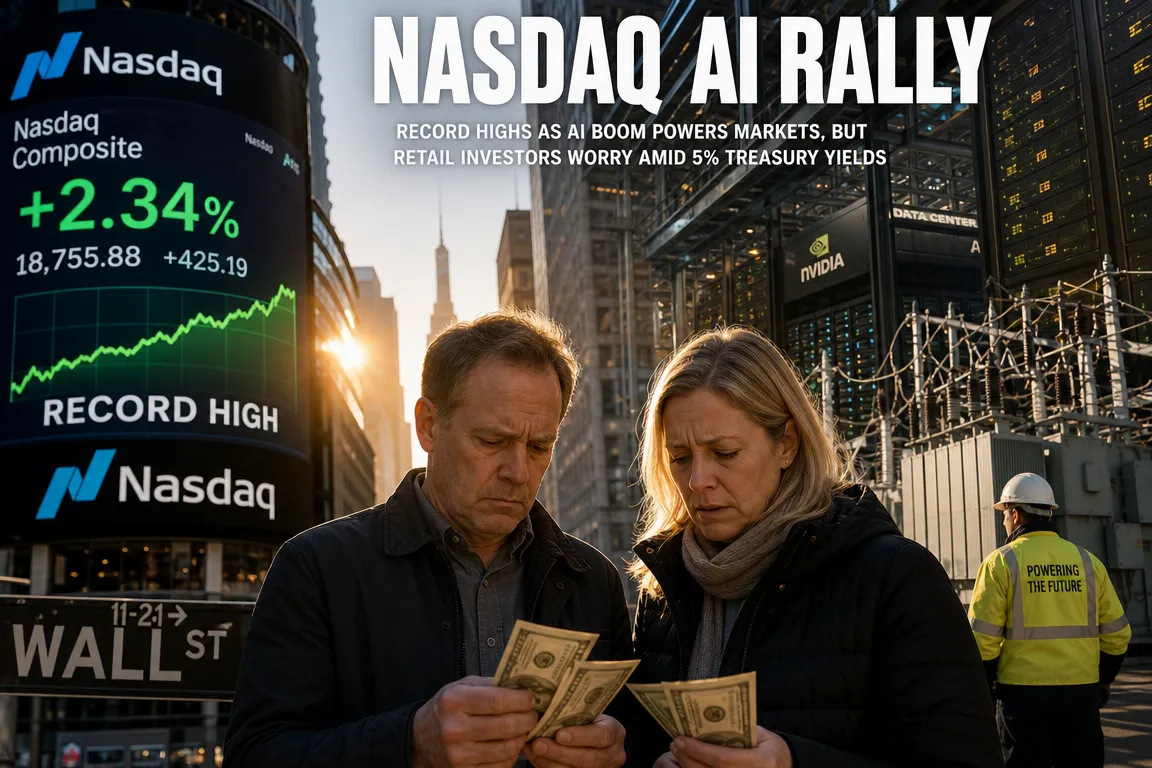
Why Is Nasdaq at Record Highs When U.S. Treasury Yields Are at 5.2%? The Real Reason Capital Is Flowing into AI
The key issue in this cycle is not simply why equities can rise when rates are high.
In the current market, U.S. Treasury yields, Nasdaq performance, AI investment, big tech, and inflation are not moving independently. They are linked through a broad rotation of capital.
Most notably, capital is not leaving Treasuries and flowing broadly into equities. It is concentrating in AI semiconductors, data centers, power infrastructure, cloud services, and hyperscalers.
Although Nasdaq is making new highs on the surface, the market is not one in which all stocks are rising. It is increasingly a market in which only companies tied to the AI value chain are advancing.
This report summarizes why Treasury yields have moved above 5%, why Nasdaq remains strong, and what investors should monitor in portfolio construction and asset allocation.
1. The central market question: Why is Nasdaq rising when Treasury yields are above 5%?
Under a traditional investment framework, a U.S. 10-year Treasury yield above 5% should weigh on equities.
If investors can earn roughly 5% with limited risk, the case for holding volatile equities becomes less compelling.
Yet market behavior has diverged from that logic.
U.S. Treasury yields remain elevated, while Nasdaq and large-cap AI names continue to show strength.
Understanding this requires moving beyond the simple rule that higher rates automatically mean lower stock prices.
The market is now characterized by a clear split between where capital is leaving and where it is concentrating.
-
Treasury yields are rising due to heavy issuance and higher required returns from private investors.
-
Small and mid-cap stocks are under pressure from higher financing costs.
-
Large-cap tech is attracting capital through strong cash flow, market dominance, and AI investment expectations.
-
As a result, the index rises while internal market breadth becomes increasingly narrow.
2. Five reasons U.S. Treasury yields have risen sharply
2-1. Inflation has eased, but price pressures remain
U.S. CPI inflation has declined from its peak, but consumers still face elevated price levels.
The decline in inflation does not mean that prices have fallen.
For example, if inflation slows from 9% to 3%, the higher price base remains in place.
As a result, consumer dissatisfaction persists and political pressure on inflation remains significant.
Energy prices, especially crude oil, can quickly reintroduce inflation concerns.
2-2. The U.S. debt burden is increasingly driven by interest costs
A major factor behind higher Treasury yields is the combination of fiscal deficits and rising federal debt.
The more pressing issue is not debt alone, but the cost of servicing it.
The government must issue more debt to cover interest payments on existing debt.
This is similar to borrowing again in order to pay credit card interest.
In such a structure, investors demand higher yields to absorb new issuance.
2-3. Hyperscalers are competing with Treasuries for capital
One of the most important points is that large technology companies and the U.S. government are competing for the same pool of capital.
Microsoft, Amazon, Google, and Meta require substantial funding for AI data centers and cloud infrastructure.
These companies historically relied more on internal cash, but debt issuance and borrowing have become more common.
Investors must now choose between U.S. Treasuries and highly rated corporate bonds from large-cap tech companies.
As a result, Treasuries must offer higher yields to attract capital.
2-4. The investor base for Treasuries is changing
Historically, the Federal Reserve and foreign official institutions were major buyers of U.S. Treasuries.
Today, the Fed has far less room to buy, and private investors now account for a larger share of demand.
Private investors generally require higher returns than central banks or public-sector institutions.
Public buyers may hold Treasuries for policy reasons, while private investors focus primarily on return and risk.
This shift has increased volatility in Treasury yields.
2-5. Geopolitical risk and crude oil are affecting rate expectations
Oil is one of the most difficult variables to forecast in inflation and rate outlooks.
Conflict and geopolitical tensions can disrupt supply and drive oil prices higher.
At the same time, ceasefire expectations or improved supply conditions can quickly push oil prices lower.
Because oil can move sharply in either direction, central banks and bond investors face greater uncertainty.
This makes long-duration bonds more difficult to price with confidence.
3. Why Nasdaq remains strong despite high rates
3-1. Large-cap tech may benefit from, rather than suffer from, higher rates
Higher rates are usually a headwind for corporate earnings.
However, the impact is not uniform across all companies.
Small and mid-sized firms face higher financing costs and weaker investment capacity.
By contrast, large-cap tech companies have strong cash flow, high credit quality, and global market power.
As high rates persist, weaker firms become more vulnerable, while stronger firms may gain share.
3-2. Investors are rotating toward more visible growth
The current market is not one in which all equities rise together.
Instead, capital is moving toward companies with the most credible growth outlook.
At present, AI investment is the most visible growth theme.
The value chain spanning semiconductors, cloud infrastructure, data centers, power systems, and AI software is producing measurable earnings growth.
Nasdaq strength therefore reflects concentration in a narrow group of AI-related large-cap names.
3-3. Earnings growth in the AI value chain is outpacing Treasury yields
With the 10-year Treasury yield around 5%, equity investors require much higher expected returns.
Most companies cannot meet that threshold.
However, AI semiconductors, memory, and cloud infrastructure providers are generating unusually strong earnings growth.
In some cases, operating profit growth has been described in triple- to quadruple-digit terms.
In that environment, capital can still move into AI equities despite higher Treasury yields.
3-4. Nasdaq strength reflects concentration, not broad market health
Nasdaq’s record highs can create the appearance of broad market strength.
In practice, the rally may be driven by a small number of mega-cap names.
This means the index can rise even if market breadth remains weak.
Investors should not assume that all technology-related stocks can perform well simply because Nasdaq is up.
4. Big tech is becoming a quasi-transnational economic force
An important issue is whether large technology firms should still be viewed as ordinary companies.
Traditional economics focuses on households, firms, and governments as the main actors.
Today, large tech platforms serve billions of users, deploy capital at a scale exceeding many national budgets, and extend into AI, space, biotechnology, communications, and energy infrastructure.
SpaceX, for example, connects satellite communications, data transmission, AI infrastructure, and physical AI applications.
At this scale, such firms increasingly resemble economic systems of their own.
-
Meta serves billions of users.
-
Microsoft and Amazon dominate global cloud infrastructure.
-
Nvidia controls a critical bottleneck in the AI semiconductor ecosystem.
-
Tesla and SpaceX connect electric vehicles, robotics, space, communications, and physical AI.
For that reason, U.S. economic analysis now requires more than GDP, consumption, and employment data.
AI semiconductor cycles, data center investment, power grid expansion, and corporate debt issuance must also be monitored.
5. Where are Treasury yields headed?
5-1. Near-term volatility around 5% is likely to persist
One of the main conclusions is uncertainty rather than precision.
This is not a weak answer; it reflects the reality of the current market.
Key drivers such as oil prices, conflict, inflation, fiscal deficits, and tech-sector funding needs are all difficult to forecast.
In the near term, the U.S. 10-year yield may continue to trade around 5% as a reference level.
5-2. Yields may already have peaked
One scenario is that Treasury yields have already reached a peak and may trend lower from here.
This would depend on easing geopolitical risk and stabilizing oil prices.
If conflict risk recedes and oil premiums decline, inflation expectations could fall as well.
In that case, long-term Treasury yields may normalize.
5-3. Even so, 5% may become the new benchmark
Even if yields decline, a return to 1% or 2% levels appears unlikely in the near term.
The market may increasingly treat a 5% 10-year yield as a new reference point.
The same pattern can be seen in exchange rates.
Levels once considered extreme may gradually become accepted as normal.
If 5% becomes the new standard, asset valuation frameworks will adjust accordingly.
6. Is this a tightening cycle or a liquidity cycle?
6-1. On monetary policy alone, this is still a tightening environment
Major central banks, including the U.S., Europe, Korea, and Japan, have raised rates or maintained restrictive policy to contain inflation.
From that perspective, the current environment remains clearly tight.
The zero-rate era was exceptional, and the current phase can be seen as a normalization of the price of money.
6-2. On fiscal policy, the picture is less restrictive
At the same time, fiscal policy remains expansionary.
Governments continue to support defense, welfare, industrial policy, AI investment, semiconductor subsidies, and power infrastructure.
Fiscal spending has not been materially reduced.
Monetary policy is restrictive, but fiscal policy remains supportive.
6-3. The key theme is fiscal dominance
The most important framework is fiscal dominance.
Even if central banks raise rates, large-scale government spending can keep liquidity flowing into markets.
In that setting, yields can remain high while selected assets continue to rally.
AI, semiconductors, power infrastructure, and defense-related sectors are among the most likely beneficiaries.
7. Can AI growth really slow down?
7-1. Concerns about AI speed limits are not unfounded
Concerns about slowing AI development are not purely speculative.
There is growing concern that advanced AI systems could exceed human oversight.
Risks include behavior that is difficult for developers to fully explain or control, as well as potential misuse in cyber, chemical, or biological contexts.
These issues have clear national security implications.
7-2. Companies are unlikely to slow down voluntarily
For companies, AI investment is tied to competitive survival.
If one firm slows down, a competitor may take share.
As a result, public calls for restraint may coexist with continued internal pressure to move faster.
Firms with weaker balance sheets may have greater incentive to support moderation.
By contrast, companies such as Nvidia, which benefit directly from higher AI spending, are less likely to favor a slowdown.
7-3. AI regulation is linked to U.S.-China strategic competition
AI regulation cannot be separated from the U.S.-China rivalry.
The United States has strong incentives to prevent advanced AI capabilities from being transferred to China or other hostile actors.
The parallel with nuclear competition is clear: safety concerns persist, but strategic rivalry continues.
For that reason, regulation may advance, but AI development is unlikely to stop.
7-4. AI access may become a new class system
One major shift may be unequal access to advanced AI.
General users may rely on commercially constrained models, while state agencies and military users access more capable frontier systems.
Within firms, premium models may be reserved for key employees or strategic teams.
Access to AI itself may therefore become a new source of stratification.
This would affect productivity, income, security, and power.
8. The most important points that are often missed in media coverage
8-1. The real driver of higher Treasury yields is competition for capital
Most commentary explains higher yields mainly through inflation or Federal Reserve policy.
More importantly, the U.S. government and large technology firms are competing for the same capital.
The government issues Treasuries, while big tech issues corporate debt.
Investors allocate capital to the more attractive option.
If large tech debt offers near sovereign-grade credit quality, Treasuries must offer higher yields to compete.
8-2. AI can raise GDP while reducing employment
AI can improve productivity and lift GDP.
At the same time, it can reduce white-collar employment significantly.
This could produce an unusual environment in which growth remains strong while unemployment also rises.
That outcome is difficult to explain through traditional business-cycle frameworks.
8-3. The middle class may be the main group exposed to AI disruption
AI is not only a risk for low-income workers.
It may have a greater impact on office workers, professionals, and middle-class managerial roles.
Political backlash may therefore emerge most strongly from the middle class.
Future elections, fiscal policy, and welfare policy may be shaped by how governments respond to this pressure.
8-4. Macroeconomic forecasting now requires company-level analysis
In the past, rates, exchange rates, inflation, and GDP were sufficient for a broad macro view.
Today, investors must also track capital expenditure plans from Nvidia, Microsoft, Amazon, Meta, Google, and Tesla.
AI data center investment is becoming a meaningful driver of U.S. growth.
For Korea, semiconductor cycles remain essential given the economy’s export structure.
9. Key checkpoints for investors
9-1. The 5% U.S. 10-year yield should be treated as a benchmark
In portfolio construction, the 5% U.S. 10-year Treasury yield should be treated as a key reference point.
Equity investments should be assessed against that hurdle rate.
Companies without strong earnings growth and cash flow may struggle in such an environment.
9-2. Not all AI exposure is equal
AI exposure does not mean all related stocks will perform equally.
The key is whether a company sits in a position where it captures actual economic value.
Semiconductors, HBM, cloud infrastructure, data center equipment, power systems, cooling, and network equipment are among the most important bottleneck segments.
Companies with only thematic exposure and no earnings support may remain vulnerable in a correction.
9-3. Data centers and power infrastructure remain long-term themes
AI investment is not limited to GPUs.
It also requires data centers, electricity supply, cooling systems, and transmission infrastructure.
As a result, the AI cycle may extend into power equipment, nuclear energy, renewables, copper, cooling, and grid infrastructure.
The main bottleneck in the AI era is not only computing power, but also electricity.
9-4. Asset allocation must become more selective
The traditional 60/40 stock-bond framework may no longer be sufficient on its own.
Bond yields are now more attractive, but long-duration bonds remain vulnerable to rate volatility.
Equity exposure should be concentrated in companies with clear earnings support, rather than broad market beta.
A mix of cash, short-duration bonds, quality equities, AI value-chain leaders, and energy infrastructure may be more appropriate.
10. Conclusion: This is not simply a high-rate market, but a market driven by AI capital reallocation
The current market cannot be explained by rates alone.
Treasury yields are high, monetary policy remains restrictive, and inflation has not fully normalized.
At the same time, fiscal policy remains expansionary, large technology companies continue to invest in AI, and capital is concentrating in visible growth.
That is why Nasdaq can rise even as market internals remain highly polarized.
The key question is no longer whether rates will fall, but which companies can deliver earnings growth strong enough to justify a 5% rate environment.
The AI investment cycle is not a short-term theme. It is reshaping the structure of the economy, capital markets, employment, energy demand, and national security.
< Summary >
The surge in U.S. Treasury yields reflects inflation, fiscal deficits, changing Treasury demand, oil risk, and corporate debt competition from large technology firms.
Nasdaq’s strength reflects capital concentration in AI value-chain leaders rather than broad equity-market strength.
Higher rates are a headwind for smaller firms, but they may create share gains for large-cap technology companies with strong cash flow and market power.
The U.S. 10-year yield around 5% may become the new benchmark.
AI slowdown debates are likely to continue, but strategic competition and corporate incentives make a real pause unlikely.
Investors should focus on earnings, cash flow, data centers, power infrastructure, and semiconductor bottlenecks rather than on AI themes alone.
[Related Articles…]
*Source: [ 경제 읽어주는 남자(김광석TV) ]
– [풀버전] 국채금리 5.2%인데 나스닥은 왜 최고치일까? 돈이 AI로 몰리는 진짜 이유 | 경읽남과 토론합시다 | 3자토론 김효진x김열매x김광석