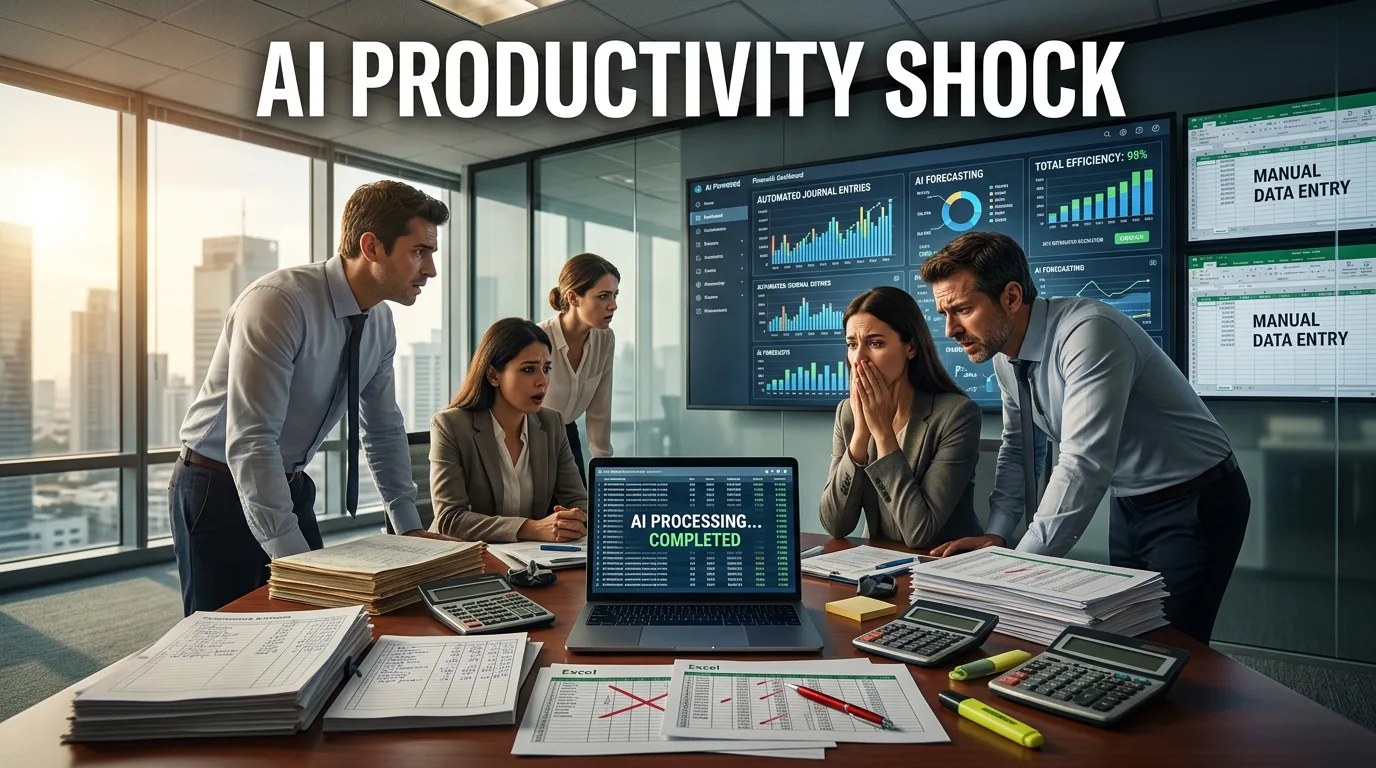
● AI Productivity Shock
Has AI Become Faster and More Accurate Than Accountants and Lawyers? A Summary of the ‘AI Productivity Shock’ Disrupting the Professional Job Market
The core point of this issue is not simply that “AI has become smarter.”
The truly important point is that AI has gone beyond merely assisting experts, and in some tasks, human expert involvement has become a bottleneck that actually reduces speed and accuracy.
This is especially being seen quickly in core tasks of high-paying white-collar jobs such as accounting, law, investment banking, Excel modeling, and document review.
This change connects to major trends spanning the global economic outlook, AI investment, productivity innovation, labor market restructuring, and even the semiconductor cycle.
Today, centered on the accounting experiment results, let’s summarize in news format why the professional job market is shaking and what individuals and investors should prepare for.
1. Shocking Results from a U.S. Accountant Experiment
An interesting experiment was conducted in the United States.
Twelve U.S. CPAs, or Certified Public Accountants, carried out accounting work together with the AI model Claude.
The participants were experienced professionals from major accounting firms, with an average of more than 5.5 years of practical experience.
The experimental task was a company’s month-end closing work.
Month-end closing involves reviewing transactions that occurred over the month, accurately recognizing revenue and expenses, and organizing the books.
It is a highly important area in accounting practice, but also one where many errors can occur.
- Participants: 12 U.S. CPAs
- Experience: from major accounting firms, average 5.5+ years
- Task: 4 month-end closing-related assignments
- Comparison: AI alone, human alone, AI followed by human review
- Model used: Claude Opus 3 based on the original text
The results were quite shocking.
When AI solved the problems alone, it scored 100 on all 20 attempts.
By contrast, when accountants intervened in the AI results, errors actually occurred.
Even the working time was about 15 times longer than AI working alone.
2. Why Were the Accountants Struggling?
This task was not a simple accounting exam.
It was a practical problem requiring the detection of errors across dozens of documents and data points.
For example, in a hotel accounting task, there was a case where $4,000 of parking revenue was incorrectly recorded as room revenue.
There was also a case where a customer who stayed in December paid on January 3, but that revenue was omitted from December revenue.
According to accounting standards, even if the money is received in January, if the actual service was provided in December, the revenue must be recognized in December.
- Parking revenue misclassified as room revenue
- A December guest’s January payment omitted from December revenue
- Inconsistencies across data scattered in multiple documents
- A structure requiring simultaneous review of dozens of traps
From a human perspective, catching all of these issues is extremely difficult.
That is because there are many documents, account items are mixed together, and dates and transaction conditions must also be checked.
In the experiment, when accountants solved the problems alone, the average score was around 37.
Even the experts who created the problems reportedly said that “even skilled accountants would have difficulty getting over half.”
3. What It Means That AI Alone Outperformed Human + AI
The most important point is not merely that AI scored higher than humans.
More important is that performance actually got worse when humans reviewed AI results.
Common sense tells us that accuracy should improve when an expert checks once more.
But in this experiment, the opposite result appeared.
- AI alone: 100 on all 20 attempts
- AI alone working time: under 10 minutes per case
- With human intervention: errors occurred
- With human intervention: working time increased by about 15 times
- AI alone cost: about $0.21 per problem
- Accountant cost: about $10 per problem
- Cost gap: about 50 times
The meaning of this result is clear.
In some areas of knowledge work, human experts may no longer be quality assurance mechanisms but bottlenecks.
When considering speed, accuracy, and cost together, there are areas where AI is overwhelmingly superior.
This is not simple automation; it is a signal of labor market restructuring.
4. It’s Not Just Accounting: The Spread to Legal and Investment Banking Work
There may be an argument that “accounting is a field with numbers and correct answers, so AI is naturally good at it.”
That is true.
Accounting is an area where AI can excel because it deals with structured documents and numbers.
But the problem is that similar phenomena are appearing in legal, investment banking, and corporate finance work as well.
The original text mentions a benchmark called APEX.
This benchmark tests corporate legal and investment banking tasks.
Here, AI performs complex corporate practical assignments.
It is not just about answering multiple-choice questions, but about reviewing numerous files, revising Excel models, and producing outputs needed for decision-making.
- Corporate legal document review
- Investment banking analysis
- LBO, or leveraged buyout, Excel modeling
- Data analysis based on hundreds of files
- Adjusting complex variables such as growth rate, debt cost, and investor returns
In particular, LBO Excel modeling is a representative example of advanced investment banking work.
If you change one growth rate, revenue and profit change; if you change debt cost, investor returns change.
Because countless formulas in Excel are interconnected, it is difficult for a person to revise them without errors.
According to the original text, work that could take more than a week for a person was handled by AI in about 20 minutes.
5. The More Frightening Thing Is Not ‘AI Performance’ but ‘AI Speed of Improvement’
The scarier part of this issue is not current performance but the speed of improvement.
The original text explains that about a year and a half ago, GPT-4 could barely solve these accounting tasks.
But subsequent models approached the 30-point range, and then within another year reportedly rose to a level that overwhelmed experts.
In other words, AI is not improving little by little; from a certain point onward, it is advancing by surpassing humans at the level of job tasks.
The original text also mentions some recent model names and scores.
However, because this may include names that require public verification or benchmark interpretations, the key takeaway is not the specific model names but the trend that “AI performance is improving very rapidly in high-difficulty knowledge work.”
- In the past, GPT-4-level systems were assessed as being limited in handling demanding practical tasks
- Subsequent models rapidly approached expert level
- Recently, some tasks have produced results surpassing experts
- Benchmark performance has risen sharply over six-month to one-year intervals
This trend is a very important change for companies.
Companies will not ignore tools that can simultaneously reduce labor costs, working time, and quality control costs.
In the end, AI adoption is likely to become not just cost cutting but a core strategy for productivity innovation.
6. What It Means When Humans Become the Bottleneck
Traditionally, AI was a tool that assisted humans.
But now, in some knowledge work, humans are finding themselves in a position where they must assist AI.
Moreover, there are cases where human involvement makes things slower and more error-prone.
This is the so-called “human bottleneck” phenomenon.
In the past, people who were good at using calculators could compute quickly.
But nobody competes by claiming they can do mental arithmetic better than a calculator.
A similar change is beginning in knowledge work as well.
The competition to know more than AI, read documents faster than AI, and calculate more accurately than AI may become increasingly less meaningful.
What will matter more in the future is not memorizing vast amounts of knowledge.
It will be the ability to provide the right context to AI, ask good questions, and connect results to business decisions.
7. Will Professional Jobs Disappear? The Key Is ‘Stamp Value’ and Responsibility
That said, it is difficult to say that professional jobs such as accountants, lawyers, tax specialists, and analysts will disappear immediately.
There are still areas within professional work that only humans can handle.
That is responsibility and trust.
AI cannot sign an audit report.
AI cannot take legal responsibility in court as a licensed lawyer.
AI does not coordinate interests with clients or bear legal responsibility for final judgments.
Ultimately, the value of professional jobs is likely to move away from knowledge ownership and toward judgment and responsibility.
- What AI does well: data processing, drafting, document review, calculation, comparative analysis
- What humans must do: final judgment, client communication, problem definition, responsible signing
- The future value of professional jobs: shifting from knowledge workers to responsibility designers
Simply put, professional workers of the future are likely to become not “people who do everything themselves,” but “people who take final responsibility based on results created by AI.”
8. A More Important Message for Office Workers: This Is Not Someone Else’s Problem
This issue should not be seen as a problem only for professional occupations.
If accountants and lawyers are shaken, general office workers, planners, marketers, developers, researchers, and analysts are not safe either.
A large part of white-collar work consists of reading documents, organizing materials, calculations, report writing, and data comparison.
And this is exactly the area where AI is advancing the fastest.
The productivity gap between people who use AI well and those who do not is likely to grow even wider in the future.
Even within the same company, employees who deeply integrate AI into their work processes can do the work of several people on their own.
By contrast, people who use AI merely as a simple search box may not feel much difference in performance.
9. Why People Underestimate AI
Many people say, “I tried AI, and it wasn’t that good.”
But in reality, often it is not that AI is lacking, but that the way it is used is lacking.
People often do not give AI enough context, do not clearly explain the goal, or evaluate performance while using outdated models.
- Bad prompt: “Summarize this.”
- Good prompt: “Organize this material for a CFO report, focusing on 5 risks and 3 response strategies.”
- Bad usage: getting one answer and stopping
- Good usage: continuous work from draft, verification, counterargument, rewriting, to decision-making
In the future, if an AI output is poor, we may enter an era where we first need to examine the user’s instruction method and work design ability before blaming AI itself.
10. The Real Core Point Rarely Explained Well in Other News or YouTube
Most content focuses on the sensational part that “AI beat accountants.”
But the truly important thing is elsewhere.
- First, AI is entering not just repetitive tasks but also high-difficulty judgment-based document work.
- Second, the belief that human review always improves quality is being broken.
- Third, companies will never ignore a structure in which costs differ by 50 times.
- Fourth, the value of professional work is moving from knowledge possession to responsibility and client trust.
- Fifth, the income gap between individuals who use AI and those who do not is likely to widen.
- Sixth, companies and countries with AI infrastructure are likely to capture more added value.
Especially noteworthy is the capital gap.
Companies that use AI well reduce labor costs, increase productivity, and acquire more data.
That data then leads to further AI performance improvements and service expansion.
In the end, industrial concentration may increase around AI companies, cloud companies, semiconductor companies, and data center companies.
This trend is a variable that must be checked when looking at AI investment and the global economic outlook.
11. Changes to Watch from an Investment Perspective
If AI changes the productivity of professional work, corporate profit structures will also change.
The greater the labor cost burden in an industry, the larger the potential effect of AI adoption.
Accounting, law, finance, consulting, software, healthcare administration, and insurance review are representative areas.
At the same time, the importance of infrastructure supporting the AI industry is also growing.
As AI models advance, more GPUs, memory semiconductors, power, cooling systems, and data centers are needed.
That is why the AI trend is not just a technical issue but is also connected to the semiconductor cycle, power infrastructure, cloud investment, and interest rate outlook.
- Areas that may benefit: AI software, cloud, semiconductors, data centers, power infrastructure
- Areas that may come under pressure: outsourcing centered on simple document processing, repetitive office work, low-value-added research tasks
- Key variables: AI adoption speed, regulation, corporate cost-cutting pressure, interest rate environment
In a high-interest-rate environment, companies become more sensitive to cost reduction.
At that point, AI becomes not just an innovation tool but a survival strategy that changes the cost structure.
Conversely, if expectations for rate cuts grow, AI infrastructure investment could expand even more aggressively.
12. What Individuals Should Do Right Now
The most practical response is twofold.
First, keep using AI.
Second, understand the structure of the AI industry.
AI cannot really be learned from books alone.
You have to put it directly into your work.
Try attaching it to your own tasks as much as possible, such as report writing, email drafting, Excel analysis, meeting notes, market research, code writing, and contract review.
- Try automating one repetitive daily task with AI
- Let AI draft reports while you focus on structure and judgment
- Have AI present counterarguments to check decision-making risks
- Connect AI to Excel, documents, and presentation work
- Change the entire work process to be AI-friendly, not just the prompt
In the future, competitiveness will likely depend not on “knowing AI,” but on “having a system that works with AI.”
13. What Companies Need to Prepare
Companies also should not stop at simply purchasing a few AI accounts.
They need to redesign work processes around AI.
In particular, they should first review document work repeatedly handled by high-cost specialists.
- Introduce an AI review stage into accounting closing processes
- Automate legal contract review
- Automate data extraction from investment review materials
- Automate customer support and internal report writing
- Build an approval system for responsible personnel regarding AI outputs
However, AI cannot take over all responsibility.
Therefore, companies must design AI usage rules, data security, result verification processes, and final approval authority together.
14. Conclusion: Not a Crisis for Professional Jobs, but a Restructuring of Work Definition
This accountant experiment does not mean that professional jobs are over.
More precisely, it signals that the definition of professional work is changing.
In the past, people who knew a lot and handled tasks quickly were strong.
In the future, those who use AI to define bigger problems, take responsibility for results, and deliver judgments in a way clients can understand are likely to become stronger.
AI may not replace all human work at once.
But the likelihood that people who use AI will replace those who do not use AI is very high.
Whether you are a professional or an office worker, what is needed now is not fear but transition.
If you see AI only as a competitor, you will become anxious; if you see it only as a tool, you may miss the opportunity.
Those who accept AI as a new infrastructure for working together are likely to become beneficiaries of the next productivity innovation.
< Summary >
In an accounting experiment involving 12 U.S. CPAs, AI scored 100 on all 20 attempts when working alone.
By contrast, when human experts intervened, errors occurred and working time increased by about 15 times.
AI cost about $0.21 per problem, while accountant cost was about $10, a difference of roughly 50 times.
This change is spreading beyond accounting into advanced knowledge work such as law, investment banking, and Excel modeling.
The core value of professional jobs is moving from knowledge processing to responsibility, judgment, and client communication.
Individuals must keep applying AI to their work, and companies must redesign processes around AI.
Competitiveness in the AI era depends not on being smarter than AI, but on building a system that uses AI best.
[Related Articles…]
- AI Productivity Revolution and the Future Strategy for Office Workers
- AI Infrastructure Investment and the Semiconductor Cycle Outlook
*Source: [ 월텍남 – 월스트리트 테크남 ]
– “AI혼자가 전문직+AI보다 낫다고?” 회계사, 변호사 업계 ‘술렁‘