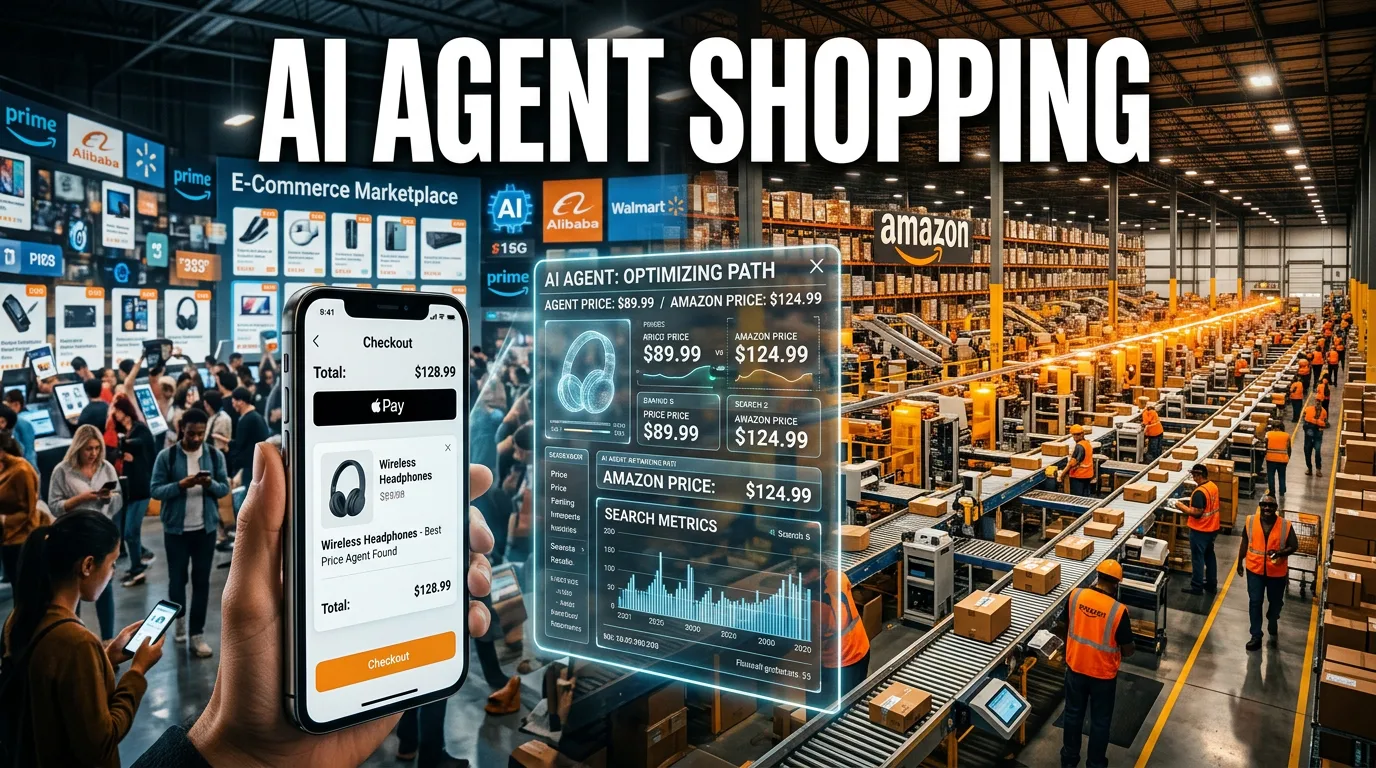
● Meta Muse vs Amazon
Why Meta Muse Was Blocked by Amazon and Welcomed by Shopify: How AI Agent Shopping Is Shaking Up E-Commerce Profit Models
The core point of this issue is not whether “AI should shop for us.”
The real core point is who controls the first touchpoint where consumers choose products, the moment ads are shown, pre-purchase taste data, and the power over payments and logistics.
Meta’s personal AI agent, “Muse,” was blocked by Amazon and opened by Shopify and Walmart.
On the surface, it looks like a security and authentication issue, but underneath it all, Amazon ads, e-commerce platform competition, seller operating systems, and competition over AI agent standards are all intertwined at once.
This incident is especially important from the perspective of the global economic outlook.
That is because the money-making structure of online shopping could shift from “search box → ads → product click → purchase” to “ask AI → narrow options → approve purchase.”
1. Event Summary: Meta Muse Was Blocked by Amazon and Opened by Shopify
Meta’s released “Muse” is a personal AI agent that follows user instructions and carries out tasks by moving through websites.
One of its main uses is shopping functions that connect product search, comparison, recommendations, and purchase approval.
Market interest surged quickly, with 5 million downloads in about three weeks after launch.
- Amazon’s choice: block it
Amazon blocked Muse from accessing its website.
When Muse tries to access Amazon, a notice appears stating that use of an unauthorized AI tool violates the terms of service.
Amazon argued that Muse accessed its site without prior agreement, did not sufficiently disclose that it is an AI agent, and poses risks in the way it handles customer login information. - Shopify’s choice: open it
Shopify made the opposite choice.
It opened its stores so that users can find products through Muse and make purchases via Shop Pay, Shopify’s payment service.
From Shopify’s perspective, revenue is generated whether consumers visit directly or an AI agent buys on their behalf, as long as payment and operating services are used. - Walmart’s choice: partner participation
Walmart also joined as a shopping partner with Meta.
This is more than a simple alliance; it is expanding into a new shopping infrastructure competition where AI agents connect with distribution platforms.
2. On the Surface, a Security Issue; Beneath It, a Battle for Control of Shopping
Amazon’s official reason is security and identity verification.
The logic is that it could be risky if an AI agent enters a website pretending to be a person and handles login information or makes purchases on the user’s behalf.
This argument itself is quite reasonable.
There is a real possibility that an AI agent could order the wrong product, mishandle personal information, or act beyond the user’s authorized scope.
But there is one important point here.
Meta, Shopify, Walmart, Stripe, Sierra, and others are working to build a common standard called the Personal Agent Protocol, or PAP.
PAP is a set of rules that AI agents must follow when using corporate websites or systems.
In simple terms, it is a technical standard that allows companies to verify “who this AI is acting for,” “what permissions it has,” and “what tasks it is allowed to perform.”
- What PAP can solve
It can reduce identity verification issues for AI agents.
It can clearly indicate the scope of user permissions.
From a company’s perspective, it can ease the difficulty of telling whether the visitor is a human or a bot. - What PAP cannot fully solve
The possibility of AI malfunction still remains.
Responsibility for handling personal information does not disappear completely.
Interpreting what the consumer actually intended when they approved something is also complicated.
Still, if a technical standard can ease much of the security issue, then Amazon’s block is hard to view as a simple security matter alone.
The core point is that AI could take over the front end of Amazon’s shopping experience.
3. What Amazon Is Really Afraid Of: A Shopping Experience Without Ads
Amazon is not just an online shopping mall.
Amazon is a massive advertising platform.
Its retail business itself is not highly profitable, but advertising is a core pillar supporting Amazon’s profitability.
Based on the original source, Amazon’s total ad services revenue in 2025 is about $68.6 billion, or roughly 92 trillion won.
This includes search ads, video ads, and display ads.
The most important part is sponsored ads shown in Amazon search results.
According to market researcher eMarketer, about two-thirds of ad services revenue comes from on-site search ads.
For example, let’s say a consumer wants to buy running shoes on Amazon.
In the traditional shopping method, the consumer types “running shoes” into the search box.
Then they scroll through the results and compare brands, prices, reviews, and shipping conditions.
During this process, sellers pay Amazon for ads to make their products more visible.
Amazon earns not only sales commissions, but also ad revenue while consumers are still deciding.
But in AI agent shopping, this structure is shaken dramatically.
If a consumer tells Muse, “Find me comfortable running shoes for commuting every day. It would be nice if they could also handle rainy days,” the AI compares multiple shopping sites and narrows down the options.
The consumer then approves a purchase after seeing only a few recommended products.
In that case, even if Amazon receives the final order, the time consumers spend browsing ad products is greatly reduced.
For Amazon, there is something even more important than one order.
It is the ad revenue and data generated in the process of creating that order.
4. The Key Economic Point: AI Shopping Compresses the “Search Ad Economy”
Up to now, e-commerce has grown around search and advertising.
When consumers searched, platforms showed ads, sellers paid for exposure, and platforms earned both intermediary fees and ad revenue.
But if AI agents compress consumer decision-making on their behalf, the value of the search results page could decline.
- Traditional structure
Consumer search → ad exposure → click → review comparison → cart → purchase
In this process, platforms secure ad revenue, sales commissions, and data collection opportunities all at once. - AI agent structure
Consumer request → AI analysis → candidate recommendation → purchase approval
In this process, ad exposure decreases, and consumer preference data accumulates first on the AI agent side.
This change could affect not only Amazon, but also Naver, Coupang, Kakao, TikTok Shop, YouTube Shopping, and Instagram Shopping.
If the consumer’s starting point shifts from a platform search box to an AI chat window, the ad pricing and customer data strategies of existing e-commerce companies could be disrupted at the same time.
5. Amazon vs Meta: It’s Not Product Sales Competition, It’s Customer Data Competition
Another reason Amazon sees Muse as troublesome is that Meta is a powerful advertising competitor.
Meta has interest data from Facebook, Instagram, and Reels.
Amazon has search and purchase data.
But if an AI agent like Muse takes over the front end of shopping conversations, Meta can also secure consumer purchase intent data.
For example, let’s say a consumer says this to the AI:
“I have wide feet, and a certain brand was uncomfortable before. Recommend shoes for commuting that won’t hurt my feet even if I walk a lot.”
This conversation contains much richer information than a search term.
It includes taste, discomfort experiences, budget, situation, purchase intent, and brand preferences and dislikes.
Even if Amazon handles the final order, the context behind that purchase decision may be accumulated first by Meta Muse.
This is the truly important change.
The AI competition going forward is not just about who sells products, but about who hears consumer intent first.
6. The Clash with Perplexity Comet Is in the Same Context
This is not the first time Amazon has clashed with an external shopping AI.
It has also taken a restrictive stance toward Google and OpenAI crawling its pages, and it has clashed with Perplexity’s AI browser, Comet.
Comet is an AI browser that can find products in the browser and help users purchase items according to their instructions.
Amazon claimed that Comet accessed its site without properly disclosing that it was AI, demanded that access be stopped, and even filed a lawsuit.
Perplexity criticized Amazon, saying it was trying to protect its existing business rather than consumer convenience.
The existing business being referred to here is ultimately Amazon’s ad business.
If AI browsers and AI agents handle the consumer’s exploration process, the opportunity for Amazon search ads to be shown will inevitably decline.
7. Why Shopify Welcomed Muse: Transactions Matter More Than Visitors
Shopify’s business model is different from Amazon’s.
Amazon is a massive marketplace where consumers visit directly to search for and buy products.
Shopify, on the other hand, is closer to an infrastructure company that helps sellers build online stores and handle payments and operations.
Based on the original source, of Shopify’s 2025 revenue of about $11.6 billion, about $8.8 billion, or 76%, came from merchant solutions.
Merchant solutions include online store operations, payment processing, and currency exchange fees.
From Shopify’s perspective, where consumers discover products matters relatively less.
Whether they discover products on Instagram, TikTok, or through Meta Muse, revenue is generated as long as payment and operations happen through Shopify’s infrastructure.
That is why Shopify can see AI agent shopping as an opportunity rather than a threat.
- Amazon’s revenue logic
The more consumers search and stay on Amazon, the greater the ad revenue.
That is why external AI taking over the exploration process is a burden. - Shopify’s revenue logic
Revenue is generated when purchases happen and payment and operating services are used.
That is why it can welcome AI agents bringing customers from outside.
8. But Amazon Is Opening the Door Wide for Seller-Side AI
What is interesting is that Amazon is not blocking all AI.
It blocks external AI agents on the consumer side, but it is actively opening external AI connections on the seller side.
Amazon provides Seller Central and Seller Assistant as solutions for sellers.
Seller Central is the business platform where sellers manage product listings, orders, inventory, pricing, and shipping.
Seller Assistant is a seller AI agent that analyzes sales status, recommends responses, and can even handle tasks on the seller’s behalf.
On September 23, Amazon announced a plugin that allows sellers to connect external AI tools like Claude directly with Seller Central.
Without logging into Seller Central every time, sellers can continue checking inventory, forecasting sales, adjusting prices, managing product listings, and analyzing data through conversations with Claude.
For example, suppose a seller is already using Claude connected to accounting data and supplier information.
If Amazon sales data is added to that setup, there is less need to separately download inventory and sales performance data and re-enter it.
They can handle Amazon sales tasks inside the AI work environment they already use.
Amazon is cautious about losing consumers to external AI, but it is actively pursuing a role at the center of sellers’ operations.
9. The Expansion of Seller Central: Amazon Is Moving Into Shopify’s Territory
On September 24, Amazon announced another important feature.
It is a multi-channel management feature that allows sellers to connect accounts from other sales channels such as eBay, Shopify, TikTok, and Walmart in Seller Central and manage sales and orders together.
For example, let’s say a seller sells smartphone cases on multiple shopping platforms.
Previously, they had to log into each Amazon, Shopify, TikTok Shop, and Walmart account separately to check orders and inventory.
Now they can check and manage orders from multiple channels in one place in Seller Central.
They can even check an order that came from Shopify in Seller Central and then have it shipped through Amazon logistics.
Product listing management also becomes easier.
Because the required formats differ by channel even for the same product, sellers had to modify listings for each platform.
Amazon’s direction is to automatically update this in Seller Central and even generate product introductions and detailed descriptions with AI.
This means Amazon is moving into Shopify’s territory.
Shopify already offers a multi-channel management service called Marketplace Connect.
Amazon products, orders, and inventory can be managed from the Shopify admin screen.
Now Amazon is trying, in reverse, to pull the center of sellers’ business operations into Seller Central.
10. The Real Core Point That Other Coverage Misses: Amazon Wants to Control Both the “Customer Touchpoint” and the “Seller Operating System”
Many reports focus on the surface-level clash of Amazon blocking Meta Muse.
But the more important point is that Amazon is creating fronts on both sides at the same time.
- On the consumer side, it is checking external AI
Amazon wants to protect the touchpoint where consumers search, compare, and make purchase decisions.
If this touchpoint breaks down, Amazon’s ad revenue and pre-purchase data could weaken. - On the seller side, it is absorbing external AI
Amazon is connecting external AI like Claude with Seller Central and moving into the center of seller operations.
The strategy is to make sellers use Amazon for operations and logistics no matter which channel they sell on. - In the end, Amazon’s strategy is double defense
It wants to keep the consumer’s shopping starting point inside Amazon as much as possible.
At the same time, even if consumers shop outside Amazon, it is building a structure where Amazon can still make money in seller order management and logistics.
This is the most important interpretation of this issue.
Amazon is not simply a company that rejects AI.
Amazon actively accepts AI that is favorable to it and blocks AI that shakes its profit model.
11. Paul Graham’s Take: A New Opportunity for Startups to Compete with Amazon
Paul Graham, co-founder of Y Combinator, offered an interesting interpretation of Amazon’s decision to block Muse.
He sees it as the first time since Amazon’s founding that startups have a chance to grow into competitors to Amazon.
The reason is simple.
If Amazon is going out of its way to block AI agents, that means there is real demand to shop through AI agents.
If there were no users and no threat, there would be no reason to block them.
From this perspective, AI shopping startups, AI browsers, personal shopping agents, and product comparison automation services can become new entry points into e-commerce.
In the past, competing with a giant platform like Amazon required logistics, product scale, seller networks, and search traffic.
But going forward, AI companies that secure the consumer’s chat window first may be able to gather shopping demand outside the platform.
12. The Same Question Applies to Domestic E-Commerce: How Will Naver, Kakao, and Coupang Respond?
The original text mentions that major domestic e-commerce companies such as Naver, Kakao, and Coupang also blocked external AI agent access.
Domestic platforms are likely to face a similar dilemma to Amazon’s.
- Naver
Search ads and the shopping search ecosystem are central.
If AI agents bypass the search results page, the ad exposure structure could be shaken. - Coupang
Rocket Delivery, membership, time spent in the app, and recommendation algorithms are important.
If external AI takes over product selection, Coupang’s control over the in-app customer experience could weaken. - Kakao
Gift-giving, talk-based commerce, and ad and messaging touchpoints are its strengths.
If AI agents take over gift recommendations and purchases, the value of touchpoints inside KakaoTalk could change.
Domestic companies are also likely to face the same choices.
The core issue is whether to block external AI agents, open them in a limited way through standard authentication, or build their own AI agents.
13. The Ripple Effects of AI Shopping from a Global Economic Outlook Perspective
AI agent shopping is not just a technology trend.
It is a digital transformation issue connected to the advertising market, distribution market, payments market, logistics market, and cloud market.
- Ad market restructuring
Ad spending centered on search ads could shift toward AI recommendation-based ads or conversational commerce ads.
Brands will need to think about strategies to enter AI recommendation candidates rather than just ranking at the top of search results. - Changes in platform revenue models
Platforms that make money based on visitor counts and time spent could come under pressure.
On the other hand, companies that control transaction infrastructure such as payments, logistics, and operational automation could become more advantageous. - Changes in data value
The value of conversation data could become greater than click data.
The budget, tastes, situations, complaints, and goals consumers tell AI are highly refined purchase intent data. - Expansion of seller workflow automation
Inventory management, price adjustments, product description writing, sales forecasting, and channel-specific listing optimization are likely to be rapidly automated by AI.
Small and medium-sized sellers may be able to operate across multiple platforms with fewer staff. - Changes in big tech competition
Meta, Amazon, Google, OpenAI, Shopify, Walmart, and Stripe will all compete over AI shopping standards and payment flows.
This could also become an important variable for future big tech stock prices and investment strategies.
14. Five Checkpoints to Watch Going Forward
- First, watch whether standards like PAP for AI agents spread.
If standards take hold, companies may be more likely to allow authenticated access rather than block everything. - Second, check Amazon’s ad revenue growth rate.
If AI shopping spreads, whether search ad growth slows will be the earliest important signal. - Third, look at the share of Shopify’s payment and merchant solutions revenue.
As external AI shopping grows, transaction infrastructure companies like Shopify may benefit. - Fourth, watch competition among seller operating platforms.
It will matter whether Seller Central or the Shopify admin screen becomes the main operating system for sellers. - Fifth, watch where consumers’ shopping starts.
The flow may shift from search boxes to app feeds, and from app feeds to AI chat windows.
15. Interpretation from an Investment and Business Strategy Perspective
This issue is also a fairly important signal for investors.
Amazon is still a powerful e-commerce, cloud, and advertising company, but the fact that AI agents can shake the front end of search ads is a medium- to long-term risk.
By contrast, Shopify can turn the spread of AI agents into an opportunity for more transactions and greater payment revenue.
From the perspective of brands and sellers, a more practical change is coming.
In the future, optimizing search ad keywords alone may not be enough.
When AI recommends products, factors such as price, reviews, return policy, shipping reliability, and the level of structure in product descriptions may matter more.
Product data that AI can easily read is likely to become the new competitive advantage in sales.
In short, future shopping competition may move from “products that are easy for people to see” to “products that AI can understand and recommend well.”
< Summary >
Meta Muse is an AI agent that helps consumers search for, compare, and buy products on their behalf.
Amazon blocked Muse’s access, citing security and authentication concerns.
But the core point is Amazon’s defense of ad revenue and customer touchpoints.
If AI agents compress the shopping process, opportunities for search ad exposure and pre-purchase data collection shrink.
Shopify welcomes AI agents because payment and operating service usage matter more than visitors.
Amazon blocks external AI on the consumer side, but it actively opens external AI connections on the seller side.
In the end, this incident is a battle over who controls consumer intent data and transaction infrastructure in the era of AI shopping.
[Related Articles…]
- AI Agent Shopping and the Future of E-Commerce Competition
- Amazon’s Ad Revenue Model and the Outlook for Digital Platform Economics
*Source: [ 티타임즈TV ]
– 메타 뮤즈를 왜 아마존은 막고 쇼피파이는 열었나?