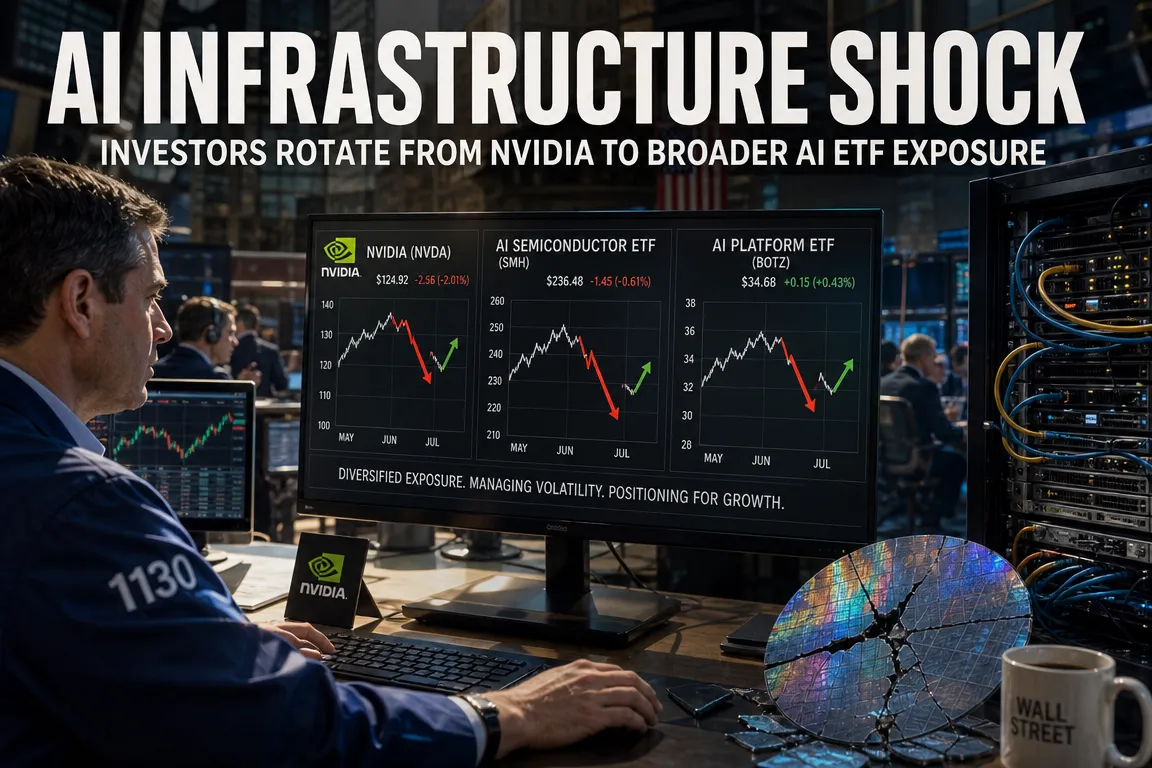
● Big Tech Cash Flow Shock
Not an AI bubble collapse, but the day big tech earnings were put to the ‘cash flow test’
What really matters in this selloff is not that “AI is over,” but that the market has completely changed its 기준 when looking at big tech earnings.
Amazon fell about 8% in after-hours trading, and Intel plunged about 20%.
Marvell also slid more than 13% on the Lumentum acquisition issue, sharply shaking sentiment toward semiconductor stocks.
But if you look closely, AI investment, data center infrastructure, and cloud growth are actually getting stronger.
In this article, we will summarize the earnings of Amazon, Google, Microsoft, Intel, and Marvell all at once, and explain in news style why the market reacted so sensitively.
In particular, we separately organized the key takeaway that many other reports miss: free cash flow, the difference between CAPEX delays and reductions, optical communications bottlenecks, and the possibility of a 2027 semiconductor cycle.
1. Market situation summary: Why the Nasdaq and semiconductors were shaken at the same time
In this session, the Nasdaq fell about 1.3%.
The Philadelphia Semiconductor Index also dropped about 1.4%.
The problem was that the decline continued even after the regular session.
After Amazon and Intel released earnings, additional selling hit the after-hours market, pushing Nasdaq futures down by another 1% or so.
Subjectively, the whole technology sector felt under nearly 3% pressure in just one day.
The obvious reason for the market drop is a big tech earnings shock.
But the real reason is that, more than the earnings themselves, the market’s expectations for free cash flow have risen much higher.
In the past, as long as revenue growth and EPS were decent, stock prices held up.
Not anymore.
The market is now much more strictly judging how much money is being spent on AI data centers and whether any real cash is left after those investments.
2. The key framework for understanding this decline: more like “punishing the honor students” than “the collapse of the AI bubble”
It is easier to understand if you compare this big tech earnings season to a school setting.
Google, Microsoft, and Amazon are companies that the market usually treats like top students.
But in this earnings season, top students who were expected to score 100 got a 90.
If an average student gets 90, that is good. But if a top student gets 90, the teacher scolds them.
That is exactly how the market feels right now.
It is not that AI monetization is failing.
In fact, cloud and data center growth rates are stronger than expected.
However, because the investment scale is so large, the market is asking, “So how much cash is actually left?”
Companies that gave a clear answer to that question held up, while those with vague answers got hit hard.
3. Google earnings analysis: Search is slowing, AI cloud is exploding
The key change at Google is that the company is shifting its axis from search advertising to AI cloud.
Based on the original text, Google Cloud and AI-related growth recorded a strong growth rate of around 103%.
At that level, this is not just a rebound; the center of the business is changing.
On the other hand, search advertising fell a bit short of expectations.
Search growth dropped from 19% in the past to 17%, and was recently mentioned as slowing to around 12%.
Given that search ads used to be Google’s absolute core business, this is a point where the market could be disappointed.
But looking more broadly, this is a structural shift caused by AI moving in a direction that replaces or complements search.
In other words, rather than saying Google’s growth is over because search is weakening, it is more accurate to see this as a transition from search revenue to AI cloud revenue.
Still, the biggest reason the market turned negative was that free cash flow moved into negative territory.
The company is still making money, but because spending on AI data centers and server infrastructure has increased even more, cash flow was pressured in the short term.
That is why Google stock got hit by the market even though the earnings were not bad.
4. Microsoft earnings analysis: The company that gave the answer the market wanted most clearly
Microsoft received the most stable 평가 among this big tech earnings group.
Both revenue and adjusted EPS met market expectations.
Most importantly, free cash flow stood out.
The market had expected about 85 billion dollars of cash inflow, but in reality the company is being praised for showing much stronger cash generation than that.
This was the core of the stock’s defense.
Azure growth also matters.
The Azure growth rate, which once fell to around 38%, has recently climbed back to nearly 50%.
The meaning is clear.
Microsoft is no longer just a company that sells Windows and Office; it is being re-rated as a company that sells AI cloud and productivity AI.
This is the structure the market likes most: AI investment and AI monetization happening at the same time.
In particular, Microsoft’s remaining performance obligations, meaning the amount of contracts not yet recognized as revenue, were mentioned at about 677 billion dollars.
That is close to 800 trillion won.
This figure is an important indicator showing that cloud and AI service revenue can continue to build in the future.
5. CAPEX controversy: Investment has not been reduced; some of it has simply been delayed
One of the biggest reasons semiconductor stocks were shaken in this earnings season was concern that big tech CAPEX was slowing down.
Investors worried that Microsoft and Google might be cutting back data center investment.
But if you look at the details, it is closer to a delay than a reduction.
Microsoft saw some first-quarter spending decrease because of delays in deliveries from external data center suppliers.
Investment was not stopped because demand weakened; execution was pushed back because supply could not keep up.
The company still says customer demand exceeds supply.
Therefore, the amount not executed in the first quarter is likely to roll over into the second quarter and beyond.
Alphabet is similar.
Some investment execution was smaller than expected, but the full 2026 investment plan remains in place, and the message was that spending could actually rise even more in 2027.
This is very important when looking at the semiconductor cycle.
If data center infrastructure investment was not cut but delayed due to bottlenecks, demand for semiconductors and power infrastructure can surge again later.
6. Amazon earnings analysis: AWS was strong, but free cash flow was the issue
Amazon fell about 8% in after-hours trading.
On the surface, both revenue and EPS missed expectations.
Revenue came in about 0.2% below market estimates, and EPS was about 3.6% lower.
Advertising revenue also came in about 5.7% below expectations, deepening disappointment.
The company cited Prime Day effects, but that was not enough to convince the market.
But Amazon’s real core is AWS.
AWS growth accelerated to the fastest pace in the past five years, and the original text mentioned growth of nearly 40%.
If the growth rate previously mentioned at around 28% climbed to 40%, that does not mean a simple rebound; it means AI cloud demand is starting to attach in earnest.
Also, about 63% of Amazon’s operating profit now comes from its data center and cloud businesses.
In the past, Amazon was seen as an e-commerce company, but now it is much more clearly an AI infrastructure company in practice.
Overall operating margin also rose to 13.9%, the highest level ever.
This is because the share of the higher-margin cloud business has grown relative to lower-margin commerce.
Still, the reason the stock fell was free cash flow.
Amazon’s annual free cash flow was mentioned as negative 42.3 billion dollars.
That is about 70 trillion won in cash outflow.
It is not because the company is failing to make money; it is because it is investing more heavily in AI data centers.
From the market’s perspective, the question is: “The growth rate is good, but when does it turn into cash?”
7. Intel earnings analysis: The problem was the guidance, not the current quarter
Intel plunged about 20% in after-hours trading.
The current earnings themselves cannot be said to be completely broken.
The real issue was the next-quarter guidance.
The outlook fell far short of market expectations, and some indicators were described as being around half of what was expected, leading to heavy disappointment.
In particular, margin compression was larger than expected.
The company also appears to acknowledge demand weakness.
Intel is in a position where it could benefit geopolitically as a key company in the restructuring of the U.S. semiconductor supply chain.
Government support, foundry development, and the broader push to expand domestic semiconductor production are clearly positive trends.
But the problem is execution.
In the past, Intel has repeatedly fallen short on new technology transitions, process innovation, and foundry expansion.
That is why the market still cannot shake the doubt: “Can things really be different this time?”
In a situation where semiconductor sentiment is already weak, Intel’s weak guidance weighed on the entire sector.
8. Marvell plunge analysis: Lumentum acquisition is a short-term headwind, but the long-term strategy is strong
Marvell Technology fell more than 13% on the Lumentum M&A issue.
Lumentum is a very important company in optical communications, optical engines, and laser light sources.
Marvell makes custom ASICs and switch chips.
In simple terms, Marvell is close to a mini Broadcom.
In AI data centers, it can supply the custom semiconductors and network chips needed when big tech companies build their own chips.
Lumentum can handle the optical engines and laser light sources that attach next to those chips.
This structure is exactly co-packaged optics, or CPO.
Inside AI data centers, it is becoming difficult to move data using only copper wires as in the past.
As data transfer between GPUs, ASICs, and switches explodes, optical communications are becoming essential infrastructure.
That is why Marvell’s strategy to want Lumentum is itself highly rational.
The problem is money.
Marvell’s cash balance was mentioned at about 3.9 billion dollars.
But acquiring Lumentum would require much more capital, including a control premium.
Acquisition targets usually rise on premium expectations.
That is why Lumentum’s stock went up.
Conversely, the acquiring company has to bear the burden of cash outlays, increased debt, and possible share issuance.
Marvell stock fell because existing shareholders became more concerned about dilution.
The original text mentioned concerns that, if new shares were issued, existing shareholders could see their stake diluted by about 30%.
In the short term, that is clearly a negative factor.
But in the long term, it could be a strategy to get ahead of the AI data center bottleneck.
If Lumentum’s CEO said it can only meet 30% of current light-source demand, that implies more than 70% supply shortage.
One of the biggest bottlenecks in AI infrastructure in 2027 is likely to be optical networks.
From that perspective, Marvell’s aggressive acquisition attempt can be interpreted not as a reckless move, but as a strategy aimed at a leap comparable to Broadcom’s rise.
9. The key point rarely stated in other reports: The market is watching “cash recovery speed,” not AI revenue
The core of this earnings season is not AI growth rates.
AI growth rates are already strong.
Google Cloud, Microsoft Azure, and Amazon AWS are all seeing stronger growth thanks to AI demand.
What the market is looking at now is free cash flow.
Free cash flow is the money left in a company after subtracting capital expenditures from cash generated by operations.
In simple terms, it is the cash left in my pocket after subtracting all the money spent on data centers and equipment from what the business earned.
In the AI era, this metric has become even more important.
That is because AI requires enormous upfront investment before revenue growth arrives.
GPU, HBM, network equipment, power infrastructure, cooling systems, and data center sites all require advance spending.
So even if big tech earnings are good, stock prices can still shake if free cash flow is weak.
Conversely, if free cash flow is solid like Microsoft’s, the market will give a relatively high valuation some leeway.
If you simply view this selloff as the collapse of the AI bubble, you will miss the point.
More precisely, this is the stage where the market is verifying how quickly AI monetization is being converted into real cash.
10. U.S. macro trend: AI investment has started to affect GDP growth as well
U.S. third-quarter growth was mentioned in the original text at 3.4%, beating the market’s expectation of 3.2%.
Some analysis also said that AI-related investment contributed about 1.6 percentage points of growth, almost half of the total.
This number matters because it shows AI investment is no longer just a stock market theme; it has become an investment cycle affecting the real global economic outlook.
Data center construction, semiconductor equipment, power grids, cooling systems, optical communications equipment, and server components are all linked across wide-ranging industries.
U.S. Treasury yields are also an important variable.
If the 10-year Treasury yield falls below 5%, it can give growth stock valuations some breathing room.
However, even if rates are high, the market can hold up as long as corporate earnings growth is faster.
At present, it is also possible to interpret the tech sector as entering a phase where earnings growth is faster than stock price gains.
11. Tech valuation: Stock prices have wobbled, but profits are rising even faster
In the original text, the one-year return of tech stocks was mentioned at around 20%.
By contrast, EPS growth was presented at more than 55%.
That means earnings are rising faster than stock prices.
As a result, the price-to-earnings ratio, or PER, of tech stocks has actually fallen.
Some analyses say certain tech names have moved into the 19x to 21x range, below their 10-year average.
Of course, this interpretation has a condition.
AI revenue and corporate profits must not slow down next year as well.
If AI demand suddenly weakens, the current valuation logic could break down.
But for now, cloud order backlog, data center contracts, and AI usage indicators all point toward growth.
12. AI demand outlook: Agent AI and physical AI are the next growth engines
One indicator often left out of the AI bubble debate is token usage.
The original text explains that the amount of tokens consumed by AI agents is increasing in a quadratic pattern and is showing annual growth of more than tenfold.
This trend matters because AI usage is moving from simple chatbots to agent AI.
Agent AI is the form that takes user commands and independently performs search, document writing, reservations, analysis, coding, and work automation.
If the era comes when each person uses their own AI agent, token usage could become much larger than it is now.
And that is not the end.
The next step is physical AI.
If AI that moves in the real world spreads through robots, autonomous driving, smart factories, and logistics automation, computing demand could surge again.
The adoption rate of paid AI services by companies is also still early.
The original text mentioned the corporate paid AI adoption rate at around 55.9%.
That it has crossed the halfway mark is positive.
But on the flip side, it also means that nearly half of companies are still not using full-fledged paid AI services.
More important is the spending share.
The cost companies currently spend on paid AI services was said to be only about 0.1% to 1% of total spending.
Compared with labor costs, that is still very small.
That means the AI service market is still mostly open.
That is why some argue the AI investment cycle can continue through 2027, 2028, and 2029.
13. Semiconductor investment perspective: 2027 could once again be led by infrastructure and semiconductors
Current semiconductor stocks are under heavy correction pressure.
That is because the AI bubble debate, concerns over big tech free cash flow, CAPEX delays, and the Intel guidance shock all hit at once.
But from an infrastructure perspective, a different interpretation is possible.
Hyperscalers ultimately have no choice but to keep spending.
As AI models grow, agent AI spreads, and physical AI emerges, data center infrastructure demand will increase even more.
The beneficiaries will not be limited to GPUs.
Memory semiconductors like HBM, network chips, custom ASICs, switch chips, optical communication components, power infrastructure, and cooling systems will all become important.
In particular, memory semiconductors, network semiconductors, and power infrastructure companies could generate large free cash flows.
Short-term stock prices can still swing wildly.
There may also be periods when institutional investors mechanically sell due to the midterm elections, year-end profit taking, or volatility avoidance.
But if the fundamentals are not damaged, these periods can instead become important observation windows for long-term investors.
Ultimately, the core of the 2027 semiconductor cycle is not whether “AI is a fad or not.”
The core point is whether the infrastructure is sufficient to handle AI demand.
The current answer is closer to “not enough.”
14. Key checkpoints by stock
Google should be judged more by AI cloud growth than by slower search advertising.
Weaker free cash flow is a short-term negative, but if cloud growth continues to accelerate, the business model transition is positive.
Microsoft is the most stable example, showing both AI monetization and strong free cash flow.
Recovery in Azure growth and massive remaining contract backlog improve future revenue visibility.
Amazon has strong AWS growth, but weak advertising and negative free cash flow pressured the stock.
Long term, it could be re-rated as an AI cloud company, but in the short term it needs cash flow recovery.
Intel needs execution validation more than geopolitical benefits.
The next-quarter guidance and margin recovery are the key points.
Marvell faces short-term dilution worries from the Lumentum acquisition issue, but long term it could be a strategic bet on getting ahead of the optical communications bottleneck.
15. Five indicators investors should watch now
First, free cash flow.
Even if AI revenue is strong, stock prices can wobble if cash is not left over.
Second, distinguish whether CAPEX has been reduced or merely delayed.
Reduction is negative, but delay may mean demand is simply being pushed back.
Third, cloud growth rates.
Azure, Google Cloud, and AWS growth are the most direct indicators of AI demand.
Fourth, order backlog and purchase commitments.
Microsoft and Alphabet’s large contract backlogs show future data center infrastructure demand.
Fifth, optical communication and power bottlenecks.
Going forward, the bottleneck in AI data centers is likely to come not only from GPUs but also from networks and power.
< Summary >
This decline is less about an AI bubble collapse and more about the market raising the bar for big tech earnings.
Google, Microsoft, and Amazon still have strong AI cloud growth rates.
But the market now cares more about free cash flow than revenue.
Microsoft defended its stock because its cash flow is strong, while Google and Amazon faced cash flow concerns as AI investment grew.
Intel was hurt by weak guidance and margin worries, and Marvell plunged on dilution fears tied to the Lumentum acquisition.
Still, in the long run, demand for data center infrastructure, the semiconductor cycle, optical communications, and power infrastructure is likely to keep growing.
The key point is not whether AI is over, but how quickly and how much of the AI investment is recovered in cash.
[Related Articles…]
AI investment cycle and data center infrastructure growth outlook
Semiconductor cycle and the 2027 AI infrastructure beneficiaries
*Source: [ 월텍남 – 월스트리트 테크남 ]
– 결국 AI버블 붕괴중..ㄷㄷ[아마존 구글 인텔 마벨 폭락 분석]