● AI Shock
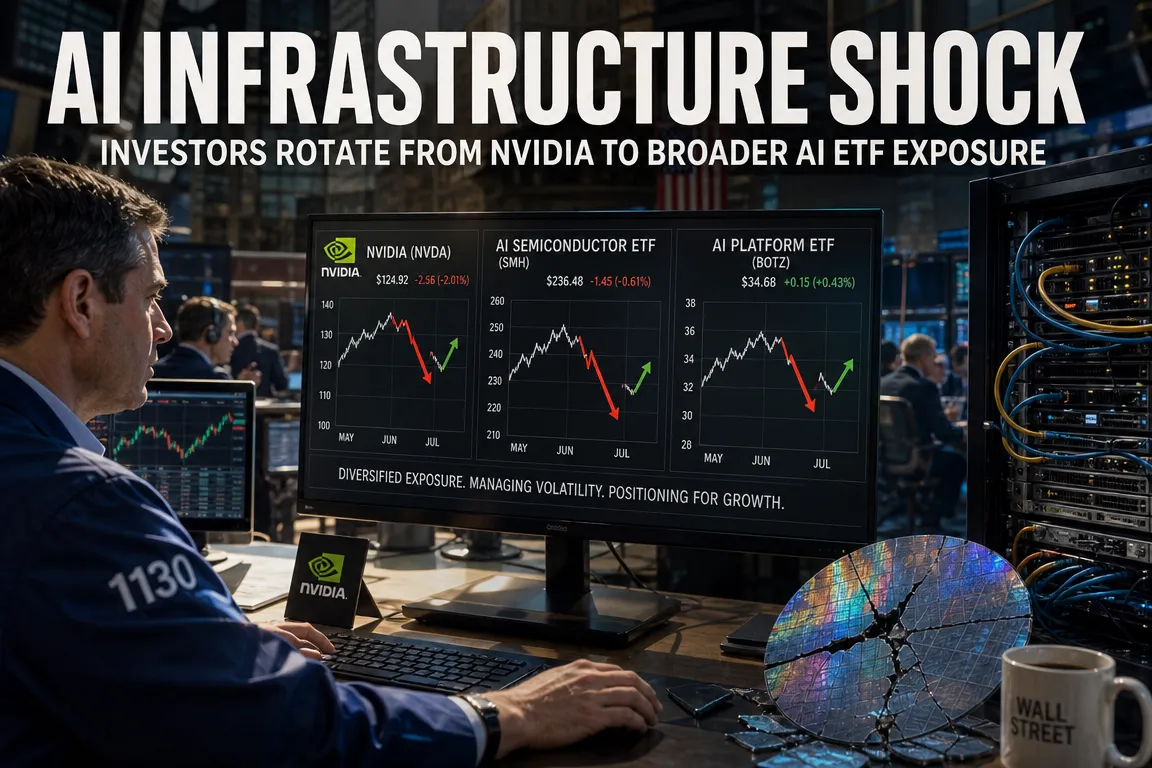
Responding to an AI Infrastructure Shock: Identifying the Next Winners Across Nvidia, AI Semiconductor, and Big Tech Platform ETFs
The central issue is whether investors should add to Nvidia during an AI-related sell-off, rotate from semiconductors into software, or invest in the broader market.
This report examines changes in the AI infrastructure investment cycle, the risks of concentrated exposure to Nvidia, the differences between AI semiconductor and AI platform ETFs, and the potential market impact of an Anthropic IPO.
The focus is not on predicting short-term prices, but on maintaining market exposure while the eventual winners of the AI industry remain uncertain.
An AI infrastructure correction does not necessarily signal the end of the AI growth cycle.
However, investors may need to broaden their focus beyond GPUs to include CPUs, memory, networking, cloud computing, data platforms, cybersecurity, AI agents, and software platforms.
1. Why AI Stocks Are Under Pressure
The recent volatility in AI-related equities reflects a conflict between elevated expectations and valuations rather than a straightforward deterioration in operating performance.
Markets rapidly priced in expectations that generative AI adoption and data-center investment would expand at exceptional rates.
Consequently, even strong earnings can trigger share-price declines when growth fails to exceed already elevated expectations.
Another key issue is the timing and extent to which substantial AI data-center capital expenditures will generate revenue and earnings.
The rapid decline in inference cost per token has both positive and negative implications.
Lower usage costs can accelerate adoption among consumers and enterprises, but they can also intensify price competition and margin pressure for model providers.
The current AI infrastructure shock is therefore better interpreted as a reassessment of investment intensity and monetization timelines than as evidence that demand has disappeared.
2. Why Semiconductors Remain Essential in the AI Agent Era
AI agents extend beyond answering questions by planning tasks, using multiple tools, and executing workflows.
As AI systems perform more work on behalf of users, computational requirements and data traffic are likely to increase.
GPUs remain central to training large-scale AI models.
However, production-grade agent services do not rely exclusively on GPUs.
CPUs are required to coordinate agents, applications, and broader system operations.
High-bandwidth memory and server memory support the rapid storage and retrieval of model data.
Networking semiconductors and optical equipment connect large clusters of GPUs and servers.
Custom AI accelerators, including ASICs, are also becoming more important as major technology companies seek to reduce costs and dependence on Nvidia.
AI semiconductor exposure is therefore expanding from a single GPU supplier to CPUs, memory, networking, foundries, semiconductor intellectual property, and custom chips.
3. Is Nvidia-Only Exposure Sufficient?
Nvidia can no longer be viewed solely as a GPU manufacturer.
By integrating GPUs, CPUs, networking, server racks, system software, and a broad developer ecosystem, the company is evolving into a comprehensive AI infrastructure provider.
For investors with long-term conviction in AI growth, using Nvidia as a core holding can remain a valid strategy.
However, a company’s competitive strength and the attractiveness of its share price are separate considerations.
Nvidia’s high market share is a significant advantage, but customers face concentration risk from excessive dependence on a single supplier.
Alphabet, Amazon, Microsoft, Meta, and major AI model developers are expanding their internal and custom-chip programs to control costs and improve negotiating leverage.
Specific projects involving OpenAI and Broadcom that have not been fully confirmed should be treated as industry reports rather than established facts.
If GPU and CPU functions converge into new architectures, or if custom chips gain market share, beneficiaries may differ from today’s market leaders.
Concentrated exposure to Nvidia may produce higher returns during strong markets, but it also carries direct exposure to valuation compression and shifts in the competitive landscape.
4. Structure of the 1Q Nvidia Fixed US AI Semiconductor ETF
The 1Q Nvidia Fixed US AI Semiconductor ETF is designed to maintain Nvidia as a central holding while diversifying across other major semiconductor companies.
According to the product description, the ETF holds 10 companies.
Nvidia remains a permanent constituent, while the other nine holdings may change based on index rules and market conditions.
Nvidia’s target weight is reset to 25% at scheduled rebalancing dates.
The fund does not maintain a constant daily weight of 25%, so Nvidia’s actual allocation may rise above or fall below that level between rebalancing dates.
Potential major holdings cited in the product description include TSMC, Broadcom, AMD, Micron, SanDisk, Marvell Technology, and Arm.
Because constituents and weights may change, investors should review the latest fund report and portfolio disclosure before investing.
5. How It Differs from Philadelphia Semiconductor Index ETFs
The Philadelphia Semiconductor Index generally provides broader diversification across a larger group of semiconductor companies.
Greater diversification can limit the contribution of an individual large-cap stock even when that company records substantial gains.
By contrast, the 1Q Nvidia Fixed US AI Semiconductor ETF concentrates exposure in 10 companies and assigns Nvidia a relatively high target weight.
This structure can respond more strongly when Nvidia and other leading AI semiconductor companies drive the market higher.
It can also incur larger losses when major holdings decline or the semiconductor cycle weakens.
| Category | Philadelphia Semiconductor Index Strategy | Nvidia-Focused Strategy |
|---|---|---|
| Number of holdings | Relatively broad | 10, based on the product description |
| Diversification | Relatively high | Relatively low |
| Nvidia exposure | Limited by index capping rules | High, with a 25% target weight |
| Performance in rising markets | Tracks gains across the semiconductor industry | More sensitive to gains in leading holdings |
| Primary risk | May not fully capture gains in the strongest companies | Higher concentration and volatility |
Neither approach is inherently superior. The choice depends on whether investors prefer broad industry exposure or concentration in selected market leaders.
6. Will Software and Platforms Become the Next AI Winners?
The development of the AI industry can be compared with the growth of the smartphone market.
During the initial smartphone cycle, investors focused on semiconductors, displays, components, and device manufacturers.
Over time, app-store ecosystems enabled the growth of video streaming, mobile advertising, gaming, payments, and delivery platforms.
Similarly, GPUs and data centers have led the early AI investment cycle, but software and services that convert AI capabilities into revenue may become increasingly important.
The relevant companies are not limited to those with the strongest AI models.
Platform companies that can integrate AI directly into established products and customer relationships may have an advantage.
Alphabet can deploy AI across search, YouTube, advertising, and cloud services.
Microsoft can integrate AI into Office, Windows, Azure, and enterprise software.
Amazon can connect AI with AWS, e-commerce, advertising, and logistics.
Meta can use the large user bases of Facebook, Instagram, and WhatsApp to test AI agents and advertising services.
The competitive advantage of these companies lies not only in model performance, but also in their existing customers, data, distribution networks, and cash flows.
7. The Growing Importance of AI Integration Providers
Adopting an advanced AI model does not automatically transform enterprise workflows.
Companies must organize internal data, connect AI systems to business applications, validate outputs, and manage security.
Many enterprises lack the internal resources to complete all these tasks independently.
This creates potential opportunities for data platforms, cloud providers, enterprise AI software vendors, and systems integrators.
Companies such as Palantir and Snowflake have attracted investor interest because they operate at the intersection of enterprise data and AI models.
The most significant monetization opportunities may accrue not only to model developers, but also to companies that integrate AI into operational business processes.
8. Why Cybersecurity Is Essential to AI Adoption
To execute workflows, AI agents may require access to email, documents, customer records, payment information, and internal systems.
Broader access increases the risks of data leakage and misuse of permissions.
AI can also make phishing, malware development, and automated cyberattacks more sophisticated.
Enterprises must record which AI systems access specific data, detect abnormal behavior, and prevent unauthorized transmission of sensitive information.
Under these conditions, companies such as CrowdStrike, Palo Alto Networks, and Cloudflare may benefit indirectly from AI adoption through endpoint, network, and cloud-security demand.
AI security is increasingly becoming a necessary infrastructure layer rather than an optional service.
9. Investment Scope of the 1Q US AI Tech Platform Top 10 ETF
The 1Q US AI Tech Platform Top 10 ETF focuses on AI software and platforms rather than semiconductor hardware.
Its primary investment universe includes major technology companies such as Alphabet, Microsoft, Meta, and Amazon, which can integrate AI into established platforms.
It may also include companies such as Palantir and Snowflake, which connect enterprise data with AI models.
Cybersecurity companies such as CrowdStrike, Palo Alto Networks, and Cloudflare may also be treated as part of the AI platform ecosystem.
The ETF centers on 10 companies, but its constituents are not permanently fixed.
Scheduled reviews may replace existing holdings when new AI platform companies emerge or the competitive positions of current constituents weaken.
Investors should verify current holdings and weights using the latest prospectus and official fund-manager disclosures.
10. Why an Anthropic IPO Would Matter
A public listing by a frontier AI model developer such as Anthropic would represent more than the addition of another large-cap stock.
It would indicate that AI model companies are moving from private technology development into public-market evaluation based on revenue, growth, and profitability.
Following an Anthropic listing, investors could more directly assess model usage, enterprise customer growth, computing costs, cash burn, and long-term margins.
Such a transaction could also increase expectations for future listings by OpenAI and other AI companies.
Over time, AI model developers could develop into a distinct investment category or technology subsector.
However, any reported listing month for Anthropic should not be treated as a confirmed schedule.
The IPO decision and timetable should be verified through company announcements, filings with the U.S. Securities and Exchange Commission, and exchange disclosures.
11. Potential Short-Term Market Impact of an Anthropic IPO
A large IPO can draw capital away from existing growth stocks as investors fund purchases of newly issued shares.
AI software and cloud stocks with similar thematic exposure could face short-term supply and demand pressure.
Institutional investors may reduce existing positions to allocate capital to a newly listed large-cap company.
If the new stock rises sharply after listing, valuation comparisons may affect other companies in the same industry.
Conversely, a high valuation for the listed company could raise valuation benchmarks across the AI software sector.
A large IPO may absorb liquidity in the short term while supporting broader expansion of the AI capital market over the medium to long term.
12. When Could Newly Listed AI Companies Enter an ETF?
According to the product description, the 1Q US AI Tech Platform Top 10 ETF may evaluate newly listed companies outside its regular rebalancing schedule.
If companies such as Anthropic or OpenAI complete public listings, an index committee may assess their eligibility using public filings and listing information.
If approved, the product description indicates that inclusion could occur in stages from T+2 through T+4 rather than on the U.S. listing date.
For example, if a company lists on Monday and there are no intervening market holidays, staged purchases could occur from Wednesday through Friday.
This mechanism may reduce exposure to excessive first-day volatility and entry-price risk.
Newly listed companies are not necessarily added automatically.
Eligibility may depend on market capitalization, liquidity, business relevance, continued listing requirements, and index committee approval.
Investors should confirm the applicable rules in the latest index methodology and prospectus.
13. Key Issues Often Overlooked in Market Coverage
First, the next AI winner may not come exclusively from either semiconductors or software.
The AI industry is more likely to develop through a mutually reinforcing relationship between hardware and platforms than through a complete transition from one segment to the other.
Rising AI service usage increases demand for inference chips and data centers, while lower infrastructure costs enable additional AI services.
Second, lower token prices are not necessarily negative for AI infrastructure.
If usage expands faster than unit prices decline, total computing demand and market size can continue to grow.
The relevant variables are usage growth, pricing declines, and provider margins.
Third, the strongest advantage of major technology companies may not be ownership of the highest-performing AI model.
Companies with billions of users, enterprise customers, payment relationships, and established services can deploy and monetize AI more rapidly.
Even if model rankings change, platforms that control customer access may retain strategic value.
Fourth, index methodology is more important than an ETF’s name.
Products using similar terms such as “AI,” “Nvidia,” or “platform” can produce materially different outcomes depending on constituent selection, weight caps, rebalancing frequency, and rules for newly listed companies.
Fifth, rapid inclusion of newly listed stocks is not always beneficial.
Post-IPO prices can fluctuate substantially during price discovery. Staged inclusion may forgo part of an early gain but reduce the risk of purchasing at an initial peak.
14. Applying a Core-Satellite Strategy
When the eventual AI winners remain uncertain, dividing a portfolio into core and satellite allocations can provide a practical framework.
The core may consist of broad U.S. equity index exposure, while satellite positions may include AI semiconductor and AI platform ETFs.
This structure allows continued participation in broader market growth even if a specific AI company underperforms.
Investors seeking greater sensitivity to Nvidia and semiconductor gains may allocate to an AI semiconductor ETF.
Those prioritizing monetization through AI services and enterprise software may consider an AI technology platform ETF.
Investors unable to determine which segment will lead may hold both hardware and software exposure.
However, thematic funds may hold overlapping semiconductor or Big Tech companies. Investors should therefore calculate effective exposure at the total-portfolio level.
15. Practical Principles for Managing a Sell-Off
-
Avoid investing the full allocation at once.
Because AI-related equities are highly volatile, staged purchases can reduce entry-price risk.
-
Establish target allocations in advance.
Setting a maximum AI thematic allocation can reduce the risk of increasing exposure impulsively during a rally.
-
Rebalance periodically.
If a stock or ETF rises enough to create excessive concentration, investors may reduce the position and reallocate to underweighted assets.
-
Monitor operating indicators rather than share prices alone.
Relevant metrics include data-center investment, cloud revenue, AI service usage, enterprise customer growth, and operating cash flow.
-
Do not alter a long-term strategy based on isolated short-term events.
Repositioning an entire portfolio in response to a single IPO timetable, product announcement, or quarterly result can increase transaction costs and decision risk.
16. Risk Factors to Review Before Investing
According to their product descriptions, both ETFs are unhedged. Changes in the U.S. dollar exchange rate can therefore affect returns measured in the investor’s domestic currency.
Even if U.S. equities rise, domestic-currency appreciation against the dollar can reduce translated returns.
Conversely, dollar appreciation can partially offset losses in U.S. equities.
ETFs concentrated in 10 companies have greater exposure to individual stocks and industry-specific risks than broad-market index funds.
Monthly rebalancing may create transaction costs and index-tracking differences.
Despite strong growth potential, the AI industry faces risks from elevated valuations, regulation, technological disruption, power constraints, slower data-center investment, and intensifying competition.
Investors should review not only the stated management fee, but also other expenses, trading volume, bid-ask spreads, net assets, premiums, and discounts.
Product names and constituent rules may change. Final investment decisions should be based on the latest prospectus and official disclosures.
17. The AI Investment Cycle in the Global Economic Outlook
AI has the potential to improve productivity across the global economy, but substantial time may be required for corporate capital expenditures to translate into measurable productivity gains.
Persistently high interest rates can pressure the valuations of technology companies whose prices reflect long-duration growth expectations.
Conversely, declining interest rates combined with improving earnings could reduce discount-rate pressure on growth stocks.
Investors in U.S. equities should monitor not only AI technology, but also interest rates, the U.S. dollar, power infrastructure, and the corporate capital-expenditure cycle.
Even if the long-term direction of AI investment remains favorable, entry valuations and portfolio sizing can materially affect realized returns.
ETFs are therefore better viewed as tools for participating in industry growth while diversifying uncertainty, rather than as instruments for predicting the eventual winners with precision.
< Summary >
The AI infrastructure correction is more consistent with a reassessment of elevated expectations and monetization timelines than with the end of AI demand.
Nvidia remains a leading AI infrastructure company, but it faces risks from customer-developed chips, portfolio concentration, and valuation sensitivity.
AI semiconductor ETFs provide exposure to hardware segments including GPUs, CPUs, memory, and networking.
AI technology platform ETFs provide exposure to Big Tech, data platforms, enterprise software, and cybersecurity companies.
An Anthropic IPO could become an important test of AI model commercialization, but the timetable and potential ETF inclusion should be verified through official disclosures.
Long-term investors may consider using broad-market index exposure as the core of a portfolio and AI hardware and software ETFs as satellite allocations.
Currency movements, concentration, rebalancing, tracking differences, and elevated volatility remain material risks.
[Related Articles…]
- AI Infrastructure Investment and the Outlook for Global Technology Stocks
- Identifying the Next Winners in AI Semiconductors Beyond Nvidia
*Source: [ 소수몽키 ]
– AI인프라 쇼크 어떻게 대응해야 할까, 다음 승자까지 마음 편하게 투자하는 법
● 50s-Retirement-Shock, AI-Layoff-Crush, Boomers-at-Risk
Large-Scale Restructuring Among Workers in Their 50s: Five Priorities for Those Born in 1970
The current restructuring cycle extends beyond reducing the number of executives in their 50s.
It reflects a broader redesign of corporate workforces and roles amid demographic change, low economic growth, industrial restructuring, and generative AI adoption.
Workers born around 1970 face elevated exposure to year-end personnel changes and voluntary retirement programs because many hold executive or senior management positions with relatively high compensation.
At the same time, this cohort could emerge as a new class of consumers and producers with substantial assets, professional experience, and digital capabilities.
The following analysis examines the drivers of restructuring, retirement planning, mid-career reemployment, self-employment risks, AI-related labor market changes, and emerging opportunities in a super-aged society.
Key Development 1: Workers Born in 1970 Are Entering the Core Restructuring Cohort
A central projection is that workers born around 1970 are increasingly likely to be included in large-scale restructuring programs.
Executive and management appointments at large corporations, financial institutions, and technology companies generally occur between late October and early December.
Executive replacements are often accompanied by organizational consolidation, voluntary retirement, role reassignment, and transfers between affiliates.
While workers born in the late 1960s were previously the primary target group, the restructuring threshold is shifting toward those born in the early 1970s.
This does not imply uniform restructuring based on birth year.
Actual exposure varies according to corporate performance, industry growth prospects, the revenue contribution of each role, AI substitution potential, and workforce cost structures.
- Large corporations with high concentrations of executives and senior managers
- Financial and retail companies reducing branches and offline operations
- Office-based businesses rapidly adopting automation and generative AI
- Holding companies and affiliates consolidating overlapping support functions
- Manufacturers facing both low growth and declining profitability
The relevant question is not whether an employee was born in 1970, but whether the employee’s role can continue to support revenue growth, cost reduction, and customer acquisition.
Key Development 2: Restructuring Reflects the Combined Impact of Demographics, Economic Conditions, and AI
Past restructuring cycles were generally driven by recessions or temporary earnings deterioration. The current cycle is more structural.
Companies are responding to slower domestic growth, weak internal demand, and population decline while accelerating digital transformation and AI automation.
When revenue growth remains constrained and labor and administrative costs rise, companies have a strong incentive to reduce organizational layers.
Generative AI is automating not only repetitive tasks but also parts of research, report writing, translation, customer service, marketing content production, and data analysis.
The impact is not limited to junior employees.
Middle managers focused primarily on consolidating information, reporting, and routing approvals may also be exposed to organizational reductions.
By contrast, senior professionals who combine industry expertise and customer networks with AI capabilities may become more valuable.
AI does not eliminate the value of experience itself. It reduces the market value of experience that cannot be combined with AI.
Key Development 3: The Emergence of a 9.54 Million-Person Cohort Born Between 1964 and 1974
Professor Lee Dong-woo defines approximately 9.54 million people born between 1964 and 1974 as a generation that rejects conventional definitions of aging.
This group substantially overlaps with South Korea’s second baby boom and has different views on consumption, retirement, and family responsibilities from earlier generations.
The concept does not imply simple opposition. It indicates resistance to established assumptions about retirement and elderly identity.
- They are reluctant to identify themselves as elderly or senior citizens.
- They may avoid products and spaces explicitly designated for older consumers.
- They are less likely to assume that all assets must be transferred to their children.
- They do not necessarily favor complete retirement at a predetermined age.
- They seek to avoid retirement characterized by dependency, poverty, and institutional care.
This cohort entered the workforce during the expansion of the internet and has routinely used smartphones for work and daily activities.
Adoption of YouTube, mobile finance, and generative AI is also increasing.
Corporate and government policies that classify all consumers in their 50s as digitally vulnerable may therefore be inconsistent with market conditions.
Key Development 4: Retirement of the Second Baby Boom Could Affect Economic Growth
Citing related Bank of Korea analysis, the discussion indicated that a large-scale labor market exit by the second baby-boom generation could reduce annual economic growth by approximately 0.38 percentage points between 2024 and 2034.
This estimate could change depending on economic participation, reemployment, and labor productivity among older workers.
The principal risk is not population decline alone, but the loss of productive capacity when experienced workers leave the labor market simultaneously.
For companies, removing all senior employees is not necessarily optimal.
Customer relationships, institutional knowledge, crisis-management experience, and international networks cannot be immediately replaced by manuals or AI systems.
Employment models could increasingly include project contracts, expert adviser positions, part-time employment, mentoring, and internal consulting rather than conventional full-time extensions.
Key Development 5: Retired Workers in Their 50s Represent a Major Consumer Market
Viewing retirement among workers in their 50s only as a constraint on economic growth risks overlooking a significant market opportunity.
Some consumers in their 50s and 60s have accumulated property and financial assets and are healthier than previous generations at the same age.
They have extensive professional experience, purchasing power, and familiarity with mobile payments and e-commerce.
Although they face pressure in the labor market, they could become one of the most important consumer groups.
A representative opportunity is age-inclusive design: products developed to accommodate older users without being explicitly marketed as senior products.
For example, vehicles that temporarily adjust their height when doors open can reduce strain on the knees and back.
Companies generally present such functions as convenience or premium technology rather than features for elderly users.
The longevity economy framework associated with the MIT AgeLab similarly emphasizes products and services that improve usability across all age groups.
The “Senior-Only” Label Can Discourage Target Consumers
Companies should consider not only product functionality but also product naming.
Labels such as senior-only mobile phones, elderly clothing, or food for older adults can discourage even intended users.
Many consumers do not identify themselves as elderly despite advancing age.
Protein supplements may support muscle maintenance among middle-aged and older consumers, but marketing typically emphasizes exercise, health, and vitality.
Communicating purpose and benefits can attract a broader customer base than emphasizing age.
However, simplified claims such as “muscle development is 80% diet and 20% exercise” should not be treated as universal medical guidance.
Exercise and protein intake should reflect individual health, kidney function, and medication use, with professional consultation where appropriate.
The Expansion of Age-Inclusive and Gender-Inclusive Markets
Fashion and sports brands are increasingly reducing distinctions between men’s and women’s products or offering the same designs across broader size ranges.
Product segmentation between older and younger consumers may similarly weaken.
Large text, intuitive controls, lower product weight, and improved safety benefit users across all age groups.
High-growth markets are therefore more effectively positioned around convenience, health, safety, mobility, and independence rather than the concept of an elderly industry.
- Convenience foods and personalized healthcare
- Muscle-loss prevention and rehabilitation services
- Smart homes and fall-prevention technology
- Financial asset management and pension withdrawal planning
- Mobility services and autonomous driving
- Care robots and AI-based health monitoring
- Mid-career education and job-transition platforms
- Long-stay travel and interest-based communities
The Working Poor Among Older Adults in a Super-Aged Society
South Korea combines a high elderly poverty rate with relatively high economic participation among older adults.
Many older people remain poor despite working because their employment provides insufficient hours, wages, and stability.
Under employment statistics, a person may be classified as employed after working for income for at least one hour during the survey reference week.
This international statistical standard measures labor market participation; it does not indicate that one hour of work constitutes stable employment.
An increase in older employed persons therefore does not necessarily indicate improved retirement income security.
Employment rates should be assessed together with average monthly working hours, wages, job continuity, and social insurance coverage.
Government policy should focus not only on employment numbers but also on sustainable jobs that provide a viable income.
Implications of a Projected 43.9% Share of People Aged 65 or Older by 2060
Based on Statistics Korea’s population projections, the share of South Korea’s population aged 65 or older could reach 43.9% by 2060.
Long-term projections vary according to assumptions regarding fertility, life expectancy, and international migration, but the direction of population aging is clear.
In a society where nearly one in two people is aged 65 or older, current retirement, pension, welfare, healthcare, and housing systems will become increasingly difficult to maintain.
Future 65-year-olds should not be evaluated under the same assumptions applied to the current elderly population.
Longer healthy life expectancy, higher education levels, and stronger technology capabilities could allow people in their 60s and 70s to remain major workers and consumers.
As the median age approaches the 60s, functional capacity and professional capability are likely to become more relevant than chronological age.
The Traditional Education-Employment-Retirement Model Is Ending
The traditional life cycle consisted of education, employment, and retirement.
This three-stage model is increasingly unsustainable in a 100-year lifespan.
Knowledge acquired in a person’s 20s is unlikely to support the same role through the 50s and 60s, particularly as industrial and technological change accelerates.
Multi-stage careers involving retraining, occupational transitions, entrepreneurship, and project-based work are likely to become more common.
- Formal education and initial employment
- Professional experience and expertise accumulation
- Retraining and qualification transition
- A second career or project-based work
- Small business ownership or advisory work
- Part-time employment and social contribution
Retirement preparation is becoming an ongoing form of career management rather than an activity initiated immediately before leaving employment.
The Primary Risk for Workers in Their 50s Is Unprepared Self-Employment
Workers unable to secure suitable employment after retirement often consider restaurants, cafes, convenience stores, or franchise businesses.
However, self-employment is highly competitive and characterized by frequent business openings and closures.
Investing retirement benefits and borrowed funds in a single venture can convert business failure directly into the loss of retirement assets.
Entering an industry unrelated to a retiree’s prior professional experience creates additional risk.
Before signing a lease or franchise agreement, prospective business owners should complete the following steps:
- Work directly in the target industry and assess its revenue structure.
- Analyze actual customers and repeat-purchase rates rather than relying on pedestrian traffic.
- Review existing operators’ income statements rather than franchisor revenue estimates.
- Test whether the business can absorb higher labor, rental, and input costs.
- Limit investment to an amount that can be lost without compromising retirement security.
- Evaluate business-to-business opportunities based on prior experience before opening a physical store.
Retirement Priority 1: Define Marketable Capabilities Rather Than Corporate Titles
After retirement, the first assets to disappear are the corporate title and institutional credibility attached to the employer.
Within a company, executives and senior managers receive recognition through their positions. After departure, they are evaluated on their individual capabilities.
Describing oneself as a former executive with 25 years at a major corporation does not, by itself, establish reemployment competitiveness.
Professionals should instead provide specific evidence of results:
- The amount by which costs were reduced in an unprofitable business unit
- Methods used to acquire new customers and international accounts
- Approaches used to resolve organizational conflict and crises
- Experience developing junior employees and operational teams
- The ability to identify and manage industry-specific risks
Career profiles should emphasize solved problems and measurable outcomes rather than titles and tenure.
Retirement Priority 2: Do Not Treat a Lower Title as Failure
For example, a country chief executive at a global technology company may receive an offer to become a business unit head at a competitor.
The formal title may be lower, but the move could preserve professional relevance and create new networks.
Mid-career candidates who insist on maintaining their previous title and compensation materially reduce their available options.
Even with lower compensation, continued market participation can support future advisory, teaching, project, and employment opportunities.
A title may decline without reducing professional expertise or social contribution.
Retirement Priority 3: Focus Education on Monetizable Capabilities, Not Certificate Accumulation
Professional development is necessary, but education alone does not guarantee employment.
Learning technologies connected to existing expertise is generally more effective than acquiring multiple qualifications with limited commercial application.
Professionals should combine expertise in finance, human resources, sales, production, or legal affairs with data analysis and AI capabilities.
- AI-assisted research and report writing
- Business analysis using spreadsheets and data visualization
- Industry regulation and ESG compliance
- Digital sales and online marketing
- Development of training, coaching, and consulting content
- Project management and negotiation
Publishing research, reports, training materials, and portfolios can provide market evidence of professional expertise.
Retirement Priority 4: Redesign Retirement Assets Around Cash Flow
High net worth does not ensure retirement security if monthly liquidity is insufficient.
Retirement planning should assess required living expenses before public pension payments begin, rather than focusing only on property values and total retirement benefits.
- The income gap between retirement and public pension eligibility
- Mortgage payments and financial support for children
- Health insurance premiums and medical expenses
- Essential household spending and discretionary expenses
- Parental support and potential long-term care costs
- Business formation and reemployment preparation costs
Retirement benefits should be separated into living expenses, emergency reserves, and long-term investments rather than invested as a single amount.
High-return investment claims, business proposals from acquaintances, and unverified franchise opportunities require particular caution.
Retirement Priority 5: Build External Networks Before Leaving Employment
Networks composed entirely of internal corporate contacts can weaken rapidly after retirement.
Reemployment and project opportunities often emerge through established trust relationships rather than public recruitment.
Professionals should establish connections with industry associations, academic societies, alumni networks, expert communities, and startup ecosystems while still employed.
The objective is not simply to expand the number of contacts, but to demonstrate a consistent ability to solve relevant problems.
Publishing concise industry analysis, documenting professional cases, and mentoring junior professionals can support personal brand development.
Key Issues Often Overlooked in News and Online Commentary
First, restructuring is fundamentally a repricing of corporate roles rather than a direct consequence of age.
Companies are not concluding that all workers in their 50s are unnecessary. They are reducing high-cost roles whose performance contribution is difficult to demonstrate.
Senior professionals directly connected to customers, technology, and revenue remain valuable.
Second, AI can extend the commercial life of professional experience.
Users without industry experience may generate generic AI output. Experienced professionals can use AI to produce faster and more applicable decisions.
Third, full-time reemployment should not be the only measure of success.
Portfolio careers combining project work, part-time employment, external advisory services, teaching, mentoring, and multiple income sources are increasingly practical.
Fourth, higher employment rates among older adults do not necessarily resolve retirement insecurity.
Working hours, wages, and job continuity are as important as the number of jobs.
Fifth, workers in their 50s are both restructuring targets and strategically important consumers.
Companies that recognize this group as independent and technology-capable consumers may be better positioned to capture opportunities in the longevity economy.
Immediate Restructuring Response Checklist for Workers in Their 50s
- Quantify the current role’s contribution to revenue or cost reduction.
- Calculate minimum living expenses for the first 24 months after departure.
- Confirm expected public and private pension payment dates.
- Rewrite career profiles around measurable results rather than job titles.
- Learn at least two AI tools applicable to existing professional expertise.
- Build relationships with external experts and industry networks before departure.
- Realistically evaluate lower titles and compensation in future employment.
- Work in the target industry before committing capital to a new business.
- Avoid placing retirement benefits or residential property into concentrated high-risk investments.
- Prepare advisory, teaching, and project-based work alongside full-time employment options.
< Summary >
Workers born around 1970 face increasing exposure to year-end executive changes, voluntary retirement programs, and AI-driven organizational restructuring.
However, this cohort also represents an important source of professional expertise, accumulated assets, digital capability, and consumer demand.
Effective retirement preparation requires converting prior experience into marketable functions and combining established expertise with AI capabilities.
Unprepared self-employment should be avoided. Cash-flow management, external networks, and project-based employment should form part of an integrated retirement strategy.
In a super-aged society, repeated cycles of education, reemployment, advisory work, and part-time employment are likely to replace the traditional model of complete retirement.
[Related Articles…]
- Corporate Restructuring and Workforce Survival Strategies in the AI Era
- Retirement Planning and Reemployment Opportunities in a Super-Aged Economy
*Source: [ 경제 읽어주는 남자(김광석TV) ]
– 50대 대규모 구조조정 시작된다…은퇴 후 진짜 준비해야 할 것 | 경읽남과 토론합시다 | 이동우 교수