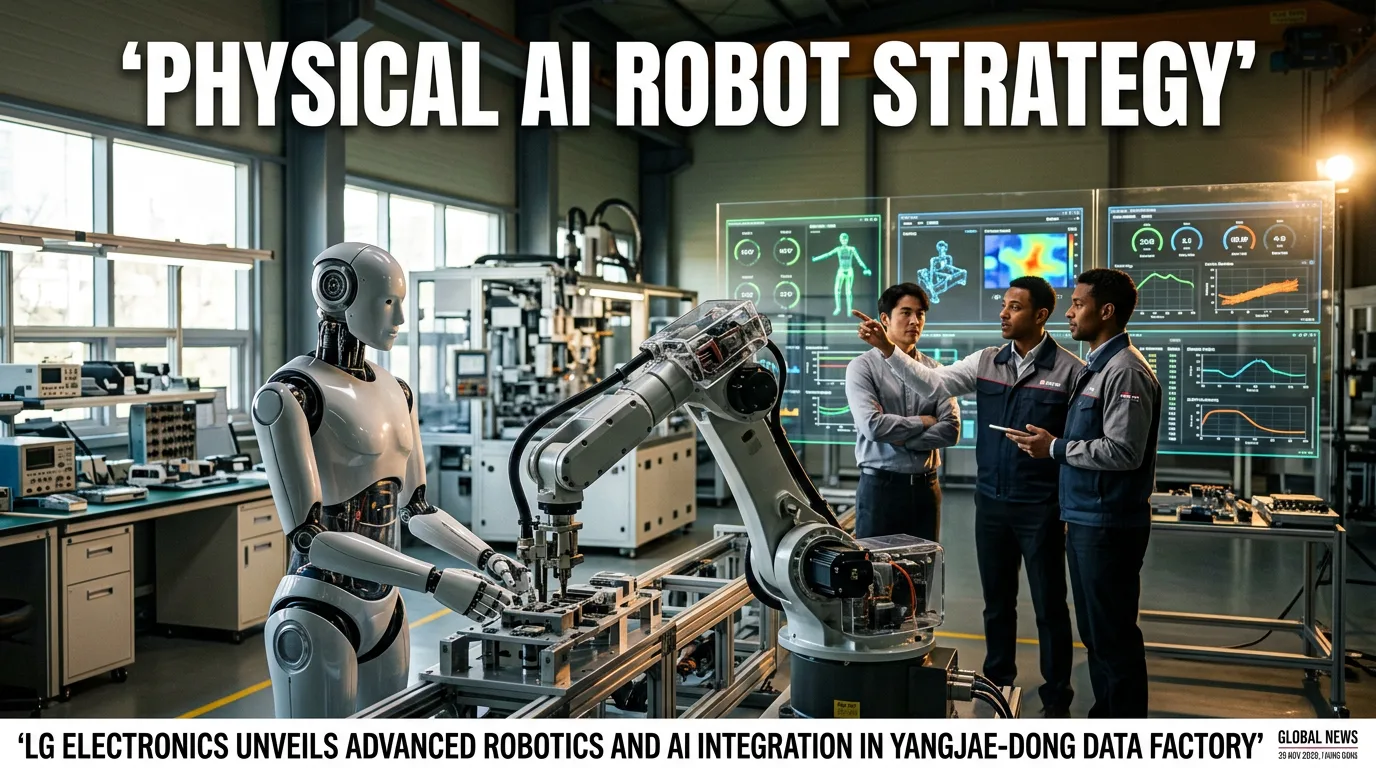
● LG Builds a Physical AI Robot Data Factory With NVIDIA
Why LG Electronics Is Serious About Robotics: A Physical AI Strategy Seen Through CLOi, NVIDIA, and Axium
The real key point in LG Electronics’ robotics strategy is not that it “made a cute home robot.”
The core point is that LG is preparing, all at once, the behavior data, AI training infrastructure, robot joint components, and manufacturing capabilities needed for robots to actually do household chores, factory work, and logistics tasks.
These days, you see a lot of videos of humanoid robots doing backflips, kung fu moves, and getting back up after falling.
But from an investment perspective, there is an even more important question.
“So, can that robot actually make money?”
“Can it replace human labor at home, in commercial spaces, and in factories?”
LG Electronics’ reason for entering the robotics business is directly tied to that question.
LG is not simply a company making robots for show; it is closer to preparing an industrial automation platform for the age of physical AI.
This trend is also directly connected to global economic outlooks, AI semiconductor demand, manufacturing productivity innovation, supply chain restructuring, and robotics investment strategies.
1. The key to today’s robotics industry is not “flashy moves,” but “the ability to do work”
Recently, in the global robotics market, humanoid companies like Figure in the United States have drawn major attention.
As of last September, Figure was valued at around $39 billion, becoming a hot topic in the investment market.
The sight of two robots naturally handling housework looked almost like a married couple living together.
But if you look at the robotics industry coldly, many technologies are still closer to “demonstration use.”
Being good at backflips does not mean a robot can move parts in a factory, serve in a restaurant, or wash dishes at home.
The true standard for commercialization comes down to three things.
- Can it recognize objects?
- Can it adjust its movements to the situation?
- Can it perform repetitive tasks reliably?
Only when those three are possible does a robot become not an entertainment machine, but a productivity innovation tool that replaces real labor.
2. LG’s home robot CLOi is not just a household appliance accessory
In January this year at CES, LG Electronics unveiled its home robot CLOi.
The reaction on site was quite enthusiastic.
CLOi moves on wheels and can handle objects using two arms and hands.
It also showed the ability to respond when a person greets it.
At first glance, it may look like nothing more than a “cute home robot.”
But from LG’s perspective, CLOi is closer to an experimental platform for creating, collecting, and training robot behavior data than to a simple product.
In other words, CLOi is both a final product of the robotics business and a data-generation device for training the next generation of robot AI.
3. Why even picking up one cup is hard for a robot: the core point is behavior data
Humans naturally reach out and grab a cup when they see one.
But for a robot, that process is extremely complex.
To pick up a single cup, a robot must simultaneously judge the following information.
- Where the cup is
- Whether the cup is made of glass, plastic, or paper
- Which direction the arm should move
- How much force the fingers should apply
- How to correct if the cup’s position shifts slightly
- Where to move after picking it up
The data that records all of this together is what we call behavior data.
Behavior data includes the scene seen by the camera, movements of robot joints, hand pressure, contact information with objects, and time-synchronized data.
The problem is that this data is still in critically short supply.
Data for picking up cups at home and data for moving parts in a factory are completely different.
Data for serving in a restaurant and data for carrying boxes in a logistics warehouse are different too.
That is why the real bottleneck in the robotics industry is not hardware, but a lack of training data.
4. The race to secure data in the humanoid market has already begun
According to Counterpoint statistics, as of the first half of 2026, data production and research purposes accounted for about 27% of humanoid shipments.
The largest share is still in entertainment and performance.
In other words, while demand for showpiece robots is still large, the next most important demand is for robots used to accumulate data.
This is a very important change.
It means robotics companies are moving from selling as many robots as possible to the stage of collecting data while making robots move.
Market estimates suggest that by early 2026, the time required for robot training will exceed 10 million hours.
Meanwhile, available data is expected to be only around 500,000 hours.
That means there is a gap of more than 20 times.
NVIDIA also emphasizes that the most important factor in physical AI is data generation capability.
In particular, simulation data is more valuable than human video data, and data created by actual robots moving is even rarer.
This is where LG Electronics’ strength comes in.
5. LG’s hidden weapon: the robot data factory in Yangjae, Seoul
LG Electronics is building a large-scale robot data factory in Yangjae, Seoul.
The total floor area across four stories is about 10,000 square meters.
That is about 1.4 soccer fields in size.
In this space, robots learn by moving between virtual and real environments.
For example, they can be trained to transport, load, and move parts in a specific manufacturing process.
Manufacturing sites are far more complex than they seem.
Each process handles different items, works under different conditions, and requires different movements.
LG Electronics is a company that has directly made home appliances and operated factories.
In other words, it is a company that already understands the real manufacturing data robots need to learn from.
This is a major difference from ordinary robotics startups.
Last August, LG Electronics explained its plan to create, collect, and train data using CLOi.
The goal is to fully operate the Yangjae data factory by the end of this year.
If actual collected data is combined with augmented synthetic virtual data, LG expects to secure about 500,000 hours of data by year-end.
Calculated over 24 hours, that amounts to roughly 60 years of data.
At that scale, it is no longer just an experiment; it can be seen as building core infrastructure for the physical AI business.
6. Collaboration with NVIDIA: building a training ground for robot AI
An important partner in LG Electronics’ robotics strategy is NVIDIA.
It is reported that Madison Huang, the daughter of NVIDIA CEO Jensen Huang, visited LG Electronics in person to discuss robotics collaboration.
The core of this collaboration is linking LG’s manufacturing and logistics site data with NVIDIA’s virtual environment construction technology.
The key platforms here are NVIDIA Omniverse and Isaac.
Omniverse is used to implement factories, logistics centers, and robot work environments in virtual worlds.
Isaac is a robotics platform used for robot development, simulation, testing, and training.
Simply put, LG knows the real manufacturing sites, and NVIDIA has the technology to turn those sites into a training ground in digital space.
What the two companies are doing together is the following.
- Building virtual work environments
- Generating robot training data
- Testing robot movements
- Simulating before real-world deployment
- Improving models through feedback from results
This structure is also connected to AI semiconductor demand.
Physical AI requires more computing resources and simulation infrastructure than a simple chatbot.
That is because robots must train millions of times in virtual environments before moving in the real world.
7. What LG is trying to build is GPT for robots, in other words, a robot foundation model
LG Electronics wants to advance a robot foundation model based on the data it collects in this way.
This idea is easy to understand if you think of large language models like GPT or Claude.
Just as GPT learns text to write, answer questions, and generate code, a robot foundation model learns movement and behavior.
For example, when a robot receives the command, “Pick up the cup and place it on the table,” simply understanding the sentence is not enough.
It must actually find the cup, extend its arm, grasp it with its hand, adjust pressure, and move to the table.
All of that falls within the scope of the robot foundation model.
In the end, future robotics competitiveness will likely be decided less by hardware and more by “how many different behaviors it has learned.”
8. Another key point: the robot joint component Axium
Even if a robot has finished learning, it still needs precise parts to move in reality.
The important part here is the actuator.
Simply put, an actuator is the robot’s joint.
It is the power device that precisely controls the speed, force, and position of the arm.
LG Electronics is preparing this actuator under the brand name Axium.
Here, LG’s existing business strengths really stand out.
LG has more than 60 years of experience developing motors and mass-producing home appliances.
A robot joint is not just a simple motor.
It has to be small, strong, precise, and stable.
It also needs to be mass-producible to achieve cost competitiveness.
LG appears to be moving in the direction of building standardized actuators, much like Tesla.
In the first half of this year, it was reported to have built a pilot production line in Changwon.
Whether it will be mass-produced still remains to be seen, but the important thing is that LG is preparing even the core components of robots itself.
9. LG’s robotics strategy targets home, commercial, and industrial markets all at once
LG Electronics’ robotics business is not focused on just one product.
It has a structure that spans home, commercial, and industrial settings.
- Home robots: Home robots centered on CLOi
- Commercial robots: Serving and service robots through Bear Robotics
- Industrial robots: Manufacturing and factory automation robots through Robostar
- Core components: Axium actuators
- AI software: Robot foundation models and data training infrastructure
In other words, LG is not just making finished robots.
It is pursuing a strategy that connects data, software, components, manufacturing, and sales channels.
In July, it also established a robotics business center.
This organization handles business development, sales, supply chain, and manufacturing.
It is less of a research organization and more of a structure for actual commercialization.
It signals that LG sees robotics not just as a future technology, but as a new growth business it is moving to scale in earnest.
10. The most important point that other news rarely explains
Most news stories say things like “LG unveiled a robot,” “It is collaborating with NVIDIA,” or “CLOi is cute.”
But the truly important point is something else.
① LG is not just a robot manufacturer; it is building a physical AI value chain
LG’s strategy does not stop at selling finished robots.
It creates training data in its data factory, simulates through NVIDIA’s platform, advances the robot foundation model, and even prepares Axium actuators.
This is not merely a robotics business; it is a move to build a physical AI industrial ecosystem.
② LG’s real strength is that it started as a home appliance company
At first, you might wonder, “Why would a home appliance company do robotics?”
But in fact, being a home appliance company gave it many advantages.
LG has experience in motors, sensors, durability, safety, mass production, quality management, and global supply chain operations.
Robots are ultimately products that combine hardware and AI.
The know-how accumulated in home appliances can naturally carry over into robotics.
③ Robot data is likely to become a new asset for AI companies
In the generative AI era, text and image data were important.
In the physical AI era, behavior data becomes important.
The problem is that behavior data is much harder and more expensive to create.
That is because actual robots must move and accumulate data.
Therefore, companies that build robot data factories first can create a major barrier to entry over the long term.
④ LG may be able to sell parts not only to its own robots, but to other robotics companies too
The reason Axium actuators matter is that they may not be used only in LG robots.
If LG can supply them to other robotics manufacturers in the future, it could become both a finished robot company and a key component supplier.
This is similar to how NVIDIA secured its platform position in the AI semiconductor market.
In the robotics industry as well, companies that control components and platforms are more likely to achieve greater profitability.
⑤ Korea has the conditions to become a physical AI powerhouse
Korea has a strong manufacturing base, extensive factory automation experience, and developed semiconductor, battery, home appliance, and automotive industries.
Physical AI is AI connected to the real world.
That is why data from manufacturing sites, logistics sites, and living spaces matters.
From this perspective, Korean companies can build competitiveness in a different way from U.S. big tech.
11. The economic meaning of LG’s robotics strategy
LG’s robotics business is not just a new product launch; it is connected to long-term industrial structural change.
First, demand for industrial automation to reduce labor costs in manufacturing is growing.
Second, as aging and labor shortages intensify, the service robot and home robot markets are likely to expand.
Third, demand for AI semiconductors and robotics simulation infrastructure may rise together.
Fourth, the supply chain for core robot components could emerge as a new strategic industry.
Fifth, physical AI could affect companies’ cost structures and even the global economic outlook through productivity innovation.
In particular, robots are likely to be an industry that does not produce explosive sales in the short term, but expands rapidly after a certain point.
In the early stage, securing data and proving the technology are important; later, mass production and cost reduction become the key issues.
LG appears to be preparing for both stages at the same time.
12. Conclusion: LG’s reason for doing robotics is more straightforward than it seems
The reason LG Electronics entered the robotics business is not simply to find the next growth engine.
LG already has many of the conditions needed for the age of physical AI.
- Practical operational know-how accumulated in home appliances and manufacturing sites
- A data factory capable of creating robot behavior data
- Simulation and AI collaboration with NVIDIA
- Core component development capabilities such as Axium actuators
- A product portfolio spanning CLOi, Bear Robotics, and Robostar
- Experience in mass production and global supply chain operations
In the end, the robots LG is trying to build are not robots that show backflips.
They are robots that move parts in factories, work in restaurants, and help with life at home.
That difference is very important.
What matters more than flashy performance is how reliably they can perform real work.
From that standard, LG’s robotics strategy looks quite realistic, while also offering strong long-term scalability.
< Summary >
LG Electronics is not simply making the home robot CLOi; it is preparing for the age of physical AI.
The core point is robot behavior data, simulation collaboration with NVIDIA, robot foundation models, Axium actuators, and manufacturing capabilities.
At the Yangjae data factory in Seoul, LG plans to secure about 500,000 hours of robot training data by combining real data and synthetic data.
LG is building a robotics value chain that connects home-use CLOi, commercial Bear Robotics, industrial Robostar, and core components like Axium.
The most important point is that LG is moving beyond a finished robot company to become a physical AI ecosystem company.
Going forward, the decisive factor in the robotics industry is likely to be not impressive moves, but the ability to perform real work and secure behavior data.
[Related Articles…]
- How AI Semiconductors Are Reshaping the Global Industrial Outlook
- Manufacturing Productivity Innovation Begins in the Age of Robotics Automation
*Source: [ 월텍남 – 월스트리트 테크남 ]
– LG가 웬 로봇?ㅋ.. 저도 놀랬습니다