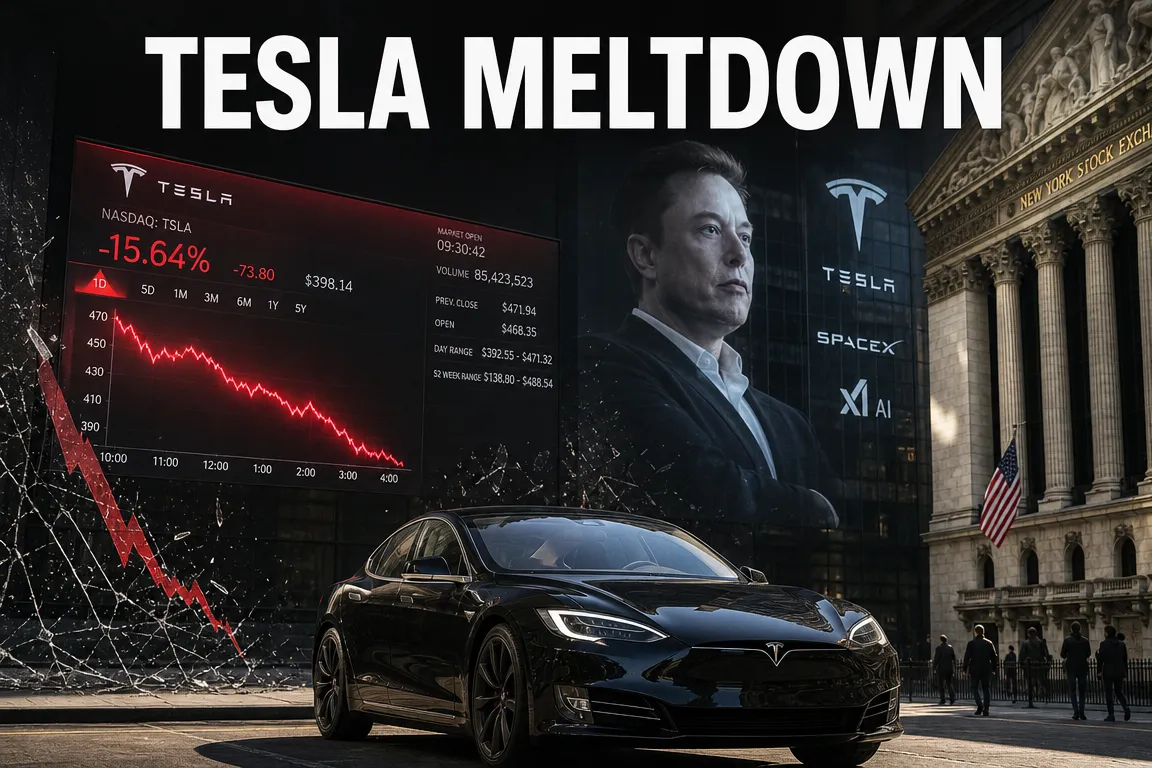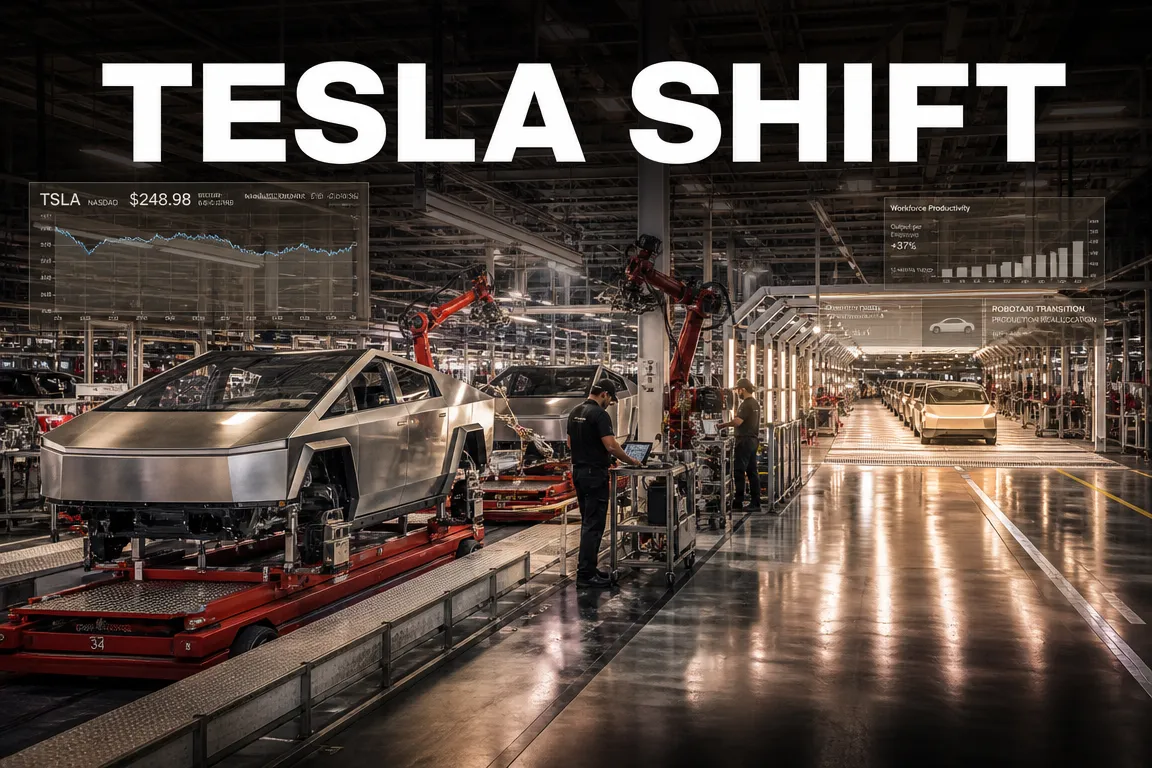
● Tesla Shock, Cybertruck Cut, Cybercab Surge
Tesla Cybertruck Discontinuation Speculation, the Cybercab Transition, and the Investment Factors That Matter More Than the $358 Share Price
The central issues are whether Tesla will discontinue the Cybertruck, why it may reallocate Gigafactory Texas production capacity to the Cybercab, and how this could affect Tesla’s valuation.
This report separately examines the source material’s claims regarding weak Cybertruck sales, price increases, robotaxi profitability, more than $25 billion in capital expenditures, and regulatory risk.
This should not be viewed merely as a vehicle discontinuation story.
It may indicate which businesses Tesla is prepared to scale back and where it intends to allocate capital as it seeks to transition from an automaker into an autonomous-driving and AI platform company.
1. Core Development: Cybertruck Production May Be Reduced to Make Room for Cybercab
According to the source, Elon Musk indicated that Tesla could gradually reduce Cybertruck production at Gigafactory Texas beginning in the middle of next year and use the capacity to expand Cybercab production.
Because the Cybertruck is produced exclusively at Gigafactory Texas in Austin, a prolonged production reduction could be interpreted as a path toward effective discontinuation.
However, a production reduction is not equivalent to an official discontinuation.
Tesla could lower output while continuing to fulfill orders in limited volumes or retain only selected trims.
Investors should therefore prioritize Tesla’s official production plans and changes to its ordering website over social media statements.
- Whether new Cybertruck orders remain available.
- Which lower-priced or premium trims remain in production.
- Whether Gigafactory Texas’s annual Cybertruck capacity is materially reduced.
- Whether Cybercab production equipment is being installed on the existing line.
- Whether Tesla provides separate plans for maintenance, warranty service, and parts availability.
2. Weak Sales, Rather Than Limited Space, May Be the Main Reason for Reducing Cybertruck Production
Even if Tesla cites the need to secure Cybercab production space, the more significant economic factor may be the Cybertruck line’s low utilization rate.
The source states that quarterly deliveries of “other models,” including the Cybertruck, Model S, Model X, and Semi, declined to 8,295 units.
It also reports total deliveries of 486,532 units for the same period, implying that all other models combined accounted for less than 2% of Tesla’s deliveries.
If accurate, these figures suggest that the Cybertruck’s earnings contribution remains limited relative to its brand visibility.
An external estimate cited by the source places annual U.S. Cybertruck sales at approximately 22,337 units.
This is substantially below Musk’s previously stated annual target of 250,000 units.
If Tesla built annual capacity exceeding 125,000 units while actual sales remained significantly lower, the resulting fixed-cost burden would be material.
Factories and production equipment generate depreciation, maintenance, labor, and inventory costs even when utilization is low.
Tesla’s decision may therefore reflect capital efficiency rather than product popularity alone.
3. Why Tesla Might Raise Cybertruck Prices Despite Weak Demand
According to the source, Tesla raised U.S. Cybertruck prices approximately 80 minutes before announcing the production reduction.
The premium all-wheel-drive model reportedly increased by $7,500, from $84,990 to $92,490.
The source also claims that the lowest-priced dual-motor all-wheel-drive model was removed from the ordering lineup.
The source lists the Cyberbeast price as “$1,024,490,” which is likely a typographical error and should be verified through Tesla’s official ordering website.
Raising prices on a product with weak demand is inconsistent with a conventional volume-growth strategy.
The move may instead indicate an effort to concentrate remaining production on higher-priced trims and protect per-vehicle profitability.
Eliminating lower-priced trims can increase the average selling price even if total sales decline.
Limited production could also create scarcity and reduce resistance to higher prices.
The price increase may therefore be intended to limit losses during a production wind-down rather than support a broad Cybertruck recovery.
4. Why Cybertruck Sales May Have Fallen Short of Expectations
The Cybertruck’s challenges cannot be attributed to design alone.
The vehicle was initially presented with a starting price of $39,900, but its price at delivery was substantially higher.
Approximately four years passed between the product announcement and initial deliveries, creating a gap between early reservation holders’ expectations and the vehicle’s final pricing and specifications.
The stainless-steel body and unconventional production process provided differentiation but may also have increased repair costs, insurance expenses, and manufacturing complexity.
The vehicle’s body design and pedestrian-safety requirements may constrain entry into overseas markets, including Europe.
A North America-focused sales strategy limits the total addressable market.
Repeated recalls and quality issues may also increase consumer concerns regarding maintenance costs and residual values.
Pickup-truck buyers evaluate payload, towing capability, charging infrastructure, and long-distance practicality in addition to design.
The Cybertruck generated substantial attention but appears to have faced limitations in converting that attention into mass-market pickup demand.
5. Issues Existing Cybertruck Owners Should Monitor
A production reduction or termination would not immediately eliminate Tesla’s warranty obligations for vehicles already sold.
However, long-term availability of model-specific parts and accident-repair times could become significant concerns.
Because the Cybertruck uses body materials and components that differ from those of conventional Tesla vehicles, service-center repair capabilities will also be important.
Discontinuation could support resale values through scarcity, but limited parts availability and higher insurance costs could reduce residual values.
Owners should assess local parts inventories and the long-term availability of warranty service.
If the Cybertruck is classified as a commercial vehicle in certain markets and receives limited subsidy support, its acquisition and total ownership costs may remain elevated.
6. Did Gigafactory Texas Actually Lack Space for Cybercab?
The source argues that Gigafactory Texas’s scale and the Cybercab line’s trial capacity make a simple lack-of-space explanation less persuasive.
If the Cybercab line can produce approximately 340 vehicles per day, as stated in the source, its annualized capacity would already be substantial.
However, installed production capacity does not necessarily mean commercially viable output.
If autonomous-driving software remains incomplete or regulatory approval is delayed, higher production would not necessarily generate transportation revenue.
The more important constraints may be autonomous-driving approval, accident liability, insurance, remote assistance, and local operating permits.
The number of cities in which Tesla can provide paid robotaxi service is more relevant than Cybercab production speed alone.
7. Tesla Is Shifting from an Automaker Toward an AI and Robotics Company
The decision may indicate how Tesla wants investors to value the company in the future.
The source states that Tesla plans to allocate Model S and Model X production space to Optimus and Cybertruck space to Cybercab.
If confirmed, Tesla would be reducing investment in lower-volume vehicles and concentrating production assets on autonomous driving and humanoid robotics.
This strategy may be intended to address intensifying electric-vehicle competition while shifting toward AI businesses that could support higher valuation multiples than vehicle manufacturing.
Vehicle sales generate substantial revenue at the point of sale, but recurring revenue is relatively limited.
A robotaxi can generate transportation revenue repeatedly from the same vehicle.
Optimus could similarly combine hardware sales with software and maintenance services.
These models could theoretically provide recurring revenue and higher asset utilization, but unresolved technical and regulatory issues could result in substantial capital spending before meaningful revenue is generated.
8. ARK’s Robotaxi Revenue Thesis
The ARK thesis presented in the source assumes that Tesla will transition from a vehicle manufacturer into an autonomous-driving platform with recurring revenue.
ARK reportedly uses an average ride-hailing fare of approximately $2.80 per mile to estimate the value of Tesla’s robotaxi business.
Because autonomous vehicles do not require paid drivers, they could operate at a lower cost than conventional ride-hailing services if utilization is sufficiently high.
Longer daily operating hours could also increase revenue per vehicle.
ARK projects that autonomous driving could materially increase Tesla’s consolidated gross margin over the long term.
However, this outlook requires high utilization, low accident rates, sufficient paid demand, and regulatory approval.
Service in a limited number of locations is unlikely to have a material near-term impact on consolidated results.
Investors should distinguish potential robotaxi returns from current cash flow.
9. Investors Should Prioritize Paid Operating Metrics Over Production Volume
Higher Cybercab production alone would not demonstrate the success of the robotaxi business.
If Tesla retains ownership of the vehicles, it may not recognize automotive sales revenue at the time of production.
Instead, Tesla would hold the vehicles as assets, incur depreciation and operating expenses, and recognize transportation revenue over time.
This model would increase near-term cash outflows while deferring revenue and profitability.
Investors should monitor the following metrics:
- Number of cities permitting paid operation.
- Average daily trips per Cybercab.
- Percentage of miles traveled with paying passengers.
- Revenue and operating cost per mile.
- Frequency of accidents and service interruptions.
- Number of vehicles managed per remote-support employee.
- Downtime required for charging, cleaning, and maintenance.
Without disclosure of these metrics, a high robotaxi valuation would remain heavily dependent on long-term assumptions.
10. More Than $25 Billion in Capital Expenditures and Lower Operating Margin
The source states that Tesla plans annual capital expenditures exceeding $25 billion.
This may include Cybercab expansion, Optimus production equipment, data centers, and AI infrastructure.
The key risk is that Tesla may undertake major investment while the operating margin of its core automotive business is declining.
The source reports a quarterly operating margin of 2.6%, down from 6.6% in the prior-year period.
The exact figures should be verified through Tesla’s official quarterly filing, but the direction is financially significant.
Large investments in AI and robotics could reduce free cash flow if automotive pricing pressure weakens cash generation.
Conversely, successful commercialization of Cybercab and Optimus could materially increase Tesla’s long-term growth rate and margins.
Tesla appears to be entering a period in which upfront investment in future businesses may take precedence over near-term earnings expansion.
11. Why U.S. Interest Rates Matter for Tesla’s Valuation
The source states that stronger U.S. employment data increased expectations of an interest-rate hike.
Stronger-than-expected employment can lead the Federal Reserve to maintain restrictive monetary policy if inflation remains elevated.
However, the cited probabilities of 70% and 78% for a rate increase require separate verification because market-implied probabilities change continuously.
Interest rates are particularly important for Tesla because its valuation incorporates substantial future cash flows from robotaxis and AI businesses that have not yet been realized.
Higher rates reduce the present value of earnings expected several years in the future.
Growth stocks whose valuations depend more on future expectations than current earnings can therefore be especially sensitive to rising yields.
Investors should assess changes in U.S. Treasury yields and Tesla’s long-term earnings estimates rather than focusing solely on a $358 share price.
12. Oil Prices and Electric-Vehicle Demand
The source discusses a sharp decline and subsequent recovery in Brent crude prices, as well as geopolitical risks involving the Strait of Hormuz.
Lower oil prices reduce fuel costs for internal-combustion vehicles and may weaken the economic incentive to switch to electric vehicles.
Conversely, sustained increases in oil prices can improve the relative total-cost-of-ownership proposition for electric vehicles.
Short-term oil-price movements alone are insufficient to explain Tesla’s sales performance.
Vehicle pricing, subsidies, interest rates, charging infrastructure, and product cycles may have a more direct effect on electric-vehicle demand.
13. Semiconductor Recovery and Data-Center Regulation Also Affect Tesla
The source states that semiconductor stocks led a Nasdaq recovery while concerns remained about the pace of data-center development.
Tesla requires substantial computing resources for autonomous-driving training and inference.
Delays in data-center construction caused by power, water, or regulatory constraints could affect AI development costs and timelines.
Stricter environmental regulation of data centers in Texas could create additional costs for Tesla and other Musk-affiliated companies, including xAI.
AI investment analysis should therefore consider power-grid capacity, cooling infrastructure, and local permitting in addition to semiconductor supply.
The primary constraint on AI growth may be shifting from GPU availability toward electricity and regulation.
14. Significance and Limitations of Tesla’s Leading Position in South Korea
According to the source, Tesla ranked first in South Korea’s imported-vehicle market for nine consecutive months.
October registrations were reported at 9,165 vehicles, representing approximately 29.5% of total imported-vehicle registrations.
This represented an increase of 110.7% year over year but a decline of 25.9% from the previous month.
Cumulative registrations from January through October were reported at 98,313 vehicles, approaching 100,000 annual units.
Outperforming established premium brands such as Mercedes-Benz would indicate that Tesla’s brand and pricing remain competitive in South Korea.
However, South Korean sales alone are unlikely to determine Tesla’s consolidated performance or share-price direction.
Sales volumes and average selling prices in China, the United States, and Europe have a greater impact on consolidated results.
Monthly registration data can also fluctuate because of vessel arrival schedules and inventory availability, making quarterly and annual analysis more informative.
15. Key Issues That May Be Overlooked
First, the return on production assets matters more than whether the Cybertruck is formally discontinued.
The central issue is whether the same factory space and workforce can generate higher future returns through Cybercab production.
Second, higher Cybercab production does not immediately translate into higher revenue.
Without broader regulatory approval and expansion of paid service areas, produced vehicles could become depreciating inventory rather than revenue-generating assets.
Third, projected robotaxi margins may exclude material operating expenses.
Charging, cleaning, maintenance, insurance, accident management, remote support, and vehicle-recovery costs must be included when estimating operating profitability.
Fourth, demand from affiliated companies should be distinguished from independent consumer demand.
If SpaceX was a major Cybertruck customer, as stated in the source, investors should assess how much of the reported volume represented external market demand.
Fifth, a narrower vehicle lineup creates both operating focus and concentration risk.
Greater reliance on the Model 3 and Model Y could improve production efficiency while increasing exposure to specific models and markets.
Sixth, Tesla’s investment thesis is shifting from vehicle deliveries toward the pace of regulatory approval.
The number of jurisdictions authorizing autonomous operation and the total miles of paid driverless service may become as important as quarterly deliveries.
16. Investment Factors for Tesla Shareholders at Approximately $358
Even if Tesla trades near $358, the share price alone is insufficient to support an investment decision.
To justify the current valuation, Tesla must preserve cash generation from its automotive business while developing robotaxis and Optimus into new sources of profit.
- Confirm whether Cybertruck production is officially ending.
- Distinguish monthly Cybercab production from the number of vehicles in paid operation.
- Monitor the outcomes of federal and state autonomous-driving investigations.
- Assess whether robotaxi service expands beyond Austin.
- Track stabilization in automotive gross margin and operating margin.
- Evaluate how capital expenditures exceeding $25 billion affect free cash flow.
- Determine whether Optimus progresses from internal testing to external customer revenue.
- Monitor the effects of U.S. interest rates and Treasury yields on growth-stock valuations.
In a favorable scenario, Tesla would eliminate underutilized Cybertruck capacity and rapidly expand commercial Cybercab operations.
In an adverse scenario, profitability in the core automotive business would decline while robotaxi approvals and Optimus revenue were delayed.
Investors should prioritize quarterly execution metrics over long-term strategic statements.
17. Upcoming Events and Official Sources to Monitor
The source identifies Tesla’s shareholder meeting, stated as December 4 in South Korean time, as the first major event to monitor.
The date should be verified through Tesla’s investor-relations website and proxy materials.
Investors should assess whether the meeting provides specific Cybercab production targets, commercial operating regions, autonomous-driving regulatory plans, and capital-expenditure guidance.
Subsequent quarterly results should indicate whether the Cybertruck production reduction has been implemented.
Cybercab certification and investigation outcomes from the National Highway Traffic Safety Administration will also be material.
International investors should additionally consider exchange-rate exposure and changes to overseas investment taxation.
The foreign-stock merger capital-gains tax petition referenced in the source could affect mergers and share exchanges involving overseas companies, not only Tesla.
< Summary >
According to the source, Tesla may reduce Cybertruck production and redirect Gigafactory Texas resources toward the Cybercab.
Although the stated rationale is Cybercab expansion, weak Cybertruck sales and low capacity utilization suggest that the decision may primarily involve reducing investment in an underperforming product.
Higher Cybertruck prices and fewer lower-priced trims may be intended to protect margins on remaining production rather than drive volume growth.
Tesla is attempting to transition from an automaker into an AI platform centered on robotaxis and Optimus.
However, regulatory approvals, paid operating regions, vehicle utilization, and cash flow are more important than Cybercab production volume alone.
Tesla investors should evaluate automotive profitability, capital expenditures, U.S. interest rates, and the pace of robotaxi commercialization rather than focusing solely on a $358 share price.
[Related Articles…]
*Source: [ 오늘의 테슬라 뉴스 ]
– 일론 머스크 “테슬라 최고의 차” 접는다… 그 공장은 사이버캡에게? $358 테슬라 주주는?
● AI-Driven Job Shock
How AI Agents Are Reshaping the Future of White-Collar Work | The Critical Divide Between Displaced and Resilient Workers
White-collar jobs are unlikely to disappear simultaneously. The initial impact will be a widening productivity gap between employees who use AI effectively and those who continue to perform repetitive tasks manually.
This report examines how AI could affect national growth, corporate earnings, exports, and tax revenue, as well as how the transition from generative AI to reasoning models and AI agents is changing business processes.
The central issue is the development of agentic workflows that integrate organizational knowledge, objectives, decision criteria, and feedback, rather than limiting AI use to basic chatbot queries.
The report also distinguishes verified data from forecasts and interpretations in global economic projections.
Additional themes include the AI productivity paradox, organizational AI, cognitive outsourcing, and the changing role of middle management.
1. What Is the AI-Driven Reversal of Capital Flows?
The reversal of capital flows refers to the rapid movement of capital from traditional industries and non-AI economies toward countries and companies that control AI semiconductors, data centers, cloud infrastructure, electricity systems, and enterprise software.
Even if global growth slows, investment, revenue, and exports may remain concentrated within the AI value chain.
As a result, AI-producing and AI-operating economies could outperform the broader global economy.
- AI semiconductors: Demand is increasing for high-bandwidth memory, AI accelerators, and advanced packaging.
- Data centers: Investment is expanding beyond servers to power grids, cooling systems, transformers, nuclear power, and gas-fired generation.
- Cloud infrastructure: Companies are increasingly accessing AI models and computing resources as services rather than operating proprietary servers.
- Enterprise software: Generative AI is evolving from search and summarization toward direct task execution.
- Robotics and manufacturing: Physical AI is extending AI capabilities from digital environments into industrial and physical operations.
South Korea may benefit from its capabilities in memory semiconductors, manufacturing, power equipment, batteries, robotics, and related supply chains.
However, stronger AI-related exports would not automatically resolve weakness in domestic consumption, construction, small businesses, and non-AI services.
Investors should therefore assess not only aggregate GDP growth but also the divergence between AI-linked export industries and non-AI domestic sectors.
2. Economic Data Must Be Separated into Confirmed Results and Forecasts
The source material cites global growth of 3.1%, Korean growth indicators, a recovery in potential growth, Samsung Electronics operating profit, the current-account balance, tax revenue, and a potential increase in the 2027 budget.
Some figures lack clear references to publication dates, reporting institutions, base years, or nominal and real measurement standards.
These figures should therefore be treated as scenarios or interpretations unless independently verified.
- Global growth of 3.1%: IMF and OECD forecasts are revised regularly, making the publication date and forecast year essential.
- South Korean growth of 3.3% or 3.6%: These figures appear high relative to recent consensus forecasts for real GDP growth and require verification of the underlying indicator.
- Potential growth of 2.1% to 2.2%: Potential growth is estimated from labor, capital, and productivity assumptions and may vary by institution.
- Samsung Electronics operating profit of approximately KRW 110 trillion: Investors should determine whether this represents confirmed earnings or a forward estimate and assess the timing of AI memory contributions.
- South Korea’s current-account surplus exceeding the combined surpluses of Germany and Japan: This requires comparison using IMF data for the same period and measurement basis.
- KRW 150 trillion in excess tax revenue and a 12% budget increase: Verification is required to determine whether the figures combine national taxes, non-tax revenue, public funds, or supplementary budgets.
The broader transmission mechanism remains relevant: AI investment can increase semiconductor exports and corporate earnings, potentially improving corporate tax revenue and fiscal capacity.
For this impact to become structural, higher semiconductor prices and exports must extend beyond a cyclical upturn and support investment, employment, wages, and domestic demand.
3. The Primary Competition Is Not Between Humans and AI
The more immediate competitive divide is between workers who use AI and those who do not.
Within the same company and role, employees using AI for research, drafting, data analysis, and document review may achieve materially higher productivity than employees relying exclusively on conventional processes.
This does not imply the simultaneous elimination of all white-collar jobs.
Automation is more likely to affect repetitive tasks within occupations before eliminating entire occupations.
- Meeting transcription and summarization can be automated.
- Report structures and first drafts can be produced more quickly.
- Customer inquiries can be classified and standard responses generated automatically.
- Relevant data can be extracted from financial statements and contracts.
- Initial market and competitor research can be delegated to AI agents.
- Scheduling, task allocation, and progress reporting can be integrated and automated.
Employment risk will increasingly depend on task structure rather than job title.
Tasks with explicit rules, standardized outputs, and easily verifiable errors are more exposed to automation.
Roles requiring stakeholder coordination, accountable decision-making, negotiation, field response, leadership, and ethical judgment are more likely to retain substantial human involvement.
4. The Transition from Chatbots to Reasoning AI and AI Agents
AI development can be viewed as a progression from chatbots to reasoning AI, AI agents, and physical AI.
This is a practical framework for understanding expanding AI responsibilities rather than a formal technical classification.
Chatbot AI | Question-and-Answer Interaction
Users submit questions, and AI explains information, summarizes documents, or generates drafts.
The principal human responsibilities are prompt design and output review.
Reasoning AI | Analysis and Alternative Generation
AI decomposes complex problems into multiple steps and proposes scenarios or potential solutions.
Humans remain responsible for selecting among alternatives.
Final decisions and accountability remain with the user even when AI expands the scope of analysis.
AI Agents | Goal-Based Task Execution
AI agents can develop plans, use external tools, and execute a sequence of tasks toward a defined objective.
For example, an agent instructed to analyze three competitors’ new products may conduct searches, classify information, prepare comparison tables, and draft a strategy report.
The human role shifts from question writer to manager of objectives, evaluation criteria, permissions, and prohibited actions.
Physical AI | Converting Digital Decisions into Physical Actions
Physical AI connects AI decision-making with real-world activity through robotics, autonomous vehicles, and smart factories.
When office automation is integrated with robotics, the effects may extend to logistics, manufacturing, transportation, inspection, and selected service functions.
Forecasts that physical AI will reach an inflection point in 2027 or 2028-2029 should not be treated as fixed timelines.
Adoption will depend on robot costs, safety regulation, batteries, sensors, training data, insurance, and liability frameworks.
5. AI Changes Operating Rules, Not Just Tools
The printing press did more than accelerate book reproduction. It reduced demand for scribes while creating printing, editing, publishing, retail, and distribution industries.
The internet reduced information-search costs while enabling search engines, platforms, e-commerce, digital advertising, and online content industries.
AI could similarly change the division of labor, organizational structures, and recruitment standards.
Research and drafting processes that previously required several employees and multiple days may increasingly be initiated by one employee within hours.
Companies may produce the same output with fewer resources or increase project volume while maintaining existing headcount.
The central question is not whether a company has adopted AI.
The critical issues are which tasks AI performs, which decisions remain under human control, and who is accountable for the outcome.
6. Two Paths to AI-Driven Productivity
Productivity is generally measured as output relative to input.
AI can increase productivity through two principal mechanisms.
- Increasing output while maintaining working hours: Employees produce more reports, content, and analysis within the same period.
- Reducing working hours while maintaining output: Employees complete the same work faster and reallocate time to learning, additional responsibilities, or leisure.
In practice, AI does not necessarily reduce working hours.
Organizations may assign additional tasks after earlier work is completed, while employees may spend more time reviewing and correcting AI-generated outputs.
This represents an AI productivity paradox: faster tools raise expected output, leaving total workloads unchanged or higher.
Companies should therefore measure actual working hours, error rates, customer satisfaction, and rework rates rather than AI usage alone.
7. SYNC as the Foundation of Agentic Workflows
SYNC describes a system in which AI operates according to the working methods of an individual or organization rather than functioning as a one-time search tool.
Without organizational context, customer information, objectives, and decision criteria, even an advanced AI model operates like a newly hired employee without institutional knowledge.
When context and feedback are continuously integrated, AI can incorporate prior outcomes and anticipate subsequent tasks.
Effective AI capability = AI model intelligence × level of synchronization with the individual or organization
This explains why access to a high-performance model does not independently guarantee superior results.
S | Story: Provide Organizational Memory and Context
Story refers to the historical records, context, and experience required for AI to understand a task.
Relevant inputs include company information, customer characteristics, prior reports, successful projects, failed initiatives, and recurring errors.
Without context, AI may produce incorrect results more quickly and at greater scale.
Y | Why: Define Objectives and Decision Criteria
Why defines the purpose of the task, the characteristics of a successful outcome, and the relevant priorities.
A directive to compare competitor pricing and customer responses and propose three actionable strategies for acquiring customers in their thirties is more precise than a general request to prepare a marketing report.
Specifying budgets, deadlines, acceptable sources, and prohibited language can further improve consistency.
N | Native: Redesign the Human-AI Operating Model
Native means redesigning workflows for human-AI collaboration rather than adding AI to an unchanged legacy process.
AI may handle data collection and drafting, while humans retain responsibility for verification, stakeholder coordination, and final approval.
Assigning models and tools according to task complexity and risk is generally more economical than using the most expensive model for every activity.
C | Cycle: Repeat Execution and Feedback
Cycle refers to incorporating human evaluations and corrections into subsequent AI tasks.
Without distinguishing successful from unsuccessful outputs, AI cannot align effectively with organizational standards.
Evaluation results, correction rationales, and approval criteria should be documented and updated continuously.
8. A Practical AI Agent Workflow for Employees
Implementation does not require an enterprise-wide system at the outset.
A practical approach is to begin with one frequently repeated task that has clear evaluation criteria.
- Select a repetitive task.
Examples include weekly reports, market research, meeting minutes, and email drafts. - Define the objective in one sentence.
Specify the audience, the decision being supported, and the required output format. - Connect the relevant information.
Provide prior reports, internal policies, customer information, and standard language while protecting personal data and trade secrets. - Separate AI and human responsibilities.
AI may conduct research and prepare drafts, while humans verify information, exercise judgment, and provide final approval. - Establish verification procedures.
Figures, quotations, dates, and legal or financial information should be checked against primary and official sources. - Record feedback.
Document corrections and their rationale for use in subsequent tasks. - Measure performance.
Evaluate time savings, error rates, rework, and customer satisfaction.
Through this process, AI can develop from a chatbot requiring repeated instructions into a digital collaborator supporting recurring workflows.
9. White-Collar Tasks Most Exposed to Early Automation
AI is more likely to reduce specific tasks before eliminating entire occupations.
- General administration: Document classification, scheduling, standardized forms, and meeting summaries may be automated.
- Customer support: AI can process repetitive inquiries, summarize interactions, and recommend responses.
- Marketing: Advertising copy, content drafts, customer segmentation, and campaign summaries may be automated.
- Accounting and finance support: Document classification, account recommendations, anomaly detection, and basic financial analysis may become faster.
- Legal support: AI can compare contract clauses, search case law, and identify potential risk provisions.
- Human resources: Resume classification, job descriptions, and training materials may be generated automatically.
- Market research: Fewer employees may be required for information searches, competitor comparisons, and survey summaries.
- Software development: Routine coding, test generation, and error detection may accelerate, while architecture and security accountability become more important.
Greater AI adoption does not necessarily imply the elimination of these occupations.
The initial impact may appear through lower entry-level recruitment as each employee becomes capable of handling a larger workload.
A key long-term risk is the erosion of junior-level tasks through which employees traditionally acquire professional experience.
10. Organizational AI Will Change the Role of Middle Management
While an AI agent may function as an individual assistant, organizational AI operates more like a system connecting workflows across departments.
Sales data can be transferred into marketing analysis, inventory changes can update production plans, and customer inquiries can become product-development tasks.
Middle managers whose primary function is consolidating and forwarding reports may face pressure as these systems expand.
The following management capabilities are likely to become more valuable:
- Defining objectives and priorities for AI-executed tasks.
- Coordinating departmental data and access permissions.
- Identifying errors and bias in AI outputs.
- Resolving conflicts and accountability issues created by automation.
- Explaining and assuming responsibility for final decisions.
Managers may increasingly oversee employees, AI agents, data, and automated processes as an integrated operating system.
11. Underappreciated Strategic Implications
First, Organizational Memory May Be More Important Than Model Acquisition
Many companies focus on purchasing the latest AI models, but operational competitiveness may depend more heavily on the quality of internal information.
If project records, customer feedback, failure causes, and approval standards are not documented, advanced AI systems may continue to produce generic outputs.
Organizational context and decision records are strategic assets alongside the AI model itself.
Second, Lower Junior Hiring Could Create a Future Shortage of Experienced Professionals
Companies may reduce junior-level work through AI, but the removal of entry-level development opportunities could limit the future supply of managers and specialists.
Automation strategies should preserve training, mentoring, and verification responsibilities that support employee development.
Third, Faster AI Can Increase the Cost of Incorrect Objectives
AI can execute an incorrectly defined objective rapidly and at scale.
If inaccurate reports are distributed automatically or flawed decisions trigger subsequent actions, losses can compound.
Permission limits, stop conditions, and human approval procedures are therefore critical in agentic systems.
Fourth, Productivity Gains May Not Produce More Employee Leisure
If employers increase targets as AI reduces task-completion times, employee workloads may rise rather than fall.
AI transformation should be evaluated using working hours, job satisfaction, and burnout indicators in addition to output.
Fifth, Cognitive Outsourcing May Be as Significant as Job Displacement
Continuous delegation of scheduling, communication, personal decisions, and relationship management to AI may weaken individual judgment.
A prudent process is to develop an initial hypothesis independently, compare it with AI output, and retain responsibility for the final conclusion.
12. Why Judgment Should Not Be Fully Delegated to AI
AI can generate confident but inaccurate answers based on outdated information, flawed training data, or incomplete search results.
Time-sensitive information involving central-bank leadership, interest rates, laws, tax rates, and corporate earnings should be checked against official sources.
Even a straightforward question concerning the chair of the US Federal Reserve may produce outdated information and should be verified through the Federal Reserve’s official publications.
Natural language quality should not be treated as evidence of factual accuracy.
Human review and accountability remain essential, particularly in employment, lending, healthcare, legal services, and investment decisions.
13. Capabilities Required for Workforce Resilience
- Problem definition: Clearly identify the issue that must be resolved.
- Workflow structuring: Divide complex work into research, analysis, execution, and verification stages.
- Verification: Compare AI-generated figures, citations, and reasoning with authoritative sources.
- Domain expertise: Assess whether outputs are realistic within the relevant industry and function.
- Communication: Translate AI output into language that an organization can understand and implement.
- Accountable judgment: Consider ethics, risk, and customer impact alongside efficiency and cost.
- Workflow design: Convert one-time AI use into a repeatable operating process.
Prompt-writing skills alone are insufficient.
The more important capability is designing what information AI receives, what authority it holds, and where human intervention is mandatory.
14. Opportunities and Risks for the South Korean Economy
AI-sector growth could provide a new growth engine through semiconductor exports, capital expenditure, and stronger corporate earnings.
Expansion in power grids, data centers, cooling equipment, robotics, and industrial software could also support adjacent manufacturing and service industries.
However, income and industrial disparities may widen if gains remain concentrated among large companies, specific regions, and highly skilled workers.
Improved corporate earnings and trade balances may not strengthen domestic sentiment unless employment and household income also increase.
Investors should monitor the following indicators:
- The extent to which AI semiconductor exports support broader exports and domestic demand.
- Whether corporate AI investment primarily reduces headcount or supports new businesses and workforce retraining.
- The effect of data-center electricity demand on power prices and industrial competitiveness.
- Whether productivity gains are distributed through higher wages or shorter working hours.
- Whether small and medium-sized enterprises can absorb AI transition costs.
15. Conclusion | The End of Legacy Workflows Will Precede the End of White-Collar Work
Claims that AI will immediately eliminate all white-collar jobs are overstated.
However, conventional methods of research, report preparation, and information distribution are changing rapidly.
The most competitive workers will not necessarily be those who use AI most frequently.
They will be those who connect experience and organizational standards to AI, define objectives and permissions, verify outputs, and retain accountability.
Employees who avoid AI may lose productivity competitiveness, while those who delegate all judgment may weaken their independent reasoning.
The central strategy is to integrate deeply with AI while keeping humans in the final decision-making position.
< Summary >
- AI is widening growth differentials among countries, companies, and workers.
- Repetitive and standardized tasks are likely to be automated before entire white-collar occupations disappear.
- Generative AI is evolving from an answer engine into reasoning AI, AI agents, and organizational AI.
- AI performance depends on the integration of organizational memory, objectives, and decision criteria, not only model capability.
- SYNC aligns human and AI workflows through Story, Why, Native, and Cycle.
- AI-driven productivity may increase workloads rather than reduce working hours.
- Cognitive outsourcing represents a significant risk alongside employment displacement.
- Factual verification, final decisions, and accountability should remain under human control.
[Related Articles…]
*Source: [ 경제 읽어주는 남자(김광석TV) ]
– [풀버전] 사무직 종말 시작된다…AI를 쓰는 사람과 대체되는 사람으로 갈린다 | 김광석의 북리뷰 | ‘에이전트 워크플로우’