● Musk Mega-Bet, AI Empire Merge, Starlink Shock
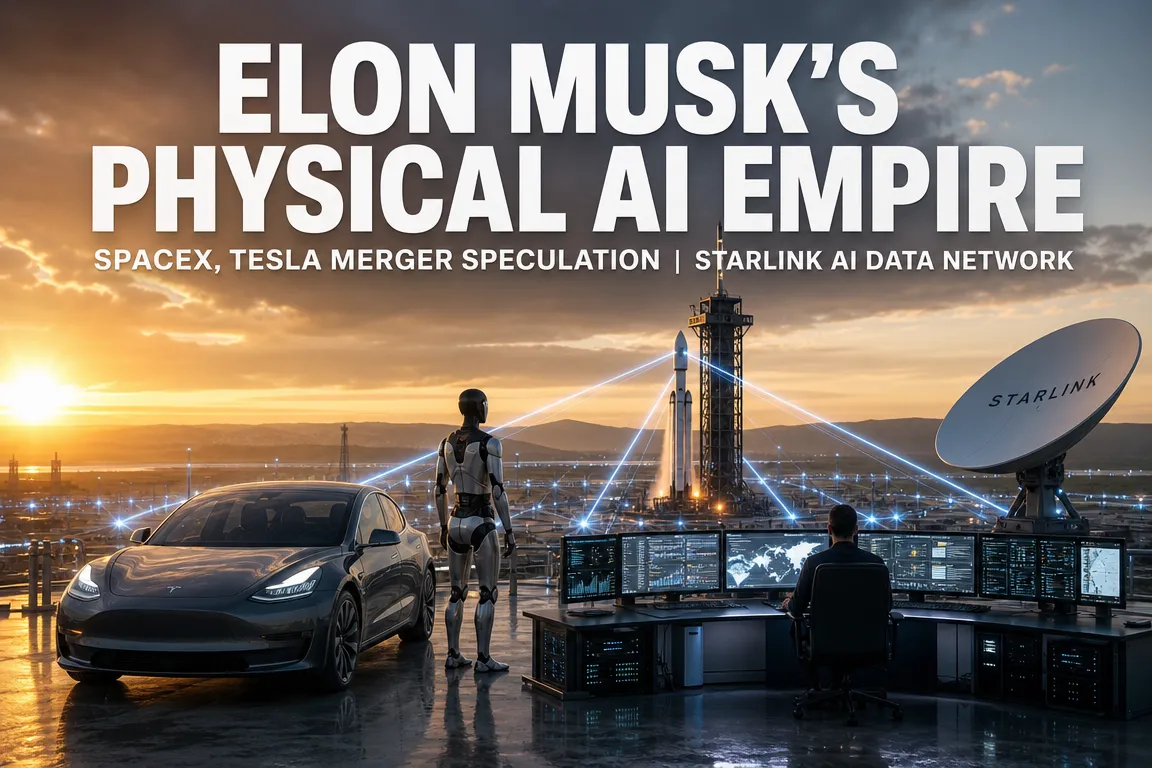
SpaceX-Tesla Merger Speculation: How Viable Is Musk’s “Physical AI Empire”?
The central issue is not simply whether SpaceX and Tesla may merge.
The broader question is whether Elon Musk intends to integrate satellite communications, AI models, data centers, semiconductors, autonomous vehicles, and humanoid robots into a single ecosystem.
Investors should assess the potential benefits and costs for Tesla shareholders, Starlink’s expansion into telecommunications, rising AI infrastructure investment, and the emergence of physical AI as a possible next-generation growth theme.
Claims regarding a SpaceX listing, integration with xAI, quarterly performance, and growth rates require separate verification through official disclosures and regulatory filings.
The following is therefore a scenario analysis based on the business structures and arguments presented in the source discussion, not confirmation of a proposed merger.
1. Why a SpaceX-Tesla Merger Is Being Discussed
The core argument is that SpaceX may no longer be viewed solely as a launch and satellite communications company.
As its broader ecosystem expands into AI computing, data centers, and communications infrastructure, the strategic overlap with Tesla increases.
- SpaceX could provide launch services, satellite deployment, Starlink connectivity, and global network infrastructure.
- xAI could supply AI models and inference services.
- Tesla could contribute autonomous vehicles, energy storage systems, manufacturing capacity, and Optimus robots.
- X could serve as a consumer platform linking user data with AI services.
- Neuralink and The Boring Company could add long-term exposure to human-machine interfaces and urban infrastructure.
Each business has standalone value, but integration could create a vertically coordinated system spanning data collection, AI training, communications, energy, and physical execution.
This structure represents the foundation of what could be interpreted as Musk’s physical AI ecosystem.
2. Musk’s Ecosystem as a Physical AI Value Chain
Physical AI extends beyond digital content generation. It enables vehicles, robots, factories, drones, and other machines to perceive their environment and perform physical tasks.
Effective deployment requires more than a capable AI model.
| Value Chain Segment | Musk Ecosystem Business | Potential Role |
|---|---|---|
| Power Infrastructure | Megapack, solar energy, and energy storage | Supply electricity to AI data centers and factories |
| Computing Infrastructure | AI data centers and proprietary semiconductor initiatives | Provide computing capacity for AI training and inference |
| Communications Infrastructure | Starlink | Connect vehicles and robots to a global network |
| AI Models | xAI and Grok | Perform data analysis, reasoning, and decision-making |
| Service Platform | X and related services | Provide user access and real-time data |
| Physical Products | Tesla vehicles, robotaxis, and Optimus | Deploy AI in the physical world |
| Space Infrastructure | SpaceX launch vehicles and satellites | Build global communications networks and expand space-based services |
The ecosystem’s potential competitive advantage lies in controlling the broader system rather than a single product.
While Nvidia supplies AI processors and telecommunications companies provide connectivity, Musk’s businesses could attempt to integrate semiconductors, data centers, communications networks, AI models, vehicles, and robots.
3. Why Merge Instead of Relying on Partnerships?
Tesla and SpaceX share a common founder but remain legally separate companies.
Any transfer of personnel, technology, capital, or infrastructure between the companies requires contracts and appropriate compensation.
Providing personnel or assets without fair consideration could raise minority shareholder and conflict-of-interest concerns.
Three factors support the merger scenario.
- Personnel and technology could be allocated more efficiently.
Autonomous driving, robotics, AI model, and satellite communications teams could operate within a unified organization. - Large-scale capital could be deployed on an integrated basis.
Cash flow generated by Starlink could potentially fund AI data centers or robotic manufacturing capacity. - Musk’s control could increase.
Depending on the exchange ratio and voting structure, Musk could secure greater authority over the combined entity.
The principal issue is capital allocation and governance rather than technological synergy alone.
A merger would determine not only how technologies are combined, but also who controls the company and which businesses receive investment priority.
4. Shareholder Approval and the Exchange Ratio Are the Main Variables
Strategic synergy would not guarantee completion of a merger.
A formal transaction would require board and shareholder approvals, valuation assessments, regulatory review, and consideration of potential litigation.
The exchange ratio would be particularly important for Tesla shareholders.
A higher SpaceX valuation could result in greater dilution for existing Tesla shareholders.
Conversely, an excessive Tesla valuation could disadvantage existing SpaceX shareholders.
Potential shareholder incentives could include:
- Special dividends, share repurchases, or other capital-return measures
- An exchange ratio or premium favorable to Tesla shareholders
- Disclosure of segment performance and capital-allocation plans
- An independent committee to mitigate conflicts of interest
- Clear disclosure of Musk’s voting rights and compensation structure
Investors should examine the exchange ratio, dilution, and voting structure before treating a merger announcement as inherently positive.
5. How This Would Differ from the 2016 SolarCity Acquisition
Tesla’s acquisition of SolarCity was criticized as a potential rescue of a financially weak company.
Musk’s interests in both companies were also central to the controversy.
A transaction between SpaceX and Tesla could raise similar conflict-of-interest concerns.
However, the circumstances may differ.
If Starlink has a stable subscriber base and cash flow, and the AI business generates meaningful revenue, the transaction would be more difficult to characterize as a bailout.
The central question would be whether both companies received objective and independent valuations.
Without adequate valuation and shareholder-protection procedures, even a strategically credible transaction could face prolonged litigation and regulatory scrutiny.
6. Implications of Valuing SpaceX as an AI Company
The source discussion claims that SpaceX’s AI-related operations are expanding rapidly and becoming more significant relative to its traditional space businesses.
It also cites strong Starlink growth and profitability, rapid AI revenue expansion, and substantial capital expenditure.
These figures require verification through official financial disclosures and detailed business reports.
The more significant issue is that SpaceX’s valuation framework could change.
- As a space company, key metrics would include launch frequency, satellite count, subscribers, and government contracts.
- As a telecommunications company, key metrics would include average revenue per user, churn, network costs, and operating margins.
- As an AI company, key metrics would include computing investment, model performance, inference revenue, and customer growth.
Reclassification as an AI infrastructure company could support a higher growth premium.
However, weaker AI investment sentiment could reduce its valuation even if the underlying space business remains resilient.
Business diversification could therefore increase valuation sensitivity to the AI investment cycle.
7. Why Strong Growth Can Still Create Valuation Risk
Revenue growth alone is insufficient when assessing a growth company.
Investors must also evaluate the capital expenditure required to generate that growth.
AI data centers and semiconductor fabrication facilities require substantial spending on power, cooling, servers, networking equipment, and land.
If investment grows faster than revenue, free cash flow could deteriorate despite strong top-line growth.
Key metrics include:
- Actual AI revenue and the proportion of recurring revenue
- AI data center utilization and customer composition
- Incremental revenue generated relative to capital expenditure
- Operating cash flow and free cash flow
- Potential external borrowing and equity issuance
- AI chip procurement costs and access to power
Long-term appreciation in Tesla’s share price and SpaceX’s valuation would require evidence of returns on investment, not merely higher spending.
8. Why the “Terafab” Semiconductor Initiative Matters
Expansion across vehicles, robots, satellites, and data centers would significantly increase semiconductor demand within Musk’s ecosystem.
Reliance on external chip suppliers would create exposure to shortages, price increases, and geopolitical risk.
Proprietary semiconductor production or large-scale foundry partnerships could reduce these risks.
If successful, a common design ecosystem could support automotive processors, AI accelerators, robotic chips, and space-grade semiconductors.
However, semiconductor manufacturing presents greater technical and capital intensity than vehicle assembly or data center construction.
It requires substantial investment, advanced process technology, yield management, specialized personnel, and a sophisticated equipment supply chain.
The Terafab concept could therefore become both a major source of synergy and a significant drain on cash.
9. Why Starlink Could Challenge Established Telecommunications Companies
Starlink’s long-term value extends beyond subscriber growth in satellite broadband.
If satellites can connect directly to smartphones and use terrestrial mobile spectrum, Starlink could compete more directly with established telecommunications providers.
Historically, terrestrial and satellite communications have operated in separate markets.
Terrestrial operators have used cell towers and fiber networks to serve urban and densely populated areas.
Satellite operators have focused on remote regions, maritime services, aviation, and locations without adequate ground infrastructure.
Starlink could reduce the distinction between these markets through:
- Direct satellite-to-smartphone connectivity
- High-speed internet for aircraft and ships
- Continuous connectivity for autonomous vehicles
- Emergency networks in disaster areas
- Internet access in developing markets and remote regions
- Remote operation of robots and drones
National telecommunications markets are often concentrated among domestic operators, while satellite networks can scale across borders.
Country-specific spectrum approvals and telecommunications regulations remain material barriers.
Nevertheless, competitive pricing and service quality could allow Starlink to alter the global telecommunications market structure.
10. Key Issues Often Overlooked in Merger Coverage
First, the data feedback loop may be more important than the merger itself.
Tesla vehicles and Optimus robots could collect real-world data, Starlink could transmit it, and xAI could use it for training before deploying updated models back to vehicles and robots.
As the installed base expands, more data could improve AI performance, while stronger AI performance could increase product competitiveness.
Second, Starlink could function as the neural network of physical AI rather than merely as a communications service.
Autonomous vehicles and robots require reliable connectivity to operate globally.
Starlink could become infrastructure connecting large numbers of machines and AI systems.
Third, the combined valuation could be lower than the sum of the individual businesses.
Markets often apply a conglomerate discount to complex corporate structures.
Combining space, telecommunications, AI, automotive, and robotics operations could increase strategic synergies while reducing transparency regarding segment performance and investment efficiency.
Fourth, voting control may be a more important merger objective than technology.
The combined entity’s equity and voting structure could strengthen Musk’s control.
Investors should evaluate dual-class shares, compensation arrangements, and board independence.
Fifth, AI infrastructure spending is closely linked to interest rates and power markets.
Large data centers and semiconductor facilities require long-term financing and substantial electricity supply.
High interest rates or delayed grid connections could disrupt project schedules and cash flow despite technological progress.
11. What Could Lead the Market After the Initial AI Investment Cycle?
Rather than an entirely new industry replacing AI, market leadership may shift among segments of the AI value chain.
The initial phase was led by computing infrastructure, including GPUs and high-bandwidth memory.
The next phase requires AI software and services to demonstrate sustainable monetization.
Physical AI applications, including autonomous vehicles, humanoid robots, AI-enabled smartphones, and smart factories, could subsequently gain prominence.
A potential sequence is:
- AI infrastructure investment centered on GPUs and memory
- Expansion of paid AI models and software services
- Enterprise and industrial AI adoption
- Commercialization of autonomous vehicles and robots
- Development of global AI operating infrastructure incorporating satellite communications and power networks
Musk’s ecosystem is distinctive because it has exposure to each stage.
However, participation across multiple segments does not ensure success in all of them.
12. Investor Checklist
- Formal confirmation of a merger
The transaction should remain a scenario until supported by company announcements and regulatory filings. - Exchange ratio
Investors should review the respective valuations assigned to Tesla and SpaceX. - Share dilution
The scale of new share issuance and the reduction in existing ownership should be quantified. - Quality of AI revenue
Revenue from external customers should be distinguished from related-party transactions. - Capital expenditure
Investors should assess whether cash flow remains sustainable after AI data center and semiconductor investments. - Starlink regulation
Country-specific spectrum approvals, privacy rules, and national security requirements should be monitored. - Commercialization of robotics and autonomous driving
Actual sales and recurring revenue are more relevant than technology demonstrations. - Key-person risk
The concentration of management authority and brand value in Musk should be incorporated into risk assessments.
13. Why Long-Term and Short-Term Investors Should Apply Different Frameworks
Over the long term, SpaceX and Tesla offer exposure to large growth markets spanning space, telecommunications, AI, and robotics.
In the short term, valuations could remain highly sensitive to AI investment sentiment, interest rates, regulation, and transaction terms.
A constructive view of the industry’s long-term direction does not imply that the current valuation is reasonable.
Long-term investors should focus on business durability, market position, and management execution.
Short-term investors should place greater emphasis on valuation, market positioning, event timing, and risk controls.
A high-quality company and an attractive purchase price are separate considerations.
< Summary >
Speculation regarding a SpaceX-Tesla merger should be treated as a strategic scenario rather than a confirmed transaction.
The central thesis is not the combination of rockets and electric vehicles, but the creation of a physical AI ecosystem integrating Starlink, xAI, autonomous driving, and Optimus.
Potential benefits include integrated technology, personnel, and capital allocation. Key risks include the exchange ratio, shareholder dilution, governance, and substantial AI infrastructure spending.
Starlink could evolve beyond satellite broadband into a global AI network connecting autonomous vehicles and robots.
Investors should monitor official disclosures, shareholder approvals, cash flow, capital expenditure, and regulatory developments rather than relying solely on merger expectations.
[Related Articles…]
*Source: [ 경제 읽어주는 남자(김광석TV) ]
– [풀버전] 스페이스X·테슬라 합병 가능성 커졌다…머스크가 그린 ‘피지컬 AI 제국’ | 경읽남과 토론합시다 | 정의훈 연구원님