● Tesla EMAG Shock – Optimus Boom or Stock Bust
Tesla’s New German Entity and Reported EMAG Links: Key Factors for Optimus Production, AI Chips, and Equity Valuation
The significance of Tesla’s new German entity lies not in its registered address, but in whether it signals an effort to secure precision-machining capabilities and skilled production personnel.
Robotic-hand durability, AI chip memory costs, and robotaxi profitability could become important determinants of Tesla’s valuation.
Investors who purchased Tesla shares at $380 should focus less on new business announcements and more on whether technology is translating into repeatable production and cash flow.
1. Tesla’s New German Entity and EMAG: What Matters
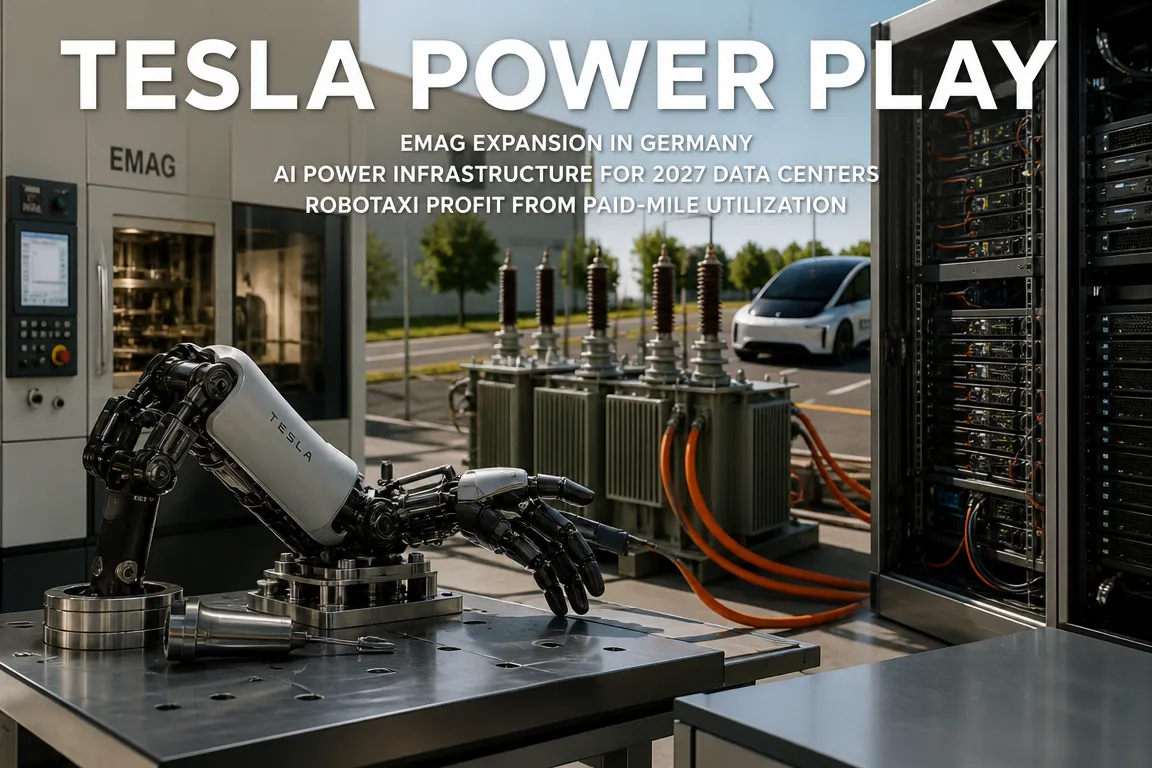
Key development: Reports indicate that Tesla’s new German entity uses the headquarters address of precision machine-tool manufacturer EMAG and that some employees may transfer to Tesla.
A shared address alone does not establish an acquisition of EMAG or the transfer of specific technologies.
- Corporate registration: The name “Tesla Machining Technologies Management” and registered capital of €120,000 have been cited. The exact legal form and registration history require verification against the original registry documents.
- Potential employee transfers: Approximately 220 employees could move to Tesla, but the transaction scope and employment-transfer terms remain unverified.
- Potential strategic purpose: Tesla may be seeking precision-machining equipment and specialist personnel for Optimus component production.
- Unconfirmed matters: Whether Tesla is acquiring EMAG in full, which technologies would transfer, which components would be produced, and the production timeline.
Investors should distinguish between acquiring a company and securing selected manufacturing capabilities.
A full acquisition, business-unit purchase, recruitment initiative, and equipment supply agreement have different capital requirements and operational implications.
Registered capital does not indicate the transaction price or future investment commitments.
Tesla previously strengthened its manufacturing capabilities by acquiring German automation company Grohmann.
That precedent does not establish the nature of the current transaction.
The value of this initiative depends on which equipment, personnel, and intellectual property Tesla actually secures, rather than the entity’s name.
2. Optimus: The Challenge Is Not Just a Functional Hand, but a Durable One
A humanoid robot grasping an object once is fundamentally different from repeating the task thousands of times a day in a factory.
Demonstrations emphasize successful movement; industrial deployment requires consistent accuracy, low failure rates, and manageable maintenance costs.
① Precision: Small deviations can cause task failures.
Finger actuators and gears must transmit force within confined spaces while enabling precise movement.
Greater mechanical play and friction can reduce accuracy when handling small objects.
② Durability: Performance must remain stable over time.
Component wear from repetitive work can gradually undermine initially reliable movements.
Hand performance depends on gears, sensors, cables, actuation systems, control software, and operating conditions.
Precision-machining capabilities alone are therefore unlikely to resolve every technical constraint.
③ Manufacturability: Consistent quality must extend to high-volume production.
Producing hundreds of thousands of components to consistent standards can be more challenging than building a few high-quality prototypes.
Machine-tool suppliers such as EMAG can contribute through machining accuracy, process automation, and consistent production quality.
Whether specific EMAG equipment is used for Optimus hands requires separate verification.
The ability to machine robotic-joint components is not evidence of actual production for a specific Tesla component.
Production targets also require careful attention to units.
Annual production of 1 million robots would require 2 million hands, excluding replacements.
This is an arithmetic illustration, not a statement of Tesla’s actual capacity or a confirmed target.
Designed capacity, installed capacity, actual output, and customer deliveries are distinct metrics.
3. AI Chips and Memory Costs: The Limits of Vertical Integration
Key development: Claims that rising memory prices are increasing Tesla’s AI computer costs have emerged alongside proposals for large-scale semiconductor manufacturing.
Accounts of executive negotiations, specific component-price increases, and proposed internal production capacity require confirmation from official sources.
The underlying economic distinction is clear.
Designing AI chips and securing reliable memory supplies are separate capabilities.
- Chip design: Optimizing computing functions and power efficiency.
- Foundry manufacturing: Fabricating physical semiconductors from chip designs.
- Memory procurement: Securing memory that meets price, quality, and volume requirements.
- Packaging and system integration: Reliably connecting components and delivering system-level performance.
A foundry relationship, such as the AI6 manufacturing agreement with Samsung Electronics, does not automatically secure favorable memory prices or supply terms.
Data-center HBM and memory used in automotive AI computers differ in product configuration and qualification requirements. Price increases for one product should not be extrapolated across the entire memory market.
The relevant earnings metric is the incremental cost per product, rather than memory prices alone.
Investors should assess the increase relative to total vehicle costs, Tesla’s ability to pass it through to customers, and potential savings in other components.
An internal semiconductor fabrication facility could improve long-term supply-chain control.
However, substantial capital expenditure, technical capabilities, and stable production yields would be required, making it an unlikely immediate solution to rising costs.
These dynamics also explain the importance of AI infrastructure investment to the global economic outlook.
Expanding demand creates growth opportunities while potentially intensifying component shortages and capital requirements.
4. NACS Adoption: Charging Standards and Charging Profits Are Different
Key development: Proposals have been discussed to introduce NACS on GM electric vehicles sold in South Korea and expand Supercharger access.
Eligible models, implementation dates, and adapter support require confirmation from the manufacturers and Tesla.
Broader NACS adoption could benefit Tesla’s charging ecosystem.
A larger compatible vehicle base creates opportunities to increase utilization of existing charging stations.
A shared connector does not mean every vehicle can use every Supercharger.
Vehicle and charger compatibility, communication and payment integration, operator authorization, and country-specific operating conditions must be verified.
NACS has been standardized as SAE J3400. Broader adoption therefore does not automatically generate exclusive revenue or usage fees for Tesla.
- Revenue: Actual charging volume and pricing are the key drivers.
- Costs: Electricity procurement, site expenses, and maintenance must be included.
- Investment: Higher utilization must generate sufficient returns to justify additional charging infrastructure.
Charging-standard adoption is an important competitive factor in the EV market.
For investors, however, station utilization and investment payback periods are more direct measures of profitability than the number of adopting manufacturers.
5. Robotaxi Competition: Profit per Paid Mile Matters More Than Vehicle Price
Comparisons between Tesla’s robotaxi business and Waymo should distinguish registered vehicles, service coverage, and actual operating activity.
Not every registered vehicle is active, and broader service coverage does not necessarily translate into more paid rides.
Cybercab pricing and subscription fees should be assessed on a comparable basis with estimated Waymo vehicle acquisition costs.
Comparing one company’s selling price with another company’s estimated costs including sensors and tariffs can produce misleading conclusions.
Robotaxi economics should incorporate the following factors.
- Vehicle costs: Acquisition, depreciation, and financing.
- Operating costs: Charging, cleaning, maintenance, insurance, and remote support.
- Utilization: The share of each day spent generating revenue.
- Empty-mile ratio: The proportion of distance traveled without passengers.
- Safety and operating conditions: Service restrictions, human intervention requirements, and incident-response obligations.
Tesla’s internal manufacturing capabilities could provide advantages in vehicle procurement and cost management.
Lower vehicle prices, however, do not guarantee higher operating profits.
Reliable autonomous-driving performance, regulatory approval, and sufficient passenger demand are also necessary.
Key metrics include paid trips, revenue per vehicle, and total cost per paid mile.
Fleet size alone is insufficient to conclude that a competitor’s business is no longer viable.
6. SpaceX Developments Should Not Be Confused with Tesla Shareholder Rights
Proposals to distribute SpaceX shares through children’s investment accounts, along with any sale restrictions, require verification against company announcements and governing program documents.
Account numbers, eligibility, new-share issuance, and disposal restrictions carry material legal and economic implications and should not be treated as established facts without confirmation.
Tesla and SpaceX are separate companies.
Owning Tesla shares does not confer direct rights to SpaceX shares.
Claims that Tesla holds a SpaceX stake, or speculation about a merger, should not be incorporated into valuation as established facts without supporting disclosures.
Even if a share-distribution program proceeds, dilution, recipient taxes, valuation, and sale restrictions require separate analysis.
High-profile announcements should be distinguished from developments that affect Tesla’s consolidated financial results.
7. A Central Investment Issue: Each Tesla Business Faces Different Bottlenecks
Across these businesses, a common question is who controls the critical bottlenecks.
Potential constraints include precision components and durability for Optimus, semiconductor supply chains for AI computers, access and utilization for charging, and safety and operating efficiency for robotaxis.
① Bringing production in-house can reduce external costs while increasing fixed costs.
Lower supplier payments may be offset by the burden of owning equipment and employing personnel when production volumes are insufficient.
Any EMAG-related initiative should therefore be assessed for both technology acquisition benefits and equipment utilization.
② Robotic-hand service life can materially influence purchasing decisions.
Frequent failures create replacement costs, downtime, and reconfiguration expenses.
Continuous operating hours, repeat-task success rates, and component replacement intervals are more informative than demonstration videos.
③ Task-specific applications may become economically viable before general-purpose robots are fully developed.
Reliable repetition of a defined task in a controlled environment may reach commercialization before human-like performance across all tasks.
Early Optimus economics should therefore be assessed against both the range of supported tasks and the associated cost savings.
④ Public demonstrations and commercialization follow different timelines.
A new video does not establish readiness for external sales.
Conversely, delayed video releases do not establish technical failure.
External customer validation, actual deliveries, and maintenance capabilities matter more than presentation schedules.
8. Investment Checklist for Tesla Shareholders with a $380 Entry Price
A $380 purchase price determines an investor’s personal gain or loss, but not Tesla’s prospective fair value.
Assessing the stock requires separating cash generation from existing operations and the commercial prospects of emerging businesses.
| Business Area | Metrics to Monitor | Interpretation Risks |
|---|---|---|
| Automotive | Sales volume, average selling price, automotive margins, inventory | Do not assume higher sales imply better profitability |
| Optimus | Repeat-task performance, actual production, external customer deliveries | Do not equate successful demonstrations with successful mass production |
| Robotaxis | Paid service volume, utilization, total cost per mile | Distinguish registered vehicles from active vehicles |
| Charging | Charging volume, utilization, operating profitability | Do not equate standard adoption with immediate profit growth |
| Financials | Operating cash flow, capital expenditure, free cash flow | Do not assume higher growth investment is necessarily positive |
A favorable scenario would combine sustained cash generation from existing businesses with improving commercialization metrics for robotics and autonomous driving.
A downside scenario would involve rising investment while production and paid-service expansion are delayed.
Equity investors must assess not only business growth but also how much of that growth is already reflected in the share price.
Operational progress can still coincide with weak share performance if it falls short of market expectations.
The German entity reports suggest a possible effort to secure Optimus manufacturing capabilities; they do not establish successful mass production or guarantee share-price appreciation.
The next milestones are official transaction confirmation, identification of acquired technologies, validation of repeat-task performance, and external revenue generation.
< Summary >
- Reports linking Tesla’s registered address and potential employee transfers to EMAG suggest possible acquisition of precision-machining capabilities. The transaction scope and application to Optimus remain unconfirmed.
- Optimus requires not only functional hands but also durability, consistent production quality, and competitive total operating costs for customers.
- Internal AI chip design does not eliminate memory-price exposure or supply-chain risks.
- The value of NACS adoption and robotaxi expansion should be validated through actual usage and profitability.
- Investors with a $380 entry price should prioritize future cash flows and expectations embedded in the prevailing share price over their purchase price.
[Related Articles…]
*Source: [ 오늘의 테슬라 뉴스 ]
– 테슬라 새 회사 주소는 독일 EMAG, 테슬라 뭘 노리나?— $380 테슬라 주주는?
● AI Power Boom – The Next Profit Shock
2027 Equity Market Outlook: Why Power Infrastructure Deserves Attention Alongside AI Semiconductors
The key investment question for 2027 is not “What comes after AI?” but “Which companies will convert AI investment into earnings?”
This perspective broadens the investment universe beyond semiconductors to suppliers of transformers, cables, and power distribution equipment.
The following analysis examines the growth drivers for power infrastructure, selection criteria for robotics stocks, and why investments in growing industries can still generate losses.
This analysis is based on the supplied materials dated November 25, 2026.
Real-time share prices, regulatory filings, and primary policy documents have not been independently verified. The 2027 outlook presents conditional scenarios rather than established outcomes.
1. Core Investment Strategy for 2027: Broaden Exposure Across the AI Supply Chain
The central investment link extends from AI semiconductors to power infrastructure.
Expanding AI services require computing equipment, data centers, and reliable electricity supplies.
A pause in semiconductor share performance therefore does not necessarily indicate that growth across the broader AI industry has ended.
- Semiconductors: Enable AI computing and data processing but remain sensitive to technological competition and customer investment cycles.
- Power infrastructure: Connects, transforms, and distributes electricity to data centers while also benefiting from grid replacement demand.
- Energy and backup power: Support supply reliability, although project economics depend on fuel costs, permitting, and environmental regulation.
- Robotics: Extends AI into physical tasks, but investors must assess the gap between technical demonstrations and commercial profitability.
Applying the global economic outlook to investment decisions requires tracking corporate capital expenditure across supply chains, not merely monitoring GDP growth.
Growth in AI does not guarantee gains across all AI-related stocks.
Identifying a growing industry and buying a competitive business at an appropriate valuation are separate tasks.
2. Why Power Infrastructure Matters: Data Centers Cannot Operate Without Electricity
Data centers require electricity regardless of which company’s AI accelerators they deploy.
Power equipment suppliers may therefore have exposure to broader data center investment and grid expansion rather than the success of a particular semiconductor technology.
This does not make them inherently safer than semiconductor companies or guarantee higher returns.
① Transformers: Essential Equipment for Converting Supply Voltage
Transformers adjust grid voltage to levels suitable for data centers and industrial facilities.
Investors should assess production capacity, delivery schedules, product mix, and contract profitability alongside new orders.
② Wires and Cables: Infrastructure Connecting Generation and Demand
Grid expansion and industrial capacity additions can support cable demand.
However, higher copper and other raw material prices can inflate revenue without improving underlying competitiveness.
Assess raw material cost pass-through provisions alongside operating profit.
③ Switchgear, Circuit Breakers, and Bus Ducts: Safe Power Distribution Within Facilities
Data centers require both substantial power supplies and reliable distribution to individual systems.
Bus ducts distribute electricity through conductors enclosed in metal housings; they are not simply another term for cables.
④ Emergency Generators, Energy Storage Systems, and Fuel Cells: Measures to Reduce Supply Disruptions
These technologies support data center reliability, but their functions and economics differ.
Investment assessments should prioritize confirmed supply contracts and earnings contributions over general claims of data center exposure.
3. Evaluating Power Infrastructure Stocks: Financial Metrics Before Company Names
Investors can compare companies such as Hyosung Heavy Industries, LS ELECTRIC, and cable manufacturers by business segment.
Differences in exposure to transformers, distribution equipment, automation, and cables limit the usefulness of uniform valuation criteria.
Group-wide growth expectations must also be distinguished from the earnings of the specific listed entity.
| Assessment Area | Key Factors | Investment Relevance |
|---|---|---|
| Order backlog | Growth, delivery schedules, cancellation and modification terms | Indicates when orders may convert into revenue. |
| New-order profitability | Selling prices, cost pass-through provisions, product mix | Order growth may provide limited earnings improvement if contract pricing is weak. |
| Production capacity | Expansion scale, commissioning schedules, initial costs | Production and delivery constraints can delay earnings recognition despite strong demand. |
| Cash flow | Operating cash flow, inventories, receivables, customer advances | Shows whether reported earnings translate into cash generation. |
| Valuation | Share price relative to expected earnings and historical multiples | Strong operating performance may already be fully reflected in the share price. |
The key sequence is order growth → production expansion → revenue recognition → earnings improvement → cash collection.
Company filings should also be reviewed for growth in direct orders from data center operators and changes in historically utility-focused customer bases.
U.S. data center power policies require examination of executive orders, legislation, and local regulations. A universal requirement for operators to generate their own electricity should not be assumed.
4. Robotics Outlook: Prioritize Repeat Revenue and Earnings Over Product Demonstrations
Robotics merits long-term attention, but investors should distinguish operational technology from profitable businesses.
A successful humanoid demonstration does not establish readiness for mass production, deployment, maintenance, or profitability.
① Customer Payback Periods Matter for Robot Manufacturers.
Customers purchase robots to improve productivity or reduce costs.
Commercial adoption depends on pricing, task completion rates, uptime, maintenance costs, and safety.
② Component Suppliers Require Verified Delivery Records.
Actuator, reducer, motor, and sensor suppliers can serve multiple robot manufacturers.
Companies should not automatically be classified as beneficiaries without confirmed supply relationships.
Repeat orders, customer diversification, and operating margins are key indicators.
③ Forecast Profitability Is an Estimate, Not a Reported Result.
Determine whether projected profits depend on higher sales volumes, cost reductions, or nonrecurring income.
Improving charts and trading volumes may indicate short-term market activity but do not establish long-term commercial viability.
Unit sales alone are also insufficient to assess the success of large corporations’ robotics businesses.
Relevant measures include selling prices, margins, service revenue, internal productivity gains, and contributions to consolidated results.
5. Defense, Shipbuilding, and Climate Themes: Assess Earnings Durability
Defense and shipbuilding are long-cycle, order-driven industries and should not be dismissed as short-term themes.
However, their earnings drivers differ from those of AI-related power infrastructure.
- Defense: Assess defense budgets, export contracts, delivery schedules, and payment terms.
- Shipbuilding: Monitor vessel prices, order mix by vessel type, construction costs, workforce availability, and exchange rates.
- Policy- and diplomacy-related stocks: Verify whether announced measures materially affect operating conditions and revenue.
- Climate-related stocks: Examine effects on crop yields, inventories, logistics, and export restrictions rather than weather events alone.
El Niño and La Niña should not be treated as mechanical predictors of grain price movements.
Their effects vary by region, crop, timing, and intensity.
Sustained attention alone does not establish market leadership; earnings and cash flow durability remain critical.
6. Key Risks: Power Shortages Are Not Always Positive for Power Infrastructure Stocks
First, power shortages can increase equipment orders while delaying data center projects.
Grid connection and permitting delays can affect commissioning, equipment deliveries, and revenue recognition.
Power demand forecasts should therefore be assessed alongside construction, connection, and operating schedules.
Second, current supply shortages do not guarantee lasting pricing power.
Strong margins may encourage simultaneous capacity expansion, eventually normalizing lead times and prices.
Competitors’ capacity additions are therefore as relevant as demand growth.
Third, AI efficiency and electricity demand do not have a simple inverse relationship.
Total electricity demand can rise even as power consumption per task declines if AI usage grows faster.
Conversely, weaker-than-expected AI monetization could trigger adjustments to data center capital expenditure.
Fourth, shares purchased at excessive valuations can underperform despite industry growth.
Stocks pricing in strong growth may decline even when earnings improve if results fall short of expectations.
Investors should avoid assuming that AI-related stocks will inevitably recover over time.
7. The 2027 Equity Outlook and Portfolio Implications for Salaried Investors
A practical approach to the 2027 outlook is to define the conditions supporting an investment thesis rather than predict the timing of market gains.
- Positive scenario: Sustained AI capital expenditure and conversion of power equipment orders into revenue and profit support earnings improvement.
- Neutral scenario: The industry grows, but elevated expectations already embedded in valuations lead to greater dispersion in stock returns.
- Negative scenario: Reduced AI investment, higher interest rates, project delays, and expanding supply weaken earnings forecasts and valuation multiples.
Interest rates affect both financing costs for capital-intensive data center projects and growth-stock valuations.
Exchange-rate effects vary by company, depending on export revenue, raw material costs, and hedging arrangements.
Investors using salary income should establish asset allocation principles and purchase criteria before attempting to time market direction.
Allocations across semiconductors, power infrastructure, and robotics may provide limited diversification if all remain exposed to the same AI investment cycle.
Separating living expenses and emergency reserves from investment capital, avoiding leverage, and reviewing orders, earnings, and cash flow quarterly can support a more sustainable approach.
Phased buying spreads entry points over time; it does not correct excessive valuations or a flawed investment thesis.
< Summary >
- The 2027 investment outlook warrants monitoring earnings conversion in power infrastructure alongside AI semiconductors.
- For transformers, cables, and distribution equipment, profitability, delivery schedules, and cash flow matter more than order volume alone.
- Robotics stocks should be assessed on repeat orders and actual earnings rather than technical demonstrations.
- Power shortages can create investment opportunities while also delaying projects.
- Even in growing industries, entry valuations and asset allocation materially influence investment outcomes.
[Related Articles…]
*Source: [ Jun’s economy lab ]
– 내년 이 업종에 투자해야만 합니다(ft.차영주 소장 2부)