● AI Eats SaaS, Microsoft Plunges, Meta Soars, CAPEX Shock
Has AI Entered a Phase of “Eating” Software? The Real Reasons Behind MS -10% vs Meta +10%, and the Next Investment Hints
The biggest question in the market right now is not “Are this quarter’s results good or bad?”
It is “Will this company’s software survive three years from now?” that is determining stock prices.
This article contains all the core points below.
Why the fear that AI agents will replace SaaS is hitting software stocks “regardless of earnings.”
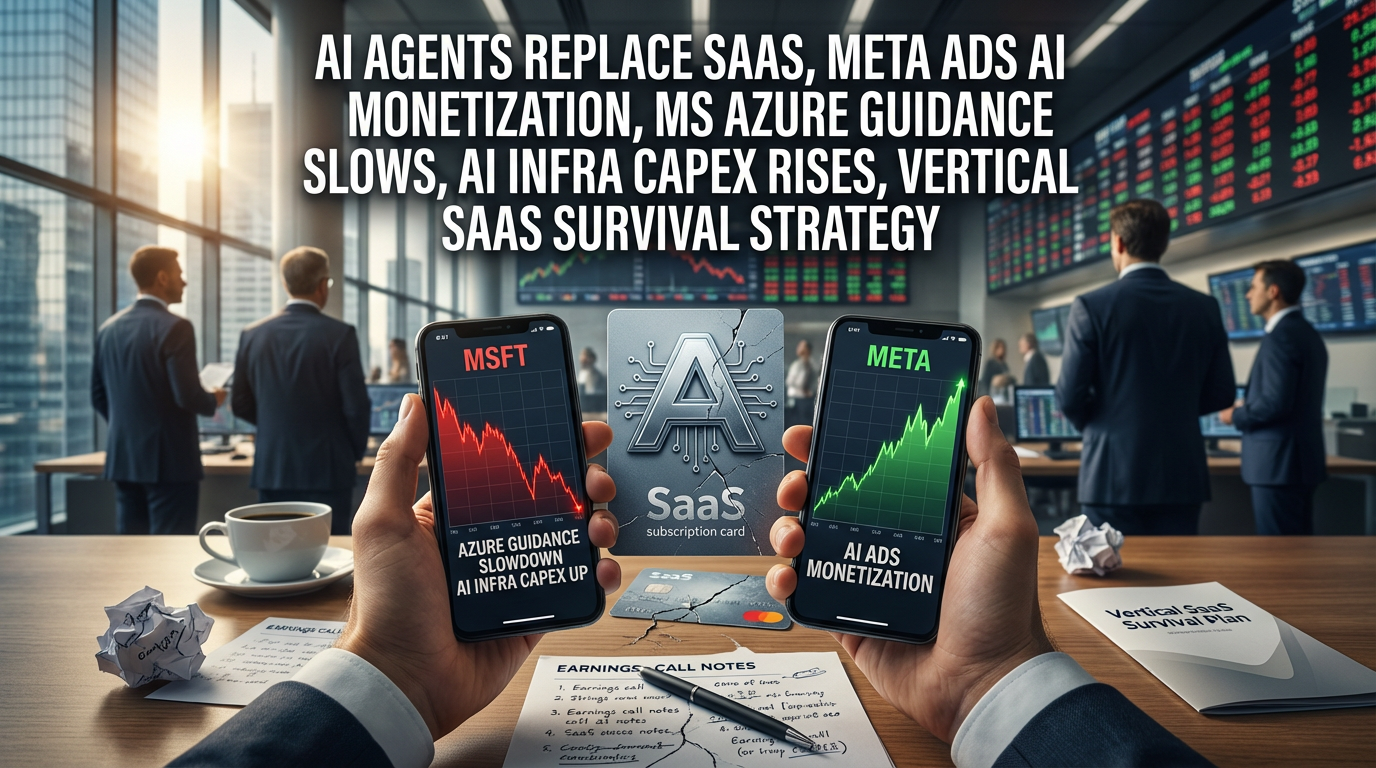
The decisive trigger that caused Microsoft to drop 10% despite record results (Azure+CAPEX combination).
Why Meta received +10% even while saying “we will burn more money on AI” (the monetization structure of advertising AI).
And I will separately summarize the “really important core point” that other news/YouTube rarely mention.
1) One-line market summary today (news briefing)
The Nasdaq adjusted down 0.7%.
However, Microsoft plunged 10% and Meta jumped 10%.
Both reported strong results, but their narratives diverged.
The market prioritized “AI-era survivability + slowing growth rate + investment burden” over “good earnings.”
2) Why the fear that AI will replace software causes such a strong reaction
2-1. The frightening sentence: “AI agents will replace SaaS”
Since the second half of last year, one sentence has dominated the software sector.
If AI agents perform tasks on behalf of users, the need to pay subscription fees for existing SaaS diminishes.
Once this logic spreads, even good earnings are dismissed as “isn’t that just an old report card?”
2-2. The trigger trend: generative AI is melting apps down into functions
In the past, software provided functions and users opened those apps.
Now AI calls functions via language.
Tasks like file organization, report writing, merging PDFs, and calendar entries finish without switching apps.
What this means is simple.
Value previously provided by apps is shifting from UI/workflow to the final output.
2-3. The real point investors fear: “the black holeification of software”
Beyond AI calling external apps, if tools like Slack or Figma run as if they are built into the AI.
From the user’s perspective, there is less reason to purchase individual SaaS separately.
So the market is now asking software companies: Do you have an indispensability that AI cannot absorb?
2-4. It is not all over; “sorting the wheat from the chaff” is accelerating
It is hard to say all SaaS will die.
However, general-purpose functions are more likely to be replaced quickly by AI.
Those likely to survive fall into these types.
Vertical SaaS (healthcare/legal/financial regulatory domains combining domain knowledge+data+workflow).
Enterprise tools where customer data/permissions/audit logs/compliance are core.
Systems deeply tied to national/industry regulation (areas with high replacement costs).
2-5. Types becoming risky (the places market fear is hitting)
General-purpose tools that anyone can use but where AI can directly produce the output.
Areas where functions are easily decomposed into APIs and attachable to AI.
Areas where user lock-in is limited to UI habit.
These areas are the first to be revalued under macroeconomic uncertainty.
3) Microsoft results: the numbers were perfect, so why did the market give -10%?
3-1. Core point figures
Total revenue of $81.3 billion exceeded market expectations.
EPS of 4.14 beat consensus (about 3.8).
Cloud revenue of $51.5 billion, surpassing $50 billion for the first time.
Future revenue visibility (RPO) rose significantly to $625 billion.
With numbers like this, Microsoft would normally receive a “big tech premium,” yet the stock moved in the opposite direction.
3-2. Trigger 1: Next-quarter Azure growth guidance 38% (vs prior 40%)
What the market reacted to sensitively was not the absolute level but the direction of change.
40% → 38% looks like a 2 percentage-point change.
In an environment where AI expectations are overheated, it is overinterpreted as a “peak-out” signal.
This is the typical “good earnings + stock falls” pattern during earnings season.
3-3. Trigger 2: Anxiety created by a surge in CAPEX
Last year CAPEX $64.5 billion → this year $98.0 billion, a large increase.
The message reads like this.
Growth appears to be slowing, yet investment is increasing.
This raises doubts about free cash flow (FCF) and margins.
In the current interest-rate environment, this is particularly damaging.
If rate-cut expectations falter, investors scrutinize “cash now” more than “growth far in the future.”
3-4. But is this the “real” problem? Microsoft’s defensive logic
Azure growth slowdown could be due not to demand collapse but to resource allocation.
One could interpret that Microsoft prioritized internal AI/R&D and proprietary services (Copilot, etc.) over external cloud sales.
Microsoft is a rare vertical-integrated model combining infrastructure + platform + software in the AI era.
So some view a short-term price dip from fear as a buying opportunity.
3-5. A risk the market is uneasy about: reliance on OpenAI
The nuance that RPO contains a significant portion related to OpenAI is something investors notice.
If issues arise with OpenAI, short-term volatility could increase.
However, Microsoft is not solely dependent on OpenAI; its cloud/Office/Windows/security/developer tools provide support.
4) Meta results: why did it get +10% (even though it’s expanding AI investment)?
4-1. Core point figures
Revenue and EPS both beat market expectations.
Operating margin remained around 41%.
This is the core point.
It gave confidence that “even while spending more on AI, they make more money.”
4-2. Meta’s essence: AI is not a cost but an “advertising revenue engine”
Meta is not doing AI for show.
Ad targeting/recommendation engines are the revenue.
It’s not just that Daily Active People (DAP) increased.
More importantly, revenue per person (ARPU/ARPP) is rising faster.
In short, “both the user base and revenue per user are increasing.”
4-3. Meta’s AI leverage: improved recommendations → higher ad efficiency → higher prices
You may feel Instagram/Facebook ads are more precisely matched to your interests lately.
That improves advertisers’ ROI.
Advertisers then spend more.
Meta can raise prices.
This virtuous cycle justifies increased AI investment.
4-4. Why the market liked CAPEX increases
Meta proved it is not “burning money on AI” but “extracting more money with AI.”
Therefore, aggressive investment like a large CAPEX expansion in 2025 and $115–135B guidance for 2026 was accepted.
The market reacted as “you invest and you get returns.”
4-5. Why they continue to push XR/smart glasses (Reality Labs)
From a short-term earnings perspective, Reality Labs is a burden.
But in the long term, it is a bet on the next form factor.
If you can own the interface after smartphones, you can gain platform power.
Meta is an advertising company but also wants to own a platform.
5) Global investment signals from this event (including macro perspective)
5-1. It is too early to conclude “AI bubble” debate
Microsoft is increasing CAPEX.
Meta is increasing CAPEX more aggressively.
At least within big tech, the AI infrastructure race “shows no sign of stopping.”
Even if market volatility increases, demand for AI data centers/power/semiconductors is likely to remain structurally strong.
5-2. Software is now judged more by “narrative/survivability” than by earnings
Strong earnings are not a get-out-of-jail-free card.
Instead, companies must answer these questions.
Why can’t AI absorb our product?
What are our moats in data/regulation/security/workflow?
Can you show scenarios where you grow even more in the AI era, not just defend with AI?
5-3. Next leaders in the market: the infrastructure layer (the picks and shovels) reemerges
The more AI shakes SaaS, the more valuable these areas become.
Chips, data centers, networks, power, cooling, server supply chains.
These are hard to replace, and if bottlenecks form, pricing power emerges.
This is why investors are turning their attention back to AI infrastructure.
6) The “most important content” that other YouTube/news outlets rarely mention
6-1. The essence of “AI replaces SaaS” is a change in purchasing unit, not just product competition
Most say “AI gets smarter and kills existing software.”
The real core point is that corporate purchasing units are shifting from app/seat to outcome/automation.
Previously, when headcount increased by one, you bought one SaaS license per seat.
If one agent handles the work of ten people, seat-based pricing breaks.
This structural change can put sustained pressure on SaaS valuations.
6-2. Behind Microsoft’s drop: more than “cloud growth slowdown,” it’s a signal of AI supply bottlenecks
Azure guidance of 38% may be due not to lack of demand but to supply limits (data centers/power/chips) and internal prioritization.
If so, on the flip side of software weakness, there may be longer excess demand for power/data centers/semiconductors.
6-3. The crux of Meta’s surge is that the formula for converting AI into ad revenue is already complete
Many see Meta only as a social network company.
In reality, it operates one of the world’s largest “AI commercialization engines (ad optimization).”
Thus, Meta’s AI CAPEX is viewed not as “future experimentation” but as “capacity investment that extracts cash now.”
7) Points to watch going forward (next-quarter watchers)
Microsoft: whether Azure growth actually slows further or rebounds as supply bottlenecks ease.
Whether Microsoft’s Copilot/Foundry/Fabric grow into meaningful revenue units (not just user counts).
Meta: whether ad ARPU growth continues to be driven by AI enhancements (including regulatory/privacy variables).
Big tech overall: the speed at which CAPEX increases translate into revenue growth (ROI) and the pressure on cash flows.
Software sector: general-purpose SaaS continued de-rating vs vertical/regulation/security-focused SaaS maintaining relative defense.
8) Keyword flow from an SEO perspective (the naturally connected core axes)
This issue ultimately ties to US stock market trends.
Growth stocks can be more volatile depending on changes in rate-cut expectations.
AI semiconductor and data center investment have solidified as the most important expense line in big tech results.
Nasdaq volatility is likely to cause more frequent capital rotation between “software and infrastructure.”
< Summary >
The spread of AI agents is pressuring software stocks regardless of earnings because of the fear that “SaaS can be replaced.”
Microsoft plunged 10% despite record results due to the combination of Azure growth guidance slowdown and surging CAPEX.
Meta jumped 10% because it demonstrated how AI immediately converts into ad revenue (recommendation/targeting optimization) and maintained 41% margins.
The real core point is not just that AI gets smarter, but that the corporate purchasing unit is shifting from seats/apps to outcomes/automation.
Going forward, general-purpose SaaS re-rating down and AI infrastructure (chips/power/data centers) revaluation are likely to proceed in parallel.
[Related articles…]
How to Read Rotation Signals Between Growth and Value Stocks When Nasdaq Volatility Increases
The Impact of Data Center Investment Expansion on Power, Semiconductors, and Real Estate Markets
*Source: [ 월텍남 – 월스트리트 테크남 ]
– AI가 테크주 학살중? 마소, 메타 실적에 엇갈린 운명…ㄷㄷ