● Genie 3 Ignites World Model Arms Race, Physical AI Training Ground Battle
Why Google’s DeepMind ‘Genie 3 (GENIE 3)’ Is Truly Scary: The War Has Begun Over a ‘Physical AI Training Ground,’ Not ‘Game Generation’
Today’s article contains the following.
1) What makes Genie 3 different from existing video generation AIs (the meaning of “real-time interaction”)
2) Why the world is in an uproar: the structure that connects beyond games and content to robots, autonomous driving, and defense simulations
3) The ‘training ground (simulation) supremacy’ competition with NVIDIA Omniverse perspective
4) From an investment/industry perspective where money is made: value chain summary from cloud, semiconductors, game engines to edutech
5) The core point that other news/YouTube rarely talk about: “If world models become the standard, the value of data changes”
1) News briefing: Why is Genie 3 causing such a stir?
One-line summary
Genie 3 is not a “video-making AI” but should be seen as a World Model family system that reacts to user inputs (WASD/arrow keys, etc.) while continuously generating and maintaining a consistent 3D virtual world itself in real time.
Core point scenes from the original
– You input an environment (Alpine mountains, etc.) and characters (Shiba Inu, etc.) in the prompt and press “Create World,” and a 3D world is generated
– The real point here is that when you press the arrow keys, it does not “replay an existing scene” but predictively generates the next scene at that moment
– If you insert a photo (a box/cat, etc.), the object can move within the world like a character and interact
– First-person/third-person views, UI presentation, and timecode elements are also implemented quite plausibly
Access conditions (according to the original)
– It has been released to the public, but restrictions such as an expensive pricing tier (e.g., around $200/month) + a US account requirement exist
– In other words, it is not at the “full mainstream” stage yet; it is currently spreading among early access/premium-tier users.
2) Why is it on a different level than ‘video generation’: the essence of the World Model
Video generation AIs usually can produce a “plausible next frame,” but if a user intervenes and disturbs the world, they quickly collapse.
The direction Genie 3 shows is below.
2-1. It remembers state and action
– It is not a one-off generation but tries to maintain objects/backgrounds/relationships in the world as context.
– The core signal is that if you turn left and then turn right again, you see the continuity of the previously existing world, not a newly sampled screen.
2-2. What ‘state space’ means
– When the user gives input, the model predicts the next state and updates the world.
– This directly connects to the “environment + agent” structure discussed in reinforcement learning (RL), robotics, and autonomous driving.
2-3. A regime where physical laws don’t have to be 100% correct to be ‘good enough for training’
– The original also mentions that “there are many awkward parts,” and that’s true.
– But the important thing is that industrial use becomes possible once repeatable interactions + world consistency are secured, even if physics is imperfect.
3) Actual use cases: “Making games” is a demo, but the real market lies elsewhere
The original strongly showcases game examples (a Fortnite feel, a GTA-like vibe), but industrially the following are bigger.
3-1. Robots/Autonomous driving: ‘Simulation training’ that drives failure costs close to zero
– If a robot falls over in the real world or an autonomous vehicle causes an accident, the cost is high.
– As world model–based simulations improve, you can perform an infinite number of trials and errors in virtual environments.
– This structure ties directly to companies’ productivity improvements and, in the long term, drives demand for AI semiconductors.
3-2. Defense/Security: ‘Battlefield simulations like game engines’ already attract funding
– The original also mentions that “the U.S. Department of Defense has had large budgets for simulation-based AI training since 2020.”
– The core point here is not that it “looks like a game” but that virtual environments for training tactics, autonomous drones, and robot systems will become more advanced.
– Official announcements are often packaged as cloud/AI services, but the market ultimately funnels into high-performance computing (HPC) + cloud infrastructure.
3-3. Edutech: History/science ‘experiential education’ evolving from text/video to simulation
– Recreating historical events like the crucifixion of Jesus can be sensitive, but technically there is strong demand for “immersive learning.”
– Education could shift from content to interaction-based experiences.
3-4. Games/Content: It overturns the cost structure of production
– Game development today still has high costs for art/level design/QA.
– As world models advance, prototyping and world generation costs will plummet.
– The important caveat is that not “all games will be replaced by AI,” but rather development pipelines will be reorganized.
4) Market perspective: Where will money flow as World Models grow?
From a blog reader’s perspective, “where the money goes” is the most important question.
Trends like Genie 3 tend to attract funding to the following four areas.
4-1. Cloud infrastructure
– Real-time generation/maintenance requires continuous compute, so on-device alone has big limitations.
– Consequently, investment in GPU servers, networking, and storage cloud infrastructure is likely to increase.
4-2. AI semiconductors
– World models require “long-term memory, immediate reaction, and high-quality generation,” which means high compute demands.
– This structurally boosts long-term demand across the AI semiconductor value chain.
4-3. Generative AI platform competition
– If existing generative AI centered on documents/images/video, world models expand into interactive environments.
– Whoever secures the platform will attract developer ecosystems and subscription/payments.
4-4. A reignition of digital transformation demand
– Even when manufacturing/logistics/retail adopted digital twins, actual use was hindered by lack of realism/operational costs/modeling expense.
– If world models lower those barriers, companies will have fresh justification to aggressively deploy digital transformation budgets.
5) (Important) The key takeaway that other YouTube/news outlets talk less about: “If World Models become the standard, the value of data changes”
Many pieces focus on “like GTA” or “it’s like Fortnite,” but a more important point is this.
5-1. ‘Behavioral data’ may become more valuable than ‘text data’ going forward
– In the LLM era, text fuels such as web documents/books/code were the main fuel,
– In the World Model era, the value shifts to trajectory data of behavior like how people move, what they choose, and the timing of actions.
5-2. ‘Rules/interactions/reward design’ becomes the competitive edge rather than ‘content’
– If the world is auto-generated, differentiation moves away from graphics and toward
– the rules and feedback loops that determine user experience.
5-3. Regulatory issues are broader than ‘deepfake’
– World models do not just synthesize videos; they can make people “experience” specific events/scenes.
– Debates about experience manipulation around history/politics/violence/hate/religion could become much larger.
– This can lead to platform risk (policy/censorship/country-specific service restrictions) and affect public company valuations.
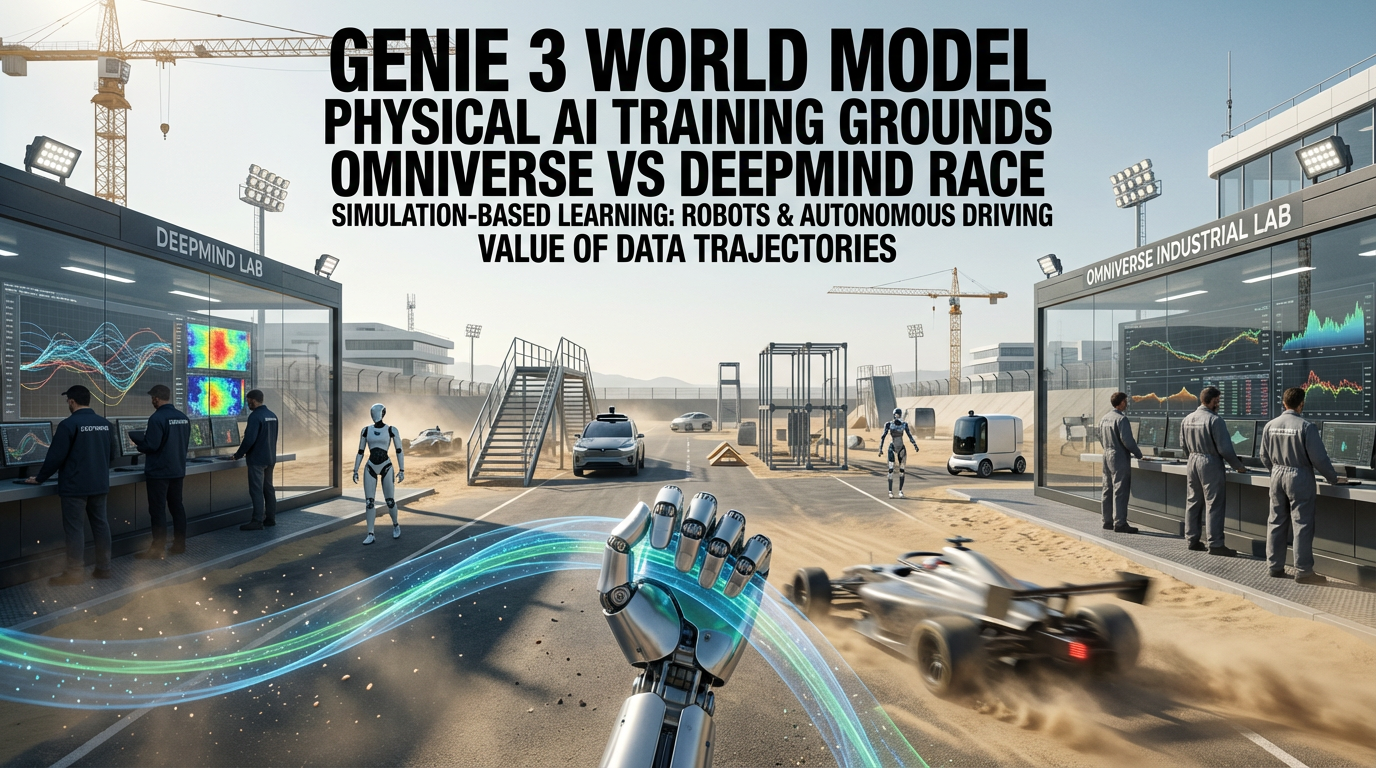
6) NVIDIA Omniverse vs Google DeepMind: The battle for dominance of the “Physical AI training ground”
As the original noted, this trend directly overlaps with NVIDIA Omniverse (simulation/digital twin camp).
6-1. Why the training ground matters
– Physical AI (robots/autonomous driving) trained only on real-world data is slow and risky.
– Ultimately the competition is about “who provides a cheaper, faster, more realistic, and larger environment for training.”
6-2. Google’s strengths
– Massive model training experience
– Potential access to user behavior data derived from Search/YouTube/Android ecosystems
– Easy extension to subscription models when combined with cloud
6-3. NVIDIA camp’s strengths
– A dominant developer ecosystem centered on GPUs
– Integration with industrial simulation pipelines and touchpoints with manufacturing/robot companies
In conclusion, the battle is less about “who made a better demo” and more about “who captures the industry-standard workflow.”
7) Checkpoint: Criteria that separate overestimation/underestimation at this stage
Points easy to overestimate
– “GTA-level games will instantly be produced by AI”
– “Physical laws are perfectly implemented”
Points easy to underestimate
– Even if not 100% like reality, companies will immediately use it for “training/validation/prototyping.”
– Especially for robots/autonomous driving, repeatable training environments matter before perfect realism.
Actual observation points
– Context maintenance time (how long the world stays consistent)
– Multi-agent stability (stability when multiple NPCs/robots move simultaneously)
– Cost (the rate at which the unit cost of real-time generation falls)
– Developer tooling (API/SDK availability, monetization models)
< Summary >
Genie 3 is not a video generation AI but a World Model trend that reacts to inputs while maintaining and expanding a 3D world in real time.
The game demos are just the beginning; the real markets are training/experiential areas like robots, autonomous driving, defense simulations, and edutech.
This competition is likely to escalate into a fight for the “Physical AI training ground” between NVIDIA Omniverse and Google DeepMind.
As World Models grow, behavioral data may become more valuable than text, and money will flow into cloud infrastructure, AI semiconductors, and generative AI platforms.
[Related articles…]
Google AI strategy shift: What ‘World Models’ mean after generative AI
NVIDIA Omniverse and Digital Twin: The next stage of productivity innovation in manufacturing
*Source: [ 월텍남 – 월스트리트 테크남 ]
– 구글 지니3 출시! 전세계가 난리난 이유가 있네요 ㄷㄷ..