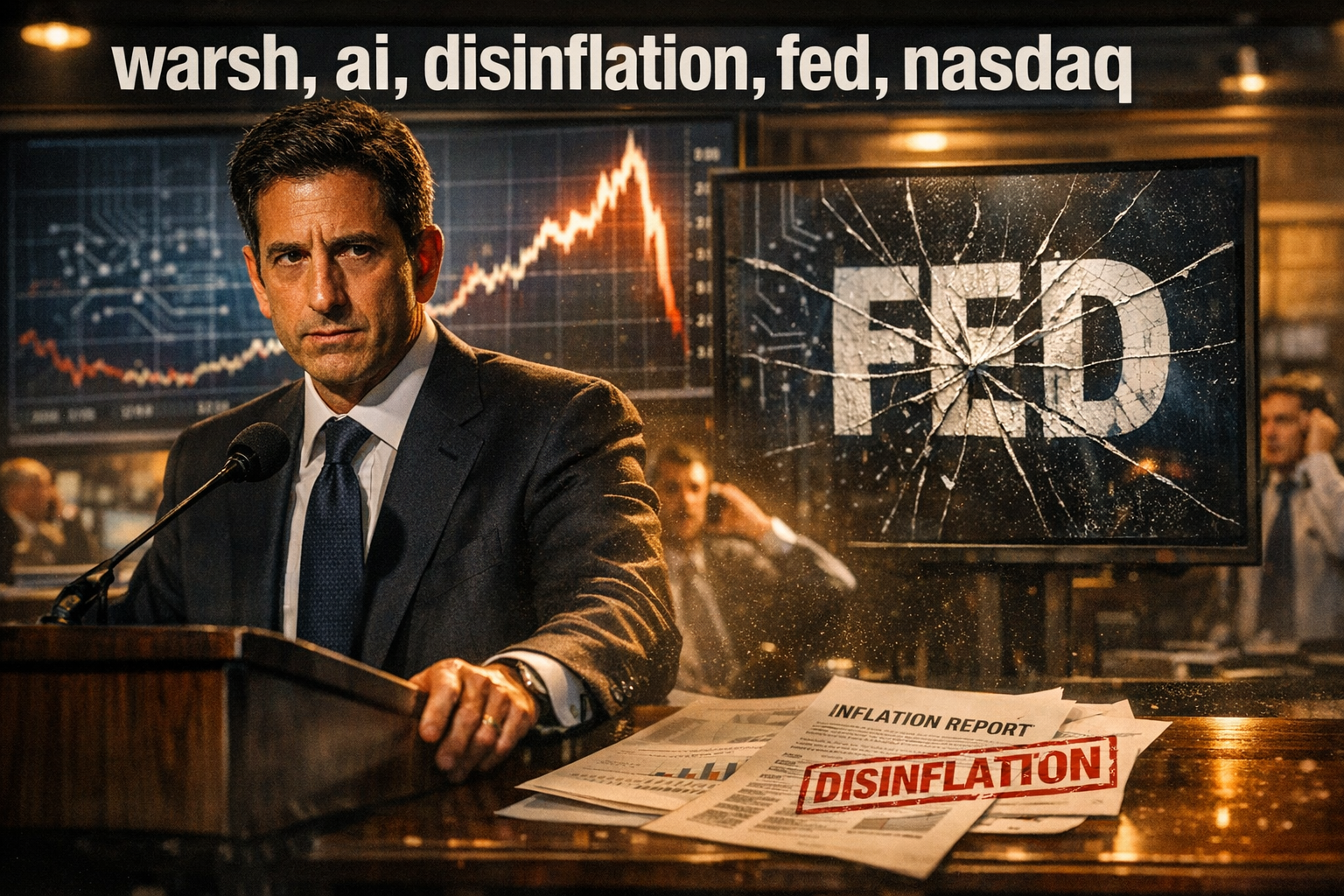
● Wash Shock, AI Disinflation, Rate-Cut Pivot
Misclassifying Kevin Warsh as an “Ultra-Hawk” Is a Risk: AI-Driven Disinflation Framework, 2008 Voting Record, and Potential Fed Scenarios
This report covers three points:
1) The market’s primary misread of Kevin Warsh (rhetoric vs. voting record).
2) How Warsh’s “AI → productivity → disinflation” framework could influence rate policy.
3) The potential inflection points for US equities (especially the Nasdaq) and global asset allocation.
1) News Brief: “Leading Candidate for Fed Chair? The Market’s Misread of Kevin Warsh”
Market consensus often labels Warsh as hawkish (favoring higher rates). A closer review suggests a different profile: principled in rhetoric, but historically flexible in key policy moments.
2) Key Fact Check: “Critical of QE in Public, Supportive in Votes”
The most relevant evidence comes from the Global Financial Crisis period. Warsh served as a Federal Reserve Governor from 2006 to 2011 and held voting authority during the crisis.
Key divergence:
- Publicly, he criticized quantitative easing (QE).
- In practice, he voted in favor of QE-related actions.
For market participants, voting behavior is typically a more reliable indicator of policy inclination than public statements. A simplistic “hawk” classification fails to explain this inconsistency.
3) “Rule-Oriented” but Operationally Adaptive: The 2008 Morgan Stanley Emergency Approval
Another highlighted episode concerns the emergency approval of Morgan Stanley as a bank holding company (BHC) during the subprime crisis. Despite potential conflict-of-interest concerns, the decision reportedly prioritized system stability.
Implication: Warsh should not be viewed as purely doctrinaire; he has demonstrated a willingness to shift toward stabilization when market structure is at risk.
4) Warsh’s Current Framework: AI as a Disinflationary Force
Warsh’s recent framework is as follows: AI-driven innovation raises productivity, expands effective supply capacity, and can reduce inflation (disinflation).
He extends this into a policy message: the traditional assumption that “growth implies inflation, which implies rate hikes” may not hold in a productivity-led expansion. Under an AI-driven productivity regime, economic growth may not require policy tightening.
This is consequential because it reframes the macro policy anchor from “inflation and rates” toward “productivity (technology) and structural inflation.” The implication is not limited to marginal rate adjustments; it can shift the policy framework.
5) Scenario Analysis: Three Potential Paths Under a Warsh Chair
5-1) (Base Case) “Hawkish Rhetoric, Easing at Stress Points”
Warsh could maintain relatively tight messaging while pivoting to accommodation if markets destabilize or financial conditions tighten abruptly. This configuration may increase volatility: markets react to rhetoric, then reprice on implementation.
5-2) (AI-Centric Case) “If AI Is Disinflationary, Earlier Cuts Become Rational”
If AI is treated as a durable disinflationary force, the rationale for maintaining restrictive policy weakens.
If inflation decelerates faster than expected, policy options could include earlier rate cuts or a larger cumulative easing path. Under this route, sensitivity in growth equities and technology shares, particularly the Nasdaq, could rise.
5-3) (Risk Case) “Over-Easing Could Create Overheating”
If the AI-disinflation framework is over-weighted, policy could become overly accommodative, increasing the risk of overheating.
Markets may initially rally (especially growth equities) but later transition to renewed inflation risk, asset-price excess concerns, and higher volatility.
6) “The Chair Role Changes the Person”: The Fed Chair “Pill” Analogy
A recurring institutional reality is that the Fed Chair role tends to subordinate personal doctrine to institutional constraints, political pressure, and the need to manage market impact.
Therefore, forecasting policy solely from pre-appointment commentary is high risk.
7) Global Investment Implications: Why Warsh Could Be Equity-Supportive at an “AI Inflection”
AI is a central theme in global equities, and Warsh views AI as a key driver of productivity and disinflation.
If rate policy threatens the AI investment cycle (data centers, semiconductors, cloud infrastructure, and software capex), Warsh may prefer adaptive easing over rigid tightening. This could be interpreted as supportive for a soft-landing narrative and Nasdaq valuations.
If AI-driven shifts materially alter supply chains and corporate margin structure, traditional inflation models (wage- and demand-centric) may be insufficient. A stronger emphasis on technology-led structural inflation could affect both long-run inflation expectations and risk-asset valuation frameworks.
8) Key Point Often Missed in Media Coverage (Analyst View)
Many discussions reduce Warsh to a binary “hawk vs. dove” classification. The more relevant considerations are:
1) Warsh is better described by a priority function than a fixed bias
He emphasizes inflation discipline and rules in normal conditions, but may reweight decisions toward system risk management or protection of productivity engines (AI) under stress.
2) “AI disinflation” is a proposed change to the policy rule, not a generic tech-optimism thesis
If adopted, it could alter not only the rate path but also perceived terminal-rate ceilings and long-end rate expectations.
3) The primary risk is expectation volatility, not a one-direction tightening shock
A pattern of “tough messaging, flexible execution” can generate asymmetric communication and higher market volatility.
4) Markets price framework shifts more than individuals
The key event risk may be less about who chairs the Fed and more about whether the Fed formally incorporates AI-driven productivity into its disinflation framework.
< Summary >
Kevin Warsh publicly criticized QE but supported crisis-era actions through his voting record, complicating a simple hawkish label.
He advances an AI-driven productivity-to-disinflation framework that can reduce the perceived need for rate hikes even in growth phases.
Because the Fed Chair role is constrained by institutional and political pressures, the core risk is not necessarily tighter policy but higher volatility in policy expectations.
Given AI’s central role in equity markets, a preference to protect the AI investment cycle via policy flexibility could be interpreted as supportive for equities under certain conditions.
[Related Posts…]
- https://NextGenInsight.net?s=Fed
- https://NextGenInsight.net?s=AI
*Source: [ 내일은 투자왕 – 김단테 ]
– 새로운 연준의장에 대해 우리가 완전히 잘못 알고 있었습니다. (케빈 워시)